


J. L. BELL is a Massachusetts writer who specializes in (among other things) the start of the American Revolution in and around Boston. He is particularly interested in the experiences of children in 1765-75. He has published scholarly papers and popular articles for both children and adults. He was consultant for an episode of History Detectives, and contributed to a display at Minute Man National Historic Park.

Subscribe thru Follow.it


•••••••••••••••••


Showing posts with label John Crozier. Show all posts

Sunday, February 16, 2025

Who Wrote the “Account of Lexington”?
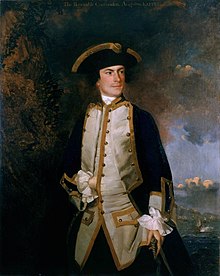
In 1953 J. E. Tyler published an article in the William and Mary Quarterly titled “An Account of Lexington in the Rockingham Mss. at Sheffield.” 

This account appeared in two letters, the first dated 23 Apr 1775 and the second written a short time later. They were addressed to a friend named “Rogers,” with whom the writer had served “at Jamaica,” and offered news and good wishes for “the Admiral.”

That appears to have been Adm. Augustus Keppel (1725–1786, shown here), who brought the letters (or copies of them) to the Marquess of Rockingham’s cottage in Wimbledon. Ultimately the marchioness filed those copies or further copies.

Tyler wrote: “it is the more unfortunate that the signatures, though copied along with the main text of the letters, have been heavily cancelled, since it is now virtually impossible to establish the identity of the writer.” The clues that remain show that that person:
  • wrote from “Empress of Russia Boston April 23th.”
  • signed “what appears to be the initial letter ‘J’” at the start of his name.
  • described himself as “an Old Valiant.”
  • planned also to write “to my precious Girls.”
  • promised to show Rogers’s letter to “The General [Thomas Gage] and Earl Percy.”
Tyler then hazards a guess that the letter writer was the master of the troop transport Empress of Russia, listed in an Admiralty Office record from 1776 as John Crozier.

However, as reported yesterday, Crozier died in November 1774. He had been in command of the Empress of Russia, and his name might have lingered in some naval records, but he didn’t see the start of the war.

Documents in Gage’s papers confirm that the Empress of Russia was in Boston harbor from April 1775 to the end of the year, when it sailed to the Caribbean for supplies. The commander of the vessel in those months was Lt. John Bourmaster (1736–1807), agent for all the transports to Boston and thus a liaison between navy and army.

Bourmaster was a merchant seaman for most of the 1750s, passing the exam to become a Royal Navy lieutenant in late 1759. His first assignment was H.M.S. Valiant, commanded by Adm. Keppel from 1759 to 1764. Starting in late 1762, Keppel was in command of the Jamaica station. Keppel’s secretary was George Rogers, who would be on the Admiralty Board by the end of the war.

After a slow start, Bourmaster’s Royal Navy career also took off. He became a captain in 1777, a rear admiral in 1794, and a full admiral in 1804. The year 1797 saw the marriage of “Harriet, youngest daughter of Admiral John Bourmaster, of Titchfield”—meaning he had more than one daughter.

Thus, all the clues in those letters are consistent with the writer being Lt. John Bourmaster. 

Saturday, February 15, 2025

The Barber and the Ship Captain

As I said yesterday, I searched for more information from American sources about the conflict between a New York barber and a British ship captain reported and illustrated in Britain in early 1775.

I couldn’t find any mention of that dispute in the New York press. I spotted no trace in American newspapers of a captain named “Crozer.” 

The British newspaper article claimed that “the worthy sons of liberty in solemn Congress assembled…voted and unanimously” to praise the barber. There was no New York Provincial Congress yet, so that could only mean the Continental Congress, which did no such thing.

For a while I wondered if this anecdote was completely fictional, made up to make the Americans look petty and hateful but then assumed to be true by some British readers. Slowly, however, I was able to nail down some surrounding details.

The barber in the print did exist. On 9 Feb 1769 “Jacob Vredenburgh, Peruke-maker,” was registered as a freeman of the city of New York.

Later that year, on 23 October, the banns were published for “Jacob Vredenburg” to marry Jannetje Brouwer at the Reformed Dutch Church. There were no surviving children from that marriage.

Vredenburgh shows up in records related to his wife’s family: at the baptism of a niece in 1771, as a co-executor with John Brower in November 1798, and in his own will proved in September 1800, with his wife (now called Jane) and John Brower among the executors.

There’s also a 1788 will of “John Vredenburgh, hairdresser, of New York City,” that names one heir as that man’s brother “Jacob Vredenburgh, of Elizabethtown, New Jersey, hairdresser,” so he may have moved out of the state for a while.

Furthermore, the captain in the print did exist. Or rather, had existed.

On 30 June 1774, the Massachusetts Spy printed this item:
Last Saturday arrived at Marblehead, the Schooner Dove, Ebenezer Parker from Newfoundland, who spoke with the ship Empress of Russia, John Crosier master, from Ireland, out six weeks bound to Boston with the 38th regiment on board.
The next day, that regiment arrived, along with the 5th and Adm. Samuel Graves’s flagship.

After the “Powder Alarm” on 2 September, Gen. Thomas Gage began moving all his troops in New York City up to Boston, too. The Empress of Russia might well have been part of that operation, putting Capt. John Crozier in New York in late September or early October, when he reportedly had his dispute with Vredenburgh. But then he would have headed back to Boston.

The Boston Evening-Post for 21 Nov 1774 listed among the people who had died in town:
Capt. Crozier, Commander of the Empress of Russia Transport Ship.
The records of King’s Chapel include the burial on 19 November of:
John Crozier / Captain of the King of Prussia Transport / [age] 51
(Empress of Russia—King of Prussia—all the same, right?)

Thus, less than two months after Jacob Vredenburgh allegedly kicked John Crozier out of his barber shop in New York, the captain died in Boston. By the time a satirical print was made to illustrate that story, he had been dead for nearly three months.

TOMORROW: A letter from a dead man?

Friday, February 14, 2025

A Print of a “Patriotick Barber”

On 14 Feb 1775, 250 years ago today, Robert Sayer and John Bennett published a satirical print, probably created by Philip Dawe, titled “The Patriotick Barber of New York.”

As I discussed back here, that was one of several images Sayer, Bennett, and probably Dawe produced for British customers interested in American affairs.

The artist appears to have taken inspiration from news stories printed in British newspapers. In this case, the article appeared in the 7 January Kentish Gazette, the 13 January Edinburgh Advertiser, and perhaps elsewhere.

As quoted by R. T. H. Haley in The Boston Port Bill as Pictured by a Contemporary London Cartoonist, it said:
The following card, copies of which were circulated at New York, is too singular not to merit insertion:

“A Card,
“New York, Oct. 3rd.

“The thanks of the worthy sons of liberty in solemn Congress assembled, were this night voted and unanimously allowed to be justly due to Mr. Jacob Vredenburgh, Barber, for his firm spirited and patriotic conduct, in refusing to complete an operation, vulgarly called Shaving, which he had begun on the face of Captain John Crozer, Commander of the Empress of Russia, one of his Majesty’s [troop] transports, now lying in the river, but most fortunately and providentially was informed of the identity of the gentleman’s person, when he had about half finished the job.

“It is most devoutly to be wished that all Gentlemen of the Razor will follow this wise, prudent, interesting and praiseworthy example, so steadily, that every person who pays due allegiance to his Majesty, and wishes Peace, Happiness, and Unanimity to the Colonies, may have his beard grow as long as ever was King Nebuchadnezzar’s.”
The picture showed the barber, well wigged but ugly and sneering, pushing the handsome but half-shaved captain out of his chair. “Orders of Government” poke from the captain’s pocket while another man tries to hand him a letter marked “To Capt. Crozer.”

The print carried the subtitle “The Captain in the Suds,” and underneath it was the verse:
Then Patriot grand, maintain thy Stand,
And whilst thou sav’st Americ’s Land,
Preserve the Golden Rule;

Forbid the Captains there to roam,
Half shave them first, then send ’em home,
Objects of ridicule.
On the barbershop wall are engraved portraits of the Earls of Camden and Chatham, British politicians who spoke up for the colonies’ cause, plus Chatham’s recent speech. Beside them hangs the Continental Congress’s Articles of Association, a boycott that hadn’t actually been announced when this incident took place.

In the top and bottom of the picture are wig boxes with the names of local Whigs: “Alexander McDugell,” John Lamb, Isaac Sears, and so on. One says, “Welle Franklin.” Was that the royal governor of New Jersey?

Perhaps the most striking detail of this print is that I can’t find any mention of the incident in the American press, nor of the men involved. The event appears to have been recorded only in the British newspaper reports, and those would have been long forgotten if not for this picture.

But because the print was so dramatic, 200 years after publication it inspired Ashley Vernon and Greta Hartwig to create a one-act opera, The Barber of New York.

TOMORROW: More about the barber.