J. L. BELL is a Massachusetts writer who specializes in (among other things) the start of the American Revolution in and around Boston. He is particularly interested in the experiences of children in 1765-75. He has published scholarly papers and popular articles for both children and adults. He was consultant for an episode of History Detectives, and contributed to a display at Minute Man National Historic Park.

Subscribe thru Follow.it


•••••••••••••••••


Showing posts with label Ancient and Honorable Artillery Company. Show all posts

Friday, January 15, 2021

Digging into the Three Cranes Tavern in Charlestown
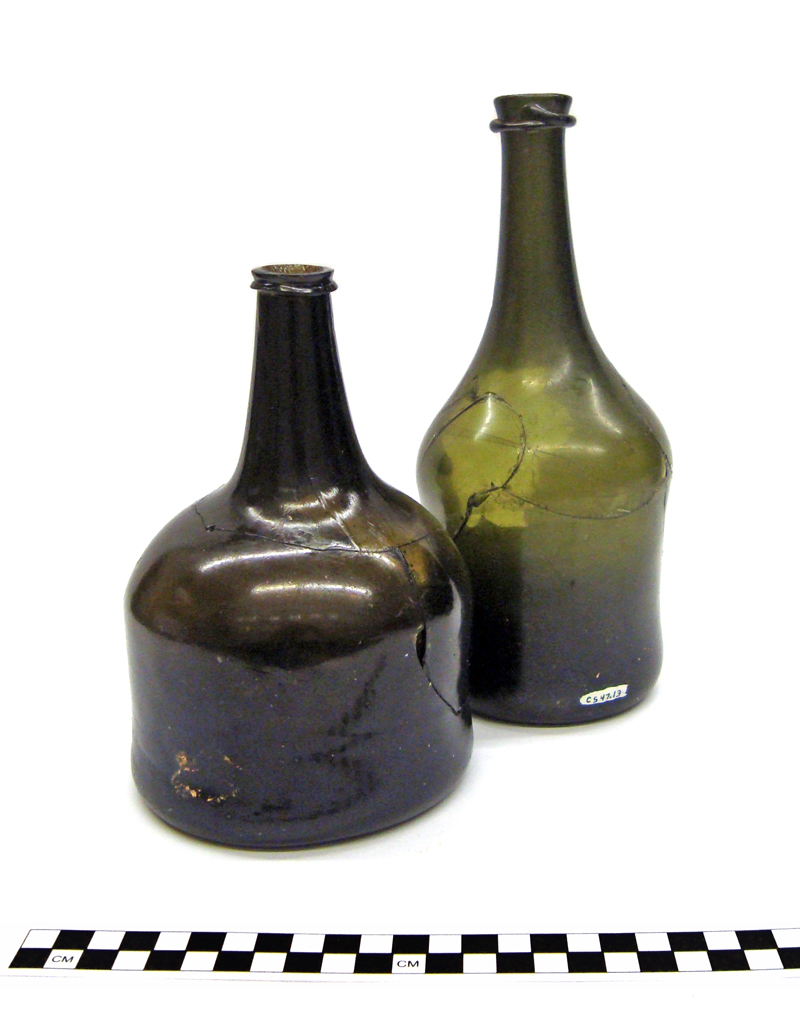
I was intrigued by the Massachusetts Historical Council’s webpage for the archeological site of the Three Cranes Tavern in Charlestown.

As the page explains, Charlestown was settled in 1629, the year before Boston, and that site was originally the location of the Great House that served as a meetinghouse, storehouse, and protection. In 1635 a man named Robert Long bought part of the property and opened the Three Cranes Tavern, named after a well known public house in London.

The Three Cranes remained in the extended Long family and one of the town’s busiest taverns for the next 140 years. In that time, tax records and the archeological record show, the owners added a separate dwelling house, brewery, stone foundation, and wine cellar.

As of 1763, the tavern was the southern end of the stage coach route from Portsmouth, New Hampshire. The horses were stabled there while passengers could continue over the ferry to Boston if they chose.

In 1766 proprietor Nathaniel Brown mortgaged the property to the Ancient and Honorable Artillery Company. Without banks, I’m guessing, that was one of the province’s few chartered institutions that could lend out money.

Then came the war and destruction, as the webpage says:
The long history of the Three Cranes Tavern came to a fiery end on June 17, 1775. On the night of June 16, 1775, rebellious colonists occupied Breed‘s Hill. General [Thomas] Gage responded by sending British troops to remove the Americans from the hill. The famous Battle of Bunker Hill ensued. Rebel snipers in nearby Charlestown shot at British soldiers from windows, so General Gage [sic] turned his cannon on the town setting fires everywhere. By the end of the night most of downtown Charlestown, including the Three Cranes Tavern, had burnt to the ground.

Although the damage was great, most of the streets, chimneys, and foundations were visible among the rubble. The citizens of Charlestown cleaned up the debris, filled the site of the tavern over, and created an open market in its place. Market Square was renamed City Square in 1848 to celebrate Charlestown becoming a city.
It actually took quite a while to reuse the tavern site. Nathaniel Brown was a Loyalist and apparently gave up on the property, moving first to Pownalborough, Maine, and then to Nova Scotia. The Ancient and Honorable Artillery Company went into abeyance from 1775 to 1786. Finally in 1794 the artillery company donated the land to the city.

For those who want to dig deeper, here’s a 2014 article about Boston city archeologist Joe Bagley’s work on the site and a 2016 reevaluation of the evidence by Craig S. Chartier.

Tuesday, April 16, 2019

“Mr. Adjutant Daws & the Sergeants”

In Paul Revere’s Ride, David Hackett Fischer made an impressive case that Paul Revere had a social network among the Boston Whigs second only to Dr. Joseph Warren.

As I’ve delved into the sources myself, I came to see the data that went into that analysis as seriously flawed. Nonetheless, I think the conclusion about about the importance of those two men’s social networks is sound.

One of the main themes of my talk last weekend about William Dawes, Jr., was that he, too, enjoyed a broad and buzzing social network.

Dawes got off too a good start as first cousin to the builder Thomas Dawes (1731-1809), who hosted a political caucus in the early 1760s, later rose to be colonel of the Boston militia regiment, and eventually was a deacon at Old South.

In the early 1770s, William Dawes began to climb in Boston society by those same routes. He was elected to office in town meetings, starting as an “Informer of Deer”—basically a game warden. Provincial law required all towns to elect such deer-reeves. Boston was unlikely to have had many deer being hunted out of season, and I can’t tell if Dawes got this job as a sinecure or because as a leather-dresser he was actually in touch with deer poachers.

Dawes also rose within the militia, being designated as the regiment’s adjutant with the rank of lieutenant in 1772. (In The Road to Concord I said he was “junior adjutant” because I was misled by old typography and didn’t think through old prose with new knowledge. The “Junr.” was part of Dawes’s name, not his rank.) As adjutant, he helped organize the militia drills and therefore must have gotten to know all the officers and most of the men.

On 4 Nov 1772, for example, the selectmen of Boston (including John Hancock) met at Faneuil Hall to consider a request for the use of that building. According to the official town records:
Mr. Adjutant Dows, has desired on behalf of a milatary chore [i.e. corps] to have the use of Faneuil Hall three Monday Nights in a Month which was granted accordingly.
Dawes’s crowd used the hall through that winter. On 10 Mar 1773, another militia officer came to the selectmen with a competing request:
The Selectmen having heard Capt. Waters and Mr. Adjutant Dows relative to the Hall, it was determined that they should each have the Hall two Nights, in a Month. the Adjutant to have the first Monday Night.
I believe “Capt. Waters” was Josiah Waters, Sr. (1721-1784), listed with that rank in the militia in 1774. He was also William Dawes’s uncle by marriage.

A few weeks later, on 28 April, Waters was back at the selectmen’s office:
Capt. Waters attended, and desired the use of the Hall for his Company every Monday Evening, as Capt. Waters informs that Mr. Adjutant Daws & the Sergeants have done with it.
It would be nice to know how “Mr. Adjutant Daws & the Sergeants” used Faneuil Hall. Were they training themselves in the standard drill so they could train the men, training some of those men, or just socializing?

That winter the Ancient and Honorable Artillery Company met in Faneuil Hall every first Wednesday evening before shifting to Fridays. Dawes was also a member of that organization from 1768, and he served as a sergeant in 1770. In 1772, however, he was fined a shilling for not appearing at a meeting. After the war, Dawes helped to revive the company by signing up a large class of new members, several related to him—more networking.

Since Dawes knew so many men in Boston, it makes sense that the Massachusetts Provincial Congress’s committee of safety went to him in early 1775 when they needed to connect with the militiamen hiding two brass cannon. Likewise, he made a good messenger for Dr. Warren. Col. John Hancock of the Company of Cadets must have recognized Adjutant Dawes in Lexington in the early morning of April 19, 1775, just as he recognized Paul Revere.

Saturday, March 17, 2018

A Blanket the British Army Left Behind

Today is Evacuation Day, the anniversary of the day in 1776 when the British military left Boston.

Back in 2013, Patrick Browne wrote on his blog Historical Digression about something the British left behind, an artifact now at the Duxbury Rural and Historical Society:
A number of British regiments were camped upon Boston Common. When they departed, they left all manner of gear strewn across that open space. We can imagine curious Bostonians picking through the debris when the British were gone. Frugal Yankees, they must have scavenged a good number of useful items.

One such Bostonian was William Hickling [1742-1790], a merchant, roughly 30 years old. He was a patriot who had been out and about on the fateful night of the Boston Massacre back in 1770, though, according to the deposition of Richard Palmes, Hickling went home before the real trouble began. Hickling had been, according to family tradition, rather more active during the Boston Tea Party in 1773 as evidenced by the tea leaves that were found in his shoes the following morning.
According to his will, quoted here, Hickling was officially a distiller, but he sold other things besides rum. His father was also a distiller named William Hickling (1704-1774), and he had a son and a nephew of the same name, so there’s opportunity for a lot of confusion.

The name of William Hickling doesn’t appear on most lists of men involved in the Tea Party, even the expansive roster in Francis S. Drake’s Tea Leaves. The family tradition that he helped to destroy the tea was nonetheless in print by 1900.

Other sources do show William Hickling as a participant in Boston’s pre-Revolutionary politics. But which William Hickling attended the Sons of Liberty dinner in Dorchester in 1769? Which was renting rooms to Pvt. James Hartigan and his new wife Elizabeth in 1770? Which was a member of the North End Caucus in 1772? I’ll play the odds and say that Palmes encountered the younger William Hickling (and his brother John) on 5 Mar 1770, and that the younger William was also the caucus member, but I won’t hazard a guess about the other questions.

The William Hickling born in 1742 was almost certainly the man who joined the Ancient and Honorable Artillery Company in 1764 and served as paymaster of Col. John Brooks’s Continental Army regiment in 1777 and 1778.

But back to the spring of 1776 and Patrick Browne’s essay:
Foraging across Boston Common, Hickling probably picked up a number of things. One of them was the white woolen blanket of a British soldier. The “standard issue” blanket, bearing the royal symbol of the King’s Arrow and the initials “GR” for George Rex (or King George) eventually made its way to Duxbury, Massachusetts after William’s death when his widow moved in with her daughter [Sarah] and son-in-law, bringing a number of Hickling family objects with her. The son-in-law was Captain Gershom Bradford, a Duxbury master mariner. Fast forward to 1968, Gershom Bradford’s house, along with a vast number of family belongings, was donated to the Duxbury Rural and Historical Society by the captain’s great-grandsons.
It sounds like the blanket didn’t come with a provenance, not like the tea story. But it certainly appears to be a standard-issue British army blanket.

Friday, September 01, 2017

Solomon Davis and the Fatal Plum Cake

John and Dolly Hancock were known for hosting dinner parties in their mansion on Beacon Hill (shown here shortly before it was torn down).

According to James Spear Loring’s Hundred Boston Orators (which cribbed freely from older sources), they even built “a lofty and spacious hall on the northern wing of his mansion, extending sixty feet, devoted to festive parties, and built of wood.” That wing was removed in the early 1800s, so it’s not in this photo.

On 6 June 1791, the Ancient and Honorable Artillery Company had its annual election and dinner at Faneuil Hall, a major social occasion for Boston’s elite men. That evening, Hancock hosted a supper party. Loring wrote:
Among the company present, were Col. Azor Orne, and Solomon Davis, Esq., a merchant who resided in Tremont-street, opposite the Savings Bank. He was very facetious.

A superb plum-cake graced the centre of the table. It was noticed by the guests that Mr. Davis partook very freely of this cake; and, moreover, that the silver tankard of punch was greatly lightened of its liquid, by liberal draughts through his lips. As was the natural habit of Mr. Davis, he set the table in a roar; and in one of his puns being specially felicitous, Col. Orne remarked, “Go home, Davis, and die;—you can never beat that!”

Mr. Davis, on his way home, fell dead, in a fit of apoplexy, near King’s Chapel, and his pockets were found filled with plum-cake.
Davis was a couple of weeks shy of turning seventy-seven.

Loring tended to print the most dramatic version of a story, and not always accurately. In this case, we have different details from the letters of Davis’s widow as Barrett Wendell summarized them in his article “A Gentlewoman of Boston” in the American Antiquarian Society Proceedings.

Catherine (Wendell) Davis stayed home that evening because she had received a letter from a relation “with particulars of his melancholy disaster.” So her husband went to the Hancock supper alone.
Freed from conjugal observation, Mr. Davis appears to have supped imprudently; what he drank is not mentioned, but he ate more plum-cake and fruit than was good for him. On his way home, he was seized with a fit in the street. Carried to his house, and there helped by the doctor, he so far recovered himself as to go cheerfully up stairs; but once in his chamber he was again overcome by sickness, and instantly expired. 
In addition, Amos Otis’s Genealogical Notes of Barnstable Families (1888) said of Davis, “On his way home he was taken suddenly ill, and sat down on the steps of King’s Chapel, from whence he was removed to his house in the vicinity, where he shortly after died.” So there’s the King’s Chapel detail.

Finally, one of Hancock’s successors as governor, John Brooks, used to counsel another, William Eustis, about his diet by saying, “Don’t you remember that Solomon Davis died after eating plum cake?” So even if we have no confirmation for the plum cake in Davis’s pockets, people definitely remembered that dessert as why he died.

Wednesday, April 13, 2016

William Dawes After His Ride

Most histories of the start of the Revolutionary War don’t say much about William Dawes after he escaped the British army officers who caught Paul Revere. (I discussed Dawes’s amusing anecdote about that episode here.)

According to David H. Fischer, after losing his horse and his watch, Dawes went back to Lexington and went to bed. There’s a family story that a few days later he went back to the site in Lincoln where he fell off his horse and found his watch. But anything else?

In 1878 descendant Henry W. Holland, relying on family traditions and published sources, wrote:

Dawes at once joined the Continental troops at Cambridge, and, it is said, fought at Bunker Hill, but never, I believe, took commission in the regular army. When Boston became unsafe, he moved his family to Worcester, one of the great centres of rebellion; and when the siege ended, and the war was removed from New England, he was appointed commissary at Worcester by Congress.
Holland’s sources were older relatives born after the war, so he relying on thirdhand information. I’m not sure about that Bunker Hill thing (so many family insisted their ancestors were at Bunker Hill), and I suspect Dawes did take a formal military role.

Below are the entries in Massachusetts Soldiers and Sailors in the Revolutionary War for men named William Dawes. Each has a separate entry in the state archives. However, some of these could pertain to the same man. And of course some could pertain to multiple men with the same name.
Clearly we can connect the assistant commissary of August 1779 with Dawes, based on his family recollection (as well as a period complaint about how he shortchanged prisoners of war).

But what about the adjutant? What about the major of the Boston militia regiment?

We know that in 1768 Dawes joined the Ancient & Honorable Artillery Company, then an organization of men who wanted extra training to become militia officers. In April 1772 the printer John Boyle listed Dawes as “Adjut. Lieuts. Rank” in the Boston militia regiment. In early 1775 Massachusetts Committee of Safety contacted Dawes about getting cannon out of Boston [as discussed in my upcoming book, The Road to Concord], and of course Dr. Joseph Warren sent him out to Lexington.

In short, Dawes had experience in military administration and the trust of the Massachusetts Patriots. And there was a war on. It makes sense for him to serve as Gen. William Heath’s adjutant in the first months of the war, and to become a major (another position of administrative responsibility) in the Boston militia regiment after the British evacuated. But then he resigned and went to Worcester.

As for the first entry, that William Dawes was a junior officer in the Continental Army from January 1777 to May 1778, with a possible short service in late 1776. That stretch doesn’t directly contradict the other entries, but they seem to refer to a younger man.

Sunday, April 03, 2016

“Hoping he will still continue Honestly, faithfully & obediently to serve”

To find out more about Caesar Marion, also called “the well-known Caesar Merriam,” I looked into the life of the man who once owned him.

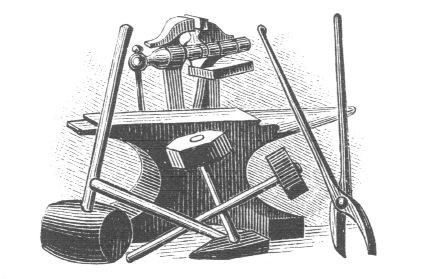
Edward Marion was born in Boston in 1692. He served in some town offices in the 1720s and ’30s, joined the Ancient and Honorable Artillery Company, and donated blacksmithing work for the town’s new workhouse.

Marion didn’t advertise his services (blacksmiths rarely had to), but he placed a couple of advertisements in the Boston Gazette in 1758 when he administered the estate of turner John Underwood.

Marion married Mary Reynolds in 1715. I’ve found no evidence that they had children, which would explain why the blacksmith didn’t feel a need to preserve his property for a son. It also left the Marions without the traditional source of support in their old age.

Both Edward and Mary Marion turned seventy years old in the early 1760s. Presumably journeymen and slaves like Caesar were already doing most of the physical work in Edward’s smithy.

On 9 May 1769, Marion made out an unusual written promise:
of my own meer motion & in consideration of the Faithfullness & honesty wherewith my Negro Servant Caeser has Served me for divers years past, & hoping he will still continue Honestly, faithfully & obediently to serve me & his mistress Mary my Wife I do hereby order & declare that it is my Will & pleasure that at & immediately after the Decease of me and my said Wife & the Survivor of us that my said Negro Caeser shall be manumitted & freed from his Servitude.

And I do also hereby give & order unto my said Negro at the time of his freedom all my working Tools belonging to the Black smiths Business now in my Shop & also the sum of six Pounds lawfull money and I do hereby also order my Ex’ors or Adm’ors In Case of his Living to be Aged or Infirm & unable to Support himself, that they be Aiding & Ajusting to him out of my Estate to prevent his becomeing a Charge to the Town—

provided always & these presents are granted upon this Condition that my said Negro shall honestly Soberly obediently & faithfully [missing word—behave?] himself towards me & my said Wife during our & each of our Lives otherwise I do hereby reserve in my own Power to revoke & invalidate this my bequest in case my said Negro shall not so faithfully & honestly bare & behave himself towards me & his said Mistress as I hope & expect he will.

I or his said Mistress may invalidate the same either by Destroying this Instrument or Expressing the same by Writing
Marion added to that promise on 30 Jan 1770:
I the within named Edward Marion do further give and order unto my said Negro at the time of his Freedom All his Cloaths Bed & Bedding, & also the Use & Improvement of my Blacksmiths Shop for him to Work in during his Life upon the Condition of his future faithfull Service to me & my said Wife as within mentioned.
As discussed yesterday, notary Ezekiel Price recorded the document on 2 February.

Jared Hardesty interprets the legal recording of that document as evidence of Caesar Marion looking out for his economic interest, exercising agency in his own life. I’m struck by how it shows the reversal of a concern I’ve seen in anecdotes about enslaved people resisting emancipation in old age, when they feared their owners simply didn’t want to support them any longer after having squeezed the labor out of them.

In this case, Edward Marion was concerned for his and his wife’s support. And he was willing to make their slave into their heir to ensure it. Of course, the blacksmith also added clauses demanding that Caesar keep up his end of the bargain at the risk of losing everything (and added a clause to keep him from becoming a burden on the town). Of course, Edward Marion may also have been motivated by feelings of duty and genuine fondness toward Caesar—we can’t read that in the legal record.

COMING UP: How did this arrangement work out?

(Thanks to professional genealogist Liz Loveland for sharing images from the Ezekiel Price notarial records at the Boston Athenaeum, the source of the above quotations.)

Monday, March 30, 2015

The “Black Regiment” in the Newspapers

As I quoted yesterday, the Loyalist refugee Peter Oliver wrote that on entering electoral politics James Otis, Jr., had said, “that it was necessary to secure the black Regiment, these were his Words, & his Meaning was to engage ye. dissenting Clergy on his Side.”

Oliver was not the first to make that accusation, as shown by an item in the 25 July 1768 Boston Gazette headlined “Dialogue, between a PENSIONER and a DIVINE.” In this context, the “pensioner” was someone being paid by the imperial government and the “divine” a minister. The colloquy begins:

PENSIONER. It seems to me that the Clergy interest themselves too much in the political Dispute of the Day. The Gentlemen in Crape have no Right to intermediate in such Things. But Otis says he could not carry his Points without the Aid of the black Regiment.

DIVINE. If Mr. Otis expressed himself in that Manner, (which I question) he might have expressed himself rather more decently; but surely you will allow this to be a Day of Darkness and Difficulty, and you will also allow us to pray for Light and Direction.
Thus, there was debate at the time over whether Otis had actually spoken of the “black Regiment.” And the side questioning that attribution was also defending clerical involvement in politics.

Two years later, on 8 June 1770, acting governor Thomas Hutchinson wrote to John Pownall, undersecretary of state, with his own complaints about politicized clergy:
It is certain that the present leaders of the people of Boston wish for a general convulsion, not only by harangues, but by the prayers and preaching of many of the clergy under their influence, inflame the minds of the people, and instil principles repugnant to the fundamental principles of government. At the Artillery Election Sermon, one minister in his prayers deplored the tragedy, etc., then prayed “that the people might have a martial spirit, that they might be instructed and expert in military discipline, and able to defend themselves against their proud oppressors, and the men whose feet are swift to shed innocent blood.“ Our pulpits are filled with such dark covered expressions and the people are led to think they may as lawfully resist the King’s troops as any foreign enemy.
A copy of that letter was found in Hutchinson’s Milton mansion after the war began and printed in the 8 August 1775 Massachusetts Spy. The Rev. Samuel Stillman had delivered the sermon to the Ancient and Honorable Artillery Company four days before Hutchinson’s letter and three months after the Boston Massacre. He was the minister of Boston’s Second Baptist Meeting, not an orthodox Congregationalist, but he was on the Whig side.

Hutchinson made the same arguments as the fictional “Pensioner” and the real Judge Oliver about ministers speaking against the government, but I haven’t found him using the “black Regiment” phrase. (Maybe the editors of his papers know better.)

Nonetheless, another political essay accused Hutchinson of using that phrase. On 7 Dec 1772, the Boston Gazette ran an item it said came from the 8 September Public Ledger of London. Writing six days before in the metropolis’s “Pennsylvania Coffee house,” a man signing himself “An ISRAELITE” told readers:
Mr. Thomas Hutchinson…was, from his earliest entering into life, a most rigid Dissenter; and being a man of uncommon art, subtilty, and disguise,…had once the greatest part of the dissenting Clergy of New-England, and some here very much devoted to him. The BLACK REGIMENT, as he of late terms them was his main support; there was no doing without the Black Regiment, which he for many years headed, in bitter opposition to the ease and prosperity of the Church of England in that part of the world. The Black Regiment have, however, since found him out; have had the most convincing proofs of his hypocrisy, falshood, and total want of principle; and therefore, almost to a man despise him with an hatred and detestation that can hardly be expressed:

however, as it has always been a maxim with Mr. Hutchinson, that in political affairs, nothing can be done to any effect without spiritual assistance of some sort or other, he has put on another mask, and is now paying his greatest court and attention to the Episcopal Clergy; goes mostly to Church, stays to the Communion, and stands God father to the children of all such as think proper to ask him to the Altar, thinking that such conduct, together with secretly insinuating here, that a Suffragan Bishop would be of great service to Civil Government in New England, will engage our Clergy to become Advocates for his Administration, and thereby be the means of his continuing (however obnoxious) at the head of Government in that Colony.
The essay ended by insinuating that if Hutchinson thought he could gain “a more lucrative Place” by it, he would endure “the pains of Circumcision at the age of seventy.” Nice.

This “Israelite” thus managed to remind his London audience that Hutchinson wasn’t Anglican while also accusing him of trying to install a bishop in America. Overall that essay suggested that any politician might seek clerical support; the real sin was being unfaithful to one’s own denomination.

I’ve found one more example of this use of the phrase “black Regiment” in Massachusetts newspapers. On 11 Jan 1776, inside besieged Boston, the Boston News-Letter published an essay signed “Z.Z.” which described an unnamed man this way:
This man’s adroitness in law was thought necessary to be engaged in the cause of defeating acts of parliament: He was engaged, and he had shrewdness enough to start a thought which, artfully pursued, hath generally its expected effect in all popular commotions; he said, that it was necessary to enlist a black regiment in their service: the bait was snapped at; and many ministers of the gospel, too, too many for the honor of the christian religion joined in the cry.
Phrases in the “Z.Z.” essays show that the author was Peter Oliver, and the man described here was obviously James Otis, Jr. Which brings us back to where we started.

TOMORROW: Other meanings of the “black Regiment.”

Tuesday, February 12, 2013

Peirce Family Anecdotes about Henry Knox

In 1849 Hunt’s Merchants’ Magazine and Commercial Review published an obituary of a descendant of Joseph and Ann Peirce, apparently based on information from the family or even written by a member of the family. That article turns out to contain interesting information about Henry Knox that I’d never seen before and that doesn’t appear in any Knox biography I know of. Whether it’s reliable information is another question.

Joseph Peirce founded Boston’s militia grenadier company in 1772 with Henry Knox as his lieutenant. The two men kept up a correspondence after the war when both invested heavily in Maine land. And some traditions about Knox came down in the Peirce family and made their way into that magazine:
Mr. Joseph Peirce, although a merchant of Boston, had, prior to the outbreak of the Revolution, organized a company of grenadiers, which he continued to command with Henry Knox, afterward Gen. Knox, as lieutenant, down to the day on which the tea was cast into Boston harbor. The grenadier corps was one of the finest in the colonies, and being drawn up in State, then King-street, to receive the new Governor [Thomas] Gage, on his arrival from England, elicited from that officer the remark that “he did not know his Majesty had any troops in America”—a compliment to the soldierly appearance of the corps long cherished by its officers even when patriotism had led them to oppose the king’s troops. Capt. Peirce was in charge of the tea ships as guard on the night previous to the appearance of those world-renowned “Indians,” of whom his brother John was one. That event brought about the dissolution of the corps; but the friendship then formed between Gen. Knox and Mr. Peirce existed uninterruptedly to the death of the former, in 1806.
There are two interesting anecdotes in that passage, and unfortunately they’re contradictory. If the grenadier company had dissolved soon after the Tea Party in December 1773, it could not have greeted Gen. Gage when he arrived in Boston in May 1774. Furthermore, Gage was commander-in-chief of the British army in North America and knew exactly how many troops his Majesty had there.

Gage’s alleged praise for the grenadiers echoes a story that evidently circulated in Maine about a British officer seeing the grenadiers and saying, “that “a country that produced such boy soldiers, cannot long be held in subjection.” I doubt either version of the story is wholly reliable, but they might have had a common source in a real event.

I haven’t seen any contemporaneous mention of the grenadier company dissolving shortly after the Tea Party. Rather, Boston’s specialized militia companies appear to have broken up in late 1774 as the political divide widened: the Company of Cadets in August after Gage dismissed their commander, John Hancock, and the artillery train in mid-September after its cannon vanished. The Ancient and Honorable Artillery Company, not officially part of the militia, went into abeyance late in the year. It would make sense for the grenadiers to do so as well.

The obituary went on to provide this anecdote about Henry and Lucy Knox’s departure from Boston:
When Lieut. Knox, impelled by his glowing patriotism, sought to join the army of Washington, then at Cambridge, preparatory to the fight at Bunker’s Hill, he had some difficulty in escaping from Boston, but he was enabled to do so through a permit obtained by Mr. Peirce for a chaise to pass the lines on Boston Neck. As he took leave of the future general, the latter remarked, “My sword-blade is thrust through the cushions on which we sit, and Lucy (his wife) has the hilt in her pocket.”
Again, whoever wrote this story had difficulty with chronology. The Knoxes appear to have been out of Boston by 14 May 1775. Gen. George Washington didn’t arrive in Cambridge until July.

Another version of the Peirce lore appeared in print the year before, in a review of J. T. Headley’s Washington and His Generals in the United States Democratic Review. The reviewer identified himself (or herself) as someone who had Joseph Peirce as a “maternal grandfather,” and told readers, “we have often listened with delight to the anecdotes of Knox, told by his octogenarian commander.” About the Knoxes’ departure:
[Headley’s] memoir remarks that Knox had some difficulty in escaping from Boston when the war broke out, and that his wife accompanied him, concealing his sword beneath her dress. This is not strictly correct. The lines as they were called, were on “the Neck,” and Knox’s former commander in the grenadiers having been to the lines to procure the passage of a chaise containing a nurse and child that had been in the country for its health, on his return, met Knox riding out of town. The future General remarked, “I have at last got clear, I think. My sword blade is thrust through the cushions on which we sat, and Lucy has the hilt in her pocket.”
In this version, Peirce didn’t secure the pass that the Knoxes used; he simply met Henry after he’d exited the gates. But the quotation is the same.

The Peirce story overlaps with one recorded by Knox’s first biographer, Francis S. Drake, in 1873: that Lucy smuggled out Henry’s sword “quilted into the lining of her cloak.” Hiding it in the cushions seems more effective. But really, swords weren’t what the provincial army needed.

Sunday, September 30, 2012

A Dispute within the Artillery Company in 1768

Here’s an anecdote from Zachariah Whitman’s 1842 History of the Ancient and Honorable Artillery Company. As I’ve described before, that organization wasn’t a part of the provincial militia but a private organization men joined to improve their military skills and show they had what it took to be officers. According to Whitman:
In 1768, several regiments of British troops were in Boston. On a field day, under command of Capt. [William] Heath, then Lieutenant [Footnote: It was customary before the Revolution, and so continued until recently, to give the Lieutenant the privilege of command one field day during the year.], it appearing probable that the Ar. Co. would not leave the Common until after the roll-call of the troops, their commanding officer sent orders that he must retire without beat of drum, and that there must be no firing at the deposit of their standard.

The Company opposed a compliance; but Lieut. Heath, conceiving it his duty to comply with the orders of a superior officer in his Majesty’s service, marched to Faneuil Hall in silence, and without firing.

This appeared to some of the members an infringement of their privileges. One Hopestill Capen, then Orderly, resented it so highly, that he went to the top of his house, and fired his musket three times, and even many years after would not vote for Gen. Heath.
Remarkably, while Heath served in the American army from the very first day of the Revolutionary War to the very last, Capen, who had resented the orders of an army officer, became a Loyalist. He had joined the Sandemanian sect, convinced of his religious duty to obey the king. Despite the general Sandemanian teaching of pacifism, during the siege Capen joined Boston’s Association, a Loyalist militia.

The photo above, from the Boston Public Library’s Flickr collection, shows Capen’s house and rooftop as they appeared in 1930.

Tuesday, September 11, 2012

Ancient & Honorable, Old and New

Yesterday’s Boston Globe brought news that the Ancient & Honorable Artillery Company of Boston is inducting its first female members: Lt. Col. Catherine M. Corkery and Lt. Col. Christine Hoffmann of the National Guard.

The organization was founded in 1638 as part of the young colony’s defense. By the mid-1700s it was no longer an official militia company reporting to the governor but a private organization. Men—and only men—joined because they wanted to improve and demonstrate their skills as military officers.

In the early 1760s, for example, William Heath was a lieutenant in the Roxbury militia company. According to American National Biography, he put himself in as a candidate for a higher rank; the men didn’t choose him, so he resigned in disappointment. According to Heath’s memoir, his home-town company was “inactive.”

In any event, in the spring of 1765 Heath

went over to Boston, and entered a member of the Ancient and Honorable Artillery Company. This immediately recommended him to the notice of the Colonel of the first regiment of militia in the county of Suffolk, who sent for him, and importuned him to take the command of his own company; to which Mr. Heath was reluctant; apprehensive that his youth, and stepping over those who had a better claim, by former office in the company, to the command of it, might produce an uneasiness. He was, however, commissioned by Gov. [Francis] Barnard; and his apprehensions of uneasiness proved to be groundless.
That’s from the introduction to Heath’s memoir, which you might not be able to tell was also written by Heath.

That’s how the Ancient & Honorable Artillery Company worked in the pre-Revolutionary period: it was a training organization and social network for men with militia ambitions. It went dormant during the war and then reformed with a big crop of veterans in 1786.

Despite its name, the company had nothing to do with artillery for over a century before the early 1800s. And then its gunnery practice produced the hole in the “Adams” cannon on display at the top of the Bunker Hill Monument.

The Ancient & Honorable Artillery Company now has, as the Globe says, ”a more ceremonial role, appearing in city parades, fund-raising for veterans’ associations, and delivering a reading of the Declaration of Independence from the State House balcony each Independence Day.” The group maintains a museum on the top floor of Faneuil Hall. Adding women to its ranks, the institution continues to evolve and reflect the values of Massachusetts society.

Saturday, December 03, 2011

Liberty Bell Curiosities

Gary B. Nash’s The Liberty Bell, published by Yale University Press last year as part of a series on American icons, offers these intriguing facts:
  • In 1828 the city of Philadelphia commissioned William Meredith to make a new bell for the old Pennsylvania State House. That building’s damaged pre-Revolutionary bell was stuck on the fourth floor of a tower, and the city told the bell-maker that for $400 he could have it for scrap. After looking at the situation, Meredith decided it wouldn’t be worth the trouble of hoisting the bell down and hauling it away. And that’s why we still have the bell that, seven years later, abolitionists in New York dubbed the Liberty Bell.
  • In 1893, the Daughters of the American Revolution collected copper coins from the Roman Empire, the heads of pikes used by John Brown’s raiders, a silver spoon from John C. Calhoun, hinges from Abraham Lincoln’s house, links of George Washington’s surveying chain, a copper kettle from Thomas Jefferson, and Lucretia Mott’s silver fruit knife, and had them all melted down to make the Columbian Liberty Bell, a 13,000-pound tribute to the Liberty Bell at the Columbian Exposition in Chicago. (Hey, cheer up! Most of those artifacts probably had horrible provenances.)
  • The Liberty Bell has been on display in Boston only once, for two days in 1903 around the 128th anniversary of the Battle of Bunker Hill. (Boston had asked for the bell three years earlier, but Philadelphia decided to keep it—perhaps to be present at the 125th anniversaries of the creation of the Continental Army and the naming of Washington as commander-in-chief.) After the bell arrived in Boston by train, it was carried on “a float drawn by thirteen bay horses and escorted by the Ancient and Honorable Artillery Company” to the Bunker Hill monument for its brief display.
  • The bell rang to summon “eight thousand Philadelphians to the State House to hear the portentous news in April 1775—brought by Paul Revere after a five-day dash on his magnificent mare, Brown Betty, from Boston to the Quaker City—about the firefights at Lexington and Concord.”
Ooh! Ouch! Reading that last sentence is like watching a pig fall down a flight of stairs—getting both more awful and more risible with each bump. It mixes up Revere’s ride to Philadelphia with the Suffolk Resolves in the fall of 1774 with the series of express riders who carried news of shots at Lexington (but not yet Concord) in April 1775. The name of Revere’s horse was Brown Beauty, at least according to a 1930 genealogy. I don’t know about the eight thousand people, but Nash is an expert on the social history of Philadelphia, so on that detail I trust him.

Tuesday, November 22, 2011

More Pelham Miniatures—Or Are They?

Miniatures that Henry Pelham painted while he lived in America are very rare. The Metropolitan Museum of Art in New York has one of Stephen Hooper; correspondence between Pelham and Hooper confirms that the artist produced such a miniature.

During the war, Pelham left Massachusetts for Ireland. The National Gallery of Ireland has a miniature Pelham painted in 1779 of Lewis Farley Johnston, a little boy who grew up to be a judge.

I suspect that Pelham’s relationship to his celebrated half-brother John Singleton Copley has made people eager to attribute more miniatures to him. The Museum of Fine Arts in Boston says this image of Peter Chardon, Jr. (1738-1766) was painted by Pelham in “about 1760”—but Henry was only eleven years old that year. (Perhaps he painted it from a 1760 Copley portrait after Chardon’s death.)

The M.F.A. also has a couple of miniatures attributed to Copley that show Henry Pelham as a grown man—or they show Copley’s brother-in-law Jonathan Clarke instead. Or maybe Pelham painted Clarke.

In 2007, Freeman’s sold the miniature of Jeremiah Kahler shown above as Pelham’s work. That auction house also said that Kahler was born in Hull and “lost at sea before 1830.” In fact, according to records of the Ancient and Honorable Artillery Company, Kahler was born in Germany and “died at Boston, Feb. 2d, 1829, aged 86, extremely poor.” Period newspapers confirm both the date and the poverty.

I went looking for information on when Kahler arrived in New England. The earliest record I found of him dates from 1784, when he subscribed along with over two hundred other businessmen to improve Boston Common. The Massachusetts General Court naturalized him in November 1788 under the name Jeremiah Joachim/Joakim Khaler, which implies, but doesn’t prove, that Kahler had not been established in Massachusetts before independence. That act identified the merchant as “late a subject of the King of Denmark”; perhaps Kahler had come to Boston from the Danish West Indies.

The first newspaper advertisement I found from Kahler appeared in the Columbian Centinel in 1793. The next year he married Hannah Spear (1765-1845), and he was active in many business and charitable societies around the turn of the century. Kahler’s translations from German newspapers for the Boston press were reprinted all along the Atlantic seaboard, and he was the connection between Bostonians and Prof. Christoph Daniel Ebeling of Hamburg.

For Pelham to have painted this miniature, Kahler would have had to arrive in America before March 1776, when the artist left with the British military. It’s conceivable that the two men crossed paths somewhere else. But it seems most likely that this miniature was created by another, less interesting artist.

Monday, May 09, 2011

New Paintings of the Gages

Although John Singleton Copley’s fellow artists praised his portrait of Margaret Gage, her friends didn’t think it did her justice. Or perhaps it just didn’t show her according to the latest English fashion.

In the mid-1770s, the Gage family commissioned two new portraits from the British painter David Martin (1737-1797). He portrayed Margaret and Gen. Thomas Gage at full length, rather than the three-quarters views that Copley supplied, and he posed them against pastoral landscapes.

Martin put more detail into the general’s uniform. He depicted Margaret with fashionably powdered and/or graying hair. Notably, she once again appeared in a loose gown, this time with a flowing red wrap.

Even as he made those changes, Martin borrowed the couple’s basic poses from the Copley paintings, particularly the one of Margaret. It’s hard to lounge languidly while standing up, but in Martin’s painting she’s trying.

The Gages kept all four paintings at the family seat, Firle Place. They remained there until the twentieth century, with few or no reproductions. Nineteenth-century Bostonians therefore had no easy way to know what Massachusetts’s last royal governor had looked like.

Old-timers pointed folks to a local Copley portrait of a man who they said looked like the general. That was, ironically, Samuel Adams.

Thursday, September 10, 2009

Reforming the Ancient and Honorables

When we last left the private military training organization called the Ancient and Honorable Artillery Company, it had gone dormant because of the Revolutionary War. The group’s records indicate a brief stirring of activity in 1782, but it wasn’t really active again until 1786.

That summer, some members visited the last elected captain, William Bell, and convinced him to start meetings again. They elected a new clerk, William Dawes, who went around Boston signing on a bumper crop of new members, including John Brooks, Benjamin Lincoln, Samuel Gore, John Winslow, Alexander Hodgdon, Jonathan Balch, John Johnson, Andrew Cunningham, and many other veterans of the Revolutionary movement and the war.

On 6 Sept 1786, the Federalist Massachusetts Centinel newspaper reported:

On Monday last for the first time, since the commencement of the late Revolution, the Ancient and Honorable Artillery Company, commanded by Major Bell, paraded at the State house in this town, and, preceded by a band of musick, marched into the common, where they performed a number of military exercises—after which they marched to Faneuil Hall, discharged a volley of small arms and finished the day much to their honour, and the credit of the town.

It was gratifying to the real friends of this country, to see our aged citizens, some of whom were near seventy years of age, equipped in the accoutrements of soldiers and setting an example to the younger part of the community, that should their country require their aid in the field, they might be found ready disciplined and fit for immediate service.
What prompted that burst of military activity? I don’t think it was coincidence that the company’s rebirth followed a rumbling of unrest in western Massachusetts—the “Regulators” whose movement was eventually dubbed Shays’ Rebellion. Several other private military companies formed in and around Boston at the same time. Within four months, Gen. Lincoln would lead militia companies, paid for by wealthy citizens, west from Boston to put down that unrest.

Sunday, April 05, 2009

“Fifty Pompions in Arms”

In 1774 the bricklayer William Bell (1731-1804) was elected captain of Boston’s Ancient and Honorable Artillery Company. That group wasn’t an official company of the Massachusetts militia, but rather a private organization that functioned as a sort of militia officers’ training school.

Like the town’s official companies, the Ancient and Honorables usually drilled on Boston Common. But in the fall of 1774, there were British army tents on much of that land. So Bell led his comrades to the biggest stretch of open space in the North End, on Copp’s Hill.

Merchant John Andrews had a fun time describing what happened in a 4 Oct 1774 letter to a relative in Philadelphia:

Yesterday afternoon our honorable and ancient Artillery company turn’d out, and for want of a better place they march’d down to Cop’s hill, where they went through their several manoeuvres to the satisfaction of every one, and really made a much more respectable appearance than they formerly us’d to.

Their fifes and drums, when near the hill, alarm’d the [warship] Lively, which lays near the ferry [to Charlestown]; and when they had got upon the hill, in sight of the Ship, the Boatswain’s whistle call’d all hands upon deck, the marines with their firelocks were fix’d upon the quarter, the ports open’d with a spring upon their cables, the round tops man’d, and a boat man’d and sent out upon each side to reconnoitre.

Such was the terror they were in, from the appearance of about fifty pompions [i.e., pumpkins, and metaphorical ones at that] in arms. At about five o’clock they remarched into King street, where they perform’d their evolutions with the greatest propriety and exactness; much more so, in my opinion, than any performances of the [regular] troops since they’ve been here.
Andrews’s letter is the main evidence of this event; the organization’s contemporaneous records don’t mention it. His sardonic tone seems to reflect a conviction that the British authorities weren’t up for a real military confrontation, and would back down before things got that bad.

The Ancient and Honorable Artillery Company met next, according to its records, on 3 Apr 1775, planning for their big annual parade and election of new officers in May. But then the war started, and the organization basically went dormant until 1782.

Wednesday, August 30, 2006

The Boston Regiment in late 1774

After last week's posting about war games on Boston Common, Alfred F. Young wrote to ask, “Do you have any idea of how many militia companies there were in Boston?” So I looked it up in Mills and Hicks’s British and American Register for the Year 1775.

These were the officers of the “BOSTON REGIMENT” when that little reference book was printed in late 1774:

Col. John Erving (shown here in a postcard from Smith College)
Lt. Col. John Leverett
Maj. Thomas Dawes
Captains
Richard Boynton (with the rank of major)
Jeremiah Stimpson
Josiah Waters
Martin Gay
Samuel Ridgway
Samuel Barrett
John Haskins
Ephraim May
David Spear
Andrew Symmes
Edward Procter
Job Wheelwright
Adjutant William Dawes, Jr. (with the rank of lieutenant)
There were twelve captains in all, one for each company. After each captain’s name the Register listed his lieutenant and ensign (the equivalent of a second lieutenant).

There’s a similar rundown of the Boston regiment’s officers as of 1 Apr 1772 in young printer John Boyle’s “Journal of Occurrences in Boston,” printed in volumes 84 and 85 of the New England Historical & Genealogical Register. A close look shows why Boyle was so pleased to record this information: he'd just been commissioned as an ensign in one company. (By late 1774, he was a lieutenant.)

Comparing the two lists show that the captains and all superior officers remained the same, but three lieutenants had been succeeded by men who had been ensigns and one by an entirely new name. Of the twelve ensigns in 1774, only five had held that rank in 1772.

Boston also had some specialized militia units, which Mills & Hicks listed in this order:
  • The grenadier company, founded in 1772. Maj. Dawes of the main regiment was also captain of this company (which might have been why blacksmith Capt. Boynton got the brevet rank of major).
  • The train, or artillery company, under Maj. Adino Paddock. According to an inside source, however, this company had basically dissolved in Sept 1774 when its cannons disappeared.
  • The South Battery company, under Maj. Jeremiah Green, which staffed the fort overlooking the southern end of the wharfs; by late 1774, British army units were using that battery.
  • The North Battery company, under Maj. Nathaniel Barber, still overseeing the smaller battery in the North End.
In addition, Boston was home to the Ancient & Honorable Artillery Company, then functioning as a private training organization for militia officers; the governor’s troop of horse-guards, fourteen strong and probably no more than ceremonial; and the Independent Company of Cadets, in flux after most members had resigned when Gen. Thomas Gage dismissed John Hancock from his role as company captain.

All told, that’s seventeen functioning companies, though the two battery companies might have needed fewer men than the rest. The 1765 census found 2,941 white men over the age of sixteen in Boston. The law exempted some of those men (sexagenarians, clergymen, etc.) from militia service, but the mystery for me is what informal customs militia officers followed in running the regiment.

Did Samuel Adams, whose hands shook with palsy, carry a musket alongside his neighbors? (Would you want to drill in front of him?) We know African-American men served in militia units outside of Boston. Did they also drill in the big town’s musters? How easy was it to skip militia training by paying a small fine or simply not showing up? How did the system deal with illnesses or absences for, say, going out on a fishing boat? In sum, the law said nearly every white male inhabitant between sixteen and sixty was supposed to turn out for militia training, but how many actually did?