J. L. BELL is a Massachusetts writer who specializes in (among other things) the start of the American Revolution in and around Boston. He is particularly interested in the experiences of children in 1765-75. He has published scholarly papers and popular articles for both children and adults. He was consultant for an episode of History Detectives, and contributed to a display at Minute Man National Historic Park.

Subscribe thru Follow.it


•••••••••••••••••


Showing posts with label Hannah Mather Crocker. Show all posts

Saturday, November 12, 2022

Seeking John Morey in Roxbury
There were two generations of men named John Morey (also spelled Mory) in Roxbury.

The first John Morey was born in 1687 and married a woman named Hannah. They had several children, including a baby named John in 1736 who died early and another named John born on 23 Jan 1738. The couple’s daughters married into the Pierpoint and Turrell families.

This John Morey became prominent and wealthy. In 1734 he served as one of the two coroners of Suffolk County. As of 1741, he was using the suffix “Esq.” in a newspaper advertisement. In 1745 and 1753, Morey took in poor teenagers under indenture from the Boston Overseers of the Poor.

Morey also owned enslaved people. According to Hannah Mather Crocker, he was the owner of a mason named John Marcy, whom he hired out for jobs in Boston. Marcy was evangelized by hearing the Rev. George Whitefield, joined the Rev. John Moorhead’s church, married an enslaved servant of Lt. Gov. William Dummer, and eventually gained his freedom.

That John Morey died in 1771. He left an estate valued at almost £3,400. It included a large farm and lots of livestock, but also an eight-day clock, a map of the city of London, and five books—more luxury goods than an ordinary farmer had. He was labeled a “Gentleman” in his son’s newspaper advertisement settling the estate.

Also on that 1771 estate inventory were:
  • …a Nego [sic] Boy Named Cato about 12 Years Old…[valued at £]32.0.0
  • …a Negro Garl About 11 Years Old…26.13.4
  • …Ditto Named Bino About 7 Years Old…16.0.0
  • …Ditto Named Zippra an Inferm garl…6.0.0
It looks like the clock went to the West Roxbury meetinghouse. At least, the publication of an 1853 sermon referred to the meetinghouse having that clock with Morey’s name as donor on it. The church also received a silver baptismal basin in 1774; I’m guessing that was given by the younger John Morey but at the behest of his father.

Back in 1768, that second-generation John Morey had turned thirty and married Mary Cheney, born in 1743. The following year, that couple had their first baby, a son they naturally named John. He was followed by Hannah in 1771, Ebenezer Cheaney in 1774, and Susannah in 1776.

Mary’s father was Ebenezer Cheney (1699–1780) of Roxbury. His will left her considerable real estate in Middleborough. The couple prepared to move south. On 2 Oct 1783 John Morey advertised in the Independent Chronicle to sell “A very valuable Farm in Roxbury…containing one hundred and fifty Acres,” plus “Salt Marsh” and “near twenty Acres of good Wood Land.” Interested parties could speak with Morey or three of his neighbors, one being Eleazer Weld, Esq. Morey also called in his debts.

In March and April 1785, four Boston newspapers ran identically worded advertisements announcing the sale “By Publick Vendue [i.e., auction], on the premises, the Monday the 25th day of April next, The valuable FARM of Mr. John Morey, lying in Roxbury.” Reflecting the postwar economic situation, this ad said:
N.B. The payment will be made easy to purchasers, as the whole sum will not be immediately wanted, and government securities will be taken at their common rate of discount.
This time people could inquire of Weld and two other neighbors, but Morey was no longer said to be living on the property.

The facts of John Morey’s life shed a little light on the sale/indenture of the boy named Dick Morey in July 1785, discussed yesterday. For one thing, Morey was leaving that child behind in Roxbury as he moved to a new farm in Middleborough. David Stoddard Greenough paid him £5 for Dick’s next sixteen years, less than the value of a seven-year-old girl for life back in 1771. 

More ominously, it looks like that enslaved girl named Bino whom Morey inherited in 1771 was probably the mother he called “my Negro servant Binah” in 1785. She had given birth around 1780 when she was about sixteen years old. We don’t know who the father was, but he was white since Bino was listed as “a Negro Garl” and her son as “a Molatto Boy.” The list of possible fathers has to start with John Morey himself.

Finally, the Eleazer Weld who helped in selling the Morey farm was also one of the magistrates who affirmed Dick Morey’s indenture in 1787.

John Morey died in Middleborough in 1800, his widow Mary in 1821.

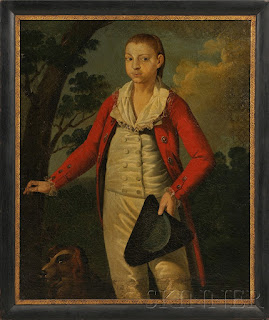
David S. Greenough and his wife Anna had a son (shown above) in the Loring Greenough House in 1787. Anna also had one surviving child from her first marriage. Those boys presumably grew up with Dick Morey as a household servant or farm hand in between their ages but not in their class.

However, I haven’t found any record of Dick Morey past those two documents from 1785–1787.

Sunday, January 06, 2019

Jacob Bailey Meets Charles Paxton’s “Gay Order”

Jacob Bailey (1731-1808) graduated from Harvard College in 1755, ranked at the bottom of his class in social rank. He chose to go into the ministry, starting as a Congregationalist like most of his fellow New Englanders.

Shortly after receiving his master’s degree in 1758, however, Bailey decided to become an Anglican minister. That required going to England to meet with a bishop for ordination. In his diary he wrote:
I visited my parents, where I found my Aunt Bailey, who all cried out upon me when I discovered my resolutions of visiting London for orders; and after all, I found it extremely difficult, with all the arguments I could use, to gain them over to any favorable sentiments concerning the Church of England.
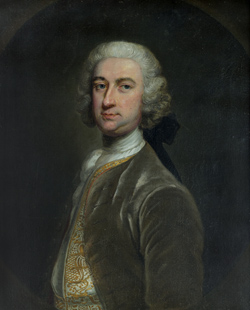
Bailey didn’t set out on his journey until late 1759, traveling first to Boston to arrange passage. He met with Charles Paxton (shown here), a Customs officer and warden of King’s Chapel, on 26 December. The young man wrote in his diary that Paxton promised “to use his interest with the commander of the Hind in my behalf, for a passage to England.”

Twelfth Night, 6 Jan 1760, was a Sunday. The Congregationalist meetinghouses had their regular services, but the Anglican churches made a bigger deal of the holiday. Bailey apparently attended King’s Chapel and visited briefly with the rector, the Rev. Henry Caner. Then he made a more unusual social call:
…having received an invitation from Mr. Paxon, I waited upon him, was politely received, introduced into a fine parlor among several agreeable gentlemen. I found here the famous Kit Minot, Mr. McKensie, and one Mr. Stuart, a pretty young gentleman.

I observed that our company, though chiefly upon the gay order, distinguished the day by a kind of reverent decorum. Our conversation was modest and perfectly innocent, and I scarce remember my ever being in any company where I could behave with greater freedom.
Let’s imagine reading those same words from a mid-20th-century author: a gathering of men, most “upon the gay order” and one “a pretty young gentleman.” The writer is obviously concerned about the conversation not being “modest and perfectly innocent.” But he comes away feeling he’s never been “in any company where I could behave with greater freedom.” We’d easily interpret that as the account of a homosexual man meeting other out-homosexual men for the first time.

Charles Paxton was in fact a lifelong bachelor. The Whig press ridiculed his elaborate courtly manners and sneered that he was frightened of boys’ games and once concealed himself in women’s clothing.

Christopher (Kit) Minot also never married. Born in 1706 and graduating from Harvard in 1725, he eventually joined the Customs service, serving as a land waiter. Hannah Mather Crocker later wrote that Minot was “a man of keen wit” who “moved in the first circles.” He left Boston during the 1776 evacuation and died in Halifax in March 1783.

I’m not sure of the identities of the other men Bailey named, but they might also be connected to the Customs service. William McKenzie was a searcher for the Customs office in Savannah in the late 1760s. Stuart might have been Duncan Stewart (1732-1793), later Customs collector in New London, Connecticut; Stuart married a daughter of Boston merchant John Erving in 1767, and they had ten children.

Likewise, Jacob Bailey eventually married and had six children. I didn’t find in his modern biography any further indication of interest in other men. But just four days later as he rode out of Boston, he wrote: “In the boat’s crew I discovered a young man, whose appearance and behavior pleased me more than all I had seen.” Here he was, just trying to sail away to be ordained, and attractive young men kept throwing themselves in front of him.

Okay, “gay” didn’t acquire its sexual definition until the twentieth century, and our understanding of homosexuality is also different from that of 1760. When Bailey wrote about gentlemen “chiefly upon the gay order,” he probably meant an upper-class, non-Calvinist, luxury-enjoying lifestyle. Bailey’s relatively poor, rural family descended from New England Puritans was mostly likely awash with suspicions about wealthy Anglicans. What sort of society was he getting himself into as he changed denominations? But the young minister was pleased to find a set of gentlemen sharing a decorous Twelfth Night conversation—and he could relax.

Of course, there might well have been gay men in that parlor.

Friday, November 13, 2015

“Glass Branches” for the Old North

This week Bryan McQuarrie of the Boston Globe reported on the return of an eighteenth-century chandelier to the Old North Church in Boston’s North End.

The five-armed glass chandelier first came to the church as half of a matched pair. According to Hannah Mather Crocker’s Reminiscences and Traditions of Boston, written in the 1820s:
The chandeliers were given by Capt Gruchy. They were taken near the close of the Spanish War. They were made for one of their cathedrals, but were way laid by a privateer belonging to him and thus brought to Boston to be hung up in the North Church since remembrance.
In Rambles in Old Boston, New England (1887), the Rev. Edward G. Porter quoted this item from the Christ Church (North Church) records:
June 16, 1746. Whereas Messrs. Mr. Robert Jenkins, Capt. Grushia, Mr. Hugh McDaniel, Mr. Jno. Gould, Mr. Jno. Baker, oners of the Priveter Queen of Hungary, hath made a present to Christ Church in Boston of 4 cherubims and 2 glass branches taken by ye said Vessell, Voted, That the branches be hung in ye body of the church and ye cherubims placed on ye top of the Organ.
Thomas James Gruchy was a privateer captain during King George’s War, now known as the War of the Austrian Succession or more fondly as the War of Jenkins’s Ear. He commanded the Queen of Hungary, sharing ownership with those other men.

Gruchy reportedly captured a French ship on its way to Québec. Its cargo included those two chandeliers (the “glass branches”) and four carved wooden angels. Gruchy apparently led the choice to donate those to Christ Church, where he was a junior warden.

By 1830, that North Church—soon to be the “Old North”—had refurbished its interior. The carved wooden angels were moved to a new spot, but the chandeliers were put outside in the courtyard. A former church official was founding an Episcopal mission in the western Massachusetts town of Otis, and he took one chandelier out for its new building. The other disappeared.

That church in Otis is now defunct, the building up for sale. Episcopal officials packed up some of its furnishings, including the chandelier, and sent them back east. The National Park Service is now analyzing the pulpit and prayer desk for clues to their age, and Old North is looking for a place to hang its new, old glass chandelier.

Thursday, August 27, 2015

“The same enraged mob whent to the house of Judge Hutchinson”

On 26 Aug 1765, the Boston Gazette ran this notice on the bottom of its third page amidst the local news:
Messieurs Edes & Gill.

I Desire the Printers of the Thursday’s Paper [Richard Draper’s “News-Letter”] to tell their Readers who those Gentlemen of Integrity and Reputation were that informed the Populace that an honorable Gentleman had “not only spoke but wrote AGAINST laying on the Stamp Duties”

And if these Gentlemen will make it appear to be a Fact, they shall have the Honor of three Cheers, with the free Consent, of your humble Servant,

TOM.
As Harbottle Dorr’s note on his copy of the newspaper shows, readers understood that the “honorable Gentleman” in question was Lt. Gov. Thomas Hutchinson.

Bostonians had been assigning Hutchinson some blame for the Stamp Act for weeks. On 14 August he tried to defend—reportedly with his sword—the house of stamp agent Andrew Oliver. The next night he refused to tell crowds at his door that he’d opposed the law because, as he wrote, “I did not like to be accountable to them.”

On top of that, Hutchinson was also connected to the Customs house inquiry that had riled Boston’s maritime community the previous year, as described yesterday. On the night of 26 August, crowds visited four men who had been part of that scandal, ransacking at least two of their homes. And then they headed for Hutchinson’s mansion in the North End.

The lieutenant governor left several accounts of this event, but I’ll quote one from his niece Hannah Mather Crocker, recently printed in Reminiscences and Traditions of Boston. Hannah’s father, the Rev. Samuel Mather (1706-1785, shown above courtesy of the American Antiquarian Society), was Hutchinson’s brother-in-law and neighbor. Thirteen years old at the time, she recalled:
The same enraged mob whent to the house of Judge Hutchinson [&] demanded his person. Not finding him, they distroyed great part of his house and furniture [&] drank wine till many of them could drink no more.

Part of the mob whent to Dr. Mather’s house where he had taken refuge. The Dr. told them his house was his castle and he should protect his brother Hutchinson.

At last the contest grew so warm that it was not thought safe for Mr. Hutchinson to stay any longer at his sister’s house. The present writer of this account was sent to shew him a private pass, the back way through an alley to the house of Mr. Thomas Edes [1715-1794] father of the late Edwards Edes.

There he remained till six o’clock in the morn when he partook of breakfast with his sister’s family. He conducted like a calm philosopher through the whole scene. After breakfast he whent up to court in his common dress, as his bag wig and robes had been distroyed by the mob. He opened court with a very affecting speach.
Young lawyer Josiah Quincy, Jr., heard that speech and wrote down one of two versions to survive. According to him, Chief Justice Hutchinson began:
Gentlemen: There not being a Quorum of the Court without me, I am oblig’d to appear.—Some Apology is necessary for my Dress—indeed I had no other. Destitute of every Thing—no other Shirt—no other Garment, but what I have on.—And not One in my whole family in a better Situation than myself. The Distress of a whole family around me, young & tender Infants hanging about me [Hutchinson’s youngest children were eleven and thirteen], are infinitely more insupportable than what I feel for myself, tho’ I am obliged to borrow Part of this Cloathing.
In addition to almost all his household’s clothes, Hutchinson was missing his windows, his furniture, his plate, his family pictures, his wainscotting, his front fence, his official comission as lieutenant governor, £900 sterling, and—perhaps most devastating to a historian—his books and manuscripts. Fortunately for Hutchinson, he had a backup mansion in Milton.

TOMORROW: A street-level view of this riot.

Wednesday, December 10, 2014

Revisiting the Long Room Club

As long as I’m discussing how Boston’s pre-Revolutionary Whigs organized, I should go back to the Long Room Club. Back in 2013 I said that:
  • the earliest printed reference to this group was in Samuel Adams Drake’s Old Landmarks and Historic Personages of Boston (1873), which cited no source for that information.
  • Drake’s list of members included two men too young to have been in the top political leadership of the 1770s or before, two from outside Boston, and a printer known for being politically centrist, not Whig.
A commenter kindly alerted me that Hannah Mather Crocker wrote about the Long Room Club before her death in 1829 in the manuscripts published in 2011 as Reminiscences and Traditions of Boston. Drake cited “Mrs. Crocker’s memoir” for other information in his book, so she was almost certainly his source on the Long Room Club as well.

Crocker left multiple overlapping manuscripts, which editors Eileen Hunt Botting and Sarah L. Houser assembled in one volume. All its mentions of the Long Room Club offer the same basic information. As Crocker understood it, the group was formed in 1762 by Samuel Adams. Members included:
[Benjamin] Edes and [John] Gill…, [John] Green and [Joseph] Russell…, [John] Hancock, James Otis, Samuel Dexter of Dedham…, Colonel James Warren of Plymouth, Dr. Joseph Warren, Dr. [Charles] Jarvis, Dr. [Benjamin] Church, the honorable Ben Austin…, Dr. Sam Cooper, William Cooper town clerk, Josiah Quincy…, Thomas Daws…, Mr. Sam Phillips Savage, Capt [Samuel] Partridge, Thomas Fleet, Royal Tyler, Samuel Whitewell, William Mollineaux, John Winthrop, Paul Revere, Adam Coulston, and Thomas Melvell—we think the only survivor of the Long Room Club.
Crocker credited the Long Room Club with opposing the policy to station soldiers in town in 1768 and determining to destroy the tea in 1773. She wrote that the club dissolved before the war, but the leaders “formed the first provincial congress.”

Drake listed fewer members than Crocker had, leaving out Green, Russell, Jarvis, Partridge, Austin, Whitwell, Molineux, and Colson, and listing only one Warren. Drake rendered Samuel Phillips Savage as Samuel Phillips and John Winthrop as John Winslow.

Crocker wrote, “The long room over the printing office was devoted to the use of a political society.” In both versions of that statement, the printers she had just written about were Green and Russell, who published the Boston Post-Boy until 1773. Drake interpreted Crocker to mean instead that the club met in a room over Edes and Gill’s print shop, which is how the story came down to us. But what if Crocker meant Green and Russell? They weren’t as politically active or radical, which would cast a different light on the organization.

Crocker may have gotten her information from Thomas Melvill. She called him “a standing monument of the Long Room Club and the only left to tell.” Yet Melvill was born in 1751, meaning he was only eleven when the group was reportedly founded and just twenty-four when it disbanded. Thus, although Melvill was an active young man in the Revolution and the war, he probably was never in the top echelon of the Whigs.

That still leaves questions about the accuracy of our information about the Long Room Club. Crocker’s manuscripts let us push back the earliest reference to it by about half a century, to a time when veterans of the Revolutionary War were still alive. But there are still a lot of odd details, and we’re still dependent on one fallible source. (The footnotes in Reminiscences and Traditions of Boston cite Esther Forbes’s Paul Revere and the World He Lived In as another source, but that book’s description of the Long Room Club matches Drake, who evidently relied on Crocker.)

Tuesday, January 17, 2012

Women Respond to William Scott

Yesterday I quoted a rather bad poem that Boston shoemaker William Scott sent to the New-Hampshire Gazette in 1764 explaining why he liked to wear his beard unfashionably, outrageously long. And oiled. And “combed and tied together as the gentlemen of that day wore their cravats,” according to Hannah Mather Crocker.

It appears Scott also sent along some responses to his lines, probably from his relatives or customers (he specialized in women’s shoes).

So the newspaper item continued:
Upon which several young Ladies desire you’ll print their Attempts to rival the Bard.

Sophia’s Face is smooth and fair,
On Scott’s is awful Beard of Hair,
She screams and says it shant be there.
Clarissa Peep.
A Woman’s Face in smooth and fair,
On Man’s is plac’d a Beard of Hair,
But Women love to feel it there.
Arabelle Tickle.
The Women now are out of Shoes,
and sorely they complain,
They view Scott’s Face, and gratify
a curious Taste though vain.
Ann Sober.
The Women being out of Shoes,
to Scott they run for more;
They view his Beard, and then return
saying, he’s now Fourscore.
Betty Simper.

Of course, it’s possible that Scott made up those responses to amuse himself. I even wondered if someone else wrote out the whole thing as a joke on him, but the poetry seems too bad for that.

Shoemakers were usually among the poorest of craftsmen, and we hardly ever hear from them. (Ebenezer Mackintosh and George R. T. Hewes are two exceptions.) Scott was unusual in publishing in a newspaper, as well as for having his portrait made by Joseph Badger (who also started out as a craftsman). Of course, Crocker wrote about Scott as one of Boston’s biggest “excentrics,” so he wasn’t bound by social norms.

Sunday, January 15, 2012

“He wore a long beard which he used to oile and comb…”

Last Thursday I went to Eileen Hunt Botting’s talk to the North End Historical Society about how Hannah Mather Crocker described Boston’s religious history through the 1820s. I’d ordered a copy of Crocker’s Reminiscences and Traditions of Boston, co-edited by Botting and Sarah L. Houser, but it hadn’t arrived by that morning. (I found it on my front stoop when I came home that night.)

At the talk I chatted with Eileen Botting, whom I’d met before only by email, about how our childhood memories are often our strongest, and how that might have affected Crocker’s storytelling.

I also chatted with Samantha Nelson of the Bostonian Society about a completely different matter: how eighteenth-century British-American fashion required men to be clean-shaven and what that means for eighteenth-century reenactments today.

Thumbing through Crocker’s Reminiscences, I came across a passage that amazingly speaks to both those points:
Till the [year] 1774 or 5 there was a very singular man in Boston by the name of Scott, a shoe maker by trade famous for making ladies’ shoes. He wore a long beard which he used to oile and comb and tye it together as the gentlemen of that day wore their [cravats]. He used to parade about town to show himself. He used to hold himself justified by the example as expressed in the 133 psalm, “How good and precious it is for brethern to dwell together in unity, (ver 2) tis like the precious ointment upon the head that ran down upon the beard, even Aaron’s beard that went down to the skirts of his garments.” This was his wise plea for wearing a foolish troublesome long beard. He was quite an excentric man. Several now living remember him as he was, a terror to many little children. He died 1774 or 5 and many rejoiced to be “Scott free.”
I get the strong feeling that Crocker herself (born in 1752) was among those “many little children” who were scared by Scott the shoemaker.

And as for reenactors who want to wear beards, here’s a precedent for doing so—as long as you’re portraying an “excentric” who wore what people thought was a “foolish troublesome long beard” in a very peculiar way and scared children so much they delighted in his death. In other words, Scott wasn’t just atypical for his time; he was outlandish! But he did exist.

TOMORROW: William Scott the shoemaker in his own words.

Wednesday, January 11, 2012

Botting on Hannah Mather Crocker in the North End, 12 Jan.

Tomorrow night at 6:00 P.M., the North End Historical Society is hosting Dr. Eileen Botting of the University of Notre Dame, co-editor of Hannah Mather Crocker’s Reminiscences and Traditions of Boston.

Crocker (1752-1829) was a descendant of the famous Mather family, great-granddaughter of Increase and granddaughter of Cotton. She was also a niece of Gov. Thomas Hutchinson, and an eyewitness to the aftermath of the attack on his North End mansion in August 1765.

She inherited the Mather library and published essays on women’s rights, Freemasonry, and other controversial topics. So, naturally, she was labeled a “bluestocking.”

Crocker assembled her local history using those books, public documents, and her own memories, but was never able to get it published. Though known to scholars, the manuscript was never in print until the New England Historic Genealogical Society issued it in a handsome hardcover volume last year.

Botting’s talk and book-signing will take place in Sacred Heart Church Hall at 9 Sun Court Street in the North End. Because there’s limited space, the society asks people to email or call 617-680-3829 to be sure of having a seat reserved.

Monday, December 27, 2010

Hannah Mather Crocker Book Still on the Way

Two years ago, I got word that Hannah Mather Crocker’s history of colonial New England was being readied for publication this year. Then I lost track of the project.

I just picked up the trail again through the blog for the New England Regional Fellowship Consortium’s blog, at which Prof. Eileen Hunt Botting reports:

The first edition of Hannah Mather Crocker’s Reminiscences and Traditions of Boston is slated to be published by the New England Historic Genealogical Society Press in April 2011. I worked on this edition while a NERFC fellow in 2009-10.

Crocker (1752-1829) was the daughter of Samuel Mather, the grand-daughter of Cotton Mather, and the great-granddaughter of Increase Mather, all famed Boston ministers. Crocker wrote the Reminiscences between 1822 and 1829, when she left the book unpublished at her death. The manuscript was acquired by the NEHGS in 1879.

Crocker’s history of Boston spans from the city’s founding by the Puritans in 1630 through the War of 1812. There are also scattered, eye-witness references to life in the city for the duration of Crocker’s life from the 1750s through the 1820s. The narrative is not chronological but rather thematically recounts the development of Boston via its topography, the genealogy of its inhabitants, and its politics.

The narrative orients itself around several key political events to which it periodically returns: the Puritan founding, the crafting of the colonial and provincial charters of Massachusetts, the American Revolution, the post-revolutionary rebirth of the city, and the War of 1812. Her non-chronological treatment of the city’s history allows Crocker to draw connections between events and people across time and space.

The narrative climax of Crocker’s history is the American Revolution, in which Crocker weaves her eye-witness testimony into a reflective work of synthetic history that draws from primary, secondary, and oral sources.
Still looking forward to this volume! If we can follow Mark Twain’s “autobiography,” surely we can follow how Crocker weaves strands of New England history.

Tuesday, December 16, 2008

Seeking a Peek at Hannah Mather Crocker

Hannah Mather Crocker (1752-1829) was a descendant of the leading Puritan ministers Increase and Cotton Mather, daughter of the Rev. Samuel Mather of the North Bennet Street meeting-house during the Revolution, and niece of Gov. Thomas Hutchinson. Apparently she was actually in Hutchinson’s house on 26 Aug 1765 when an anti-Stamp Act mob attacked it.

Crocker inherited the Mather family’s scholarly library. In 1827 she finished writing a manuscript titled Reminiscences and Traditions of Old Boston, which assembled stories she’d heard and read about the town’s founding with some personal experiences. It was never published. Maybe, just maybe, because she was a woman?

The New England Historic Genealogical Society, which has preserved that manuscript, announced this month that Prof. Eileen Hunt Botting and Sarah L. Houser of the University of Notre Dame are editing it for publication in 2010. I’m intrigued by the prospect of recollections of the Revolutionary turmoil from a young female perspective.

The authors are now looking for “a portrait or any image of Hannah Mather Crocker” to be used on the cover or frontispiece of that book; Prof. Hunt asked anyone who might have such a portrait up in the attic to email her. There are well-known portraits of all her famous ancestors, but none of her. Maybe, just maybe, because she was a woman?

Crocker is linked to the even less documented figure of Sarah Kemble Knight (1666-1727). In Observations on the Real Rights of Women (1818), which Botting calls “the first book-length treatise on women’s rights in the United States,” Crocker wrote of Knight:

Among some of the early instructors of writing may be found Mrs. Sarah Knights, in the year 1706. She was famous in her day for teaching to write. Most of the letters on business, and notes of hand, and letters on friendship were wrote by her. She was a smart, witty, sensible woman, and had considerable influence at that period.
Seven years later, Madam Knight’s journal of a journey from Boston to New York in 1704-05 was published by Theodore Dwight, one of the Hartford Wits. Here’s an online edition.

The actual manuscript of Knight’s diary has never turned up, nor other significant documents from her. Dogged research has found evidence of a Sarah Knight in Massachusetts and Connecticut, but there’s still a leap of faith that she took a journey of this sort in 1704 and wrote this diary. Early on people suggested that the text was created by Dwight and his cronies. Why would those conservative Federalists wish to lampoon both Crocker as an author and a learned colonist whom she had written about? Maybe, just maybe,...

On the other hand, what might have made those early reviewers of The Journal of Madam Knight insist that no woman of 1704 could have written it, so it had to be the creation of a man? Maybe, just maybe...