J. L. BELL is a Massachusetts writer who specializes in (among other things) the start of the American Revolution in and around Boston. He is particularly interested in the experiences of children in 1765-75. He has published scholarly papers and popular articles for both children and adults. He was consultant for an episode of History Detectives, and contributed to a display at Minute Man National Historic Park.

Subscribe thru Follow.it


•••••••••••••••••


Showing posts with label John Montresor. Show all posts

Saturday, April 04, 2026

Crean Brush’s American Career

Yesterday’s post reported that among the people captured aboard the evacuation ship Elizabeth in April 1776 was Crean Brush.

Eric Wiser wrote a good article about Brush for the Journal of the American Revolution: “Hell’s Half-Acre: The Fall of Loyalist Crean Brush.” More information can be found in “Crean Brush vs. Ethan Allen: A Winner’s Tale” by John J. Duffy and Eugene A. Coyle, published in Vermont History (P.D.F. download). I’ll review just the main points here.

Brush came to America from county Tyrone in Ireland in the 1760s when he was in his thirties and already a widower. He soon established himself as a lawyer and government appointee in New York City.

Brush married Margaretha Schoolcraft, who had a daughter named Frances from her previous relationship with Capt. John Montresor, the British army engineer. (Some sources say this girl was Margaretha’s niece. Others give the girl’s surname as Montezuma. It seems clear those were cover stories.)

In 1772, after accumulating grants of tens of thousands of acres of frontier land, Brush moved his family to the new town of Westminster, New York, between Lake Champlain and the Connecticut River. Soon he was a leader of the new community, variously commissioner of the court, surrogate of the court, county clerk, and representative in the colonial legislature. Brush worked with Philip Schuyler to establish the rule of (New York) law in his new county.

Unfortunately for Brush, others had settled the same region with grants from New Hampshire that overlapped and competed with the grants from New York. These men, led by Ethan Allen, Seth Warner, and Remember Baker, called themselves the Green Mountain Boys. Brush called them the Bennington Mob, becoming an early opponent and target of that faction. The London government had approved New York’s side of that dispute, giving Brush more reason to support royal policies.

On 13 Mar 1775, while Brush was away at the legislature, there was a fatal fight around the Westminster courthouse. Then war broke out in Massachusetts. The Green Mountain Boys seized Fort Ticonderoga for the rebels. Brush realized the region wasn’t safe for him, and neither was his former home in New York City. The Brush family moved into besieged Boston.

On 1 October, Gen. Thomas Gage gave Brush a commission to collect goods from the buildings of people who had left Boston so they wouldn’t be damaged when British soldiers were lodged in those homes and warehouses. The general required Brush “to take all due Care thereof, and to deliver said Goods when called upon, to those to whom you shall have given Receipts for the same.”

What Brush really wanted, though, was the British commander’s approval for his scheme to raise a Loyalist regiment and take back his corner of New York from the Green Mountain Boys. Gage never authorized that, which probably saved Brush from dying in a futile battle. Still, Brush presented the same proposal to Gen. William Howe in early 1776, but he didn’t get any further before it was time to leave.

TOMORROW: Preparing to evacuate.

Tuesday, June 24, 2025

“The only one now living of those who acted as aids-de-camp to General Howe”

Thomas Hyde Page (1746–1821) graduated top in his class from the Royal Military Academy at Woolwich in 1769, winning a gold medal from the king.

Page became a lieutenant in the Corps of Engineers and arrived in Boston in the spring of 1775. During the Battle of Bunker Hill he served as one of Gen. William Howe’s aides.

Richard Frothingham quoted the 11 Jan 1776 London Chronicle as saying:
A few days ago arrived in town, from Boston, Lieutenant Page, of his majesty’s corps of engineers, on account of the wounds he received the 17th of June, in the action of Charlestown. This gentleman is the only one now living of those who acted as aids-de-camp to General Howe, so great was the slaughter of officers that day. He particularly distinguished himself in the storming of the redoubt, for which he received General Howe’s thanks.
Page was back in London because he had been wounded in the leg, badly enough to require some sort of amputation.

Capt. John Montresor wrote to Page from Philadelphia on 17 June 1778 noting the “disagreeable memory” of the date. “I hope you are able to saunter without a stick.”

In his journal, however, Montresor grumped about his lack of a pension and wrote, “Page served Eleven days and was then wounded and return’d home and had ten shillings per diem settled for life.” (Of course, Montresor still had both his legs.)

Page continued to work on various engineering projects for the British military. Promotion was slow in that branch of the service, but between 1781 and 1783 he became a captain. That summer he received a double honor: he was elected to the Royal Society and knighted. A couple of years later he shifted to the invalid corps.

In 1790, Lt. Col. John Small, who had been Gen. Robert Pigot’s brigade major, wrote to Page:
The interesting position we were placed in side by side at the memorable Battle of Bunker’s Hill will never be forgotten, and will ever excite the most anxious emotions in the breast of the fellow campaigner who has now the honor of addressing you; who witnessed in the most trying moments, your innate worth, your professional Intrepidity and skill, and was most seriously affected when at your side he saw you ffall from a very dangerous wound, receiv’d when displaying your exertions in the ffield, when your cool and manly example, and sound judicious advice, contributed much to acquire success and victory.
I wish I had more of that letter to understand who was asking what favor.

Using surveys by Montresor and others, Page published very good maps of Boston harbor and the town of Boston. His 1793 “Plan of the Action at Bunkers Hill” is still the most useful source on the topography of the Charlestown peninsula in 1775—though it’s also notable in switching the labels of Bunker’s Hill and Breed’s Hill.

Most of Page’s engineering work involved drainage, harbors, canals, and other civil projects rather than fortifications. James Northcote’s portrait of Page above shows him “holding a Plan of Fort Landguard and seen in the distance.” Page didn’t build that fort, but he engineered its tricky well. (Once apparently at Boston, that painting is now on display at the Tyntesfield estate in North Somerset.)

Sir Thomas Hyde Page remained active all around Great Britain for decades and finally retired to Boulogne, France, where he died.

Friday, April 07, 2023

Exploring the Story of Samuel Dyer

This week I have two articles up on the Journal of the American Revolution:
These are two parts of the same research project. To borrow the summary from the second article:
in October 1774 a sailor named Samuel Dyer returned to Boston, accusing high officers of the British army of holding him captive, interrogating him about the Boston Tea Party, and shipping him off to London in irons. Unable to file a lawsuit for damages, Dyer attacked two army officers on the town’s main street, cutting one and nearly shooting another—the first gunshot aimed at royal authorities in Boston in the whole Revolution. Those actions alarmed both sides of the political divide, and Dyer was soon locked up in the Boston jail. Everyone seemed to agree the man was insane.
But there was a lot more going on than Bostonians could see. And Dyer resurfaced in an unexpected way.

Originally I wrote up this story for The Road to Concord, but it has only a passing connection to that book’s focus, the Massachusetts Provincial Congress’s cannon. Still, the events involved many of the same players and further raised tensions in October 1774. Dyer’s attack could even have started the war in a way quite different from how we remember it.

To spread the word about this project, I’ll do a couple of audio interviews in the next few days.

On the morning of Friday, 7 April, starting at 10:00 A.M., I’ll be Jimmy Mack’s guest on the Dave Nemo show on Sirius XM, discussing the months leading up to April 1775. This will be part of the show’s “Revolution Road” segment featuring writers from the Journal of the American Revolution.

On Sunday, I’ll discuss these articles with Brady Crytzer for the Dispatches podcast. That episode will drop later this month.

Wednesday, January 26, 2022

“What a dreadful apprehension for a wife”

When the eminent historian George Bancroft discussed Thomas Gage’s April 1775 decision-making in 1860, he wrote that the general was just too wishy-washy to carry out his orders from London:
Gage was neither fit to reconcile nor to subdue. By his mild temper and love of society, he gained the good-will of his boon companions, and escaped personal enmities; but in earnest business he inspired neither confidence nor fear. Though his disposition was far from being malignant, he was so poor in spirit and so weak of will, so dull in his perceptions and so unsettled in his opinions, that he was sure to follow the worst advice, and vacillate between smooth words of concession and merciless severity.

He had promised the king that with four regiments he would play the “lion,” and troops beyond his requisition were hourly expected. His instructions enjoined upon him the seizure and condign punishment of Samuel Adams, [John] Hancock, Joseph Warren, and other leading patriots; but he stood in such dread of them that he never so much as attempted their arrest.
Bancroft didn’t suggest that Gen. Gage was lenient because he was influenced by his American wife, Margaret

(My own theory about Gage is that he aimed for the provincial artillery supplies rather than Patriot leaders in order to save himself from embarrassment before his superiors. See The Road to Concord for the full argument.)

In the decades that followed Bancroft’s magisterial history of the U.S. of A., more sources came into print, many of them from Britain. Those cast a different light on Gen. Gage. It turned out contemporary critics in both London and Boston thought he was being lenient. And we got more gossip about Margaret Gage. Here are those passages in order of their appearance in print.

Boston merchant John Andrews, writing a private letter in March 1775, published in 1866:
…it seems the officers and soldiers are a good deal disaffected towards the Governor, thinking, I suppose, that he is partial to the inhabitants, many of the latter have made no scruples to call him an Old Woman.
Capt. John Barker of the 4th Regiment was one of those officers who thought Gage was too accommodating to the locals. In his diary he called the commander “Tommy” a couple of times. Barker’s entry for 12 Jan 1775, as published in the Atlantic Monthly in 1877, was also snarky about the general’s wife:
Yesterday even. was a Ball by subscription; seven of each Corps was the number fix’d, and the Ladies were invited by the managers; this scheme was proposed by Mrs. G—e, and carried into execution by her favorites; by which she enjoyed a dance and an opportunity of seeing her friends at no expense.
Maj. James Wemyss of the British army assessed dozens of commanders in the war (Gage by reputation, not personal experience), and his comments were transcribed by historian Jared Sparks. This paragraph was published by 1879:
Lieut.-General Gage, a commander-in-chief of moderate abilities, but altogether deficient in military knowledge. Timid and undecided on every emergency, he was very unfit to command at a time of resistance and approaching rebellion to the mother country. He was governed by his wife, a handsome American; her brothers and relations held all the staff appointments in the army, and were, with less abilities, as weak characters as himself. To the great joy of the army, he went to England soon after the disastrous attack at Bunker Hill.
That’s the transcription published in a footnote in William Cullen Bryant and Sidney Howard Gay’s A Popular History of the United States in 1879, and two years later in the Proceedings of the American Antiquarian Society. Gene Procknow, author of William Hunter - Finding Free Speech: A British Soldier’s Son Who Became an Early American, has looked at the original document in the Sparks Manuscripts and produced a more accurate transcription here. The basic sentiment remains the same.

The British engineer Capt. John Montresor (shown above) wrote this note during the war, as published by the New-York Historical Society in 1882:
Should the American Colonies (after all) be lost to Great Britain, it may be attributed to a variety of unfortunate circumstances and Blunders, &c., viz. General Gage having all his Cabinet papers, Ministers’ Letters, &c., and his Correspondence all stole out of a large Closet, or Wardrobe, up one pair of Stairs on the Landing at the Government House at Boston…1775.
Gage’s voluminous papers, apparently intact, sailed home with him and are now at the Clements Library in Ann Arbor, Michigan. Montresor’s complaint therefore reflects what he thought of Gage more than the actual whereabouts of the general’s papers.

Former Massachusetts governor Thomas Hutchinson in his diary on 27 July 1775, published 1884:
Mr. Keene called: complains of Gage: says his lady has said she hoped her husband would never be the instrument of sacrificing the lives of her countrymen. I doubted it. He said he did not, but did not chuse to be quoted for it.
Whitshed Keene was a former British army officer, Member of Parliament, and a brother-in-law of Lord Dartmouth, the Secretary of State.

Finally, in 1899 the British government published text from an unsigned letter that someone in Perth Amboy, New Jersey, had sent to Margaret Gage on 1 Nov 1775. That mail had been intercepted by the British government back during the war and stored in the Home Office files. Gage’s friend or relative wrote:
I have heard some good news, which is that [Gen. Richard] Montgomery is with his whole army cut to pieces or taken by Genl. [Guy] Carleton. God grant it be true! and yet I shudder. I recollect with horror the bloody scene at Charlestown. Poor Jennet [Montgomery]! I have been told that she charged Montgomery to avoid, at any rate, being taken prisoner. A cord, I suppose, she apprehended would finish his exploits.

What a dreadful apprehension for a wife; let either side conquer, what heartfelt woe must it occasion! This puts me in mind of a conversation you and I had the day after that dreadful one, when you thought the lines so expressive:
The Sun’s o’ercast with blood; fair day, adieu!
Which is the side that I must go withal?
I am with both; each army hath a hand,
And in their rage,—I having hold of both,—
They whirl asunder, and dismember me.
And again:
Whoever wins, on that side shall I lose
Assured loss, before the match be played.
Those are lines from Shakespeare’s King John, spoken by Lady Blanch as she feels torn between her husband on one side of a war and her family on another.

Richard Montgomery was a retired British army officer who had joined the Continental Army and was leading the attack on Québec. He hadn’t been “cut to pieces” yet, but he would be. Janet Montgomery lived on for decades in New York as the celebrated widow of an American military martyr.

TOMORROW: What do we make of these sources?

Tuesday, October 12, 2021

“Old Mr. Thompson” and Charlestown Cannon

For this posting I’m indebted to a tip from Chris Hurley, whom one can see at colonial reenactments demonstrating cider-making, among other skills.

Timothy Thompson (1750-1834) was a carpenter in Charlestown. He married Mary Frothingham in January 1775, and their first child arrived eight months later. By that point Thompson was a sergeant in the provincial army, Mary was a war refugee in Woburn, and their home was in ashes.

Charlestown rebuilt after the British left, so those years were probably a good time to be a carpenter. Thompson bought real estate, built on it, then expanded. He built two Federal houses for himself and his son Benjamin that today help to anchor the “Thompson Triangle.”

On 26 July 1830, Edward Everett, then a member of Congress, wrote in his diary:
Visited old Mr Thompson & received from him an account of stealing the Cannon from the Battery in the Navy Yard.—

He said that for ten years there had not been a new house added to the town prior to the Revolution.—
(So that decade before the war was not a good time to be a carpenter.)

Thompson’s story of “stealing the Cannon” took place on 7 Sept 1774, shortly after the “Powder Alarm” had pushed people on both sides of the political dispute into looking for military solutions.

At the time, Charlestown had a battery guarding its waterfront, cannon pointing out at where enemy vessels might round the Boston peninsula. In 1770 Capt. John Montresor had counted five iron eighteen-pounders in that battery.

According to the Boston merchant John Andrews, Gen. Thomas Gage heard rumors that the locals planned to move those guns out of his control. On the morning of 7 September, he sent an army officer across the river to scout out the site. By the time a squad of artillerymen arrived that evening to seize the ordnance, the five guns were gone.

That was one of the earliest moves in what The Road to Concord calls an “arms race” all around Boston in September 1774. Everett had heard about Thompson’s story at least once before. In 1878 the president of the Bunker Hill Monument Association, Richard Frothingham, reported:
…the account of the proceedings of the Standing Committee of August 2, 1824, has the following in the handwriting of Edward Everett, the Secretary: “An account of the carrying off and secreting some heavy artillery from a fort in Charlestown, in the year 1774, by Timothy Thompson, one of the persons engaged in that exploit, was presented by Col. [Samuel D.] Harris, and ordered to be filed.” This paper cannot be found.
In his own local history published in 1845, Frothingham had included the names of three men he believed had participated in that action: William Calder, William Lane, and Timothy Thompson.

Friday, May 21, 2021

“No Person whatever, belonging to the Army, is to be innoculated for the Small-Pox”

This being the two-week anniversary of my second vaccination against Covid-19, I’m going to celebrate by looking at a controversy around inoculation in 1776.

By then it was no longer controversial that inoculation programs helped protect individuals and communities against smallpox. But people still had reasons for fear.

Inoculated people developed the disease—a mild, non-fatal case, they hoped—and were infectious for several days, including some days before visible symptoms. Furthermore, doctors worried that clothing and other goods might be contaminated and spread the pox. Therefore, people wanted any inoculation program to keep its patients strictly isolated until they had fully recovered, and to take other measure to prevent uncontrolled infection.

On top of that, for an army commander, the benefits of having troops inoculated against smallpox had to be weighed against the risk of taking large numbers of men out of action for about four weeks, leaving the force vulnerable to a non-viral attack.

Gen. George Washington didn’t have to worry about smallpox personally. He’d contracted the disease in the “natural way” as a teenager and was therefore immune. But he worried about his troops and the general population, even accusing the British commanders inside Boston of sending out infectious people during the siege.

Smallpox was already damaging another part of the Continental Army. After Gen. Richard Montgomery failed to take Québec at the end of December 1775, the Continental Congress responded by sending even more soldiers into Canada, with Gen. John Thomas to command them. But that American army was steadily disintegrating, and the worst foe wasn’t the small royal force in Québec but the smallpox epidemic.

Meanwhile, Gen. Washington had moved his larger portion of the Continental Army from Massachusetts to New York. He worried that the British would attack that city before his defenses were ready. As usual, he feared he didn’t have enough troops, and he didn’t want to lose any to either epidemic or inoculation.

On 20 May, Washington’s general orders therefore declared:
No Person whatever, belonging to the Army, is to be innoculated for the Small-Pox—those who have already undergone that operation, or who may be seized with Symptoms of that disorder, are immediately to be removed to the Hospital provided for that purpose on Montresors’-Island. Any disobedience to this order, will be most severely punished—As it is at present of the utmost importance, that the spreading of that distemper, in the Army and City, should be prevented.
Montresor’s Island sat at the mouth of the Harlem River to the east of Manhattan, far enough from the city to serve as a smallpox hospital. Since 1772 it had been the property of Capt. John Montresor, the chief engineer of the British army in North America. (After the war Montresor’s Island was renamed Randall’s Island, and in the twentieth century it was connected to two other islands nearby.)

It took only four days for the authorities to hear about men in the Continental Army disobeying Washington’s order.

TOMORROW: A suspicious doctor.

Friday, November 09, 2018

“What do you think of the Patriotism of W.M”?

When Boston businessmen started to lease property to the royal army in late October 1768, word of those deals got around quickly.

Andrew Oliver, secretary of the province and merchant, sent this news to a business associate in London on 28 October:
[The army] is taking up Stores & other Buildings for their accomodation. They first took up Mr. [James] Smiths Sugar House of Mr. [James] Murray; this was well enough; he acted in character and upon Principle, but what do you think of the Patriotism of W.M who used his utmost interest in supporting the People in the Manufactory House in their Opposition to the Troops coming in there; and then made an Offer of the Stores on Wheelwrights Whff. at the modest rate of £400 Sterl. p. Ann:?

The General has however agreed with Mr. Apthorp himself for them at the rate of £300 and you may guess who will finally pay the reckoning.

Or what do you think of the patriotism of J R. to sollicit the Supply of the Troops and in fact letting his Stores for the Use of the Troops?

Or what do you think of J O’s sending a Card to the General & his Family to dine with him? Or of their refusing it? Where is Patriotism or where is Principle?
“J O” was probably James Otis, being polite to Gen. Thomas Gage and “his Family”—in this case meaning his aides. Otis had indeed opposed the Crown’s decision to station troops in Boston, but he was also an upper-class gentleman (even a bit of a snob) and a canny politician. He understood that being personally polite to the king’s general would look better than snubbing him. There was no financial interest in what he did.

In contrast, “J R.” or John Rowe did indeed profit from leasing buildings to the army. We know that he made that deal from his own diary. We also know he was both joining the other selectmen in protesting those troops and socializing with army officers, sometimes on the same day. Rowe’s politics swung with the prevailing winds.

The real surprise was “W.M”—William Molineux. He was one of the Whigs’ most confrontational leaders. Just the month before, Oliver had probably heard Gov. Francis Bernard and Lt. Gov. Thomas Hutchinson discuss a warning that Molineux was prepared to lead 500 men in an attack on the troops. So did the same Molineux really rent buildings to the army?

We know that he did because of a letter from Molineux himself. On 13 Feb 1769 he sent a complaint to Lt. Col. John Pomeroy, at that time the highest-ranking officer in Boston:
By Indentures of Agreement between [Royal Engineers Capt.] John Montresor Esq [shown above] & my Self, the 28th. Octr. Last I Lett him all the Stores on Wheelwrights Warffe, (so Called) at £25 Sterling per month to be paid monthly, which he promisd to Pay Punctually—& also on the 5th. Novemr: Let him a Sugar House for the Artillery Company, which they now Occupy, at £5 per month to be paid in Like manner.
In 1769 Molineux was no longer complaining that the army had barracks near the center of Boston. He was complaining that the army hadn’t given him enough money for those buildings.

TOMORROW: But who really owned that property?

Sunday, July 23, 2017

Talking About Revolutionary Massachusetts This Week

From midnight to 1:00 A.M. on Wednesday, 26 July, I’m scheduled to be interviewed by Bradley Jay on his radio show, Jay Talking. That will be on WBZ, 1030 AM.

[CORRECTION: It turns out that when I agreed to be on the show on 26 July, the producer was thinking that’s the date when I’d show up at the studio for a show to be broadcast on 27 July. So the conversation will actually happen early on Thursday.]

(Assuming, that is, that the U.S. Constitution is still operative and we haven’t stumbled into any wars that will preempt regular programming. Hard to be confident these days.)

I understand that Jay is a fan of Revolutionary history. I expect we’ll talk about The Road to Concord, Gen. Washington in Cambridge, and other gossip I’ve collected over the years. But this will be a new experience.

On Saturday, 29 July, I’ll be one of the many speakers at History Camp Pioneer Valley, to be held at the Kittredge Center at Holyoke Community College. This is the second annual gathering of history enthusiasts sharing their research to be organized by the Pioneer Valley History Network.

My presentation will be “An Assassin in Pre-Revolutionary Boston: The Strange Case of Samuel Dyer.” Other presentations on Revolutionary history include “Resurrecting the Memory of Major Joseph Hawley of Northampton: John Adams’s Campaign for a Forgotten Patriot” by Morgan E. Kolakowski, “A Forgotten ‘HessianPrisoner in Brimfield during the Revolutionary War” by Larry and Kitty Lowenthal, “Early Black American Patriotism” by Adam McNeil, and “Pioneer Valley Gravestones (and some of the men who made them), c. 1650-1850” by Bob Drinkwater.

As of today there are still a few slots available for History Camp Pioneer Valley.

Monday, July 03, 2017

”What is necessary to be done relative to a Colony Seal”

As I described yesterday, in October 1775 Gen. Thomas Gage discovered that the royal seal of Massachusetts had disappeared from the Council Chamber in what’s now the Old State House.

Naturally, we might assume that Patriots had stolen it. After all, they had stolen four cannon from militia armories under redcoat guard in September 1774 [see The Road to Concord].

The British military engineer Capt. John Montresor at some point even wrote in his diary about “General Gage having all his Cabinet papers, Ministers’ Letters, &c., and his Correspondence all stole out of a large Closet, or Wardrobe, up one pair of Stairs on the Landing at the Government House at Boston.” (But there’s no confirmation of such a theft, and Gage’s correspondence seems to be intact at the Clements Library.)

So was the seal spirited out of Boston for the Patriot government to use?

Probably not. Because that government outside Boston had already commissioned and started to use a new seal reflecting its ideology. The state Secretary of State states:
When the conflict between the province and England began in 1775, General Thomas Gage, the royal governor, had custody of the province seal. As his authority was no longer recognized by the province it became necessary to establish a new public seal.

The General Court passed an order on July 28, 1775, appointing a committee to consider ”what is necessary to be done relative to a Colony Seal.” The design adopted was that of an English-American man holding the Magna Carta. The seal was engraved by Paul Revere, whose original signed bill for the work is located in the Massachusetts Archives.

A motto in Latin was also chosen—“Ense petit placidam sub libertate quietem”—which remains the motto of the Commonwealth today. Freely translated this means, “By the sword we seek peace, but peace only under liberty.” It was written about 1659 and is attributed to the famous English patriot, Algernon Sydney [sic].
It’s conceivable that the royal seal was taken out to the Massachusetts Council and that body just decided not to use it. If I were writing a spy novel, I’d imagine Patriots using it to forge a commission or other credentials for an undercover agent. But my bet is that the royal seal went missing during the turbulence of the siege, and within a few months no one cared.

Sunday, April 09, 2017

Gen. Gage’s “disappointment at Charlestown”

Yesterday I quoted merchant John Andrews’s description of the removal of cannon from Charlestown’s shore battery on 7 Sept 1774.

As Andrews wrote in a letter dated 12 September, Gen. Thomas Gage didn’t just shrug off the disappearance of those guns:
He is by no means satisfied with his disappointment at Charlestown, as he sent a number of officers and soldiers over there yesterday; who were employ’d, in service time in particular [i.e., during religious services], in traversing the streets and by—ways, and tampering with the children, to get out of them where the cannon were hid. . . .

The [Suffolk] County Committee waited upon the Governor this forenoon…when he express’d himself nearly as follows:— [“]Good God! Gentlemen, make yourselves easy, and I’ll be so. You have done all in your power to convince the world and me that you will not submit to the [Coercive] Acts, and I’ll make representations home accordingly, for which I will embrace the earliest opportunity. You must be sensible it is as much for my benefit as yours’, not to take any measures that may prevent the country from bringing in their provisions, and in return should be glad to be answer’d in some questions I may ask, vizt.—What is the reason that the cannon were remov'd from Charlestown?”
That question also appeared in Gage’s written reply to the committee.

The Suffolk County delegates, led by Dr. Joseph Warren, told the governor that they would respond to that and other queries in writing. The next day they delivered their reply, longer than their original address and Gage’s response put together. And yet they never answered his question about what the people of Charlestown meant to do with their battery’s cannon.

On 13 September, Andrews passed along another rumor:
Am just inform’d that the officers prevail’d on a negro at Charlestown to inform ’em where the cannon were lodg’d; which being known there, they mustered about three thousand, and with teems carried ’em about ten or a dozen miles further up. Several among ’em were eight and forty pounders, which weigh’d between two and three ton apiece.
Massachusetts political leaders shared a fear of being betrayed by black people, enslaved or free—who at the time had little reason to support them. I’m not convinced that a man of African ancestry actually told British officers where to find the cannon. Locals may simply have feared that one would.

In addition, I’ve come to suspect that Andrews doubled or tripled a lot of the numbers in his letters, especially when it came to weights. As of November 1770, Capt. John Montresor of the Royal Artillery had reported, the Charlestown battery contained five eighteen-pounder cannon, not forty-eight-pounders. Much bigger than the brass guns of the Boston train (two- and three-pounders), but not huge.

Thursday, March 09, 2017

A Whitehouse Briefing

Last week I wrote about Pvt. Joseph Whitehouse and his bride Jane Crothers, who each testified to events on the night of the Boston Massacre. (She more reliably than he, I believe.)

Don Hagist, author of
British Soldiers, American War and The Revolution’s Last Men, wrote with more information about Pvt. Whitehouse and the experiences of wives attached to the 14th Regiment of Foot, so I’m gratefully sharing that information as a “guest blogger” posting.

Joseph Whitehouse was thirty years old when he married Jane Crothers in March 1770. He was born in Birmingham, England, and had pursued a trade fairly typical for that industrial city; he was a smith. By the age of twenty-five he’d tired of that profession, and he enlisted in the army.

This was a common path for a British soldier; most of the men who served in British infantry regiments during the American Revolution enlisted in their early twenties, after having pursued one or more other lines of work. The army offered steady employment, the opportunity to travel, and a pension after long service—perquisites not offered by any other profession of the era.

After their marriage, and their testimonies about the troubles in Boston in 1770, Joseph and Jane Whitehouse probably stayed with the regiment at Castle William in Boston Harbor, but they may have had opportunities to visit the mainland. Some soldiers’ wives did, and the Boston Post-Boy of 25 February 1771 reported that two of them fell into misfortune:
On Friday last as two Women belonging to the 14th Regiment were crossing the Ice at the South End of Town, they both fell through, and altho’ they were soon taken out by the Assistance of the Town’s People, yet one of them, Susannah Mills, was so chil’d with the cold, that she expir’d immediately; the other is like to do well.
Conditions on Castle Island were crowded and brought challenges different that those posed by the hostile townspeople. Late in 1771, engineering officer John Montresor wrote:
There is a deficiency [of water] from the latter end of July unto the latter end of November. . . . the 14th is now 400 men – 70 women & 90 children. Obliged to employ a large Boat every other day – sent to Boston to Peck’s wharf & bought there at one shilling per Hogshead – One hhd serves one Company of the 14th Regt Two days.
The 14th Regiment didn’t have to endure these conditions much longer, but their next station was even more difficult. In 1772 they left Boston harbor for the island of St. Vincent in the West Indies, part of a force sent to quell a rebellion by island natives. There, disease took a toll on the regiment in addition to casualties from fighting. By 1774, the regiment was due to be sent back to Great Britain after eight years in North America, but rising tensions in the colonies forced those plans to be changed. The regiment was divided up among posts in Florida, Virginia, and the Bahamas. Their grenadier company suffered severely in the Battle of Great Bridge in December of 1775.

As the British war effort turned sour in the south, the 14th Regiment was sent to join the British army in New York that was enjoying great success in the waning months of 1776. The regiment was quite worn out by this time, so the decision was made to send them home, but first the able-bodied soldiers were transferred to other regiments campaigning in America. The officers, and the soldiers no longer fit for service, were sent home, the former to recuit and the latter to be discharged.
Among the soldiers of the 14th Regiment of Foot who were discharged in England in early 1777 was Joseph Whitehouse. On 29 April, he went before the out-pension examining board at Chelsea Hospital; their examination book recorded his age, place of birth, trade and length of service, as well as the malady that prevented him from remaining a soldier. During his twelve years in the army, he had contracted a hernia, called a “rupture” in the parlance of the day, and was deemed no longer fit for service. He was granted a pension, paid semi-annually at a rate of five-eighths of a soldier‘s regular pay, a modest sum but enough to subsist on. He was still living in 1808.

What became of his wife, Jane, is not known. She was entitled to follow him with the regiment, and to accompany him to Great Britain when he was discharged from the army, but at this writing we have no information about her fate.

Thanks, Don!

Wednesday, September 14, 2016

Cannon All Around Boston

In 1770 Capt. John Montresor, the highest-ranking British army Engineer in North America, came to Boston to assess its defenses. Those fortifications had been designed over time to prevent an attack by sea, most likely by the French but perhaps by the Spanish.

The main protection was a harbor island called Castle William. It included a big fort, the Royal Battery and Shirley’s Battery along the eastern shore, and a couple more fortified and armed positions. Here’s a modern diagram of the island, based on work by Ens. Henry DeBerniere in 1775.

There were also artillery batteries on other spots in the harbor, such as Governor’s Island, which, Montresor wrote, “anno 1744, was fortified when Duc D’Anville was expected.” That French admiral’s armada actually reached North America in 1746, and its approach to Boston inspired Longfellow’s “Ballad of the French Fleet.”

In addition, Montresor wrote, “There are 3 Batteries—two at Boston and one of Charleston all directed to the water, all in very bad repair. The North Battery the best, though bad, the South Battery the next, and the Charleston one irreparable.” Since the end of the last war, Massachusetts hadn’t seen maintaining those fortifications as a spending priority.

This is Montresor’s count of cannon in and around Boston, as published in his papers by the New-York Historical Society.

I don’t recommend trying to add all those rows up, or sorting out the right hand columns. The takeaway is that there were several dozen cannon around Boston in the early 1770s.

For many years, Massachusetts had the responsibility to staff those fortifications through its militia system. But in October 1770, Gov. Thomas Hutchinson announced that as military commander of the province he was removing local troops from Castle William and turning it all over to the British army regiment stationed there since the Boston Massacre. Whig legislators objected, but they couldn’t do anything to reverse that. (After all, they had demanded that Hutchinson send the army regiments out to the island in the first place.)

Then British soldiers returned to Boston in May 1774. The Royal Artillery took over the town’s South Battery to store its supplies. That left the North Battery still in local hands, as well as the Charlestown battery across the river.

As I describe in The Road to Concord, during the first week of September 1774, the people of Charlestown took all the cannon and supplies out of their battery and hauled them inland. Those guns—Montresor had counted five eighteen-pounders—became the start of the Massachusetts Patriots’ secret artillery force.

TOMORROW: A busy night in Boston.

Sunday, November 22, 2015

How the New Yorkers Came to a Deal

On 5 Nov 1765, Lt. Gov. Cadwallader Colden of New York sent a report to London about how an angry crowd was besieging him inside Fort George with the province’s stamped paper.

In his letter to the Marquess of Granby, Colden wrote, “I expect the Fort will be stormed this night—everything is done in my power to give them a warm reception.”

Capt. John Montresor of the Royal Artillery, who had been busy strengthening the fort, wrote in his journal that 5th of November:
Advertisements and many papers placarded throughout this city declaring the storming of the Fort this Night under cover of burning the Pope and pretender unless the Stamps were delivered.
But in fact there was a compromise in the works. The next day Colden updated his messenger on the developments:
In the forenoon yesterday the Common Council of the City presented an Address to me Requesting that in order to restore Peace to the City & to prevent the effusion of Blood, I would deliver the Stamp’d Paper into the care of the Corporation, who in that case undertook to protect them. I was surprised at the Proposition, but upon their adding a Clause whereby the Mayor & Corporation became engaged for the full amount of the Paper &c and Duty, in case they were lost, destroyed or carried out of the Province, I consented to take the advice of his Majesty’s council upon it.
Colden was worried about the slippery slope: “The delivering the stamp’d Papers on the threats of a Mob, who may still make further demands greatly affects the dignity of his Majesty’s Government; & may have a tendency to encourage perpetual mobish proceedings hereafter.”

New York’s provincial Council advised that “the City appeared to be in perfect annarchy, and the power of Government either Military or Civil insufficient—that the defense of the Fort would involve the destruction of the City.” Those gentlemen recommended taking the deal. Colden then asked Gen. Thomas Gage for his advice as commander of the king’s army in North America, and he concurred. Colden had thus covered himself bureaucratically as much as he could.

Therefore, on the evening of 5 November the lieutenant governor turned the stamped paper in Fort George over to a committee led by Mayor John Cruger (shown above), who had participated in the Stamp Act Congress the previous month.

Cruger signed this receipt:
Received of the Honble. Cadwallader Colden, Esq. his Majesty’s Lt. Govr. and Commander in Chief of the Province of New York, Seven Packages containing Stamp’d Paper & Parchment all marked No. 1, J. McE., New York which I promise in behalf of the Corporation of the City of New York to take charge & care of, and to be accountable in case they shall be destroyed, or carried out of the Province as particularly set forth and declared in the Minutes of the Common Council of the said Corporation of this Day. Witness my hand in the City of New York this fifth day of November 1765.
TOMORROW: Was that enough to calm the populace?

Saturday, November 21, 2015

Lt. Gov. Colden’s Unsafe Situation

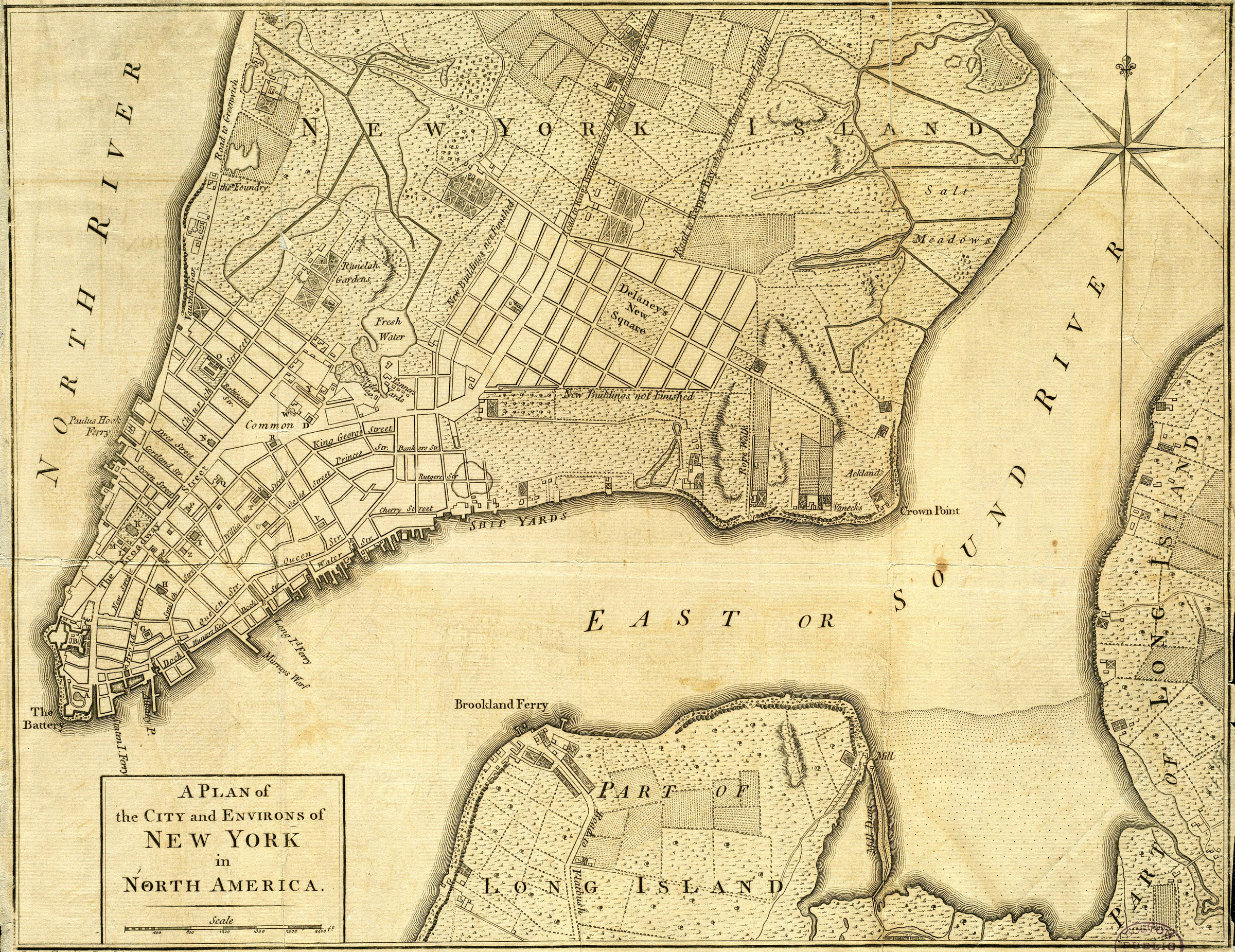
As November 1765 began, New York acting governor Cadwallader Colden was holed up in Manhattan’s Fort George (on the far left of the map above) with a contingent of the king’s military forces and the stamped paper for three colonies. Outside was a crowd of thousands of men convinced that the Stamp Act was tyrannical and determined to keep it from taking effect.

Maj. Thomas James commanded some men from the Royal Artillery inside the fort. That, and his contemptuous remarks, had caused the crowd to tear apart the mansion he was renting in town on the night of 1 November. 

Capt. Archibald Kennedy had sent “Lieutenant Owen & twenty four Marines” to the fort to support Colden. However, he added, “by doing this I leave the Ships without Marines, & as most of our men are imprest there is a great risque of their deserting.” But he declined to take charge of the stamps, lest the crown attack his home and property.

Colden asked the military engineers how they would strengthen Fort George. On 2 November, Capts. Harry Gordon (d. 1787), Thomas Sowers, and John Montresor delivered their report:
The most necessary & Expeditious way of putting this Fort in an immediate posture of defence.

A Number of Barrells Boxes or such Instruments as will contain a sufficient quantity of earth to make them Musquet proof to be put on the Salient Angles of the Bastions to form a Lodgement for 12 Men each, filld with earth 4 ft. 6 in. high. The Earth for filling them to be taken from the inside of the parapet leaving only a Banquet inside of the Barrells Boxes &c. A piece of artillery behind those lodgements towards the shoulders of the Bastions.

Two Pieces of light artillery covered with their mantelets &c. to be mounted on each Flank & the shoulders rais’d to cover them.

A Howitzer to be mounted on each Curtin towards the Town

The Crows feet to be scetterd to the Gate, Sorties and other practicable Avenues to the Fort.

All the Remainder of the Chevaux des frises to be fix’d and ready to plant along the places where the parapet remains en harbet and to be steadied by some Earth thrown against them

A Lodgment of Mattresses or Bedding or any thing proper to make a Covering a top of the large House for a Serjeant & 12 good men who have been practised to firing.

One hundred hand Grenades to be lodg’d at each Curtin & forty near each small lodgment on the Points of the Bastions to be loaded & ready to be lighted & thrown.

The Gate to be Barricaded within at Night as fast as possible & two pieces of large artillery to be planted against it, & two light pieces at some distance behind the Chevaux des frises.

The several Fronts of the Fort to be disencumbered from the Buildings &c

’Twould be necessary for the defence of the Fort if Capt. Kennedy’s House was taken possession of as it commands two Fronts the most accessible of the Fort.

Proper Instruments & Workmen for the defence should be immediately provided and a sufficient number of Men at least three hundred.

Notwithstanding the above Improvements for the defence of the place, its still under great inconveniences arising principally from the want of proper cover within, & being commanded by the Circumjacent Buildings.
In other words, even with at least 300 men, plenty of weapons, Kennedy’s full cooperation, and a lot of hard work, Fort George would still be vulnerable. It had been built to protect the city from attack by sea, not to withstand a siege by land. And was there time to do all those things anyway?

The next morning, a paper was found inside an oyster shell at the gate of Fort George, addressed to Colden himself:
Sir

As one who is an enemy to Mischief of all kinds, & a Well wisher to you & your Family, I give you this Notice that Evil is determined against you & your Adherents & will in all human Probability take Effect, unless Speedily prevented by your public Declaration upon Oath, That you will never, in any Manner, countenance, or assist, in the Execution of the Stamp Act, or anything belonging to it; and also, that you will, to the utmost of your Power, endeavour to get it repealed in England, and meanwhile prevent its taking Effect here. Your Life may depend upon the Notice you take of this Advice.

Benevolus

P.S. I well know the Guides of the People would only shew you that they may dare also; but don't incense them, for God’s Sake, by an unpolitical Contempt! You are not safe at Flushing.
Flushing was where Colden had his country estate. He was probably wishing he were there.

TOMORROW: Reaching a compromise. 

Monday, May 07, 2007

Making of America: Another Delightful Digital Database

Back in January, David Parker at Another History Blog described the value of the Making of America database. (Thanks also to Millard Fillmore’s Bathtub for laying the trail of crumbs.) And I’ve been meaning to express my gratitude to the University of Michigan for creating it.

Now this database doesn’t go all the way back to the 1700s. But it’s still valuable for folks studying eighteenth-century history because it archives:

  • Some volumes of documents from the founding era that were transcribed and published in the mid- and late 1800s.
  • Histories written around the Centennial, showing what Americans then thought of the Revolution.
Among the former, don’t miss the volumes mysteriously catalogued under the series title “John Watts DePeyster Publication Fund.” Those are the Collections of the New-York Historical Society. And the Making of America version provides both page views (like Google Book) and crude transcriptions.

Volume 14, for example, reprints the journals of Capt. John Montresor, the British army’s top engineer in North America. (That’s him above, as painted by John S. Copley.) Here are some of the captain’s notes on his Boston 1774-75 experience, apparently written as he sailed back to England (and perhaps prepared to make a claim for promotion or reward):
I attended Lord Percy from Boston towards the Battle of Lexington. My advancing some miles in front of his Corps with four volunteers, and securing the Bridge across Cambridge River, 19th April, 1775; which prevented his Body from going the Watertown Road, whereby the Light Infantry and Grenadiers were not cut off, my having sent one Volunteer back to his Lordship; the town of Cambridge in arms, and I galloped through them.

During part of Gen. Gage’s Command at Boston [i.e., in late 1774], the Garrison were distressed for want of Specie, and also Carpenters; which I undertook to remedy, by supplying it £6,ooo in gold, and got it sent on board the “Asia,” and so to us at Boston.—Government insuring it.

I was twice attempted to be assassinated for supporting the honor and credit of the Crown during my Command in the course of the Rebellion.—1st., near Brattle Square, at Boston, by means of Rebel Doctor [Samuel] Cooper; and, 2nd, near the South end of Boston, by Samuel Dyer, when I saved General [Samuel] Cleaveland’s Life, Commanding Officer of Artillery. This man was sent off by the Sheriffs of London, Messrs. [William] Lee and [Stephen] Sayre, to murther Lt.-Col. [George] Maddison of the 4th Regiment.
I know nothing about Montresor’s accusation of the Rev. Dr. Cooper, minister of the Brattle-Street Meeting, and this remark isn’t mentioned in Charles W. Akers’s modern biography.

Montresor is correct that he and Cleaveland were nearly killed by a sailor named Samuel Dyer on 18 October 1774. That was, as far as I can tell, the first time in the Revolutionary conflict that someone in Boston tried to fire a gunshot at someone from the royal government or military. And Montresor actually blamed American-born politicians back in London for it. Eighteenth-century paranoia is wonderful to behold.