J. L. BELL is a Massachusetts writer who specializes in (among other things) the start of the American Revolution in and around Boston. He is particularly interested in the experiences of children in 1765-75. He has published scholarly papers and popular articles for both children and adults. He was consultant for an episode of History Detectives, and contributed to a display at Minute Man National Historic Park.

Subscribe thru Follow.it


•••••••••••••••••


Showing posts with label John Pomeroy. Show all posts

Thursday, August 12, 2021

“Opportunity of hearing NANCY DAWSON”
As I described yesterday, in late 1768 Boston officials became concerned about the army regiments in town playing music on Sundays.

That music was a normal aspect of changing the guard. The garrison’s main guard was at the center of town, near the Old Brick Meeting-House.

By early December, that dispute nearly led to violence as soldiers chased away local youths who “behaved so as to displease the officer” in charge.

At the end of the year, the town’s highest elected officials complained directly to the officer commanding the four regiments:
Yesterday the Selectmen, waited upon General [John] Pomeroy, to acquaint him that the music of the fife, &c. on the Sabbath, was very disagreeable to the inhabitants, and might have an ill effect upon the younger and more thoughtless part of the community, with respect to the observance of that day; and as they apprehended it contrary to law, they expressed their hopes and desires that it might be omitted for the future, as they had taken notice it had sometimes been in stormy weather…
The selectmen also used the occasion to complain about sentries challenging civilians who passed their guardhouses and stations, as soldiers were ordered to do. Why did a British town at peace need sentries? Mostly to stop men from deserting from the army.  

The selectmen’s request had no effect according to the Whigs’ “Journal of the Times” dispatch for 1 Jan 1769.
The soldiery are obliged, the Lord’s day not excepted, to attend twice or thrice a day at the calling of the rolls. . . . The noise of the fife was this day more general and offensive than it has been upon any Sabbath, since the troops came among us.
But then the “Journal of the Times” didn’t mention military music again for over four months. (Or rather, the writers confined their complaints to a reportedly violent officers’ ball and the 29th Regiment’s black drummers.)

The issue of music on Sundays returned on 15 May:
Yesterday, but before divine service began, part of the town had opportunity of hearing NANCY DAWSON from a most elegant band of music, the French horns certainly were inimitable.—

It is some time since we have had such a Sunday morning’s regale, the drums and fife, being the common entertainment, and ‘tis uncertain to whose taste we owe this: Some think it the fancy of Madam G——m, while others think that the Justice himself conceived it might be an agreeable relief to the wardens under the burthen of their duty.
While fifes and drums were standard instruments for military musicians, many regimental bands had indeed expanded into French horns and oboes.

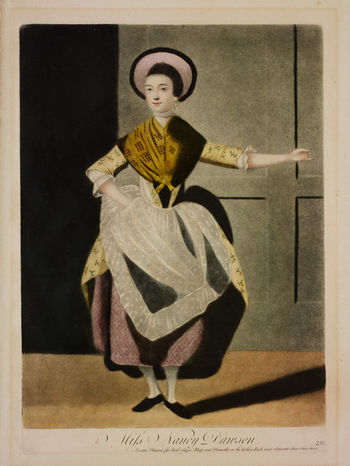
As for the allusions in that passage, Nancy Dawson (shown above) was a British actress and dancer who died in 1767. The hornpipe titled “The Ballad of Nancy Dawson” became very popular in the British Empire. That melody was also known as “Piss on the Grass,” and is now most easily identified as “Here We Go Round the Mulberry Bush.” (Boston’s youth also referred to the boys who dressed in women’s gowns and danced around the effigies during Pope Night processions as “Nancy Dawsons.”)

Finally we come to “Madam G——m” and “the Justice himself.” Dr. Samuel Gillam was a justice of the peace in Surrey, England. In May 1768 he authorized soldiers to disperse a crowd gathered to support John Wilkes, killing six or seven people. Whigs across the Empire viewed that “Massacre at St. George’s Fields” as an example of tyranny. Gillam was even tried for murder, but acquitted.

Earlier in their “Journal of the Times” the Boston Whigs had reported that ”the G——r had nominated and appointed the J—s M——y already noticed in this Journal, as one of his Majesty’s justices of the peace.” That is, Gov. Francis Bernard had made the Scottish-born merchant James Murray a magistrate. The Whigs warned, “the G——r will not now want a Justice Gillam.” In other words, Bernard now had an appointee willing to read the Riot Act and unleash troops on civilians.

The Whigs’ reference to “Madam G——m” and “the Justice himself” thus meant James Murray and his second wife, the former Margaret (Mackay) Thompson. According to Patricia Cleary’s biography of James’s sister, Margaret Murray was known in the family for enjoying the social whirl. That might be why the Whigs dragged her into this little controversy.

TOMORROW: Confrontation in June.

Friday, February 22, 2019

“A concert hall is again opened to all”

At the end of January 1769, the Boston Whigs told newspapers in other towns, British army officers behaved so badly at a musical concert that the hosts canceled all further scheduled performances.

But on 6 Feb 1769, the Whig-leaning Boston Gazette and Boston Evening-Post ran this advertisement:
The Subscribers to the Concert,
which was to have been on Wednesday Evening the 8th Instant, are hereby notified that it will be on Friday the 10th, at Concert-Hall; and after that will be continued every other Wednesday, during the Season.
So the biweekly musical assemblies were back on, with just a two-day delay that week.

In their “Journal of Occurrences,” the Boston Whigs tried to spin the resumption of concerts in their favor on 16 February:
A concert hall is again opened to all who have, or may commence subscribers to such musical entertainments. We are told proper concessions have been made Mr. [Stephen] D[e]bl[oi]s, and that G[eneral] [John] P[omero]y, has engaged that the o—ff[ice]rs of his core, shall for the future behave with decency, and agreeable to the regulations of such assemblies.
And there was no further commotion. On 29 May, the Boston Chronicle announced:
The Subscribers to the Wednesday-Night CONCERT, are hereby notified, that said Concert will end, Wednesday next.

N.B. Any Gentlemen who are not Subscribers and Ladies, will be admitted to said Concert, at Concert-Hall, paying half a Dollar each.

The Concert begins at half after Seven.

No Subscribers will be admitted without delivering his Ticket.
The season thus passed without giving the Whigs anything further to complain about.

Concert Hall wasn’t the only venue offering musical entertainment that winter, and I’m not talking about James Joan’s “Music Hall.” On 17 February the Whigs ran another dispatch:
There has been within these few days a great many severe whippings; among the number chastised, was one of the negro drummers, who received 100 lashes, in part of 150, he was sentenced to receive at a Court Martial,—It is said this fellow had adventur’d to beat time at a concert of music, given at the Manufactory-House.
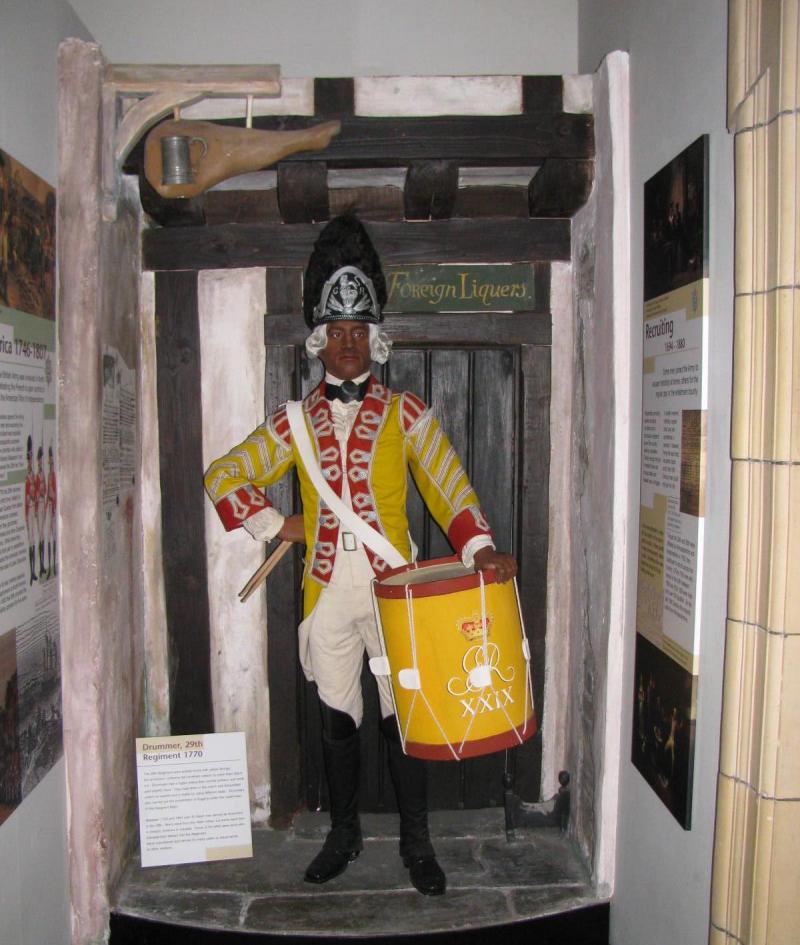
The drummers of the 29th were black, bought or recruited in the Caribbean. At first Bostonians had viewed them as a curiosity, then as a threat to the regular social order since drummers were tasked with carrying out the whippings and other corporal punishments in a regiment. But here, when a drummer was receiving punishment, the Whigs were mildly sympathetic to him.

It’s unclear why a regimental drummer would be punished for playing at a concert. Soldiers were allowed to earn money by taking jobs in their off-hours, and other sources show regimental musicians giving private concerts. Indeed, it’s possible that much of the band at the subscription concerts had come from the army. Perhaps this drummer played the concert when he was supposed to be on duty, or had been expressly told not to play at the Manufactory given its recent history as a battleground between army and locals. The Whigs might have neglected to include such a detail.

This news item is another odd link, after Pvt. William Clarke’s play The Miser, between the Manufactory building or its tenants the Browns and popular entertainment. Perhaps as immigrants the Browns just didn’t share Boston’s traditional resistance to such public frivolities. But any “concert of music” at the Manufactory was probably meant for a lower-class audience than the assemblies at Concert Hall.

Wednesday, February 20, 2019

A Concert “turned topsy turvy”


Though the Boston Whigs sneered that few young ladies attended the 22 Dec 1768 musical assembly at Concert Hall (as quoted yesterday), the 29 December Boston News-Letter gave the event more respectful coverage:

Thursday evening, the Assembly for the winter began at Concert Hall; at which, were present, the Honourable the Commissioners of the Custom, Commodore [Samuel] Hood, Brigadier General [John] Pomeroy, and most of the Gentlemen of the army and navy, &c. &c.
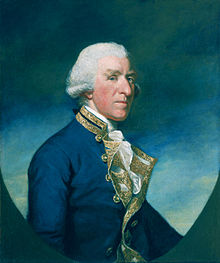
The commodore is shown here in a portrait from fifteen years later, after he had become an admiral and a baronet. (Eventually Hood was made a viscount.)

The next subscription or “private Concert,” a Boston News-Letter advertisement clarified on 12 January, was scheduled for the 25th.

In the meantime, the pro-Crown newspapers advertised another musical event:
A grand CONCERT
of Vocal and Instrumental Musick
To be performed at Concert-Hall,
On FRIDAY the 13th
People could buy tickets for half a dollar at the newspapers’ printers or “the London Book-Store in King street,” which was run by John Mein, also co-owner of the Boston Chronicle.

That concert also got positive reviews from the pro-Crown press, as in the 16 January Boston Post-Boy:
Last Friday Evening there was a grand Concert of Vocal and Instrumental Music at Concert Hall, at which were present a very polite Company.
James Joan was the main performer, if not the only one.

According to the Whigs, however, audience members weren’t so polite at Joan’s concert, and they behaved even worse at the first subscription concert on 25 January:
The court concert of the last evening was it seems, turned topsy turvy, as Joan the Italian’s was a week or two before—

Some officers of the army were for a little dancing after the music, and being told that G[overno]r B[ernar]d did not approve of their proposal, they were for sending him home to eat his bread and cheese, and otherwise treated him as if he had been a mimick G[overno]r; they then called out to the band to play the Yankee Doodle tune, or the Wild Irishman, and not being gratified they grew noisy and clamorous…
Gov. Francis Bernard had evidently asked the military officers to tone down their festivities in deference to local tastes. Even though he wasn’t at the assembly, the Whigs nonetheless managed to tie the disorder to him.

TOMORROW: And what disorder it was!

Sunday, November 18, 2018

“Landed and quartered in town”

On 18 Nov 1768, 250 years ago today, the Boston Whigs’ “Journal of Occurrences” alerted their readers in other North American ports to this news:
The 64th Regiment of those troops Col. [John] Pomeroy, are landed and quartered in town, the 65th Regiment Col. [Alexander] Mackay, at Castle Island; they consist of 500 men each.—The battalion-men of the detachment of the 59th are to return to Halifax.
The Whigs also counted eleven Royal Navy ships, not counting the chartered transport ships, in the harbor.

With four regiments (the 14th, 29th, 64th, and 65th) in town, plus part of the 59th and a contingent of Royal Artillery, this was the largest number of soldiers stationed in Boston before late 1774.

The 64th and 65th were fresh from recruiting in Ireland, so they were at full strength. The Whigs’ estimate of “500 men each” is probably a little high and doesn’t necessarily apply to the two regiments that had arrived earlier from Nova Scotia.

Nonetheless, there were probably around 2,000 soldiers in Boston for a couple of weeks that fall. The 1765 census counted 2,941 white men above age sixteen (i.e., eligible for militia duty). Thus, in that stretch two out of every five white men in Boston belonged to the British army.

[The photograph above comes from Revolution250’s recent “Boston Occupied” reenactment, photographed by Chris Christo for this gallery at the Boston Herald.]