J. L. BELL is a Massachusetts writer who specializes in (among other things) the start of the American Revolution in and around Boston. He is particularly interested in the experiences of children in 1765-75. He has published scholarly papers and popular articles for both children and adults. He was consultant for an episode of History Detectives, and contributed to a display at Minute Man National Historic Park.

Subscribe thru Follow.it


•••••••••••••••••


Showing posts with label William Cheever. Show all posts

Wednesday, March 16, 2011

“Carpenter was sentenced to be hanged this day”

On 18 July 1775, the Dublin-born barber Richard Carpenter swam from Boston, held by the British military, to Dorchester, under the control of provincial troops.

On the night of 19 July, he swam back.

Boston selectman Timothy Newell reported in his journal that “Mr. Carpenter was taken by the night Patrole.” Teenager Peter Edes encountered him in the Boston jail as they were both taken to a building called Concert-Hall for a military inquiry and trial:

My four room companions and myself were escorted as before, with one Carpenter a barber, who swam from Boston to Cambridge [sic], and back again. The said Carpenter and Mr. [John] Hunt were examined.
An unnamed British officer wrote to someone in London on 25 July that Carpenter had been “caught last week swimming over to the rebels, with one of their General’s passes in his pocket.” Evidence in Gen. George Washington’s papers suggests that Carpenter had no interaction with him, but during his day on the American side of the siege lines he could have met Gen. John Thomas or even Gen. Artemas Ward. Or the British officer could have been passing on bad information.

The royal authorities quickly found Carpenter guilty and sentenced him to death. According to Newell, the barber heard
sentence passed on him to be executed the next day,—his coffin bro’t into the Goal-yard, his halter [i.e., noose] brought and he dressed as criminals are before execution.

Sentence was respited and a few days after was pardoned.
Newell didn’t write his journal entries on the dates attached to them, but a few days afterward, so events got mashed up. The young merchant William Cheever puts the mock execution on 21 July:
one Carpenter was sentenced to be hanged this day for carrying Intelligence over to the Provincials by swiming; however it was thought fit to reprieve him.
Other sources add more haze to the picture, however. According to that British officer on 25 July, Carpenter was still due to “be hanged in a day or two.” On Friday, 28 July, Ezekiel Price, outside of Boston, recorded this rumor:
the barber who swam from Boston to Dorchester about ten days ago, returned again into Boston, was taken up by General [Thomas] Gage, and hanged on Copps Hill last Saturday.
As for Peter Edes in the Boston jail, his journal never mentions Carpenter again.

So what was going on? The British authorities probably wanted to scare Carpenter into confessing all that he knew about the rebels’ intelligence operations. Which may not have been much, since he appears to have been acting on his own.

It’s also possible that the royal government wanted to scare other prisoners or Bostonians into cooperating, while also showing that it could be merciful. But in that case, I would expect to read more about Carpenter in Edes’s diary.

For a while I considered the possibility that Carpenter had been a British plant, with the aborted execution a way of providing him with cover, but other sources show that the army kept him locked up through the siege and beyond.

In the end, the British military found Carpenter suspicious and dangerous, but just wasn’t ready to hang him. I think that reflects how this early in the war neither side had the stomach for such fatal measures. The executions of Thomas Hickey and Nathan Hale were still several months away.

TOMORROW: Richard Carpenter in and out of prison.

Friday, December 03, 2010

“He must withdraw his Troops”

Here’s how young merchant William Cheever recorded a decisive moment at the end of the siege of Boston in his diary (now online from the Massachusetts Historical Society):

5th [March 1776]. Last Night & this morning a very incessant Fireing from 1/2 past 7 in the even’g ’till 6 this morning: without much damage & this day at noon, Gen’l Howe notified that all Persons who intended to follow the Army should give in their names, as he must withdraw his Troops.
The first part of that “very incessant Fireing” from the American artillery was intended to distract from and cover up the noise of that army’s overnight move onto Dorchester heights. (At the time those heights didn’t include the monument shown here.)

On the morning of 5 March, the anniversary of the Boston Massacre, the new American battery on the Dorchester hills started firing as well. All that cannonading did relatively little damage, as Cheever noted, but it threatened the British shipping and fortified positions on the Neck.

As a longtime Boston 1775 reader notes, Cheever’s diary entry offers a telling perspective on Gen. William Howe’s decision to evacuate the town. Even as he apparently made this public announcement that Loyalists should register to evacuate with his troops, Howe was also ordering his soldiers to prepare an attack on the Dorchester peninsula that evening or the next day.

A bad storm offered a reason to put off that assault, and the Americans continued to fortify their position on the hills. Howe’s council of war formally decided to evacuate on 7 March. But obviously he was already preparing to do just that.

TOMORROW: The big picture.

Thursday, December 02, 2010

“Just as the Curtain was drawn”

I’m now past the turn of the year in flipping through William Cheever’s diary of the siege of Boston, now online at the Massachusetts Historical Society. Here’s his entry for 9 Jan 1776:

Last Evening between 8 & 9 oClock a Party of the Provincials cross’d the Dam at Charlestown & set fire to a few Houses that remain’d at the upper End of it & afterw’ds carried off a Serjeant & about 10 Men without any Loss.

It is worthy of Note, that the above happen’d just as the Curtain was drawn for acting a farce called “the Blockade of Boston;” which was adjourned by the Report of the Actack of Charlestown.
This is a small but fascinating incident during the siege that I narrated back in 2008. As I wrote then, New Englanders timing an attack to disrupt the British officers’ theatricals in Faneuil Hall (shown above) seemed like too good a story to be true, but I kept finding first-hand accounts. In fact, the only major detail I think a Hollywood scriptwriter would change is that Gen. John Burgoyne was no longer in town to see his farce turned into a, well, farce.

In another way, though, the amateur performers did have the last laugh. According to merchant John Rowe’s diary (also held by the M.H.S.), the British officers and their ladies finished performing The Blockade of Boston on 22 January along with Tamburlane, and on 23 February presented The Wonder of Wonders.

TOMORROW: Gen. Howe makes a decision.

Wednesday, December 01, 2010

Putting Empty Churches to Use

Like Boston selectmen and deacon Timothy Newell, young merchant William Cheever was keen to note when the British authorities took over the town’s Congregationalist meeting-houses for any purpose. Of course, during the siege of Boston most of the town’s Congregationalists had left, so those big buildings were standing empty.

Here Cheever’s online journal entry for 17 Sept 1775:

This day Dr. [Samuel] Cooper’s Meeting-House was open’d for one Morrison a Deserter from the Provincials, who was dismissed a few Years since from Peterboro in N. Hampshire on Account of Misdemeanours, etc., at which the Scotch people chiefly attended.
John Morrison was indeed a Presbyterian minister from New Hampshire. He marched down to Boston with his local militia, and then defected on 26 June. The meeting-house where he preached, on Brattle Street, was Boston’s richest and most genteel—which just added to the insult, as far as its congregation was concerned.

For 15 November, Cheever wrote:
Almost every House whose Owner has gone out of Town is taken up for the Troops: and the old South Meeting-House is turn’d into a riding School for the light Horse, the Pews and Galleries being taken down—many of the other Places of Worship are turn’d into Barracks.
Of course, there were American troops sleeping in the deserted Anglican church out in Cambridge.

TOMORROW: A dramatic raid.

Tuesday, November 30, 2010

“Martial Law has had a full Swing”

Here’s another glimpse of life inside besieged Boston from William Cheever’s diary, now online at the Massachusetts Historical Society. This time the entry comes from 21 July 1775:

A Court martial has been held for several days upon Mess’rs Lovell, Leach and others, at which one Carpenter was sentenced to be hanged this day for carrying Intelligence over to the Provincials by swiming; however it was thought fit to reprieve him.

Martial Law has had a full Swing for this month past. The Provost with his Band entering houses at his pleasure, stoping Gentlemen from enter:g their Warehouses and puting some under Guard: as also pulling down Fences, etc., particularly Mr. Carnes’s Rope Walk and our Pasture.
The jailhouse diaries of Peter Edes, published in 1837, and John Leach, published in the New England Historical and Genealogical Register in 1865, have lots more detail about these proceedings. Which makes sense, since they were among the accused. The royal authorities eventually figured out that the man who had corresponded with Dr. Joseph Warren before the Battle of Bunker Hill was James Lovell. They let Edes and Leach go, but kept Lovell locked up past the end of the siege.

The man named “Carpenter” was, according to Leach’s journal, a barber by trade. He swam from Boston to Dorchester in July, and then back—when he was caught. Selectman Timothy Newell’s diary has more about his dramatic reprieve from hanging. [ADDENDUM FROM MARCH 2011: His name was Richard Carpenter.]

The “Provost” was William Cunningham, whose mythical end I discussed here. He and his sons had long careers as prison wardens in Britain after the war. I need to track down a book about prison reform in Gloucestershire for more information on them.

Finally, Cheever mentions “Mr. Carnes’s Rope Walk.” This was Edward Carnes, and his house and rope factory was on the sparsely-settled side of Beacon Hill, under where Historic New England’s headquarters are now. In 1782 Carnes would marry Sarah Cheever, William’s 47-year-old aunt.

TOMORROW: Church and state.

Monday, November 29, 2010

Fresh Meat in Besieged Boston

Here’s another extract from William Cheever’s diary of the siege of Boston, just put online by the Massachusetts Historical Society. It describes how food prices shot up in the summer of 1775:

Augst. 12. Fresh Provisions have been very scarce and high for some time past: Sheep selling at 6 or 8 Doll[ar]s: apiece, Ducks 2 Doll: a pair: Squabs 1 Dollar, Butter 1/4 doll:; Eggs 2 pistareens per doz: and other things in the like proportion.
On 30 November, Cheever recorded a new set of prices, again because they were so high:
Provisions and Fuel have been extremely scarce and high for some Weeks past; Wood selling for £25 O.T. the Cord — Coal (Newcastle) £36 O.T. — Charcoal 50/ O. T. Sheep £3 sterl’g, Hogs at the rate of 1/6 sterl’g alive, Geese a Guinea per Pair; Fowls 5/ sterl’g a Piece, Cheese 1/ sterl’g lb, Butter 2/ sterl’g — every thing in like propor’n.
Two items appear on both lists: sheep and butter. Cheever recorded the prices in different currencies, making the comparison a bit harder, but the standard ratio was one Spanish dollar to six British shillings. Thus, in August a sheep cost up to 48s., or £2.8s, while in November the “extremely…high” cost was £3.

Butter was apparently a quarter-dollar, or 18 pence, per pound in August. (Cheever didn’t record the unit, so I’m guessing.) It was two shillings, or 24 pence, per pound in November. Evidently between those months it became harder to obtain butter, but no harder—maybe even easier—to obtain sheep.

Cheever’s diary also offers some explanation why:
15 [August]. This afternoon arrived a number of Transports that went about a fortnight since after Provisions etc: which it is said have brought from Gardiner’s & Fisher’s Island 1900 Sheep, 101 head of Cattle, 70 Hogs, some Cheese, Butter, Eggs, and Wood. The Transports were man’d with Refugees, Sailors & about 100 Soldiers. . . .

17. A quantity of Beef delivered out from the Market-house to the Inhabitants at 8d per lb.
Cheever and his father didn’t buy any of that meat until the next month, however:
Sept. 4. A Vessell or so now and then drops in with Cattle, etc: bought a quarter of one to day which will make the first fresh Provision in the family since my Mamma, etc., went out.

5th. Cattle, Sheep, Hogs, etc., which were brought from Quebeck and N. Scotia have been selling two days past: out of which my Father bought two Oxen.
Colonial Americans were used to seeing their food supply fluctuate over an annual cycle. Fresh vegetables were scarce in the winter, of course, but that season was the usual time to slaughter cows because the large carcasses lasted longer than in summer. The siege apparently disrupted the usual pattern inside Boston as the American army stopped food deliveries by land.

The worst months for overall food supply, it appears, were in the middle of 1775. Word of the rebellion was just reaching London, so the government hadn’t had time to organize and send a resupply fleet. By autumn, cargo ships were arriving from Great Britain and other parts of the empire. In addition, as described in Cheever’s diary, the Royal Navy raided Long Island, New York, and elsewhere for livestock.

The British army was even able to seize some cattle from Cambridge, where the enemy had his headquarters:
Nov. 9. Several Companies were boated over to Phip’s Farm & brought off some Cattle at noon day under Cover of a Ship in the river, Cannon on Charlestown point, & their own Floats, etc; without any Loss.
TOMORROW: Military justice.

Sunday, November 28, 2010

Flipping through William Cheever’s Diary

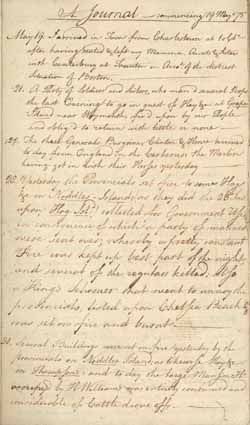
Early this month the Massachusetts Historical Society unveiled an online edition of William Cheever’s diary of the siege of Boston, May 1775 through March 1776. This document was published in the society’s Proceedings volumes in 1927, but now we can see images of the original pages plus a transcription. I’ll devote the next few days to this document.

The diary starts with what seems like an illogical move: Cheever coming into the embattled town:

I arrived in Town from Charlestown at 1 oClo. after having seated & left my Mamma, Aunts & Sisters with Canterbury at Taunton on Acco’t of the distrest Situation of Boston.
Cheever’s father had dined with the Sons of Liberty in 1769, so why did he and his son enter a town they knew was under military occupation by their enemies, and under siege from their friends?

Well, the family property, including a warehouse of trade goods, was inside those siege lines. The Cheevers wanted to protect it. William Cheever was also a young man, born in 1752 and graduating from Harvard in 1771, so he probably thought he was up for the ordeal.

Other families made similar arrangements. Fifteen-year-old Paul Revere, Jr., stayed in the family’s North End house while his siblings and stepmother joined his father outside of town. And that strategy actually worked. For the most part, families who had a member in town kept their property intact. As Cheever wrote on 15 November: “Almost every House whose Owner has gone out of Town is taken up for the Troops.” (The Quartering Act would have let the British military authorities use occupied houses as well, since it was wartime, but the commanders were still wary of offending the local populace.)

Splitting up also worked on a longer scale: Loyalist families who left some members behind after March 1776 usually managed to keep ownership of their property. Families who left entirely usually lost theirs.

On the other hand, riding out the siege inside Boston wasn’t easy.

TOMORROW: Fresh meat.