J. L. BELL is a Massachusetts writer who specializes in (among other things) the start of the American Revolution in and around Boston. He is particularly interested in the experiences of children in 1765-75. He has published scholarly papers and popular articles for both children and adults. He was consultant for an episode of History Detectives, and contributed to a display at Minute Man National Historic Park.

Subscribe thru Follow.it


•••••••••••••••••


Showing posts with label animals. Show all posts

Thursday, September 10, 2026

“She wrenched the bayonet from the piece”

George Harris was a captain in His Majesty’s 5th Regiment of Foot, sent to Boston in the summer of 1774.

Without barracks on the Boston peninsula, the 5th camped on Boston Common for the first few months.

Since the Common was where Bostonians let their cows graze, that produced some conflict, as shown in Capt. Harris’s letter on 7 August:
Our duty is so strict, that I have not yet had an opportunity of exploring the interior of the country, so that all I can say is, that it has a most beautiful and luxuriant appearance. The entrance to the harbour, and the view of the town of Boston from it, is the most charming thing I ever saw: far superior to the harbour of Dublin (which some consider equal to the Bay of Naples), and having the advantage of being wooded by nature as picturesquely, as if art had superintended her operations.

Our camp is pitched in an exceedingly pleasant situation on the gentle descent of a large common, hitherto the property of the Bostonians, and used for the purpose of grazing their cows, which now, poor creatures, from custom, often attempt to force their way into their old pastures, where the richest herbage I ever saw abounds. But from these they are now driven by stones flung at them by the different sentries.

An unfortunate one, the other day, when endeavouring to effect an entrance, ran on a range of firelocks, with the bayonets on, with such force, that she wrenched the bayonet from the piece, and went off with it sticking in her body. Finding herself wounded, she made towards home, and passed close by our mess-tent, from which some of us ran out, and drew the bayonet from her with great difficulty, then ordered a serjeant to attend her home, by letting her walk slowly the way she chose. We have since had the pleasure of hearing she is likely to recover.
I looked in the newspapers to see if this incident provoked any complaints from the locals. Remarkably, there were none.

Tuesday, September 01, 2026

The View from the Catawba River

On 1 Sept 1776, 250 years ago today, North Carolina brigadier general Griffith Rutherford wrote a letter to the body that had commissioned him, the North Carolina Council of Safety.

He had taken a force of men to the head of the Catawba River to confront Cherokees who had, to preserve their land and as allies of the British Empire, raided some western settlements earlier in the summer.

Rutherford summarized the situation:
If the Indians evacuate the Middle & Valley Towns and our provisions will hold out and it be possible to March to the overhill Towns perhaps I shall go to that place, or perhaps send a detachment to join the Virginians.

Those under my command consists of 1,971 privates of foot, about 80 light horse. . . .

I have ordered 130 under three Captains to Range and defend the forts on the frontiers of Tryon, 175 on the frontiers of Rowan, 100 on Surry.

I am in a very imperfect state of health, but will be as assidious as possible in executing the important trust reposed in me. . . .

P.S. I am this moment informed by the pack horse master General that there are about 1,400 pack horse one driver to each 4 horse and pack horse master over every 10 drivers. We have 40 days provision.
By his count, between soldiers and drivers, Rutherford commanded nearly 2,500 men. Though his letter mentioned Virginians, he was actually aiming to rendezvous with South Carolina’s similar force under Col. Andrew Williamson.

On 19 September, some of Williamson’s troops, guided by Catawba scouts, clashed with the Cherokee in the Battle of Coweecho River. In the same month Griffith’s force founded only deserted settlements, which they burned.

The NCpedia site says: “By late September the two armies made their way home after destroying thirty-six towns and laying waste to crops and storehouses, thus reducing the Indians to a state of near starvation as winter approached.”

This campaign was far from New York City, where the main Continental and Crown forces were engaged in much larger battles. The western fighting tends to be seen as regional sideshows, fought by regional troops. (Gen. John Sullivan’s campaign in New York in 1779 is an exception.)

Nonetheless, the war in the west was an integral part of the Patriots’ war against the British Empire, and the conquest of interior lands among the most far-reaching consequences of American independence.

On 25–26 September, the Catawba and Cherokee American Revolution Symposium will take place at the University of South Carolina at Lancaster.

This program will bring together scholars and researchers from various fields to discuss Catawba and Cherokee communities, conflict, diplomacy, movement, and archeology in the Revolution.

For more information, see this webpage.

Sunday, July 26, 2026

“The notorious Burglarian, that called himself Richard Steel”

Yesterday we left young Richard Steele back in the custody of Hartford County law enforcement in February 1771.

According to the 27 August Connecticut Courant, Steele “was tried for his Life for Burglary last March Term, in this Place and acquitted.”

Acquitted! The man was already being labeled “notorious.” But the evidence must not have been strong enough this time.

Nonetheless, the Connecticut authorities detained Steele on the grounds that he hadn’t paid the costs of his last case. That kept him off the streets for a few weeks, but the 2 April Connecticut Courant reported:
A few Days since the noted Richard Steel was dismissed from Goal in this Place, where he had been confined for Costs on his last Trial for Burglary——and on Tuesday Night last Week [26 March] he broke open the House of Mr. —— Kibbe, of Enfield, and rob’d it of sundry Articles and a small Sum in Money; from thence he went to the Barn of Mr. Terry of Enfield, and stole a Horse, and made off; but he was pursued and taken the next Day at Weston, and on Saturday returned to his former Lodgings in this Place, where it is hoped he will be confined till he shall receive a full Reward for all his past Offences.
Those hopes were soon dashed, though. This advertisement appeared in the 23 April Connecticut Courant and ran in that newspaper through early May:
Hartford, April 16, 1771

BROKE out of the county Gaol in this town, last Night and escaped, the following persons viz.

The notorious Burglarian, that called himself Richard Steel, that has been twice crop’d and branded, and was at March Court, in Hartford, again tried for the third Offence, but found not guilty, pursuing his old Trade, was again taken up and closely confined in Irons, but has found Means to get them off.

His appearance is that of a likely young Man of about 21 year of Age, about middling for Height somewha [sic] slender, has a lively, keen, dark colour’d Eye and is finely pitted with the Small Pox, wears his Hair, pretty dark Colour’d, but not unlikely he may soon get a wig to cover his Ears; he is pretty quick and lively in speaking, and has a little different Manner from persons born among us.
After descriptions of two other escapees, the same ad listed:
Also a woman called Rosanna Blanchard, who had been convicted of harbouring and entertaining the above named Steel and punished, and was held for the Cost.

Whoever shall take up either of the first mentioned notorious Criminals, and secure them that they may be brought to Justice, shall have a Reward of Forty Shillings; Lawful Money, and all necessary Charges paid;…and for the woman, Ten Shillings.

Ezekiel Williams, Sheriff.
The same newspaper carried this notice:
Ten Dollars Reward.

STOLEN from the Subscriber, out of his Stable in Hartford, on the Evening of the 17th Inst. a dark brown, or black colour’d MARE, with white on her near hind Foot, had on her Breast, the Mark or Print of a Collar, about fourteen Hands High, five years old; said Mare is well shaped, very high Liv’d, and good Carriage, both Paces and Trots. ALSO a plain Russett SADDLE, with a Saddle Cloth, and Bridle.—

Said Mare, &c. is supposed to be Stolen by that notorious Burglarian, who calls himself by the Name of Richard Steel, he hath been twice Crop’d and Branded within 12 Months past. Said Steel, broke out of Hartford Goal but two Nights before said Mare was Stolen, is about 21 Years old, of a middling Stature, somewhat slender, of a genteel Shape and Appearance, hath lively Dark coloured Eyes, and is very finely pitted with the Small Pox, Dark coloured Hair, European Born.

Whoever shall Apprehend and Secure said Thief, so that he may be brought to Justice, or shall secure said Mare, Saddle and Bridle, so that the Owner may have them again, shall have a Reward of TEN DOLLARS, Paid by me,
WILLIAM HOOKER.

Hartford, April 20th, 1771.
The description of Steele as “European Born” and the statement that “has a little different Manner from persons born among us” suggests that he had grown up somewhere in the British Isles.

By this time Steele was so infamous that people were assuming he was responsible for thefts simply because he was in the vicinity. Those accusations may well have been accurate, but the authorities would need better evidence if they wanted to convict him.

TOMORROW: A summer in jail.

Wednesday, June 24, 2026

Chelsea Creek and Fighting in the Indian Way

Earlier this spring the Army Historical Foundation shared Alexander Cain’s detailed article “‘The Firing Begun on Boath Sides’: The Battle of Chelsea Creek, 27-28 May 1775.”

Cain’s introduction says:

Positioned between the significant events at Lexington and Concord (19 April) and the Battle of Bunker Hill, the Battle of Chelsea Creek (27-28 May) is frequently overshadowed by these more renowned engagements. Nevertheless, Chelsea Creek should not be regarded merely as a preliminary skirmish to Bunker Hill. The events of 27-28 May are equally essential to understanding the Siege of Boston as those at Lexington and Concord and at Bunker Hill. Therefore, the Battle of Chelsea Creek warrants comparable scholarly attention.

The Battle of Chelsea Creek holds considerable significance within the broader context of the American Revolution. This engagement is notable for several key milestones, including the first planned offensive by Provincial land forces, which resulted in direct combat. It also marked the initial collaboration between military units from different colonies and the first use of artillery by American forces in support of the Revolutionary cause. Most importantly, Chelsea Creek signaled the emergence of the American Army and the adoption of a supply interdiction strategy that benefited the Provincials in subsequent campaigns.
The Battle of Chelsea Creek also led to the first time Native Americans fought for the American forces in the “Indian” way, as opposed to individual Native men serving within militia companies modeled on the British regulars.

That started on 29 May, the day after the battle. Chaplain David Avery recorded in his diary:
About noon Capt. [Jehoiakim] Yoking, a Stockbridge Indian & I reconnoitered the Ground East of the schooner & judged that the taking off the cattle was practicable. The Capt. with 3 men took a canoe & went about a mile & a quarter upon the north side of the river from the Ferry & went across to Noddle’s Island & reconnoitered & scouted round about an hour & a quarter, when he fixed his centuries & another canoe went over to his assistance & soon took 2 horses & mired a 3d when a cannon ball fell pretty near them & four barges landed upon which all the scout retreated to the main shore & came over.

Upon that I advised that they should go back & get the stock. Accordingly they got off the Stock about sunset.
On 3 July the Massachusetts committee of safety considered a request from a man who had evidently been on that raid:
Henries Vomhavi, an Indian, having represented to this committee, that he had taken two horses at Noddle’s island, one a little horse, which he is desirous of retaining as some recompense for his fatigue and risk in that action, in which, it is said he behaved with great bravery; it is the opinion of this committee, that said Indian should be gratified in his request, which will be an encouragement to others in the service, provided, the honorable Congress should approve thereof.
The Massachusetts Provincial Congress did resolve that Vomhavi should receive “a small Horse…for his own use.”

That small operation to seize livestock from Noddle’s Island thus appears to have been conceived and carried out by the Stockbridge Indian company. That was an official part of the Massachusetts force, but people viewed those fighters as living and fighting in their own way. The horse for Vomhavi, who’s otherwise unknown, shows the rebel government saw value in compensating those men differently as well. 

Friday, May 29, 2026

Meeting the Real Samuel McClellan

Yesterday’s post introduced Samuel McClellan (1730–1807) of Woodstock, Connecticut, the captain of a militia troop of horse in 1774.

McClellan was a shopkeeper and landowner in his small town. After the Revolutionary War he became a brigadier general in the state militia.

The McClellans remained locally important, and one of his great-grandsons was Gen. George B. McClellan of the Union Army and the 1864 Presidential race.

As often happens in that situation, Samuel McClellan’s descendants were influential enough to get their understanding of his role in the Revolution into local histories and biographical profiles when primary sources were hard to consult. For example, the 1902 National Cyclopedia of American Biography said:
On Oct. 13, 1773, he was commissioned captain of a fine troop of horse, raised in the towns of Pomfret, Woodstock, and Killingly, and led it Boston on receipt of the news of the battle of Lexington. He passed through the battle of Bunker hill uninjured, and in commemoration of that his wife planted three elm trees in front of residence, which attained great size and were standing when Gen. George B. McClellan visited Woodstock in 1884.
Ellen Douglas Larned’s History of Windham County, Connecticut: 1760–1880 says there were originally four elms.

The latest version of that lore is Samuel McClellan’s Wikipedia page, which as of this week says:
In 1775 Major Samuel McClellan led 184 men at the Battles of Lexington and Concord. He played a prominent role in the Battle of Bunker Hill, and after achieving the rank of lieutenant colonel in 1776, colonel in 1777, and brigadier general of the 5th Brigade in 1779, his regiment of the Connecticut Militia was stationed near New Jersey. McClellan was solicited by General George Washington to join the Continental Army and was offered a commission, but his domestic and business affairs compelled him to refuse.
That overstates the facts in multiple ways, starting with how McClellan wasn’t commissioned a major in the militia until October 1775.

News of the outbreak of war in Massachusetts didn’t reach Woodstock until 20 April, after the fighting was over, so there was no way men from that town were “at the Battles of Lexington and Concord.” Col. Israel Putnam was one of the first men from Connecticut to respond. On 21 April he wrote from Concord to say that the Massachusetts Provincial Congress hoped that Connecticut would send 6,000 men for “a standing Army.”

Putnam added as a postscript: “The Troops of Horse are not expected to come until further notice.” But Capt. McClellan had already led his 184 mounted men north into Massachusetts. That’s shown by Connecticut records of militia service, as tabulated here.

However, those same records also show that McClellan was paid for only eight days of service. Like most of his neighbors, he went home when it was clear the emergency had passed. Some men stayed or returned and enlisted in what became the New England army. McClellan didn’t.

There’s no evidence putting McClellan at the Battle of Bunker Hill or on the siege lines around Boston at the time. That undercuts the claim he “played a prominent role” in the battle, but it does explain how he remained “uninjured.”

Later in the war McClellan did mobilize with his militia regiment for short assignments in the Northern Department. He also served in the Connecticut assembly and as a commissary. In that last capacity his name comes up in Washington’s papers, but there’s no direct written solicitation from the commander for McClellan to join the Continental Army.

McClellan apparently left a fowling-piece, made by the Massachusetts gunsmith Joel White, equipped with a bayonet mount and bearing the initials “SMC.” That’s been displayed as a weapon from the Battle of Bunker Hill. McClellan may well have carried it during the Revolutionary War, but not at that fight.

Thursday, May 28, 2026

“Specimens of Indian Insult”

I’ve quoted a couple of accounts of mock battles on Boston Common during militia musters, as reported proudly in the local newspapers. On those occasions, half the local unit provided an enemy by portraying the French.

Here’s a report from the 12 May 1774 Norwich Packet, describing a different scenario in Woodstock, Connecticut, a town on the border with Massachusetts:
NORWICH, May, 12.

A Correspondent from Woodstock informs us, that on Monday the 2d. Inst. the Three Military Companies of that Town met upon the Parade, in the First Society, where they performed the Manual Exercise with a Spirit and Activity that did Honour to their Officers and themselves.

At Eleven o’Clock a Troop of Horse, under the Command of Capt. Samuel McClellan, came upon the Parade; which, for elegance of Dress, goodness of the Horses, and suitable Furniture, were judged, by the numerous Spectators present, to be inferior to no Troop in America.

At Three o’Clock the Foot and Troop feigned a Skirmish with each other, which they conducted with Propriety and Order: Suddenly a Company of Aborigines appeared, who made Captives of some of the Children present, and gave other Specimens of Indian Insult to the Foot and Horse: Their Depredations roused the New-England Spirit in the Troop, who, with seem Fury, attacked and drove them yelling off the Field, to the great Joy of the Spectators.

The good Order that was observed, not only by the Troop and Foot Companies, but also by the Spectators, was remarkable.----No Injury was sustained by any One present. The Day and Evening Entertainments, were concluded with strict Sobriety and Decency.

The Captain of the Troop gave an elegant Dinner to his Company and a Number of Gentlemen, as also did Capt. [Benjamin?] Lyon, and the Colonel of the Regiment honoured the Day with his Presence.
I’ve found this event mentioned in a local history but not quoted in full. It offers an example of what Philip J. Deloria called “playing Indian” in American culture. This moment was a few months after the Boston Tea Party, a few months before the Patriot press began to share fearful speculations that the Crown government might recruit Natives and French Canadians to attack resistant colonies.

Ironically, the town of Woodstock contains the site of Wabaquasset, a Native American “praying town” from the mid-1600s. That community was split and depopulated by the King Philip’s War. Englishmen from Roxbury then settled the land. The town’s seal now depicts Native and English men standing on either side of a heraldic shield.

Tuesday, May 26, 2026

“Environmental History & the War of Independence” in Boston, 27 May

David Hsiung is the Dr. Charles R. and Shirley A. Knox Professor of History at Juniata College in Pennsylvania.

For several years he’s been working on the problem of how the enviroment affected the American Revolution, how the Revolution affected the environment, and how it’s possible to study those interactions with the data we have.

That is, of course, a huge topic, so part of the historiographical challenge is, I’m sure, to narrow down and define the questions in a manageable way. In the meantime, I’ve been enjoying his articles and lectures, which always open my eyes to new ways of seeing this history.

On Wednesday, 27 May, David Hsiung will be at the Massachusetts Historical Society for a conversation with Joyce A. Chaplin of Harvard, author most recently of The Franklin Stove: An Unintended American Revolution.

The description of “Curious & Complex Connections: Environmental History & the War of Independence” says:
Many of us give only a moment’s thought about the environment when considering the War of Independence: the slope of Breed’s Hill, the ice-choked Delaware River, and diseases such as smallpox. But what might we gain by connecting biology, ecology, and geology to the thinking and actions of soldiers and civilians? Rebels and British soldiers acquired and used energy in the form of food, fuel, and work animals, which shaped people’s lives, the course of the war, and the direction of environmental change.
This is a hybrid event starting at 6 P.M., with a reception in the preceding half-hour for people attending in person. Attendance costs $10, but is free to M.H.S. members and Card to Culture participants. Listening in online is free. Register for either form of access through this page.

Folks can also take in these talks from Prof. Hsiung:

Friday, March 06, 2026

“By ten o’clock at night the troops have raised two forts”

Yesterday I quoted Gen. William Howe’s report on how he discovered and responded to the Continental Army fortifications on the heights of the Dorchester peninsula.

From the American side, one of the chroniclers closest to the action was the Rev. William Gordon of Roxbury. In his 1788 history he offered a detailed account of the Continental operation, which I’ll quote at length.

Folks who dislike historians describing events in the present tense may need to grit their teeth for a while.
All things being ready on Monday [4 Mar 1776]; as soon as the evening admits, the expedition goes forward. The covering party of 800 men lead the way; then come the carts with the intrenching tools; after them the main working body of about 1200 under general [John] Thomas: a train of more than 300 carts, loaded with fascines; hay in bundles of 7 or 800 weight, &c. close the martial procession.

The bundles of hay are designed for Dorchester neck, which is very low, and exposed to be raked by the enemy; and are to be laid on the side next to them [i.e., towards Boston], to cover the Americans in passing and repassing. Every man knows his place and business. The covering party, when upon the ground, divides; half goes to the point nearest to Boston, the other to that next to the castle.

All possible silence is observed. But there is no occasion to order the whips to be taken from the waggoners, lest their impatience, and the difficulty of the roads should induce them to make use of them, and occasion an alarm. The whips used by the drivers of these ox carts, are not formed for making much noise, and can give no alarm at a distance. The men in driving their oxen commonly make most noise with their voices; and now a regard to their own safety dictates to them, to speak to their cattle, as they move on, in a whispering note.

There are no bad roads to require an exertion; for the frost having been of long continuance, they are so hard frozen as to be quite good. The wind lies so as to carry what noise cannot be avoided by driving the stakes and picking against the ground, (still frozen above eighteen inches deep in many places) into the harbour between the town and the castle, so that it cannot be heard and regarded by any who have no suspicion of what is carrying on especially as there is a continued cannonade on both sides.

Many of the carts make three trips some four; for a vast quantitiy [sic] of materials have been collected, especially chandeliers and facsines [sic]. By ten o’clock at night the troops have raised two forts, one upon each hill, sufficient to defend them from small arms and grape shot. The night is remarkably mild, a finer for working could not have been sellected out of the three hundred and sixty-five. They continue working with the utmost spirit, till relieved the Tuesday morning (March 5.) about three. It is so hazy below the height that the men cannot be seen, though it is a bright moon-light night, above on the hills.

It is some time after day break before the ministerialists in Boston can clearly discern the new erected forts. They loom to great advantage, and are thought to be much larger than is really the case. General Howe is astonished upon seeing what has been done; scratches his head and is heard to say, “I know not what I shall do; the rebels have done more in one night, than my whole army would have done in months.”
That last remark is the sort that New Englanders liked to tell themselves the British commanders had made, not questioning how anyone on their side of the lines could know. And who knows? It may even be true.

TOMORROW: Does the empire strike back?

Thursday, February 19, 2026

The “Noble Train” at Hartwell Tavern, 21 Feb.

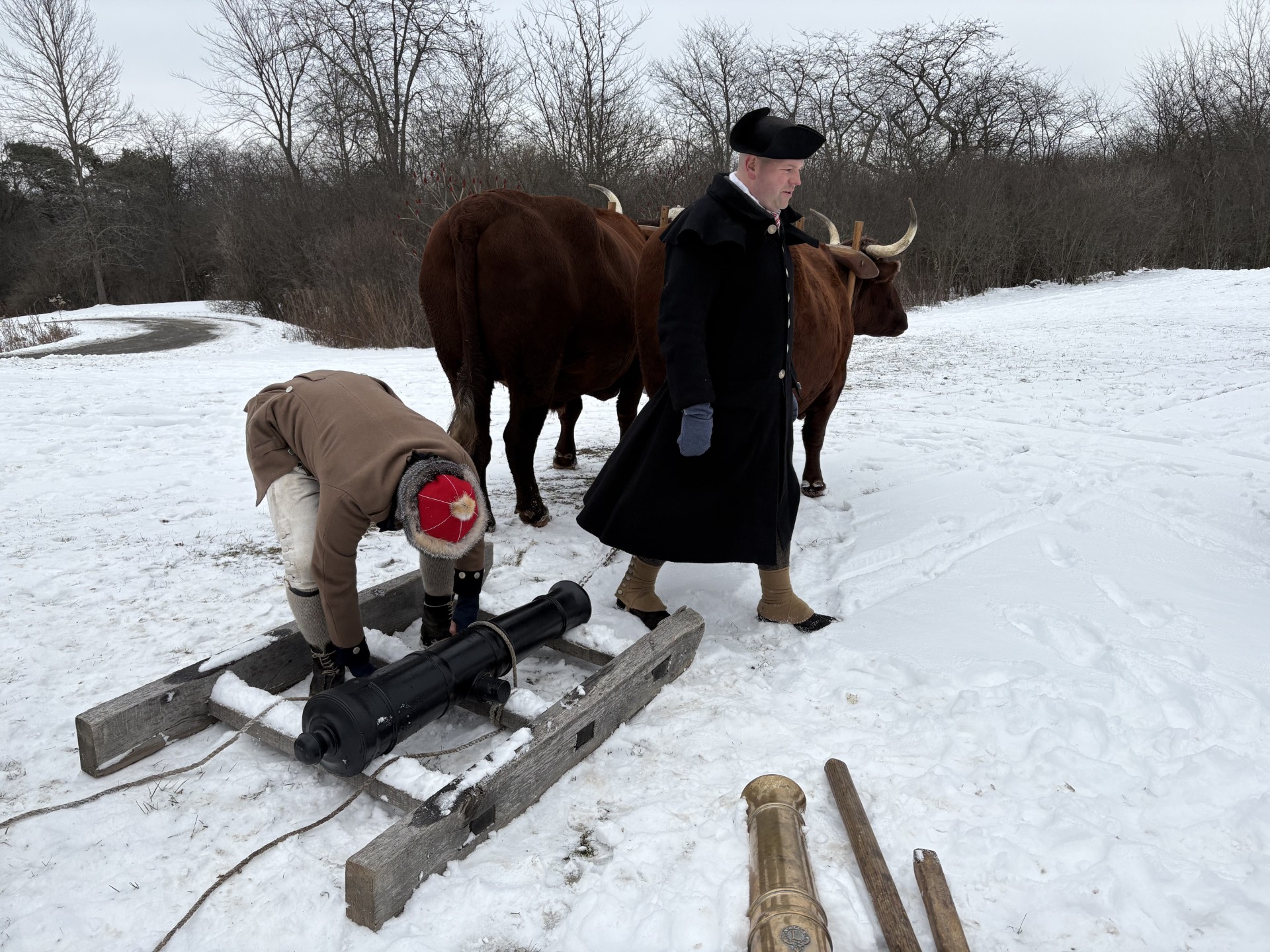
On Saturday, 21 February, Minute Man National Historical Park and Fort Ticonderoga will present a special event titled “To Win The Siege: The Noble Train Arrives.”

The park says:

We invite you to join us…at the Hartwell Tavern to commemorate the 250th anniversary of Knox’s Noble Train of Artillery arriving and outfitting for battle. Witness history come to life as the artillerists of Washington's army haul cannon via oxen, prepare supplies, and conduct artillery firing demonstrations.

Inside Hartwell Tavern we welcome you to enjoy the warmth and learn about the ways everyday people confronted the immense difficulties of surviving a siege of their own.
The living history encampment at the Hartwell Tavern site will be open from 10 A.M. to 4:30 P.M. During that time there will be demonstrations of:
  • Moving cannon with oxen, 11 A.M. and 3 P.M.
  • Firing artillery, 2 and 4 P.M.

Friday, January 30, 2026

Knox Trail Commemorations on 31 Jan.–1 Feb.

This weekend brings another set of commemorations of Col. Henry Knox’s artillery train, including a couple of events displaced by last weekend’s snow.

Saturday and Sunday, 31 January–1 February, 10 A.M. to 4 P.M.
Knox Train of Artillery
Old Sturbridge Village

In partnership with Fort Ticonderoga, this unique event explores the Noble Train as it went through central Massachusetts. For regular museum admission, join staff from the village and Fort Ti and reenactors from Knox’s Regiment of Artillery to learn about the 300-mile journey. Examine reproduction artillery tools and ammunition. Explore the historic village and interact with costumed historians as they demonstrate daily life after the Revolution. Highlights include:
  • See oxen in action hauling cannons. 
  • Watch Knox’s Regiment of Artillery demonstrate cannon firing. 
  • Learn about American artillery of the Revolution compared to the Massachusetts Artillery of the 1830s. 
  • Try using an artillery engine, lifting reproduction cannon from Fort Ticonderoga. 
  • Handle reproduction cannon ammunition and explore their types and use. 
  • See cabinetmakers building a log sled. 
  • Learn about using draft animals and their importance to 19th-century farmers. 
  • See blacksmiths forging cannon carriage hardware. 
  • Hear stories from a recreated patriot who marched on the Knox Trail from Pittsfield to Cambridge in 1976. 
For more details, including the schedule of events on each day, see the Old Sturbridge Village webpage.

Saturday, 31 January, 1 to 4 P.M.
250th Anniversary of Henry Knox & the Noble Train of Artillery
185 Salisbury Street, Worcester

Join Revolution 250, Boston Celebrations, the AC Marriott Hotel Worcester, and citizens of the towns of Brookfield, Leicester, Spencer, Worcester, Shrewsbury, and Northborough for a commemoration of the epic 1776 adventure of Henry Knox and his “Noble Train or Artillery” trekking across Massachusetts on their way to Boston. A procession will step off from Elm Park about 1 P.M. and end at City Hall. An indoor commemorative program will begin at 2 P.M.

Sunday, 1 February, 1:30 to 3 P.M.
“Were so lucky as to get the Cannon out of the River”: Henry Knox and His Noble Train of Artillery
Westford Museum

Alexander Cain will discuss Knox’s journey and its impact on the Continental Army’s firepower and the American cause. At Fort Ticonderoga, the colonel selected 58 artillery pieces, including immense 12-, 18-, and 24-pounders. Once they were ready, some of that artillery was positioned on Dorchester Heights, forcing the British evacuation of Boston. Cain explores Knox’s mission transformed the Continental Army’s firepower while embodying the ingenuity and determination that defined the American cause. Learn more about this presentation.

Sunday, 1 Febuary, 4 to 6 P.M.
Henry Knox: Presentation and Cannon Firing
Martha Mary Chapel, Wayside Inn, Sudbury

Local writer Steven Glovsky explores the improbabilities and inconsistencies of Henry Knox’s story, leading up to his undertaking the transport of urgently needed cannon in the winter of 1775–76. The presentation will be followed by cannon fire from Crane’s Third Artillery. For more information.

For those wanting to-the-date exactitude, as of 250 years ago, the fifty-eight cannon and mortars were parked in Framingham, being equipped for use. Col. Knox had taken command of the artillery regiment on the siege lines, issuing his first regimental orders.

Saturday, December 13, 2025

Was Gen. Schuyler’s Wagon Master One of His Enslaved Workers?

As quoted yesterday, on 29 Dec 1775 Col. Henry Knox wrote that Gen. Philip Schuyler “sent out his Waggon Master & other people to all parts of the Country” to hire teams of horses for transporting heavy ordnance to Springfield.

Back in 2016 Ian Mumpton at the Schuyler Mansion wrote:
It is unclear who the “Waggon Master” refers to, but as mentioned in a previous article, many of the men enslaved by the Schuyler family were skilled at driving carts and sleds. As there is no surviving record of Schuyler hiring a wagon master, it is likely that this person was one of the enslaved servants, possibly Lisbon or a man named Lewis who, five months later, was lent to Benjamin Franklin as a driver for a trip from the Schuyler’s home to New York City.
That previous article, also posted by Mumpton, analyzed a 1771 document which mentioned enslaved workers and said:
Lisbon and Dick are both mentioned in other Schuyler documents as carters or wagoners, conveying goods and people for the Schuyler family. Lisbon in particular is mentioned in at least four other sources, always in regards to his driving goods back and forth between Albany and Saratoga. These men’s ability to drive carts and sleds was a large part of their value to the Schuylers, as this was a specialized skill-set that involved being able to work with draft animals, manage tack and harness, and maintain the carts and sleds in their charge.
A comment noted another wagon driver named Anthony, Tony, or Tone.

I wouldn’t be surprised if Gen. Schuyler assigned some of his enslaved wagon drivers to the operation moving cannon toward Boston (and collected the same pay he was offering to other farmers for himself).

However, I’m not convinced that one of those men could have been Schuyler’s “Waggon Master.” That was an official designation within the Continental Army’s quartermaster department. On 9 August, Gen. George Washington appointed John Goddard of Brookline “Waggon Master General to the Army of the Twelve United Colonies.” (That count included Georgia but not Delaware, still officially a subset of Pennsylvania.)

In the fall of 1775 Schuyler had overseen preparations for Gen. Richard Montgomery’s invasion of Canada, an operation that probably required a convoy of wagons and thus an official to oversee them.

And that’s a crucial aspect of the job of wagon master. It required more than driving a wagon—indeed, the wagon master might not do any actual driving at all. The job involved making deals on behalf of the Continental Army with a large number of independent contractors and then overseeing a force of teamsters. The word “master” was even in the name. Did any enslaved man, however skilled, have the legal standing and social authority to do that job in 1775?

TOMORROW: Glimpses of Schuyler’s wagon master in spring 1776.

Friday, December 12, 2025

“After a considerable degree of conversation”

On Christmas 1775, Col. Henry Knox was making his way on horseback to Gen. Philip Schuyler’s mansion in Albany, New York.

Knox has just called off his deal with George Palmer of Stillwater to supply eighty pair of oxen to transport heavy cannon into Massachusetts.

Palmer was in his late fifties. Born in Connecticut, he had bought mills and other real estate in Stillwater in 1764 and become a big man in that town. He didn’t like being dismissed, as shown by the letter I quoted yesterday.

Since we have only one side of the correspondence, we don’t know if Knox had revealed that he’d canceled the deal on a direct order from Gen. Schuyler, who insisted he’d started making his own arrangements for moving the cannon.

Schuyler was in his mid-forties, scion of a family of Dutch landowners in Albany. He was a big man in the whole colony. He’d been elected to the Second Continental Congress and then appointed a general of the Continental Army in charge of the Northern Department.

In between those two local bigwigs was Knox, a twenty-five-year-old from Boston who hadn’t yet received his official commission as colonel. He was following orders direct from Gen. George Washington, but that mentor was very far away.

On the afternoon of 26 December, Knox reached Schuyler’s house. Evidently he persuaded the general to at least talk with Palmer. The next day Knox wrote in his journal: “Sent off for Mr Palmer to Come immediately down to Albany.”

On 28 December Knox recorded the result of that meeting:
Mr Palmer Came Down & after a considerable degree of conversation between him & General Schuyler about the price the Genl Offering 18/9. & Palmer asking 24/. P[er] day for 2 Yoke of Oxen the treaty broke off abrubtly & Mr Palmer was dismiss’d
It seems clear from the way Knox described that long conversation as between Palmer and Schuyler that he was left out—perhaps he even wanted to be left out. We don’t know what price he had offered Palmer and thus how that fit into this conversation. Did Schuyler bargain Palmer down, or did Palmer insist on sticking to the original deal?

Authors describe Knox scrapping his initial plan to use Palmer’s oxen as purely a matter of cost. That makes the situation seem entirely reasonable, especially on the part of the men commemorated with statues—Schuyler and Knox. But Schuyler had told Knox to dismiss Palmer more than a week before this sit-down, before he knew anything about prices.

That suggests Schuyler made his decision on something besides 5s.3d per day. He and Palmer might have been rivals for influence in the county. He might have assumed Palmer wouldn’t offer the best price. He might have felt he’d sunk too much money into his own preparations to stop now. The general might simply have wanted more control.

Whatever his motivation, on 29 December Schuyler sent his wagon master and other agents “to all parts of the County to immediately send up their slays with horses,” as Knox wrote. The price would be “12/. P[er] day for each pair of horses or £7. P[er] Ton for 62 miles.” At the end of the year the wagon master brought back a list of 124 teams. That number of horses would cost £74.8s. per day.

In contrast, Palmer had offered 80 yoke of oxen. Knox wrote that he ultimately quoted 24s. per day “for 2 Yoke of Oxen.” If that’s correct, using Palmer’s oxen would have cost £48 per day, considerably less than Schuyler’s arrangement. However, if Knox really meant that price to apply to each yoke of two oxen (the usual way of calculating), then Palmer was indeed asking for more than Schuyler.

There might well have been other costs and factors involved, such as the number of teamsters needed or how quickly the animals and equipment could be assembled. But whatever the details, it seems clear that Schuyler was making the decisions at this point, not Knox.

Indeed, Knox confided some worries about the final arrangement in his journal, meant for himself and perhaps for showing Gen. Washington later. On 31 December he wrote about the “Slays which I’m afraid are not Strong enough for the heavy Cannon If I can Judge from the sample Shewn me by Genl Schuyler.”

Nonetheless, those sleighs and those horses were what he had to work with.

TOMORROW: The wagon master.

Thursday, December 11, 2025

“You will therefore Countermand any directions you may have given Mr. Palmer”

As discussed back here, as of 13 Dec 1775 Col. Henry Knox and George Palmer of Stillwater, New York, had agreed on how to transport heavy ordnance to Springfield.

Knox wrote to Gen. George Washington about those arrangements on 17 December:
I have made forty two exceeding strong sleds & have provided eighty yoke of Oxen to drag them as far as Springfield where I shall get fresh Cattle to carry them to Camp.
This is the letter in which Knox promised “to present to your Excellency a Noble train of Artillery,” a phrase authors still use to describe the guns.

On the same day, Knox wrote to Gen. Philip Schuyler (shown above) in Albany. He had thought Schuyler had gone south to Philadelphia, so he might have made decisions thinking that he didn’t have to clear them with his superior officer. Knox told Schuyler:
I have agreed with Capt. Palmer of Stillwater to get proper Conveyances for them from hence to Springfield— . . . I expect Capt. Palmer up with the Teams on Tuesday & on Wednesday or Thursday I hope to move as far as Saratoga if the sleding continues as at present from thence we must wait for Snow—
The next day, Schuyler wrote back:
I am happy to hear that all the Military stores you had in charge to bring from Ticonderoga are arrived at Fort George,— I have taken Measures to forward them to Boston as soon as we shall be favoured with a fall of Snow— but I am Informed that you have Applied to Mr. Palmer to Construct Carriages for the purpose, this is a very unnecessary Expence as there are a Sufficiency of Carriges Suitable for the purpose in this County Sufficient to Carry ten times the quantity, you will therefore Countermand any directions you may have given Mr. Palmer on this head.
Note how Knox referred to Palmer as a captain, probably a militia rank, while Schuyler called him only “Mr. Palmer.”

Having received a direct order, Knox wrote to George Palmer saying that his services were no longer needed.

Palmer had been making arrangements with his network of farmers around Stillwater. He didn’t take this news well. On 25 December he responded to Knox:
Since your Departure from this I have an oppertunity with Many of the inhabitants with whom I have Contracted for the Removal of the artillery and Stores, I find all Determined To A Man to fulfill on their Part & that I Shall on mine or Be answerable for the Consequences of A Disapointment which is More than I Shall be able to Do,

Depend Sir the People (& Not only those Employed in Service But others General) are Not indifferent, they are Sensible of the importance of the Grand Cause

they are Sensible To the Minutest Degree of the insult offered in Counteracting your Measures, I take this Earliest opportunity To inform you of the Disposition of the People among whom I Live with whom I am Concerned Particularly in this afair,

your Penetration will Easily Dissern the Consequences that will follow Disapointing Such A Number of People So Resolutely Determined as you may Depend Those are, with Regard to what you mentioned of our Carrying the heavy [space] they are Determined Since there is Such an they are Determined Since there is Such an attempt made To Supplant them To fulfill the whole Contract

I am Sir with all Possible Respect your most obedient hume. Sert/.
I get the impression that Palmer no longer had complete respect for young Col. Knox.

TOMORROW: A sit-down in Albany.

Saturday, December 06, 2025

“Knox’s Mission to Lake Champlain” in Saratoga, 11 Dec.

On Thursday, 11 December, I’ll be in Saratoga, New York, to share thoughts on “Myths and Realities of Col. Henry Knox’s Mission to Lake Champlain.”

Our event description:
In November 1775, Gen. George Washington gave Henry Knox a mission to travel to New York and bring back cannons for the Continental Army. Knox was a 25-year-old bookseller with no military rank. His trek back to Cambridge has become a beloved part of the American saga. This talk digs deeper into that story, examining such questions as who first had the idea to fetch cannon from Lake Champlain, how Knox had contributed to the Patriot movement, the ways weather affected the mission, and how much those cannon changed the British army’s plans.
This talk will take place in the Saratoga National Historical Park visitor center starting at 6:30 P.M. It is free, but because seating is limited, the park asks people to make reservations by email to SARA_Reservations@nps.gov. The Friends of Saratoga Battlefield supports this and other fall lectures at the park.

The Saratoga battlefield park is within the town of Stillwater, New York. Exactly two hundred and fifty years before the date of this talk, Knox wrote in his diary, he sent a man from Fort George “to Squire Palmer of Stillwater to prepare a number of Sleds & oxen to drag the Cannon presuming that we should get there.”

According to the Gilder Lehrman Institute’s abstract of Knox’s letter to Palmer, the colonel asked for forty sleds. Since he would soon refer to “eighty Yoke of oxen,” that meant he was planning to use four beasts per sled. (The institute also says that letter was dated 12 December, so it’s possible Knox was off by a day in his journal.)

George Palmer (1719–1809) was a local bigwig, more than twice Knox’s age. According to Stillwater’s website, he had “at his own expense equipped a company of militia which marched to Crown Point and Ticonderoga, arriving just after Ethan Allen had taken the fort.”

Palmer came to Fort George on 13 December and “agreed to provide the necessary number of sleds & oxen & they to be ready by the first snow.”

COMING UP: Making other plans.

Wednesday, November 12, 2025

“Tradition gives us a graphic scene connected with her arrest”

In his biography of George Washington, published in the late 1850s, Washington Irving included a vivid description of how Mary (Butler) Wenwood was brought to the commander-in-chief’s headquarters.

Irving wrote:
Tradition gives us a graphic scene connected with her arrest. Washington was in his chamber at head-quarters, when he beheld from his window, General [Israel] Putnam approaching on horseback, with a stout woman en croupe behind him. He had pounced upon the culprit.

The group presented by the old general and his prize, overpowered even Washington’s gravity. It was the only occasion throughout the whole campaign on which he was known to laugh heartily.

He had recovered his gravity by the time the delinquent was brought to the foot of the broad staircase in head-quarters, and assured her in a severe tone from the head of it, that, unless she confessed everything before the next morning, a halter would be in readiness for her.

So far the tradition;…
This anecdote is consistent with other stories about Putnam.

However, there’s no contemporaneous support for this tale, nor did Irving explain how he came by all those details, especially the picture of the general laughing in his own bedroom.

In fact, even Irving seemed dubious, twice labeling this story “tradition.” But he couldn’t resist including it.

And some other authors, including George Washington Greene, repeated it in their books.

It can serve to signal how Mary Wenwood was about to be transmuted from a real woman into the embodiment of all female dangers.

Monday, September 22, 2025

A New Ministry Off to the Races

At the History of Parliament blog, the Georgian Lords welcomed Ioannes Chountis de Fabbri of the University of Aberdeen to discuss the equestrian genesis of the Marquess of Rockingham’s ministry:
By the spring of 1765, George III was determined to be rid of his overbearing minister, George Grenville, who had been in office since April 1763. The task of taking the pulse of the political nation, fell to the king’s uncle, William Augustus, duke of Cumberland. . . .

Cumberland had toured the great country houses in the summer of 1764, including Chatsworth, Wentworth Woodhouse and Woburn, discovering that the Whigs remained unenthusiastic about a return to power without [William] Pitt. The stalemate seemed unbreakable. Yet the solution would not be found in the names listed in the London Gazette, but in the pages of the Newmarket Calendar.

By the 1750s and 1760s horse racing had become a central ritual of aristocratic and political life. Already favoured by Charles II in the seventeenth century, by the 1740s Newmarket was the undisputed capital of the turf. The Racing Calendar, first published in 1727 by John Cheny, recorded results and pedigrees, turning the turf into a semi-official world of statistics and reputations. Ascot, founded in 1711 by Queen Anne, had by the 1760s become a highlight of the London season, attracting large crowds and royal patronage. (Morton, 56–61) Both courses were more than sporting venues: they were theatres of status, where political alliances were cultivated over wagers, where a minister could be sounded out between heats, and where a successful stable enhanced a nobleman’s standing. As one contemporary put it, ‘the turf is the true parliament of our nobility’. . . .

By 1765, Rockingham was already a figure of considerable weight within the Whig aristocracy, though not yet tested as a statesman. Born into immense wealth and heir to Wentworth Woodhouse in Yorkshire, he inherited his title in December 1750. In politics he aligned with the ‘Old Corps’ Whigs grouped around Newcastle, and from 1752 served as a gentleman of the Bedchamber to George II and George III, before resigning in 1762 in protest over Newcastle’s dismissal. . . . Like Cumberland, Rockingham was a passionate breeder and owner of racehorses, and he became known as ‘the Racing Marquess’. (Albemarle, i. 165)

Cumberland was equally at home on the turf, and in June 1765 he held court at Ascot, where the outlines of a new administration were hammered out. As well as Rockingham, the new ministry was to include Augustus Henry Fitzroy, 3rd duke of Grafton, a great-grandson of Charles II. Not yet 30, Grafton brought youth and royal blood; Rockingham brought wealth, influence, and respectability. Their conversations at Ascot and Newmarket were, as Albemarle noted, ‘held not in the closet, but at the races’. (i. 199) . . . Pamphleteers and satirists delighted in the horse racing connexion: ‘From Jockeys to Ministers’, they jibed…
The new ministry took office on 13 July 1765. The Duke of Cumberland hosted its meetings at his London home and country estate. But at the end of October he died, only forty-four years old. Rockingham, Grafton, Newcastle, and their colleagues rode on, but their coalition held together for only slightly more than one year.

During that time, Rockingham repealed the Stamp Act for North America. For the protesting colonists, that restored their loyalty to the British constitution. It did not, however, solve what London saw as the government’s revenue problem.

(The equestrian portrait of the Duke of Cumberland above was made in China, probably in the 1750s, for the British market. It is now in the collection of the Metropolitan Museum of Art in New York.)

Wednesday, June 18, 2025

“In full compensation of the damage he sustained”

For more than a week now I’ve traced Henry Howell Williams’s quest for compensation after the Battle of Chelsea Creek in May 1774 destroyed his estate on Noddle’s Island in Boston harbor.

In 1788, the Confederation Congress’s board of treasury sent him back to Massachusetts. After all, those commissioners said, his livestock had been taken and his farm burned before the Continental Army legally existed. This was a state matter.

I don’t have access to Massachusetts legislative journals from that period, but Williams must have submitted a petition during the session that started in May 1789.

On 23 June, Gov. John Hancock and state secretary John Avery signed off on this resolution passed by both houses of the General Court:
Resolved, that the Treasurer of this Commonwealth be and he hereby is directed to issue his note in behalf of the Commonwealth in favor of Henry Howell Williams, for the sum of two thousand pounds and interest thereon from date of the same in full compensation of the damage he sustained from having his stock and other property taken from him or destroyed in consequence of orders given by the commanding officer of the Massachusetts troops [Artemas Ward] in the month of May, 1775, and that the same be charged to the United States.
Williams would get £2,000. That wasn’t all he’d asked for, but it was more than half, and more than his own estimate of the value of the livestock he said the army had confiscated.

Massachusetts would supposedly try to get reimbursed for that payment from the federal government. I doubt it ever saw money back, but I don’t know how to track that now that Williams’s name was probably no longer attached to the request.

Williams had been seeking such compensation since the summer of 1775. He had asked each of these bodies for money:
  • Massachusetts Provincial Congress.
  • Massachusetts General Court under the provincial charter, seeking relief.
  • Massachusetts General Court, seeking a loan.
  • Congress of the U.S. of A. under the Articles of Confederation, through its agent.
  • Congress of the U.S. of A. by direct petition.
  • Massachusetts General Court under the constitution of 1780.
Some men might have been satisfied with £2,000. But not Williams.

Three years later he went back to Massachusetts legislators and asked if that “full compensation” from the state meant he couldn’t also ask the new federal government for money. Five members of the committees that had considered his claim in 1789 signed off on a document dated 14 Feb 1792 saying their resolution was
by no means and in no sense to preclude any further grant, Which The Federal Legislature, or any other government, May think proper to make said Williams.
So Williams sent yet another petition off to the new national capital of Philadelphia.

TOMORROW: In the room where it didn’t happen.

Tuesday, June 17, 2025

“The Memorialist should apply to that source for relief”

In 1787, the Confederation Congress was meeting in New York, at City Hall and the Fraunces Tavern (shown here).

When Henry Howell Williams asked for more than £3,600 in compensation for losses from Noddle’s Island twelve years earlier, the Congress referred his request to its Board of Treasury. (This must have happened after 10 Apr 1787, when Williams wrote to Secretary of War Henry Knox asking for his help with this petition.)

That treasury board consisted of three men, all recent Congress delegates:
These were the same three men who considered Richard Gridley’s request for payment for a horse killed in the Battle of Bunker Hill (fought 250 years ago today).

On 1 Aug 1788 that board told the Congress:
the damage done to the property of the Memorialist, and the articles stated to have been applied to the benefit of the United States, was previous to the formation of an Army, under the authority of the Union.

The Board are therefore of opinion, that if the evidence adduced in proof of the value and quantity of the articles stated to have been applied to the public use was more satisfactory than in fact it is, it would be improper to establish a Precedent, in the present instance, for an admission of numerous Claims, on the merits of which it would be impossible for the Officers of the Treasury to form any competent judgement.

The general fact, of a very valuable property belonging to the Memoralist, having been either destroyed or used for the benefit of the Army assembled at Boston in the month of May 1775, by order of a Board of General Officers, appears by the Certificate of the late Commissioner of Accounts for the State of Massachusets, marked A, to have been well established:

Inasmuch however as the aforesaid property appears to have been applied for the immediate benefit of the State, and as the merits of the Claim can be best ascertained under their authority, The Board are of opinion, that the Memorialist should apply to that source for relief; and should Claims of a similar description be hereafter allowed by the general Board of Commissioners, the State will obtain reimbursement for such sums as shall appear an equitable compensation for the real damage sustained by the Memorialist.
In short, the Congress sent Williams back to Massachusetts since the Battle of Chelsea Creek happened before any Continental Army legally existed.

It’s probably also significant that the Confederation Congress was on its last legs. It didn’t have enough money to pay all its bills. So few delegates were coming to New York that the body often lacked a quorum—hence the use of commissioners for day-to-day administration, and the long delay in actions. By the time this board submitted its report, a new Constitution was being publicly debated.

TOMORROW: Back to Massachusetts.

Monday, June 16, 2025

“Satisfied that he was intitled to a large allowance”

engraved portrait of Israel PutnamAfter listing more than £3,600 of property lost on Noddle’s Island in May and June of 1775, Henry Howell Williams presented that document to the Continental Congress’s agent in Boston and asked to be paid back.

That agent was Royal Flint (1754–1797), from Windham, Connecticut. A Yale graduate, he became a Connecticut paymaster in 1776 and eventually a Continental assistant commissary-general under Jeremiah Wadsworth. He had accompanied the army command to Valley Forge and Morristown, New Jersey. Flint was thus used to dealing with paperwork and property.

In 1786 the Congress appointed Flint to settle Continental accounts in New England, laying out procedures for him to follow. (In a possible conflict of interest, he was also starting to speculate in western lands, an enterprise that took up all of his time after 1790 and soon broke him.)

It appears that Williams approached Flint in 1786. Flint explained that his job was to settle outstanding bills with military contractors. Even if Williams’s livestock did ultimately benefit the army, he didn’t qualify. Instead, Flint advised Williams to ask for special consideration from the small Confederation bureaucracy.

On 1 Apr 1787 Williams got Flint to write that out in a certificate now shared by the Massachusetts Historical Society. Flint told the Congress, then meeting in New York:

soon after I entered upon the duties of my office as Commissioner for Settling public accounts in this State, the annexed claim was presented to me for allowance by Mr. Henry H. Williams.

As some part of it was for articles that were destroyed & which were productive of no advantage to the United States; and as none of it was Supported by regular vouchers, I suspended my determination upon it ’till I had obtained the best evidence that could be found.

The charges for the loss of Household furniture and whatever was received merely as damage could not be admitted at this Office; therefore I did not so critically investigate the proofs which were to establish that part of the Account. But that part of the claim which related to supplies of provision, or any other articles which were applied for the benefit of the United States, could be admitted, if the evidence of the fact was Satisfactory.

Under this idea, I suggested to Mr. Williams the propriety of stating in a Separate account such articles as were applied for the use of the Army; and to produce his evidence both with respect to the value & appropriation of them. From a great concurrence of testimony, he established the general fact, that his property was taken at the time & in the manner set forth in his memorial.

We also made it evident that the horses taken were turned into public Service; whether for this State or the United States, some of the witnisses were at a loss. The Honorable Moses Gill Esqr. & the late Major Genl. [Israel] Putnam informed me, they were actually applied for the United States. The number & value of the horses was not ascertained with any precision, but it was well proved that the horses were valuable & the number considerable.

It was proved to me that some Cattle & Sheep were slaughtered for the use of the Army, but the quantity was altogether uncertain.

Upon the whole, as this claim was for so large an amount, & the evidence in support of it not precise, I recommended to Mr. Williams to lay the affair before the Commissioners of the Treasury. I was however Satisfied that he was intitled to a large allowance & should have admitted that part of the account which related to articles appropriated to public use, with some deductions.

But the claimant preferred laying a memorial before the Honorable Congress under the expectation that the whole claim will be admitted. It must be Settled by general estimation. The nature of the transaction was Such as to exclude all possibility of accurate testimony. The evidence is satisfactory as far as it goes. It is perhaps as good as the nature of the case will admit.
That wasn’t a ringing endorsement, but Flint did say that Williams deserved some compensation.

That was enough for Henry Howell Williams, who submitted his request for the whole £3,600+ to the Congress.

TOMORROW: A confederated response.

(Israel Putnam was still alive in 1787, so “the late Major Genl. Putnam” must refer to his having retired from the army.)

Sunday, June 15, 2025

“Ought to be paid by the United States”

To bolster his request for compensation after the Battle of Chelsea Creek, Noddle’s Island estate owner Henry Howell Williams assembled several documents, shared by the Massachusetts Historical Society.

One came from William Burbeck, who before the war had a job managing munitions in Castle William as well as helping to lead Boston’s militia artillery train.

I quoted Burbeck’s account last month. Because Williams took the risk of helping him get out of town, Burbeck was able to become second-in-command of Massachusetts’s artillery regiment.

As for Williams’s loyalty, Burbeck wrote:
it was Done at ye Risque of Every thing that is Dear And [he] informd. me that he was ready to save me or his Country in any thing that he Could

I know of but few men if Any in America that would have taken such Risques they being in his then situation (on an Island Surounded by men of war)—

Mr. Williams Complaynd. to me of the Ill treatment he Recd. from the Enemy that his family had been abused And his Interest taken from him & Recd. nothing therefor and that his situation was Dredfull, That he wished his Interest was off the Island and himself in the Country.
Burbeck signed that account (it’s not written in his handwriting) on 17 Apr 1776, just after the siege, as the Massachusetts legislature was moving to fortify Noddle’s Island. Obviously that document was meant to answer suspicions about Williams’s loyalty and willingness to provide provisions, even passively, to the British military the previous spring.

Williams also collected two statements signed by Moses Gill (shown above), prominent Patriot politician from the town of Princeton. One is dated 20 Mar 1786 and written in what looks like the same hand as the Burbeck statement. That document was composed for multiple people to sign, but only Gill did. It said:
in the year 1775 we were appointed by the Government A Committee of Supplies for the Army that when Genrl. [Israel] Putnam Removed the Stocks from Noddles Island, Among which were a Number of Horses which were Committed to our Care, And Upon Genrl. [George] Washington taken the Command of the Army they were with other Stores turnd. over to Colo. [Joseph] Trumbell the Continental Commissary Genrel at Cambridge
The other document signed by Gill isn’t dated, but it responds to an “account above”—probably meaning Williams’s inventory of lost property. As quoted yesterday, that accounting included “43 Elegant Horses...@ 30£.” The statement said:
I cannot with precision recollect the number, yet I believe the above amount is too high charged either with respect to the number or value of the horses.
And then the scribe inserted “not” in front of “too high.” I think that was the intended meaning all along, given the rest of the sentence, but that particular edit does raise eyebrows.

Williams also claimed to have lost “3 Cattle” and “220 Sheep.” Gill responded:
As to the Cattle & Sheep charged above, I have no personal knowledge in what manner they were applied, but I have no doubt they were used for the benefit of the American Army. as I was informed so by officers & others at that time
The bottom line for Gill:
Upon the whole, the account above charged is in my opinion just & ought to be paid by the United States.
Williams was already in discussions with a representative of the national government.

TOMORROW: A federal agent.