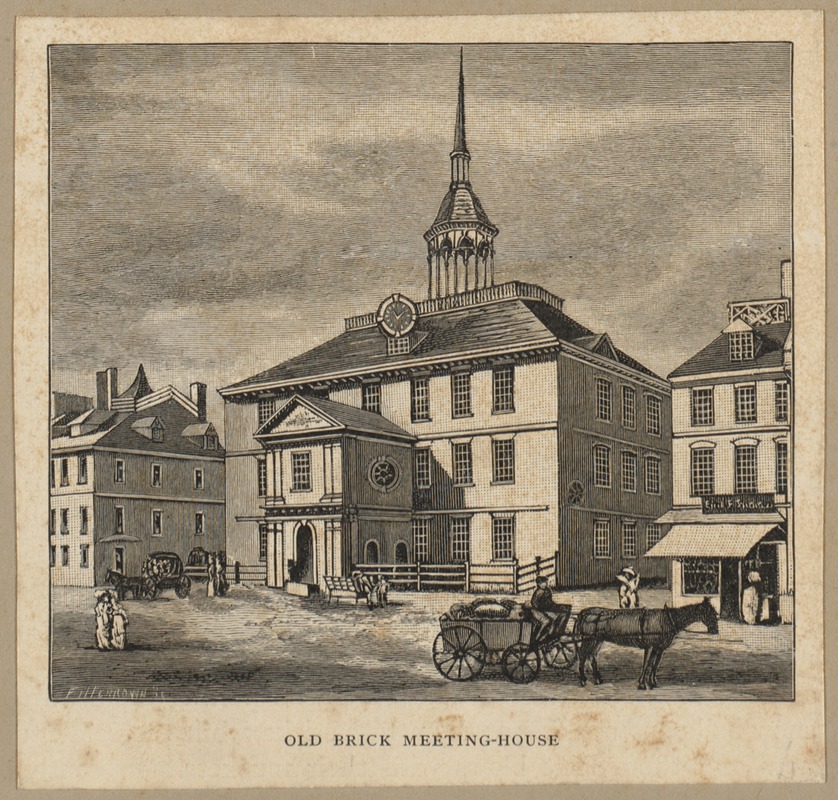
Yesterday I introduced
Thomas Williston, sexton of Boston’s
Old Brick (First) Meeting-House starting in the 1740s.
Williston also took on jobs for the town of Boston. Some of those were tied to his work as a church sexton, such as winding his meetinghouse’s clock and
burying the dead. Others were civic tasks, as in managing the weekly traffic of farm wagons at the marketplace.
In June 1754 the
town government offered another job: “Mr. Thomas Williston is appointed to attend the Select men in the room of Mr. John Savel who by reason of Age and Infirmities cannot attend the business.” Williston was also given “the care and Oversight of all the
Watches in the Town.” And he was still the sexton at the Old Brick.
Thomas Williston’s official title was doorkeeper at
Faneuil Hall. As such, he continued to patrol the marketplace, arranged to illuminate the building after the capture of Montreal in 1760, and the next year took down “the Potts & other Iron Ware” from the walls and hung “the Town Ladders” there instead.
But being doorkeeper also involved a lot of running around Boston. In 1758 the selectmen empowered Williston to enforce the town’s newly revised
by-laws, including speed limits on vehicles. They sent him out on the water to warn
ship captains against unloading “
French neutrals” or possible
smallpox patients. Along with Deacon William Larrabee, Williston was assigned to warn newcomers out of town—though he did that for only a few months,
Robert Love’s Warnings reports. At different times Williston summoned new officeholders, tax collectors, and heads of
fire companies to meet with the selectmen at Faneuil Hall.
For the annual inspection of the
schools, Williston contacted the many respected gentlemen chosen for that committee. He also visited the two grammar-school masters to obtain the names of the graduating
scholars so the selectmen could invite their parents to a
dinner at Faneuil Hall. (Students leaving the three writing schools didn’t get a party.)
Some of Williston’s assignments overlapped with his roles as gravedigger, bellringer, and watchman. For example,
in March 1761 he informed tomb owners they were responsible for paying to repair a wall of the burying ground. But he could also be told to deliver the seals to the newly elected sealers of leather, inspect leaning chimneys, and warn property owners about dangerous drains.
Williston’s busiest months on record were during the smallpox epidemic of 1764. He appears over and over in the selectmen’s minutes: tracking down reported patients, moving some to the
hospital at New Boston
in the town sedan chair, installing flags and guards (including his brother
Ichabod) outside quarantined homes, hiring and dismissing nurses, smoking homes and
clothing, and burying the dead under special arrangements to contain the disease. Thomas, his brother
John, his other brother Ichabod, and Ichabod’s wife Elizabeth all got extra pay during those months.
After
army regiments arrived in Boston in October 1768, Thomas Williston had the task of telling British officers that the selectmen wanted to speak to them—a potentially volatile clash of authorities. In November he summoned two officers accused of having “insulted & interrupted” the Dock Watch; those officers apologized for being drunk. In July 1770 “Mr. Williston, Door-keeper to the Select-men,” carried a letter from a town committee to Capt.
Thomas Preston in the town jail. In September, some sick soldiers came back from
Castle Island to enter “the Hospital in the
Common”; the selectmen had Williston summon regimental surgeon
Charles Hall for consultation.
In sum, Thomas Williston was well known in Boston, the liaison between the town’s highest elected officials and citizens of all sorts. He was based at Faneuil Hall and the Old Brick Meeting-House, but he could show up anywhere in the course of his duties.
On 18 Feb 1773,
Isaiah Thomas’s
Massachusetts Spy reported the death of Thomas Williston, “sexton of the Old-Brick, and doorkeeper of Faneuil hall.” He was
buried in the Granary Burying Ground with his wife Sarah, who had died on Christmas Day in 1771.
Four days later the selectmen met in Faneuil Hall. Those men, “taking into consideration who was a proper Person to fill up the place of Mr. Thomas Williston, who for a number of years had attended them on the Towns Business; Agreed to give the Offer of the office to Mr.
William Barrett Sexton of Dr. [
Samuel] Coopers Church” on Brattle Street.
Williston’s successor as sexton of the First Meeting-house and, as of 31 March, as a town-approved gravedigger was
Josiah Carter. As I
discussed here, he had also been a town watchman. However, Carter lasted in that sexton’s job less than two years after Williston’s demise.