


J. L. BELL is a Massachusetts writer who specializes in (among other things) the start of the American Revolution in and around Boston. He is particularly interested in the experiences of children in 1765-75. He has published scholarly papers and popular articles for both children and adults. He was consultant for an episode of History Detectives, and contributed to a display at Minute Man National Historic Park.

Subscribe thru Follow.it


•••••••••••••••••


Showing posts with label Elizabeth Arnold. Show all posts

Monday, January 16, 2023

“Poor Mrs. Macaulay! She is irrecoverably fallen.”

In October 1778, the historian Catharine Macaulay left Bath and the home she shared with the Rev. Thomas Wilson.

One possible reason for Macaulay’s move was that Wilson kept pressing her to marry him. Everyone knew the minister was besotted with the widowed author. He’d already signed over a lease to his house, erected a statue in London, and published a book of fawning poetry. But she declined to make him her second husband.

As Bob Ruppert described in this Journal of the American Revolution article, Macaulay moved across England to Leicester in the East Midlands. That was the city where her friend Elizabeth Arnold lived.

Arnold was the sister of Macaulay’s physician, Dr. James Graham, and wife of another physician who managed an asylum for the mentally ill. The two women had visited France together in late 1777.

On 14 November, a minister in Leicester married Macaulay to Dr. Graham. Not James Graham, who was with his wife and children in Scotland. That would have provided plenty of scandal and confirmed a rumor that John Wilkes had recorded earlier in the year.

Rather, the historian married William Graham, younger brother of Dr. James Graham and Elizabeth Arnold.

Much younger brother, in fact. William Graham was only twenty-one years old. He was barely a doctor, having studied in Edinburgh and trained as a surgeon’s mate for the East India Company

Even by the modern standard of “half your age plus seven,” William Graham seemed “too young” for Macaulay, who was forty-seven. And of course Macaulay was a woman. A woman who had put herself into the public eye by writing about history and politics.

The reaction was swift and negative. One acquaintance at Bath, Edmund Rack, wrote to Richard Polwhele, an eighteen-year-old admirer of the historian, on 29 December:
Poor Mrs. Macaulay! She is irrecoverably fallen. “Frailty, thy name is Woman!” Her passions, even at 52 [sic], were too strong for her reason; and she has taken to bed a stout brawny Scotchman of 21. For shame! Her enemies’ triumph is now complete. Her friends can say nothing in her favour. O, poor Catharine!—never canst thou emerge from the abyss into which thou art fallen!
And that was one of the more sympathetic responses.

COMING UP: More reactions.

[The portrait of “Mrs. Catherine M’Caulay” above is a woodcut printed in Nathaniel Ames’s Astronomical Diary; or Almanack for 1772. Paul Revere supplied versions of this cut to both Ezekiel Russell and Edes and Gill for their competing editions. Printing this illustration of Macaulay shows the admiration, or at least curiosity, that she inspired in New England at that time. (The almanac’s other images featured John Dickinson and the dwarf Emma Leach.) This image comes courtesy of the American Antiquarian Society.]

Saturday, August 27, 2022

Dining with the “agreable society” of Paris

In the fall of 1777, the historian Catharine Macaulay and her companion Elizabeth Arnold arrived in Paris.

They were supposed to proceed to Nice for Macaulay’s health, but she discovered a reason to stay in the capital, as she later told the Earl of Harcourt:
When I arrived at Paris the Physician to whom Mr. [Horace] Walpole recommended me said that I should certainly perish on the road if I attempted to go farther.

Happily for me the Bark which I had before repeatedly tried in vain about a week after I was at Paris began to have so good an effect as to abate my fever sufficiently for me to partake of that agreable society.
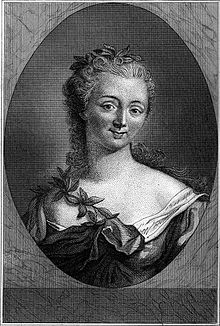
Arnold later reported that the “agreable society” included the authors Anne-Marie du Boccage (shown above) and Marmontel, Madame Helvetius, Count Sarsfield, the Duc de Liancourt, the Duc de Harcourt, Abbé Seignelay Colbert de Castlehill, the British ambassador Lord Stormont, and the recently ousted government minister Turgot. (Plus a lady named “Madame Grigson” whom I couldn’t identify.)

As a British Whig, Macaulay expected to find the French capital under the oppression of an absolute monarchy. Instead, she heard a lot of people agreeing with her own ideas about republicanism.
I must tell your Lordship that after the French had paid me compliments on my genius and on my literary powers, the quality which they regarded as the next highest compliment was that I was a hater of kings.

In regard to the part they take in our civil wars, they are all American mad; and I do assure you, my Lord, that even your Lordship would not be well received in France if you were not an American. All the enlightened French wish ardently to see a large empire established on a republican basis to keep the monarchies of the world in order; and all the vulgar have the same earnest desire, through hatred and jealousy of the English.
By “our civil wars,” Macaulay meant the British government’s conflict with the thirteen breakaway colonies in North America.

To be sure, Macaulay wasn’t seeing a cross-section of French society. She met mainly with progressive intellectuals and aristocrats who knew of her as an anti-government author in Britain. And as she acknowledged, even Frenchmen who supported the traditional order (“the vulgar”) saw a reason to support the new U.S. of A.—in order to weaken Britain.

There was one thing Macaulay couldn’t stand about France, however, and after a few weeks it sent her back to Bath:
it was sad necessity which drove me away; as my stomach was always unfortunately delicate, I nauseated from the first, tho’ I was prejudiced in its favor, at all the food I met with in France; their meat is carrion, their poultry and even their game insipid, and their cookery most detestable. They have no good sources to season their meats with, and they use them too sparingly; their made dishes are a collection of gravy drawn from bad meat, fat, &c., without over flavour but what a little onion gives; thus the stomach is loaded with everything which is baneful to it without the assistance of warm spices to help digestion; and, in addition to these mortifications, as my stomach was very weak after my illness, all their wines turned sour upon it.

Thus all the juices of my body, vitiated by my long and important illness, was deprived of that nourishment which can alone restore the decayed strength and yield fresh balm to the oppressed constitution.
Macaulay thus found the French national constitution less oppressive than she expected, but her own constitution oppressed by French cuisine. Once again, her health was on a knife’s edge.

TOMORROW: A note to Dr. Franklin.

Friday, August 26, 2022

Catharine Macaulay on the Road

I once read the observation that a group of people traveling together moves as fast as the slowest member and has as much fun as the grumpiest member.

Catharine Macaulay’s health dictated the slow pace of her travel through France with Elizabeth Arnold. As to whether she was a happy companion, Arnold later wrote about her with great admiration, but it doesn’t sound like a fun time.

Here are some anecdotes from the road as eventually published in Mary Hays’s Female Biography.
Between Calais and Paris, she looked in vain for the healthy and well-fed peasant, the beautiful and luxuriant meadows, the cultivated farms, and comfortable farm-houses, of her native island. Despotism had palsied the hand of industry; an indigent and miserable people appeared thinly scattered over wild and dreary plains. . . .

The travellers stopped one day at Chantilly, where they met with two of their friends, and where they had an opportunity of observing a royal residence [shown above], and contrasting it with the wretchedness which they had so recently witnessed. Mrs. Macaulay was not in a state of health to bear the fatigue of inspecting the palace.

To Dr. [Treadway Russell?] Nash, one of the gentlemen whom she met at Chantilly, and who would, with apparent satisfaction, have described to her the curiosities and magnificence of the prince’s residence, she replied (after thanking him courteously for the trouble he was about to give himself,) that she would spare him the repetition, since she could receive no pleasure in hearing of the splendor of one mortal, while the misery of thousands pressed upon her recollection.
Actually, I have to admire Macaulay’s force in shutting down a bore there.
…at the first post-house at which they stopped to change horses, the feelings of the travellers were again excited by the objects which, crowding around their carriage, clamorously implored their charitable donations, while they exhibited in their persons and squalid appearance every variety of want and of human wretchedness. ‘My God! my God!’ exclaimed Mrs. Macaulay, with a benevolent enthusiasm, bursting into tears, ‘have mercy on the works of thine own hand!’ She made her servant distribute to them each three livres, and divided among them the provisions she had in the carriage.
Britons, and British Whigs in particular, believed France was a country of widely unequal wealth and oppressed, starving peasants, so these rural sights confirmed what Macaulay and Arnold expected to see.

During a stop in Abbeville, when Macaulay’s “health was in a languishing state,” Arnold expressed some worry about her dying, prompting this response:
After reproving her friend’s too great sensibility and solicitude on her account, “I thought and hoped,” said she, ”that you viewed my death but as a short separation between virtuous friends, and that your assurance of a re-union with me, in a more perfect state, would have preserved you from being thus severely affected by the idea of my dissolution.” She went on to console her companion and fellow-traveller in the same strain, “Consider our parting,” said she, “but as a short privation; for, be assured, the friendship of the good will not be dissolved by death: we shall again unite in another life.”

The feeble state of her frame, and consequent sufferings, she said, naturally led her to these reflections.
Again with the illness.

Macaulay was sincerely and conventionally religious, though her politics verged on the radical. That made an interesting contrast with her rival historian David Hume, who was religiously skeptical and quite traditional in his politics.

TOMORROW: Paris at last.

Thursday, August 25, 2022

“Her fever seemed to have left her”

In late 1777, as I’ve been relating, doctors advised the historian Catharine Macaulay to leave her home in Bath and travel to Nice for her health.

Macaulay needed a companion on that trip, a genteel woman about her age. Her favored physician, Dr. James Graham, may have been the one who recommended Elizabeth Arnold (1743–1802).

This lady was the wife of Dr. Thomas Arnold of Edinburgh. More important, she was Dr. Graham’s older sister.

Years later, Arnold wrote about what she’d first heard of Mrs. Macaulay and the real person she met:
“She is deformed, (said her adversaries, wholly unacquainted with her person), she is unfortunately ugly, she despairs of distinction and admiration as a woman, she seeks, therefore, to encroach on the province of man.”

These were the notions…that I was led to entertain of Mrs Macaulay, previous to my introduction to her acquaintance. Judge then of my surprise, when I saw a woman elegant in her manners, delicate in her person, and with features, if not perfectly beautiful, so fascinating in their expression, as deservedly to rank her face among the higher order of human countenances. . . .

Infirm health, too often the attendant on an active and highly cultivated understanding, gave to her countenance an extreme delicacy, which was peculiarly interesting. To this delicacy of constitution was added a most amiable sensibility of temper, which rendered her feelingly alive to whatever concerned those with whom she was connected either by nature or by friendship.
Those impressions appeared in Mary Hays’s Female Biography, published in 1805.

The two women and their servants set off from Bath, but they didn’t get far. Although Dr. Graham’s preparation of “bark” (probably cinchona bark) did something to relieve Macaulay’s fever, it hadn’t fully kicked in yet. She later wrote, “I was so weak when I left Bath, that from Bath to London I was obliged to be six days on the road, and to remain one fortnight in London to recover strength sufficient to pursue my journey.”

Finally the ladies boarded a ship to cross the Channel. According to Hays, because Macaulay “was severely exhausted by sickness, she rested two days at Calais.” But suddenly she got better:
she soon experienced, from the change of air, or possibly from the sea sickness itself, a salutary effect. Her fever seemed to have left her, and she suffered in the remainder of her journey to Paris but little inconvenience.
In Paris, a stout British Whig like Macaulay expected to see the oppressive effects of French political and religious tyranny. To complicate matters, in late 1777 the French government was weighing whether to formally ally with Britain’s breakaway colonies and go to war.

TOMORROW: French food and French people.