J. L. BELL is a Massachusetts writer who specializes in (among other things) the start of the American Revolution in and around Boston. He is particularly interested in the experiences of children in 1765-75. He has published scholarly papers and popular articles for both children and adults. He was consultant for an episode of History Detectives, and contributed to a display at Minute Man National Historic Park.

Subscribe thru Follow.it


•••••••••••••••••


Showing posts with label Samuel Talcott. Show all posts

Wednesday, February 23, 2022

“After the steed is stolen Shut the Stable Door”
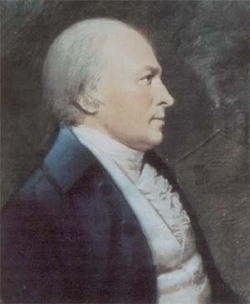
Yesterday I related, with the help of Dr. Robert A. Selig, how Samuel Talcott, Jr., sent his enslaved young man Addam off to Jeremiah Wadsworth (shown here) in Hartford.

Addam carried a letter describing how an unnamed “French general” wanted to hire or even buy him as a servant for the coming campaign. Having heard of that interest from Addam himself, Talcott asked Wadsworth to close that deal for him.

Incidentally, it turns out that was Samuel Talcott, Jr.’s second appearance on this blog. He was one of the victims of the gunpowder explosion during Hartford’s celebration of the repeal of the Stamp Act on 23 May 1766. His brother-in-law Dr. Nathaniel Ledyard was killed, and he was “very much burnt in his face and arms.”

But apparently Talcott recovered quickly enough to be back in business by the end of 1766. He appeared in Connecticut newspapers settling estates, helping to organize a new township in western Massachusetts, and otherwise acting as a respectable man of business.

We might think that experience would make Talcott more savvy than he behaved with Addam, because the next development in this story appears at the bottom of a copy of that letter he had sent off with the young man:
Dear Sr.

The foregoing is a Coppy of Mine to you sent by my negro which I find he did not deliver and hath since disappeard——

ay—after the steed is stolen Shut the Stable Door—very true Sr—but as perhaps [smudge] another old adage—Better Late than never may be applied in this Case I trouble you again

I am Dear Sr
ut Supra [as above] & I hope permanently
Saml. Talcott Junr.
Addam had taken advantage of his owner not expecting to see him back for a while to free himself.

According to Bob Selig, “There is a letter to Wadsworth a few months later asking Wadsworth to check the Black servants of the French officers for his Addam, but Wadsworth could not find him.”

Addam may have attached himself to the French troops, but on his own terms. He may have joined the Continental Army. He may have found other work.

All we know is that Samuel Talcott, Jr., ended up with neither his slave nor any of the money he hoped to see.

I found no advertisement seeking Addam’s return, though Talcott and his father did advertise at other times in the early 1780s for a missing pocketbook, a strayed mare, and of course the repayment of debts owed them.

Evidently Talcott didn’t want Addam returned that badly. Or he didn’t want to have to explain how the young man got away.

Tuesday, February 22, 2022

“I dont want the fellow but I want Money”

Earlier this month Dr. Robert A. Selig shared an interesting document on Facebook.

It may also have appeared in one of the reports Selig has written for the National Washington-Rochambeau Revolutionary Route Association, and he said he welcomed other people writing about it. So here goes.

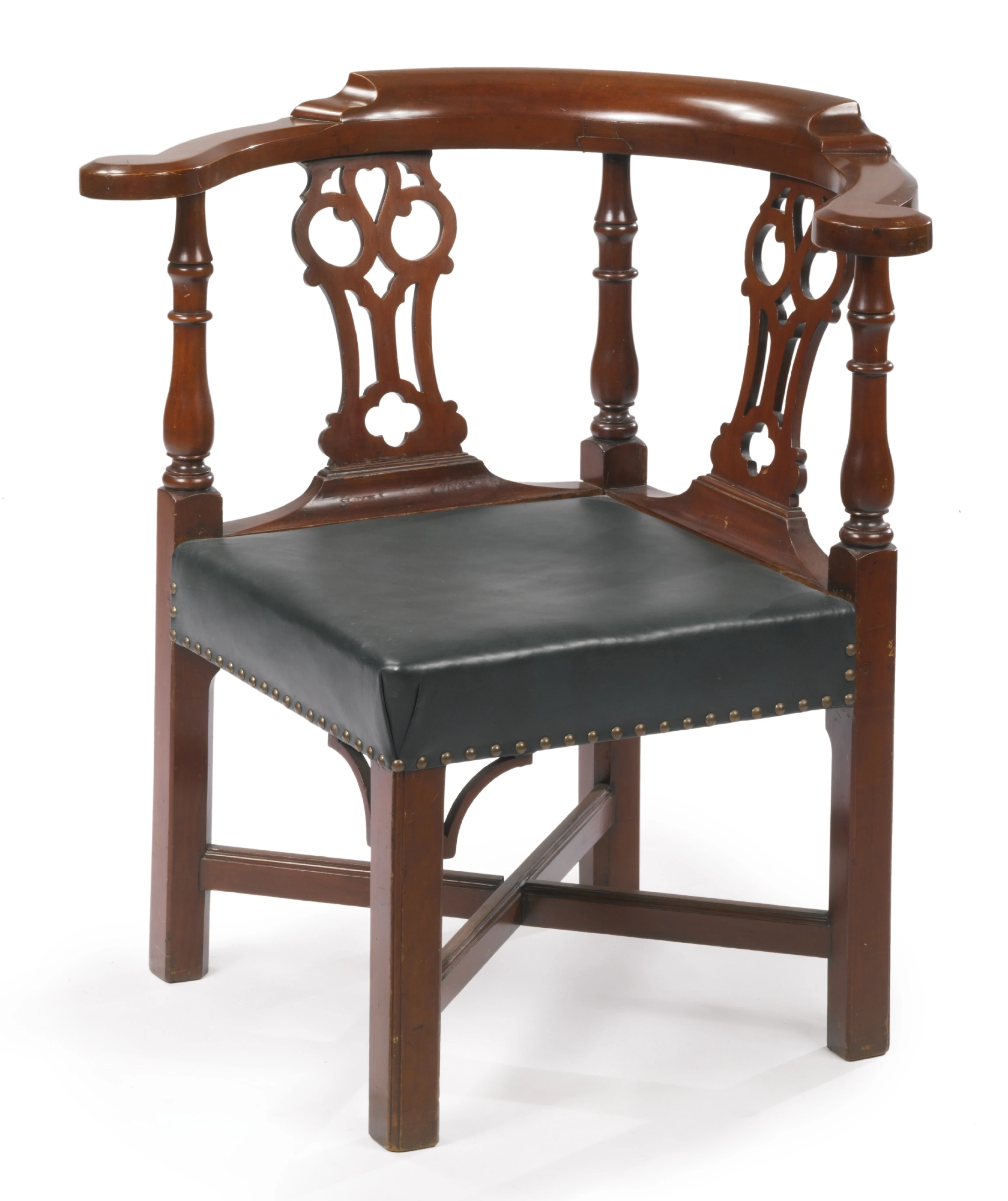
Samuel Talcott, Jr. (1740–1798), was a Hartford businessman. His paternal grandfather had been governor of Connecticut, he graduated from Yale College, and his father gave him this fine chair around the time of his marriage.

By 1781 Talcott had a growing family, an estate in West Hartford, and at least one enslaved servant. His Talcott ancestors had enslaved people as well, and there’s a record of him selling a six-year-old girl to James Wadsworth of Farmington in 1764.

In June 1781, many French troops under Gen. Rochambeau passed through Connecticut on their way from Newport to New York. Slavery was of course established in the French Empire as well. Bob Selig wrote, “Having a Black servant was somewhat of a status symbol in 18th c France and a number of French officers from Rochambeau on down either hired or purchased slaves.”

On 26 June, Talcott wrote to Jeremiah Wadsworth, who was acting as commissary for the French army in America:
Dear Sir

Notwithstanding the multiplicity of Affairs with which you Are incumbred as there is no one whose good will and Ability to Serve me in this Matter can be so well depended upon I take the Liberty to trouble you

My Negro Man Addam tells me that a French General Lodging at Mr. Caleb Bull Junr’s Wants to hire him as an attendant and will Cloath him and Give Good Wages

he says he doth not know whether the General Wants to Buy—if so he will perhaps as Likely give a Good price as Good Wages
In other words, Talcott was ready to sell Addam to this general if the price was right. Though legally the Frenchman would owe the young man’s wages to him as owner, Talcott was ready for cash now.
The Negro is about three or four and twenty strong sensible active and handy and may do very well in that department—I dont want the fellow but I want Money—he informs me that the General Goes on this Afternoon—

as I cannot Go in I desire you would take the matter up for me & act in it as you Would for yourself & it would be Done to my Entire Satisfaction, & I believe much Better than I should be able to transact it my Self

I am Dear Sr.
your Affectionate friend & Relative
Saml. Talcott Junr.
Talcott sent Addam off to Hartford with this letter for Wadsworth.

TOMORROW: A good bargain.

Monday, May 23, 2016

A Celebration Turned Tragic in Hartford

On 23 May 1766, the town of Hartford, Connecticut, celebrated the repeal of the Stamp Act with a day of thanksgiving. Church bells rang, cannons fired, and ships on the Connecticut River displayed flags. As in Boston and elsewhere, the holiday was supposed to end with a “general illumination,” including fireworks.

According to a city history published in 1886:
A number of young gentlemen had come together to make sky-rockets in an upper chamber of the brick school-house, while the powder stored in the room below was being distributed to the militia. Two companies of soldiers had just received a pound for each man, when the powder scattered by this delivery was thoughtlessly set on fire by boys, and in an instant the building was reduced to a heap of ashes, and twenty-eight persons were buried in its ruins, six of whom died after being taken out of the crumbling mass, and the others were more or less injured.
In 1836, John Warner Barber’s Connecticut Historical Collections cited the Connecticut Gazette of 31 May 1766 for this list of victims:
  • Mr. Levi Jones, John Knowles, (an apprentice to Mr. Thomas Sloan, blacksmith,) and Richard Lord, (second son to Mr. John H. Lord,) died of their wounds, soon after they were taken from under the ruins of the building.
  • Mr. William Gardiner, merchant, had both his thighs broken. [He died soon after.]
  • Mr. Samuel Talcott, Jun., very much burnt in his face and arms.
  • Mr. James Tiley, goldsmith, had one of his shoulders dislocated, and some bruises in the other parts of his body.
  • Mr. John Cook, Jun., had his back and neck hurt much.
  • Ephraim Perry, slightly wounded.
  • Thomas Forbes, wounded in his head.
  • Daniel Butler, (the tavern-keeper’s son,) had one of his ancles put out of joint.
  • Richard Burnham, son to Mr. Elisha Burnham, had his thigh, leg and ancle broke. [He was nineteen years old, and later died of his injuries.]
  • Eli Wadsworth, (Capt. Samuel’s son,) is much wounded and burnt, in his face, hands, and other parts of his body.
  • John Bunce, Jun., (an apprentice to Mr. Church, Hatter,) wounded in the head.
  • Normand Morrison, (a lad that lives with Capt. Tiley,) a good deal burnt and bruised.
  • Roderick Lawrence, (Capt. Lawrence’s son,) slightly wounded.
  • William Skinner, (Capt. Daniel’s son,) had both his thighs broke.
  • Timothy Phelps, (son to Mr. Timothy Phelps, shop-joiner,) had the calf torn off from one of his legs.
  • Valentine Vaughn, (son of Mr. Vaughn, baker,) had his skull terribly broken.
  • Horace Seymour, (son of Mr. Jonathan Seymour, Jun.,) two sons of Mr. John Goodwin, a son of Mr. John Watson, and a son of Mr. Kellogg, hatter, were slightly wounded.
  • Two molatto and two negro boys were also wounded.
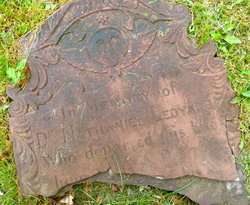
Later newspapers added that Dr. Nathaniel Ledyard, a son of one of the town’s representatives in the colonial legislature, also died of his injuries. Like Jones and Gardiner, he was among the town’s “young and newly married men.” Here is Dr. Ledyard’s broken headstone and the ledger that he and his widow used for their accounts.