J. L. BELL is a Massachusetts writer who specializes in (among other things) the start of the American Revolution in and around Boston. He is particularly interested in the experiences of children in 1765-75. He has published scholarly papers and popular articles for both children and adults. He was consultant for an episode of History Detectives, and contributed to a display at Minute Man National Historic Park.

Subscribe thru Follow.it


•••••••••••••••••


Showing posts with label George Trott. Show all posts

Monday, September 08, 2025

“Our House is an hospital in every part”

On 8 Sept 1775, 250 years ago today, Abigail Adams had serious news for her husband John, who was heading back to the Continental Congress:
Since you left me I have passed thro great distress both of Body and mind; and whether greater is to be my portion Heaven only knows. You may remember [hired boy] Isaac [Copeland] was unwell when you went from home. His Disorder increasd till a voilent Dysentery was the consequence of his complaints, there was no resting place in the House for his terible Groans. He continued in this state near a week when his Disorder abated, and we have now hopes of his recovery.

Two days after he was sick, I was seaz’d with the same disorder in a voilent manner. Had I known you was at Watertown I should have sent Bracket [a farm hand] for you. I sufferd greatly betwen my inclination to have you return, and my fear of sending least you should be a partaker of the common calamity. After 3 day[s] an abatement of my disease relieved me from that anxiety.

The next person in the same week was [servant girl] Susy. She we carried home, hope she will not be very bad.

Our Little Tommy [Thomas Boylston Adams] was the next, and he lies very ill now—there is no abatement at present of his disorder. I hope he is not dangerous.

Yesterday [servant girl] Patty was seazd and took a puke. Our House is an hospital in every part, and what with my own weakness and distress of mind for my family I have been unhappy enough.
The Adams Papers editors noted: “Patty, who was probably a relative of JA or AA and had lived four years in the Adams household, died after a protracted and grisly illness early in October.”

The letter went on to list other neighbors who were ill. Abigail and John also both knew that his brother Elihu had died of the same disease in early August.

Two days later, Abigail resumed her letter:
As to my own Health I mend but very slowly—have been fearful of a return of my disorder to day but feel rather better now. Hope it is only oweing to my having been fatigued with looking after Tommy as he is unwilling any body but Mamma should do for him, and if he was I could not find any body that is worth having but what are taken up already with the sick. Tommy I hope is mending, his fever has abated, his Bowels are better, but was you to look in upon him you would not know him, from a hearty hale corn fed Boy, he is become pale lean and wan.

Isaac is getting better, but very slowly. Patty is very bad. We cannot keep any thing down that she takes, her situation is very dangerous. Mr. Trot and one of his children are taken with the disorder.
As discussed back here, George Trott was a politically active jeweler from Boston, and Abigail had taken in the Trott family as refugees.

The epidemic that Abigail’s letter described was “camp fever,” a bacterial dysentery. It spread among provincial soldiers and then to their families and neighbors because, basically, people didn’t yet realize they had to wash their hands and clothing thoroughly to avoid spreading germs. Women and servants caring for the sick thus became vectors for the disease to themselves or others.

All this time, Abigail was also worrying about smallpox, a viral disease that spread more slowly but was more deadly. She wrote:
The small pox in the natural way was never more mortal than this Distemper has proved in this and many neighbouring Towns. 18 have been buried since you left us in Mr. [Ezra] Welds parish [of Braintree]. 4, 3 and 2 funerals in a day for many days. Heitherto our family has been greatly favourd.
Looking ahead, Abigail asked John to send her medical supplies:
By the first safe conveyance be kind eno to send me 1 oz. of turkey Rhubub, the root, and to procure me 1 quarter lb. of nutmegs for which here I used to give 2.8 Lawful, 1 oz. cloves, 2 of cinnamon. You may send me only a few of the nutmegs till Bass [another family servant] returns. I should be glad of 1 oz. of Indian root. So much sickness has occasiond a scarcity of Medicine.
Many modern American parents can easily sympathize with Abigail having to care for a child like Tommy. But the number of sick people in the household and the neighborhood, and the specters of serious illness and death, are worries we’ve usually been spared. This sort of document is a reminder of the danger of rolling back proven health measures.

Sunday, April 06, 2025

From “Loyall Nine” to “Sons of Liberty”

We have a reasonably good idea of who eight of Boston’s “Loyall Nine” were:
In addition, the ship masters Henry Wells and Joseph Field were also lumped in with this group by different contemporaries.

Within months after they started organizing anti–Stamp Act protests, the group appears to have adopted another name. Back during Parliament’s debate over that law, opponent Isaac BarrĂ© called American colonists “Sons of Liberty,” as reported to this side of the Atlantic by Jared Ingersoll. By the fall the “Loyall Nine” started using that phrase.

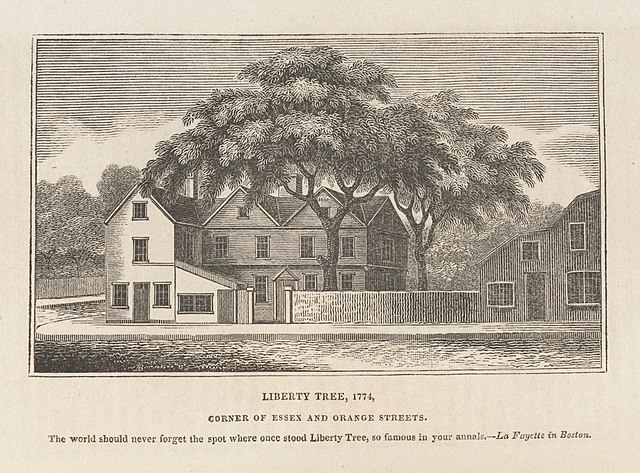
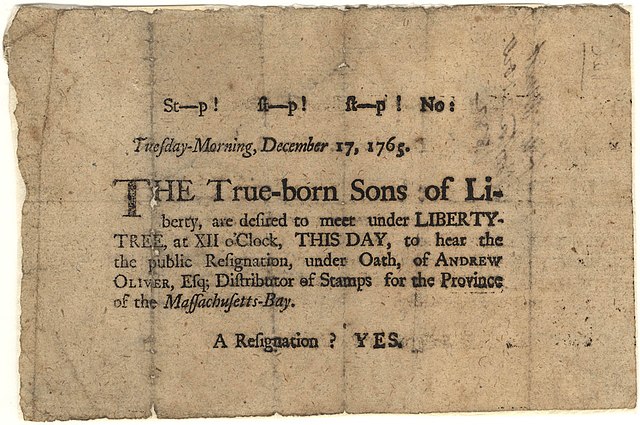
The handbills that Bass described the group printing in his December 1765 letter said: ”The True-born Sons of Liberty, are desired to meet under LIBERTY-TREE, at XII o’Clock, THIS DAY…” Evidently any man could merit that label by coming out to resist the new tax from London. In early 1766 the phrase also started to appear in newspapers in other ports.

But the group also used that term for themselves. In January 1766 John Adams called them “the Sons of Liberty.” On 15 February, Crafts wrote to Adams that “the Sons of Liberty Desired your Company at Boston Next Wensday.” Those are clearly references to a specific group, not to everyone taking a certain political stand.

It looks like the more general use won out. By August 1769, “An Alphabetical List of the Sons of Liberty who din’d at Liberty Tree [Tavern], Dorchester” included 300 names. Clearly those Sons of Liberty weren’t just the “Loyall Nine”—though all eight men listed above were there.

Nonetheless, because of some unsubstantiated claims and portrayals in popular culture, the belief persists that the Sons of Liberty was an identifiable group of activists, not a mass movement, as I’ve written before. Because of that squishiness, I tend not to use the term. But of course it’s strongly associated with the Revolution.

TOMORROW: Back to the bowl.

Saturday, April 05, 2025

Counting the “Loyall Nine”

In a 19 Dec 1765 letter divulging details about Boston’s latest Stamp Act protest, and earlier ones, Henry Bass wrote of the organizers as “the Loyall Nine.” He added:
And upon the Occasion we that Evg. had a very Genteel Supper provided to which we invited your very good friends Mr. S[amuel] A[dams] and E[des] & G[ill] and three or four others and spent the Evening in a very agreable manner Drinkg Healths etc.
On 15 Jan 1766 John Adams wrote in his diary:
Spent the Evening with the Sons of Liberty, at their own Apartment in Hanover Square, near the Tree of Liberty. It is a Compting Room in Chase & Speakmans Distillery. A very small Room it is.

John Avery Distiller or Merchant, of a liberal Education, John Smith the Brazier, Thomas Crafts the Painter, Edes the Printer, Stephen Cleverly the Brazier, [Thomas] Chase the Distiller, Joseph Field Master of a Vessell, Henry Bass, George Trott Jeweller, were present.

I was invited by Crafts and Trott, to go and spend an Evening with them and some others, Avery was mentioned to me as one.
Finally, in 1788 the Rev. William Gordon wrote in his history of the Revolution about the first anti-Stamp protest, back in August 1765:
Messrs. John Avery, jun. Thomas Crafts, John Smith, Henry Welles, Thomas Chace, Stephen Cleverly, Henry Bass, and Benjamin Edes…provide and hang out early in the morning of August the fourteenth, upon the limb of a large old elm, toward the entrance of Boston, over the most public street, two effigies,…
Those sources, which were published in reverse chronological order, all seem to refer to the same group of men. The lists of names overlap—but not exactly.

Bass said there were nine men, and seemed to treat Samuel Adams, Edes, and Gill all as guests. Gordon named eight men, including Edes among them. John Adams also listed Edes in the group, and he treated George Trott, not on Gordon’s list, as in the group.

John Adams didn’t list Henry Wells from Gordon’s list (though Tea Leaves and some subsequent books misquote him as doing so). Instead, Adams named Joseph Field, saying he was a ship captain. According to mentions in the Boston press before he died in 1768, Henry Wells was also a ship captain. Would either of them have been in town long enough to help plan protests? 

It’s therefore difficult to say exactly who the “Loyall Nine” were, but there was definitely a political club supping at the Chase distillery near Liberty Tree and organizing the protests under that tree.

TOMORROW: A change of names?

Thursday, July 16, 2020

“That obstinate Wretch will not remove his few things”

Yesterday I started quoting Abigail Adams’s July 1775 letter to her husband John reporting on her conflict with a tenant and farm hand named Hayden.

Abigail had asked Hayden to move out of the house where John had been born, or to use only some rooms in that house, to make space for the George Trott family from besieged Boston. That request became especially acute when the Adams sister-in-law with whom the Trotts were living went into labor.

Abigail’s letter continued:
I removed my dairy things, and once more requested the old Man to move into the other part of the house, but he positively tells me he will not and all the art of Man shall not stir him, even dares me to put any article out of one room into an other. Says Mr. Trot shall not come in—he has got possession and he will keep it. What not have a place to entertain his children in when they come to see him. I now write you an account of the matter, and desire you to write to him and give me orders what course I shall take.

I must take Mr. Trott in with me and all his family for the present, till he can look out further or have that house. It would make your heart ake to see what difficulties and distresses the poor Boston people are driven to…and yet that obstinate Wretch will not remove his few things into the other part of that house, but live there paying no rent upon the distresses of others.

It would be needless to enumerate all his impudence. Let it suffice to say it moved me so much that I had hard Work to suppress my temper. I want to know whether his things may be removed into the other part of the house, whether he consents or not? Mr. Trott would rejoice to take the whole, but would put up with any thing rather than be a burden to his Friends.

I told the old Man I believed I was doing nothing but what I should be justified in. He says well tis a time of war get him out if I can, but cannon Ball shall not move him.
She closed by writing, “I shall be much mortified if you do not support me. . . . I feel too angry to make this any thing further than a Letter of Buisness.”

On 16 July, while awaiting a reply, Abigail sent John an update:
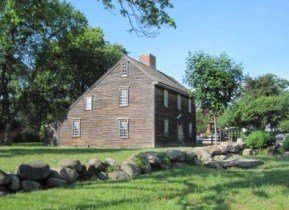
Mr. Trot I have accommodated by removeing the office into my own chamber [in the John Quincy Adams Birthplace, shown above], and after being very angry and sometimes persuaideding I obtaind the mighty concession of the Bed room, but I am now so crouded as not to have a Lodging for a Friend that calls to see me. I must beg you would give them warning to seek a place before Winter. Had that house been empty I could have had an 100 a year for it. Many person[s] had applied before Mr. Trot, but I wanted some part of it my self, and the other part it seems I have no command of.
This was the first time Abigail mentioned the financial dimension of the dispute. 

On 28 July, John responded with appropriate supportiveness:
…the ill Usage you have received from Hayden gave me great Pain and the utmost Indignation.

Your generous Solicitude for our unfortunate Friends from Boston, is very amiable and commendable, and you may depend upon my Justification of all that you have done or said to Hayden. His sawcy, insolent Tongue is well known to me, but I had rather he should indulge it to me than to you. I will not endure the least disrespectfull Expression to you. In my Absence and in your Situation, it is brutal.

I send you a Warning to him to go out of the House immediately. You may send it to him, if you see fit. If you do, let two or three Witnesses see it, before you send it, and let it be sent by a good Hand.
John Adams giving legal advice there. His “Warning” doesn’t survive. We know, however, that it had only a limited effect.

TOMORROW: The “old Man” still around.

Wednesday, July 15, 2020

“Turning him out of Door to oblige Boston folks”?

Biographies of Abigail Adams emphasize how she managed the family farm and finances in Braintree while her husband John was away for long periods as a politician and diplomat.

She had to go through a learning process, though. The couple was usually together for their first decade. Although John traveled to Massachusetts’s county courts, to a healing spring in Connecticut in 1771, and to the First Continental Congress in Philadelphia in the fall of 1774, those were relatively short trips.

It wasn’t until John went to Philadelphia for the Second Continental Congress in the spring of 1775 that he was gone for an extended period with no scheduled return. Meanwhile, Abigail was charged with the farm, which included two houses and outbuildings. She was watching children aged eleven to three, managing servants and hired farmhands, and—with the siege lines hardening—facing the effect of a refugee crisis.

On 12 July, Abigail wrote to John for help:
Dearest Friend

I have met with some abuse and very Ill treatment. I want you for my protector and justifier.

In this Day of distress for our Boston Friends when every one does what in them lyes to serve them, your Friend Gorge Trott and family moved up to Braintree, went in with her two Brothers and families with her Father, but they not thinking themselves so secure as further in the Country moved away.
George Trott was a jeweler in Boston, a member of the Loyall Nine protest organizers and third-in-command of the militia artillery company. In early 1766 Trott had married Ann Boylston (Nancy) Cunningham, one of John Adams’s cousins. Now the Trott family needed a place to live in Braintree.

There were a couple of complicating factors. As Abigail wrote, people didn’t want to live on the coast for fear that the Royal Navy would raid or shell those areas, so “the more remote from the sea coast you go the thicker you find the Boston people.” On the other hand, Trott didn’t want to be off in a remote location “upon account of his Buisness which is in considerable demand.”

For a while, John Adams’s brother Peter Boylston Adams had taken in the Trotts, but only on a temporary basis given his own imminently growing family. As Abigail wrote:
You know, from the situation of my Brothers [brother-in-law’s] family it was impossible for them to tarry there, Mrs. Trots circumstances requiring more rooms than one. In this extremity he applied to me to see if I would not accommodate him with the next house, every other spot in Town being full.

I sent for Mr. Hayden and handsomely asked him, he said he would try, but he took no pains to procure himself a place. There were several in the other parish which were to be let, but my Gentleman did not chuse to go there.
It looks like the Adamses had agreed to let Hayden and his sons live in their smaller house (shown above) in exchange for farm labor. The “other parish” meant the part of town that’s still Braintree, as opposed to Quincy.

The Adams Papers editors wrote: “Braintree literally teemed with Haydens, old and young, and the particular Hayden or Haydens who were at this time apparently tenants in the John Adams Birthplace cannot be identified.” I gave it a shot with digital resources and guesses, learned a lot more about Haydens, and didn’t enjoy any breakthroughs.

Back to Abigail:
Mr. Trott, finding there was no hopes of his [Hayden’s] going out said he would go in with him, provided I would let him have the chamber I improved [i.e., used] for a Dairy room and the lower room and chamber over it which Hayden has.

I then sent and asked Mr. Hayden to be so kind as to remove his things into the other part of the house and told him he might improve the kitchen and back chamber, the bed room and the Dairy room in which he already had a bed.

He would not tell me whether he would or not, but said I was turning him out of Door to oblige Boston folks, and he could not be stired up, and if you was at home you would not once ask him to go out, but was more of a Gentleman. (You must know that both his Sons are in the army, not but one Days Work has been done by any of them this Spring.)

I as mildly as I could represented the distress of Mr. Trot and the difficulties to which he had been put—that I looked upon it my Duty to do all in my power to Oblige him—and that he Hayden would be much better accommodated than hundreds who were turnd out of Town—and I finally said that Mr. Trott should go in.

In this State, Sister Adams got to bed and then there was not a Spot in Brothers house for them to lie down in.
“Sister Adams” was Peter Boylston Adams’s wife Mary, and their daughter Susannah arrived in time to be baptized on 16 July.

TOMORROW: Butting heads with Mr. Hayden.

Sunday, October 16, 2016

“How the Cambridge Alarm Led to the Concord Fight,” in Cambridge, 20 Oct.

Last March I spoke at Longfellow House–Washington’s Headquarters National Historic Site about “The End of Tory Row.” That talk was about that Cambridge neighborhood in the early 1770s, defined by one extended family of wealthy Anglican sugar-plantation owners. Their comfortable community came to an abrupt end on 2 Sept 1774.

On Thursday, 20 October, I’m returning to the Longfellow–Washington site to tell the next chapter of that story: “How the Cambridge Alarm Led to the Concord Fight.” Like the story of the “Tory Row” neighborhood, that narrative also involves extended family networks. The Road to Concord includes a dive into the family of young Samuel Gore, including his brothers-in-law Thomas Crafts and Moses Grant, to see why they became ready to rebel. But there are other families I could have traced out the same way.

Let’s take George Trott (1741-1780), a jeweler and goldsmith in Boston. Trott and Crafts were both members of the “Loyall Nine” who organized the public protests against the Stamp Act in 1765. Trott became the second-in-command of the train, Boston’s militia artillery company, while Crafts was the third-ranking officer.

Trott married Ann Boylston Cunningham (1745-1810), daughter of James and Elizabeth Cunningham. Her youngest sibling, Andrew (1760-1829), was the teen-aged assistant to South Writing School master Samuel Holbrook in September 1774. That’s when the train’s four small brass cannon disappeared, two of them from a building right next to the school. Coincidence? I doubt it. (I’ll describe who removed those cannon and how in my talk.)

By early 1775 those four brass cannon had been smuggled out of Boston to Lemuel Robinson’s tavern in Dorchester. Robinson (1736-1776) was an obvious choice to hide those guns. He was the captain of the militia artillery company for Suffolk County outside Boston, and he was active in the Whig movement. He put Liberty Tree on his tavern sign and hosted Boston’s Sons of Liberty at a big dinner in 1769.

Was there a family connection between Trott and Robinson? Robinson was raised in Dorchester by his maternal grandfather, Thomas Trott (1685-1762). George Trott’s father was also named Thomas Trott (1705-), a blacksmith of Boston. Genealogists have had trouble sorting out or connecting those families, though.

Robinson’s wife was born Jerusha Minot in 1734. Her brother named John (1730-1805) had a son he named George—i.e., Lemuel and Jerusha’s nephew—in 1755. A tradition in Roxbury published as early as 1835 credits a George Minot, son of John, with helping to smuggle two of the train’s four cannon out of Boston. Coincidence? Well, I’m not so convinced by the Minot stories, but if he was involved I’m sure the Robinson-Minot family network played a role. (A Dawes-Williams family network was definitely involved in moving cannon, as I’ll explain.)

My talk at the Longfellow–Washington site, 105 Brattle Street in Cambridge, starts at 6:30 P.M. (Stretches of Brattle Street open up for free parking at 6:00.) We’ll have copies of The Road to Concord for sale and signing afterward. To reserve seats in the carriage house, please call (617) 876-4491 or email reservationsat105@gmail.com.

Thursday, August 24, 2006

The Political Education of Thomas Crafts, Jr.

On 15 Jan 1766, decorative painter Thomas Crafts, Jr., aged twenty-five, and jeweler George Trott, aged twenty-four, invited thirty-four-year-old lawyer John Adams to spend the evening with their political club. In his diary, Adams called the group “the Sons of Liberty”; its membership overlaps almost exactly with the “Loyall Nine” who had organized Boston’s anti-Stamp Act protests in the previous months.

Adams reported that the young men met

at their own Apartment in Hanover Square, near the Tree of Liberty. It is a Compting Room in Chase & Speakmans Distillery. A very small Room it is. . . . We had Punch, Wine, Pipes and Tobacco, Bisquit and Cheese—&c. I heard nothing but such Conversation as passes at all Clubbs among Gentlemen about the Times. No Plotts, no Machinations. They Chose a Committee to make Preparations for grand Rejoicings upon the Arrival of the News of a Repeal of the Stamp Act, and I heard afterwards they are to have such Illuminations, Bonfires, Piramids, Obelisks, such grand Exhibitions, and such Fireworks, as were never before seen in America.—I wish they mayn't be disappointed.
The men weren’t disappointed in their hopes. Parliament repealed the Stamp Act in early 1766, and there was general rejoicing. (Celebratory obelisk pictured above from an engraving by Paul Revere.)

In 1770, Crafts served as coroner during the Boston Massacre trial, and soon was a lieutenant in the town’s artillery company. By taking on such official responsibilities, the young painter was rising from the artisan class into the ranks of the gentlemen who bought his luxury services. Meanwhile, it appears, he was educating himself in political theory. (Thanks to Al Young for alerting me to the following.)

On 23 Dec 1772, Adams bumped into Crafts and Trott again:
Took a Walk this Morning to the South End, and had some Conversation with my old Friends Crafts and Trot. I find they are both cooled—both flattened away. They complain especially Crafts that they are called Tories—&c. &c. Crafts has got Swifts Contests and Dissentions of the Nobles and Commons of Athens and Rome, and is making Extracts from it—about Clodius and Curio, popular Leaders &c. &c.
Crafts was reading Jonathan Swift's 1701 pamphlet "Discourse of the Contests and Dissensions Between the Nobles and the Commons in Athens and Rome." Swift had argued that giving the House of Commons too much power could destabilize the whole government. (Not surprisingly, Swift had been commissioned to write this by a member of the House of Lords.) Clodius was a Roman politician from the first century B.C.E., Curio his defender at one point; Swift adopted Cicero's conservative, aristocratic position that Clodius's populism was dangerous.

Such an argument about the danger of more popular government may seem like ironic reading for a Boston Whig, who basically wanted more power for the locally elected legislature and less for royally appointed officials. But Crafts had long been involved in channeling and containing the townspeople's resentments. Since 1765 he and his Loyall Nine colleagues had tried to organize safe, non-violent demonstrations—like the Stamp Act repeal celebration Adams had heard them planning. At one point Crafts had even helped pull someone else's effigy off Liberty Tree. Violent disorder reflected badly on Boston and its ability to govern itself, genteel politicians insisted.

Apparently, by late 1772, some Bostonians had come to dislike Crafts's arguments against confrontation, and sneered that he had become a "Tory." With seven years of political activism behind him, Crafts took that hard. Adopting the politics of a gentleman exacted a cost.