J. L. BELL is a Massachusetts writer who specializes in (among other things) the start of the American Revolution in and around Boston. He is particularly interested in the experiences of children in 1765-75. He has published scholarly papers and popular articles for both children and adults. He was consultant for an episode of History Detectives, and contributed to a display at Minute Man National Historic Park.

Subscribe thru Follow.it


•••••••••••••••••


Showing posts with label Old New-Gate Prison. Show all posts

Thursday, July 23, 2026

Back to the Old New-Gate Prison

In January I broke off a series of postings about the first years of Connecticut’s New-Gate Prison because of the press of other matters.

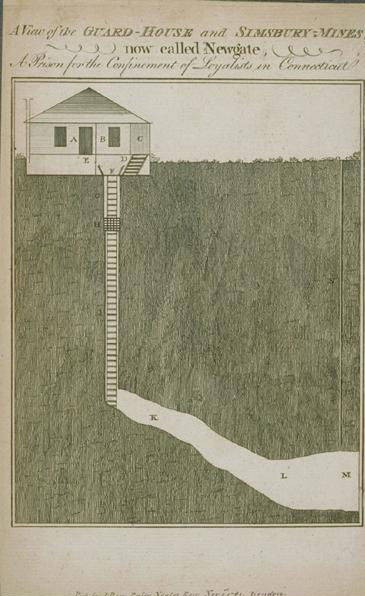
As awful as we might think of being imprisoned underground in an old, dank copper mine, the colony actually opened that prison as a reform measure. It was an alternative to corporal and capital punishment. And enforced labor might even make that mine profitable.

From December 1773 to April 1774, Connecticut courts sent six convicted criminals to the prison in Simsbury, to be locked down under the eye of keeper John Viets.

By that April, all six had disappeared, either to parts unknown or under the rubble of a collapsed tunnel.

In a comment on my last posting Mike asked:
Did it occur to the people of Connecticut that Mr. Viet may have been a less than adequate overseer?
That’s a good question, and here are some thoughts grappling for an answer.

First, the official “overseers” of the prison were three members of the Connecticut legislature who supervised Viets. They had the responsibility to hire the keeper, but they were also responsible for securing him the resources necessary to do that job.

Second, long-term incarceration was still an experiment. If the Connecticut legislature wanted its prison to work (and the government had already sunk a fair amount of money into converting the old mine), it needed to get the budget and rules right. The legislators might have expected (or accepted) a period of adjustment.

Finally, the overseers had probably hired John Viets because he was convenient. He owned a tavern right next to the mine. That was the infrastructure for feeding the prisoners, housing the guards, and keeping someone on site watching for disturbances and escapes. Hiring a new keeper and setting him up in Simsbury would have been a big expense.

Viets knew that an unfortunate pattern was developing. His 26 April advertisement began “New Gate Prison was again broke open…” But he remained on the job.

TOMORROW: A hardened criminal appears.

Saturday, July 11, 2026

New Dramas at Old Places in Newport, Deerfield, and East Granby

This is a very busy summer for Plays in Place, which works with historic sites to create new plays built on their past, informed by their archives, and designed for their spaces.

At the Hunter House in Newport, Rhode Island, Newport Mansions presents Loyalty or Liberty, a trio of short plays set between 1778 and 1781 as control of that port changed hands.

“Dinah” by Ken Green follows an enslaved woman in a Loyalist household whose husband plans to enlist in the Continental Army, seeking freedom for the family. “For Love and Glory” by Patrick Gabridge dramatizes the conference between Axel von Fersen, aide-de-camp to Gen. Rochambeau, and Adm. de Barras, who has to be convinced to sail his fleet to Yorktown. “Where We Once” by Lily Mathews picks up the story of Dinah’s enslaver, Sarah Wanton, as she faces life in an independent republic. These plays are directed by Rachel Walshe and produced by Jessica Chace.

Loyalty or Liberty will run Tuesday and Saturday evenings through 1 September. Normally the plays will be staged outdoors, overlooking Narragansett Bay, but in bad weather the production will move into the Guild Hall at St. John’s Church. Buy tickets here.

Historic Deerfield is hosting A Stake in the Ground: 1774, three short plays about conflicts in that Loyalist-leaning town as Massachusetts slid out of royal control.

In the summer of 1774, Patriots brought a Liberty Pole into Deerfield. “The Liberty Lark” by Talya Kingston, “Jinny and Cato” by Valyn Lyric Turner, and “Sparks on Dry Tinder” by Patrick Gabridge explore the political divisions, tangled family relations, and complexities of enslavement stirred up by that political act and the protest against it. These dramas are directed by Brianna Sloane and produced by Talya Kingston.

Performances will take place on Friday and Saturday evenings and Sunday afternoons through 16 August. A Stake in the Ground will be staged outside, with the audience walking to each location and sitting on folding chairs. On 31 July–2 August, and in very bad weather, the same plays will be performed inside the Deerfield Community Center for a more traditional and accessible theatrical experience. Tickets available here.

At the Old New-Gate Prison & Copper Mine in East Granby, Connecticut, visitors can take in The Slippery Truth: Prisonbreak at New Gate by Patrick Gabridge, directed by Zoë Golub-Sass and produced by Nicole Young-Martin.

On 18 May 1781, a group of captive Loyalists rushed up a 35-foot ladder and overpowered their guards, killing one man before escaping into the night. Was this brave resistance by political prisoners or a desperate blow by criminals? Did they have inside help? Prison trustee John Forward interrogates guards and recaptured prisoners to find the truth.

The Slippery Truth will be produced indoors—to be precise, inside the mine. The audience will enter via 33 steps and a 100-yard loop starting at 35 feet below ground and descending to 75 feet below. The shortest tunnel is 4 feet. The mine is always 52 degrees and wet. Strollers, wheelchairs, walkers, and similar devices are not permitted, and visitors should consider their medical history and physical limitations before attending.

Performances will happen on Friday, Saturday, and Sunday evenings through 30 August. Tickets at this page.

Tuesday, January 06, 2026

“New Gate Prison was again broke open”

Three months and a day after he first reported a convict escaped from Connecticut’s New-Gate Prison, keeper John Viets wrote out a second notice for the newspapers.

Here’s the text as it appeared in Hartford’s Connecticut Courant on 3 May 1774:
Simsbury, April 11, 1774.

LAST Saturday night the prisoners in New Gate Prison in Simsbury opened a way that had been in part stop’d up, that led from the place of their confinement into an old deep shaft that was partly filled with rocks & stones;

William Johnson Crawford, and Daniel Humphry (sometimes called Daniel Collyer Humphry) being more bold than the rest, ventured to pull away the stones from over their heads, and to work upwards in the old shaft, and so these two in the shaft pulled down the stones and the other three prisoners be low removed them out of the way to keep a communication between them, and all promised themselves a speedy escape—

when (at about three o’clock in the morning) the rock, stones, &c. in the shaft all gave away, and sunk into the shaft, where Crawford and Humphry were at work, to the great consternation of the three other prisoners, who say they really believe that Crawford and Humphry are both buried under the stones, &c.—but whether they are buried there or by some means escaped appears uncertain to those who have viewed the place, but rather conjecture the latter.

Therefore, this is to give notice, that if any person or persons will take up said Crawford and Humphry, or either of them, and convey them to said New Gate, shall have Ten Dollars reward for each, paid by
JOHN VIETS, Keeper of said Prison.

N B Said Crawford is about twenty four years of age, five feet and eight inches high, black curled hair, black eyes had on a light brown broad cloth cost, red duffel trowsers. Humphry is about twenty years of age, five feet and eight inches high, had on a light brown sea jacket, and brown plush breeches, both well set, spry young men.
That advertisement ran for another week, indicating the two fugitives were unaccounted for a month after their disappearance.

The other three men were still in the prison—two horse thieves convicted alongside Humphry and a “Ruffian” who had mugged a man near Norwich for his rum.

Then the 26 April Connecticut Courant offered this notice:
Last Saturday night
New Gate Prison was again broke open, and the following persons made their escape, viz. Zephaniah Ramsdel about 27 years of age, about 5 feet 8 inches high, lightish yellow hair something short, grey eyes, thinish face; had on a black coat & vest, cloth coloured plush breeches, a blue duffel great coat, and new shoes.—

Also, John Roberts, about 40 years old, about 5 feet 9 inches high, grey eyes, and short black curled hair; had on a brownish or redish colour’d surtout, a pair leather breeches very black if not washed since, a pair old shoes.—

Also, James Williams, a short well set fellow, about 28 years old, with short black hair; had on a blue cap, a pair long nasty linnen trowsers, check shirt, and new shoes. Whoever will take up either or all of said fellows, and return them to said New Gate, shall have Fifteen Dollars reward for each, paid by
JOHN VIETS.

Simsbury, April 25, 1774.
Apparently John Roberts had recovered from falling down a shaft, as reported when he first arrived at the prison.

For those keeping score, in 1774 the colony sent six men to its new New-Gate Prison for sentences of two to ten years, and by the end of April all six of those men had disappeared. (Two of them possibly under rubble, or possibly free.)

COMING UP: A hardened criminal.

Monday, January 05, 2026

“The inexpressible Horrors of that Den of Death!”

At the end of February 1774, Connecticut’s New-Gate Prison was once again ready to house convicted criminals.

The first prisoner sent there had escaped after only a couple of weeks, but the colony paid to block off the shafts to the underground prison, a former copper mine.

On 3 March, the Norwich Packet newspaper reported:
We hear from Windham, that William Johnson Crawford, Zephaniah Ramsdale and John Roberts, all natives of this Country, were last week severally convicted of Horse-Stealing before the County Court then sitting, sentenced to four years confinement in New-Gate, and conducted thither accordingly.

N.B. Two of the above, it is said, are New-Hampshire men.

We hear that John Roberts, one of the above-mentioned unhappy Felons, destined to reside in the subterraneous New-Gate, at Simsbury; upon his Arrival at the Sink of that Infernal Mansion, dropped, or, as it is suspected, willfully plunged headlong into it: His Skull was so miserably fractured, that although those Men who conducted him there remained two Hours after the Accident happened, he was at their Departure unable to articulate a Word, and they imagine that his Peregrinations are completed.---FREEBOOTING HORSE JOCKIES beware, for a Gibbit is comparatively a Toy to the inexpressible Horrors of that Den of Death!
Shorter articles appeared in the 4 March Connecticut Gazette out of New London and the 11 March Connecticut Journal from New Haven. Those papers had nothing to say about John Roberts’s plunge.

On 7 April, the Norwich Packet added two more men to the roster of prisoners:
At the Session of the Superior Court of this Colony, which ended here on Friday last, Daniel Humphry, a Simsbury Man, convicted of breaking into the Cabin of a Vessel, in New-London Harbour, and stealing a Quantity of Coffee, was sentenced to six Years hard Labour and Confinement, in the Copper, Mine, at the Place of his Nativity.--

At the same time James Williams, a Ruffian, for assaulting Zachariah Whipple, on the Road between Norwich-Landing and Preston, and robbing him of a Bottle of Rum, received Sentence to be confined two years in the Newgate Prison at Simsbury.
In early April, therefore, the New-Gate Prison had at least five inmates, sentenced to serve from two to six years. (And apparently stealing a “Quantity of Coffee” was a worse crime than attacking someone for a “Bottle of Rum.”)  

On 12 April, Hartford’s Connecticut Courant told readers:
Last Saturday Night Daniel Humphrey and William Crawford, committed last Week to Newgate Prison, as mention’d in our last, broke out of said Prison and made their escape
It’s heart-warming how a horse thief from New Hampshire and a coffee fiend working a southern Connecticut waterfront were apparently able to run away together.

But that still left three men in New-Gate, right? Or maybe two and a half, if John Roberts was badly injured. 

TOMORROW: Escape methods

Sunday, January 04, 2026

“Escaped from New Gate Prison at Simsbury, one John Hinson”

Exactly one month after a New Haven court sentenced John Ensign to ten years inside Connecticut’s new prison at Simsbury, as reported yesterday, he disappeared from his underground cell.

On 10 Jan 1774, John Viets, keeper of that New-Gate Prison, wrote out an advertisement for the New Haven newspaper. Here’s the text of the ad as it appeared in the 1 February Connecticut Courant, out of Hartford:
Ten Dollars Reward.

LAST Night escaped from New Gate Prison at Simsbury, one John Hinson, lately committed for Burglary, who is about 5 Feet 8 Inches high, has black Eyes, dark Hair, of a fair Complexion, and about twenty Years of Age—(he was helped out by some evil minded Persons from without).

Whoever will take up said Fellow, and return him to the Subscriber Master of said Prison, or shall discover those that aided him in his said Escape, so that they may be brought to conviction, shall have TEN DOLLARS reward, paid by
JOHN VIETS.

January 10, 1774.
Seven decades later, in 1845, Noah A. Phelps published A History of the Copper Mines and Newgate Prison, at Granby, Conn.. It was based on interviews with Viets’ descendants, so it used his spelling of the escapee’s name (Hinson) rather than what appeared in the newspaper reports of his trial (Ensign).

Phelps wrote:
The first convict received into the prison was John Hinson. He was committed Dec, 22, 1773, and escaped on the 9th of January following, by being drawn up through the eastern shaft by a rope, assisted, it is said, by a woman, to whom he was paying his addresses.
How did the Viets family know this? How confident was Phelps about this information, which he qualified by adding “it is said”?

Despite reasons for less than full certainty, subsequent histories of the Old New-Gate Prison repeat that 1845 account in a definite tone. And it may even be accurate. But in this Boston 1775 series, I’ll emphasize contemporaneous accounts.

Whether or not Viets was right in guessing the escape method, the Connecticut legislature acted quickly to prevent future departures through that shaft. By the end of the month it voted:
Upon the representation of the overseers of Newgate Prison: It is resolved by this Assembly, that said overseers be and they are hereby directed and impowered to cause the east shaft of said prison to be effectually secured with stone or iron, at their discretion, and to cause a log-house to be built and to consist of two or three rooms, one of which to be directly over the west shaft of said prison; taking care to preserve a free communication of air.
Young Ensign was gone, those officeholders might have told themselves, but he’d benefited the colony by providing a useful test of the New-Gate Prison. Now they were making that place stronger. Soon it was ready to receive more convicts.

TOMORROW: Two sets of arrivals.

Saturday, January 03, 2026

John Ensign Sent to the New-Gate Prison

On 26 Nov 1773, the Connecticut Gazette of New London reported this legal news:
NEW HAVEN, Nov. 19

A few days since, a young fellow, who says his name is John Ensign, was committed to our goal, for breaking open and robbing Mr. Thompson’s Tavern in East Haven, he being taken in the house, before he had time to get off with his booty.
Brothers named Thompson helped to found East Haven, and I haven’t been able to narrow down which of their descendants ran this particular tavern. One candidate for the scene of the crime is the Stephen Thompson House, shown above in 1939. 

On the last day of the year, the New-Hampshire Gazette ran an item presumably picked up from a Connecticut newspaper, but I haven’t found the original:
One John Ensign was convicted, at the Superior Court at New-Haven, the 9th Inst. for robbing the House of Mr. Thomson of that Place, and sentenced to TEN YEARS Imprisonment in Simsbury Mines, now called New-Gate-Prison, agreeable to a late Act of the Colony of Connecticut.
A long term of imprisonment, as opposed to corporal punishment or execution, was a novelty, warranting coverage even two colonies away.

The 7 Jan 1774 Connecticut Gazette kept up the story:
NEW HAVEN, Dec. 24

The beginning of this Week, John Ensign, was conveyed from the Prison in this Town, to Newgate Prison, in Symsbury.
John Ensign thus became the first prisoner in the colony’s new prison.

Two weeks later, the Connecticut Gazette told readers:
NEW HAVEN, Jan. 14

A few Nights since, John Ensign, made his Escape from Newgate Prison.
TOMORROW: The jailer’s tale.

Friday, January 02, 2026

The New New-Gate Prison

Last month I broke off a series of postings about three men Gen. George Washington sent to Simsbury, Connecticut, to be locked up in the New-Gate Prison.

Now I’m returning to that topic, but first I’m going back to fill in the background of that prison.

In the eighteenth-century British Empire, convicted criminals didn’t usually get sentenced to extended prison terms, with the perpetrator housed and fed by the state.

Instead, the most serious offenses, from murder down to major or repeated property crimes, were deemed worthy of death. Lesser infractions might bring corporal punishment like whipping or public exposure. (For assaults, it was often up to the victim to sue for damages.)

In October 1773 the Connecticut legislature voted to convert an unprofitable copper mine into a prison to house criminals for long periods. Henceforth, men convicted of burglary, robbery, and counterfeiting would be confined underground for up to ten years, or for life if they had already been convicted once. They were expected to work the mine. By modern standards that was harsh, but in this era it was an almost experimental reform.

The colony paid to build a blockhouse over the vertical entrance to the mine and to dig out living quarters below. As “Master or Keeper of said prison,” the legislature appointed John Viets (1712–1777), who ran a nearby tavern, shown above. He was a former Simsbury selectman and militia captain, respected in the community. He hired guards, many appearing to be laid-off miners; they were expected to train the prisoners in digging.

The new prison was dubbed New-Gate, after a famous jail in London. Those two places had little in common, but Americans didn’t know many other lock-ups to compare theirs to.

On 9 Dec 1773, a court in New Haven handed down the first sentence sending a man to New-Gate Prison.

TOMORROW: The first prisoner.

Friday, December 05, 2025

Sentence Analysis

The next step in the Continental Army’s punishment of Pvt. John Short, Pvt. John Smith, and Owen Ruick was to send them to Simsbury, Connecticut, to be locked up (or locked down) in the colony’s new underground prison, later dubbed “Old New-Gate.” 

As quoted back here, on 11 Dec 1775 Gen. George Washington wrote to the committee of safety in that town, stating:
the prisoners which will be deliverd you with this [letter] haveing been tried by a Court Martial & deemd to be Such flagrant & Attrocious villains, that they Cannot by any Means be Set at Large or Confined in any place near this Camp
That letter is often quoted in connection with Loyalists, thus implicating Washington in the persecution of political prisoners.

The Old New-Gate Prison no doubt did hold some Loyalists during the war, but the courts-martial which sentenced those three men to that prison in December 1775 show that they weren’t brought up on political charges. Short was convicted as a deserter from the Massachusetts army and a thief, Smith as an attempted deserter, and Ruick as a “transient” who had encouraged Smith to desert.

The legal record shows us some other things as well.

Short and Smith were convicted of violating the Massachusetts articles of war, approved by the provincial congress back in April (shown above, as published by Samuel and Ebenezer Hall in Salem). The privates had enlisted in the colony’s army under those terms.

In contrast, during this same season Gen. Washington and his staff were wrestling with how to deal with Dr. Benjamin Church, Jr., detected in a more serious “correspondence with the enemy” than John Short. Church’s commission came from the Continental Congress, so he was bound by the Continental articles of war. That document limited his potential punishment. (The military authorities thus showed their wish to be fair; they felt they that legally they had to follow the rules in place when the accused acted, not rewrite those rules later.)

That said, these sentences show the colonies of Massachusetts and Connecticut working together in the new Continental structure. Ordinarily one colony couldn’t sentence men to imprisonment in a neighboring colony. But this was a Continental Army ruling, and Washington promised that Connecticut wouldn’t have to pay the cost of imprisoning those men.

The stated sentences of two years for Short and one year for Ruick appear to have been minimums. The court-martial said both men could be confined “for as much longer as the present contest between Great Britain and the American Colonies shall subsist.” (There was no such proviso recorded for Smith, yet in practice he remained in the prison for longer than six months.)

We know now that the war would last seven more years. I don’t think anyone at the time anticipated it would take so long. But the court-martial didn’t want Short and Ruick to be free while it was still going on.

To be sure, those men’s fates could have been worse. As the American press had reported critically, the British army executed deserters on Boston Common. For theft, Short was sentenced to the Massachusetts army maximum of 39 lashes (Art. 30). In contrast, British soldiers could be subjected to hundreds.

By eighteenth-century standards, the Continental Army court-martial’s sentence to (open-ended) incarceration instead of execution, the limit on lashes, and even Connecticut’s underground prison were all reforms to the prevailing systems of crime and punishment.

COMING UP: Accounting for the prisoners.

Monday, December 01, 2025

“Sentenced to be Sent to Simsburty in Connecticut”

Here’s another glimpse of Gen. George Washington’s work in Cambridge 250 years ago.

On 11 Dec 1775, mustermaster general Stephen Moylan wrote out a letter to the committee of safety of Simsbury, Connecticut, for the commander’s signature:
Gentlemen

the prisoners which will be deliverd you with this haveing been tried by a Court Martial & deemd to be Such flagrant & Attrocious villains, that they Cannot by any Means be Set at Large or Confined in any place near this Camp were Sentenced to be Sent to Simsburty in Connecticut.

you will therefore be pleas’d to have them Secured in your Jail or in such other manner as to you shall Seem necessary So that they Cannot possibly make their escape—the Charges of their imprisonment will be at the Continental expence.
That same day Washington’s new military secretary Robert Hanson Harrison (shown here) sent this note to Gen. Artemas Ward in Roxbury, as published by Peter Force in American Archives:
I am commanded by his Excellency to enclose to your care the letter which you will herewith receive for the Committee at Symsbury. Should there be any of the Connecticut troops at Roxbury, which are going that way, and with whom the prisoners can be trusted, you will get them to take charge of them, as it will save some expense; but if you are of opinion that there will be the least risk of their getting away, you will send them off under a proper guard, with a copy of their sentence for the Committee.
On 21 December, Harrison sent a follow-up:
I wrote you the 11th inst., respecting the prisoners to be sent to Simsbury, and enclosed a letter for the Committee of that place; to these I beg leave to refer you. In case you did not receive them, his Excellency desires that you will send them off under a proper guard, unless there should be any of the Connecticut troops going home, who will take the charge of them to the Committee. You will please certify the Committee of the atrociousness of their crime, and of the court’s sentence.
Some of the Connecticut regiments had finished their enlistment terms on 10 December and were heading home. Hence the suggestion that those men could escort these prisoners to Simsbury (and presumably get a little more pay for that work).

Because Washington’s letter was printed in American Archives, a widely distributed and authoritative nineteenth-century source, it’s been quoted in many books about the Old New Gate Prison at Simsbury and American incarceration in general. 

However, I haven’t found any of those books stating who these prisoners were. Because Loyalists were confined at Simsbury later in the war, many authors have assumed that the people Washington sent to Connecticut were political prisoners. 

TOMORROW: Naming names.

Monday, February 24, 2025

Walking in Prince Mortimer’s Footsteps

Last week Connecticut Public reported how Middletown, Connecticut, renamed a street after Prince Mortimer, a man enslaved in that town before and after the Revolutionary War.

Prince Mortimer Avenue was once a walkway connecting the Irish-born trader Philip Mortimer’s mansion and his ropewalk, where he assigned his bondsman Prince to work as a spinner.

In 2006, Denis R. Caron published a book about the enslaved ropemaker: A Century in Captivity: The Life and Trials of Prince Mortimer, a Connecticut Slave.

More recently, John Mills has delved into Prince Mortimer’s life, sharing his work on his nonprofit website and at Enslaved.org. Mills led the push for memorializing Prince Mortimer, as the Middletown Press reported in 2023.

In a Commonplace review, Watson Dennison complained that Caron’s book about Prince Mortimer actually had very little to say about him, and a lot more about the Connecticut prison system in which he spent the last years of his life after being convicted of attempted murder. Dennison also felt that Caron mistakenly portrayed slavery in Connecticut as “a benign institution,” based on outdated analyses.

Studying the latest scholarship is something an author can control. Having detailed sources isn’t. For example, Caron found that no record of Prince Mortimer’s criminal trial survives. So unfortunately there’s no way to recount, much less assess, the evidence in that case.

The sources we do have can also be shaky. The earliest author to write about Prince Mortimer was Richard H. Phelps, who in 1844 published the first edition of his Newgate of Connecticut. Having grown up near that notorious prison made from the Simsbury copper mine, Phelps seems to have created this book for the edification of tourists.

Apparently Phelps conversed with Prince Mortimer himself before his death in 1834. He said the aged inmate was “supposed to be 110 years old,” having been born in Guinea and kidnapped to America as a child. But of course we don’t have records to corroborate that age.

Phelps also described Prince Mortimer as an a war veteran:
He was a servant to different officers in the Revolutionary War—had been sent on errands by General [George] Washington, and said he had “straddled many a cannon when fired by the Americans at the British troops.”
Again, there’s no other record of such service. (And that’s not a safe way to fire a cannon.)

On the one hand, we want to respect the personal statements of Prince Mortimer, wrenched away from his family and terribly victimized through life. On the other hand, exaggerating one’s age, military service, and proximity to the beloved Washington were common fibs for old men in the early 1800s, white or black. Such claims might be most understandable coming from an old man forced into prison after a lifetime of slave labor who needed all the sympathy he could get. 

The earliest contemporaneous evidence about Prince Mortimer appears to be Philip Mortimer’s will, signed in 1792. That document makes clear that “my Negro Prince” was a valuable asset. While the merchant bequeathed freedom to most of the people he enslaved on his death, he wanted Prince and another man, Peter, to “be kept at spinning” in the ropewalk for the benefit of his niece’s husband, George Starr, for another three years.

It might be a mistake to accept Phelps’s 1844 statements as facts and anchor all other evidence about Prince Mortimer’s life to them. Caron and Mills describe Philip Mortimer sending his enslaved man Prince to war in 1780. Even though that man’s skills would probably have made him more valuable, to both his owner and the American cause, in the ropewalk. And even though he was, in their analysis, in his fifties and in poor health. And even though there’s no record of such an action.

At the same time, there’s solid contemporaneous evidence that Philip Mortimer enslaved Prince Mortimer in Middleton, making him work in the ropewalk. He did walk the path now known as Prince Mortimer Avenue as an enforced laborer.

TOMORROW: The Mortimers of Boston.

Friday, November 17, 2023

Peering into a Prison in 1799

Richard Brunton (1749–1832) came to America to fight for his king as a grenadier in the 38th Regiment. That lasted until 1779, when he deserted.

As Deborah M. Child relates in her biography, Soldier, Engraver, Forger, Brunton struggled to make an honest living in New England with his talent and training as an engraver.

One product he kept coming back to was family registers and other genealogical forms. Another was counterfeit currency.

In 1799 the state of Connecticut sent Brunton to the Old New-Gate Prison in East Granby for forging coins. To pay his accompanying fine, he made art, including a portrait of Gov. Jonathan Trumbull, a seal of the state arms, and a picture of Old New-Gate itself.

That prison, also known as the Simsbury Mines, was notorious as a place where the state held Loyalists underground during the Revolutionary War. However, in 1790 the state took over the property and rebuilt it according to a modern philosophy of criminal punishment, based on locking people up for years doing labor instead of physically punishing or hanging them. Brunton depicted the place he came to know during his two-year sentence. 

The Boston Rare Maps page for this print says:
The view suggests that coopering (barrel making) was a major activity for prisoners, as two figures can be seen at upper right engaged in the task, while another at the bottom seems to be bringing a completed barrel to a shed.

Also visible are what appear to be two African-American figures carrying buckets can be seen in the view; these figures, which are completely blackened, stand out conspicuously from the others in the view. It is documented that enslaved African-Americans worked in the copper mine that had earlier operated in the location of the prison. Whether African-American were also engaged at the prison as well is a question for further research raised by this work.

Although the engraving contains an image of a prisoner receiving the lash, as a state prison Newgate followed a relatively humane approach for the period; a prisoner could be given no more than 10 lashes, and there was a limit on time served there. Participation in labor was required of all prisoners, and in addition to coopering they also engaged in nail making, blacksmithing, wagon and plow manufacture, shoe making, basket weaving and machining.
After being released, Brunton went back to Boston, where he was arrested for counterfeiting again in 1807. He served more years in a Massachusetts state prison and finally lived out his life in Groton.

The copperplate for Brunton’s Old New-Gate image survived until about 1870, when a few more prints were made. Only a handful of copies survive, and it’s impossible to tell whether they came from the initial run or the reprint decades after the artist died.

The example shown above was recently acquired by the John Carter Brown Library in Rhode Island. Other prints are at the Connecticut Historical Society and the Massachusetts Historical Society.

Wednesday, December 07, 2016

“Capt. Ingersoll was tried by a Court Martial”

In 1766, at the age of thirty-one, Peter Ingersoll opened a tavern and inn in Great Barrington, Massachusetts. (It still exists in greatly expanded form as a bed-and-breakfast called the Wainwright Inn, shown here.) He was from one of the town’s leading families, though not from one of its leading branches.

In 1775, Ingersoll was one of the town’s militia captains. News of the fighting at Lexington and Concord reached Berkshire County on 21 April. Ingersoll and his men assembled, and they marched east five days later. When Massachusetts organized an army for service to the end of the year, Ingersoll and many of the men signed on as part of Col. David Brewer’s regiment.

That regiment ran into problems in the fall. Col. Brewer was tried by court-martial and dismissed on 23 Oct 1775 for insisting that his son, also named David, be ranked and paid as a lieutenant. Such nepotism wasn’t uncommon, but in this case David Brewer, Jr., was back home in Berkshire County while his father was still collecting his pay. So that left the regiment leaderless, and perhaps resentful.

In early December, Capt. Ingersoll was brought up before another court martial—apparently at the regimental level since it’s not mentioned in Gen. George Washington’s general orders. Lt. Gamaliel Whiting of Great Barrington wrote in his diary, transcribed in Charles J. Taylor’s History of Great Barrington: “Dec. 4. Peter Ingersoll try’d by Court Marsh’ll.”

A more detailed account, and a different date, appear in the diary of Pvt. Samuel Bixby:
Dec. 7th, 1775. Thurs: Capt. Ingersoll was tried by a Court Martial for spreading false reports about the Country, tending to defame the General. He was fined £8, and dismissed the service. —

8th. Friday. The same Court fined one man £8.7s., and sentenced him to two years imprisonment in the New Gate Prison in Simsbury [Connecticut], for stealing & deserting; and another man, John Smith, for similar offences, was fined £8, and sentenced to six months at Newgate.
A third diarist, Sgt. Henry Bedinger of Virginia, also recorded court-martial verdicts on 7-9 December, overlapping with Bixby’s account, but not exactly. (He wrote that one man was named John Short.) So it’s not clear whose diary is most reliable. Yet it does seem significant that Bedinger didn’t mention Ingersoll’s case, nor have I found references to it elsewhere. Mike Sheehan was kind enough to look for the captain’s name in Summer Soldiers, James C. Neagles’s listing of more than 3,000 courts-martial in Continental Army records, and it’s not there. So was this proceeding deliberately kept quiet?

Perhaps manuscript records of this proceeding survive in some unexpected archive. They could offer details of what “false reports” Ingersoll spread and how they tended to “defame the General”—namely Washington. Was the tavern-keeper frustrated by the slow pace of the siege? Angry about Brewer’s dismissal? Pessimistic about the Patriot cause?

Whatever the details, Ingersoll went home to Great Barrington, probably in a huff. He went away without filing the paperwork the state would need to pay his men. Since it was already December, and people’s enlistments were up at the end of the year, his early return might not have been that conspicuous. (After all, David Brewer, Jr., had come back much earlier.)

Still, word got around town. The next March, after one of Great Barrington’s militia companies narrowly elected Ingersoll their captain, some men complained. New colonel Mark Hopkins described the problem to the Massachusetts Council:
a large number of the soldiers appear to be very uneasy with the officers elected. Those of the South Company say that Captain Peter Ingersoll was broke last fall by the sentence of a Court-Martial in the Continental Army, and was then declared incapable of sustaining any office in the Continental service.
By July, Ingersoll was out of Hopkins’s regiment and in another, still a captain. But I don’t know how long that lasted. Ingersoll died in 1785.

Local histories—even the one that quoted a neighbor and fellow officer saying he went before a “Court Marsh’ll”—treat Capt. Peter Ingersoll as an admirable contributor to the American cause. They say nothing about how he was cashiered for defaming Gen. Washington.

TOMORROW: Trouble in the Berkshire County militia.

Tuesday, June 30, 2009

Going to Prison in Connecticut

Anthony Vaver’s Early American Crime offers a traveler’s guide to the Old New-Gate Prison and Coppermine in East Granby, Connecticut.

The site of the prison originally supported one of the first commercial mining operations in the British colonies, before the Connecticut General Assembly decided to convert the mine into Connecticut’s first colonial prison in 1773. Today, a long set of stairs takes you down into the mine shafts, where you are free to wander around without a guide and to discover the eerie cavern once reserved for solitary confinement tucked away in the back of the tunnels.

Outside the mine is a spectacular vista of the Farmington Valley, which must have given some convicts incentive to break out. Despite claims when it first opened that the prison was one of the most secure in the American colonies, its first prisoner escaped only 18 days after his initial incarceration up a 67-foot air shaft, which can still be seen today.
Two years after the prison opened, Connecticut started using it to confine political prisoners. The “Simsbury Mines,” as many people still called the site, became quite notorious among Loyalists. But officials were convinced of its effectiveness. In his 1818 history of Connecticut, the Rev. Benjamin Trumbull (1735-1820) stated that the “prison called Newgate...has been of much greater advantage to the state than all the copper dug out of it.”

I’ve visited the Old New-Gate Prison twice, once while it was open—which was much more interesting. The view and geography are as compelling as the history. The hours on the site’s site are “Fri, Sat & Sun between 10am and 4pm” for walk-in visitors, closed 3 July but open on Independence Day and through October. Vaver recommends visiting on the last Sunday of the month, when a guide offers tours of the Viets Tavern across the road as part of the $5 admission fee.