


J. L. BELL is a Massachusetts writer who specializes in (among other things) the start of the American Revolution in and around Boston. He is particularly interested in the experiences of children in 1765-75. He has published scholarly papers and popular articles for both children and adults. He was consultant for an episode of History Detectives, and contributed to a display at Minute Man National Historic Park.

Subscribe thru Follow.it


•••••••••••••••••


Showing posts with label John Fullerton. Show all posts

Tuesday, March 05, 2019

Ripples from the Boston Massacre
Normally around the 5th of March I write about the Boston Massacre, the events that led up to it and its aftermath. But I’ve been recounting a criminal trial from 1785 which is unconnected—or is it?

Several of the figures in that burglary trial have links to the Massacre, showing the small size of pre-industrial Boston and the big impact of the violence on King Street.

Robert Treat Paine, the Massachusetts attorney general in 1785, was a special prosecutor in the Massacre trials. The town of Boston hired him when the royal attorney general, Jonathan Sewall, was looking reluctant.

James Lovell, the victim of the 1784 robbery, was the first man invited by Boston to orate on the Massacre, in April 1771. (Dr. Thomas Young had spoken on the anniversary of the killing at the Manufactory, but that was unofficial. The town took up the idea and ran with it until 1783.)

Defense attorney William Tudor was one of John Adams’s clerks during the Massacre trials. He delivered the anniversary oration in 1779.

Bartholomew Broaders was an elected constable in 1784 who helped to investigate the burglary. Back in 1770, he was one of the barber’s apprentices who got into an argument with Pvt. Hugh White in front of the Customs office, the incident that ballooned into the shooting.

Archibald McNeal, a witness to the burglary in 1784, might also have been a witness to the events of 1770. An Archibald McNeil, Jr., testified for the town report:

that on Saturday the third instant, about half an hour after four in the afternoon, the deponent with two apprentices were spinning at the lower end of Mr. McNeil’s ropewalk, three stout grenadiers, armed with bludgeons, came to them, and addressing the deponent said, You damn’d dogs, don’t you deserve to be kill’d? Are you fit to die?
However, there was at least one other Archibald McNeal in pre-Revolutionary Boston, a baker who evacuated with the British troops in 1776, so this may not be the same man.

As for shopkeeper John Fullerton, also burglarized in 1784, he was one of the victims of the Great Fire of 1760. (Yes, I’ll get back to that story, too.)

Friday, March 01, 2019

The Trial of Nero Faneuil

Nero Faneuil was a black man who petitioned for an end to slavery in Massachusetts in 1777, as quoted here. It’s unclear whether he was enslaved at the time or advocating for the many other people who were.

Seven years later, Nero Faneuil (his surname pronounced and often spelled as “Funnel”) was locked up on suspicion of two robberies in Boston: of a chest containing important papers and cash from the house of Continental official James Lovell, and of dry goods from the shop of John Fullerton.

Of the two crimes, the first was far more serious. As the 2 Dec 1784 Massachusetts Spy said:
It is reported that two persons are taken up in Boston, and committed to gaol, on suspicion of breaking open the house of the Hon. James Lovell, Esq; Continental Treasurer, in this State, and robbing him of 25,000 dollars in Loan-Office certificates, &c. 
Faneuil was charged with that crime alongside two white men, Thomas Archibald and William Scott. For the other crime, of stealing from Fullerton’s shop, Faneuil was charged alone.

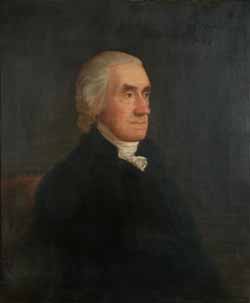
The attorney general of Massachusetts was Robert Treat Paine (shown above). His papers, as published by the Massachusetts Historical Society, are our fullest source on what happened next. At the grand jury proceedings in February 1785, all three men pled not guilty, and their trial was scheduled for 3 March.

Prospects looked bleak for Nero Faneuil. He was charged with two thefts instead of just one. Testimony established that “no part of the Property [from Lovell was] found on any but Nero.” And he was the only black man arrested.

But I think Faneuil also had an important asset: he was local. People in town knew him. According to Paine’s notes, Benjamin Hichborn testified, “Nero’s Character for Truth good.” [I think Hichborn was a slippery character himself, but he was a genteel, well-connected lawyer.] In contrast, Archibald and Scott had recently drifted into town from the south.

In addition, Faneuil seized an opening. Lovell was anxious to locate his stolen papers. He asked Scott on “the day after they were cmtted” where those were, and recalled that Scott answered “that the negro was the only person who could give me informn.” Lovell then went to Faneuil, who testified, “Mr. Lovel told me if I wd. Confess I should be a Witness.” Faneuil therefore turned state’s evidence against Archibald and Scott.

But first, Faneuil pled guilty to the Fullerton theft. The court sentenced him to be branded on the forehead with the letter “B” for “burglar.” It also ordered him to restore Fullerton’s goods and pay £84 as treble damages, which everyone must have known was beyond his means. Faneuil declared that he couldn’t pay, and the court sentenced him to serve Fullerton for seven years. He was thus thrown back into servitude.

TOMORROW: At the trial.

Thursday, February 28, 2019

A Break-in at James Lovell’s House

On 29 Nov 1784, the American Herald newspaper of Boston carried this crime report from the previous week:

The House of the Hon. JAMES LOVELL, Esq; was, on Tuesday night last [23 November], broke open, and an iron Chest, containing some valuable papers, and a little cash stolen.

And, the next Friday, three villains, viz. William Scott, Thomas Archbald and Nero Funnel, Negro, were apprehended, and the money being found upon them, they were committed to goal.
Lovell was an important man in Boston. Before the war he was an usher, or assistant teacher, under his father at the South Latin School, but then after the Battle of Bunker Hill the military authorities locked him up and then took him to Canada. That suffering provided the credentials for Massachusetts to elect Lovell to the Continental Congress in 1778. He was a delegate until 1782, at some points basically running American foreign policy because no one else was so interested.

In 1784 Lovell became collector of Continental taxes in Massachusetts. Thus, the “valuable papers” he had in a trunk in his home could have been quite valuable indeed.

The 1 December Massachusetts Centinel provided additional information that “part of the papers were recovered, tho’ a large amount are supposed to have been burnt.”

That newspaper also had this report about a related crime:
On Monday a quantity of dry goods were found concealed in a barrel near Mr. Calf’s tan yard; upon examination it appears that they were stolen from Mr. [John] Fullerton’s shop, by a negro fellow called Nero Funnel, one of the villains that stole Mr. Lovell’s chest.
The three suspects were kept in jail until the court session began in February.

TOMORROW: In court.