


The Graphic Side of The British Are Coming
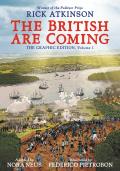
Speaking of comics, this Sestercentennial summer has also brought us The British Are Coming: The Graphic Edition, Volume 1, adapted from the first half of the first volume of Rick Atkinson’s ongoing history of the Revolutionary War.
The comic is credited to Atkinson, Nora Neus as adapter, and Federico Pietrobon as artist. This Altoona Mirror article on the project in progress and this WGBH interview with Atkinson on publication show how he approved work as it came along.
Yet it’s clear that Neus, a journalist and oral historian, made the creative choices in adapting hundreds of pages of dense, fact-filled narration into comics form for Pietrobon to illustrate.
As a CNN producer, Neus picked up the video dispatches of young Muhammad Najem from the midst of the Syrian Civil War and later worked with him to script the graphic memoir Muhammad Najem, War Reporter. She also scripted Renegade Girls, historical graphic fiction, for the same artist, Julie Robine.
The strategy Neus followed for this book, no doubt with Atkinson’s and Ten Speed Press’s approval, was to minimize the words. There are short captions to set the scenes and occasional labels to identify some individuals. All the speech balloons appear to be quotations from actual participants in the events. There are also sound effects, particularly the “BANG” of muskets. But there are an uncommonly large number of panels with no words at all.
The result doesn’t work. Almost all those quotations come perforce from written sources created after the fact, so they don’t read like speech in the moment. The speakers are rarely identified, though I’m sure the sources could all be searched out in the prose edition. The captions don’t provide enough background to understand most events, though military strategy gets a little more analysis than political developments.
In addition, because the siege of Boston was largely static from July 1775 to March 1776, with not much changing despite all the activity, the book devotes proportionally more pages to smaller campaigns: Gen. Richard Montgomery and Col. Benedict Arnold’s thrusts in Canada, Gov. Dunmore’s struggle in Virginia, and the Royal Navy attack on Falmouth.
The spare verbiage puts more burden on the art to convey the history to readers. Occasional infographics, including maps, take advantage of the visual format to impart useful information. But most of the art consists of straightforward, rather slow-paced depictions of events. And those depictions aren’t visually accurate. Pietrobon, working in Italy, didn’t get the guidance, visual references, and time that task would need.
One of my litmus tests of the right look for the late-1700s British Empire is whether a comic shows men with beards, mustaches, and sideburns, which that society shunned. In this book we see men with facial hair on just about every other page spread. Other tests: Does the art render the British flag of the 1770s correctly? No. Does it depict newspapers and shop signs in eighteenth-century style? No. Do all the women have their hair up? Not on page 208.
Except for George Washington, few individuals are recognizable, even when we know what they looked like from good portraits. Likewise, known settings such as King Street in Boston and the Lexington common appear strange. Other places, like Washington’s Cambridge headquarters and Yale College, are all too recognizable because Pietrobon relied on photographs of their present forms.
To assess panel breakdowns, I looked at an episode I’ve studied to death, the Battle of Lexington and Concord (shown on pages 21–49). This rendering starts by showing Lord Dartmouth’s strong suggestion to arrest Patriot leaders and Gen. Thomas Gage’s order to destroy armaments; we see those men’s own words, but the book doesn’t note or explain the difference for readers.
The commander of the British expedition reads his orders before leaving Boston, not after. Paul Revere and William Dawes are shown spotting the redcoats on the march in Cambridge and then setting out west together, not dispatched separately by Dr. Joseph Warren. Then comes the lantern signal from Old North Church, which is placed out in an open field, not on a hill in a dense neighborhood. We never see anyone receiving that signal (and in fact it didn’t matter to how events turned out).
The few seconds of confrontation in Lexington fill seven pages—perhaps proportionate to the importance of that event, but also an indication of how strung out the action is.
At Concord, the British enter in ranks over a hillside rather than along the road. The coloring on page 38 inexplicably changes from day to twilight. The terse description the troops’ search suggests they found nothing in town and all proceeded west. The fight at the North Bridge is portrayed as “a motley crew of farmers and part-time militiamen” stopping the British from crossing. In fact, four companies of regulars had already passed that point without opposition, and most of the British soldiers were still searching the center of town. Only three companies of redcoats were at the bridge, so the provincials were the larger force trying to take control of that chokepoint.
Much of that history is counterintuitive, calling out for explanation. But by choosing to use only historic quotations and minimizing the word count, the creators of this graphic recounting hobbled their ability to explain.
In its verbal approach and pacing, The British Are Coming: The Graphic Edition, Volume 1 might have worked as a visual teaser or accompaniment for Atkinson’s full prose volume—a way to give readers images of its complete, detailed, and explicated narration of events. But the many inaccuracies in the art undercut that value.
Steve Donoghue assessed the volume at Open Letters Review as a reader of history and comics rather than a historian plowing the same field. He came away disappointed as well.
The comic is credited to Atkinson, Nora Neus as adapter, and Federico Pietrobon as artist. This Altoona Mirror article on the project in progress and this WGBH interview with Atkinson on publication show how he approved work as it came along.
Yet it’s clear that Neus, a journalist and oral historian, made the creative choices in adapting hundreds of pages of dense, fact-filled narration into comics form for Pietrobon to illustrate.
As a CNN producer, Neus picked up the video dispatches of young Muhammad Najem from the midst of the Syrian Civil War and later worked with him to script the graphic memoir Muhammad Najem, War Reporter. She also scripted Renegade Girls, historical graphic fiction, for the same artist, Julie Robine.
The strategy Neus followed for this book, no doubt with Atkinson’s and Ten Speed Press’s approval, was to minimize the words. There are short captions to set the scenes and occasional labels to identify some individuals. All the speech balloons appear to be quotations from actual participants in the events. There are also sound effects, particularly the “BANG” of muskets. But there are an uncommonly large number of panels with no words at all.
The result doesn’t work. Almost all those quotations come perforce from written sources created after the fact, so they don’t read like speech in the moment. The speakers are rarely identified, though I’m sure the sources could all be searched out in the prose edition. The captions don’t provide enough background to understand most events, though military strategy gets a little more analysis than political developments.
In addition, because the siege of Boston was largely static from July 1775 to March 1776, with not much changing despite all the activity, the book devotes proportionally more pages to smaller campaigns: Gen. Richard Montgomery and Col. Benedict Arnold’s thrusts in Canada, Gov. Dunmore’s struggle in Virginia, and the Royal Navy attack on Falmouth.
The spare verbiage puts more burden on the art to convey the history to readers. Occasional infographics, including maps, take advantage of the visual format to impart useful information. But most of the art consists of straightforward, rather slow-paced depictions of events. And those depictions aren’t visually accurate. Pietrobon, working in Italy, didn’t get the guidance, visual references, and time that task would need.
One of my litmus tests of the right look for the late-1700s British Empire is whether a comic shows men with beards, mustaches, and sideburns, which that society shunned. In this book we see men with facial hair on just about every other page spread. Other tests: Does the art render the British flag of the 1770s correctly? No. Does it depict newspapers and shop signs in eighteenth-century style? No. Do all the women have their hair up? Not on page 208.
Except for George Washington, few individuals are recognizable, even when we know what they looked like from good portraits. Likewise, known settings such as King Street in Boston and the Lexington common appear strange. Other places, like Washington’s Cambridge headquarters and Yale College, are all too recognizable because Pietrobon relied on photographs of their present forms.
To assess panel breakdowns, I looked at an episode I’ve studied to death, the Battle of Lexington and Concord (shown on pages 21–49). This rendering starts by showing Lord Dartmouth’s strong suggestion to arrest Patriot leaders and Gen. Thomas Gage’s order to destroy armaments; we see those men’s own words, but the book doesn’t note or explain the difference for readers.
The commander of the British expedition reads his orders before leaving Boston, not after. Paul Revere and William Dawes are shown spotting the redcoats on the march in Cambridge and then setting out west together, not dispatched separately by Dr. Joseph Warren. Then comes the lantern signal from Old North Church, which is placed out in an open field, not on a hill in a dense neighborhood. We never see anyone receiving that signal (and in fact it didn’t matter to how events turned out).
The few seconds of confrontation in Lexington fill seven pages—perhaps proportionate to the importance of that event, but also an indication of how strung out the action is.
At Concord, the British enter in ranks over a hillside rather than along the road. The coloring on page 38 inexplicably changes from day to twilight. The terse description the troops’ search suggests they found nothing in town and all proceeded west. The fight at the North Bridge is portrayed as “a motley crew of farmers and part-time militiamen” stopping the British from crossing. In fact, four companies of regulars had already passed that point without opposition, and most of the British soldiers were still searching the center of town. Only three companies of redcoats were at the bridge, so the provincials were the larger force trying to take control of that chokepoint.
Much of that history is counterintuitive, calling out for explanation. But by choosing to use only historic quotations and minimizing the word count, the creators of this graphic recounting hobbled their ability to explain.
In its verbal approach and pacing, The British Are Coming: The Graphic Edition, Volume 1 might have worked as a visual teaser or accompaniment for Atkinson’s full prose volume—a way to give readers images of its complete, detailed, and explicated narration of events. But the many inaccuracies in the art undercut that value.
Steve Donoghue assessed the volume at Open Letters Review as a reader of history and comics rather than a historian plowing the same field. He came away disappointed as well.

No comments:
Post a Comment