J. L. BELL is a Massachusetts writer who specializes in (among other things) the start of the American Revolution in and around Boston. He is particularly interested in the experiences of children in 1765-75. He has published scholarly papers and popular articles for both children and adults. He was consultant for an episode of History Detectives, and contributed to a display at Minute Man National Historic Park.

Subscribe thru Follow.it


•••••••••••••••••


Showing posts with label Fitchburg. Show all posts

Thursday, June 05, 2025

More Talks on the Battle of Bunker Hill and Its Aftermath

Here are more upcoming talks that look ahead to the Sestercentennial of the Battle of Bunker Hill.

Tuesday, 10 June, 6:00 P.M.
Courage and Resolve in Nation and Institution Building
Massachusetts General Hospital and online

Major General Joseph Warren’s death at the Battle of Bunker Hill on June 17, 1775, secured his legacy as a Revolutionary War hero. Lesser known is his role as an advocate for organized healthcare for the poor and needy. Both he and his brother John advanced American medicine during the Revolutionary and Early Republic eras. In the early 1800s, John’s son Dr. John Collins Warren would build upon those ideals through his own role in co-founding the Massachusetts General Hospital. Biographer Dr. Samuel Forman explores the lives of these three men and their continued influence on current health care.

This free event will take place in the hospital’s Paul S. Russell, M.D., Museum of Medical History and Innovation at 2 North Grove Street. Register for a seat or a link here.

Thursday, 12 June, 5:30 P.M.
General James Reed and the Battle of Bunker Hill
Main Street Studios, 569 Main Street

The Fitchburg Historical Society says, “Join us for fun discussion,” part of a series on “Local Stories from the American Revolution.” It looks like society officials will provide the basic information.

Continental Army general James Reed (1722–1807) lived in Fitchburg when it was part of Lunenburg and again in the last decade of his life. He was born in Woburn, however, and starting in 1765 led a settlement in Fitzwilliam, New Hampshire. After war broke out, Reed returned to Massachusetts as colonel of a New Hampshire regiment and fought alongside Col. John Stark at the rail fence. In mid-1776 Reed was assigned to the Northern Department, helping the retreat from Canada. He contracted smallpox, lost his sight, and retired from the army.

Friday, 13 June, 10:00 A.M.
Rebels, Rights & Revolution: Battle of Bunker Hill
Massachusetts Historical Society, Boston

Join Chief Historian Peter Drummey for a gallery talk on the exhibition, “1775: Rebels, Rights & Revolution,” which charts major Massachusetts events in the first year of the American Revolution. Drummey will discuss the impact of the Battle of Bunker Hill using items on display. Visitors are invited to explore the rest of the exhibition and ask questions.

Friday, May 31, 2019

“Declaring Independence: Then & Now” in Concord, 2 June

The next session of the “Declaring Independence: Then & Now” public reading and discussion of the Declaration of Independence will take place on Sunday, 2 June, in Concord.

“Declaring Independence: Then & Now” is a program developed by the Freedom’s Way National Heritage Area and the American Antiquarian Society. I observed multiple sessions last year as part of an American Association for State and Local History evaluation. Every session is different, depending on what the local partners and attendees choose.

The basic questions are:
What does the Declaration of Independence mean today and what did it mean to citizens throughout the Freedom’s Way National Heritage Area when it was conceived and debated during their lifetime? The thought-provoking public performance piece Declaring Independence: Then & Now seeks to answer this question by integrating a reading of the Declaration of Independence with first-person accounts presented by living-history performers. As the 18th-century words and ideas are performed, the narrator explores their meaning to challenge the audience to consider their relevance and power for today.
The First Parish in Concord’s Social Action Council is hosting a session at the First Parish, 20 Lexington Road, from 12:30 to 2:00 P.M. The event is free, and the public is invited to come and participate in the discussion. 

The next “Declaring Independence: Then & Now” session on the schedule is at the First Parish Church of Fitchburg, 923 Main Street, on Thursday, 20 June, starting at 6:00 P.M. That is co-hosted by the Fitchburg Historical Society. 

Thursday, June 22, 2017

Declaring Independence , 27 June–July 4

In connection with other historical organizations and venues, the Freedom’s Way National Heritage Area and the American Antiquarian Society are presenting a series of public performances of “Declaring Independence—Then & Now.”

These are presentations about forty minutes long in which a narrator and five costumed re-enactors bring to life the Declaration of Independence as seen from the local level in the community where they are speaking.

Each presentation includes voices from the host town or city in 1776. That spring, the Massachusetts legislature invited town meetings to discuss whether it was time to declare independence from Great Britain. Those responses, as well as newspaper essays and letters, create the tapestry of public debate.

“Declaring Independence” presentations then proceed to a complete reading of the Continental Congress’s Declaration of July 1776 (with the obscure bits explained). Finally, the presenters and audience engaged in a moderated discussion of the issues that the Declaration raises today.

The upcoming performances of “Declaring Independence” are:

27 June, 7:00-8:30 P.M.
American Antiquarian Society, Worcester

29 June, 6:00-8:00 P.M.
Longfellow’s Wayside Inn, Sudbury, with the Sudbury Historical Society

1 July, 7:00-8:30 P.M.
First Parish Church, Fitchburg, with the Fitchburg Public Library & Fitchburg Historical Society

1-4 July, 10:00 A.M. & 12:00 noon
Old Sturbridge Village, Sturbridge

2 July, 1:00, 3:00 & 5:00 P.M.
Old North Church, Boston, with Boston’s Harborfest

4 July, 7:00-8:30 P.M.
The Depot, Lexington, with the Lexington Historical Society

Contact the host organizations for more information about each event. “Declaring Independence” is an outgrowth of the Patriots’ Paths project, in which Freedom’s Way historian Mary Fuhrer works with members of a community to explore its primary documents about America’s move toward independence. If you want your local historical organization to help create and host a future presentation, contact Freedom’s Way.

Sunday, August 14, 2016

But Enough about Me—Let’s Talk about My Book

Laura Beach of Antiques and the Arts recently interviewed me about how I got into researching and writing history and then creating this blog. Here’s a taste of that exchange:
How broad is public interest in American history?

American history at this level is a niche interest, but, like any niche, it has fervent followers. The way media is going, it’s all niches and fervent followers. Americans are interested in parts of history they see as significant to the nation: the settlement period, the founding, the Civil War, for instance. People who write about these periods in a dramatic fashion, which doesn’t necessarily mean poorly researched, really grab a nerve.
Go here for the rest.

If that’s not enough of me, Lee Wright of The History List archived my session at the Pioneer Valley History Camp earlier this summer. My talk, drawn from The Road to Concord, was titled “How the British Empire Lost New England Seven Months Before the Revolutionary War.” That video is here.

Lee shared two more talks as well:
Speaking of The Road to Concord, it’s received some nice reviews on Amazon, for which I’m very grateful. One reader called for a movie adaptation. Another felt the book has too much information for his taste, and I’m just going to have to live with that. I do load it on.

Monday, May 05, 2014

The Man with Two Monuments

Yesterday Bob O’Hara described the transformation of Thomas Cowdin from his central Massachusetts town’s most notorious opponent of military action against the Crown to the same town’s American militia leader and legislative representative. Here’s the end of that story.

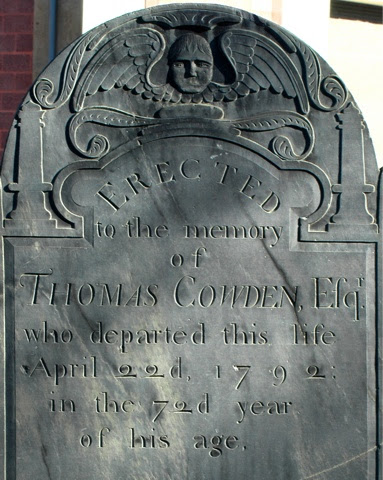
Thomas Cowdin, Esq., died in Fitchburg on 22 Apr 1792. He turned out to be as notable in death as he was in life because by an accident of history he is the only person in the town with two gravestones.

If you stand today at Fitchburg’s minuteman monument and look off to the southwest, you can just make out Thomas Cowdin’s great granite obelisk on the crest of the Laurel Hill Cemetery. But if you turn and look to the south, behind a row of trees and some rundown buildings, you may be able to spot Fitchburg’s original village burying ground, the tiny and almost forgotten South Street Cemetery. There you will find Thomas Cowdin’s actual grave, in company with the graves of several of the Fitchburg minutemen who were quicker to respond to the Lexington alarm than he was.

In 1884 one of Thomas Cowdin’s grandsons, John Cowdin of Boston, decided that the tiny colonial burying ground was not a suitably prominent place of rest for his prominent ancestor. He made arrangements for a granite obelisk to be erected at the top of Laurel Hill, overlooking the whole of downtown Fitchburg, and to have Thomas’s remains, along with the remains of his wife second Hannah, reinterred at the new location. The granite obelisk was put in place, but John Cowdin died before his grandparents’ graves could be moved.

The Laurel Hill obelisk thus stands as an accidental cenotaph. No casual visitor passing it today would ever know that Thomas Cowdin, Esq., the reluctant revolutionary, isn’t even there.

For more on Thomas Cowdin’s life and times, try these references, all of which are available online:
  • Fosdick, Charles. 1895. Captain Thomas Cowdin’s journal. Proceedings of the Fitchburg Historical Society, 1: 135-146. (Transcribing Cowdin's diary from 25 May to 2 June 1784 during one of his periods of service on “the Grate & General Coart.“)
  • Garfield, James F.D. 1908. Fitchburg soldiers of the Revolution. Proceedings of the Fitchburg Historical Society, 4: 172-232. (The standard reference on Fitchburg during the Revolution.)
  • Howard, Ada L. 1902. Captain Thomas Cowdin. Proceedings of the Fitchburg Historical Society, 3: 19-38. (A somewhat romanticized family portrait, by a descendant.)
  • Stearns, Ezra S. 1914. Capt. Thomas Cowdin in the Revolution. Proceedings of the Fitchburg Historical Society, 5: 270-277. (Transcribing the records of Cowdin’s arrest and trial in August 1775.)

Thanks for the story, Bob! Those references are a good reminder of how many smaller historical societies used to have publishing programs sharing local resources and lore. The volumes those societies created, often little known outside the area, have lots of Revolutionary stories to rediscover and expand on.

Sunday, May 04, 2014

The Transformation of Thomas Cowdin

Today Bob O’Hara continues his story of Thomas Cowdin, an Irish-born farmer who became a prominent landowner in central Massachusetts.

In the weeks that followed the battle of Lexington and Concord, it’s tempting to think that all the residents of Massachusetts sorted themselves neatly into Patriot and Tory camps, with one side laying siege to Boston and the other side coming under siege in their homes and villages all across the countryside. But the career of Thomas Cowdin of Fitchburg reminds us that revolutions are rarely neat—for Thomas Cowdin was indeed a soldier of the Revolution, but not at first.

As described yesterday, when news of the fatal shots at Lexington and Concord reached Fitchburg, Cowdin resisted the call to join the militia alarm. But in August 1775, he traveled to the siege lines to ask Continental authorities for a commission as an army officer.

Cowdin’s reputation for reluctance had preceded him, however. Reporting for duty four months after the war had begun looked suspicious to some of his fellow townsmen. When Cowdin arrived in Cambridge, he was promptly arrested by Gen. Nathanael Greene for having “invariably opposed every Measure pursued for the Restoration of our violated Previlages,” and he was sent to Gen. George Washington’s headquarters on 6 Aug 1775 for examination. Washington, skillful politician that he was, declined to involve himself in a local matter and referred the Cowdin case to the newly-reconstituted Massachusetts legislature, then sitting at Watertown.

Before that assembly two days later, Cowdin acknowledged that he had been “Backward In town Affairs with Regard to the Liberties of the Country.” He begged “the forgiveness of the honourable Board & hous of Representatives & all the good People of this Country,” declaring that he was “Now Ready to Convince the World of this Solemn Declaration not only by Word Interest—but even by exposing my life itself if my Country Calls me there to.”

After due consideration of his public apology, the General Court politely declined to recommend Cowdin for the commission he was seeking. But because they did apprehend in him “evidence of a Reformation,” they agreed to send him home to Fitchburg with a certificate “for his own security against the further resentment of the Publick for his past offences.”

But Thomas Cowdin was never one to sit still, and over the coming two years he worked assiduously to regain the trust of his Fitchburg neighbors. By 1777 he was again accepted into the town’s militia company and served in New York. By 1779 he was that company’s captain. The next year, his townsmen elected him as their first representative to the Massachusetts General Court under the new state constitution drafted by John Adams. The General Court was the same body that had denied him a commission in 1775, so he surely must have considered his rehabilitation complete.

TOMORROW: The man with two monuments.

Saturday, May 03, 2014

Thomas Cowdin of Fitchburg, Reluctant Revolutionary

While I’m out of town this weekend at a conference, I’m gratefully taking the opportunity to run some guest postings from Bob O’Hara, sharing the story of a prominent man from central Massachusetts.

This year is the 250th anniversary of the founding of Fitchburg, which was set off from its parent town of Lunenburg in 1764. In honor of that anniversary it’s worth remembering “Squire Cowdin,” who was for many years one of the young town’s biggest men.

If you stand today at Fitchburg’s minuteman monument, on the banks of the Nashua River in the heart of the city, and look to the southwest, you can just make out on the crest of the nearby Laurel Hill Cemetery one of the largest obelisks on the grounds: the memorial to Thomas Cowdin, Esquire.

Cowdin was born on Christmas Day in 1720 in the north of Ireland, the first son of James Cowdin and his wife Janet (Craige) Cowdin, who emigrated to New England about 1728 and who settled, along with many other Scots-Irish migrants of the time, near Worcester.

Thomas grew up and in 1748 married, in Worcester, Experience Grey or Gray, with whom he had four children. Experience died in 1760, and in Rutland the next year Thomas married Hannah Craige, with whom he had nine more children, for a total of thirteen in all. Thomas himself always wrote his surname “Cowdin,” but it often appears as “Cowden” in the documents of the time.

As a young man Thomas Cowdin served king and country at the first siege of Louisbourg during King George’s War in 1745, and then later as captain of a company of foot at Crown Point during the French and Indian War in 1762.

Soon after Fitchburg was incorporated, Thomas and his second wife removed to the new town, perhaps sensing opportunity. By the time of the 1771 tax census Thomas was by far the wealthiest man in the community, owning forty acres of mowing land and fifty acres of pasture, as well as one of the two taverns in the town. He also had two “servants for life,” as the tax valuation called them.

When Massachusetts broke out in open armed rebellion in the spring of 1775, Thomas Cowdin was fifty-four years old, so he might have been excused from marching to confront the redcoats. But when the alarm guns were fired on the morning of the Lexington Alarm, he tried to prevent two of his hired hands from setting aside their work and going to the militia assembly point.

TOMORROW: The transformation of Thomas Cowdin.

Tuesday, June 19, 2012

The Gravestone of James Reed

My recent postings about Col. James Reed of New Hampshire and his regiment brought a message and photo from Boston 1775 reader Robert J. O’Hara. I decided to adapt them into a guest blogger posting, letting me rest in peace on new material for another day.

James Reed is buried in the Laurel Hill Cemetery in Fitchburg, under a fine large stone carved in John Dwight’s workshop in Shirley. He might have become as well known as his fellow New Hampshireman John Stark, but the year after Bunker Hill he became ill, possibly with smallpox, and this left him almost totally blind. He retired to Keene, and then eventually to Fitchburg, where he lived in a house on the lot now occupied by the Fitchburg City Hall. He died there in 1807.


JAMES REED
Born at Woburn 1723
In the various Military scenes
In which his country was concerned
from 1755 to the superiour conflict
distinguished in our history as the
Revolution
He sustained Commissions.
In that Revolution, at the import-
ant post of Lake George,
he totally lost his sight.
From that period to his death he
receiv’d from his country the
retribution allowed to pensioners
of the rank of
Brigadier General.
died at Fitchburg
February 13th 1807.

Please visit this webpage for more information and photos about Fitchburg’s cemeteries.

Thanks, Bob!