J. L. BELL is a Massachusetts writer who specializes in (among other things) the start of the American Revolution in and around Boston. He is particularly interested in the experiences of children in 1765-75. He has published scholarly papers and popular articles for both children and adults. He was consultant for an episode of History Detectives, and contributed to a display at Minute Man National Historic Park.

Subscribe thru Follow.it


•••••••••••••••••


Showing posts with label Continental soldiers. Show all posts

Thursday, September 03, 2026

“Environmental Histories of New England” in Boston, 18 Sept.

On Friday, 18 September, the Massachusetts Historical Society will host the New England Quarterly Symposium on Environmental Histories of New England, 1600-2026.

Papers relevant to our period include:
  • “Preserving the Catch: Curing Practices, Environmental Agency, and the Eighteenth-Century New England Commercial Cod Fishery” by Morgan S. Hardy, University of Tennessee
  • “Beyond ‘Hot Girl Summer’: Rural Life and Gendered Experiences of Seasonal Variability in Eighteenth-Century Northern New England” by Emma C. Moesswilde, Elon University
  • “Many Are These Awfully Sudden Deaths: Mapping the Environmental History of Boston’s 1721 Epidemic” by Christopher Parsons, Northeastern University, and Molly Nebiolo, Butler University
  • “Environmental history with/for Indigenous communities: Examples from Acadia” by Catherine Schmitt, Schoodic Institute at Acadia National Park
  • “‘A Fishay Noyse’: Taunton’s Herring Crisis and New England Energy Futures” by Zachary Bennett, Norwich University
The keynote address at the end of the day will be “Tom Paine’s Sunshine Soldiers” by Joyce Chaplin, the James Duncan Phillips Professor of Early American History at Harvard University.

Registration, which includes food, costs $20. The event is free for graduate students, teachers, and adjunct faculty.

On the afternoon before the symposium, the Norman B. Leventhal Map & Education Center, a co-sponsor of the event, will host an open house in its facilities at the Boston Public Library central building.

For the full program and registration information, start at this page.

Sunday, August 30, 2026

Long Island Has Fallen

On the morning of 30 Aug 1776, 250 years ago today, Gen. William Heath was stationed at Kingsbridge, New York, on the Hudson River just north of Manhattan Island.

Heath wrote urgently to his commander-in-chief:
A very Extraordinary Report has Just Spread here, that whether True or false we are as yet uncertain That Long-Island is Evacuated by Our Troops. . . .

I am in Anxiety Untill I hear from you
This letter is transcribed at Founders Online, and the Massachusetts Historical Society has digitized Heath’s copy.

Likewise, Abraham Yates, Jr., head of the New York committee of safety, wrote to the commander from the same place:
In our way to Fishkill agreable to an adjournment of the Convention, we are informed that the Army is removed from Long Island to the City of New York—

an anxiety to know the fact, as well as to be informed wether you think any measures necessary for us to take—Induces us to trouble your Excellency at this time for an answer hereto—

We have ordered last Night all the Militia of the Counties of Ulster, Dutchess, Orange and Westchester to be ready at a Minutes warning, with five days provisions.
Gen. George Washington wrote back to Yates:
Circumstanced as this Army was in respect to Situation Strength &c., it was the unanimous advice of a Council of General Officers to give up Long-Island, and not by divideing our Force be unable to resist the Enemy in any one point of Attack, this reason added to some others, particularly the fear of haveing our Communication cut of from the Main (of which there seemed to be no Small probability) and the extreame fatigue our Troops were laid under in guarding such extensive Lines, without proper Shelter from the weather, induced the above Resolution.

It is the most intricate thing in the World Sir to know in what manner to conduct ones self with Respect to the Militia, if you do not begin many days before they are wanted to raise them, you cannot have them in time, if you do they get tired and return, besides being under very little Order or Government whilst in Service—

However if the Enemy have a design of serveing of Us at this place as we apprehended they meant to do on Long-Island—it might not be improper to have a body in readiness to prevent or retard a Landing of them on the East of Harlem River, if need be—

In haste & not a little fatigued, I remain with great Respect & Esteem Sir Yr Most Obedt Hume sert…
Washington let the adjutant general, Joseph Reed, reply to Heath:
The Report of the Evacuation of Long Island last night is true—it was a Measure founded in the fullest Necessity after the Surprize of our Troops last Tuesday [the Battle of Brooklyn], by which the Flower of our Army & some of our best Officers were lost.

add to this that the constant Rains upon Troops without Cover has so spoil’d the Ammunition & enfeebled the Men that had the Enemy attempted to force our Lines they must have done it with great Ease. The Ships have also been trying to get up the whole Week, which if they could effect our Communication would have been cut off and the whole Army must have surrendered at Discretion.

Under these Circumstances the remaining General Officers were unanimously of Opinion that it was absolutely necessary to retreat which was done so as to bring off all our Ammunition & Artillery except the heavy Pieces & most of our Provisions

Our Situation is in all Respects critical Ld. Stirling & Gen. [John] Sullivan are both Prisoners—the latter was permitted to come out this Morning on his Parole with a Message from Ld. Howe. This is the Substance of what has passed in this important Week.

Wednesday, August 26, 2026

Identifying a Revolutionary Unknown Soldier at Camden

Last month the Independent newspaper reported on the identification of remains from the Revolutionary War using a relatively new method.

The story started on the battlefield at Camden, where on 16 Aug 1780 Gen. Cornwallis’s redcoats decisively defeated a Continental force under Gen. Horatio Gates.

The article says:
Archaeologists surveying the area in 2020 came across human bones protruding from the ground. Eventually, 14 sets of remains were identified — 12 of them Continental soldiers. The others were determined to be connected to the British side and were reburied at the battlefield.

The Richland County Coroner’s Office had worked with Texas-based FHD Forensics on modern-day cases and asked for their help.
The head of that organization is Allison Peacock. She and her associates use the immense databases of genetic code that have built up in recent decades to find unknown biological relatives for a range of reasons.

One of the American corpses was labeled “Camden 9B” as the second body retrieved from the ninth excavated burial.
The 12 Continentals were later reinterred [in 2023] with full military honors. Camden 9B’s headstone read: “UNKNOWN. REV WAR. BATTLE OF CAMDEN. AUG 16 1780.”

Meanwhile, samples from two of the soldiers were sent to Astrea Forensics in California for DNA extraction and sequencing. . . .

From a petrous portion of the temporal bone, a delicate structure behind the ear at the base of the skull, they successfully extracted DNA that generated [Camden 9B]’s entire genome. Peacock’s team then uploaded the data to FamilyTreeDNA and GEDmatch to trace three types of DNA matches: autosomal, X chromosome and Y chromosome.

“We got 20,000 matches to work with,” she said. “So, it was a lot to kind of comb through.”
Another clue was that when Camden 9B died, “the growth plates around his knees had not yet fully closed,” meaning he was still young.

The genetic markers found a match on the maternal line with Russ Hudson, a “retired federal agent in Gettysburg, Pennsylvania.” He offered to join the search in archival sources.

Ultimately, the team found records of a Continental Army private from Anne Arundel County, Maryland, named John Pumphrey. He was in the right age range and had a family connection to Hudson.

Pumphrey’s exact birthdate is unknown, but those growth plates suggest he was between thirteen and fifteen years old when he enlisted in the 7th Maryland Regiment on 6 Jan 1777. He could sign his name only with an X.

As Historic Camden relates, Pumphrey’s regiment served at Brandywine, Germantown, Valley Forge, and Monmouth. He reenlisted on 28 Feb 1779, as shown in the paperwork above. The regiment spent the brutally cold winter of 1780 at Morristown.

In April 1780, the Maryland Line was sent south. The last part of their travels was a brutal trek from Cox’s Mill, North Carolina, to Camden, South Carolina—a difficult route with little food available along the way. Then came the battle for one of the British army’s main inland garrisons.

The skeleton doesn’t preserve clues to how Pvt. Pumphrey died. However, his brigade was part of an especially brutal fight with the 71st Highlanders, and the bodies were found in that part of the field.

Research continues on another of the bodies from the Camden field that had surviving D.N.A.,  now known only as 11A.

Monday, July 13, 2026

“Headquarters of a Revolution” in Cambridge, 19 July

On Sunday, 19 July, the Longfellow House–Washington’s Headquarters National Historic Site in Cambridge will host a commemoration called “Headquarters of a Revolution: Washington’s Arrival in Cambridge,” coinciding with the 251st anniversary of the new commander-in-chief’s first week living in that mansion.

Here are the events scheduled for that day, including two from me.

10 A.M. to 3 P.M.
Living History
On the Lawn

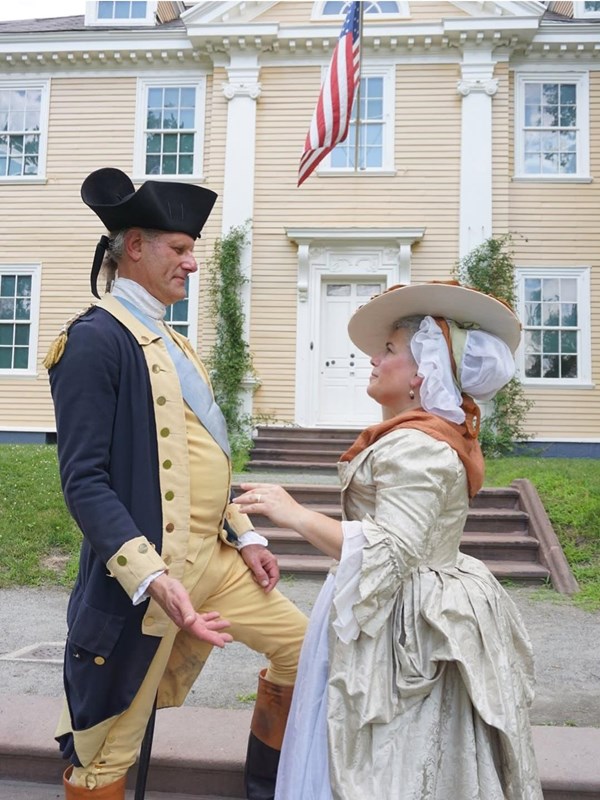
Interact with living historians John Koopman (as George Washington) and Sandy Spector (as Martha Washington), including a noontime Q&A with Mrs. Washington. Free family activities and a story walk available all day.

10 and 11:30 A.M., 2:30 P.M.
House Tour: Headquarters of a Revolution
Starting in the Visitor Center

General George Washington’s Cambridge headquarters was a testing ground for many of the ideals, institutions, and questions that still define our nation. This conversational tour with an N.P.S. ranger explores Cambridge Headquarters as a hub of revolutionary activity, where generals, enslaved people, paid laborers, poets, Indigenous diplomats, politicians, and soldiers shaped history—and how later generations would shape its memory.

10:15 A.M.
Get Ready with Martha
Carriage House

Learn all about the clothing of 1775 as Mrs. Washington finishes dressing for her day. There will be some stories and some gossip, too! Sandy Spector is a Boston-based historian, researcher, and interpreter, and has been a Revolutionary War reenactor since 2000. She spends most of her time researching and interpreting Mrs. Washington and has been portraying Martha—alone or with George—in numerous states and venues for the past 10 years.

11:30 A.M. to 12:15 P.M.
The Last British Army to Come Through Cambridge
Carriage House

In November 1777, nearly 6,000 soldiers of the king arrived in Cambridge. With them came about a thousand women and children. These weren’t invaders but prisoners of war, British and German, captured at Saratoga. Top officers were housed in mansions along “Tory Row” while enlisted men went into the leftover barracks on Prospect and Winter Hills. Over the next few months Cambridge, Charlestown, and neighboring towns had to adjust to a new population under guard. J. L. Bell explores what we should remember about this “Convention Army” as we approach the 250th anniversary of its arrival.

12:30 to 1:15 P.M.
“Though Dwelling in a Land of Freedom”
Carriage House

Join poet, educator, and Darby Vassall descendant Denise Washington for an exploration of Revolutionary-era freedom struggles surrounding Washington’s Headquarters through the lens of Anthony, Cuba, and Darby Vassall, as well as Phillis Wheatley Peters.

1:30 to 3 P.M.
The Black Patriots of Lexington – Silas Burdoo
Carriage House

This film explores the role that third-generation Lexington resident Silas Burdoo played in the Revolutionary War, starting with the battle on 19 Apr 1775. Burdoo was a grandson of Ann and Philip Burdoo, who married in Medford in 1704 and then purchased 40 acres in Cambridge Farms, which became Lexington. This film screening will be followed by a discussion with Zine Magubane, professor of historical sociology at Boston College, and Sean D. Osborne, producer of the Black Patriots of Lexington YouTube series.

3 P.M.
What Washington Saw on Cambridge Common
Walking Tour starting at the gate at the southern tip of the common

What did the center of Cambridge look like in July 1775? Since April, the town had been the base of the New England army besieging Boston, with war transforming the community. On this walking tour J. L. Bell looks at sites in and around the common, including the first headquarters, buildings turned into barracks, and the Continental artillery’s lost laboratory. How well do the Washington Elm and the Revolutionary monuments that dot the common memorialize the men who were actually there?

All of these events are free, as organized by the National Park Service.

Monday, June 22, 2026

“Orders to march to Breeds Hill in Charlestown”

As I quoted yesterday, in July 1775 the Massachusetts Provincial Congress officially deemed the provincial fortification of Breed’s Hill in Charlestown to have been done “by some Mistake.”

Nine months later, Dr. Cotton Tufts echoed that assessment in a letter to John Adams: “Could a greater Blunder have been committed than that of Breeds Hill. Yet it finally has operated to our Advantage and trust will continue to do so.”

By then, New Englanders had decided that the Battle of Bunker Hill had worked out well because, even though they’d suffered hundreds of casualties and lost territory, the cost for the British army was catastrophic.

Who had made that fateful mistake? The report used the passive voice to avoid naming names, but everyone knew the battlefield commanders who’d overseen the building of the redoubt were Col. William Prescott, Connecticut general Israel Putnam, and Massachusetts colonel Richard Gridley of the artillery.

And the rumor I quoted here absolved Gridley, saying one of the top two infantry officers had insisted on Breed’s Hill. Or, to be exact, either Prescott or Putnam had insisted on digging the redoubt there before fortifying a fallback position on Bunker’s Hill, as the other two men thought wise.

Adams followed up the report from Massachusetts with some questions from Philadelphia. On 25 August, Prescott wrote back: “On the 16 June in the Evening I received Orders to march to Breeds Hill in Charlestown. . . . We arrived at the Spot, the Lines were drawn by the Enginier and we began the Intrenchmant…”

No written orders survive. If Gen. Artemas Ward and his council of war did indeed use the name “Breed’s Hill,” that would be our earliest confirmed example of that label, before the newspapers accounts I quoted here. But it’s also possible Prescott wrote “Breed’s Hill” in hindsight to reflect his understanding of those orders.

Prescott’s letter criticized some other officers. Gridley “the Enginier forsook me.” His “Field Officers being indisposed could render me but Little Service.” That makes it notable that Prescott didn’t complain about Putnam overruling his judgment and insisting on fortifying Breed’s Hill first. It thus seems clear that Prescott had been the officer sticking to that course.

Prescott didn’t take that position (figuratively and literally) because he deemed it more strategic for attacking Boston, as some analysts have argued. He declared that he was following instructions from his superiors. Perhaps those orders included some ambiguous term like “Charlestown Hill.” The memory of such a command probably empowered Prescott to convince Gridley to draw the entrenchment lines despite his and Putnam’s concerns—because that’s what they understood the council of war had told them to do.

TOMORROW: Why that mattered.

Sunday, June 21, 2026

“The detachment marched upon this design to Breed’s hill”

After the British army drove provincial troops off the Charlestown peninsula on 17 June 1775, the Massachusetts committee of safety proposed an inquiry into what happened.

Nominally the committee wanted to respond to statements from Gen. Thomas Gage. But I’m pretty sure those politicians were also wondering what factors led to losing the Battle of Bunker Hill.

On 6 July the committee urged the Massachusetts Provincial Congress to form a committee to write this report. The next day, the congress handed that responsibility back to the committee of safety.

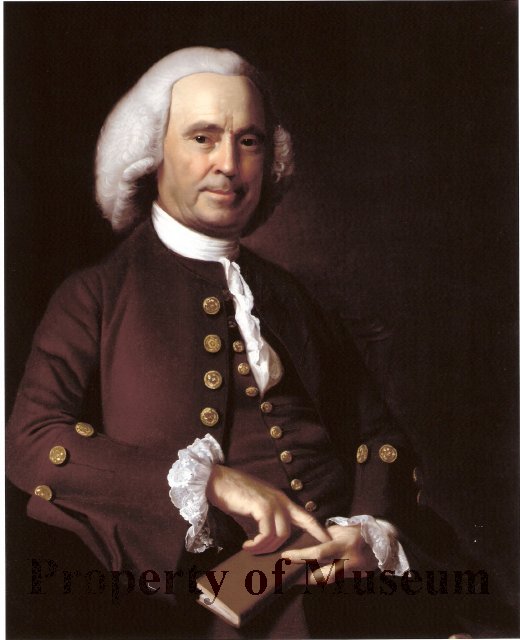
The committee then commissioned three Patriot clergymen—the Rev. Peter Thacher (1752–1802, shown here), William Gordon, and Samuel Cooper—to produce the report. Thacher’s draft was published by the American Antiquarian Society. The final report, dated 25 July, appears in the Adams Papers.

The report says that the New England commanders’ plan was to fortify Bunker’s Hill, near the Charlestown neck:
Genl. Gage had issued Orders for a Party of Troops under his Command, to post themselves on Bunkers Hill, a Promontory just at the Entrance of the Peninsula of Charlestown; upon which it was determined, with the Advice of this Committee, to send a Party who might erect some Fortifications upon said Hill and defeat this Design of our Enemies.
But that’s not what happened.

Thacher’s draft is transcribed as:
about 9 o clock in the evening the detachment marched upon this design to Breed’s hill situated on the further part of the peninsula next to Boston, for by a mistake of orders this hill was marked out for the entrenchment instead of the other hill.
Thacher initially finished that sentence to “the hill behind, Bunkers,” a perspective that conflicted with his earlier “the further part of the peninsula.” And should “next to” be “west of,” as in the final report?

After editing for clarity and brevity, the final language was:
just before 9 oClock they left Cambridge, and proceeded to Breeds Hill, situated on the further Part of the Peninsula West of Boston, for by some Mistake this Hill was marked out for the Entrenchment instead of the other…
That report thus officially distinguished between Bunker’s Hill and Breed’s Hill. As laid out in previous postings, the term “Breed’s Hill” hadn’t appeared in print until shortly after the battle. This report deemed that distinction significant—indeed, a matter of life and death.

Thus, the name “Breed’s Hill” for that part of Charlestown’s geography was solidified by the battle fought there and the need to discuss it. Before June 1775, that might have been the local name, or one of the local names, but it wasn’t on any map, any official document, or any known letter. By the end of July, the “mistake” about Breed’s Hill was on its way to being notorious.

TOMORROW: What difference does it make? 

Thursday, June 11, 2026

Remembering the Battle of Bunker Hill This Week

Next week brings the 251st anniversary of the Battle of Bunker Hill, and the Charlestown Historical Society and partner organizations have planned several events to commemorate it.

On Saturday, 13 June, there will be an Author & Historian Symposium in the lodge beside the Bunker Hill Monument. Among the scheduled speakers from 10 A.M. to 4:30 P.M. are:
  • Timothy Reardon on the Brothers of the Battle of Bunker Hill descendants group 
  • James Philbrick on his ancestor, David Howe
  • Joni and Christine Parker on their ancestor, Benjamin Parker
  • Christian Di Spigna on Dr. Joseph Warren
  • J. L. Bell on the “whites of their eyes” quotation
  • Joe Bagley on archeology in Charlestown, including the dig completed the day before
  • Julie Hall on how public relations shaped the American Revolution
Throughout the day family artifacts, letters, journals, ephemera, and other historic items will be on display for visitors. A musket demonstration by the National Park Service is scheduled for 4:30.

Charlestown’s annual Bunker Hill Day Parade will be on Sunday, 14 June, from 12:30 to 4:30 P.M. I understand through other sources that there will also be a sidewalk demonstration against White House censorship of signs quoting later generations on the monument inside the lodge, as discussed here.

On Tuesday, 16 June, the society, the city of Boston, and GBH will cohost a community viewing of the Bunker Hill portion of Ken Burns, Sarah Botstein, and David Schmidt’s documentary series The American Revolution. Some of the historians, archeologists, and descendants from Saturday will be on hand, as well as Donald R. Ryan, biographer of William Prescott. That discussion will take place from 6 to 8 P.M. in the street-level meeting room of the Bunker Hill Museum.

On Wednesday, 17 June, the Bunker Hill Monument Association will have its annual meeting at 11 A.M. in the museum. Prof. Robert Allison from Suffolk University will speak on “The Importance of the Left Flank and the Rail Fence.” This event is open to B.H.M.A. members and invited guests only.

Finally, from 3:30 to 5 P.M. that Wednesday, the annual Remembrance Ceremony on the monument grounds will be open to the public.

Tuesday, May 26, 2026

“Environmental History & the War of Independence” in Boston, 27 May

David Hsiung is the Dr. Charles R. and Shirley A. Knox Professor of History at Juniata College in Pennsylvania.

For several years he’s been working on the problem of how the enviroment affected the American Revolution, how the Revolution affected the environment, and how it’s possible to study those interactions with the data we have.

That is, of course, a huge topic, so part of the historiographical challenge is, I’m sure, to narrow down and define the questions in a manageable way. In the meantime, I’ve been enjoying his articles and lectures, which always open my eyes to new ways of seeing this history.

On Wednesday, 27 May, David Hsiung will be at the Massachusetts Historical Society for a conversation with Joyce A. Chaplin of Harvard, author most recently of The Franklin Stove: An Unintended American Revolution.

The description of “Curious & Complex Connections: Environmental History & the War of Independence” says:
Many of us give only a moment’s thought about the environment when considering the War of Independence: the slope of Breed’s Hill, the ice-choked Delaware River, and diseases such as smallpox. But what might we gain by connecting biology, ecology, and geology to the thinking and actions of soldiers and civilians? Rebels and British soldiers acquired and used energy in the form of food, fuel, and work animals, which shaped people’s lives, the course of the war, and the direction of environmental change.
This is a hybrid event starting at 6 P.M., with a reception in the preceding half-hour for people attending in person. Attendance costs $10, but is free to M.H.S. members and Card to Culture participants. Listening in online is free. Register for either form of access through this page.

Folks can also take in these talks from Prof. Hsiung:

Wednesday, May 20, 2026

“Entirely useless by breaking off the Trunnions”

Yesterday I started quoting a 29 Apr 1776 letter from the Rev. Dr. Samuel Cooper to Samuel Adams about Boston’s defenses soon after the British military left.

That letter goes on to say:

The Enemy employ’d no little Time in…destroying the Guns: The Trunnions of all of which, except 8 or so, they entirely knock’d off, besides spiking up the Touch holes in the most effectual Manner.
“Trunnions” was a term technical enough not to appear in Dr. Samuel Johnson’s dictionary. Merriam-Webster now defines them as the pivots on which something can be rotated or tilted, particularly the “two opposite gudgeons on which a cannon is swiveled.” (And it defines “gudgeons” as pivots.)

This overhead view of a cannon might convey the information better.
A gun carriage held a cannon by the two horizontal trunnions. They provided the fulcrum that allowed gunners to point the cannon up or down. A cannon without its trunnions was a heavy metal tube, very hard to mount and impossible to aim. Or, as Gen. George Washington deemed the broken guns left behind in Boston, “entirely useless.”

British artillerists broke trunnions to keep the rebels from having useful weapons. In Concord on 19 Apr 1775, Ens. Henry DeBerniere reported, “Capt. [Mundy] Pole of 10th regiment…knock’d the trunnions off three iron 24 pound cannon and burnt their carriages.”

With little other choice, the Continental Army still tried to use such damaged artillery pieces. Dr. James Thacher reported that the army started out with “a few old honey-comb iron pieces, with their trunnions broken off.” The doctor was pleased when Capt. John Manley and Col. Henry Knox brought in some intact guns.

Given that expertise, and necessity, on 24 March Washington expressed hope that Boston’s broken and spiked cannon “may be made serviceable again.” But how?

TOMORROW: A genius appears.

Saturday, April 18, 2026

“Thus did I engage in the arduous Struggle in the commencement of that revolution”

In the summer and fall of 1783, Lt. Joseph Wheaton was feuding with another Continental Army officer. Among the issues was the accusation that he sold rum to the soldiers at a personal profit. There were court-martial proceedings.

Lt. Wheaton wrote what Henry Knox Papers cataloguers call a “Long letter describing his service in the army and denouncing the accusations made in ‘envy’ against him.” That letters said that he’d “been in the army close to eight years,” or since 1775.

In fact, in early 1776 Wheaton appears to have been inside British-held Boston. The earliest evidence he was helping the American side was in late 1777, and his first Continental commission came in early 1779. But suggesting he had been fighting the war from the start sounded more impressive.

Wheaton also appears in the correspondence of the first five Presidents, usually asking for better jobs on the basis of his past services. For example, as John Adams left office, Wheaton sent him this letter:
Having been honord by you with a request to State Some circumstances which took place in the eastern part of the State of Massachusetts in the early part of our revolution, I have taken the liberty now to inclose that Statement to you, and permit me to add, that thus did I engage in the arduous Struggle in the commencement of that revolution with a zeal commensurate With the object, and continued in the armies of my country until tranquility was restored and the object of our contention obtained, Since which I need not add how my feble efforts have been imployed—Notwithstanding I have much reason to fear, that tho’ I am grown grey in Service, I shall be heard of Soon (if any Should deign to enquire after me) in retirement, and in poverty, unable to Support a wife and two young Children my feelings have lately been much agitated by the political disquietude and changes of this Country, on which I make no comment…
After the War of 1812, Wheaton spent years lobbying the U.S. Congress to reimburse him for expenses he allegedly incurred as a quartermaster. Once again he demanded respect for “Having served nine campaigns in the revolution under experienced officers,—commencing on the 11th day of May. 1775, in the capture of the Margaretta…” (Which actually took place in June 1775, and had nothing to do with his financial accounts forty years later.)

Wheaton even passed that mission on to his progeny. Decades after he died in a Baltimore asylum, his heirs were still petitioning Congress for compensation. Wheaton’s Revolutionary War pension file doesn’t have the usual reminiscences from the petitioner and his witnesses in the early 1800s. Instead, it’s all about what congressional committees were deciding about him after the Civil War.

As I said yesterday, it’s possible Joseph Wheaton did take part in attacking H.M.S. Margaretta in June 1775, just as he claimed—over and over. And it’s possible that those claims were exaggerated or completely made up as a way to improve his social standing in the new republic.

All we can be sure of is that the first contemporaneous evidence of Wheaton’s activity during the Revolutionary War shows him seizing a civilian boat on behalf of the Royal Navy.

TOMORROW: Marblehead harbor in 1776.

Wednesday, April 15, 2026

“Sacrificed his home and domestic ties for the cause of liberty”

The story of Joseph Wheaton’s defection from his Loyalist family to the Continental Army was passed down in both branches of the divided family, but the details got fuzzy and/or exaggerated.

E. Alfred Jones published the Canadian Wheatons’ version in his Loyalists of Massachusetts:
Joseph, also a loyalist, was taken prisoner and confined in Concord gaol, where he was successfully induced to join the Americans and was given a commission as ensign.
I haven’t yet found any connection between Wheaton and Concord, but members of the family were indeed detained in 1776.

A U.S. Congressional report in 1879 accepted this version from Joseph Wheaton’s descendants:
that Lieutenant Joseph Wheaton served in the Rhode Island Line from the commencement to the close of the revolutionary war; that his father and ten brothers all held commissions as officers in the British service, and that he alone sacrificed his home and domestic ties for the cause of liberty; that he was disinherited by his father, Colonel Caleb Wheaton, who commanded a regiment of British pioneers, who to the day of his death never forgave his son for what he considered a disloyalty to the King of Great Britain in joining the “Yankee rebels”…
Joseph Wheaton’s father Caleb was a lieutenant in a provincial company of guards and pioneers, never a colonel. The family boasted that five sons served in branches of the British military, not ten.

Most significant, Joseph Wheaton wasn’t in the Continental Army “from the commencement“ of the war. As I’ve been discussing, in April 1776 he, his father, and the family were captured by Continental schooners trying to sail from Boston to Halifax with the British invasion fleet.

But Wheaton did eventually join the Continental forces. Documents show that in September 1777 the New Hampshire committee of safety began to disburse money to him, and as of January 1778 he had “orders…to Enlist men for Rhod Island,” where the British were holding Newport. In April 1778 he was commissioned as a lieutenant in Capt. Samuel Dearborn’s state company for that campaign.

Francis B. Heitman’s Historical Register of Officers of the Continental Army stated that Joseph Wheaton became an ensign in the Second Rhode Island Regiment on 1 Mar 1779, rising to lieutenant by the end of the war.

According to a letter he wrote in June 1783, Lt. Wheaton went into New York City at the end of the war to seek out his Loyalist relatives. He found that “his parents were gone to England and Nova Scotia”; indeed, Caleb Wheaton, Sr., was in London pursuing a Loyalist claim in the middle of that decade. In 1820 Joseph described this situation as: “[I] found myself disinherited by my father for shedding my blood in the cause of liberty and my country.”

On 12 May 1789, the weeks-old U.S. House of Representatives elected Joseph Wheaton to be its first sergeant at arms, empowered to carry a ceremonial mace and enforce protocol. He held that position until 1807, meaning he moved with the federal government from New York to Philadelphia to Washington, D.C. The picture above shows the unfinished U.S. Capitol in 1800.

During the War of 1812 the old lieutenant returned to the U.S. Army, serving as a captain and then major in the quartermaster department from 1813 to early 1815.

According to the Congressional report quoted above, early in the Revolutionary War Joseph Wheaton had “received a severe saber wound on the head, which troubled his mind through life, and terminated in his dying in the insane asylum, in Baltimore, in the year 1828.”

As we’ll see, there’s reason to doubt that account of his Revolutionary activity.

TOMORROW: Back to Machias.

Wednesday, March 25, 2026

“Near or quite fifty Sail are got out to Sea”

Lt. Nahum Ward, son of Gen. Artemas Ward, carried Gen. George Washington’s letter (quoted yesterday) to Josiah Quincy, Esq. (shown here), of Braintree on 24 Mar 1776.

The squire, encouraged, started to make detailed notes about what the British fleet was doing out on the Nantasket Road, the shipping channel in the outer harbor.

“The Admiral [Molyneux Shuldam] has a Signal now flying at his main top mast Head,” Quincy wrote the next day, 250 years ago today. “I wish it was in my Power to construe it.” Yes, that would have been more helpful.

But then he saw movement.
11 OClock. This Moment an Explanation of the above Signal occurrs: Part of the Fleet are come to Sail: I shall proceed, journalwise, to inform your Excellency of their Movements, ’till the Bearer, who is gone to see Colo. [Benjamin] Tupper, returns.

1 OClock They are still coming to sail: near or quite fifty Sail are got out to Sea; about half of them Brigs, Schooners, and Sloops; one or two Frigates, and the remainder Transport Ships; their Course shaped for Cape Cod: May not this Division be bound for Martha’s Vineyard, and the Islands in that Sound to procure fresh Provision for the Fleet, which is to rendevous at Hallifax, and from thence to proceed to Quebec?

3 OClock My Servant, who was directed to take an Account of the Number that have sailed, informs me, there are in all fifty two: One transport Brig: is just arrived: . . .

5 OClock The Adml has just now hoisted another Signal a Pendant under his Flagg two more Ships are under Sail going out of the Harbor: 7 O’Clock, Mr Ward & Colo. Tupper are just arrived: They are of Opinion, that the Ships which sailed to Day, have carried off the Tories, and are bound with them to Lewisburgh.

Tuesday Morng [26 March] Mr Ward’s tarrying in Town, gives me a further Opportunity to inform your Excellency that the Fleet, consisting of about 100 Sail, chiefly large Ships, remain as they were last Night.

10 OClock The same Signal is now flying at the Admiral’s Main top mast Head as was hoisted yesterday morning: Scarce hoisted before it was lower’d again, & in abt ½ an hour a blew [blue] flag is flying at mizen Top mast Head and a Pendant at his mizen Peek.

11 O’Clock The above Signals are changed, for a red Ensign hoisted just under his Mizen Yard: A signal is just now hoisted upon the Top of the Light House, for Vessels in the Offing; and immediately followed, by a blew broad Pendant from the middle of the Tower: In less than 10 Minutes the Signal first mentioned vizt a Pendant is flying from his main top mast Head.

12 O’Clock A red Ensign is now flying at his mizen top mast Head; a blew Ensign at his starboard mizen Shrouds, and a pendant thrown out between, by hand, & immediately taken in again.

2 OClock The 60 gun Ship in King Road is come to Sail & going down to Nantasket: The Admiral’s red Ensign is struck; the blew one remains: a large transport Ship and a Brig are just arrived within the Light.
Quincy wasn’t sure all that detail could be useful, but he promised Washington he’d keep sending it until the general said otherwise. He really wanted to be part of the effort to defeat the British.

About half of the fleet had moved off, heading for the safe port of Halifax, Nova Scotia. Most of the rest would follow by the end of 26 March. A few warships stayed behind to patrol Boston harbor.

TOMORROW: Aboard one of those ships.

Thursday, March 19, 2026

“The gratifycation of being selected to carry the American flag”

Ens. Samuel Richards had a unique perspective on the Continental Army’s entrance into Boston after the British evacuation on 17 Mar 1776.

The young Connecticut officer was chosen (I don’t know how) to lead the troops in with his regiment’s flag.

He recorded his memories for his family many decades later:
By the enemies inactivity for several succeeding days we concluded they had abandoned the idea of attacking our fort. This comparative inactivity continued untill the 17th of the month when the whole of our troops were paraded and commenced our march into Boston, it being announced that the enemy were evacuating it. I had the gratifycation of being selected to carry the American flag at the head of the column which entered from the Roxbury side.

When arrived in the town numerous incidents crouded upon our view: I can particurize but few of them. The burst of joy shown in the countenances of our friends so long shut up and domineered over by an insulting enemy: the meeting and mutual salutations of parents and children and other members of families having been seperated and continued seperated by the sudden shuting up of the town after the battle of Lexington: the general delapidation of the houses: several churches emptied of all the inside work—and turned into riding schools for their cavalry [that actually happened in only one church, the Old South Meeting-House]: all the places which had been previously used for public resort torn to pieces: and at the stores around the wharves groceries—particularly salt—were in a state of destruction.

As I had no particular command I rambled at my pleasure—and being the carrier of the flag attracted some attention, was almost constantly pressed with invitations to “call in and take a glass of wine with me”

I saw the last boat of the enemy put off and proceed to the shiping.
Richards did some sightseeing, first visiting the fortifications left behind in Charlestown.
The next day I went and viewed the works on Castle island, the enemy had endeavored to blow up every usefull part of the works; in many instances they had succeeded, in others but partially, they had broken off the trunnions of all the heavy cannon, and in addition had spiked them up. In general every thing was mutilated and rendered useless.

I was invited to take lodgings at the house of a respectable widow lady Mrs. C. and treated with the utmost hospitality during the few days of my stay in the town.

On the 25th of the month the troops began their march by regiments toward New York, and by the 4th of April 21 regiments had moved on, ours being one of the number: five regiments being left to garrison the town…
Richards remained in the Continental Army through the year 1780, becoming a captain. He returned to Farmington and worked as the postmaster for two decades. In retirement he followed a daughter to Wilkes-Barre, Pennsylvania, where he died at age eighty-eight.

Wednesday, March 18, 2026

“The next morning presented to the view of the enemy a regular fort”

Samuel Richards (1753–1841) came from Farmington, Connecticut. In May 1775 he marched north with his town’s company to the Boston siege lines.

According to the memoir he wrote for his family decades later, Richards went as a gentleman volunteer, not in the ranks, and in Roxbury, Gen. Joseph Spencer offered him a post as private secretary.

However, contemporaneous records show that the young man was a sergeant in Capt. Noadiah Hooker’s company from May to December 1775. Perhaps Richards preferred his family to consider him as always of genteel class. 

Those sources agree that when the Continental Army was enlisted for a second year, Samuel Richards signed on as an ensign—the lowest rank of officer.

Ens. Richards’s regiment served on the southern side of the siege. For a while they camped on Gen. William Heath’s family farm in Roxbury, then in barracks as close to the Neck as possible.

Richards and his company were part of the reinforcement that went onto the Dorchester peninsula on the morning of 5 Mar 1776 to prepare for an expected British counterattack. He left this account of what followed in his memoir, published in 1909:
the next morning at 8 oClock a relief was sent on—of which I was one—in passing the neck the tide having overflowed it I found my boots filled with mud and water, but we had no dry clothes with us, nor any time or opportunity for changing. . . .

I found a redoubt considerably advanced in a position well calculated for defence. Outside the parapet were casks filled with sand and so placed that a slight touch would set them rolling down the hill which was very steep on every side, and thus break the ranks of the enemy on their advance.
Those barrels had prompted a lot of discussion.
On the afternoon of the 6th we very plainly saw the enemy in motion in the town: dense columns of troops moving down the main street to the wharf and embarking on board the ships which moved down the harbor and formed in a kind of crescent at considerable distance from the hill.

most of the next day [still 6 March] was spent by those ships in beating up nearer to our post—the wind being a head:

we continued our work incessantly in compleating the redoubt, being urged to exertion by a full expectation of being attacked by the enemy’s troops we had seen embark on board the ships; we had no time to spare for reflecting on and counting the cost of the issue of the expected battle, we did not work litterally with arms in our hands, but they were lying by our sides, and it is presumed that every one ardently wished for the opportunity of shewing the enemy what freemen would do when contending for their just rights. No one needed stimulating to the performance of his duty as every one possessed the inclination.

As night approached an uncommonly severe South East rain storm came on with very high wind, and in that elevated situation, surrounded by the sea, it was felt in all its force, but the severity of the storm did not stop our work, which we pushed forward with the utmost alacrity. The next morning presented to the view of the enemy a regular fort, far advanced to completion—and to our view their ships below apparently in a very disorderly condition: the day passed without any thing worthy of particular notice.
In looking back, Ens. Richards skipped over the couple of days that passed before the next action.
At evening we broke ground on Nook, or Nuke point, a small hill very near the water oposite South Boston. The enemy could plainly hear the sound of our entrenching tools, on which they opened and continued an incessant cannonade with a general direction towards this point. I counted the number of discharges up to about 1500 during half an hour and then left off counting; this firing was continued through the night, and the morning shewed a novel sight; the ground all around where the work had been carrying on appeared as if it had been plowed irregularly, and a very great number of cannon balls were picked up: but strange as it may seem there was but a surgeons mate and two privates killed during the night.
Contemporaneous sources say a doctor and three Continental privates were killed.

TOMORROW: Marching into Boston.

(Richards’s portrait, as copied for another family member around 1890, appears above. It was auctioned in 2020.)

Tuesday, March 17, 2026

“This Convinced me that they were Actually fled”

Gen. John Sullivan of New Hampshire wrote this description of how experienced the end of the siege of Boston for John Adams:

We Saw the Ships under way about 8 in the morning and the River full of Boats with Armed Soldiers. This gave an Alarm as Some Suspected they were about to Land at Dochester but having a full view of them with a Glass from Plowed Hill I found they were going on board the Ships.

I then took my Horse and Rode Down to Charlestown Neck where I had a Clear view of Bunkers Hill. I Saw the Sentrys Standing as usual with their Firelocks Shouldered but finding they never moved I Soon Suspected what Regiment they belonged to and upon taking a Clear view with my Glass found they were only Effigies Set there by the flying Enemy. This Convinced me that they were Actually fled for if they meant to Decoy us they would have taken away Every appearance of Men.

By this time I was Joined by Colo. [Thomas] Mifflin who with my Brigade Major [Alexander Scammell] agreed to go up[;] Sending two persons Round the works to Examine whether there was any of them in the Rear of the works while we went up in the front. I at the Same time Sent for a Strong party to follow us on to the Hill to assist us in Running away (if necessary).

We found no persons there and bravely Took a fortress Defended by Lifeless Sentries. I then brought on the party to Secure what we had So bravely won and went Down to the other works where we found all Abandoned but the works not Injured in any part.

We hailed the ferry Boat which came over and Informed us that they had abandoned the Town. We then gave Information to the General who ordered me with the Troops under my Command to take possession of Charlestown and General [Israel] Putnam with 2000 men to take possession of the works in Boston
Samuel Hall’s New-England Chronicle for 21 March offered the public this account of the action at the other end of Boston on the Neck:
About the same time General [Artemas] Ward, attended by about 500 troops from Roxbury, under the command of Col. Ebenezer Learned, (who unbarr’d and opened the gates) entered the town on that quarter, Ensign [Samuel] Richards carrying the standard.

The command of the whole being then given to General Putnam, he proceeded to take possession of all the important posts, and thereby became possessed, in the name of the Thirteen United Colonies of North-America, of all the fortresses in that large and once populous and flourishing metropolis, which the flower of the British army, headed by an experienced General, and supported by a formidable fleet of men of war, had, but an hour before, evacuated in the most precipitate and cowardly manner.
That’s rubbing it in, don’t you think?

TOMORROW: Ens. Richards’s perspective.

Monday, March 16, 2026

“Very lucky for us that we got possession of Nook Hill”

On 16 Mar 1776, 250 years ago today, Abigail Adams wrote from Braintree to her husband John in Philadelphia:
There has been no firing since Last twesday [12 March], till about 12 o clock last Night, when I was waked out of my sleep with a smart Cannonade which continued till nine o clock this morning, and prevented any further repose for me
That cannon fire from the north was prompted by the Continental Army moving again onto Nook’s Hill on the end of the Dorchester peninsula nearest Boston.

As related back here, the Continentals had started to fortify that strategic ground on 9 March, but the British artillery forced them back with the loss of four men. A few quiet days followed before Gen. George Washington became impatient with the speed of the British departure and ordered another try.

The next day, Adams was able to report more details she’d heard about the operation:
It was very lucky for us that we got possession of Nook Hill. They had placed their cannon so as to fire upon the Top of the Hill where they had observed our people marking out the Ground, but it was only to elude them for they began lower upon the Hill and nearer the Town. It was a very foggy dark evening and they had possession of the Hill six hours before a gun was fired, and when they did fire they over shot our people so that they were coverd before morning and not one man lost
Meanwhile, the British inside Boston would have been happy to be outside Boston. They were staying in town despite every effort to leave. On 15 March, Capt. John Barker wrote in his diary:
The Wind being fair at 12 oclock in the day, the Troops were order’d under Arms in order to embark; but after waiting some time returned to their Quarters, the Wind having shifted.
And then on the 16th: “Still detained by the Wind.”

Abigail Adams saw the new position on Nook’s Hill as forcing the British out: “the enemy no sooner discoverd [that fortification] than Bunker Hill [in Charlestown] was abandoned and every Man decamp’d as soon as he could.” But as with the entire siege, Gen. William Howe was responding to weather conditions as much as or more than his enemy’s maneuvers.

Friday, March 13, 2026

A Council of War in Roxbury

Early on the morning of 13 Mar 1776, 250 years ago today, Gen. Artemas Ward received a note from Stephen Moylan, muster-master general of the Continental Army, who was acting as an aide to George Washington, commander-in-chief.

Moylan wrote:
His Excellency the General, wants to Consult with you, General [John] Thomas, & General [Joseph] Spencer upon many matters & as he does not think it prudent at this time, that you all Should be So far as Cambridge from your posts, I have it in Comand to inform you that he will Call at your house or General Thomas’s this day at ten ôClock, where he will expect to meet you & them
I imagine a bit of a scramble that morning as the generals on the southern wing of the Continental siege lines prepared to receive their boss.

(It’s notable that Moylan didn’t mention Joseph Frye, a colonel ranked as a brigadier under Ward. The commander didn’t much like Frye. He had served in the summer of 1775, gone home when he didn’t get a Continental commission, and come back in February 1776. On 7 March, Gen. Washington told Joseph Reed that Frye “has not, and I doubt will not, do much Service to the cause—at present he keeps his Room, & talks learnedly of Emeticks Catharticks &ca. For my own part I see nothing but a declining life that matters him.”)

When Gen. Washington came to Roxbury, he brought Gens. Israel Putnam, William Heath, John Sullivan, Nathanael Greene, and Horatio Gates—all the generals present at the siege. They held a council of war in Ward’s headquarters. (The picture above shows that house in the mid-1800s after a lot of modification.)

The record of that council shows that Washington asked for advice on three questions:
  • Should he order part of the army to head to New York to guard that city in case the British military struck there next?
  • If the British evacuated Boston, should he leave part of the army there to guard the town?
  • If the British lingered in Boston, should he order the army to try fortifying Nook’s Hill, as they had on 9–10 March (with the loss of four men)?
The council of war concluded:
  • The rifle battalion should march immediately to New York, to be augmented by militia troops from that and neighboring colonies.
  • There would be no need to leave Continental troops in Boston since the Massachusetts militia could guard it.
  • If the British troops were still in Boston on 14 March, the army would go back onto Nook’s Hill.
Once again, the siege was over, and yet not over.

Tuesday, March 10, 2026

“He must not fire upon the Town of Boston tonight”

On 10 Mar 1776, 250 years ago today, Gen. George Washington’s military secretary, Robert Hanson Harrison (shown here), sent this order to Gen. Artemas Ward in Roxbury:
By his Excellency’s command I am to inform you that It is his desire that you give peremptory Orders to the Artillery Officer commandg at Lams Dam, that he must not fire upon the Town of Boston tonight unless the Enemy first begin a Cannonade, and that you Inform the Officer at Dorchester heights that he is not to fire from thence on the Town—

If they begin, and we have any Cannon on Nuke Hill, his Excellency wou’d have the fire to be returned from thence among the Shipping and every damage done them that possibly can.

Notwithstanding the accounts received of the Enemy’s being about to evacuate the Town with all seeming hurry & expedition, his Excellency is apprehensive that Genl [William] Howe has some design of having a brush before his departure and is only waiting in hopes of findg us of our Guard, he therefore desires that you will be very vigilant and have every necessary precaution taken to prevent a Surprize and to give them a proper reception in case they attempt anything
This conditional order summed up the Continental commanders’ dilemma. On the one hand, they didn’t want to waste gunpowder and cause unnecessary damage to the town if the British army was leaving. On the other hand, they still didn’t fully trust the British commander to leave.

Around seven o’clock that evening, Gen. Horatio Gates sent another message to Ward with a similar mix of optimism and paranoid preparation:
The Motions of The Enemys Fleet, Strongly intimate their intention of Abandoning The Town of Boston tomorrow,

His Excellency Generel Washington is therefore Anxious to take every Possible Advantage of their precipate Retreat; & desires you would Order all the Troops at Roxbury, & Dorchester Heights, to be paraded at their Several Alarm Posts, half an hour before day tomorrow morning; it is not possible for His Excellency to give any Particular directions as to the manner of Distressing the Enemy, or assisting Our Friends in The Town, as there is no foreseeing the Circumstances that will accompany the departure of [the] Ministerial Army: a very exact Observation will be taken from hence of all The Enemys Motions at Sun rise.

the General desires the like attention may be paid on Your side, & wishes you to Communicate every half hour all extraordinary Occurrences; you may be assured of receiving the like minute Accounts from hence
Meanwhile, inside Boston Gen. Howe’s orders were all about preparing to sail, though he did add that “Upon Ringing the Church Bells at Night the Troops are to get under Arms.” Because he wasn’t entirely sure there would be no Continental attack, either.

Capt. John Barker summed up the situation inside the town this way: “Nothing but hurry and confusion.”

Monday, March 09, 2026

“The Firings Continued all Night”

With hindsight, we can see that 250 years ago the siege of Boston was basically over, with the British military preparing to leave.

At the time, however, Gen. George Washington couldn’t be completely sure that Gen. William Howe was pulling out. He had good indications from the letter I discussed yesterday and from some people who slipped out of Boston around the same time. But he still had to consider the possibility that Howe was deceiving him, or might change his mind.

On the night of 9 Mar 1776, the Continental troops moved to fortify another high point of the Dorchester peninsula: Nook’s Hill, also known as Foster’s Hill. It was on the tip closest to Boston, from which cannon could threaten the town.

Nook’s Hill wasn’t as high as the heights that Gen. John Thomas had first fortified. It was closer to the British artillery on the Neck and inside Boston. It was vulnerable.

Capt. John Barker of the Tenth Regiment described the action that day:
The Rebels having been deserned carrying Materials for making a Battery to Foster’s hill at Dorchester, the nearest of any to Boston; and at 8 o’clock in the evening it being reported they were at work there, our Batteries at the Blockhouse, the New Work at the Neck, and [John Rowe’s] Wharf began to play upon them, and kept it up all night so as to prevent their Working: they likewise fired at the Town from their different Batteries at Roxbury.
Sgt. Henry Bedinger of the Virginia riflemen described the experience from the American side:
About 2 hours after Dark the Enemy Began to fire on a part of our men who were throwing up a Breastwork on the Nearest point to Boston on Dorchester. They fired from a Small Vessel from Boston Neck, from the wharf, from Fort Hill, &c. Supposed they Fired 1000 Shott as it Lasted the whole Night. Our people Fired in Boston from Roxberry. The Firings Continued all Night. We had 1 Surgeon & Three men Kill'd.
The surgeon was Dr. Enoch Dole, buried in his native town of Littleton, as shown above and discussed here.

Ezekiel Price heard the cannonade out in Milton. In his diary for 10 March, he added that “some travellers from below [i.e., downriver]” had told him “Four men, some say five, were killed by the enemy’s cannon, and by one ball; they were sitting round a fire on the hill.”

Even during that exchange of fire, however, the British military really was preparing to leave. Barker also wrote: “All the Brass Artillery on board except a few small field pieces. Orders for all the sick Men and Wo[men to] be embarked before night.”

TOMORROW: Pressure.

Saturday, March 07, 2026

“A more interesting and bloody scene is apprehended”

The Rev. William Gordon’s account of the end of the siege of Boston continues, picking up (in the present historical tense) just after Gen. William Howe has spotted the Continental Army positions on the hills of the Dorchester peninsula:
The admiral [Molyneux Shuldam] informs him, that if the Americans possess those heights he cannot keep one of his majesty’s ships in the harbour. A council of war determines to attempt dislodging them.

General [George] Washington has settled his plan of defence and offence. Boston is so surrounded on every land side by neighbouring hills, that nothing can take place on the wharves or next to the water, but it may be noted by the help of glasses. Proper signals having been agreed on, by means of the hills, which are in view one of another, intelligence can be conveyed instantly from Dorchester heights to Roxbury, and from Roxbury to Cambridge and so the reverse. This mode of communicating information is the speediest and safest.

General Washington’s plan is, in case any number of the enemy leave Boston to attack the heights and are defeated, to communicate such defeat by the proper signal, when 4000 provincials are to cross over from Cambridge side, and attempt the town in the confusion that the regulars will be under. The boats are prepared, and the men paraded ready to embark. General [John] Sullivan commands the first division, and general [Nathanael] Green the second. Gen. [William] Heath objected to the command when offered, and remains in perfect safety with the troops left in Cambridge. The whole force which the commander in chief now has, including all the militia, is not much short of 20,000.

All is hurry and bustle in Boston. General Howe orders the ladders in town to be cut to ten feet lengths, that they may be fit for scaling. A large body of troops are to embark on board the transports, and to proceed down the harbour, with a view of landing in the hollow between the furtherest of the two fortified hills and the castle.

The men are observed by one, at whose door they are drawn up before embarking, to look in general, pale and dejected; and are heard to say, “It will be another Bunker’s Hill affair, or worse”—they have adopted the prevailing mistake of Bunker’s for Breed’s Hill. Some show great resolution and boast of what they will do with the rebels. When these troops, amounting to about 2,000, and designed to be under the command of lord Percy, are upon the wharves, and passing in the boats to the transports, the Americans expect they are intended for an immediate attack, clap their hands for joy, and wish them to come on.

General Washington happens at that instant to be on one of the heights; thinks with his men; and says to those who are at hand, “Remember it is the fifth of March, and avenge the death of your brethren.” It is instantly asked by such as are not near enough to hear, “What says the general?” His words are given in answer. They fly from man to man through all the troops upon the spot, and add fuel to the martial fire already kindled, and burning with uncommon intenseness.

The surrounding hills and elevations about Boston, affording a secure view of the ground on which the contending parties are expected to engage, are alive with the numerous spectators that throng them. A more interesting and bloody scene is apprehended to be just upon commencing, than what presented at Charlestown. They wait, as do the troops, officers and privates, the morning through; and till far into the afternoon, when they are convinced of the tide’s being so far ebbed, that no attack can be made by general Howe on the Tuesday, which indeed is not his intention, for he is preparing to do it on the Wednesday.

The transports go down in the evening toward the castle, a floating battery is also towed down, but the wind is unfavorable, and before they reach their destination blows up fresh, and forces three of the vessels ashore on Governor’s Island. A storm succeeds at night, such as few remember ever to have heard; and toward morning it rains excessively hard.

[March 6.] The design of general Howe was hereby frustrated, and a deal of bloodshed providentially prevented. A council of war, was called in the morning, and agreed to evacuate the town as soon as possible. The time that had been gained by the Americans for strengthening their works, before any attempt could be now made upon them, took away all hope of success…
And with that return to the past tense, Gordon signaled that the height of suspense was past. The siege would not end with a second mighty battle.

TOMORROW: When is an exchange of messages not an exchange of messages?