






“The first essays with the submarine Vessel”
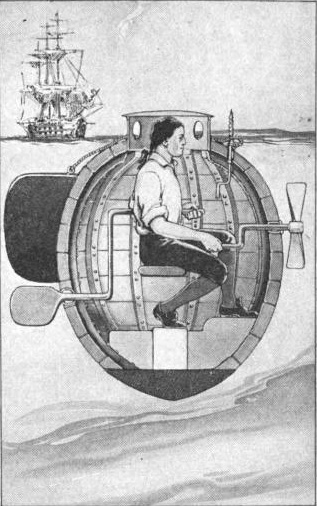
After Bushnell left the room, the officials voted to keep the conversation secret and to send Matthew Griswold, the deputy governor, to Bushnell with £60 to encourage his work.
Back home, Bushnell resumed work on his machine—the first submarine to be deployed in warfare.
Years later, Bushnell described his invention to a curious Thomas Jefferson:
The external shape of the Submarine Vessel bore some resemblance to two upper tortoise shells of equal size, joined together: the place of entrance into the Vessel being represented by the opening, made by the swell of the shells, at the head of the animal. The inside was capable of containing the Operator, and air, sufficient to supply him, thirty minutes, without receiving fresh air.David Bushnell’s first operator was his own brother Ezra. They had inherited a farm together, and Ezra had bought out David’s interest to give him the capital to attend Yale College—an unusual course for a man in his late twenties.
At the bottom, opposite to the entrance, was fixed a quantity of lead for ballast. At one edge, which was directly before the operator, who sat upright, was an oar, for rowing forward or backward. At the other edge, was a rudder for steering. An aperture, at the bottom, with its valve, was designed to admit water for the purpose of descending; & two brass forcing pumps served to eject the water within, when necessary for ascending. At the top, there was likewise an oar, for ascending or descending, or continuing at any particular depth. A Watergage or Barometer, determined the depth of descent, a compass directed the course, & a ventilator within, supplied the Vessel with fresh air, when on the surface. . . .
The skilful operator could swim so low on the surface of the water, as to approach very near a Ship, in the Night, without fear of being discovered, and might if he chose, approach the stem or stern, above water, with very little danger. He could sink very quick, keep at any depth he pleased, and row a great distance, in any direction he desired, without coming to the surface; & when he rose to the surface, he would soon obtain a fresh supply of air, when, if necessary, he might descend again and pursue his course. . . .
In the first essays with the submarine Vessel, I took care to prove its strength to sustain the great pressures of the incumbent water when sunk deep, before I trusted any person to descend much below the surface: and I never suffered any person to go under water without having a strong piece of rigging made fast to it, until I found him well acquainted with the operations necessary for his safety. After that I made him descend and continue at particular depths, without rising or sinking, row by the compass, approach a Vessel, go under her, and fix the Woodscrew…into her Bottom, &c. until I thought him sufficiently expert to put my design into execution.
I found agreeably to my expectation, that it required many trials to make a person of common ingenuity, a skilful operator. The first I employed was very ingenious and made himself master of the business, but was taken sick in the campaign of 1776 at N.York, before he had an opportunity to make use of his skill, and never recovered his health sufficiently afterwards.
Jefferson had Bushnell’s detailed description of his invention published by the American Philosophical Society in 1799. Those documents serve as the source for all attempts to depict and recreate the submarine, such as the 1916 illustration above.
TOMORROW: Into action.

No comments:
Post a Comment