J. L. BELL is a Massachusetts writer who specializes in (among other things) the start of the American Revolution in and around Boston. He is particularly interested in the experiences of children in 1765-75. He has published scholarly papers and popular articles for both children and adults. He was consultant for an episode of History Detectives, and contributed to a display at Minute Man National Historic Park.

Subscribe thru Follow.it


•••••••••••••••••


Showing posts with label Nathaniel Appleton. Show all posts

Sunday, May 18, 2025

“What Stock you had upon the Island”

Most islands in Boston harbor weren’t convenient for living on, but some were good for keeping livestock.

Cattle and sheep could graze on the natural grasses, taking in adequate water and salt, and they couldn’t run away.

That meant that as the Revolutionary War began, several islands had a lot of animals on them, as well as pasturage that could feed horses.

As the same time, the British military found itself penned up inside Boston, cut off from the town’s usual supply of food from the countryside.

It would take about six weeks before the government and merchants of London would hear of the outbreak of war, another six weeks before any supply ships they sent in response would arrive at Boston. The royal authorities therefore had to secure their own provisions for the next three months. Of course, that was a concern for Boston’s civilian authorities as well.

Leaders of the Massachusetts Provincial Congress saw the same situation. Recognizing that it was to their advantage to starve out the enemy, the committee of safety told farmers around the harbor not to sell provisions to anyone in the British military. Of course, that was easier said than done.

Boston selectman Oliver Wendell owned animals on Hog Island. “Greatly shocked by the Nervous Disorder,” he had left Boston for Newbury before the fighting broke out. His former apprentice Henry Prentiss therefore was trying to manage Wendell’s assets for him from Charlestown.

Of course, neither of those merchants actually handled the animals; that was the job of an employee named William Harris. On 9 May, Prentiss told Oliver Wendell, “Harris continues [on the] Island and sells to every one that comes.”

That wasn’t entirely voluntary. The next day, a man named Elijah Shaw told the committee of safety that British soldiers had “robbed him of 11 cows, 3 calves, a yearling heifer, 48 sheep, 61 lambs, 4 hogs, and poultry, hay 5 tons, and almost all his furniture.” The military was confiscating valuable provisions from people who wouldn’t sell.

On 12 May, Prentiss sent more details, starting with an inquiry from one of Wendell’s fellow selectmen, Thomas Marshall:
Coll. Marshall sent over here to know what Stock you had upon the Island, upon which I sent Mingo to the Island to bring an account to me.

He tells me Mr. Harris is very uneasy, the people from the Men of War frequently go to the Island to Buy fresh Provision, his own safety obliges him to sell to them, on the other Hand the Committee of Safety have thretned if he sells anything to the Army or Navy, that they will take all the Cattle from the Island, & our folks tell him they shall handle him very rufly.
Mingo was enslaved to Wendell, it appears, and trusted by him. At the start of the month another mercantile partner, Nathaniel Appleton, reported that Mingo had just gotten out of besieged Boston and “will give you more particulars of the Town.” Then the man returned from Newbury to Charlestown, doing this job for Prentiss.

Thursday, July 11, 2024

“Spent most part of the Day with the Town Committee”

The merchant John Rowe had an unusual perspective on the crisis of the Boston Port Bill.

On the one hand, he cared most about his business and trimmed his politics accordingly. Gov. Thomas Hutchinson suspected him of being behind all sorts of nefarious deals, but the local crowd considered him “a great Tory.”

I suspect Rowe also liked being liked, “trimming” to play to his current audience. During the big public meetings on the ships full of East India Company tea, he made an offhand remark about mixing tea with saltwater. That got him applause, and the crowd believed he’d come over to the radicals. Privately Rowe was upset, but he didn’t try to clarify his stance.

In those same months Rowe was spearheading a complex and costly effort to import and install Boston’s first street lamps. He seems to have long hoped to be elected to public office, and here he was visibly serving the public. How long could he keep that up?

On 10 May 1774, the same day Boston reelected its representatives to the Massachusetts General Court, the town received the first shocking news of the new law. Rowe went back to that day’s diary entry to add: “The Harmony Capt. Shayler arrived from London & brings the Severest Act ever was Penned against the Town of Boston.”

Three days later, with the news confirmed, Rowe lamented the “Late Act of Parliament for Blocking up the Harbour of Boston which is & will be a Great Evill.”

On that day, Boston called a sudden town meeting, ultimately choosing a committee to recommend what to do. The citizens put Rowe on that committee. In fact, he was the second man named, right after Samuel Adams.

This committee of eleven included gentlemen from various groups:
There was, to be sure, some overlap in those groups, particularly the centrists and merchants.

To his credit, Rowe actually participated in the committee discussions. On 14 May he “Spent most part of the Day with the Town Committee at the Representatives Room” inside the Town House and then went back on 16 May. Boylston and Appleton didn’t attend either of those meetings, so Rowe was the merchants’ voice.

Not that the discussions was productive. On 18 May, the committee reported back to the town that they had received “several Proposals & plans” but hadn’t had time to digest them. The ongoing meeting pushed them to hurry and come up with solutions.

Rowe never recorded attending any more of those committee discussions. Instead, he began to pay more attention to other sources of authority in town. As I wrote back here, he declined an invitation to chair the town meeting, and expressed deep disagreement with it—privately, of course.

TOMORROW: Here comes the general.

Thursday, December 14, 2023

The Committee of Correspondence and the Stringer Bell Rule

The Boston Tea Party Ships & Museum social media has been sharing an image from the Boston committee of correspondence records, showing what that group of hard-core activists was doing in December 1773.

Or rather, not showing.

These records are now held by the New York Public Library. The pages in question are in the subcollection “Minutes,” volume 6, pages 463–4. The whole collection is digitized but not transcribed, so you have to read a lot of pages or know what you’re looking for.

The committee of correspondence was an official arm of the Boston town meeting, and thus had some responsibility to keep public records. Most of those records are the letters the committee sent to committees in other towns and colonies, copied by town clerk William Cooper. It was a committee of correspondence, after all.

However, like the Continental Congress making itself a committee of the whole to debate sensitive matters like a little light treason off the record, the Boston committee had ways around openness.

As Stringer Bell reminded us on The Wire, you don’t take notes on a criminal conspiracy.

On Sunday, 12 December, a day after sending a subcommittee to meet with Francis Rotch about his ship Dartmouth and a day before meeting with colleagues from neighboring towns, the Boston committee gathered at the selectmen’s chamber in Faneuil Hall after dark on the Sabbath. But the record of that meeting is:
No Business transacted to be made matter of Record
The discussions with the other towns’ committees “continued thru. the Evening” on Monday. Not that we know what anyone said.

On Tuesday, the Boston men gathered again in the morning.
No Business transacted, matter of Record—
And in the evening.
No Business transacted, matter of Record—
There were no meetings on 15–16 December. Presumably all the committee members were busy at Old South Meeting-House and, well, elsewhere.

On 17 December, with tea leaves floating in the harbor, the committee chose five members of their group to write a “Declaration” about the destruction of the tea. Those men included several of the most radical writers in Boston: Samuel Adams, Dr. Benjamin Church, Dr. Thomas Young, and Dr. Joseph Warren. The fifth was Nathaniel Appleton (1731–1798), since these committees needed someone to represent the town’s merchants.

Saturday, December 02, 2023

“A child Laid to him by his housekeeper”

Though the Harvard College corporation kept quiet about the reason for president Samuel Locke’s resignation in December 1773, news was already seeping out. Tea wasn’t the only thing people around Boston were talking about 250 years ago.

One of the finest sources on Revolutionary Boston is the collection of letters that the businessman John Andrews wrote to his brother-in-law William Barrell in Philadelphia in the 1770s.

Andrews was a gossip sponge, and apparently uninhibited when writing to someone out of town. His letters were discovered during the Civil War, sent back north to the Massachusetts Historical Society, and published in the society’s Proceedings in 1866.

Not entirely, though. The transcriber, Winthrop Sargent, focused on political developments and conflicts with the royal authorities. And of course there was this thing called the Victorian sensibility.

One bit left out of print came from a letter Andrews dated 29 Nov 1773. Most of that letter was about money issues, followed by a paragraph about the arrival of East India Company cargos. (Andrews was working under the impression that two ships had arrived, not one.)

Then came a long postscript in small writing along the left side of the page:
P.S. I have a secret to tell you, which not only affects ye. direction of our Colledge, but brings great dishonor upon it:

after sufferg. the most poignant distress for two months past, and repeatedly leavg. ye. Sacraments, with frequently leavg. off, while in Prayer at ye. Chappel in a most abrupt manner, & going out; it has come out that no less a man than P—i—t L—ke has a child Laid to him by his housekeeper: after trying every method compromise to ye. mattr. wth. her, without effect, even to ye. offerg. her £150 Sterlg., he has retird to ye. Country, [???] wth. ye. most sincere grief, his situation excites ye. compassn. of all, as he is curs’d wth. a wife, whose vices, has been ye. means of drivg. him to it
Clifford K. Shipton quoted two clauses out of that passage in his Sibley’s Harvard Graduates biography of Locke, but I think this is the first time the whole thing is out in the world.

Andrews’s letter tells us that two days before Locke wrote out his resignation from the college presidency, people in Boston were already talking about the sex scandal behind it.

By 9 December, the Rev. Ezra Stiles down in Newport wrote in his diary: “More melancholy news about President Locke of Harvard College Camb.” And a week later: “The Corporation of Harvard College met last Week, & sent a Committee to wait on President Locke, & on return, voted his Answer not satisfactory.”

The Rev. Nathaniel Appleton of Cambridge was the corporation member who forced Locke to stop dithering and resign. His grandson, recent Harvard graduate Nathaniel Walker Appleton, wrote to his classmate Eliphalet Pearson on 14 December:
The unhappy affair concerning the late Pr-s-d-nt remains as yet something in the dark, perhaps Time may discover it. He resigned on 6th. Inst & went off to Sherburne the next Day. We Hope that the Corporation will make Choice of a Person to fill the vacant Chair who by his exemplary VIRTUE will remove the Blemish which now lays upon the College.
But only Andrews’s letter was straightforward about what that blemish was.

TOMORROW: And it was all Mrs. Locke’s fault?

(Incidentally, lately I’ve seen some items identifying John Andrews as a lawyer. He’s labeled “Merchant” in the 25 Feb 1771 Boston Post-Boy report of his marriage to Ruth Barrell. He was later a selectman and helped to set up the Boston Sail-Cloth Manufactory, the Massachusetts Fire Insurance Company, the Boston Dispensary, and other organizations.)

Friday, December 01, 2023

The Resignation of Samuel Locke

On 1 Dec 1773, two and a half centuries ago today, the Rev. Dr. Samuel Locke resigned as president of Harvard College.

I wrote about how the college had come to choose Locke back in 2020, on the sestercentennial of his installment.

Locke had been a star student at the college, where John Adams considered him the second-best classical scholar. He then had a quiet career as a minister in Sherborn, where he married a daughter of his predecessor (whose dowry included some good farmland) and started a family.

Locke wasn’t the Harvard corporation’s first choice to be president in 1770, and he took a long time to accept the job. It looks like the governing board wanted someone clearly different from the Rev. Dr. Edward Holyoke, who had served more than thirty years as president before dying at age seventy-nine. Locke would be the youngest Harvard president ever, and the board hoped he would modernize the teaching and scholarship.

Things appeared to have started off well. In 1772 the college gave Locke an honorary doctorate in sacred theology. The following June, the Rev. Ezra Stiles wrote good things about him, while wishing he would be more supportive of local resistance to the Crown.

And then suddenly Locke was gone. The official college records about his departure come from the minutes of a corporation meeting on 7 December:
Dr. [Nathaniel] Appleton communicated a Letter from President Locke dated Dec. 1st 1773, signifying his resignation of the Office of President of this College. Voted. that the Revd Dr. Appleton, Professor [John] Winthrop and Mr. [Andrew] Eliot be a Committee to receive and take into their Care the Books Papers and other Things in the President’s house, that belong to the College and to receive the Keys as soon as the late President has removed his Family & Effects.
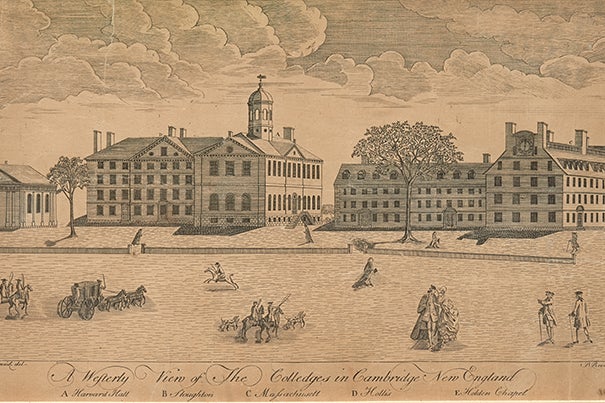
Appleton was the Congregationalist minister in Cambridge, his meetinghouse right next to the college campus. Prof. Winthrop lived nearby. Eliot was a minister in Boston, someone who had turned down the office of president back during the last search. Now they had the task of tidying up after President Locke.

TOMORROW: “The unhappy affair.”

Friday, January 07, 2022

Thousands of Curiosities from the Harvard Libraries

The Harvard Libraries have created a set of webpages called “CURIOSity Digital Collections” which provide “Curated views that provide specialized search options and unique content.”

That content comes from the university’s own holdings, and since the Harvard system adds up to one of the largest libraries on the planet, there’s a lot of content to choose from.

Some of the topics covered by these pages are:
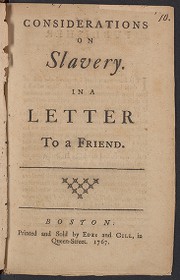
The newest collection looks at Slavery, Abolition, Emancipation, and Freedom. Linking to more than a thousand items related to black history and culture, this collection is the result of a university-wide effort that digital collections program manager Dorothy Berry has led since 2020, as reported in the Harvard Gazette.

Some of the eighteenth-century items to explore in that section are:
Plus, there are pamphlets from the same years printed in Philadelphia, London, and other important British cities.

This collection extends into the nineteenth century, so there are many items from the fight for (and against) abolition in the U.S. of A. and around the world. Plus, more to come.

Friday, June 12, 2020

“The grand source of most of the Evils we groan under”

The same 14 Dec 1747 issue of the Boston Post-Boy that leaked Gov. William Shirley’s letters about riots the previous month also reported on how the Town House in Boston had burned down.

As good descendants of Puritans, the people of Massachusetts couldn’t help but worry that fire might be a sign of divine displeasure at how some of them had been behaving.

On 28 December, a day before issuing a new message to mollify the Boston town meeting, Gov. Shirley issued a proclamation for a public fast in one month. He noted:
the continued and growing Calamities of the War; and the many Difficulties and Embarrassments which attend our Publick Affairs, and in the signal Frown of Divine Providence in the Destruction of the Court-House by Fire, and therein of a great Part of the publick Records of the Province, and other useful and valuable Writings.
On the designated fast day, 28 Jan 1748, ministers in every Massachusetts town preached on how the people should improve themselves.

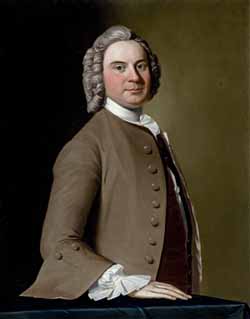
In Cambridge, the Rev. Nathaniel Appleton (1693-1784, shown above) spoke on The Cry of Oppression where Judgment is Looked for, and the Sore Calamities Such a People May Expect from a Righteous God. In Charlestown, the Rev. Thomas Prentice preached The Vanity of Zeal for Fasts without True Judgment, Mercy and Compassions. In Medford, the Rev. Ebenezer Turell published a Brief and Plain Exhortation to His People on the Late Fast, a condensed version of his sermon.

All three of those clergymen pointed to the same problem. Was it rioting? Spending too much on luxury goods? New Light enthusiasm? Old Light recalcitrance? No, it was that burdensome sin—allowing the value of paper money to depreciate!

“For one and all agree,” Appleton declared from his pulpit, “that the Sinking of the Value of these Bills below what is expressed in the Face of them, is the Cause of the present Complaints and Cries that are heard in the Land.”

“We find GOD complaining most grievously, of his people Israel, Amos viii.5. for their not dealing with just Measures and Weights according to the fixed Standard,” Prentice preached; “…and such like Instability, either in the Measure of Commodities, or in the Weight and Value of Money, is a most dreadful Injustice.”

Turell explained that “the grand source of most of the Evils we groan under at this Day” was “our Medium of Exchange, unstable as Water, and variable as the Wind. . . . We trade and traffick, buy and sell by this Measure, and so we daily oppress one another.”

This was a long-standing challenge to the Massachusetts economy. Without enough specie (gold and silver coinage) to keep commerce going, the province issued notes on paper. Those notes never traded at quite their nominal value, and as time went on the bills came to be worth less and less.

That was a problem for people who had fixed incomes—particularly ministers who had negotiated set salaries with their congregations when they assumed their pulpits.

In his speech to the Massachusetts General Court on 3 February, Gov. Shirley devoted a whole paragraph to both “the extraordinary Emissions of Paper Money, whereby the Value thereof for all Occasions of Life is sunk so low and is still sinking,” and “the Difficulties, which many of the Ministers of the Gospel within this Province are brought under, thro’ the great Depreciation of the Bills of Credit.”

Thus, the question of rebuilding the Town House in Boston or building a new legislative meeting hall somewhere else was also a question of adding to the public debt just when that was becoming a real problem for influential people in the colony.

TOMORROW: Back to the Massachusetts house’s discussion.

Friday, May 20, 2016

Stamp Act Celebrations in Medford, Charlestown, and Cambridge

The same 26 May 1766 issue of the Boston Gazette that described Boston’s send-off to the Stamp Act in such detail also reported on celebrations in nearby towns. Militia companies played a big role in those activities.

Medford’s celebration appears to have started soon after news of the law’s repeal arrived the previous Friday, 16 May (though possibly one week later, depending on how one interprets the article).
…last Friday Evening, the Dwelling-House, Summer-House, &c. of the Hon. Brigadier General [Isaac] Royall were very handsomely illuminated, a Number of Chambers were fired, Rockets discharged, and Fireworks displayed, with many other Demonstrations of Joy—And the Military Company of Medford being that Day raised, they repaired in the Evening to the Brigadier’s House, and were generously entertained.

We also hear that a Number of other Houses in the said Town were illuminated, a large Bonfire made, and such Expressions of Joy as became a free & loyal People.
Royall’s house is still standing in Medford, and tomorrow has its own community open house.

Like Boston, Charlestown celebrated on Monday, 19 May.
At Noon the Independent Company belonging to Castle William muster’d, and discharged the Cannon at the Battery; and in the Afternoon the same Company met at the Long-Wharff, where a Number of the principal Gentlemen of the Town assembled, and the following Toasts were drank…
Charlestown’s toasts honored the King, Parliament, William Pitt, peace and harmony, and “All the True Sons of Liberty on the Continent.”

Cambridge held its celebration on Tuesday, 20 May:
last Tuesday in the Afternoon there was a great Assembly in the Meeting House, unto whom he [the Rev. Nathaniel Appleton] preached a most excellent Sermon, now in the Press, at the Desire of almost all that heard it, and at the Expence of General [William] Brattle, from the two last Verses of the 30th Psalm. The Solemnity began with Prayer, and was concluded by the young Gentlemen of the College singing two Anthems extreamly well suited to the joyful Occasion.

Immediately upon the Congregation’s coming out of the Meeting House, there was a Discharge of Field Pieces, &c. planted before General Brattle’s Door, many Gentlemen went to his House, and a vast Number of those of lower Rank, all Friends of Liberty, where the proper Healths were drank, accompanied with the discharge of the Cannon there…
The big homes, government buildings, and college buildings near the center of town were illuminated. In the evening there was a party for “many Gentlemen of the Town and many living out of the Town” at the courthouse. There was a “Bonfire (where Liquid was provided for every one that pleased to drink).” And there were fireworks “at the Charge of the Gentlemen of Cambridge.”

The following day, William Brattle led militia exercises on Cambridge common and hosted another banquet. He had been one of the most prominent opponents of the Stamp Act, skipping a Council meeting with Gov. Francis Bernard to lead a protest march with the Boston crowd.

Eight years later, however, Brattle had come around to supporting the royal government. As I discuss in the opening chapter of The Road to Concord, on 1 Sept 1774 he gave Gen. Thomas Gage’s troops the keys to the county militia’s gunpowder storehouse and two cannon—probably the same two fieldpieces that had been planted in front of his house (shown above) on 20 May 1766. That angered Brattle’s neighbors so much that he fled Cambridge forever.

TOMORROW: Illuminating Liberty Tree.