J. L. BELL is a Massachusetts writer who specializes in (among other things) the start of the American Revolution in and around Boston. He is particularly interested in the experiences of children in 1765-75. He has published scholarly papers and popular articles for both children and adults. He was consultant for an episode of History Detectives, and contributed to a display at Minute Man National Historic Park.

Subscribe thru Follow.it


•••••••••••••••••


Showing posts with label William Brattle. Show all posts

Wednesday, September 04, 2024

The Flight of the Cambridge Loyalists, part 1

The Cambridge neighborhood later dubbed “Tory Row” became a lot less populous after the “Powder Alarm” of 1774—which was only natural since all of those estates’ owners were either targets of the crowds or related to targets.

Attorney general Jonathan Sewall was the first to depart. He arrived in Boston “between 12 & one” on 1 September, having been “advised to leave his house,” according to a letter from his father-in-law, Edmund Quincy. (That letter is in the Massachusetts Historical Society’s Miscellaneous Bound Manuscripts collection.) 

William Brattle also left Cambridge on 1 September after learning that his letter to Gov. Thomas Gage, quoted here, had become public in Boston that afternoon. And that evening, a local crowd came looking for Brattle and Sewall.

Late the next afternoon, Lt. Gov. Thomas Oliver faced off against what he counted as 4,000 men demanding his resignation from the Council. After signing their document under protest, he also hightailed it to Boston.

If Elizabeth Oliver and her children didn’t accompany Thomas to Boston then, they followed within days. So did Esther Sewall and her children.

William Brattle’s daughter, the widow Katherine Wendell, remained in the family’s Cambridge home—not only for the next several months but through the siege of Boston. She thus kept ownership of the house for the family while several nearby properties were confiscated by the state during the war.

Thomas Oliver’s wife Elizabeth was a Vassall by birth, and thus related to several other families in the area. One of her maternal uncles was David Phips, the royal sheriff of Middlesex County. Notes taken by the Loyalists Commission say:
He apprehended that his Life was in danger after he had removed the Gunpowder to Boston. . . . In Consequence of this treatment he removed himself to Boston & his family soon followed him.
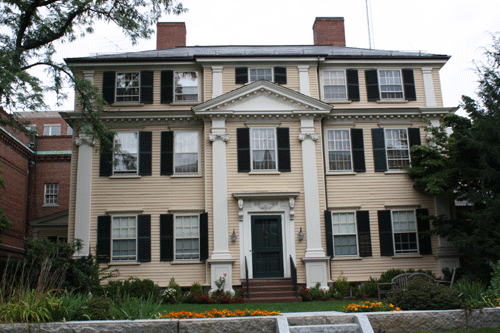
Elizabeth Vassall’s paternal aunt Anna had married her stepbrother John Borland when she was thirteen and he twenty. In 1774 they lived in a Cambridge mansion originally commissioned by the Rev. East Apthorp, not counted as part of “Tory Row” since it wasn’t on the road to Watertown but near Harvard College. (In fact, today that house, shown above, is in the middle of the university’s Adams House.)

The Borlands also felt the “Powder Alarm” was too close for their comfort and moved into Boston. The 8 June 1775 New-England Chronicle reported:
DIED ] At Boston, on the 5th Instant [i.e., of this month], John Borland, Esq; aged 47 [actually 46]. His Death was occasioned by the sudden breaking of a Ladder, on which he stood, leading from the Garret Floor to the Top of his House.
According to none other than Jonathan Sewall, Borland “lost his life by a fall in attempting to get upon the top of his house to see an expedition to Hog Island.”

TOMORROW: More departures.

Saturday, August 31, 2024

“Mr. Brattle presents his Duty to Governor Gage.”

In August 1774, Gen. Thomas Gage asked William Brattle, general overseeing the Middlesex County militia, for an inventory of the gunpowder in the Charlestown powderhouse.

I’ve quoted Brattle’s reply before, but that was an astonishing seventeen years ago, so I’m running that text again, as it appeared in the 5 September Boston Gazette. Apologies to anyone who remembers it exactly from before.

On 27 August, Brattle wrote:
Mr. Brattle presents his Duty to Governor Gage. He apprehends it his Duty to acquaint his Excellency from Time to Time with every Thing he hears and knows to be true and is of Importance in these troublesome Times, which is the Apology Mr. Brattle makes for troubling the General with this Letter.

Capt. [Jonas] Minot of Concord, a very worthy Man, this Minute informed Mr. Brattle that there had been repeatedly made pressing Applications to him to warn his Company to meet at one Minute’s Warning, equipt with Arms and Ammunition, according to law, he had constantly denied them, adding, if he did not gratify them he should be constrained to quit his Farms and Town;

Mr. Brattle told him he had better do that than lose his Life and be hanged for a Rebel, he observed that many Captains had done it, though not in the Regiment to which he belonged, which was and is under Col. Elisha Jones, but in a neighbouring Regiment.

Mr. Brattle begs Leave humbly to quere, Whether it would not be best that there should not be one Commission Officer of the Militia in the Province.

This morning the Select Men of Medford, came and received their Town Stock of Powder, which was in the Arsenal on Quarry-Hill, so that there is now therein, the King’s Powder only, which shall remain there as a sacred Depositum till ordered out by the Capt. General.

To his Excellency General Gage, &c. &c. &c.
This time around, I’m struck by the phrase “warn his company to meet at one minute’s warning, equipt with arms and ammunition.” This was weeks before the Worcester County Convention issued a call for towns to prepare a third of their militia members ”to be ready to act at a minute’s warning.” When the Massachusetts Provincial Congress endorsed that call in October, it left out the reference to a minute. Nonetheless, the popular term for those units became “minute companies” and “minute men.”

This 27 August letter shows that the proposal to have fighting men ready in a minute was already in the air before it became a formal proposal and before it reached print.

Indeed, because Brattle’s letter was transcribed into a lot of newspapers that September, it might well have played a role in popularizing the “minute’s warning” metric. And of course, that letter set off the chain of events that produced the “Powder Alarm.”

For more about that “Powder Alarm” and its Sestercentennial significance, you can listen to my conversation with Tiziana Dearing on WBUR’s Radio Boston show. And come out to the commemorations this Sunday, Monday, and Wednesday.

Sunday, July 07, 2024

A Guide to the “Powder Alarm” and More

The sestercentennial of the “Powder Alarm” is coming up on 2 September, and American Heritage revisits the event with “The Revolution Could Have Started Here,” an excerpt from Bob Thompson’s book Revolutionary Roads.

Here’s a taste:

Today, 42 Brattle houses the Cambridge Center for Adult Education. In 1774, as tensions between Great Britain and New England neared an all-time high, it was home to William Brattle, a 68-year-old gentleman farmer and Massachusetts militia general who had kicked off the September craziness by writing the governor a letter. Composed in late August, it informed [Thomas] Gage, who was his boss, that gunpowder was starting to disappear from the Powder House. Gage took the hint. Before dawn on September 1, longboats ferried some 250 Boston-based British soldiers three miles up the Mystic River, where they got out and marched another mile to their destination. Removing hobnailed boots, lest a spark blow them to kingdom come, they collected the remaining powder in the tower; a few went to Cambridge to confiscate a couple of artillery pieces, as well. All were safely back in Boston by noon, and the governor was a happy man.

Not for long, though.

Later that day, Gage’s enemies somehow got their hands on Brattle’s letter. A crowd of local protesters showed up outside his house, but, by then, the owner was gone. “He went into Boston,” Bell said, “and never saw Cambridge again.” Unsatisfied, the crowd reassembled half a mile up the street, at the home of a colonial official named Jonathan Sewall, whose wife said he wasn’t home. The protesters didn’t believe her and tried to break in. Someone inside fired a pistol—accidentally, it was claimed—which sobered everybody up, and the crowd dispersed.
You may have noticed the name “Bell” in there. I was Thompson’s tour guide along Brattle Street nearly a decade ago. This article also profiles me, in case you were curious.

Friday, February 23, 2024

“Becoming dependent for their Salaries upon their Crown”

The dispute that led to colonial Massachusetts’s second impeachment action started with the Townshend Acts of 1767.

Parliament imposed new tariffs on a handful of goods, particularly tea. And it said the revenue from those taxes would go to administering the colonies.

The expenses of that royal administration included salaries for the governors in most colonies and for the judges those governors appointed.

In the fallow period of 1771 to early 1773, with no new taxes and no troops on the streets of Boston, Samuel Adams didn’t have many issues to raise, so he highlighted those judicial salaries.

Through Boston’s committee of correspondence, Adams argued that not only had Parliament imposed taxation without representation, but those salaries would insulate judges from local pressure. The colonial legislatures would no longer be able to limit or delay judges’ pay to signal displeasure with their rulings.

On 14 Dec 1772, Cambridge called a town meeting to consider that problem. Most men at that meeting endorsed the Boston committee’s position. But one local big man objected.

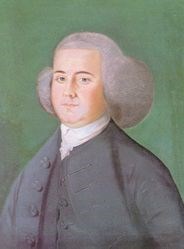
William Brattle (shown here) was an old-fashioned type of country gentleman—a little bit of a lawyer, a little bit of a doctor, a little bit of a merchant, a little bit of a farmer. In politics he had become a member of the Council, and in the militia he had risen to the rank of general.

Back in 1765, Brattle had marched at the head of the anti-Stamp Act processions beside Ebenezer Mackintosh. Gov. Francis Bernard saw him as one of his most nettlesome enemies. But Gov. Thomas Hutchinson had apparently won Brattle over to the Crown side, possibly with those militia promotions.

Brattle told his fellow Cambridge citizens that judicial salaries weren’t anything to worry about. He claimed that judges were appointed for life as long as they maintained “good behavior.” Once judges were on the bench, therefore, neither the royal government nor the populace had leverage over them. (He also said that since official word about judicial salaries hadn’t come from London yet, the town shouldn’t vote on the matter.)

After losing that vote, Brattle published his argument in the 31 December Boston News-Letter.

In the 4 Jan 1773 Boston Gazette someone signing “M.Y.” addressed “W.B. Esq.,” asking how he could hold such a position when as a member of the Council he had heard that Gov. Bernard had written to Gov. Hutchinson that judicial salaries were definitely a go. Brattle denied having heard any such letter.

The 11 Jan 1773 Boston Gazette brought a more vigorous response to Brattle from John Adams. Citing various legal authorities, he wrote that judges were appointed “at the pleasure” of the Crown, forcing those men to maintain the approval of the royal government to keep their jobs.

The next week, Adams published another essay saying the same thing, with different sources. And then the week after that. In all, Adams published seven essays to Brattle’s two. By March, even Adams wrote in his diary: “I have written a tedious Examination of Brattle’s absurdities.”

In his diary Adams also claimed that in the town meeting Brattle had said “Mr. [James] Otis, Mr. Adams, Mr. John Adams I mean, and Mr. Josiah Quincy” wouldn’t be able to refute his argument, and that he had later issued a public challenge in the newspapers. I can’t find Brattle doing the latter. But Adams was clearly rankled. He also told his diary in March:
My own Determination had been to decline all Invitations to public Affairs and Enquiries, but Brattles rude, indecent, and unmeaning Challenge of me in Particular, laid me under peculiar Obligations to undeceive the People, and changed my Resolution. I hope that some good will come out of it.—God knows.
Remember the xkcd cartoon, “Someone is wrong on the internet”? That was basically Adams’s reaction.

Those newspaper essays didn’t have much effect. The exchange probably raised Adams’s profile a little and pushed Brattle further into the royal governor’s camp. But the London government had a plan, and all the resolutions passed by all the town meetings in Massachusetts wouldn’t change that.

In February, as John Adams’s essays rolled on, Gov. Hutchinson confirmed that Lord North had ordered the judges paid from the tariffs. The Massachusetts assembly, with Samuel Adams as its clerk and guiding voice, responded:
We conceive that no Judge who had a due regard to Justice, or even to his own Character, would chuse to be placed under such an undue bias as they must be under, in the Opinion of the House, by accepting of and becoming dependent for their Salaries upon their Crown. Had not his Majesty been misinformed with Respect to the Constitution and Appointment of our Judges by those who advised to this Measure, we are persuaded he would never have passed such an Order.
That dig about “misinformed” was how Samuel Adams and his allies were representing the larger situation: Bernard, Hutchinson, and other royal appointees were feeding the government in London false information, and the result were these unjust measures that Massachusetts didn’t deserve.

TOMORROW: Rival salaries.

Monday, March 08, 2021

“The End of Tory Row” Online, 11 March

On the evening of Thursday, 11 March, I’ll offer an online presentation for the Longfellow House–Washington’s Headquarters National Historic Site about “The End of Tory Row.”

For the past several years, I’ve spoken about that mansion’s Revolutionary history each March around Evacuation Day.

Usually those talks have focused on Gen. George Washington, who used the house as his headquarters from July 1775 to April 1776, and challenges he faced. Last year, for example, I shared information about Native American visitors to Cambridge during Washington’s time and his efforts at diplomacy on the continent.

That was the last public event I attended for many months. The audience was small and the chairs distanced, according to the protocols of the time. Soon most local institutions shut down completely for visitors. Historical talks moved online, which has brought both technical difficulties and benefits in wider access.

This year’s talk will look at how what’s now Brattle Street in Cambridge became a neighborhood of wealthy households, all related to John Vassall, the man who in 1759 commissioned and moved into that mansion. And how in September 1774 that enclave dissolved under political and militia pressure. I’ll also discuss how that neighborhood’s lifestyle depended both economically and in daily life on the exploitation of slavery.

I’ve discussed the Vassall family and the events of September 1774 before, but this year I’m trying to make more of the online format by incorporating more visuals and perhaps even moving footage. There will be a live question-and-answer session after the presentation.

This online event is free to all through support from the Friends of Longfellow House–Washington’s Headquarters, the Massachusetts Society of the Cincinnati, and the National Park Service. To register in order to receive the viewing link, please start at this page. The event will start at 7:00 P.M. on Thursday.

Sunday, January 31, 2021

Israel Putnam and ”an express from Boston”

engraved portrait of Israel PutnamOn 1 Sept 1774, British soldiers acting on orders of Gen. Thomas Gage took control of province-owned gunpowder stored in Charlestown (now Somerville) and two cannon used by a Cambridge militia company.

As governor and thus captain-general of the Massachusetts militia, Gage had the authority to issue that order. But coming on top of the Massachusetts Government Act the previous month, the move looked to local white men like another step toward depriving them of their traditional rights.

That evening there were some disturbances in Cambridge outside the house of William Brattle, the militia general who had prompted Gage’s move, and Jonathan Sewall, the royal attorney general. But eventually everyone went home, especially after Esther Sewall treated the crowd around her home to a round of drinks.

News of the event still spread, and the farther it got from Cambridge, the more dire it became. People were hearing there had been a second Massacre, or worse. The outer towns in Middlesex County were alarmed enough to send thousands of militiamen streaming into Cambridge the next day—a confrontation that historians later dubbed the “Powder Alarm.” (The first two chapters of The Road to Concord describe those two days in September 1774, which I argue is when Massachusetts’s resistance turned into revolution.)

Though there was still no violence in Cambridge, the rumors from 1 September continued to spread faster than that corrective good news. The alarm reached Israel Putnam (shown above) in Pomfret, Connecticut, in the late morning of Saturday, 3 September.

Putnam had extensive military experience in the Seven Years’ War, both with Rogers’ Rangers in the west and on the 1762 expedition to Cuba. He ranked as a colonel in the Connecticut militia. And on 3 September he saw his job as mobilizing that militia to help Massachusetts.

Putnam sent letters to men in other part of Connecticut, and he dashed off a special note to his neighbor Godfrey Malbone. We met Malbone last year in connection with the Anglican church he built in his largely Congregationalist corner of Connecticut.

Malbone had also reached the rank of colonel in the militia, mostly on the basis of his wealth. But he didn’t come from an old New England family, he’d spent some years at the University of Oxford, and he didn’t much care for his Yankee neighbors.

According to the Connecticut Historical Society, Putnam wrote to Malbone:

Saturday, 12 p.m.

Dear Sir. I have this minute had an express from Boston that the fight between Boston and Regulars [began] last night at sunset, the cannon began to and continued playing all night, and they beg for help,—and don’t you think it is time to go?

I am, Sir, your most obedient servant,
Israel Putnam
Malbone’s reply was short:
Go to the devil
TOMORROW: Connecticut on the march.

Sunday, September 01, 2019

Attack on Jonathan Sewall’s House

On 1 Sept 1774, Gen. Thomas Gage sent soldiers out to Charlestown to remove the provincial militia’s supply of gunpowder from the stone tower that still stands in what is now Somerville.

Some of Gage’s troops went on into Cambridge and wheeled away two small cannon that the Middlesex County militia trained with.

Locals treated those actions as a raid on their military resources, an attempt to curtail their self-defense. By the end of the afternoon, people learned that William Brattle of Cambridge had alerted the governor about that gunpowder. Men surrounded Brattle’s house, but he had already fled into the army camp in Boston.

Some of that crowd moved out the Watertown road to the house of Jonathan Sewall, attorney general and Vice Admiralty Court judge. He was a high-profile supporter of the royal government, having represented it in court (though he sat out the Boston Massacre case) and written newspaper essays.

Sewall lived in a country mansion with his wife Esther and two young sons, a few household servants, and at least two young men studying law, Ward Chipman (1754-1824) and Thomas Aston Cotton (1754-1810). Chipman also tutored the boys in Latin.

A third young man was also in the Sewall house that night and left an anonymous description of events now preserved in the Public Archives of Canada:
On Thursday evening September 1, 1774 there was a riotous assembling of about 40 or 50 men & boys in the town of Cambridge—I passed by them several times in the course of the evening carefully observing their number strength & movements—

About half past 11 or at 12 o’clock in the night, thinking that they had dispersed in a great measure & perceiving that they had been in indifferent spirits the whole evening, I went to Judge Sewall’s & informed Mrs Sewall that I believed there was no danger of a visit from them at that time of night; but if they came, they were so little used to acts of violence that I thought we might safely venture to resist them.

About 1/2 hour after being alarmed with the noise of their coming, & having secured the Windows & Doors as well as we could, we repaired to Mrs Sewall’s Chamber; they came shouting & blowing a horn & Mrs Sewall threw up the window when they had got to the house & asked them what they would have—

they replied Mr. Sewall,—

she told them he was not at home, but had gone to Boston in the morning & had not returned since;

on which they exclaimed she was a damned liar &c that he was in the house & they would search the house for him & have him;—

on which there was a tumultuous noise, but Mrs Sewall begged to be heard, & being a little more silent, she observed to them that being a woman she expected civil treatment from them as she had & would treat them;

they exclaimed that he was an enemy to his country & have him they would—

Mrs Sewall begged them not to disturb her—that being alone she hoped they would not treat her or her children ill, & if they would go away, they should have anything she could give them out of the house.

They swore they would search the house & immediately burst open the door. Finding they had entered & hearing them below, Mr. Chipman, Mr. Coffin & myself, together with a servant [i.e., slave] of Judge Sewall’s, being all the males that were in the house ran downstairs, attacked them & by an active & vigorous application of the argumentum baculinum [argument by means of clubs] drove them out & Mr. Coffin declared he would blow the first man’s brains out, that offered to enter again.
Jonathan Sewall really had gone into Boston earlier that day. According to his father-in-law, Boston magistrate Edmund Quincy, he “came here between 12 & one yesterday, said he was advised to leave his house & come to town.” Gage might have anticipated trouble, or he might simply have wanted legal counsel.

Either way, that left Esther Sewall overseeing a besieged house of small children, servants, and three hotheaded young men.

TOMORROW: Beyond the argumentum baculinum.

Wednesday, April 10, 2019

John Adams and “the important Secret”

John Adams’s diary offers a case study of how well the Massachusetts Whigs kept the secrets that Benjamin Franklin asked Thomas Cushing to keep.

Adams received the “Collection of Seventeen Letters” on 22 March 1773. Since he was no longer a member of the Massachusetts legislature, he definitely wasn’t on Franklin’s list of people Cushing could share the letters with. But evidently he was supposed to take the letters to someone else while attending a county court.

At some point Adams copied the cover letter, omitting Franklin’s name (if he’d even received the original revealing it). He also copied out the most damning letter by Thomas Hutchinson. As far as I can tell, there’s no clear evidence of when Adams made that copy—it might have been after the letters were published. But Franklin had asked for no one to make copies.

We can presume Adams told his wife Abigail about the letters. She doesn’t seem to have been as active in political discussions then as she would be later, when she didn’t have four children under the age of eight to look after. But John was probably already sharing what was on his mind, and those letters certainly were.

On 24 April, John wrote in his diary:
I have communicated to Mr. Norton Quincy, and to Mr. Wibird the important Secret. They are as much affected, by it, as any others.
Norton Quincy (1716-1801) was Abigail’s favorite uncle. He lived in some seclusion in Braintree after the death of his wife, so he probably wouldn’t pass on the secret.

“Mr. Wibird” was the Rev. Anthony Wibird (1729-1800), the Adamses’ minister, not yet in his dotage. Given New England’s deference to clergymen, discussing the letters with him was at least understandable.

Adams went on, indicating he had already discussed the letters with two members of the General Court:
Bone of our Bone, born and educated among us! Mr. [John] Hancock is deeply affected, is determined in Conjunction with Majr. [Joseph] Hawley to watch the vile Serpent, and his deputy Serpent [William] Brattle.

The Subtilty, of this Serpent, is equal to that of the old one.
The “vile Serpent” was Gov. Hutchinson. William Brattle was a member of the Council who had been a big supporter of the anti-Stamp Act demonstrations in 1765 but then moved over to the royal authorities’ side after becoming a militia general. He and Adams had a public argument over judicial salaries.

But those weren’t all the people who knew.
Aunt is let into the Secret, and is full of her Interjections!
I’m not sure which lady Adams meant by this. I think he had only one living aunt at the time, Bethiah Bicknell of Braintree, and they weren’t particularly close. He referred to many other older female relatives as “Aunt,” however, so who knows what lady was interjecting about “the important secret”?

Adams had also heard how other people knew and might spread the word:
Cushing tells me, that [Council member Jeremiah Dummer] Powell told him, he had it from a Tory, or one who was not suspected to be any Thing else, that certain Letters were come, written by 4 Persons, which would shew the Causes and the Authors of our present Grievances. This Tory, we conjecture to be Bob. Temple [of Medford], who has received a Letter, in which he is informed of these Things. If the Secret [should leak] out by this means, I am glad it is not to be charged upon any of Us—to whom it has been committed in Confidence.
Because of course it would look bad if the Whigs couldn’t keep a secret.

The next afternoon, Adams attended the Rev. Dr. Samuel Cooper’s meeting in Boston:
Dr. Cooper was upon Rev. 12.9. And the great Dragon was cast out, that old Serpent called the Devil and Satan, which deceiveth the whole World: he was cast out into the Earth and his Angells were cast out with him. Query. Whether the Dr. had not some political Allusions in the Choice of this Text.
Adams felt Cooper was poor at keeping secrets, judging by his remark the following month after hearing Hancock speak of political plans. “Cooper no doubt carried it directly to Brattle, or at least to his Son Thomas,” Adams wrote. “Such a leaky Vessell is this worthy Gentleman.”

As I quoted yesterday, in June 1773 Cushing assured Franklin that only two other people knew he had supplied the letters—but one of those two was Cooper.

So really it’s remarkable that the letters came as a surprise to anybody in Boston.

Saturday, June 23, 2018

A Request for Documents Concerning the Circular Letter

On 22 June 1768, the Massachusetts House chose a committee to respond to Gov. Francis Bernard’s transmission of the Earl of Hillsborough’s response to their circular letter.

That committee consisted largely of the men who had served on the committees that created the circular letter in the first place: speaker Thomas Cushing, clerk Samuel Adams, both James Otises, John Hancock, and Jerathmeel Bowers, plus three more representatives:
On 23 June, 250 years ago today, that committee told the assembly that to reply to the governor’s message
it would be of great Use to them, to have before them a Copy of his Majesty’s Instructions referred to therein, the whole of Lord Hillsborough’s Letter, his Excellency’s [i.e., the governor’s] own Letters on the Occasion; and also another Letter from Lord Hillsborough to his Excellency, said to have been communicated to the honorable Board [i.e., the Council].
After the speaker called in all members, they voted to send Otis to the Council to request any letters from Hillsborough it had. Councilor William Brattle came back with the message that they had only heard province secretary Andrew Oliver read the letters to them, so they had no copies.

The House then approved another committee of five to carry its request for documents to the governor. It strikes me as significant that four of that new committee’s members had military titles, and Spooner was the only overlap with the larger committee. The House didn’t give Bernard any opening to complain that this request came from unpatriotic malcontents.

Since our federal Freedom of Information Act and Presidential Records Act, we have a fairly expansive expectation of getting to see government documents—eventually, at least, even if they have to be Scotch-taped back together.

Back in the eighteenth century, even British governments didn’t operate so openly. Parliamentary debates weren’t regularly transcribed or published, and rare reports of speeches appeared with the members’ names disguised just in case publication turned out to be illegal. Likewise, the Massachusetts House records say nothing about the first, unsuccessful attempt to win approval for the circular letter or of Otis’s “harangue” against the royal government on 22 June.

The executive branch was particularly closed. All of its members theoretically acted as one on behalf of the King and enjoyed some measure of royal privilege. That’s why the Earl of Hillsborough wrote in the name of “his Majesty” and Gov. Bernard had referred to the earl’s letter as being “his Majesty’s Instruction.” Bernard and Hillsborough considered their correspondence confidential, available to the legislature or public only on the terms they chose.

But of course Gov. Bernard knew that simply refusing the House’s request to see those letters would give them something new to complain about. He faced the question of whether that would be worse than releasing them.

TOMORROW: Selective disclosure.

Friday, November 24, 2017

Publishing the 1771 Thanksgiving Proclamation

I’ve been considering Gov. Thomas Hutchinson’s Thanksgiving proclamation in 1771, one of the many bones of contention in Revolutionary Boston. Hutchinson’s own account may have been accurate in the basics but it wasn’t in all details, so I’m doubling back into other sources, starting with the newspapers.

On 17 October the Boston News-Letter, the paper closest to the royal government, reported that Hutchinson would name 21 November as the holiday. The Monday papers, most in opposition to the governor or neutral, repeated that news. People wanted early notice to plan for the holiday.

Gov. Hutchinson didn’t issue his official proclamation until 23 October. He might well have been working on its text. Some people later said “ONE of the council” had proposed reinstating language from before 1761 about the province’s “civil and religious Rights and Liberties.” Harbottle Dorr wrote in his newspaper collection that this Councilor was “supposed to be Colo. [William] Brattle.”

In 1765 Brattle (shown above) had marched with Ebenezer Mackintosh against the Stamp Act. He was one of Gov. Francis Bernard’s biggest thorns on the Council. In the 1770s he moved closer to the royal prerogative party, eventually sealing his fate as a Loyalist by setting off the “Powder Alarm” of 1774. But in 1771 Brattle might have sincerely still felt he was a Whig and that his colleagues should be pleased by the new governor acknowledging traditional liberties in traditional phrasing. Hutchinson probably liked the idea of reestablishing normalcy.

The governor’s final text went to Richard Draper, the printer with the contract from the province and Council to issue such official announcements as broadsides. Draper also published the News-Letter, and the proclamation appeared in that newspaper on 24 October. The Boston Evening-Post, Boston Post-Boy, and Essex Gazette of Salem ran the text on their front pages the following week.

Notably, Gov. Hutchinson’s proclamation didn’t appear in Edes and Gill’s 28 October Boston Gazette or in either 24 October or 31 October issues of Isaiah Thomas’s Massachusetts Spy. Those were the most radical newspapers in Boston. Their printers appear to have made a choice not to give any space to the governor’s proclamation.

Those newspapers ran another item of Council business instead—Hutchinson’s complaint about the Gazette publishing an essay by “Junius Americanus” (the Virginia-born London lobbyist Arthur Lee) that called province secretary Andrew Oliver a “perjured traitor.” The Spy also published another in a series of essays signed “Mucius Scaevola,” this one complaining about the governor, the Customs Commissioners, and Secretary of State Hillsborough all at once.

TOMORROW: The Whig objections to Gov. Hutchinson’s language.

Friday, September 02, 2016

“An Intimation of the Bombardment of Boston”

Today is the anniversary of the militia uprising in 1774 that Richard Frothingham dubbed the “Powder Alarm” in his biography of Dr. Joseph Warren.

On 2 Sept 1774 up to five thousand Massachusetts militiamen crowded into Cambridge, forcing every royal appointee in town to resign or apologize.

That event demonstrated the end of royal rule in the province outside of Boston, a few harbor islands, and (later) parts of Marshfield—places where the British military was stationed.

Those militiamen were reacting to the British army’s seizure of gunpowder and militia cannon on 1 September. Or, to be more accurate, many of them were reacting to exaggerated accounts of the previous day.

A traveling merchant named McNeil told the Rev. Ezra Stiles that in Shrewsbury he was woken in the middle of the night by “somebody violently rapping up the Landlord, telling the doleful Story that the Powder was taken, six men killed.”

From Hartford, Titus Hosmer informed Silas Deane that “[William] Brattle at Cambridge, a high tory, had petitioned [Gen. Thomas] Gage for troops to protect him at his house, which Gage granted; a mob gathered and demand of Brattle to renounce his toryism or whatever you may term it; but after a short parley the troop fired, kill’d some right out, a large number wounded.”

The Rev. Stephen Williams, minister of Longmeadow, and his congregation heard that “the [Royal Navy] Ships in ye Harbour—of Boston, & ye Army on ye Land Side were allso fireing upon ye Town so yt. it was like ye Town was Demolishd.” [For more of the Williams diary, visit the Longmeadow Library. Thanks to Ray Raphael for pointing me to that source.]

And one of my favorite responses came from young Joseph Plumb Martin, then thirteen years old and living in Milford, Connecticut:

In the afternoon, one Sabbath day [4 Sept 1774], while the people were assembled at meeting, word was brought that the British (regulars, as the good people then called them) were advancing from Boston, spreading death and desolation in their route in every direction. . . .

I went out of the house in the dusk of the evening, when I heard the sound of a carriage on the road, in the direction of Boston; I thought they were coming as sure as a gun; I shall be dead or a captive before to-morrow morning; however, I went to bed late in the evening, dreamed of “fire and sword,” I suppose; waked in the morning, found myself alive, and the house standing where it did the evening before.
The dire rumors traveled at least as far as Philadelphia, where John Adams wrote about “an Intimation of the Bombardment of Boston—a confused account, but an alarming one indeed.” More accurate stories about what had happened in Cambridge followed, but by the time they arrived people’s thinking about the royal government had started to change.

I devote the first two chapters of The Road to Concord to the gunpowder seizure and Powder Alarm of September 1774 because they’re so important to the political shifts in New England and the start of the Revolutionary War that started.

Friday, May 20, 2016

Stamp Act Celebrations in Medford, Charlestown, and Cambridge

The same 26 May 1766 issue of the Boston Gazette that described Boston’s send-off to the Stamp Act in such detail also reported on celebrations in nearby towns. Militia companies played a big role in those activities.

Medford’s celebration appears to have started soon after news of the law’s repeal arrived the previous Friday, 16 May (though possibly one week later, depending on how one interprets the article).
…last Friday Evening, the Dwelling-House, Summer-House, &c. of the Hon. Brigadier General [Isaac] Royall were very handsomely illuminated, a Number of Chambers were fired, Rockets discharged, and Fireworks displayed, with many other Demonstrations of Joy—And the Military Company of Medford being that Day raised, they repaired in the Evening to the Brigadier’s House, and were generously entertained.

We also hear that a Number of other Houses in the said Town were illuminated, a large Bonfire made, and such Expressions of Joy as became a free & loyal People.
Royall’s house is still standing in Medford, and tomorrow has its own community open house.

Like Boston, Charlestown celebrated on Monday, 19 May.
At Noon the Independent Company belonging to Castle William muster’d, and discharged the Cannon at the Battery; and in the Afternoon the same Company met at the Long-Wharff, where a Number of the principal Gentlemen of the Town assembled, and the following Toasts were drank…
Charlestown’s toasts honored the King, Parliament, William Pitt, peace and harmony, and “All the True Sons of Liberty on the Continent.”

Cambridge held its celebration on Tuesday, 20 May:
last Tuesday in the Afternoon there was a great Assembly in the Meeting House, unto whom he [the Rev. Nathaniel Appleton] preached a most excellent Sermon, now in the Press, at the Desire of almost all that heard it, and at the Expence of General [William] Brattle, from the two last Verses of the 30th Psalm. The Solemnity began with Prayer, and was concluded by the young Gentlemen of the College singing two Anthems extreamly well suited to the joyful Occasion.

Immediately upon the Congregation’s coming out of the Meeting House, there was a Discharge of Field Pieces, &c. planted before General Brattle’s Door, many Gentlemen went to his House, and a vast Number of those of lower Rank, all Friends of Liberty, where the proper Healths were drank, accompanied with the discharge of the Cannon there…
The big homes, government buildings, and college buildings near the center of town were illuminated. In the evening there was a party for “many Gentlemen of the Town and many living out of the Town” at the courthouse. There was a “Bonfire (where Liquid was provided for every one that pleased to drink).” And there were fireworks “at the Charge of the Gentlemen of Cambridge.”

The following day, William Brattle led militia exercises on Cambridge common and hosted another banquet. He had been one of the most prominent opponents of the Stamp Act, skipping a Council meeting with Gov. Francis Bernard to lead a protest march with the Boston crowd.

Eight years later, however, Brattle had come around to supporting the royal government. As I discuss in the opening chapter of The Road to Concord, on 1 Sept 1774 he gave Gen. Thomas Gage’s troops the keys to the county militia’s gunpowder storehouse and two cannon—probably the same two fieldpieces that had been planted in front of his house (shown above) on 20 May 1766. That angered Brattle’s neighbors so much that he fled Cambridge forever.

TOMORROW: Illuminating Liberty Tree.

Tuesday, November 10, 2015

Poking through the Joseph Hawley Papers

Harvard University isn’t the only institution digitizing Revolutionary-era documents, of course.

The New York Public Library ended up with a bunch of significant papers from Massachusetts, including Samuel Adams’s papers and the correspondence of the Boston Committee of Correspondence. It too has been scanning lots of documents and making them available to the world for free as part of its Early American Manuscripts Project.

I’ll start with the Joseph Hawley Papers. Hawley was an attorney in Northampton, respected by all Massachusetts Whigs for his legal knowledge and judgment. He was quite active in the Massachusetts legislature leading up to the Revolutionary War.

This is Hawley’s copy of the text of a letter that William Brattle sent to Gen. Thomas Gage in late August 1774 warning about rumblings of military preparation in the countryside. Gage responded by removing gunpowder from the provincial powderhouse in what is now Somerville. The rural militia mobilized in what became known as the “Powder Alarm.” That event signaled how Massachusetts farmers had become more confrontational than Bostonians.

Here’s a letter from a man in Boston on 27 Feb 1775 worrying that the Massachusetts Provincial Congress has given too much power to its Committee of Safety to call out the militia again:
when once the Soldiers are mustered by order of the Committee they will suppose it their duty to fight, and for fear of being Impeached for Cowardice, it is more than probable they will Commence Hostilities…
Who wrote that letter? The page with the signature doesn’t appear to have survived. But the handwriting looks a lot like that in this July 1775 letter from Thomas Cushing—Boston merchant, speaker of the Massachusetts house, and delegate to the Continental Congress.

Later in July Cushing wrote again with news that the Congress had chosen Hawley to help negotiate with Native American nations in the northern theater. Hawley’s papers also include a commission signed by John Hancock. There follow a few letters from the other commissioners, asking why they hadn’t heard from Hawley. Finally he wrote to the Congress saying he couldn’t take on the job because of this health—quite possibly the beginning of a long depression that curtailed his political activity.

Hawley appears to have remained active in local affairs, at least at times. His papers include an August 1775 document in which a bunch of British prisoners signed onto the terms of their parole within the town of Northampton. Here are notes on how Hawley’s town voted to pay “nine-month men” enlisting in the Continental Army, and here’s the list of some men who signed up on those terms.

Saturday, November 07, 2015

“As regular as a military Corps”

As I read the accounts of anti-Stamp Act demonstrations from late 1765, I’ve been struck by their emphasis on the crowd’s military discipline.

After the 1 November procession, Gov. Francis Bernard reported to London: “[Ebenezer] MackIntosh is a noted Captain of a Mob & has under him 100 or 150 men trained as regular as a military Corps.”

And in more detail:
To show how fully this Town is in the hands of the mob, I will add that Capt. Mackintosh (now called Genl. Mackintosh) who took the care of the Town, after the Militia had refused to muster under my order, & the Council advised me to discharge the Order, & who professes to have 150 or 200 men trained under him; on the 1 of November marshalled at least 2,000 men, & marched in regular order.

What is more surpising is, that one of the Council, Col. [William] Brattle, walked with him, arm in arm, along the Streets, complimented him on the Order kept & told him his Post was one of the highest in the Government. This Councellor conducted him round the Town House whilst both the Houses were sitting; before which regular Huzza’s were made.
Brattle (shown above) was a high-ranking militia officer, on his way to becoming a general, so his praise for Mackintosh meant a lot. As did skipping out on a Council meeting to march around with the working-men outside.

Mackintosh wasn’t really a captain or general, of course. He gained his informal title from leading the South End gang during Pope Night processions and brawls in the early 1760s. But Mackintosh was a veteran of the previous war, and he and nearly every other young man in Boston trained with their militia companies each season, so they knew how to march in step and obey military command.

In fact, they were extremely disciplined. And that worried the royal authorities as much as riots and disorder. Judge Peter Oliver later wrote of Mackintosh:
He dressed genteelly; & in Order to convince the publick of that Power with which he was invested, he paraded the Town with a Mob of 2000 Men in two Files, & passed by the Stadthouse, when the general Assembly were sitting, to display his Power. If a Whisper was heard among his Followers, the holding up his Finger hushed it in a Moment: & when he had fully displayed his Authority, he marched his Men to the first Rendevouz, & order'd them to retire peacably to their several Homes; & was punctually obeyed.
The implication of such discipline, of course, is that with a flick of the same finger Mackintosh could order those same hundreds of men to attack.

Wednesday, September 17, 2014

“Women of Tory Row” Tour, 20 Sept.

Saturday, 20 September, is this year’s Cambridge Discovery Day. The city’s historical commission has organized a series of walking tours, exhibits, and lectures, most of them free.

I’m leading a tour of Brattle Street called “The Women of Tory Row.” We’ll start at 3:00 at the Tory Row historical marker on the corner of Brattle and Mason Streets. That means we won’t see the Brattle House, now part of the Cambridge Center for Adult Education, so I’ll talk about the ladies in that house now.

William Brattle was a militia general who triggered the “Powder Alarm” of 1-2 September 1774. As soon as he realized his neighbors knew he’d told Gen. Thomas Gage about gunpowder in the county powderhouse, and that those neighbors saw his action as a betrayal, Brattle fled into Boston.

Brattle’s widowed daughter, Katherine Wendell, remained in Cambridge, and remained determined to keep the family property from being damaged or confiscated. Her method, according to descendants, was to obtain “the favor of men in power civil and military.”

During the siege of Boston, when Cambridge housed thousands of Continental soldiers, Mrs. Wendell hosted two teen-aged girls in that house:
  • Her daughter, Martha-Fitch Wendell (1762-1835).
  • Abigail Collins (1757-1832), daughter of a Rhode Island Patriot and an Avery from Boston.
Collins’s son later described them as “two young ladies whose personal qualities rendered them the centre of attraction among the officers of the army.” Not least because there probably weren’t any other upper-class young women around.

By August, Thomas Mifflin of Pennsylvania had accepted the post of quartermaster-general of the army and chose the Brattle house to be his home and office. I suspect Mrs. Wendell moved herself and the girls into back rooms, accommodating the quartermaster to curry his favor and make sure people understood that she still claimed the house.

That month, Abigail Adams sent her husband in Philadelphia a word to pass on to Mifflin’s wife Sarah (shown with him above): “tell her I do not know whether her Husband is safe here. Belona and Cupid have a contest about[.] You hear nothing from the Ladies, but about Major Mifflins easy address, politeness, complasance &c. &c.”

TOMORROW: Can this marriage be saved?

Monday, October 29, 2012

Time for Reporting the Revolutionary War

I’ve been sharing highlights of my report on George Washington in Cambridge, but that’s not the only new book this season that features my writing.

Reporting the Revolutionary War: Before It Was History, It Was News was conceived and assembled by Todd Andrlik of the Rag Linen site. It traces how America’s move to independence was reported at the time in American and English newspapers. Every section shows some actual eighteenth-century news reports alongside a historian’s analysis of the event.

I wrote two sections. The first is on the “Powder Alarm” of September 1774, which signaled the de facto end of royal rule in most of New England; that doesn’t get a lot of space in most histories of the war because, well, nobody died. But it was a big deal for newspapers. Whig printers presented the notes of the mass gathering on Cambridge common as if it were a formal meeting, and William Brattle published a public letter trying to deny what he’d been caught saying in private—not that it did him any good.

My second essay is on the Battle of Lexington and Concord eight months later. For that I took the approach of tracing how news of the event spread, starting with the first oral reports of British army officers riding out of Boston. As with any fight, it took a while for the authorities and the press to sort out rumors, false claims, and facts. Newspapers in both America and Britain show how the Massachusetts Provincial Congress did a much better job than Gen. Thomas Gage in spreading its version of events. And you can read the actual articles, reproduced in color on pages about 10x10 inches.

Reporting the Revolutionary War extends from the Sugar and Stamp Acts in the 1760s through Washington’s resignation as commander-in-chief in 1783. The list of contributors contains a lot of friends: Ray Raphael, Don Hagist, Ben Carp, Bob Allison, Will Tatum, Ben Irvin, Tom Fleming, as well as authors I know only through their books. At $39.99, it’s a coffee-table book with serious substance.

Reporting the Revolutionary War has its own website, with content samples, contributor bios, videos, lesson plans, and more, plus a Facebook page. There’s a Military Book Club edition. The hardcover officially goes on sale next month, but Todd tells me it’s already on some store shelves and #1 at Amazon in the all-important “Propaganda and Political Psychology” category.

Saturday, November 12, 2011

Ebenezer Mackintosh, Captain of the South Enders

Pope Night is turning out very long this year. Some Boston 1775 readers thought yesterday’s description of the Fifth of November celebration in 1765 put too much emphasis on upper-class gentlemen manipulating the crowds. But I can read the same events the other way as well: the crowds manipulating the elite. Or perhaps both groups got what they wanted together.

There are many more sources from the genteel class than from the working class, of course. Rich men of all political persuasions wrote about the “mob” with distaste. Friends of the royal government blamed riots on secret Whig instigators. Whigs blamed the same events on oppressive laws spurring entirely foreseeable anger from the lower sort. No one recorded much about what workingmen themselves thought, how they organized, and what they hoped to accomplish.

Alfred F. Young’s “Ebenezer Mackintosh: Boston’s Captain General of the Liberty Tree,” an essay published earlier this year in Revolutionary Founders, collects what we know about the most prominent working-class political figure in pre-Revolutionary Boston.

Mackintosh, a twenty-seven-year-old shoemaker, was the captain of the South End gang in 1764. It looks like the youth of that part of Boston chose him for that post, along with some unnamed lieutenants, but we have no idea how. The South Enders won that year’s Pope Night brawl, but a young boy was killed, town officials tried to seize the wagons, and North End captain Henry Swift lay in a coma for days.

In March 1765 Mackintosh, Swift, and others were indicted for rioting, with a stern lecture from Chief Justice Thomas Hutchinson. Yet the same month, Bostonians elected Mackintosh as a Sealer of Leather, one of the town’s many inspectors. So clearly he was still popular, and commanded some respect from the men who could vote in town meeting.

The next month brought news of the Stamp Act, scheduled to take effect at the start of November. Boston was the site of America’s first public protest against that law, carried out by a large crowd in the South End on 14 Aug 1765. With Ebenezer Mackintosh as a very visible leader, that protest used the same sort of effigies as on Pope Night. The elm hanging over the proceedings was later dubbed “Liberty Tree,” and Mackintosh became its “Captain General,” a term borrowed from the militia.

Behind the scenes, it looks like the Loyall Nine, a group of young merchants and luxury craftsmen, did much of the preparation for that protest. Records also show that two days before it Samuel Adams had sworn out a warrant for unpaid taxes against Mackintosh and his partner; later, Adams apparently dropped that matter. Was that because Mackintosh had kept the violence under control and directed against the property of Stamp Act agent Andrew Oliver?

On 26 August, a more spontaneous crowd sacked Hutchinson’s house in the North End. That’s a very murky affair, made murkier by Hutchinson’s conspiracy theories. Mackintosh was arrested for the riot, then let go on the grounds that there would be worse trouble if he were locked up. No one preserved evidence that Mackintosh was actually involved, but by then many officials perceived him as controlling the Boston crowd.

That fall, protests against the Stamp Act spread up and down the Atlantic coast. In Massachusetts it became clear that Oliver wouldn’t be able to collect the new tax, and that judges and other officials would proceed without requiring stamped paper. With that struggle going his way, and legal threats still hanging over him, Mackintosh had an incentive to help keep Boston peaceful. At the same time, his South End gang constituency was probably looking forward to their Pope Night celebrations.

Yesterday’s posting said that town leaders convinced the South End and North End gangs to forgo their traditional brawl on 5 Nov 1765 by supplying a festive banquet instead. In fact, gentlemen paid for large quantities of food and drink three times that fall:

  • In late October, the two “richest men in town”—perhaps John Hancock and John Rowe—hosted two hundred workingmen at a tavern, with Mackintosh and Swift at the head table.
  • On Pope Night, there were refreshments for all under Liberty Tree as the gangs rolled their wagons around peacefully.
  • There was another formal dinner a week after the holiday, filling five rooms.

Furthermore, merchants gave the Pope Night officers new blue and red uniforms, hats, and canes. The young men first wore those in a public march on 1 November, the day the Stamp Act was to take effect. Mackintosh walked alongside William Brattle, general of the Massachusetts militia and Council member. A gentleman and a shoemaker, South Enders and North Enders, Pope Night officers and militia units—Bostonians thus showed their unified opposition to the Stamps. If Pope Night was all about having fun while showing off one’s patriotism, those parades and banquets accomplished the same thing without anyone getting bashed on the head.

Mackintosh wasn’t just getting a few meals and a fancy coat, furthermore. He was also getting a seat at the political table, a show of respect from gentlemen. There’s some evidence Mackintosh did have a wider political consciousness; he named his first son after a famous Corsican rebel. But we don’t have any sense of his platform, or how he might have differed on issues with the town’s rich merchants and employers. Was he a puppet, or a puppeteer, or just another actor in a complex process?

Supporters of the royal government and officials in London continued to worry about Mackintosh until the start of the war. Back in Boston, he was never prominent after 1766. Debt, the death of his wife, and possibly drink caught up with him. Mackintosh took his children to Haverhill, New Hampshire, in 1774.

More genteel men such as Dr. Thomas Young and merchant William Molineux became the Whigs’ street leaders. Members of the Loyall Nine, such as Thomas Crafts, rose to more high political offices. As for the crowds, they continued to act on their own, sometimes supporting Whig positions and sometimes defying pleas from Whig leaders. Even Mackintosh couldn’t really control everyone.


Thursday, August 25, 2011

Lectures on “Hidden Gems” of Georgian Architecture

Next month the Paul Revere House is sponsoring and Old South Meeting House is hosting a series of free lectures on “Hidden Gems: Historic Georgian Houses in the Boston Area.” Each talk will take place on a Wednesday evening from 6:30 to 7:30 P.M.

7 September
“Liberty Road: Boston’s Georgian Landmarks of the Revolution”
This year marks the 300th anniversary of the construction of the Pierce-Hichborn House, one of the earliest Georgian buildings in Boston. Like that house, many of Boston’s Georgian landmarks have undergone significant transformation over the years. Key civic and religious landmarks, like the Old State House, Faneuil Hall, and the Old North Church, looked quite different in the 18th century than they do today. In addition to discussing surviving Georgian-era buildings, architect and preservation planner Frederic C. Detwiller will also consider such long-vanished buildings as the Province House, the Brattle Street Church, and the Clark-Frankland and Hutchinson mansions in the North End.

14 September
“Freedom and Independence in Colonial Massachusetts: The Royall House and Slave Quarters of Medford”
The Royalls were one of New England’s wealthiest families, having made their fortune from their Antigua sugar plantations. In 1732, they retired to Medford where they lived in lavish style in an early Georgian mansion supported by 25 to 35 slaves. Tom Lincoln, Executive Director of the Royall House Association, will consider the architecture and history of the Royall House mansion and site in the broader context of a slavery regime whose existence and outlines have been well hidden until recent years. He will also discuss recent efforts to re-interpret the slave quarters, and show how the site and its history teach powerful lessons about life in the 18th century.

21 September
“‘A Constant Round of Entertainments’: The Life of the William Brattle House”
Built in 1727 for militia general William Brattle, reputedly the wealthiest man in Massachusetts at the time, the William Brattle House is one of seven Georgian mansions on Cambridge’s Brattle Street known together as “Tory Row.” After the Brattle family was forced to leave following the “powder alarm” of 1774, the house served as base for the Quartermaster General of the Continental Army during the siege of Boston. Wendy Frontiero, architect and historic preservation consultant, will discuss the entire history of the building, including its use as the home of writer and feminist Margaret Fuller, as the residence of numerous Harvard students, and as headquarters of the Cambridge Center for Adult Education.

28 September
“Rediscovering the Hooper-Lee-Nichols House”
In 2008, the Cambridge Historical Society embarked on an innovative and exciting exploration of the Hooper-Lee-Nichols House, a late-17th-century building later modified into a Georgian mansion. Because the house was already closed to the public for repainting and electrical work, and because a recent paint study raised questions that could not be answered, the organization seized this rare opportunity to carefully open Georgian casings and discover what might remain of the original first period structure. Cambridge Historical Society Executive Director Gavin Kleespies will show how the paint analysis, a small amount of dendrochronology, and information gathered from a number of strategic openings in the skin of the building answered some questions and provoked many more.

Sunday, September 02, 2007

Militiamen Rise Up Against Gen. Gage—in 1774

Yesterday’s posting described how on 1 Sept 1774 Gen. Thomas Gage, using his authority as governor of Massachusetts, ordered British soldiers to empty the provincial gunpowder storehouse in Charlestown (a part that’s now Somerville) and collect two small brass cannons from the militia in Cambridge.

Local people noticed. (It’s hard for over 200 redcoated soldiers to roll cannons and gunpowder wagons through a town without people noticing.) They started asking questions. And then, according to merchant John Andrews, this happened in Boston:

The Governor walking up the main street to dine with Brigadier [Robert] Pigot of the 43d, who improves a house just above Liberty tree, by chance or design, in pulling out his handkerchief, dropt a letter from Brigadier [William] Brattle of Cambridge
Andrews thought Gage deliberately dropped that letter “to exculpate himself from being thought to take such a measure of his own head”—i.e., to let people know that he’d acted only after a note from Brattle, their own militia general (shown above). Some historians have suggested that a Whig stole this note and made up a cover story about it falling from Gage’s pocket. And, of course, the general could truly have lost it by accident.

In any event, Cambridge quickly learned what Brattle had done. On 2 September, Andrews wrote that the people of that town “did not fail to visit Brattle and [Attorney General Jonathan] Sewall’s house last evening, but not finding either of ’em at home, they quietly went off.” Actually, these local crowds made a lot of noise, broke windows, and then went off. Even before they came, Brattle had hurried into Boston and taken refuge in the army camp, knowing how upset his neighbors would be.

And that was just the beginning of the provincial reaction. As word of the removal of the powder and cannons spread out from Cambridge, the rumors became more dire. Eventually people were hearing that the army had attacked a crowd of people, set fire to the town. (Which town? Rumors disagreed.) Men mustered in their militia companies and marched toward Charlestown.

That was how the militia system was supposed to work in a world before electronic communication. A military emergency allowed no time to wait for commanders to gather, confer, and bring back orders. The companies in each town prepared themselves to march to where it seemed they were needed.

And they marched with notable speed. Andrews later wrote:
Though they had an account at Marlborough of the powder’s being remov’d, last Thursday night, yet they were down to Cambridge (which is thirty miles) by eight o’clock Fryday morning, with a troop of horse and another of foot.
These two companies from Marlborough joined a crowd of 3,000, then 4,000 men from Middlesex County massing on Cambridge common early on 2 September. The town itself contained only 1,582 people according to the census of 1765. The militiamen had stacked their muskets somewhere along the way when it became clear that there was no imminent danger. Nevertheless, their numbers were enough to intimidate anyone in Cambridge who supported Gen. Gage’s actions. Even Boston’s Patriot leaders—men like Dr. Joseph Warren, Dr. Thomas Young, and town clerk William Cooper—were alarmed by this crowd, and hurried out to Cambridge to urge the crowd not to do anything violent or rash.

The government in London had appointed three Cambridge gentlemen to the new Council under the Massachusetts Government Act: Lt. Gov. Thomas Oliver, Samuel Danforth, and Joseph Lee. The crowd insisted that all three publicly resign their seats, and they did. Sheriff David Phipps had to apologize for helping the army remove the powder and cannons, and promise not to enforce as writs under the new act. By that evening Attorney General Sewall and Lt. Gov. Oliver joined Brattle in Boston, and over the next couple of weeks most other Loyalist families in Cambridge left their homes as well.

That night, William Tudor of Boston wrote in his diary: “at 5 P.m. came on hard Thunder & Lightning with a great Shower.” And the next morning: “It Rain’d plentifully all last Night.” The storm encouraged the crowd to disperse and return to their homes. But those militiamen had already shown Gen. Gage, the province’s Whig activists, and themselves that they would oppose any further changes to their ability to defend or govern themselves. On 2 Sept 1774, months before the Battle of Lexington and Concord, it was also clear that the royal government’s power no longer extended farther than the gates of Boston.