






Forgetting the Faiths of New England’s Revolutionary Founders
After pointing out several ways the administration has promoted Christian nationalism over other religious approaches, Lecaque wrote:
[Assistant to the Secretary of Defense for Public Affairs Sean] Parnell’s statement feints at pluralistic neutrality, but stating that the Chaplain Corps is there to “provide the best spiritual care to our warfighters” suggests that what military personnel of all (real) religious backgrounds—which includes lots of kinds of Christians; agnostics, atheists, and Other Religions-ists; as well as Sikhs, Jews, Muslims (that one had to hurt), Hindus, Buddhists, and Baha’i—are really entitled to is Christianity-inflected pastoral care.This decision seems to reflect both the prejudices and the ignorance of Defense Secretary Pete Hegseth, who back in April solemnly read out quasi-Biblical lines from the Japanese action movie Karate Kiba, filtered through the U.S. action movie Pulp Fiction.
Guess who didn’t make the list, though?
Unitarian Universalists, Congregationalists, and Deists. Which, if you’re keeping score at home, you’ll recognize as the religious affiliations of Founding Fathers John Adams, Samuel Adams, Benjamin Rush, Paul Revere, Ethan Allen, Benjamin Franklin, Thomas Paine, Hugh Williamson, James Wilson—and possibly of Thomas Jefferson, James Monroe, and George Washington (who were raised Anglican, and, as historians have noted, demonstrated Unitarian, Deist, and/or semi-secular leanings).
Lecaque went on to say, “We could argue these exclusions don’t matter—in a country that ‘to bigotry gives no sanction, to persecution no assistance,’ the Founders’ religious commitments (or lack thereof) should be immaterial.” He thus correctly quoted President Washington’s letter to the Touro synagogue in Newport. “But for an administration whose officers and supporters keep talking about Originalism as if it’s real (it’s not), people trying to wrap this country in the flag and the cross for its birthday party, the irony and hypocrisy somehow still manage to sting amidst larger horrors.”
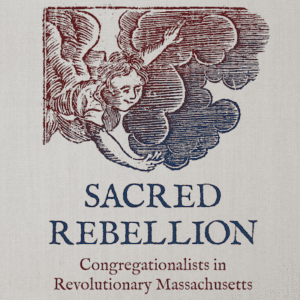
Meanwhile, the Congregational Library in Boston has announced it will reopen its free exhibition “Sacred Rebellion: Congregationalists in Revolutionary Massachusetts” on eight dates in June, July, and August. On each of those days there will also be a curator’s tour for $5 at 1 P.M.

No comments:
Post a Comment