“They hold a Parnassus-fair every Thursday”

Riggs’s mother was, according to the novelist Frances Burney, “a most prodigious fat old lady,…very merry and facetious.” Horace Walpole said she was “an old rough humorist who passed for a wit.”
In 1765 Riggs married John Miller (c. 1744–1798), from a genteel but poor Irish family. He served as a junior officer in a light-horse regiment during the last three years of the Seven Years’ War and then tried studying the law.
Miller was “full of good-natured officiousness,” Walpole said, but that didn’t promise financial success. Fortunately, Anna inherited a fortune from her grandfather.
The Riggs-Millers (John took on Anna’s surname in honor of her money) bought an estate in the village of Batheaston, near Bath. They spent a lot of the Riggs family money fixing up the manor and laying out ornamental gardens.
By 1770 this lifestyle had become too expensive or, in Walpole’s words, “the whole caravan were forced to go abroad”—the Riggs-Millers, their infant girl, and Anna’s mother, plus select servants. The family spent a couple of years in France and Italy, expanding with the birth of a boy in Paris. Anna Riggs-Miller bought an antique vase dug up “by a labouring man in 1769 at Frescati, near the spot where is supposed to have stood the Tusculanum of Cicero.”
The couple came back to Batheaston full of continental sophistication. Well, a version of it, per Walpole:
Alas! Mrs. Miller is returned a beauty, a genius, a Sappho, a tenth Muse, as romantic as Mademoiselle [Madeleine de] Scuderi, and as sophisticated as Mrs. [Elizabeth] Vesey. The Captain’s fingers are loaded with cameos, his tongue runs over with virtù…Anna published her Letters from Italy in three volumes in 1776.
By 1775 the Riggs-Millers were hosting literary salons at Batheaston. The main ritual of these gatherings was a poetry contest staged around that antique vase. Once again, here’s Walpole, from a 15 Jan 1775 letter in which he also remarked on news from Massachusetts about something “called minute-men”:
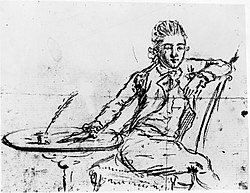
They hold a Parnassus-fair every Thursday, give out rhymes and themes, and all the flux of quality at Bath contend for the prizes. A Roman vase, dressed with pink ribbons and myrtles, receives the poetry, which is drawn out every festival; six judges of these Olympic games retire and select the brightest compositions, which the respective successful acknowledge, kneel to Mrs. Calliope Miller, kiss her fair hand, and are crowned by it with myrtle, with—I don't know what.Between 1775 and 1781 the Riggs-Millers published four volumes of Poetical Amusements at a Villa Near Bath, along with the smaller collections On Novelty and Hobby Horses, giving the proceeds to charity. The frontispiece of the first volume showed the “Roman vase,” above.
You may think this is fiction or exaggeration. Be dumb, unbelievers! The collection is printed, published. Yes, on my faith, there are bouts-rimés on a buttered muffin, made by her Grace the Duchess of Northumberland; receipts to make them, by Corydon the venerable, alias George Pitt; others, very pretty, by Lord Palmerston; some by Lord Carmarthen; many by Mrs. Miller herself, that have no fault but wanting metre; and immortality promised to her without end or measure.
In short since folly, which never ripens to madness but in this hot climate, ran distracted, there never was anything so entertaining or so dull—for you cannot read so long as I have been telling.
Literary reviewers and poets who weren’t invited to the salons tended to disdain the whole enterprise. Nonetheless, notable writers like William Mason and David Garrick contributed work. The poet Anna Seward credited that biweekly salon for discovering her. In 1778 John Riggs-Miller was made a baronet (on the Irish establishment).
In October 1778, as I described back here, the celebrated historian Catharine Macaulay left Bath after sharing the Rev. Thomas Wilson’s house for years. The next month, in the town of Leicester, she married William Graham, a doctor less than half her age. By the end of the year, the posh people of Bath were gossiping about the newlyweds. And in that same period Sir John and Lady Miller hosted one of their regular salons.
TOMORROW: “Winter’s Amusement.”