J. L. BELL is a Massachusetts writer who specializes in (among other things) the start of the American Revolution in and around Boston. He is particularly interested in the experiences of children in 1765-75. He has published scholarly papers and popular articles for both children and adults. He was consultant for an episode of History Detectives, and contributed to a display at Minute Man National Historic Park.

Subscribe thru Follow.it


•••••••••••••••••


Showing posts with label sestercentennial events. Show all posts

Tuesday, September 01, 2026

The View from the Catawba River

On 1 Sept 1776, 250 years ago today, North Carolina brigadier general Griffith Rutherford wrote a letter to the body that had commissioned him, the North Carolina Council of Safety.

He had taken a force of men to the head of the Catawba River to confront Cherokees who had, to preserve their land and as allies of the British Empire, raided some western settlements earlier in the summer.

Rutherford summarized the situation:
If the Indians evacuate the Middle & Valley Towns and our provisions will hold out and it be possible to March to the overhill Towns perhaps I shall go to that place, or perhaps send a detachment to join the Virginians.

Those under my command consists of 1,971 privates of foot, about 80 light horse. . . .

I have ordered 130 under three Captains to Range and defend the forts on the frontiers of Tryon, 175 on the frontiers of Rowan, 100 on Surry.

I am in a very imperfect state of health, but will be as assidious as possible in executing the important trust reposed in me. . . .

P.S. I am this moment informed by the pack horse master General that there are about 1,400 pack horse one driver to each 4 horse and pack horse master over every 10 drivers. We have 40 days provision.
By his count, between soldiers and drivers, Rutherford commanded nearly 2,500 men. Though his letter mentioned Virginians, he was actually aiming to rendezvous with South Carolina’s similar force under Col. Andrew Williamson.

On 19 September, some of Williamson’s troops, guided by Catawba scouts, clashed with the Cherokee in the Battle of Coweecho River. In the same month Griffith’s force founded only deserted settlements, which they burned.

The NCpedia site says: “By late September the two armies made their way home after destroying thirty-six towns and laying waste to crops and storehouses, thus reducing the Indians to a state of near starvation as winter approached.”

This campaign was far from New York City, where the main Continental and Crown forces were engaged in much larger battles. The western fighting tends to be seen as regional sideshows, fought by regional troops. (Gen. John Sullivan’s campaign in New York in 1779 is an exception.)

Nonetheless, the war in the west was an integral part of the Patriots’ war against the British Empire, and the conquest of interior lands among the most far-reaching consequences of American independence.

On 25–26 September, the Catawba and Cherokee American Revolution Symposium will take place at the University of South Carolina at Lancaster.

This program will bring together scholars and researchers from various fields to discuss Catawba and Cherokee communities, conflict, diplomacy, movement, and archeology in the Revolution.

For more information, see this webpage.

Monday, August 31, 2026

Two Vast and Trunkless Legs of Stone

Earlier this summer the National Park Service issued a series of reports about the triumphal arch proposed for Memorial Circle in Washington, D.C.

Those reports can be downloaded from this webpage.

One document, for instance, is a summary of the 100,936 public comments on this project (P.D.F. download; much smaller addendum).

The summary aggregates the points citizens have made, not counting how many people expressed particular ideas. Those points are overwhelmingly negative. (Some groups have filed suit to block the project.)

Appendix D (P.D.F. download) is a table of historic sites that could be adversely affected, directly or indirectly, by the arch. Those affected sites are:
1. Memorial Avenue Corridor Cultural Landscape
2. Arlington Memorial Bridge and Associated Features
3. Lady Bird Johnson Park Cultural Landscape
4. Arlington National Cemetery Historic District
5. Arlington House Historic District
6. Arlington House (Robert E. Lee Memorial)
7. Arlington House Cultural Landscape
8. Lyndon B. Johnson Memorial Grove
9. Mount Vernon Memorial Highway Historic District
10. Lincoln Memorial Cultural Landscape
11. Lincoln Memorial
12. National Mall Site and National Mall Historic District
13. The Mall Cultural Landscape
14. Washington Monument
15. Washington Monument and Grounds Historic District
16. Washington Monument and Grounds Cultural Landscape
17. Rock Creek and Potomac Parkway Historic District
18. East and West Potomac Park Historic District
19. L'Enfant Plan of the City of Washington, District of Columbia
20. Arlington Ridge Park
21. Pentagon
22. Fort Myer National Historic Landmark District
23. George Mason Memorial
24. Thomas Jefferson Memorial Cultural Landscape

On 28 August, the N.P.S. press office issued a new document titled “Triumphal Arch Assessment of Effect (Revised)”.

In this report, the adverse effects table is Appendix L, part of the main file. It adds to the sites expected to suffer adverse effects:
25. World War II Memorial
26. Thomas Jefferson Memorial
27. United States Capitol
28. Georgetown Historic District
29. Old Naval Observatory
30. Observatory Hill Historic District
31. Alban Towers Apartment Building
32. American Institute of Pharmacy Building
33. Halcyon House
34. Francis Scott Key Bridge
35. National Cathedral
36. National War College
37. Vigilant Firehouse
38. Bridge #5020
39. Mount Vernon Memorial Highway North Cultural Landscape Inventory
40. Old Warehouse Area and Ground Maintenance Complex
41. Frederick Douglass National Historic Site

Nonetheless, that latest report states:
Placing the Triumphal Arch within the George Washington Memorial Parkway is consistent with the park’s purpose as a scenic roadway honoring the nation’s first president and protecting the cultural and natural resources that frame the Potomac River corridor. The Arch’s role in celebrating the 250th anniversary of the United States aligns with the Parkway’s long-standing function as a landscape dedicated to reflection on national ideals, unity, and sacrifice.
News media have reported this report as the N.P.S. “approving” of the construction, which technically it is, but only because the political appointees atop the Department of the Interior have insisted on rubber-stamping the President’s grandiose ideas.

Back in October 2025, when Donald Trump started waving around models of the arch, Time reported:
At the end of a press conference in the Oval Office Wednesday before the dinner, Trump was asked about the arch, of which a model sat on his desk. “Who is it for?” asked CBS reporter Ed O’Keefe. “Me. It’s going to be beautiful” replied President Trump.
Nothing about the Sestercentennial, “national ideals, unity, and sacrifice,” or “honoring the nation’s first president,” much less protecting cultural and natural resources.

“Me.”

Sunday, August 30, 2026

Long Island Has Fallen

On the morning of 30 Aug 1776, 250 years ago today, Gen. William Heath was stationed at Kingsbridge, New York, on the Hudson River just north of Manhattan Island.

Heath wrote urgently to his commander-in-chief:
A very Extraordinary Report has Just Spread here, that whether True or false we are as yet uncertain That Long-Island is Evacuated by Our Troops. . . .

I am in Anxiety Untill I hear from you
This letter is transcribed at Founders Online, and the Massachusetts Historical Society has digitized Heath’s copy.

Likewise, Abraham Yates, Jr., head of the New York committee of safety, wrote to the commander from the same place:
In our way to Fishkill agreable to an adjournment of the Convention, we are informed that the Army is removed from Long Island to the City of New York—

an anxiety to know the fact, as well as to be informed wether you think any measures necessary for us to take—Induces us to trouble your Excellency at this time for an answer hereto—

We have ordered last Night all the Militia of the Counties of Ulster, Dutchess, Orange and Westchester to be ready at a Minutes warning, with five days provisions.
Gen. George Washington wrote back to Yates:
Circumstanced as this Army was in respect to Situation Strength &c., it was the unanimous advice of a Council of General Officers to give up Long-Island, and not by divideing our Force be unable to resist the Enemy in any one point of Attack, this reason added to some others, particularly the fear of haveing our Communication cut of from the Main (of which there seemed to be no Small probability) and the extreame fatigue our Troops were laid under in guarding such extensive Lines, without proper Shelter from the weather, induced the above Resolution.

It is the most intricate thing in the World Sir to know in what manner to conduct ones self with Respect to the Militia, if you do not begin many days before they are wanted to raise them, you cannot have them in time, if you do they get tired and return, besides being under very little Order or Government whilst in Service—

However if the Enemy have a design of serveing of Us at this place as we apprehended they meant to do on Long-Island—it might not be improper to have a body in readiness to prevent or retard a Landing of them on the East of Harlem River, if need be—

In haste & not a little fatigued, I remain with great Respect & Esteem Sir Yr Most Obedt Hume sert…
Washington let the adjutant general, Joseph Reed, reply to Heath:
The Report of the Evacuation of Long Island last night is true—it was a Measure founded in the fullest Necessity after the Surprize of our Troops last Tuesday [the Battle of Brooklyn], by which the Flower of our Army & some of our best Officers were lost.

add to this that the constant Rains upon Troops without Cover has so spoil’d the Ammunition & enfeebled the Men that had the Enemy attempted to force our Lines they must have done it with great Ease. The Ships have also been trying to get up the whole Week, which if they could effect our Communication would have been cut off and the whole Army must have surrendered at Discretion.

Under these Circumstances the remaining General Officers were unanimously of Opinion that it was absolutely necessary to retreat which was done so as to bring off all our Ammunition & Artillery except the heavy Pieces & most of our Provisions

Our Situation is in all Respects critical Ld. Stirling & Gen. [John] Sullivan are both Prisoners—the latter was permitted to come out this Morning on his Parole with a Message from Ld. Howe. This is the Substance of what has passed in this important Week.

Thursday, August 27, 2026

“Arnold’s Defeat or Ultimate Victory?” Conference at Fort Ti, 9–10 Oct.

On 9–10 Oct 2026, Fort Tionderoga will host a Special 250th Conference on “Arnold’s Defeat or Ultimate Victory?: Perspectives on the 1776 Campaign,” covering the Battle of Valcour Island and surrounding events.

The venue explains:
The failure of the British to seize Ticonderoga in the fall of 1776 was a critical, vital victory for the Americans in the early years of the Revolutionary War—acknowledged even at the time. But who gets the credit for the year’s victory? Benedict Arnold and his lake fleet? Horatio Gates and the defenses of Ticonderoga and Mount Independence? Sharing new perspectives and new research from a variety of disciplines, our panelists will detail, and debate, the critical actions of the campaign to better understand the impact of October 1776.
The event starts with optional programs on Friday:
  • 11 A.M.: Tour of Liberty Hill and the Outer Defenses of Fort Ticonderoga with Stuart Lilie, Vice President of Public History.
  • 1:15 P.M.: Crewing a Bateau—Join the fort’s Maritime Trades staff, take an oar, and head out on Lake Champlain in a bateau.
  • 3 P.M.: Ticonderoga’s Treasures: The 1776 Campaign on Lake Champlain with Dr. Matthew Keagle, Curator.
These programs have limited space and additional fees ranging from $35 to $50.

Here are the conference presentations scheduled for the Saturday conference:
  • “Carleton’s Race to Ticonderoga: His Opponents and Why He Lost” by Don Hagist, editor of the Journal of the American Revolution.
  • “Crafting Independence: The Work Behind the Battle of Valcour Island” by Kenneth Cohen, Chair of the Division of Military & Society at the Smithsonian’s National Museum of American History.
  • “‘To prevent Shipping coming past’: Ticonderoga’s Amphibious Fortifications” by Stuart Lilie, Vice President of Public History at Fort Ticonderoga.
  • “The day must shortly come when these facts will be known to the World” by Eric Schnitzer, ranger and military historian at Saratoga National Historical Park.
  • “‘An Active Part in Our Favour’: The Stockbridge Mohican Indians” by Mark R. Anderson, author of Down the Warpath to the Cedars.
  • “The Archaeology of ‘Destruction Bay’ and the Events of October 13, 1776” by Christopher Sabick, executive director of the Lake Champlain Maritime Museum.
The sessions will end with a panel discussion collecting all the speakers and moderator Dr. Matthew Keagle, Curator of Fort Ticonderoga.

The fort also organized a Sunday cruise on Lake Champlain, following the maritime action, but that’s already sold out.

The presentations will be livestreamed so people can register to listen online. For more information, including cost, meals, and schedule, visit the conference webpage.

And while you’re there, also check out Fort Ti’s annual conference on the American Revolution, scheduled 26–27 September.

Thursday, August 06, 2026

Hopestill Capen from the Cornfields to the Jail

On 6 Aug 1776, 250 years ago today, authorities in Boston locked merchant Hopestill Capen (1731–1807) in jail for “aiding and abetting those called enemies to the Colonies.”

For decades Capen had run his dry goods business at the sign of the Cornfields in a building he owned, now known as the Union Oyster House. He served as a militia officer and held minor town offices.

Late in 1769 Capen took on Benjamin Thompson as an apprentice, but that arrangement didn’t last long. The merchant later reportedly told the teenager’s mother “he oftener found her son under the counter, with gimblets, knife, and saw, constructing some little machine, or looking over some book of science, than behind it, arranging the cloths or waiting upon customers.”

from 1771 until just before the war, one of Capen’s tenants in the building was the Whig printer Isaiah Thomas.

During that time, Capen had become known as a mild Loyalist. He signed the complimentary addresses to Gov. Thomas Hutchinson and Gen. Thomas Gage, and he joined the protest against the Solemn League and Covenant.

Capen chose not to evacuate with the British military in 1776, however. Unlike many Loyalists, he had deep family roots in Massachusetts, and all his property was there.

In April 1776 the Massachusetts House directed the Suffolk County justices and sheriff to detain and question dozens of individuals suspected of disloyalty. Capen was fifth on that list, showing his prominence in town.

But it wasn’t until the summer, after Massachusetts had declared independence from the Crown, that the Council ordered those authorities to lock Capen up. No one ever appears to have ever produced evidence of him “aiding and abetting” Crown forces, but he did refuse to pledge allegiance to the new state.

Capen presented himself as a conscientious objector, motivated by religion. In the 1760s he had joined Boston’s small Sandemanian sect, and he said that his faith required him to stay out of the war.

Some analysts have described the Sandemanians as pacifist because of statements like Capen’s. But he wasn’t opposed to military action in principle. He’d been an active member of the Ancient and Honorable Artillery Company as well as the colonial militia, and during the siege he became a sergeant in a Loyal Associated Volunteers under Capt. Adino Paddock.

Rather, the Sandemanian creed said believers should be loyal to the government in control on the grounds that it must be divinely ordained. With the war still going on, and thus divine will not yet clear, Capen insisted that he couldn’t promise his allegiance to the U.S. of A.

Tuesday, August 04, 2026

Back to Philadelphia for “The Road to Independence” in September

In April, I went to Philadelphia to help lead the Pursuit of History Weekend on “The Road to Independence,” nearly three full days of exploring the city and the Continental Congress’s move to breaking from Britain.

That was so much fun that we’re offering a similar program on 18–20 September. The anniversary of the Declaration of Independence has passed, of course, but we can dig deeper into its history in this Sestercentennial year. In fact, we have the chance to take in new material and historic spaces not available in the spring.

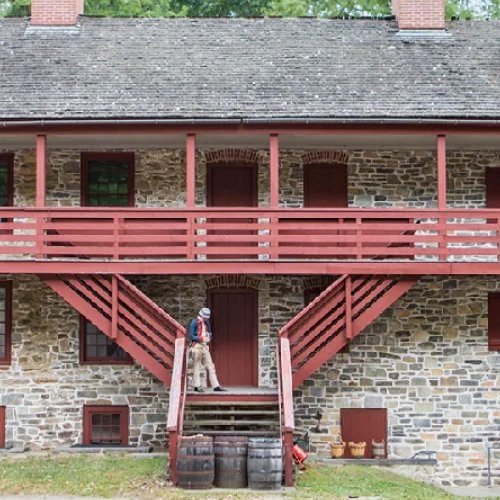
This time our base will be the Arch Street Meetinghouse, commissioned by Quakers in 1803–04 and shown above. We’ll also visit Carpenters’ Hall, Independence Hall, the controversial Presidents’ House site, the Arch Street Burying-Ground, the Museum of the American Revolution, the American Philosophical Society Museum, and other places in scenic Philadelphia.

One addition to this session is the First Bank of the United States, which just reopened after a major refurbishment. We’ll visit that on Sunday, our “extra” day when we go outside the period of our main focus.

Our speakers this time around will be:
  • Jane E. Calvert, Ph.D., author of Penman of the Founding and founding director of the John Dickinson Writings Project.
  • Christina R. Carrick and James P. McClure, Ph.D., editors at the Papers of Thomas Jefferson.
  • Shawn David McGhee, Ph.D., author of No Longer Subjects of the British King: The Political Transformation of Royal Subjects to Republican Citizens, 1774–1776.
  • Samuel A. Forman, M.D., M.P.H., author of Joseph Warren and Ill-Fated Frontier, and a native of Philadelphia.
  • Richard Vague, author of The Banker Who Made America: Thomas Willing and The Rise of the American Financial Aristocracy, 1731–1821.
  • J. L. Bell, program director and author of The Road to Concord.
We’re expecting this session to be smaller than the one in the spring, but still looking for two to three dozen folks interested in Revolutionary history.

For more information about what’s included, costs, and registration for “The Road to Independence,” please visit the Pursuit of History website.

(Meanwhile, I’m also working on the program for a new Pursuit of History Weekend in November.)

Tuesday, July 21, 2026

America250’s Christian Comics

When Boston 1775 last looked in on America250, the commemorative campaign of the Congressionally-established Semiquincentennial commission, the Trump White House was trying to replace it with its own Freedom250 campaign.

And, of course, its own merchandise for sale.

America250 continues to issue material, though. Among the products bearing its brand and sold through its website is a series of comic books about American history.

That line has included fifteen comics about 36 pages long, a collection of ten of those comics which cover the settlement and founding periods, and a graphic novel on the U.S. Constitution.

The America250 website doesn’t offer clear info on contents and credits, and not all the titles are available there anymore. Its publishing partner, Kingstone, offers all the titles, and at lower prices.

Journalist and historian Colin Woodard recently looked at those comics for Talking Points Memo and reported:
The comics — beautifully executed and bearing the America250 logo — were produced by Kingstone, a Christian publisher best known for its 2000-page, 10,000 panel graphic interpretation of the Bible. . . .

The series — drawn by a world-class Brazilian artist [Joe Bennett] who lost his gig with Marvel comics over antisemitic imagery in cartoons championing Jair Bolsonaro — devotes five volumes to the colonial era, its characters, themes and settings carefully curated to depict the eventual creation of the United States as an outgrowth of divine will and intervention. They all take place north of the Mason-Dixon line, with the action rarely leaving the confines of New England, the only part of colonial North America where Calvinists were the dominant political and cultural force. . . . More glaring is the omission of the origin stories of all of the colonies south of New England — home to most of colonial America’s inhabitants — which don’t fit so well into Kingstone’s narrative. . . .

Miracles abound in the story. Among those explicitly called out in the comics: a young George Washington surviving a rain of French bullets in a 1755 raid; Jefferson writing “all men are created equal” even though he was a slaveowner; the dense fog that fell to protect Washington’s army’s retreat across the East River during the Battle of Long Island; the reversal of fortune allowing Washington’s [sic] victory at the Battle of Saratoga in 1777; the early start to the 1781 hurricane season and the bad decisions made by British generals that facilitated the final British defeat at Yorktown; Franklin’s suggestion that delegates pray to find a compromise solution on legislative representation at the Constitutional Convention; and the Constitution itself, because of its alleged brilliance.
Woodard also detailed many ways the Constitution graphic novel promotes particular positions on today’s political issues, from a historically unfounded reading of the Fourteenth Amendment to opposition to gun regulations, reforming the Electoral College, and expanding the Supreme Court.

Saturday, July 18, 2026

“To hear the proclamation for independance read and proclamed”

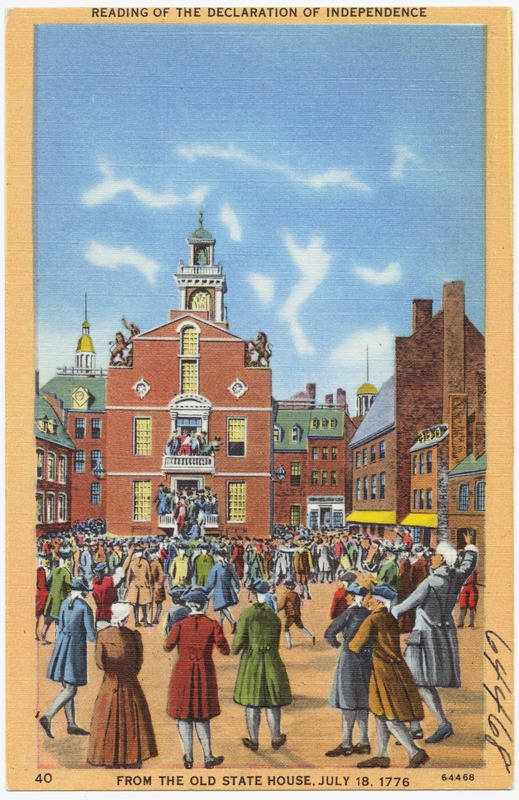
On 18 July 1776, 250 years ago today, the Declaration of Independence was officially proclaimed in Massachusetts.

People had already heard about the Continental Congress’s vote, and many had probably read the Declaration in newspapers. But this was a governmental ceremony. It happened in two places, and on two levels.

With no governor, the highest executive authority in Massachusetts was the Council. Most of its members were meeting in the Edmund Fowle house in Watertown.

Therefore, one part of the official reading was performed by Council secretary Perez Morton, reading the Declaration to the Council and to a crowd gathered outside. Also present were delegates from the Mi’kmaq and St. John’s/Maliseet communities, ready to sign a treaty of friendship with this new United States.

In Boston, there was a parallel, larger ceremony. Inside the Council’s chamber in what was now the State House, Suffolk County sheriff William Greenleaf read the Declaration to some Council members and other officials.

Col. Thomas Crafts of the Massachusetts artillery regiment, who had a bellowing voice, then “deaconed” or repeated the text phrase by phrase from the balcony of the Council chamber to the crowd gathered on the street below.

Thus, most Bostonians at the event heard Col. Crafts’s reading, but the official proclamation in Boston came from Sheriff Greenleaf. The ceremony was meant for both government officials and the “people out of doors.”

On 21 July, Abigail Adams reported to her husband:
Last Thursday after hearing a very Good Sermon I went with the Multitude into Kings Street to hear the proclamation for independance read and proclamed. Some Field peices with the Train were brought there, the troops appeard under Arms and all the inhabitants assembled there (the small pox prevented many thousand from the Country).

When Col. Crafts read from the Belcona of the State House the Proclamation, great attention was given to every word. As soon as he ended, the cry from the Belcona, was God Save our American States and then 3 cheers which rended the air, the Bells rang, the privateers fired, the forts and Batteries, the cannon were discharged, the platoons followed and every face appeard joyfull.

Mr. [James] Bowdoin [a senior member of the Council] then gave a Sentiment, Stability and perpetuity to American independance.

After dinner the kings arms were taken down from the State House and every vestage of him from every place in which it appeard and burnt in King Street. Thus ends royall Authority in this State, and all the people shall say Amen.
Not everyone was entirely pleased. Merchant John Rowe characterized the celebration as “a Great Confusion in Town.”

Pulling the royal emblems of the lion and unicorn down from the State House roof was probably inspired by reports of New Yorkers toppling the statue of King George III after that city’s reading of the Declaration on 9 July. But the street was still called King Street until 1784.

Friday, July 10, 2026

Musical Offerings across Massachusetts

Theaters on either side of Massachusetts are offering Revolutionary musicals in this Independence Day season.

Through Sunday, 19 July, at the Kathleen E. McDermott Auditorium in Great Barrington, John Alan Segalla’s new musical Rebel Town is being staged under the direction of Michael Siktberg.

This show is set in 1773 and looks at the disputes leading up to the destruction of the tea. The main characters are carpenter William Grey, his wife Sarah, and apprentice Peter Slater, presumably based on the ropemaker’s boy of that name. Among the historical figures in the cast are Mercy Warren, Samuel Adams, John Hancock, Paul Revere, Francis Rotch, Gov. Thomas Hutchinson, and Gen. Thomas Gage.

On Cape Cod, the Academy of Performing Arts in Orleans is producing 1776, with music and lyrics by Sherman Edwards and a book by Peter Stone. This production, directed by Joan Baird, also runs through 19 July.

Staged on Broadway in 1969 and filmed in 1972, 1776 dramatizes the process of declaring independence. Most of the characters are delegates to the Continental Congress, starting with John Adams, Thomas Jefferson, Benjamin Franklin, and John Dickinson. Abigail Adams and Martha Jefferson appear as well.

In Boston’s North End, the Paul Revere House is hosting a hammered dulcimer concert by Dave Neiman on Saturday, 18 July, from 1 to 3 P.M.

Thursday, July 09, 2026

“Im Congress, den 4ten July, 1776.”

On 9 July 1776, 250 years ago today, Heinrich Miller’s Pennsylvanischer Staatsbote newspaper printed the first translation of the Declaration of Independence into another language.

Miller’s paper served the colony’s substantial German population. He supported independence, so he was happy to spread this news.

At some point two more German printers, Melchior Steiner and Charles Cist, issued a broadside with the same translation. Emily Sneff reports that only two copies are known to survive.
Miller’s printing filled the entire first page of his newspaper below the masthead and about half of page 2. Steiner and Cist fit more type into each column and thus got the whole text onto one side of a broadsheet.

Both printings rendered the Continental Congress’s president as “John Hancock” and its secretary as “Carl Thomson.”

Wednesday, July 08, 2026

Counting Votes in Independence Hall

As quoted yesterday, Edward Rutledge hoped that John Jay would return to the Continental Congress by 1 July so he could help to argue against declaring independence, at least at that time.

Jay didn’t make it, and on that date the delegations in Philadelphia took a test vote in their committee of the whole.

Nine colonies voted for independence. Four voted otherwise.

Rutledge’s South Carolina voted against. That colony contained the fourth largest port in North America and was very tied in with trade to the Caribbean and Africa.

Pennsylvania voted against independence. Its large delegation was split. Such heavyweights as John Dickinson and Robert Morris opposed the measure while a minority including Benjamin Franklin favored it.

Delaware had sent three delegates to Congress, but only two were present. Those men, Thomas McKean and George Read, disagreed. As a result, that delegation had to abstain.

New York also abstained because its delegates had received no guidance from its provincial congress. That colony contained the second-largest port along the coast, under imminent threat from the British military.

The vote was thus 9 delegations for independence, 2 against, and 2 abstaining.

The committee of the whole thus supported independence, but a big chunk of the Middle Colonies, including the two largest cities, were missing from the pro-independence bloc. There was no formal requirement that the vote be unanimous, but everyone realized that reporting disunity would hamper any ongoing resistance to the Crown.

The next day, Caesar Rodney returned from Delaware, “detained by thunder and rain,” as he wrote. McKean later said his colleague appeared “at the State-house door, in his boots and spurs.” Rodney’s arrival tipped the Delaware delegation into the pro-independence camp.

10 – 2 – 1.

Rutledge saw the trend. He decided that the danger of displaying disunity was worse than the danger of declaring independence before finishing the Articles of Confederation and Perpetual Union. He moved for a new vote, signaling that South Carolina would switch to approval.

11 – 1 – 1.

Thinking along the same lines, Dickinson and Morris chose not to attend the 2 July session of the Congress. That meant most of the Pennsylvania delegates in the assembly hall supported independence, changing that colony’s vote.

12 – 0 – 1.

The Congress could thus report that the vote for independence was unopposed.

Monday, July 06, 2026

How Philadelphia Printers Shared News of the Declaration

John Dunlap printed official broadsides of the Declaration of Independence for the Continental Congress, but other printers were issuing the same text in other forms.

And that was how the Congress wanted it. The point was to spread the news through newspapers, broadside reprints, and public readings, not to keep it confined.

Back on Tuesday, 2 July 1776, the Pennsylvania Evening Post was the first newspaper to report that the Congress had voted for independence. Since Benjamin Towne and his staff laid out and printed the last page of that paper in the afternoon, they could slip in one more line of fresh news:

This day the CONTINENTAL CONGRESS declared the UNITED COLONIES FREE and INDEPENDENT STATES.
The next morning, David Hall and William Sellers’s Pennsylvania Gazette shared the same item.

The only Philadelphia newspaper to publish on Friday, 5 July, was Heinrich Miller’s Pennsylvanischer Staatsbote, printed in German. Miller ran two paragraphs about independence and the Declaration being on the press at the start of his local reports.
On Saturday, 6 July, 250 years ago today, the Pennsylvania Evening Post ran the full text of the Declaration starting on the front page. Towne’s print shop had probably laid out that text the previous day since newspapers usually printed the front page first.
Only a few Americans saw the Dunlap broadside and other government publications, but thousands would read the Declaration text in newspapers over the following weeks.

Sunday, July 05, 2026

John Hancock’s Enclosures

The Continental Congress approved its edited text of the Declaration of Independence in the middle of the day on 4 July 1776.

The delegates moved on to other business while a clerk—most likely Timothy Matlack—wrote out the final text neatly.

John Hancock signed that document as Congress chairman. Charles Thomson signed as secretary. Then it went to printer John Dunlap.

Years later, a handful of Philadelphians recalled hearing the Declaration, or part of it, read to the crowd outside the Pennsylvania State House that afternoon. This wasn’t the official proclamation, just someone like Matlack sharing news.

Dunlap’s shop set the text in type and printed copies that evening and into the next day. Those broadsheets were to go to the delegates, the army, and the Patriot governments of the new states.

On 5 July, 250 years ago today, Hancock started to fulfill his duty of distributing copies. He wrote to the Pennsylvania Committee of Safety:
I do myself the Honour to enclose, in Obedience to the Commands of Congress, a Copy of the Declaration of Independence; which I am directed to request, you will have proclaimed, in your Colony, in the Way and Manner, you shall judge best.

The American States being now for ever divided from those who wished to destroy them, it has become absolutely necessary for their Security and Happiness to adopt some Government of their own. In this View of the Matter, the important Consequences, flowing from a Declaration of Independence, considered as the Ground & Foundation thereof, will naturally suggest the Propriety of proclaiming it in such a Mode, that the People may be universally informed of it.
On the same day Hancock put two of those three sentences into a letter to the New Jersey Convention that first discussed moving prisoners to York, Pennsylvania.

On 6 July, Hancock signed more letters. These went to the New York Convention, Gov. Jonathan Trumbull of Connecticut, Gov. Nicholas Cooke of Rhode Island, the Massachusetts General Court, and the New Hampshire Assembly:
Altho it is not possible to foresee the Consequences of Human Actions, yet it is nevertheless a Duty we owe ourselves and Posterity in all our public Counsels, to decide in the best Manner we are able, and to trust the Event to that Being who controuls both Causes and Events so as to bring about his own Determinations.

Impressed with this Sentiment, and at the same Time fully convinced that our Affairs may take a more favourable Turn, the Congress have judged it necessary to dissolve all Connection between Great Britain & the American Colonies, and to declare them free and independent States, as you will perceive by the enclosed Declaration, which I am directed by Congress to transmit to you, and to request you will have it proclaimed in your Colony in the Way you shall think most proper.

The important Consequences to the American States from this Declaration of Independence, considered as the Ground & Foundation of a future Government, will naturally suggest the Propriety of proclaiming it in such a Manner, that the People may be universally informed of it.
Hancock finished that task on 8 July, sending the Declaration to states to the south. His letter to Georgia has been sold a couple of times in the last decade.

TOMORROW: Publication.

Saturday, July 04, 2026

“Avoid becoming the draughtsman of papers to be reviewed by a public body”

Two hundred fifty years ago today, the Continental Congress finished polishing the Declaration of Independence and voted to approve the final text.

True to his character, Thomas Jefferson chose to be “a passive auditor” as his colleagues hashed over the words he’d drafted. But, he admitted to James Madison, the debate affected him:
during the debate I was sitting by Dr [Benjamin] Franklin, and he observed that I was writhing a little under the acrimonious criticisms on some of it’s parts; and it was on that occasion that, by way of comfort, he told me the story of John Thompson the Hatter, and his new sign. 
Jefferson didn’t explain that allusion in his letter to Madison, but he put it into his notes on Franklin:
When the Declaration of Independance was under the consideration of Congress, there were two or three unlucky expressions in it which gave offence to some members.

the words ‘Scotch and other foreign auxiliaries’ excited the ire of a gentleman or two of that country.
(Yes, suggesting that the Scottish were foreigners from outside the British Empire would have prompted complaints.)
severe strictures on the conduct of the British king, in negativing our repeated repeals of the law which permitted the importation of slaves, were disapproved by some Southern gentlemen, whose reflections were not yet matured to the full abhorrence of that traffic. altho’ the offensive expressions were immediately yielded, these gentlemen continued their depredations on other parts of the instrument.

I was sitting by Dr Franklin who percieved that I was not insensible to these mutilations. ‘I have made it a rule, said he, whenever in my power, to avoid becoming the draughtsman of papers to be reviewed by a public body. I took my lesson from an incident which I will relate to you.

when I was a journeyman printer, one of my companions, an apprentice Hatter, having served out his time, was about to open shop for himself. his first concern was to have a handsome sign-board, with a proper inscription. he composed it in these words ‘John Thompson, Hatter, makes and sells hats. for ready money,’ with a figure of a hat subjoined. but he thought he would submit it to his friends for their amendments.

the first he shewed it to thought the word ‘Hatter,’ tautologous, because followed by the words ‘makes hats’ which shew he was a Hatter. it was struck out.

the next observed that the word ‘makes’ might as well be omitted, because his customers would not care who made the hats. if good & to their mind, they would buy, by whomsoever made. he struck it out.

a third said he thought the words ‘for ready money,’ were useless as it was not the custom of the place to sell on credit. every one who purchased expected to pay. they were parted with, and the inscription now stood ‘John Thomson sells hats.’

‘sells hats’ says his next friend? why nobody will expect you to give them away. what then is the use of that word? it was stricken out, and ‘hats’ followed it, the rather, as there was one painted on the board.

so his inscription was reduced ultimately to ‘John Thomson’ with the figure of a hat subjoined.’
I don’t know any examples of authentic eighteenth-century hatters’ shop signs in the British Empire, but Colonial Williamsburg and the Adverts 250 Project have shared images of hatters’ wordy newspaper advertisements.

TOMORROW: Spreading the word.

Friday, July 03, 2026

“They unanimously pressed on myself alone to undertake the draught”

A few days after Timothy Pickering delivered an Independence Day oration in Salem in 1823, casting doubt on Thomas Jefferson’s importance in drafting the Declaration of Independence, Joseph E. Sprague (1782–1852) sent the text of that speech to Jefferson himself:
Supposing you might feel some little curiosity to see Col Pickering unwilling & ungrateful tribute to the illustrious Author of the Declaration of Independence I have taken the liberty to enclose it to you
Sprague was a postmaster and a Jeffersonian politician between terms in the Massachusetts House, so he had time to stir up trouble.

Near the end of the month Jefferson shared his version of the drafting story with his good friend and ally James Madison:
You have doubtless seen Timothy Pickering’s 4th of July Observations on the Declaration of Independance. if his principles and prejudices personal and political, gave us no reason to doubt whether he had truly quoted the information he alledges to have recieved from Mr [John] Adams, I should then say that, in some of the particulars, mr Adams’s memory has led him into unquestionable error. at the age of 88. and 47. years after the transactions of Independance, this is not wonderful.

nor should I, at the age of 80, on the small advantage of that difference only, venture to oppose my memory to his, were it not supported by written notes, taken by myself at the moment and on the spot.

he says ‘the Committee (of 5. to wit, Dr [Benjamin] Franklin, [Roger] Sherman, [Robert R.] Livingston and ourselves) met, discussed the subject, and then appointed him and myself to make the draught; that we, as a subcommittee, met, & after the urgencies of each on the other, I consented to undertake the task; that the draught being made, we, the subcommittee, met, & conned the paper over, and he does not remember that he made or suggested a single alteration.’ now these details are quite incorrect.

the Committee of 5. met, no such thing as a subcommittee was proposed, but they unanimously pressed on myself alone to undertake the draught.

I consented; I drew it; but before I reported it to the committee, I communicated it separately to Dr Franklin and mr Adams requesting their corrections; because they were the two members of whose judgments and amendments I wished most to have the benefit before presenting it to the Committee; and you have seen the original paper now in my hands, with the corrections of Doctor Franklin and mr Adams interlined in their own hand writings   

their alterations were two or three only, and merely verbal. I then wrote a fair copy, reported it to the Committee, and from them, unaltered to Congress. this personal communication and consultation with mr Adams he has misremembered into the actings of a sub-committee.
Jefferson didn’t write to Madison because he thought his friend might need convincing about this story. Rather, he was writing for posterity, putting his version of history on paper for us.

Though Pickering quoted John Adams’s letter, Jefferson took pains to excuse Adams of any fault but poor memory. By this time the two men had been corresponding amicably for over a decade. Indeed, Jefferson praised Adams in his letter:
had mr Adams been so restrained, Congress would have lost the benefit of his bold and impressive advocations of the rights of revolution. for no man’s confident & fervid addresses, more than mr Adams’s, encoraged and supported us thro’ the difficulties surrounding us, which, like the ceaseless action of gravity, weighed on us by night and by day. . . . he supported the declaration with zeal & ability, fighting fearlessly for every word of it.
Jefferson was less respectful of the arch-Federalist Pickering, though:
Timothy thinks the instrument the better for having a fourth of it expunged. he would have thought it still better had the other three fourths gone out also, all but the single sentiment (the only one he approves) which recommends friendship to his dear England, whenever she is willing to be at peace with us.
TOMORROW: Doctor’s advice.

Tuesday, June 30, 2026

“In the shape in which Mr. Jefferson had presented it”

In August 1822, Timothy Pickering wrote to John Adams with questions about the drafting of the Declaration of Independence.

Pickering had served as Secretary of State while Adams was President. The men fell out over foreign policy, and Adams chose a new Secretary of State. Later Adams grouped Pickering in the “Essex Junto” he said undermined him, to Pickering’s puzzlement.

But by 1822 both men were out of public office. Thomas Jefferson and his adherents had been in the White House for two decades. Old intraparty enmities didn’t seem so important as ongoing interparty enmities.

Pickering asked to clear up what he considered mysteries about how the Continental Congress chose its committee to write the Declaration:
Mr. Jefferson being first on the list, became the chairman. This, considering the composition of the committee, and that Mr. Jefferson was the youngest man, would appear remarkable. Mr. Charles Lee, who married a daughter of R. H. Lee, once gave me this account: That Mr. Lee having moved the resolution for declaring the Colonies independent, would, according to the usual course, have been elected chairman of the committee for preparing the declaration; but sickness in his family caused him to return home.—Mr. Jefferson, another Virginian, was then chosen to supply his place.
As Pickering said, in many committees of this sort, the first man named was not only expected to be chairman but also the principal writer of the committee’s report—in this case, the Declaration.

However, Pickering misstated the history in a couple of ways. Jefferson was older than another committee member, Robert R. Livingston. And Richard Henry Lee had a second reason to return home besides a sick wife: he wanted to be involved in how Virginia formed a state government.

The letter went on:
The late [Massachusetts] Chief Justice [Theophilus] Parsons once told me, that in conversing on this subject, you informed him, that you and Mr. Jefferson were the sub-committee to prepare the declaration, and that you left to Mr. Jefferson the making of the draught. . . . But I was at a loss to account for the committee’s letting it be reported in the shape in which Mr. Jefferson had presented it to them.
Pickering guessed that the other members of the committee held back their criticism of the wordy draft after “observing a strong attachment of the parent to his offspring,” figuring Jefferson would more easily accept revisions from the Congress as a whole.

As an arch-Federalist, Pickering invited Adams, the last Federalist President, to confirm his theories because:
there is no end of the praises of Mr. Jefferson as the author of the declaration of independence:—if he had been the author of our independence itself, he could hardly have been more eulogized.—I have thought it desirable that the real facts in this case should be ascertained.
Could Adams’s recollections knock former President Jefferson down a peg or two?

TOMORROW: Adams’s reply.

Monday, June 29, 2026

Show Changes on the Declaration of Independence

On this date 250 years ago, the Continental Congress was taking the weekend off from formal sessions.

The Congress’s proposed Declaration of Independence was lying “on the table,” discussion of it tabled in favor of tasks like a naming a committee on manufacturing sulphur and choosing who would sign another $1,000,000 in currency.

Of course, a lot of politicking happened that weekend, off the record. Delegates were no doubt reading the draft submitted on 28 June 1776, composed by Thomas Jefferson with input from John Adams, Benjamin Franklin, Roger Sherman, and possibly Robert R. Livingston. Obviously, it needed further revision.

Earlier this year, the Thomas Jefferson Papers project at Princeton University created a website laying out that writing and revision process in detail, displaying and analyzing the existing documentary record. It’s well worth a visit.

It’s also interesting to think about the pedagogical and design challenge of this project. As the editors explain:
Past editors of Jefferson’s papers employed different techniques to show the declaration’s development and the committee’s revisions to the draft. Some used the root text before any revisions were made and added extensive annotation to explain later changes. Others printed the draft as it was submitted to Congress, using annotation to describe the changes that had been made up to that point. One edition printed three stages of revision as three separate, side-by-side columns for comparison. Others simply included an image of the chaotic draft without attempting to transcribe or break down the contents . . .

The Papers of Thomas Jefferson, in the series’ first published volume, printed the underlying “original Rough draught” with footnotes showing changes made before Adams made his copy. In a different part of the same volume, the Papers printed the draft as submitted to Congress, with the changes made by the committee marked, and also printed the final Declaration of Independence. While a dedicated researcher could piece together the development of the draft, it is difficult to get a clear narrative of the draft’s development through print sources alone. For this exhibit, we separated stages of revision into three tabs, so changes to the text can be viewed side by side with zoom-capable images of the manuscript.

The first tab shows the base text before any alterations were made. This is completely in Jefferson’s hand and strips out changes and corrections that were later marked on the page.

The second tab shows changes marked before Adams made his copy. These might be early revisions Jefferson made to his own work or revisions made in early consultations with committee members.

The third tab shows the remaining revisions marked on the document prior to its submission to Congress. To ascertain this stage, we examined three copies that Jefferson sent to friends in the days shortly after July 4, in which he reconstructed the draft that the committee had laid before Congress. We also consulted another copy of the draft that Jefferson transcribed into his Notes of Proceedings of the Continental Congress, which he compiled sometime between August 1776 and August 1783. When possible, we have identified the committee member who contributed each revision.
Adams and Jefferson both left recollections of the writing process. Unfortunately, that means we don’t know what happened.

TOMORROW: The Adams chronicle.

Friday, June 26, 2026

Celebrating the Sestercentennial at Adams National Historical Park

Adams National Historical Park will host a full week of events commemorating the Sestercentennial of the Declaration of Independence, which John Adams had a little something to do with.

Unless otherwise noted, all these events will take place on the grounds of the Old House at Peace field, located at 135 Adams Street in Quincy.

Friday, 26 June, 6 P.M.
Slice of History
A night of pizza and rewatching the animated cartoon Liberty’s Kids. This event is intended for viewers ages 18–30, who might enjoy memories of the original broadcasts, but all are welcome.

Saturday, 27 June, and Sunday, 28 June
The Adamses and the American Revolution
Adams Farm at Penn’s Hill, 141 Adams Street
Ranger talks and special programs sharing the experiences of the Adams family during the American Revolution and their contributions to American independence.

Sunday, 28 June, 4 P.M.
Jefferson & Adams
This stage play by Howard Ginsberg dramatizes the friendship between John Adams, Thomas Jefferson, and Abigail Adams. Actors Bill Barker, Sam Goodyear, and Abigail Schumann bring to life the fifty-year relationship—often contentious, sometimes turbulent, and ultimately enduring.

Tuesday, 30 June, 6 P.M.
My Dearest Friend
Written by Peter Manos, this play reveals the American Revolution and the founding of the United States through the rich, witty, and passionate correspondence between Abigail and John Adams. They spent years apart, sometimes on separate continents, but stayed intensely in love for more than half a century.

Wednesday, 1 July, 10 A.M. to 4 P.M.
Stories of the American Revolution
Learn more about the many stories of the American Revolution through ranger talks and special programs.

Wednesday, 1 July, 6 P.M.
Quincy’s Women on the Page
Novelists Stephanie Dray, Laura Kamoie, and Jodi Daynard share their experiences bringing Quincy women, including Abigail Adams, to life through historical fiction.

Thursday, 2 July, 11 A.M., 1 and 3 P.M.
Independence Forever: The Continental Congress
Become a delegate to the Second Continental Congress and re-enact the passage of the Declaration of Independence. This interactive event is an invitation to adults and children to take part in the debate about whether to remain loyal to the British crown or to create a new nation.

Friday, 3 July, 11 A.M., 1 and 3 P.M.
John and Abigail Adams
The couple share their experiences during the American Revolution. Music by the Conchords at noon and 2 P.M.

Saturday, 4 July, 11 A.M., 1 and 3 P.M.
Readings of the Declaration of Independence
Lend your voice to these live public readings of the Declaration of Independence 250 years after it was adopted. The afternoon readings will be held at the Adams Farm at Penn’s Hill, the Adamses’ home during the American Revolution.

Sunday, 5 July, 10 A.M. to 4 P.M.
Stories of the American Revolution
Learn more about the many stories of the American Revolution through ranger talks and special programs.

These special programs are all free to attend and don’t require reservations. Parking is at the Visitor Center at 1250 Hancock Street, half a mile away. Also half a mile away is the Quincy Center station on the M.B.T.A. Red Line. Events may be modified or cancelled due to especially hot or stormy weather.

Monday, June 15, 2026

“To rewrite the Nation’s history with a white-out pen”

I’ve reported on how the White House mandated changes to signs interpreting the American Revolution and its legacy at Independence National Historical Park.

This month brought reports that the administration was trying to do the same at the National Parks of Boston.

Groups advocating for the parks, for history, and for science sued to reverse such changes across the system. Last week U.S. District Judge Angel Kelley, based here in Massachusetts, ruled that that lawsuit has a high chance of winning and ordered the National Park Service to restore the interpretive material to how it looked before.

You can download the 63-page ruling. Here are excerpts.
Often referred to as “America’s largest classroom,” National Parks serve in that spirit by telling the stories both of those who write history and those who go unheard. The beauty of history is the unvarnished storytelling of a time gone by and the delivery of undeniable truths. The Government’s stewardship of these park sites thus carries a responsibility to present history in full rather than in favored fragments.

Unfortunately, the Government has disregarded these principles. Under the guise of promoting American dignity, this Administration seeks to share a limited history by ordering the removal of all signs, displays, and interpretive exhibits at National Parks that do not align with its preferred narrative, thereby telling half-truths. . . .

Not only does this undermine the integrity of the National Parks; it sets a dangerous precedent of censorship and sanitization. The National Park Service Organic Act, the National Park Service Centennial Act, and the National Parks Omnibus Management Act, as well as the Administrative Procedure Act do not authorize such arbitrary and capricious action. . . .

National Parks were established to serve the public, yet the Order does not point to any evidence regarding the public’s reaction to signage at National Parks—let alone evidence that the public reacts negatively to representing diverse viewpoints and marginalized voices, or that existing interpretive materials are disfavored. Instead, tens of thousands of public comments submitted through QR codes at park sites have criticized Defendants’ actions, demonstrating that these materials instead promote the public’s ability to form stronger connections with park resources. . . .

A unilateral, unreasoned, and lawless Executive Order of a President cannot be the sole justification for an agency’s actions, lest the country be prepared to entrust its future to the whims of a single individual. . . .

According to Plaintiffs, the Secretary’s Order violates Defendants’ duty [under the Centennial Act of 2016] to implement a program of the “highest quality education and interpretation,” because such a program must include the topics now disfavored by the Order. Defendants contend that the phrase “highest quality education and interpretation” is ambiguous and, therefore, left to agency discretion. The Court agrees with Plaintiffs.

First, the Centennial Act unambiguously requires the NPS to incorporate diverse viewpoints into its interpretation and education program. Section 100802 mandates that the program be “of the highest quality.” Congress then provided clear instructions for what qualifies as “highest quality.” Section 100803 of the Act explains that the Secretary may undertake a program of regular evaluation “to ensure that [interpretation and education programs]…reflect different cultural backgrounds, ages, education, gender, abilities, ethnicity, and needs.” . . .

By its terms, the Order erases the history of countless people; alienates communities from public spaces; limits the availability of scientific information relevant to ensuring the long-term preservation of the parks themselves; and impairs the mission of the NPS to preserve the parks “for the enjoyment, education, and inspiration of this and future generations.” The Executive Order, in fact, tarnishes the legacy of this great Nation by attempting to remove these items in time for, and in honor of, the 250th anniversary of our Nation’s creation. The gravamen of these public interests cannot be overstated. . . .

Plaintiffs have demonstrated a likelihood that Defendants’ efforts, ostensibly taken in the name of restoring dignity, instead seek to rewrite the Nation’s history with a white-out pen. History cannot be faithfully told while excluding the experiences of communities whose contributions, struggles, and achievements form an important part of our Nation’s story. Indeed, at a time of facts and alternative facts, the only thing we must be able to rely on as undeniable truth is history. And telling the full truths of our shared story helps our Nation heal from past wrongs, rather than prolonging us.

Because Defendants deemed it important to strip the parks of these undeniable truths in anticipation of the 250th Anniversary of our great Nation, it is equally important that our shared history be honestly told and fully restored by the 250th Anniversary to properly honor the remarkable achievements of the United States.
I expect the executive branch, increasingly staffed by the President’s criminal-defense lawyers, will appeal this ruling. By invoking the Sestercentennial, however, the White House and Secretary of the Interior empowered Judge Kelley to impose a 4 July deadline for restoring the interpretive signs. 

Friday, May 15, 2026

“Revolutionary Narratives” Panel in Boston, 18 May

On Monday, 18 May, the Massachusetts Historical Society will host a panel discussion on the timely topic “Revolutionary Narratives: From Broadsides to Hollywood.”

The event description says:
The American Revolution has been contested since its very beginning. During the Revolution, contemporaries looking to understand what independence meant had to sift through disinformation and journalism rife with as many opinions as today.

In the war's aftermath, narratives of the Revolution went through continuous reinterpretations in response to political and social changes. From the Civil War to the Cold War and newsrooms to Hollywood, Americans looked to the Revolutionary era to debate and define what it meant to be an American, with often divisive results.

Now, during the 250th anniversary of the Revolution, Jordan E. Taylor and Michael D. Hattem will examine commentary in Revolutionary-era newspapers and broadsides, consider how understanding of American independence has changed over time, and reflect on how the public sees the nation’s founding today.
Taylor is Digital Content Manager for the Colonial Williamsburg Foundation. In Misinformation Nation: Foreign News and the Politics of Truth in Revolutionary America he argues that the American Revolution was based largely on false premises and misperception.

Hattem is the author of Past and Prologue: Politics and Memory in the American Revolution and The Memory of ’76: The Revolution in American History. He is assistant director at the Yale-New Haven Institute.

The conversation will be moderated by Debra Adams Simmons from GBH.

The in-person reception at the M.H.S. will start at 5:30 P.M., and the program will begin 6. Register to attend in person for $10, free to M.H.S. members and Card to Culture participants. Register to attend virtually for free.