J. L. BELL is a Massachusetts writer who specializes in (among other things) the start of the American Revolution in and around Boston. He is particularly interested in the experiences of children in 1765-75. He has published scholarly papers and popular articles for both children and adults. He was consultant for an episode of History Detectives, and contributed to a display at Minute Man National Historic Park.

Subscribe thru Follow.it


•••••••••••••••••


Showing posts with label John Crane. Show all posts

Friday, February 07, 2025

“Secrets on the Road to Concord” via Fort Ti, 9 Feb.

On Sunday, 9 February, at 2:00 P.M., I’ll deliver an online talk about “Secrets on the Road to Concord” in Fort Ticonderoga’s Author Series.

The event description says:
The British march to Concord in April 1775 set off the Revolutionary War, but what exactly were the redcoats looking for? Looking at General Thomas Gage’s papers reveals that his main goal was to destroy four brass cannon that Patriots had spirited out of Boston months before. In the early months of 1775, while the provincials worked to build an artillery force, General Gage used military spies and paid agents to locate those weapons. Those maneuvers led to a fatal clash on the road to Concord.
This event is free for Fort Ti members, $10 for others. The webpage asks people to register by 5:00 P.M. on Friday, 7 February, in order to receive the link.

Fort Ticonderoga has a long history, but many people know it as the source of artillery pieces that Col. Henry Knox brought back to the siege of Boston in 1776. (He also collected cannon from Crown Point and other sites along Lake Champlain.)

Years later, as secretary of war, Knox returned two of Boston’s four brass cannon to Massachusetts. But first he had them engraved with the names “HANCOCK” and “ADAMS,” and this story:
Sacred to Liberty.
This is one of four cannon,
which constituted the whole train
of Field Artillery,
possessed by the British colonies of
North America,
at the commencement of the war.
on the 19th of april 1775.

This cannon
and its fellow
belonging to a number of citizens of
Boston,
were used in many engagements
during the war.

The other two, the property of the
Government of Massachusetts
were taken by the enemy.
By order of the United States
in Congress assembled
May 19th, 1788.
Those engravings made those two cannon unique and easily traceable, which helped my research immensely. At the same time, the words promulgated a false picture of the provincials’ artillery force.

The Massachusetts committee of safety had far more than “four cannon” under its control in April 1775—more than three dozen, in fact. It had only four small brass (bronze) cannon, but it had a bunch of iron guns suitable as “Field Artillery.” Six of those cannon went onto Bunker Hill, and five were lost.

In addition, if we’re talking about “the British colonies of North America,” Rhode Island sent brass field-pieces to the siege under Capt. John Crane—who became one of Knox’s top artillery officers. New Hampshire had artillery from the raid on Fort William and Mary. And I’m not even bothering to count what other colonies had for their militia companies and shore fortifications.

I’m not sure why Knox told the history that way, especially since his audience included veterans and insiders like himself who knew the whole story. That telling does enhance the importance of his own mission to New York.

I also don’t get the distinction Knox made between one pair owned by “a number of citizens of Boston” and the other by “the Government of Massachusetts” since they were all considered Massachusetts militia guns and he was returning the “citizens” guns to the state.

Thursday, November 14, 2024

“You will have doubtless have an account of their surprizing Ticonderoga”

One striking feature of Richard Lechmere’s 22 May 1775 letter to Henry Seymour Conway, partially transcribed here, is how well informed the Loyalist merchant was about events outside besieged Boston.

Lechmere wrote to the British politician:
you will have doubtless have an account of their surprizing Ticonderoga in which Fort, there was upwards of One hundred pieces of Cannon, and some Mortars, these they are bringing down, and a Considerable train are expected to arrive from Providence to Morrow...
Col. Ethan Allen had led the takeover of Fort Ticonderoga on 10 May, only twelve days before. Lechmere not only had that news, but also an estimate of how many artillery pieces the rebels would find there.

Lechmere understood that ordnance was to be brought to the siege lines around Boston. The Massachusetts committee of safety’s orders for Col. Benedict Arnold also stated that possibility. It wasn’t some wild brainstorm of Henry Knox later in the year.

The letter also refers to “a Considerable train…from Providence.” On 8 May the Rhode Island government had commissioned John Crane as a captain of an artillery company. However, he brought only four small cannon to the siege lines. Those weren’t “Considerable,” even by Rhode Island standards, though they did double the number of brass artillery pieces available to the Continentals. Most artillery in Rhode Island was, I suspect, being held back for privateering.

But that wasn’t all Lechmere had heard about. He had heard news from Pennsylvania:
Mr. [Benjamin] Franklyn & General [Charles] Lee are Arriv’d at Philadelphia the former chosen a Delegate to the Congress & most probably the Latter may be appointed Generalissimo of the Rebel Army. Birds of a feather flock together
Lechmere probably had only a dim awareness, if any, of George Washington from Virginia. Lee, on the other hand, was a celebrated veteran of the British army who had come through Massachusetts the previous year. Lechmere wasn’t the only contemporary to mention him as a candidate to be commander-in-chief.

Saturday, November 26, 2022

“Tea which fell into the shoes”

The 10 Nov 1821 issue of the Boston Daily Advertiser contained the fifth of a series of short essays headlined “Reminiscences.”

It told readers about the destruction of the East India Company tea in Boston harbor in December 1773, an event not yet dubbed the “Boston Tea Party.” The author wrote:
The destruction was effected by the disguised persons, and some young men who volunteered; one of the latter collected the tea which fell into the shoes of himself and companions, and put it in a phial and sealed it up;—which phial is now in his possession,—containing the same tea.
In 1835 an Independence Day orator identified the man who “preserved a vial full” of tea as Thomas Melvill, who had died three years before.

Twenty-one years later a literary chronicler stated that tea was “found in his shoes on returning from the vessel it was sealed up in a vial, although it was intended that not a particle should escape destruction!”

Back in 2018, I tracked that storied sample of tea to its present repository in Revolutionary Spaces’ Old State House museum.

As a historical artifact, that vial had some advantages over the tea reportedly collected on the Dorchester shore and being distributed to historical organizations by the Rev. Dr. Thaddeus Mason Harris before he died in 1842.

First of all, the Melvill leaves had an unbroken provenance leading back to the tea ships. Harris didn’t record who collected the tea in Dorchester or who gave it to him, but Melvill and his descendants presented a complete chain of custody.

Furthermore, Melvill’s tea came from a participant in the destruction of the cargo, not just someone who woke up the next morning and found wet tea leaves on a beach.

Of course, there was the matter of Melvill preserving tea that he was supposed to destroy. But he’d explained that—he “and companions” had brought home this tea inadvertently. That touch of irony made the story even more savory.

Now either lots of other men brought home tea in their shoes the same way, to be secretly preserved by their families until the late 1800s, or this story became an archetype that several other families duplicated.

For example, there’s a strong tradition that John Crane was part of the Tea Party, and he was certainly part of the right crowd. By 1893 the Bostonian Society was in possession of a:
Tea-caddy, with tea found in the pocket and boots of John Crane, one of the Boston Tea Party, when taken injured to his home, Dec. 16, 1773.
An old photograph of that tea-caddy appears above.

By that same year of 1893, the Essex Institute in Salem had received what a young St. Nicholas correspondent named Peggy described as:
two bottles of the tea that was thrown over board at the Boston tea-party,—it was found in the shoes of Lot Cheever after removing his disguise
The name of Lot Cheever is not otherwise linked to the Tea Party. Indeed, the only Lot Cheever I can find was born in Danvers in 1837. (Ezekiel Cheever was captain of the militia patrol that Bostonians appointed to keep the cargo from being landed on November 30.) Maybe Lot Cheever was the donor of this artifact, not the original creator.

The story of tea leaves coming home with a Tea Partier also appears in Robert Lawson’s novel Mr. Revere & I, in which Paul Revere’s mother shakes out his clothing to increase her supply of caffeine. That shows the appeal of this anecdote.

TOMORROW: Competing traditions.

Wednesday, August 25, 2021

Thomas Seward, Continental Artillery Officer

Thomas Seward (1740-1800) was born in Boston and grew up to be a hatter. He married Sarah Colter at the Rev. Andrew Eliot’s New North Meeting-House in October 1763, and they had five children between 1764 and 1773.

Seward also joined the Boston militia artillery company, or train, founded in the early 1760s and commanded for most of that time by Maj. Adino Paddock. As I described in The Road to Concord, Paddock remained a Loyalist while most of the company were Patriots. In September 1774 the train fell apart, and its four brass cannon disappeared from the militia armories under redcoat guard.

By May 1775, Seward was outside Boston. He joined Col. Richard Gridley’s new artillery regiment as a lieutenant and rose to the rank of captain-lieutenant at the end of the year. On 15 July 1776 Henry Knox wrote back from New York to his brother William in Boston:
Pay Mrs Sarah Seward wife of Capt Lt Seward 20 Dollars, and inform her that Cap Seward is well and gone up to the Highland Forts about 50 miles from this City up the river—he lives near [??] ferry—don’t neglect this
That summer Seward signed a petition to Col. Knox seeking better pay for artillery captain-lieutenants. At the start of 1777, Seward became a captain in charge of his own company in Col. John Crane’s Continental artillery regiment.

Seward shows up in the documents on Founders Online only once during the war, as Gen. George Washington considered ordering him to move from one spot of the lines around New York to another. There are some letters from, to, and about Seward in the papers of Gen. Knox. The Massachusetts Historical Society holds an orderly book he kept in late 1782 with some company returns. 

Seward remained in the army until June 1783, and he was given the brevet rank of major that September as a retirement gift, along with a warrant for land.

Seward returned to Boston, his family, and his business. On 7 June 1788 he advertised in the Massachusetts Centinel:
THOMAS SEWARD
INFORMS the publick, and particularly his friends, that he has REMOVED from the Shop he lately occupied in Dock Square, to STATE STREET, adjoining Mr. Elliot’s Snuff-Store—where he continues to carry on the
HATTER’s BUSINESS—
Where any commands will be punctually executed—and every favour gratefully acknowledged.
This is the only advertisement I’ve found for Seward’s shop. Obviously he was able to keep customers without newspaper promotion. That orderly book also includes some of his personal accounts from the 1790s.

TOMORROW: Drawing on military connections.

Sunday, August 22, 2021

Samuel Akley, Continental Matross

The fourth Akley brother to serve in the Continental Army was Samuel.

He was baptized at the New South Meeting-House on 13 May 1764 and thus still only ten years old when the Revolutionary War began.

When Samuel had just turned four, the Boston Overseers of the Poor had indentured him to wheelwright John Merrill of Topsham, in the district of Maine, until 1785. But he didn’t serve that full term.

In February 1827 Samuel Akley, then living in Halifax, Vermont, applied for a Revolutionary pension. The text of that application can be read as an attachment to a later filing with the state of Maine, digitized here.

It says Samuel Akley
for the term of three years…Enlisted in the Company of Capt. [Thomas] Jackson and the Regiment of Col. [John] Crane. the first of March 1780, or 1781. enlisted in Topsham in the State of Mass: in the Mass: line—Passed Muster at Boston Mass. Joined the Army at West Point N.Y.
In 1848 Akley testified that he’d joined the army in April 1781. In 1855 he dated his service at West Point from 17 July 1780. He also said then that he was eighteen years old when he passed muster, which would mean the summer of 1782.

Samuel Akley of Topsham isn’t listed in Massachusetts Soldiers and Sailors of the Revolutionary War. However, there is a listing for a man by the same name who received a bounty from Thaddeus Lovering of Holliston to serve three years in the army in his place.

Because no families named Akley (however spelled) appear in Holliston’s published vital records from that time, and because Lovering paid the bounty in Boston, I wonder if that farmer crossed paths with Akley while he “Passed Muster at Boston.” The receipt is dated 17 June 1782, which would match the latest indicator for when Akley enlisted.

In any event, Akley became a matross in Crane’s Continental artillery regiment, the equivalent of a private on a gun crew. He served “till the Army was disbanded, and was discharged at West Point.”

Samuel Akley made his way back to Topsham, Maine. On 18 Nov 1791 he married Elizabeth (Betsey) Moody there; she appears to have been around age twenty. According to a descendant, they had at least six children together. Three of those children, ages seventeen to twelve, were still living with their parents in 1827.

In 1831, the Akleys moved to Rumford, Maine. Betsey died in 1842. Six years later, Samuel applied to the government for an increased pension as an artillerist. Seven years after that, at the age of ninety-three, he put in the paperwork for a land grant from Maine.

Samuel Akley finally died on 17 July 1861, as shown on his gravestone above. By then he and his family believed he was just short of his hundredth birthday; in fact, he was ninety-seven. He had served in the last months of the Revolutionary War and lived to see the first months of the U.S. Civil War. On his gravestone is this memento mori:
Stop traveler as you pass by
As you are now so once was I.
As I am now so you must be.
Prepare for death and follow me
TOMORROW: Wrapping up the Akely family.

Thursday, April 16, 2020

The Later Adventures of Solomon Brown

In 2008 and 2011 I wrote about Solomon Brown of Lexington, who did as much as any individual to start the Revolutionary War in that town.

At the age of eighteen, Solomon Brown:
  • spotted British army officers riding through town and alerted local militia leaders.
  • volunteered to ride to Concord to warn people there, only to be stopped by those same British officers and thus to become one of the first detainees of the war.
  • shot twice at the British troops from Buckman Tavern—after they fired at militia men in the common, he said, but conceivably before.
That day wasn’t Solomon Brown’s last effort in the war. In April 1777, two years after the memorable shots at Lexington, Brown enlisted in Capt. Benjamin Eustis’s company of Col. John Crane’s artillery regiment. He had the rank of sergeant. Army records described him as 5'10" tall with a light complexion.

Brown served three years in the Continental artillery, though for several months in 1777 he was reported as being sick in Boston. In November 1778, Lt. Col. Cornelius Van Dyck appointed Brown the “Conductor of Military Stores” at Fort Schuyler in New York. He remained in the army until 1 Apr 1780, when Gen. Henry Knox discharged him.

According to the short history of New Haven, Vermont, in Hamilton Child’s Gazetteer and Business Directory of Addison County, Vt., for 1881-82, “After leaving the army he remained in Nine Partners, N.Y., two years, then came to this town in 1787.” The years don’t add up, but Brown definitely settled in New Haven, bringing his first wife and child from Dutchess County to live in a log house.

Solomon Brown managed to build a brick house to replace that one before his first wife died in 1802. He remarried and had more children by his second wife. Another local chronicler said Brown “was a noted character and an honest store keeper at the foot of Beech Hill.” He held many town offices and became a church deacon. He or his namesake son, born in 1796, was active in the Anti-Masonic Party in 1831 and 1832.

Brown lived long enough to apply for a Revolutionary War pension, but his affidavit was entirely about his three years in the Continental Army, not his memorable day of militia service in 1775. He was too far away for Elias Phinney to get a first-hand statement for the History of the Battle of Lexington (1825).

Thus, the only recorded statement from Solomon Brown about the events of 18-19 April was the deposition he and his fellow detained messengers, Jonathan Loring and Elijah Sanderson, supplied to the Massachusetts Provincial Congress that month. They complained about being detained by the British officers at pistol point. The three men then offered no explanation of why they had been riding to Concord in the middle of the night, nor did Brown say anything about shooting his gun at dawn.

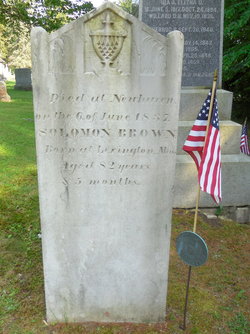
Solomon Brown died at New Haven, Vermont, on 6 June 1837. His gravestone, shown above, states proudly that he was born at Lexington and had reached the age of “82 years & 5 months.” Among the property he left to his family “the musket from which was sent the first shot.”

Sunday, December 22, 2019

Amos Lincoln during and after the War

I’ve been discussing the story of nineteen-year-old Amos Lincoln at the Boston Tea Party.

That wasn’t the end of Lincoln’s participation in the American Revolution. He was at the prime age for military service when the war began, and the lore about him says that his master, carpenter Thomas Crafts, Sr., “released him from his obligation as an apprentice, in consequence of his ardent desire to enter the army of his country.”

According to the Annals of the Massachusetts Charitable Mechanic Association, Lincoln “was in the battle of Bunker-Hill, attached to General [John] Stark’s regiment.” That raises questions since Stark commanded men from New Hampshire. With family in Hingham, Lincoln would most likely have gone to the southern side of the siege lines and served under Gen. John Thomas. It’s possible the young man simply “attached” himself to the most convenient unit, or it’s possible later storytellers did the attaching for him.

The M.C.M.A. Annals also stated that Lincoln “was in the actions at Bennington [16 Aug 1777], Brandywine [11 Sept 1777], and Monmouth [28 June 1778].” That claim makes no sense, and not just because that would put him in two different armies during the same season.

We know from Massachusetts records that Amos Lincoln served mostly close to home. He joined the state artillery regiment commanded by his master’s son, Thomas Crafts, Jr. On 10 May 1776, Col. Crafts submitted a list of officers to the state government, and Amos Lincoln was made a captain-lieutenant. He was promoted to captain in January 1778 and remained at that rank as command of the regiment passed to Lt. Col. Paul Revere in 1779.

Boston tour guide Ben Edwards displays a return of a company of matrosses (artillery privates) that Capt. Lincoln filed with the state on 1 Jan 1781, while he was helping to guard Boston harbor. In lore this became that he was “at one time in charge of the castle,” and that he “commanded the company at Fort Independence which fired the salute at the first celebration of Independence Day in Boston, July 4, 1777.”

In 1873, T. C. Amory told this story about one of Capt. Lincoln’s campaigns:
while reconnoitring on one occasion with Lafayette, the latter suggested the importance of an earthwork at an advantageous point near by, and requested him to have it forthwith constructed. The work was already approaching completion when Colonel [John] Crane,—his immediate superior, who was also of the tea-party, and indeed seriously injured in the affair by the fall of a chest upon him,—rode by, and expressed his surprise and displeasure, inquiring by whose order he had acted. Lincoln replied that it was in obedience simply to the colonel’s master and his own, and soon made his peace by giving the colonel’s name to the fort.
This may refer to the abortive campaign against the British in Rhode Island in late 1778. Crane and Lafayette were there. But I don’t see any mention in Massachusetts records of Capt. Lincoln being assigned to that campaign.

The early profiles of Lincoln state that after the war he participated in putting down the Shays Rebellion. He worked as a master carpenter in the building of the new Massachusetts State House on Beacon Hill. He was also a member of the St. Andrew’s Lodge of Freemasons starting in 1777.

Amos Lincoln married Deborah Revere, daughter of his regimental commander, in January 1781. They had nine children, and Deborah died in January 1797. In May 1797, Amos married his sister-in-law Elizabeth Revere, and they had five more children, the first arriving at the end of December. Elizabeth died in April 1805, and in July Amos married the widow Martha Robb, and they had three more children.

Amos’s older brother Levi went into the law and was eventually U.S. Attorney General under Thomas Jefferson, lieutenant governor of Massachusetts under James Sullivan, and briefly acting governor. Levi’s sons Levi, Jr., and Enoch became governors of Massachusetts and Maine, respectively. One of Amos’s grandsons, Frederic W. Lincoln, was mayor of Boston for several years. Amos Lincoln’s obituary said he was “an undeviating disciple of Washington,” thus most likely a Federalist.

Thursday, December 19, 2019

Joseph Lovering Out Late

Francis S. Drake’s Tea Leaves (1884) is our source for Joseph M. Lovering’s tale of the Boston Tea Party—as passed on by admiring neighbors.

Lovering was born in 1758, so he was still in his early teens in 1773. He lived near the corner of what became Hollis and Tremont Streets. Among his neighbors was the house carpenter John Crane, whose house is shown here.

Joseph’s father, also named Joseph Lovering, appears on that list of the first men to volunteer to patrol the docks and ensure no tea was landed.

Tea Leaves says:
Respecting Mr. Lovering’s connection with the Tea Party, Mr. George W. Allan, of West Canton Street, Boston, now eighty-two years of age, relates that about the year 1835, he frequently conversed with that gentlemen, who told him that on the evening of December 16, 1773, when he was fifteen years of age, he held the light in Crane’s carpenter’s shop, while he and others, fifteen in number, disguised themselves preparatory to throwing the tea into Boston harbor. He also said that some two hundred persons joined them on their way to the wharf, where the tea-ships lay.

Mr. George H. Allan, the son of George W. Allan, received a similar statement from Mr. Lovering, a short time before the latter’s death, which occurred June 13, 1848, at the age of eighty-nine years and nine months.

Mr. Lovering appears to have been the youngest person connected with this affair, of whom we have any knowledge. His boyish curiosity led him to accompany the party to the scene of operations at Griffin’s wharf, and on the following morning he was closely questioned and severely reprimanded by his parents, for being out after nine o’clock at night, as they were strict in their requirement that he should be in bed at that hour.
Other authors echo Drake in designating Lovering as the youngest participant in the Boston Tea Party. Of course, he didn’t claim to have destroyed any tea, only to have held that lantern and then watched the operation.

As an adult, Lovering followed his father into the spermaceti candle and perfume business, becoming quite successful. He was a Boston selectman and alderman and then a representative to the Massachusetts General Court. He was an active member of the Massachusetts Charitable Mechanic Association, serving alongside Benjamin Russell, and of the Ancient and Honorable Artillery Company. In sum, he had the social status in nineteenth-century Boston to be believed.

One of Drake’s informants for Lovering’s story, George H. Allan, also told him about Crane, his great-grandfather, and supplied a silhouette of tea ship owner Francis Rotch.

Wednesday, December 18, 2019

John Crane “knocked down by a chest of tea”

The story of John Crane at the Boston Tea Party comes to us through the Drake brothers.

Samuel Adams Drake (1833-1905) and Francis S. Drake (1828-1885, shown here) were sons of a Boston antiquarian, and they followed his path in writing multiple books about the past. Francis liked the biographical approach while Samuel organized a lot of his books geographically.

As the hundredth anniversary of the Tea Party came around, both brothers wrote about Crane. I think Samuel was first, in his Old Landmarks and Historic Personages of Boston (1873):
John Crane, another of the party, while busily employed in the hold of one of the ships, was knocked down by a chest of tea, falling from the deck upon him. He was taken up for dead, and concealed in a neighboring carpenter’s shop under a pile of shavings. After the party had finished they returned, and found Crane living. . . .

Here [on the corner of Hollis and Tremont Streets] was the dwelling and carpenter-shop of Colonel John Crane, who came so near meeting his death in the hold of the tea-ship. The shop is still used by mechanics of the same craft. Crane, after the construction of the fortifications on the Neck, commanded that post, being then major of a regiment of artillery, of which the Boston company formed the nucleus. He became an expert marksman, and was considered the most skilful in the regiment. It is related that one day, as he sighted a gun bearing upon Boston, he intended to hit the house of Dr. [Mather] Byles, a tory neighbor of his, who lived next door. The shot, however, passed over the doctor’s house, and tore away his own ridgepole.

Crane was wounded in New York in 1776; he was in [Gen. John] Sullivan’s expedition to Rhode Island in 1778, and succeeded [Henry] Knox in the command of the Massachusetts artillery. His services were highly valued by the commander-in-chief, who retained him near his headquarters. Colonel Crane was a Bostonian by birth.
At the end of that year, the January 1874 issue of Old and New magazine came out, carrying Francis S. Drake’s article on “The Boston Tea Party.” It said:
Col. John Crane, by trade a housewright, became a skilful artillerist, and commanded the regiment of Massachusetts artillery with distinction throughout the Revolution. So keen was his sight that he could see the course of the ball after its discharge from a cannon. Crane, while engaged in the hold of one of the tea ships, was knocked senseless by the fall of a derrick or a chest of tea upon his head. Some of his companions, supposing him dead, secreted the body under a pile of shavings in a carpenter’s shop adjoining the wharf; but he soon recovered, having sustained no permanent injury. 
Alas, neither brother mentioned the source of the information they set down.

Francis S. Drake repeated the story about Crane in his 1878 history of Roxbury and again in his 1884 book Tea Leaves, which aimed to profile every person involved in destroying the tea without, evidently, weighing the credibility of those stories.

The long Tea Leaves entry on Crane does state some sources, but not specifically about the Tea Party tale:
One of the famous tea party, his career came near being permanently ended by the fall of a derrick, used in hoisting out the tea, which, falling upon him, knocked him senseless. His comrades, supposing him killed, bore him to a neighboring carpenter’s shop, and secreted the body under a pile of shavings. They afterwards took him to his home, where good nursing and a strong constitution, soon brought him round. The late Colonel Joseph Lovering, who lived opposite to Crane, used to relate that he held the light on that memorable evening, while Crane, and other young men, his neighbors, disguised themselves for the occasion. . . .

Colonel Crane, in 1767, married Mehitabel Wheeler, believed to have been a sister of Captain Josiah Wheeler, a member of the tea party.
Wheeler’s name appears right under Crane’s on the list of men patrolling that docks that I showed yesterday.
His three daughters married three sons of Colonel John Allan, who, with his Indian allies, rendered valuable service to the patriot cause in protecting throughout the Revolutionary war, the exposed north-eastern frontier. William Allan, who married Alice Crane, was the grandfather of George H. Allan, of Boston, from whom many of the above facts have been derived, and who has made extensive collections relative to the Allan and Crane families.
Another possible source for the Tea Party anecdote was Catharine P. Perkins, wife of Richard Perkins. She stated that her father-in-law had married a grand-niece of John Crane, and in 1893 she gave the Bostonian Society a “China Tea-caddy, with tea found in the pocket and boots of John Crane, one of the Boston Tea Party, when taken injured to his home, Dec. 16, 1773.”

We can see some overlap between the Crane story and other well publicized lore about the Tea Party. The family of Thomas Melvill also preserved and displayed a vial of the loose tea that he inadvertently brought home, as I discussed last year. With the rise of the legend of the Bradlee brothers, authors noted they lived at the same intersection as Crane and often told those two stories together.

TOMORROW: The Lovering version.

Tuesday, December 17, 2019

John Crane at the Tea Party

As shown yesterday, the Boston Whigs played down the crowd violence against Richard Clarke and other tea consignees in early November 1773.

That effort became easier when those merchants decided it was safer to be out of town, either in the countryside like Edward Winslow or at Castle William.

When the tea ships started to arrive late that month, town leaders deployed force to ensure no one could unload the tea. But that force was the most disciplined, quasi-official force possible: eventually the town’s militia companies took turns patrolling the dock at night. That system also guarded against unauthorized riots.

The destruction of the tea itself on 16 December was an authorized riot, carried off with a minimum of violence. Of course, there was always an implicit threat in numbers. The Customs officers and mariners on those ships knew the men pushing their way on board, some in disguise, could beat them up if they resisted. So no one did.

As a result, the only person actually kicked around that night was one of the tea destroyers: Charles Conner, detected stealing some of the tea for his own use. The Whig press proudly reported that the only property to be damaged besides East India Company tea was a lock on one ship’s hold, and that was promptly and anonymously replaced the next day.

However, people feared that a man died that night—at least according to a story that surfaced decades later. That man was the carpenter John Crane (1744-1805).

Now I’m skeptical about stories, especially good stories full of emotion and detail, that surface on paper only generations after the major events they describe. At best they’ve been passed from one narrator to another, risking distortion along the way. At worst they’re late bids for historic importance.

In the case of John Crane, we have good early evidence that he was involved in the Tea Party:
  • On the hastily handwritten list of the first set of men who volunteered to patrol the docks on 29 November, one name has been traditionally transcribed as “John Crowe.” I’ve copied that portion of the page above. It could just as well say “John Crane,” especially when I can’t find any other reference to a John Crowe in Revolutionary Boston.
  • Crane was a sergeant in the militia train of artillery before the war. According to Ebenezer Stevens, that company was on patrol at the dock on 16 December when the tea was destroyed.
  • Crane’s name appears on the earliest and most reliable list of men who helped to destroy the tea, published in 1835 when survivors and their children were still around. 
Now it’s true that Stevens’s memoir of the event didn’t mention Crane even though they were both housewrights, they both moved to Providence shortly afterward, and they returned to Massachusetts together as Rhode Island artillery officers in 1775.  However, Stevens had a falling-out with Crane over command during the war, so he might not have cared to remember his old companion by name.

Thus, it seems safe to say that John Crane participated in the Boston Tea Party. As to the specific story about him, we’ll assess that on its details.

TOMORROW: He gets knocked down.

Friday, March 16, 2018

“Enlisted for six months & served that time”

Capt. Moses Harvey’s November 1775 advertisement (which I quoted Wednesday) pointedly described five men who had deserted from his Continental Army company in the preceding summer.

What happened, I asked myself, to those men? And quickly I had to give up on Simeon Smith of Greenfield and Matthias Smith of (I think) Springfield because their names are just too common.

Nor could I find anything about John Daby of Sunderland, even under the spelling Darby or Derby. (There was a different John Daby from Harvard.)

Likewise, there are multiple men named John Guilson or Gilson in Massachusetts Soldiers and Sailors and U.S. pension records, but their details don’t mesh with the guy in Harvey’s company. White and Maltsby’s Genealogical Gleanings of Siggins, and Other Pennsylvania Families (1918) states that our John Gilson was born in 1750 in Groton, but was in Sunderland in 1769 to marry Patience Graves. According to descendants, they married on 20 June; their first daughter, Lydia, arrived on 30 December, explaining why they married.

The Gilsons were still in Sunderland in 1783, but by 1791 they had moved to Salisbury, Connecticut, where they had a daughter named Betsey. (There may well have been other children.) After some time in New York the family moved out to western Pennsylvania in 1803—different sources say they traveled “by ox-cart” or “in canoes and flat-boats.” John Gilson died in Warren, Pennsylvania, in 1811, and was later considered one of that town’s pioneers.

The best documented of Capt. Harvey’s five deserters is Gideon Graves, though once again I had to sort him out from a man of the same name. Gideon Graves of Palmer (1758-1834), when applying for a Revolutionary War pension, said he had served “two months at Roxbury & four months at Ticonderoga” before joining Col. John Crane’s artillery in March 1777. Somehow he produced two pension files.

The Gideon Graves from Sunderland was a younger brother of Patience (Graves) Gilson. He was a son of Reuben and Hannah Graves, born in 1753. John Montague Smith’s History of the Town of Sunderland (1899) quotes an unidentified local diary from “sometime in the ’70’s” saying: “Gideon Graves caught a buck alive.” Which is rather impressive, though hard to pin down.

Graves applied for a federal pension while living in Stillwater, Saratoga County, New York, in 1818. He stated
That in the year 1775 he enlisted for six months & served that time and was in the battles of Bunker Hill near Boston & in 1776 he served nine months in Capt. [Phineas] Smiths Company Colonel [Elisha] Porters Regiment of the Massachusetts line [a militia regiment assigned to the northern campaign]. That for the last term of his Service he was a Sergeant.
Furthermore, this Graves enlisted for a third time in Bennington in 1777, joining Col. Rufus Putnam’s regiment and serving until 1782. He also testified to having been wounded at Saratoga.

Thus, in his pension application Graves stretched his service in 1775 and said nothing about how he had gone home without permission. But he did reenlist and spent years as a soldier. For him, not wanting to serve under Ens. Eliphalet Hastings wasn’t just an excuse to justify leaving the army for good. The U.S government awarded Graves a pension. He died intestate in Saratoga County, New York, in 1824.

Friday, December 15, 2017

Assessing Benjamin Simpson’s Tale of the Tea Party

Yesterday I quoted Benjamin Simpson’s account of the Boston Tea Party, as he reportedly wrote it in 1828 and as it was published in 1830.

That’s one of the earliest descriptions of the event from someone who said he participated in destroying the tea. Men who remained in Boston must have talked about what they did, but they kept those accounts out of print. Simpson lived in Saco, Maine, so he might not have felt so much pressure to conform to follow that model.

According to a genealogy published in the Bangor Historical Magazine in 1891, Simpson was born in York, Maine, to Joshua and Maria Simpson on 2 Jan 1755. He was their first child, born four months after their marriage.

Simpson applied for a pension as a Revolutionary War veteran twice under different laws, in 1820 and 1833. Those documents described his military service in the Massachusetts militia and the Continental Army, including a stretch at Valley Forge, between 1775 and 1779. In those applications he didn’t mention destroying the tea, but that wasn’t germane.

Evidently something happened in 1828 that caused Simpson to write down his story about the tea. Perhaps he read accounts of Joshua Wyeth of Cincinnati. Wyeth was probably the first to speak to a newspaper-man about helping to destroy the tea, and he came up with the label “Tea Party” (for the participants, not the event). Like Simpson, Wyeth had moved away from Boston.

Simpson left behind some other documents about his life. One is a diary written from 1781 to 1849, the year of his death; that’s held by the Dyer Library in Saco. Scholars have used it to study the patterns of labor in the area and the sect that Simpson joined in 1818, the Cochranites. Neighbors respected Simpson, electing him to town offices.

To participate in the Tea Party, Simpson had to have been in Boston in December 1773, and the surviving records don’t indicate when or why he left his family in York. He didn’t name the bricklayer he was apprenticed to. I haven’t been able to locate Simpson in pre-war Boston, but as an apprentice he wouldn’t have shown up in many public records.

Simpson’s pension file indicates that he was back in York when the war began. Two other Tea Party participants in the building professions, carpenters John Crane and Ebenezer Stevens, also left Boston after the event, either out of fear of being arrested or because the Boston Port Bill meant there was more work elsewhere.

Simpson’s account suggests he was in the gallery of the Old South Meeting-House during the final tea meeting—he describes what people in the gallery were calling out as Francis Rotch reported his frustrating trip to Gov. Thomas Hutchinson’s house in Milton.

“We repaired to the wharf where the ships lay,” Simpson wrote. That was an impromptu act; he wasn’t part of the small group that had prepared to board the ships in disguise. He saw “a number of men came on the wharf, (with the Indian powaw).” That last word could mean either a gathering of Natives or a leader of them, and in this case Simpson indicated the latter. It would be nice if he had offered more detail about how that man was dressed, but the brief phrase indicates that leaders of the action had indeed disguised themselves in some way as Indians while other participants hadn’t.

Simpson correctly recalled that one of the vessels was a “brig,” the other two “ships” in eighteenth-century terms. He noted how the brig still carried other cargo besides tea, unlike the two ships. He described a detail that appears in other sources as well: at low tide, the water was so shallow that the heaps of tea began to build up beside the vessels. Teen-aged apprentices had to climb overboard and sweep the leaves into the water to ensure nothing drinkable survived.

There are small glitches in Simpson’s account. He called Rotch the captain of the first tea ship rather than one of its owners. He wrote, “I was then 19 years old, am now 75.” He was three weeks shy of his nineteenth birthday during the Tea Party and seventy-three in 1828. But those are minor matters. All in all, Simpson’s story seems reliable. He wasn’t part of planning the event, but he was there.

(Confusing matters a little, another man named Benjamin Simpson moved from Massachusetts to Maine about the same time. He is said to have been born in Groton, married Sarah Shattuck in Boston in 1781, and settled in the town of Winslow in 1789. This Simpson died in 1839; accounts differ about his age. His family believed he had not only been in the Battle of Lexington and Concord but “took an Englishman prisoner” that day, and also saw action at Bunker Hill. But no Tea Party connection.)

Tuesday, December 06, 2016

“Rhode Island’s Revolutionary Artillery” in Newport, 8 Dec.

On Thursday, 8 December, I’ll speak at the Newport Historical Society on the topic “The Launch of Rhode Island’s Revolutionary Artillery.” I wrote about that development in The Road to Concord, but for this talk I’m assembling more information and analysis.

Here’s the event description:
In December 1774, the Rhode Island Assembly voted to move almost all of the cannons in Newport’s Fort George to Providence in order to, as the governor stated, “prevent their falling into the hands of the King.” The Assembly also formed a new “Train of Artillery,” a military company assigned to use those cannon to defend the colony. Oddly, however, the train’s commanders were from Boston. Within a few months, Rhode Island’s artillerists became one of the most respected units of the new Continental Army.
What links the Boston Tea Party, Providence’s First Baptist Meetinghouse (shown here),  and Rhode Island’s new Train of Artillery? That’s one of the new topics I’ll discuss. I may even venture an explanation about why Rhode Island suddenly promoted Nathanael Greene from a mere private in the Kentish Guards militia company to general in command of its “Army of Observation” around Boston.

This talk will start at 5:30 P.M. in the society’s Resource Center at 82 Touro Street. Admission is $1 for members and active and retired military personnel, $5 for others. To reserve seats, visit this webpage or call 401-841-8770. I’ll happily sign copies of The Road to Concord: How Four Stolen Cannon Ignited the Revolutionary War afterward.

Saturday, August 06, 2016

Ebenezer Stevens Exhibit in New York

The New-York Historical Society is featuring what I expect is a small but thorough exhibit on Ebenezer Stevens, a lieutenant colonel in the Continental artillery.

Stevens was a Boston mechanic who participated in the Tea Party, carefully avoiding the view of his brother-in-law Alexander Hodgdon, a mate aboard one of the ships. Sometime in the next few months Stevens and John Crane, a fellow carpenter and Tea Party veteran, moved to Rhode Island—perhaps because Boston’s economy was squeezed by the Boston Port Bill, perhaps because they feared arrest.

In December the Rhode Island assembly voted to form an artillery unit. As I’ll discuss in a talk for the Newport Historical Society late this year, the commanders of that unit were men from Boston, including Crane and Stevens. They returned to Massachusetts at the start of the siege.

At first Stevens served as one of Col. Crane’s subordinate officers, but he had further ambitions. He led a separate Provisional Artillery Battalion in the Saratoga campaign. Finally, he switched to Col. John Lamb’s artillery regiment to become a lieutenant colonel.

After the war, Stevens settled in New York and raised his family there while building a mercantile business. His descendants included the novelist Edith Wharton. And his papers and souvenirs of military service went to the New-York Historical Society. This exhibit includes “Stevens’ Society of Cincinnati badge and officer’s tailcoat.”

The Ebenezer Stevens display will be up through 2 October. That means it coincides with some other exhibits of interest at the N.Y.H.S.:

Sunday, February 15, 2015

Capt.-Lt. Kemper Confronts “unofficer and ungentlemanlike behavior”

Yesterday I mentioned Maria Sophia Kemper, daughter of German immigrants to New Jersey. Her brother Daniel became Assistant Clothier-General to the Continental Army, and her brother Jacob joined the officer corps.

Jacob Kemper served in Col. John Crane’s artillery regiment, eventually becoming a captain-lieutenant. That regiment was linked to Massachusetts.

Toward the end of 1782 Capt.-Lt. Kemper got into a dispute with Lt. Henry Abraham Williams of Col. John Lamb’s artillery regiment, which was rooted in New York. The commander-in-chief’s papers tell the story:

At the General Court Martial of which Colonel Michael Jackson is president Lieutenant Henry Williams of the 2d regiment of Artillery was tried, charged with unofficer and ungentlemanlike behavior on the evening of the 6th of October 1782
  • First for asserting a falsehood tending to promote dissention between the 2d & 3d regiments of Artillery, by saying that We the 2d regiment of Artillery to a man (addressing himself to Captn Lieutenant Kemper) do dispise you and your regiment, or any thing you can say in behalf of it—
  • 2dly For stripping to buffet with Captn Lt Kemper, and afterwards drawing a sword on him when unarmed—
  • 3dly For writing a challenge for Captn Lieutenant Kemper & leaving it in the Bar room of a public Tavern unsealed.
The Court after maturely considering the evidence for and against Lt Williams, and his Defence, are of opinion on the first charge, that Lt Williams did on the evening of the 6th of October last say that “We the 2d regiment of Artillery to a man—addressing himself to Captain Lt Kemper—do dispise you and your regiment, or any thing you can say in behalf of it[”] for which they think him very unjustifiable in breach of article 5th Section 18th of the Rules and Articles of war—

On the 2d Charge the Court are of opinion that Lt Williams did on the evening of the 6th of October last strip to buffet with Captain Lt Kemper, and did afterwards draw a sword on him when unarmed, for which Conduct they think him very unjustifiable, in breach of article 5th section 18th of the Rules and Articles of war—

The Court are also of opinion that the 3d Charge is not Supported—

The Court Sentence Lt Williams to be reprimanded in General orders and Suspended from Service for three months.
Gen. Washington confirmed the sentence and added, “Lieutenant Williams should have better understood the delacacy of an officers Character than to have suffered himself to have been betrayed into such improper conduct as he has been guilty of.”

At the end of the war, Capt.-Lt. Kemper joined the Society of the Cincinnati in New York. Lt. Williams did not.

Tuesday, July 17, 2012

Generational Tension within the Artillery Regiment

The change at the top of the Continental artillery regiment that Gershom Foster’s early-1776 orderly book documents may have brought up some generational friction.

In his first regimental orders on 28 Jan 1776, the new colonel, Henry Knox, made a point to say:
The Colnl. is fully persuaded the officers of the Artillary Regt. will not loose the present opportunity. He wishes harmony to prevail in Every Company that the officers of Experience would Chearfully communicate their Knnowledg to the Younger and unexperienced Breathen that all the officers in their Respective spheres would inculcate to the noncommisioned officers & Soldiers the duty of their Stations & the advantage & necessity of a proper Subordination.
This message to “officers of Experience” came from a man in his mid-twenties who had just replaced a sixtysomething veteran of two wars, Col. Richard Gridley.

Furthermore, Knox now commanded Lt. Col. William Burbeck, who would turn sixty in 1776, and Lt. Col. David Mason, who would turn forty. Both those men had fought in wars against the French. Knox’s only military experience before 1775 was as a junior lieutenant in Boston’s militia grenadier company. Of course, he had won Gen. George Washington’s favor by helping to design fortifications in Roxbury and then cemented it by bringing more heavy artillery from Lake Champlain.

On 29 January, Knox’s regimental orders said, “the posts at prospect and Winter hills...are to be fired and directed by Colonel Mason.” Two days later Knox designated told all the artillery officers on the northern wing of the siege to report on their ordnance to Mason. The officers elsewhere in Cambridge were to report directly to Knox, and those at Roxbury to Maj. John Crane.

So where was Lt. Col. Burbeck in that arrangement? The Foster orderly book doesn’t mention the regiment’s second-highest ranking officer after the one regimental order he issued on 3 January. (It does mention “Capt. Burbeck at the Laboratory” on Cambridge common; that must have been one of the lieutenant colonel’s sons.)

Burbeck left the Continental Army when it moved south in April 1776, insisting that his contract was with Massachusetts. But perhaps he was already withdrawn from the regiment, or at least stopped behaving “Chearfully” around the new commander.

That’s another question scholars can investigate with the Gershom Foster orderly book, part of the archive at the Society of the Cincinnati’s Anderson House in Washington, D.C.

TOMORROW: Artillery officers versus infantry officers.

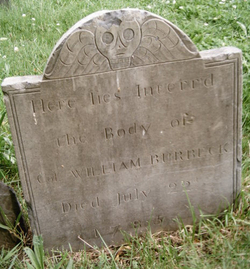
[The thumbnail above is Sharon Zingery’s photograph of William Burbeck’s gravestone in the Copp’s Hill Burying-ground, courtesy of Find-a-Grave.]

Saturday, April 17, 2010

Twitter Feed, 9-16 Apr 2010

  • Correcting a gravestone in 1773, via Vast Public Indifference: bit.ly/d1rl3d #
  • Starred PUBLISHERS WEEKLY review for Jack Rakove's REVOLUTIONARIES: bit.ly/cMrGpY #
  • RT @JBD1: Whoohoo! Panel proposal accepted for Society of Early Americanists conf in Philly next March - Libraries of Early US! // Cool #
  • Volokh Conspiracy on Georgia attempt to legislate state as republican, not democratic: bit.ly/a0Es5C #
  • Back from walking tour on Revolutionary mythmakers at Mt Auburn Cemetery. Cool, sunny weather—excellent for a Victorian stroll. #
  • RT @HeritageMuse: I am thinking of using the Toilet Paper Incident from April 1721 in my presentation tomorrow. bit.ly/bwbxC2 #
  • Supper entertainment tonight was the Haggerty School 2nd grade's "Constitution Rap." My generation's offer to sing the preamble ignored. #
  • House of Boston-born artillerist John Crane as it appeared in 1898, linked to modern map: bit.ly/9V6FlA #
  • Last US President to have served in Revolutionary War was first to inspire assassination attempt: bit.ly/9j0aCz #
  • Excitement over the arrival of Congressmen from Massachusetts—in May 1775, via @RagLinen: bit.ly/aT9QF4 #
  • RT @ToddHouse: #genealogy, chronology of Hichborn family 1673-1891 by Philip Hichborn bit.ly/aDUxFm #
  • RT @RagLinen: New Rag Linen collection: The Battle of Lexington and Concord - tinyurl.com/yycpkkx #
  • RT @gordonbelt: Curators at @TJMonticello use historical detective work to authenticate Jefferson's Artifacts: bit.ly/afRAuE #
  • Home from Charles Bahne's standing-room-only talk about Paul Revere and H W Longfellow at Cyrus Dallin Museum: bit.ly/anmp7z #
  • By end of this month, hope to tackle the 19 Apr 1775 stories of Asahel Porter, Hezekiah Wyman, and Israel Bissell. #
  • Mercy! Gravestone of Mehuman Hinsdell of Deerfield, Mass, twice a war captive: bit.ly/94cutn #
  • Vast Pub Indiff points out the doll in Copley family portrait: bit.ly/aSHOaa Also, child getting Mama's attention is future viscount #
  • New website on Jefferson's NOTES ON STATE OF VIRGINIA, so complex it comes with a tutorial: bit.ly/cTlEzw #
  • RT @librarycongress: True Story Behind Stevenson's "Kidnapped" discussed with Author A. Roger Ekirch bit.ly/biYfju #
  • RT @TJMonticello: RT @NatlParkService: The Man of Monticello: Remembering Jefferson on his Birthday: ow.ly/1y3Dw #
  • RT @BBCHistoryMag: Will the British monarchy survive? bit.ly/9Youmd // This essayist says yes. #
  • RT @historyfaculty: Historian links homicide rates to the way people feel about their government: bit.ly/b5jvz9 #
  • RT @gordonbelt: story about the original Tea Party in 1773 on @NPR this morning: n.pr/ciu1vV #
  • From the desk for "duh" news—RT @CanadasHistory: Buffalo News: US way behind Canada in War of 1812 observance funding. ow.ly/1ypk2 #
  • RT @librarycongress Library to acquire ENTIRE Twitter archive—ALL public tweets since Mar 2006! // Future historians will shake their heads. #
  • @historynerd55 One opportunity/temptation will be to analyze huge blocks of text mathematically: e.g., changing usage of key words. #
  • @historynerd55 Historians started to miss important discussions after telephone established; email actually redocuments stuff. #
  • @historynerd55 In a couple of decades biographers will be writing about subjects' credit-card bills in lieu of personal letters. #
  • RT @lynneguist: Some of Noah Webster's spelling reforms changed AmE, some didn't. Happy anniversary of his dictionary. bit.ly/9rlubH #
  • New word of the day: tenoroon. Like a bassoon, but higher. #
  • Curious spelling on a 1756 Duxbury gravestone. Or perhaps it's just a curious name. bit.ly/975Ou3 #
  • Were pocket diaries from 1700s like Twitter updates? bit.ly/aEndYG Actually, very few diarists recorded their breakfasts. #
  • Report on auction of Americana via @JBD1: bit.ly/bhbN8T #
  • Quirks of inheritance and emancipation mean there's scant evidence John Hancock owned slaves. But this is SOLID: bit.ly/9PXDSu #
  • Plus, I was there when Caitlin Hopkins took this gravestone photo: bit.ly/9PXDSu #
  • KIRKUS lambastes historical romance for teens about Nathanael Greene's wife and daughter: bit.ly/9l6mPt #
  • Oscar-nominated short from 1950 preserves a mostly all-white, all-male, Cold War view of US history: bit.ly/9m3gYg #
  • Vast Public Indifference asks why did Judge Samuel Sewell erect a "Connecticut stone post" for his late wife in 1721? bit.ly/aF967W #
  • RT @MilestoneDocs: Declaration of Independence best reflects the character of America: bit.ly/9cBPqs // Nation of high-ideal whiners? #
  • RT @gordonbelt: Why Isn't History More Interesting? A history professor tells a story that is both compelling and true: bit.ly/bYuFsX #

Saturday, October 10, 2009

Revisiting “When Was John Crane Wounded?”

In 2006, I wrote about how Maj. John Crane of the Continental artillery was wounded in the foot during the fight over Manhattan Island in 1776.

In 2007, in response to a query from a Boston 1775 reader also named Crane, I tried to pin down the date of that wounding. I figured it had to be after 3 September, when Gen. George Washington gave orders to Crane, according to a letter the commander wrote the next day. And it had to be well before 23 September, when Col. Henry Knox wrote to Crane’s wife with an update that he was “in a fair way to do well” (not, apparently, her first news of the wound).

Last weekend I came across a mention of Crane’s wounding in the diary that Gen. William Heath published after the war. He wrote:

They [the British] ran a ship past the city [New York] up the East River: she was several times struck by the shot of a 12 pounder, which was drawn to the river’s bank. Major Crane of the artillery was wounded in the foot, by a cannon shot from this ship.
So Heath’s entry might pinpoint the date of Crane’s wound—except that its date is 2 Sept 1776, one day before Washington told the Congress that he’d sent Crane to attack that ship.

So what gives? Heath edited his diary for publication, so it’s not really a contemporaneous source, like Washington’s letter. I suspect that Heath added the details about Crane to his 2 September entry at some later date, possibly the next day, possibly years later. The most likely sequence of events seems to be:
  1. 2 Sept 1776, after dark: A forty-gun ship of the Royal Navy slipped into Turtle Bay, receiving fire from a shore battery to no effect.
  2. 3 September, morning: Washington sent Maj. Crane, known for his excellent sighting, with two twelve-pounder cannons and a mortar to oppose the ship. That day, Crane hit it several times, forcing its captain to withdraw closer to Long Island. Either that morning or the next day, the ship fired back a ball that struck Crane in the foot.
  3. 4 September, morning: Washington wrote to Congress, having seen the ship withdraw but not yet aware of Crane’s injury.
And eventually Heath edited his diary entry about the ship getting into the East River, adding what he felt was pertinent information about Crane’s marksmanship and wound.

At least we’re narrowing down the answer.

Friday, July 27, 2007

When Was John Crane Wounded?

A while back I quoted how Continental artillery officer John Crane was wounded in the foot. Boston 1775 reader Scott Crane got me interested in the exact date of that event, which doesn’t appear in my source, a memoir of Crane written by Dr. William Eustis and printed (reprinted?) in the Military Journal of Dr. James Thacher.

Context says that Crane must have been wounded during the British military’s return to the U.S. of A. in the fall of 1776. The major landmarks of that campaign were the Battle of Brooklyn on 27-30 August, the landing at Kip’s Bay on 15 September, the Battle of Harlem Heights on 16 September, the Battle of White Plains on 28 October, and the taking of Fort Washington on 16 November. (Final score: Gen. Sir William Howe 5, Gen. George Washington 0.)

Using correspondence from 1776 that’s available online, I narrowed the window for when Maj. Crane was wounded. On 4 Sept 1776, Washington told Congress that the artillery officer was still quite active:

On Monday night a forty Gun Ship passed up the [Long Island] Sound between Governor’s and Long Island and Anchored in Turtle Bay. In her passage she received a discharge of Cannon from our Batteries, but without any damage and having a favourable Wind and Tide, soon got out of their reach.

Yesterday morning I dispatched Major Crane of the Artillery with two twelve pounders and a Howitzer to annoy her, who hulling her several times forced her from that Station and to take shelter behind an Island where she still continues.
A transcribed digital copy of that letter appears in the Library of Congress’s collection of Washington’s papers. (Eustis’s account, written years after the war, differs on what guns Crane was using—a minor mistake.)

By 23 Sept, it appears, Crane had been wounded. On that date, his commander, Col. Henry Knox, wrote to his brother William:
Pay Mrs. Crane, wife to Major Crane, fifty dollars, and inform her that the Major is in a fair way to do well. He is in high esteem in the army, and the loss of his services much regretted by me.
Knox obviously expected his brother and Mehitable Crane to have already heard about her husband’s wound. That implies Crane was hurt early in the month, soon after Washington’s letter. Dr. Eustis had more to say about the officer’s recovery. Eventually Knox became a general, and Crane a colonel. (And William Knox? Sooner or later I’ll discuss where he ended up.)

Online resources have also helped me clear up a mystery about the short biography of Crane’s colleague in carpentry and artillery, Ebenezer Stevens, that I quoted back here. I thought Stevens’s descendants had printed that booklet privately, but it’s an off-print from an 1877 volume of The Magazine of American History.

Tuesday, July 10, 2007

Burgoyne, Lee, and Enoch Brown's Tavern

On 8 July 1775, a trumpeter came out of occupied Boston with a letter from Gen. John Burgoyne (at right) to Charles Lee, a British officer who had served under him in Europe. Lee had become a general in the Polish army, then traveled to North America. In early June, a few days before receiving a commission as major-general from the Continental Congress, Lee had written a long, critical letter to Burgoyne. It said:

I sincerely lament the infatuation of the times, when men of such a stamp as Mr. Burgoyne and Mr. [William] Howe can be seduced into so impious and nefarious a service by the artifice of a wicked and insidious Court and Cabinet. . . .

What I have seen of Courts and Princes convinces me, that the power cannot be lodged in worse hands than in theirs; and of all Courts, I am persuaded that ours is the most corrupt and hostile to the rights of humanity. I am convinced that a regular plan has been laid (indeed every act since the present accession evinces it) to abolish even the shadow of liberty from amongst us. It was not the demolition of the tea, it was not any other particular act of the Bostonians, or of the other Province which constituted their crimes; but it is the noble spirit of liberty pervading the whole Continent which has rendered them the objects of ministerial and royal vengeance.
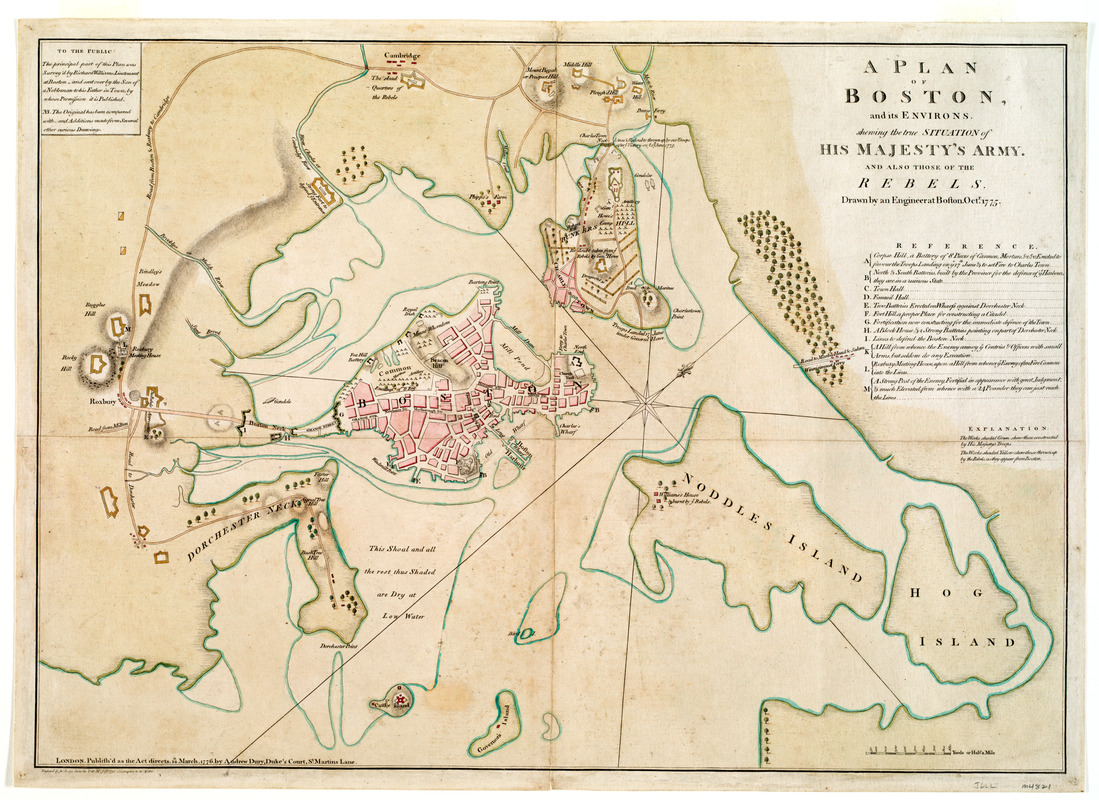
Burgoyne responded with a proposal that the two officers meet at Enoch Brown’s tavern to discuss matters. That tavern sat on Boston Neck between the town’s fortified gates and the provincial lines; the British army was using it as a forward base.

Lee wanted to take up this invitation, and asked the Massachusetts Provincial Congress to send someone along with him. The congress named Elbridge Gerry of Marblehead as their representative, but also expressed worry that the two generals might end up negotiating without due regard for Americans’ chosen representatives.

As it turned out, the New England army prevented any meeting from taking place, at least at Enoch Brown’s tavern. Boston selectmen Timothy Newell recorded what happened that night:
8th [July]. Saturday morning at half past 2 waked up with roaring of cannon and small arms upon the lines which continued two hours. Brown’s house burnt.
Gen. William Heath of Roxbury recorded the provincial attack in his diary:
A little after two o’clock in the morning, a number of volunteers, under the command of Majors [Benjamin] Tupper and [John] Crane, attacked the British advance guard at Brown’s house, on Boston Neck, and routed them, took a halbert, a musket, and two bayonets, and burnt the two houses.
Crane led an artillery company with two brass field-pieces that raked the tavern with grapeshot, forcing the British soldiers inside to run away.

Newell also described the British response on the 9th: “The Regulars last night made an advance battery near Browns on the Neck.” And then the American response to that: “10th July. Provincials last night attacked the Centinels at the lines, and burnt Brown’s shop.” Burgoyne and Lee never had their meeting.