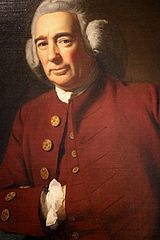
When we left Capt.
William Brown and Ens.
Henry DeBerniere, they were in a back room of
Henry Barnes’s house in
Marlborough, listening as he tried to send away a member of the local committee of correspondence.
Dr. Samuel Curtis had shown up that evening of 1 Mar 1775, uninvited and asking to stay to supper. Barnes told him the doctor that he couldn’t stay because the family already had company.
Dr. Curtis then turned to a
child—DeBerniere wrongly understood the girl to be Barnes’s daughter—and asked “who her father had got with him.”
According to the ensign, “the child innocently answered that she had asked her pappa, but he told her it was not her business.”
Still suspicious but unable to learn more, the doctor left. Brown and DeBerniere decided he was probably going to gather his political allies, so they should stay only a couple of hours to rest. They would leave at midnight, regardless of the snowy weather.
But even that was too leisurely, DeBerniere later wrote:
we got some supper on the table and were just beginning to eat, when Barnes (who had been making enquiry of his servants) found they [local Patriots] intended to attack us, and then he told us plainly he was very uneasy for us, that we could be no longer in safety in that town: upon which we resolved to set off immediately
The two officers had been inside for only twenty minutes, they estimated. Barnes took them “out of his house by the stables, and directed us a bye road which was to lead us a quarter of a mile from the town.”
Brown and DeBerniere hiked through the blowing snow until they reached “the hills that command the causeway at
Sudbury, and went into a little wood where we eat a bit of bread that we took from Mr. Barnes’s, and eat a little snow to wash it down.”
At the next house, a man came out and asked Brown, “What do you think will become of you now?” By this time the officers were totally on edge, unable to tell whether the people they met recognized who they were and were helping to plan an assault or just thought it strange for two strangers to be out walking in the night during a snowstorm.
In Sudbury the officers encountered “three or four horsemen.” Those riders moved to either side of the road, letting the strangers pass between them while they watched silently.
Brown and DeBerniere reached the safety of
Isaac Jones’s Golden Ball Tavern in
Weston about 10:30 P.M., having walked 32 miles that day. The next day, the officers got into Boston, where they were safe. They wrote out a detailed report for Gen.
Thomas Gage, which is our source for all this information. They turned over sketches and maps of the route out of
Worcester in case the general planned a march that way.
Meanwhile, back in Marlborough, soon after the British scouts left, there was yet another knock on Henry Barnes’s door. This time the whole Marlborough committee of correspondence showed up and “demanded” to see the visitors. Barnes insisted those two men were not army officers “but relations of his wife’s, from
Penobscot, and were gone to
Lancaster.” According to DeBerniere’s report:
they then searched his house from top to bottom, looked under the beds and in their cellars and when they found we were gone, they told him if they had caught us in his house they would have pulled it about his ears.
Among the Marlborough committee-men was
Alpheus Woods. Five years earlier, Woods had also been on the town committee to make Barnes follow the
non-importation agreement. Barnes’s supporters had
accused Woods of sending the merchant a letter threatening to burn down his potash works and house. Now Woods had nearly caught Barnes harboring British army
spies.
Henry Barnes departed Marlborough a few days after his busy evening. His wife
Christian Barnes went to stay with her friend
Elizabeth Inman until past the actual outbreak of fighting in April. Taking refuge in Boston, they left the Marlborough estate in the hands of Henry’s adult niece, Catharine Goldthwait.
Under Massachusetts committee of safety guidelines, local committees weren’t supposed to confiscate property from
Loyalists as long as some family members were still living peacefully on it. But the Marlborough committee including Alpheus Woods did take property from the Barnes estate, including
furniture they loaned to Col.
Henry Knox. Catharine Goldthwait complained about that to the
General Court, to no avail.
In February 1776, Henry Barnes learned that a bequest worth almost £2,000 was awaiting him in London. He and Christian sailed that month, ahead of the end of the
siege. Catharine Goldthwait followed a few years later, and Massachusetts confiscated her uncle’s property. Henry and Christian Barnes received a small Loyalist pension until he died in 1808.