J. L. BELL is a Massachusetts writer who specializes in (among other things) the start of the American Revolution in and around Boston. He is particularly interested in the experiences of children in 1765-75. He has published scholarly papers and popular articles for both children and adults. He was consultant for an episode of History Detectives, and contributed to a display at Minute Man National Historic Park.

Subscribe thru Follow.it


•••••••••••••••••


Showing posts with label mysteries. Show all posts

Saturday, June 20, 2026

“The engineer and two generals went on to the hill”

engraved portrait of Israel PutnamYesterday I quoted Samuel Gray’s 11 July 1775 description of the Battle of Bunker Hill, based on what he called “my own knowledge.”

Gray wasn’t in the battle—he was probably behind the lines in Roxbury—but he could describe the terrain and basic action.

Gray then went on to share a rumor that must have been going around the provincial camps, specifying that this wasn’t first-hand knowledge:

I am informed that, in a council of war, it was determined to intrench on Charlestown Hill and on Dorchester Hill the same night, but not till we were so supplied with powder, &c., as to be able to defend the posts we might take, and annoy the enemy; that on Friday a resolution was suddenly taken to intrench the night following, without any further council thereon; that the engineer and two generals went on to the hill at night and reconnoitered the ground; that one general and the engineer were of opinion we ought not to intrench on Charlestown Hill till we had thrown up some works on the north and south ends of Bunker Hill, to cover our men in their retreat, if that should happen, but on the pressing importunity of the other general officer, it was consented to begin as was done.
Gray didn’t name names. But “the engineer” was Richard Gridley, commander of the artillery regiment. The “two generals” were William Prescott (actually a colonel) of Groton and Israel Putnam from Connecticut (shown above).

A fair amount of ink has flowed out debating whether Prescott or Putnam was responsible for building the redoubt on Breed’s Hill (Gray’s “Charlestown Hill”) before fortifying portions of the taller Bunker’s Hill.

Some authors have written Putnam made that call, based on his higher rank; his image as fearless, aggressive fighter; and a conviction that he was in command of the provincial troops during that battle.

Others point out that Prescott oversaw the building of the redoubt and then its defense while Putnam was more focused on Bunker’s Hill, trying to get men to fortify there.

And of course there’s the possibility that Gray’s information was incorrect, that Gridley, Putnam, and Prescott did discuss where to fortify but didn’t divide so neatly, at least on that night.

This letter confirms that in the weeks after the battle people were asking why the provincials positioned themselves as they did. Because that was turning out to be a very big deal.

TOMORROW: Mistakes were made?

Wednesday, May 27, 2026

Uncovering Boston Jersey

Earlier this month the Guardian reported on how researchers had unearthed new information about a figure in this portrait.
For hundreds of years, he was known only as “Jersey”, an enslaved boy of about 11 rendered in oil on canvas by the great 18th-century portrait painter Sir Joshua Reynolds. . . .

The painting, thought to have been completed around 1748, shows the boy and his “master”, the naval officer and MP Paul Henry Ourry. While Ourry looks out into the distance authoritatively, the enslaved child gazes up at the officer tentatively. . . .

Scouring admiralty records, letters, muster books (ships’ registers) and captains’ logs, [Mark] Brayshay and Katherine Gazzard, a curator at Royal Museums Greenwich, found him named as “Boston Jersey” on ships that Ourry was attached to.

They believe he may have been given the surname Jersey because Ourry was born in the Channel Islands. It is possible he had his first name because he once lived in Boston, Massachusetts.

The researchers discovered Jersey was baptised as George Walker (possibly a name he had been known by earlier in his life) on 30 July 1752, probably in a chapel in Westminster.
The article has a little more to say about George Walker and much more about the restoration of the painting.

This discovery led to the quick creation of a Wikipedia page about Boston Jersey/George Walker.

Monday, May 25, 2026

“The services of their father in repairing certain cannon”

Preserved Clap was born in Hadley, lived in the part of that town which became Amherst, and ultimately died at age eighty up the Connecticut River in Claremont, New Hampshire.

His headstone appears here courtesy of Find a Grave. His wife Eunice’s stone is nearby.

Clapp probably had earlier ties to that region. The Preserved Clap listed as serving in 1775 in a provincial company recruited largely from Bolton was said to come from Charlestown, New Hampshire, next to Claremont.

There’s also this curious anecdote related by Jaazaniah Crosby in his History of Charlestown in New Hampshire (1833):
On the 18th of June, 1756, while Lieut. Moses Willard was endeavoring to extinguish the fire, which had been kindled in his fence, he was attacked by the Indians, and killed behind the barn of the late Capt. John Willard, and near the academy. At the same time, his son Moses was wounded in the hip by a spear, which is said to have remained in the wound till after his retreat into the fort. It is further said that a Mr. Preserved Clap carried the same spear into the revolutionary war.
Preserved and Eunice Clap’s son Roswell was living in Claremont by 1790, per the first U.S. Census.

Dr. Clap’s children followed in his footsteps in at least one way: asking to be paid for his inventions during the Revolutionary War.

In 1837, the U.S. Senate took up “the petition of Roswell Clapp and Charlotte Reed, children and heirs of Preserved Clapp, praying compensation for the services of their father in repairing certain cannon belonging to the United States.” That referred to work sixty-one years before, just after the siege of Boston.

And the Clap family kept up that plea until 1841, thirty years after the doctor had died.

Thursday, May 21, 2026

“A Genius has appear’d lately”

In his 29 Apr 1776 letter to Samuel Adams, the Rev. Dr. Samuel Cooper described the man who came forward with a solution for cannon with damaged trunnions:

It was judg’d by…all here, at first, that they could never again be made useful: But a Genius has appear’d lately, a Country Surgeon in our Army, an obscure Man till now, who has hit upon a Method of mounting them, without Trunnions, so as to render them it is tho’t, serviceable as ever.

I can only give you some general imperfect Idea of this Method. He first sinks the Cannon to its Centre, in a strong wooden Sock, like the Barrell of a Musket in it’s Stock: He braces it with three iron Clasps to prevent it’s leaping out of this Stock; and yet so as not to obstruct any Movement necessary to it’s use.

The Cannon in this wooden Bed, is mounted on a Carriage, and by rounding the lower side of the latter like the Foot of a rocking Cradle, Provision is made for the Elivation & Depression of the Cannon.

He has compleated one or two already in this Manner; and if Experience proves it, to be, what some good Judges have already pronounc’d it, the Invention will do Honor to our Country & ought to be immortalise the Name of the Man, which is Clap.

It will give us an hundred fine Cannon for the Defence of our Harbor, which a few Days ago were given up as entirely useless.
To my surprise, I find that this is the first time in more than twenty years that Boston 1775 has mentioned Dr. Preserved Clap.

Dr. Clap did make a short appearance in The Road to Concord, in which I posited that his method was how the New Englanders mounted damaged artillery pieces in 1775.
In Old Landmarks and Historic Fields of Middlesex (1895), Samuel A. Drake included this picture, saying it showed Dr. Clap’s carriage as drawn “by an officer of artillery present at the siege.” I haven’t located that original drawing or the officer’s name.

Cooper’s letter is the earliest mention of Dr. Clap and his invention that I’ve found, as well as the most detailed description of it. The wording suggests that Clap came forward with his method only in the spring of  1776, not during the siege. And Cooper’s description really doesn’t match the drawing. So I have questions.

TOMORROW: Who was Preserved Clap?

Wednesday, April 29, 2026

“Prisoners in Boston Goal” in February 1777

On 18 Feb 1777, deputy jailer Joseph Otis wrote down “A List of Prisoners in Boston Goal,” transcribed and published by the Colonial Society of Massachusetts.

This document says:
Doctṛ̣ [Benjamin] Church for holding a Tratirus Correspondence with the Enemy

John Hill for being Enemical to the States

Thoṣ̣ Mews for ditto

Thoṣ̣ Edwards for ditto

Crean Brush for ditto

Benjạ̣ Davis for ditto

Hopestill Capen for ditto

Miss [Elizabeth?] Hill & Daughter for attempting to Carry Intillegence to the Enemy

John Dean Whitworth A prisoner of War

Seven Men & two Women prisoners of War taken Near fort Cumberland

Richḍ̣ Luby for theft Sentens’d

Mary Young Sentens’d

Mary Voax Sentens’d

John Lovell for theft not had his trial

Five Debtors
It’s no surprise that Dr. Church headed this list. But it is surprising to see Brush listed fifth, given his notoriety. But perhaps the order reflects their cell assignments or some other factor.

I’ve just written about how John Hill was jailed in May, and his wife and daughter arrested in October. Those two women were the only ones explicitly locked in Boston’s jail for actions to aid the enemy, as opposed to being prisoners of war or criminals.

As for the other political prisoners, Thomas Mewse was an English “wollen-manufacturer,” as the Massachusetts Spy once put it. William Molineux had recruited him into a public-works scheme that ended with the two men suing each other. Aside from that, I know no reason to think him “Enemical.”

Thomas Edwards is usually identified as the 1771 Harvard graduate and former Braintree schoolteacher who became suspect because he apprenticed in law to a Tory. Within a couple of years, however, that Thomas Edwards was a high-ranking Continental Army officer, and he went on to a long political career. I have yet to see any contemporaneous sources describing that man as a suspected Loyalist. So I wonder if there might have been two Thomas Edwardses.

Benjamin Davis and Hopestill Capen were merchants who had sided with the Crown. Davis was captured while sailing from Halifax to New York in June 1776. Capen had stayed in Boston after the evacuation was undoubtedly regretting that decision. I may discuss them, as well as Lt. John Dean Whitworth of the Queen’s Rangers, at more length in the future.

By the time Joseph Otis wrote out this list, John Hill had been imprisoned for nine months, his wife and daughter for four. It looks like they were held separately. And it would be several more months before their situation changed.

COMING UP: An exchange.

Monday, April 27, 2026

“Possessed of that sweet Disposition towards all Mankind”

I’ve been hunting for the names of John Hill’s wife and daughter in 1776.

According to the profile of Hill at the Loyalist Directory, his first wife was Ann Powell (1737–1775), and they had a son named John in 1764.

If that’s true, Hill remarried quickly after Ann’s death since newspapers and legal documents say he had a wife by the fall of 1776. We might presume his daughter came from the first marriage.

Intriguingly, Boston’s marriage intentions list the couple ”John Hill & Eliza Kennedy” with the date of 7 Oct 1776. (But as a reminder about common names, that same volume shows men named John Hill marrying women named Elizabeth in 1753, 1759, 1784, and 1793—and women named Hannah in 1756 and 1808.)

The 29 April 1779 New-York Gazette stated that “Mrs. ELIZABETH HILL, Wife of John Hill, Esq;” had just died. It called her “A Woman amiable in her the domestic Relations, and possessed of that sweet Disposition towards all Mankind, which nothing but Christianity can bestow.” I’m guessing she’s the same wife as three years earlier.

As for Hill’s daughter, the 22 Nov 1779 New-York Gazette reported the marriage of “Miss Hill, Daughter of Mr. John Hill,” to “Lieut. Cunningham, of the Legion.” Alas, the newspaper didn’t provide the young people’s first names. The lieutenant might well be Ralph Cunningham, given John’s link to William Cunningham. Lt. Cunningham was killed in a fight at Hanging Rock, South Carolina, on 6 Aug 1780.

The reason John Hill’s wife and daughter are so interesting is that, as recounted yesterday, in 12 Oct 1776 the New London committee of correspondence stopped them from crossing onto Long Island and found they were carrying incriminating papers.

The Connecticut Gazette described “sundry Papers, containing Matters of Intelligence respecting the People, and State of the Country, sent from said Hill and others in Boston, to be communicated to General [William] Howe.”

What’s more, the women didn’t seem to be carrying that correspondence unknowingly. The article went on: “it appeared from the Papers found upon them, that they had been possessed of other Papers, which they had secured or destroyed.”

Hill’s wife and daughter “were both sent back with the Papers, under a proper Convoy, to the Place from whence they came,” reported to be Providence, Rhode Island.

TOMORROW: A family reunited.

Tuesday, April 14, 2026

Tracking the Wheaton Brothers

Winthrop Sargent, Sr.’s list of civilian men captured on the Elizabeth on 2 Apr 1776 and brought into Gloucester included (in his unique spelling):
  • Kalep Whitten – Bad Man…
  • Calep Whitten ju
  • Joseph [Whit]ten
  • John Whitten
I discussed Caleb Wheaton of Machias, Maine, yesterday. E. Alfred Jones’s Loyalists of Massachusetts states that he and his wife Mary had sixteen children, but not all survived to adulthood. The genealogies I’ve found are contradictory and confusing.

According to one family researcher whose work is shared here, those other three Wheatons were all boys born on New York’s Long Island:
  • Caleb, Jr., on 20 July 1753.
  • Joseph on 30 Dec 1754.
  • John on 9 Aug 1756.
Jones’s Loyalists says Caleb and John were both born in 1757 and thus probably twins. Other records put Joseph’s birth in 1755. But let’s agree they were all around twenty years old in 1776 when Massachusetts authorities took them into custody.

Not all three Wheaton sons were of legal age in 1776. But they were all prime age to be soldiers, which is probably what mattered for Sargent. Sisters and younger brothers didn’t make the list.

To jump ahead, Caleb, Jr., and John would have standard trajectories as young American Loyalists. By 1777 they made their way to British-occupied New York City and joined provincial regiments fighting for the king. Caleb became a lieutenant, John a captain. At the end of the war they settled in Canso and Cape Breton, Nova Scotia, respectively.

The only odd blip in those brothers’ story was that when Caleb, Jr., married Sally Bryant in November 1792, the couple was in Boston’s Trinity Church (shown above). 

Joseph Wheaton followed a different course, one that took him to the U.S. Capitol.

TOMORROW: Defection.

Saturday, April 11, 2026

“Itt’s said she has a large quantity of the Stolen goods”

It didn’t take long for New England Patriots to realize that Cdre. John Manley’s capture of the Elizabeth on 2 April 1776 was a big deal.

On 6 April, Isaac Smith, Sr. (1719–1787, shown here courtesy of the Yale University Art Gallery), wrote to his niece Abigail’s husband, John Adams, from Salem:
Commodore Manleys fleet has taken a brigantine bound to Halifax on board of which is Bill Jackson and all his Effects and itt’s said she has a large quantity of the Stolen goods—

and there is on board likewise One Greenbrush, receiver general of the stolen goods and has distinguisht himself in that way by demanding People’s propaty from them. Itts said he came from York and itts said those Carpenters and runagarders from that way has behaved worse than any Others.—

A sloop is on shore at the Cape, beleive nothing very Valuable on board but itt Appears they (the inhabitants) went away in a most dismal Cituation, not haveing even Water sufficient and crowded and some sick with the small pox.
That sloop was the Sally, commissioned by Jolley Allen and captained by no one who knew what he was doing, as described back here.

As a merchant in Boston before the siege, Isaac Smith knew William Jackson and his troubles well. But Smith wasn’t familiar with Crean Brush, who had arrived from New York after the siege began—hence his reference to the man as “One Greenbrush.”

John Rowe was all too familiar with Brush, having watched that royal appointee confiscate some of his property. On 8 April he wrote in his diary with surprising calm:
Capt. Manly is come to Town & brings the Accot. of his Taking Crian Brush Wm. Jackson & Twenty other passengers in A Brigg bound with The Fleet—

This Vessell tis Said has Twenty five Thousand pound Sterling On board—in English Goods & Other Merchandise—

among the Prisoners is A Sergiant & 12 Men of the Kings Troops
On 8 April Rowe added:
There is a Confirmation of Crean Brush & Wm. Jackson being taken & also My Negro Fellow Adam
Adam was one of the four enslaved people found aboard the Elizabeth. Remarkably, this is the only time in his published diary that Rowe mentioned the man. We therefore have no clue about how he came to be on the brig. Had Adam asked to evacuate the town, or had Rowe sent him away?

TOMORROW: Following the money.

Friday, February 27, 2026

“Possibly not the best man to colonize a new country”

I’ve been analyzing a letter from the Thomas Gage Papers at the Clements Library, written by Jonathan Hastings, Jr., on 11 June 1775.

Hastings addressed his correspondent as “Friend Jacob.” Their families were known to each other, and Jacob probably had connections to Harvard College.

Another clue to Hastings’s correspondent is his comment “Am happy you had so safe a Passage & found your Friends well.” Jacob was obviously traveling. Hastings then offered basic information about the siege, meaning he knew Jacob was far from Massachusetts. Crown forces probably intercepted the letter at sea, not on land.

I looked at the entries in Sibley’s Harvard Graduates for Harvard students in this period named Jacob who might have gone abroad. Almost all were settled down as ministers by 1775, usually inside Massachusetts.

One remaining candidate is Jacob Welsh (1755–1822) from the class of 1774. He was the son of John Welsh (1730–1812), a Boston jeweler and member of the club that used the silver punch bowl now called the “Sons of Liberty Bowl.” This Jacob had one brother, John, Jr., born in 1757.

Sibley’s says nothing about Jacob Welsh’s whereabouts between graduating in July 1774 and entering the Continental Army as an ensign at the start of 1776. (He served until late 1778, first at Fort Ticonderoga and then in the artillery.) Did Welsh leave Massachusetts in that stretch, missing the start of the Revolutionary War because he was in Europe, the Caribbean, or the west?

Jacob Welsh did prove more peripatetic than most of his peers. In addition, Sibley’s says, he “looked for the main chance wherever it might present itself.” After the war he settled in Lunenburg briefly, serving as the town’s legislative representative. But then he sailed to England, smuggling home a “carding and spinning machine” in hopes of securing a state patent for himself. In 1791 Welsh went to Philadelphia and applied to President George Washington to help build the new national capital. He invested in lots of land, as far afield as Louisiana.

In 1807, it appears, Welsh wrote to Gen. Henry Burbeck, a fellow veteran of the Continental artillery corps. According to Heritage Auctions, he submitted “suggestions for the defense of Boston,” including “substitutions for round cannonballs.”

By 1809 Welsh faced a legal judgment of almost a thousand dollars owed to a merchant in Salem. The authorities began to seize his local property. Welsh lit out for Geauga County, Ohio, to manage land that his father had bought a decade before. A county history published in 1878 stated:
Jacob Welsh was a native of Boston, of an old family, and reared in luxury, possibly not the best man to colonize a new country. At the time he came to Ohio, he was a middle-aged man; a gentleman of the old school, of medium height, fair complexion, dressed in small-clothes, with long hose and buckles at the knee, and shoe-buckles over the instep, liberally educated, of imposing appearance and stately address, quite fitted to the aristocratic drawing-rooms of Boston, but not appearing to especial advantage in the woods, trails, and cabins of the Western Reserve. While he was a good conversationalist, he had little energy, small business capacity, and a large disposition to spend money.
After another decade, enough people had settled around Welsh’s land to form a township. He promised his neighbors to “give glass and nails for a meeting-house, and fifty acres of land, to settle a minister.” In return, the township was named after him. In April 1820 Welshfield Township had its first election, and Jacob Welsh was chosen to be a trustee.

According to that county history, after Welsh died in 1822 locals found that he had “forgot” his promised bequests. Twelve years later, the community changed its name to Troy Township. That township’s website offers a more compact version of the story while Sibley’s says Welsh did make his promised donation. The county histories from 1878 and 1880 seem best documented, so I’ve relied on them.

Jacob Welsh’s gravestone appears above, courtesy of Find-a-Grave. The central, unincorporated part of Troy Township is still called Welshfield.

Wednesday, February 25, 2026

“Boston is environed on all sides”

Having shared his version of the Battle of Lexington and Concord, as quoted over the last two days, the new Cambridge postmaster Jonathan Hastings, Jr., turned to the current situation.

His 11 June 1775 letter described the siege this way:
Boston is environed on all sides. 7000 Men at Camb. 6000 at Roxbury, exclusive of smaller Numbers wch. guard the Coasts both Eastward & Southward. [Thomas] Gage acknowleges our Superiority in Number, but says we have neither Government, Discipline nor Powder. The two first Charges are false; and I hope the other Colonies will not be backward to Supply us with the last, to let him see he is mistaken in that likewise.—

Indeed we are determined to defend ourselves in the best manner at all Events, rather than submit to Slavery.—Our Motto is the same which Caesar engraved on his Breast Plate—“Nil actum reputans si quid superesset agendum.”
That was a standard eighteenth-century British rendering of a line from Lucan’s Civil War, appearing in the Spectator and Lord Chesterfield’s letters. It translates more or less as “As long as there’s anything left to do, we don’t consider anything done.” Curiously, that Latin line appears differently in modern editions of Lucan. I can’t explain the discrepancy.
Should Massachusetts be conquered, your Halcyon Days will soon be at an end. God grant our union may be like that of a Band of Brothers, wch. can never be broken. The Light Troops in Boston we are informed have not done Duty for 4 Days. An Attack is expected soon, for every Delay on their part is a Strengthening to us.

It was not the Butler who fell in Battle, but a Samuel Cooke from Danvers the largest Man in the Colony, I suppose
A Danvers man named Samuel Cook, Jr., was indeed among the provincial casualties on 19 April, killed at the Jason Russell House. I haven’t found any other reference to his size. I’ll discuss why Hastings mentioned him tomorrow.
You must excuse my not being more particular, as John intends to write to your Brother, and my Business call me away: therefore would just acquaint you that an half a whole Sheet with your Name alone will afford a particular Pleasure to your sincere Friend & very humble Servant

Jonathan Hastings Junr.

P.S.—My Father & mother desire to be remembered to you & your Friends, & would inform you that our Papers are removed into the Country, & we know not where to look for any Receipts, therefore beg you will make yourself easy with regard to us—&c
JH
That looks like a very familiar closing for an eighteenth-century letter, begging more time to pay bills. Or maybe Hastings was replying to a correspondent who had begged more time.

Of course, there was a war on. The Hastings house had become the headquarters of both the Massachusetts committee of safety and Gen. Artemas Ward, so it’s understandable that the family had moved their records out.

TOMORROW: Clues to the crowd.

Wednesday, February 18, 2026

A Last Word on Basile Boudrot

Whenever I recount a story at length, I like to add some new sources, connections, or interpretations. I don’t want to just repeat what other writers have said.

But when I started researching suspected murderer Basile Boudrot, I couldn’t find that sort of material. I felt so stymied that I thought I’d have to confine the story to my Ko-fi updates, where I’ve started to share loose ends and research in progress. 

Ultimately, I spotted enough sources to fill the past several postings. But like everyone else who’s written about this case, I hit a brick wall in August 1776, when the Continental Congress voted to send Boudrot to Massachusetts.

As my closing thoughts, I’ll offer this scenario for how the sources fit together. Bear in mind that this is only one possible reconstruction, perhaps tinged by a fiction writer’s search for plot twists, liable to be upended with a single new document. But here goes.

February 1772: Capt. Thomas Parsons and his eight-man crew sail a schooner (name unknown) out of Newburyport, headed for the Caribbean.

March 1772: Parsons’s ship founders in a storm that blows a lot of vessels north. Meanwhile, Basile Boudrot boards a ship in France, heading to Nova Scotia. Along the way he opens a letter from his relative Marguerite Landry to the D’Entremont family, describing where their relatives hid money as the British expelled Acadians almost twenty years before.

April 1772: Boudrot reaches Nova Scotia and registers for his land grant on St. Marys Bay. But first he follows the directions in the Landry letter and unearths “1004 pieces of money.” Meanwhile, people in Newburyport worry about Thomas Parsons’s ship; no one reports seeing it in the Caribbean.

May 1772: Boudrot visits the D’Entremonts in Pubnico, assuring them that Marguerite Landry and her family are in good circumstances in France. Then he takes off for the province of Canada, abandoning his land since he’s already found a fortune with much less work. Benoni d’Entremont gets suspicious and writes to Landry in Cherbourg.

Summer 1772: The D’Entremonts ask questions in Nova Scotia about Boudrot. Passing ship captains from Massachusetts, including Hector McNeill, ask questions about the missing schooner. Locals talk about Basile Boudrot suddenly having a lot of money and no good explanation for it.

Fall 1772: Folks in Newburyport piece together information and conclude that Basile Boudrot was behind the disappearance of Parsons’s schooner, that he got suddenly rich from plundering that ship after killing all its crew.

Spring 1773: Marguerite Landry writes to the D’Entremonts from Cherbourg, describing the buried money and reporting that French sea captains have spotted Basile Boudrot in North America. In Massachusetts, the Parsons family presses for an inquiry into the alleged attack on the schooner.

Late 1773: Basile Boudrot has spent through most of his windfall. He picks up whispers that the D’Entremonts and Yankee mariners are all hunting him. He adopts the alias “Dugan” to work on ships around Montréal, Lake Champlain, and points west.

Fall 1775: Americans invade Canada, besieging Québec. Massachusetts mariners Hector McNeill and William Farris leave the city and go to work for the Continental Army.

Spring 1776: As the Continentals withdraw to Montréal, McNeill spots “Dugan” working on another supply ship. McNeill identifies this man as Basile Boudrot and demands his arrest.

Summer 1776: The Continental Army holds Boudrot prisoner in New York City until the Congress endorses Gen. Samuel Holden Parsons’s plan to send him to Massachusetts to stand trial.

Fall 1776: Soon after Boudrot reaches Massachusetts, the authorities realize the accusation against him doesn’t hold water: he wasn’t even in North America when Thomas Parsons’s ship disappeared. Out of embarrassment, they drop the case and never mention it again. People in Newburyport persist in believing that Nova Scotians plundered the schooner. Basile Boudrot disappears once more.

[The photograph above shows Smuggler’s Cove park on St. Marys Bay, Nova Scotia. Nothing says “law-abiding maritime community” like naming a place Smuggler’s Cove.]

Tuesday, February 17, 2026

“A Difficult Case” in Late 1776

As recounted yesterday, in August 1776 the Continental Congress voted to send Basile Boudrot to Massachusetts to be tried for murdering Thomas Parsons and his crew or, failing that, to send him to Nova Scotia for trial.

There were some problems with that plan. As John Adams said, “It is a difficult Case.”

Yet the Congress had little choice. Just that month, its members had signed the Declaration of Independence, which complained about the king (among other things) “depriving us in many cases, of the benefits of Trial by Jury.” So the new American union had to provide Boudrot with a jury trial.

Was Essex County the right venue, even if Capt. Parsons had sailed from Newburyport? One fundament of British law was that the accused should be tried in the jurisdiction where the crime was allegedly committed. And the accusation against Boudrot was that he’d attacked Parsons’s ship up at St. Marys Bay.

Again, the Declaration might come into play. Another of its grievances was that the king was “transporting us beyond Seas to be tried for pretended offences.” The Continental Army had transported Boudrot out of Canada down to New York, and now was sending him to Massachusetts. But really he should be tried in Nova Scotia.

That of course raised practical problems. Would Nova Scotia authorities share the Continental leaders’ wish to try Basile Boudrot, pushed by the desire of the victim’s brother, Gen. Samuel Holden Parsons of the Continental Army? How would that conversation go?
“So you want us to take this man and put him on trial for plundering a ship from Massachusetts four years ago?

“Yes!”

“Will you also send us Captains Nicholasson Broughton and John Selman, who plundered our Charlottetown just last year?”

“Oh, no, no, no.”

“Ah.”

“That happened during the war, you see.”

“The war that’s still going on.”

“Yes. But our commander-in-chief didn’t let those two men back into our army!”

“So you have them in jail, awaiting trial?”

“Er, no. They’re officers in the Essex County militia.”
And speaking of practical matters, even as the Congress in Philadelphia laid out this plan for dealing with Boudrot, the Continental commanders in New York were seeing the harbor fill up with Royal Navy ships and army transports. On 27 August, the British and American armies clashed in the Battle of Brooklyn. About a month later, the redcoats were on Manhattan Island, and New York City was burning.

Given all that, it’s not so surprising that Basile Boudrot’s paper trail ends. American Patriots felt obliged to try him in the proper legal venue, but preserving the paperwork to get him there might not have been the highest priority.

I hold out hope that an archive in Massachusetts, or in Nova Scotia, contains more clues to Boudrot’s fate. Perhaps as “Boudreau,” or “Dugan” (his reported alias), or “the Acadian” (as American generals referred to him). But given the murky case, his use of aliases, the fog of war, and the passage of time, I don’t hold out much hope.

TOMORROW: One scenario.

Monday, February 16, 2026

“An Order to try one Basil Bouderot, Accused of Murther”

According to the New-York Journal article I quoted yesterday, on 10 July 1776 Basile Boudrot was sent from New York to Newburyport to stand trial for murdering Thomas Parsons and his crew in Nova Scotia four years earlier.

But it appears that rendition wasn’t official; it may never have happened at all. Although newspapers in Massachusetts reprinted the New York article, none confirmed that Boudrot actually arrived in the commonwealth.

Instead, the next document in this case is a letter from Thomas Parsons’s brother, Samuel Holden Parsons, to John Adams. The two men had been at Harvard College together. Parsons was now a respected colonel in the Connecticut Line of the Continental Army.

On 24 July, Col. Parsons wrote to Adams from New York:
The Unhappy Fate of my Brother about 4 Years ago occasioned my prefering a Memorial to Congress for an Order to try one Basil Bouderot, Accused of Murther and Robbery, in the Province of the Massachusetts Bay; The Propriety of the Application I am in some Doubt of; whither it should be to Congress or to your Provincial Legislature. I beg you Sir to take the Memorial, make such Alterations as you think proper, or if not proper to be Preferd to Congress advise me in what Way to proceed to Avenge my Brother’s Death.
That memorandum has been lost, alas. All we have in the Continental Congress’s records is that the file was referred to a committee of Thomas Jefferson, James Wilson, and Roger Sherman the next day.

On 3 August, Adams wrote back: “Your Memorial has been duely attended to, and is under Consideration of a Committee. It is a difficult Case.” But for several days, nothing happened except that Parsons was promoted to brigadier general.

On 16 August, Adams got himself “added to the Committee to whom were referred the Letters and Papers respecting the murder of Mr. Parsons.” Five days later, that committee offered its recommendation, which the Congress adopted:
Resolved, That Bazil Bouderot…be sent to the state of Massachusetts bay, and there delivered to the council of the said state, and that it be recommended to the said council to proceed against the said Bazil Bouderot according to the laws of their state; but, if they have no law by which crimes committed out of their state may be tried within the same, that then they confine the said Bazil Bouderot, until the situation of public affairs will admit his being removed to Nova Scotia, where the crime is alleged to have been committed, and there submitted to a fair trial, according to the ancient laws of that province.
That wording suggests that Boudrot had not actually been sent from New York in July, but would be now. Or maybe this resolve made an earlier action official, legally turning over the case, and the prisoner, to one of the new states. The Congress record thus offers another place to look for more documents, in the archive of the Massachusetts Council.

Because that’s where the trail ends. The Congress never took up the case again. The editors of the Washington Papers found no more traces. The editors of the Adams Papers wrote:
This episode remains a mystery. . . . The full story was in a memorial Parsons sent to Congress, but this has not been found, and the ponderous Life and Letters of Samuel Holden Parsons by Charles S. Hall, Binghamton, 1905, does not even mention the matter.
TOMORROW: A change of venue?

Thursday, February 12, 2026

“Cast away upon the Isle of Sable”

There are a lot of unanswered questions about the disappearance of Capt. Thomas Parsons, his ship, and his crew in early 1772.

As colonial newspapers show, shipwrecks happened all the time. The rocky shores of Nova Scotia were notorious for their dangers.

For example, on 16 Sept 1773, the Massachusetts Spy ran this report from John Callahan, just arrived from London:
Capt. Callahan, last Thursday se’nnight, went on shore at Cape Sable, where he saw the Wreck of a Snow, New-England built, Pink Stern, called the Kitty, loaded with Lumber, had all her Cargo on board, but her Sails, Rigging and Crew gone.
That might seem mysterious, even suspicious. But back on 10 May the Boston Post-Boy had reported:
A Fisherman, who arrived here last Week, informs, that the Snow Katy, Capt. Major, from this Port for Newfoundland, is cast away upon the Isle of Sable: The Vessel and Cargo is entirely lost; the Captain and Mate, with great Difficulty saved their Lives, and the Remainder of the Crew, (five in Number) perished.
In the case of Capt. Parsons’s schooner, within a year New Englanders suspected he’d met with foul play. What led them to that conclusion? Unfortunately, our sources don’t say.

Those sources do raise some geographic questions about this voyage. One is why, if Capt. Parsons was heading from Newburyport to the Caribbean, he’d ended up far north. Perhaps that was a way of catching trade winds. Perhaps a storm had pushed his ship off course. Perhaps people didn’t remember his destination accurately. Or perhaps Parsons’s ship was returning from the islands and overshot Cape Cod because of weather.

The March 1773 news item quoted here said a schooner had been lost “near Cape-Sable,” which is the southernmost corner of the Nova Scotia peninsula. In Newburyport people came to believe Parsons had met his fate at “St. Mary’s,” which must mean St. Mary Bay’s at the westernmost corner. Was that close enough to count as “near Cape-Sable” to a New Englander?

Yet another mystery: Near the mouth of St. Mary’s Bay sits the village of Comeauville, where Basile Boudrot was granted 300 acres in May 1772. That was three months after Capt. Parsons reportedly left Newburyport, and in that season Boudrot was supposedly busy digging up buried money. Yet somehow the people of New England came to believe that Basile Boudrot was responsible for the death of Capt. Parsons and his crew.

TOMORROW: Spotting the culprit?

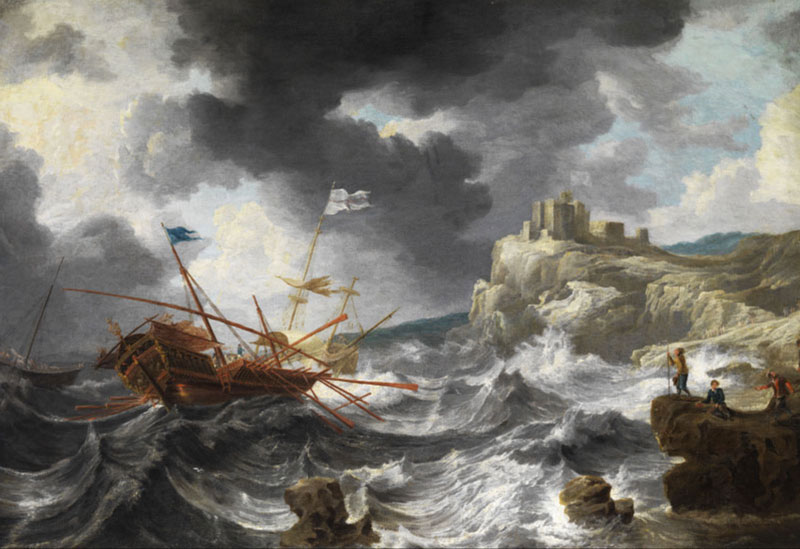
[The picture above is Bonaventura Peeters’s “Shipwreck,” ca. 1652, courtesy of the Journal of Historians of Netherlandish Art.]

Wednesday, February 11, 2026

“The supposed Plunder of the Cargo and burning of the Vessel”

Alas, the first newspaper printed in Newburyport, Massachusetts, Henry-Walter Tinges’s Essex Journal and Merrimack Packet, wasn’t founded until the end of 1773.

That means we don’t have published accounts of ships coming and going from that port in 1772, or stories on topics of local interest.

It’s possible a historian digging into the local sources like Alexander Cain will uncover a contemporaneous source on what happened to Capt. Thomas Parsons in 1772. But for now the closest he’s found is the lore published by Joshua Coffin in A Sketch of the History of Newbury, Newburyport, and West Newbury, from 1635 to 1845:
February 10th [1772]. Captain Thomas Parsons sailed from Newburyport, in a schooner, for the West Indies; was wrecked at St. Mary’s, Nova Scotia. It was supposed that he, with all his crew, eight in number, were massacred by the inhabitants there, after plundering the vessel, and setting it on fire.
We don’t know the name of Parsons’s ship or of his crewmen. Coffin also offered no sources—no indication of how the news got back to Newburyport, or when. I suspect that for months people thought the schooner had been lost at sea. Then something—the sight of a burned wreck, a bit of loot, seamen’s gossip—made people suspect there had been foul play.

On 11 Mar 1773, more than a year after Capt. Parsons’s departure, the Boston News-Letter ran this item:
We are informed, that the Accounts sent from hence of the Loss of a Schooner, belonging to Newbury, near Cape-Sable, and the supposed Plunder of the Cargo and burning of the Vessel if not the Murder of the Crew, had been received by the Governor of Nova-Scotia, and that there would be the strictest Inquiry and Prosecution by the Authority of that Province.
That was reprinted in the following weeks in the Essex Gazette of Salem and in Connecticut newspapers. (Capt. Parsons had brothers and other relatives in Connecticut who might be interested.)

It’s not certain that news item referred to rumors about Capt. Parsons’s ship, but the details are similar, and I’ve found no other possible cases. That suggests the suspicions about what happened in Nova Scotia built up over time until someone demanded an investigation.

Unfortunately, I also haven’t found any follow-up stories. Because of national boundaries, I can’t search the Halifax Gazette. Government archives in Nova Scotia might hold information. In early 1773 the royal governor, Lord William Campbell, was busy chasing smugglers and securing a better berth for himself in South Carolina, but maybe he did start an inquiry. Or at least file the “Accounts” from Massachusetts.

It’s also conceivable that some archive in the Caribbean holds a clue. Did Capt. Parsons sail to an island successfully only to run into difficulty on the way back? If he was on some sort of smuggling voyage, what sort of records would he have left?

TOMORROW: Probing the mystery.

Monday, February 09, 2026

Basile Boudrot and “1004 pieces of money”

According to the Musée des Acadiens des Pubnicos website, Basile Boudrot was born in 1739 in Port Royal, which the British had renamed as Annapolis Royal, Nova Scotia, in 1713.

War broke out between the British and French Empires in the 1740s and again in the 1750s. At some point the Boudrot family moved to Cherbourg, France. Basile’s father was a mariner, and the young man worked as a fisherman “now and then.”

In 1764 Basile married Magdelene d’Entremont in Cherbourg. She, too, had roots on Nova Scotia, in Pubnico on the southeastern shore.

Four years later, the lieutenant governor of Nova Scotia, Michael Francklin, signed a charter creating the settlement of Clare in the easternmost corner of the peninsula. That area was set aside for French-speaking Acadians.

Three important things happened to Basile Boudrot in 1772. First, the Musée des Acadiens des Pubnicos tells this story:
It was in April when he left [France] with a letter from his sister[-in-law] Marguerite Landry for her brother-in-law in Pubnico, asking him to send her the money which had been hidden at the “Cabanaux.”

On his way to Acadia, Basile opened the letter and went right straight to the spot indicated where the money had been hidden and unearthed “1004 pieces of money.”

Then he went to Pubnico and told the d’Entremont bothers that their relatives in France were well provided for, having received money from “the town-hall and a quarter out of two vessels.” Thus, he was going to keep the money. It is obvious that he did not give them Marguerite’s letter.

He left Pubnico on May 7 and disappeared forever. In a letter, we read that some captains from Cherbourg had seen him several times “in America” without saying exactly where.

A few days after Basile had left, Benoni d’Entremont wrote to his sister-in-law Marguerite Landry and told her about the visit that he and his brothers had received from Basile Boudrot. Marguerite answered April 20, 1773, telling of the letter she had entrusted him with and of the lies he had told of her being well provided for, and these the whole story of Basile’s “prevarication” came to light.
Benoni d’Entremont (1745–1841) had spent his adolescence in Marblehead, Medfield, and finally Walpole, Massachusetts, having been expelled from Acadia with his family after the capture of Louisbourg. His father died in 1759 and was reportedly buried in Roxbury. After years as “French neutrals,” the rest of the family returned to Nova Scotia.

Back to Basile Boudrot. According to Isaiah W. Wilson’s A Geography and History of the County of Digby, Nova Scotia (1900), in May 1772 the government of Nova Scotia granted him 300 acres on St. Mary’s Bay within the Clare settlement. Today the village of Comeauville claims him as a founder.

I have questions about how those events fit together, assuming all the details are correct. Did Boudrot use the money he unearthed to buy that land? The timing would be tight if he left France in April and completed the real estate deal by the end of May. Or did he return to Nova Scotia to settle on a land grant and as a bonus stumble onto buried treasure?

Pubnico and Comeauville are more than fifty miles apart, but there weren’t a whole lot of people living on eastern Nova Scotia at that time. Did the D’Entremonts really never hear about Boudrot living in the same province?

As for the third event in 1772, that’s coming up later this week.

TOMORROW: Parson Parsons’s sons.

Sunday, February 01, 2026

Getting Warmer on the Origin of a Warming Pan

At Historic New England, Erica Lome, curator of collections, shared a behind-the-scenes essay about a warming pan with a Revolutionary heritage of sorts:
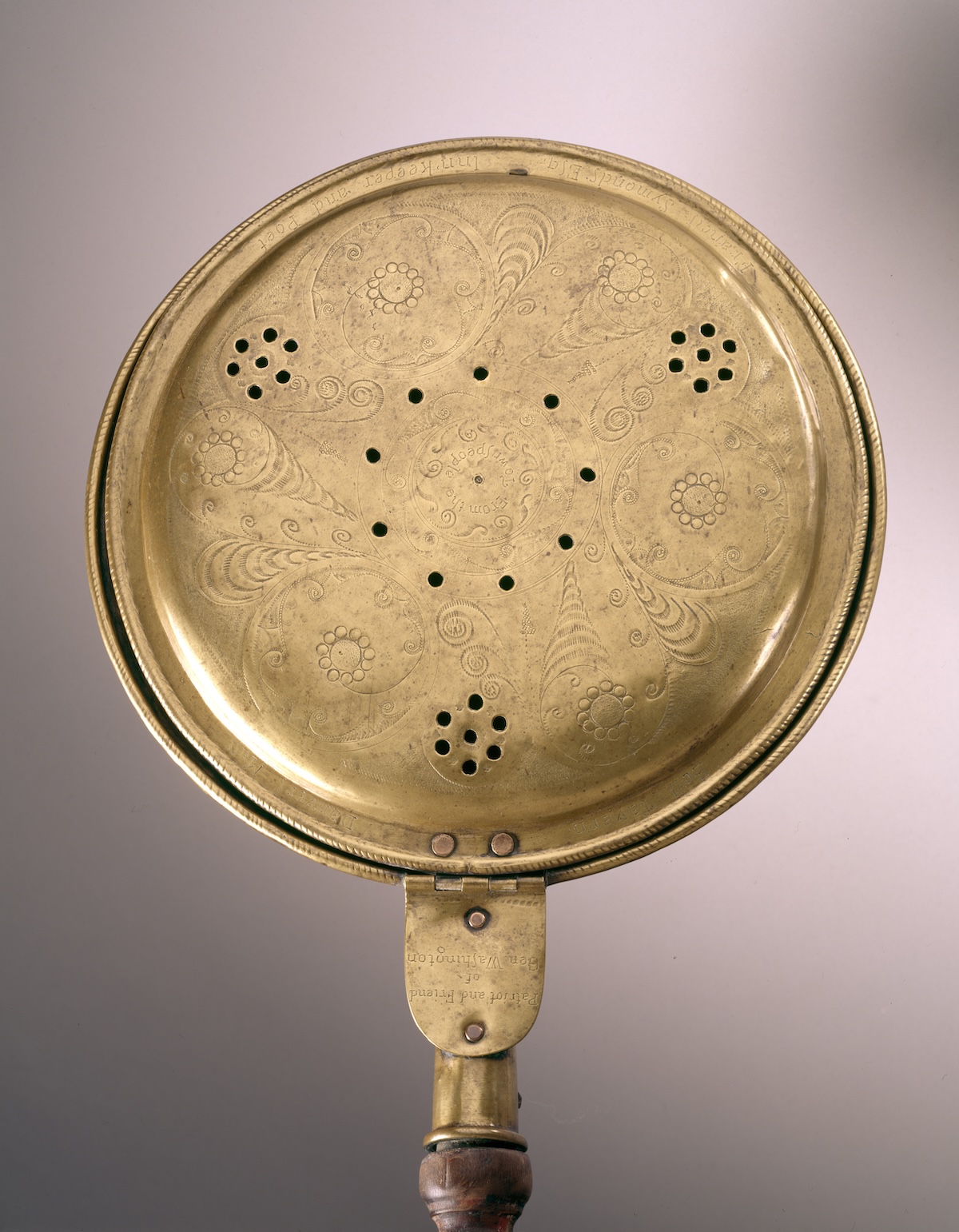
Tucked away in the parlor at Historic New England’s Cogswell’s Grant in Essex, Massachusetts, is a warming pan with a turned wooden handle and a brass container pierced with holes and engraved with scrolling vines and flowerheads. Also referred to as bed warmers, warming pans were a common household tool in colonial and post-revolutionary America, filled with embers and placed under the sheets of a bed to warm it before use.

This particular warming pan had more than just decorative motifs adorning its metallic surface. Engraved on its lid are the words:
From the Townspeople / Patriot and Friend of Gen. Washington / Bell Tavern, Danvers, Massachusetts / Francis Symonds Esq. Innkeeper and Poet.
On the pan’s sides, inside the incised outline of a bell:
I’ll toll you / if you have need / and feed you well / and bid you speed.
On the other side:
Francis Symonds / makes and sells / the best of chocolate / also shells.
John Warner Barber’s Historical Collections (1839) recorded that those verses hung on signs outside the Bell Tavern. In 1841 the Boston Cultivator stated that innkeeper Symonds’s “poetic genius caused [those lines] to be inscribed”; as Lome notes, he was known for adding bits of rhyme to his advertisements. (The Cultivator changed “also shells” to “and shells,” which scans better if you put three syllables into “chocolate.”)

The essay continues:
By its history, as recorded by Nina Fletcher Little, the warming pan was presented to Symonds around 1785: “After the war’s close, the citizens of Danvers evidently wished to present Symonds with a token of their esteem and decided on a warming pan as a practical gift.” The engraved inscription inside the bell matched the Bell Tavern’s signpost. The additional inscription praised Symonds as a patriot, friend of George Washington, and a poet, truly a prominent citizen and worthy of appreciation.

When researching this object for [the upcoming exhibit] Myth and Memory, one major detail of Symonds’s life challenged its story: Francis Symonds died on September 22, 1775. According to the Essex Gazette:
“On the 22nd Instant died at Danvers and on the 24th was very decently interred, Mr. Francis Symonds, Innholder, in the 5th Year of his Age. He was very just in his Dealings, and compassionate to the Poor as far as lay in his Power. In his last Sickness, especially towards the Close of Life, his Calmness and Resignation were very remarkable. He has left a sorrowful Widow and 6 Children, for whom we wish that the fame Compassion that he has shown to others may be shown to them.” . . .
Francis Symonds mustered for two days with Colonel [Timothy] Pickering’s regiment during the Battle of Lexington and Concord, and again on April 24, 1775, serving for a little over three months, until August 1, 1775. He was at home when he died of illness.

So, what about the warming pan? It seems very unlikely that the town of Danvers presented it to him on his deathbed, nor to his family immediately after, given the ongoing Siege of Boston. What is its true history?
Lome doesn’t offer a definite conclusion, but I like her hypothesis that the words were inscribed during a commemoration of the Revolution, such as Danvers’s dedication of a memorial obelisk near the Bell Tavern in 1835. Or later, when warming pans themselves were becoming relics of a quaint past. 

Wednesday, January 21, 2026

“Also embarked Colonel Richard Prescott”

In late 1774 the British 7th Regiment, known as the Royal Fusiliers, was stationed southwest of Montréal, guarding the frontier of the British Empire.

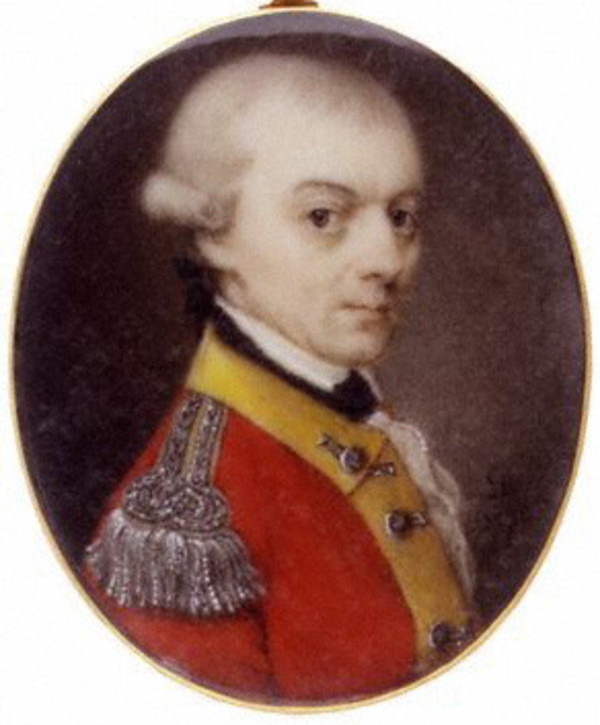
But its commanding officer, Col. Richard Prescott (shown here), wasn’t with them.

The 17 October New-York Gazette reported:
On Thursday Morning last Major General [Frederick] Haldimand embarked on board the Transport named the Countess of Darlington, attended by Major of Brigade [Thomas] Moncrieff, Capt. Thomas Gamble, Assistant Quarter-Master General, Captain [Dietrich] Brehm, Aid de Camp, and Captain [Francis] Hutcheson;

with General Haldimand also embarked Colonel Richard Prescott of his Majesty’s Royal Fusileers, a Company of the Royal Artillery, with a large Quantity of Ordnance Stores for Castle-William.
Also headed to Boston were the 47th Regiment, three companies of “the Royal Regiment of Ireland” (18th), an artillery company, and artificers to build barracks.

Those transport ships arrived on Sunday, 23 October, as reported four days later in the Boston News-Letter. This was part of Gen. Thomas Gage’s military build-up after the “Powder Alarm.” Indeed, by the end of the year the 7th would be one of the few regiments in North America not stationed inside Boston.

Col. Prescott was still in Boston when the war began because on 12 June 1775 Gen. Gage wrote to the Secretary of War, Viscount Barrington, that “Colonel Prescot, now declared Brigadier,…is going to Canada to Assist General [Guy] Carleton.”

In addition, this 1905 publication by the Canadian Archives stated that Gage sent the same news that day to Lord Dartmouth, the Secretary of State: “The Colonel Prescott goes immediately to Canada to assist General Carleton, for I hear the Rebels, after surprising Ticonderoga, made Incursions, and committed Hostilities upon the Frontiers of the Province of Quebec…” I haven’t found a copy of that letter in Gage’s papers at the Clements Library, but its online database and transcriptions are still a work in progress.

Thus, through the first half of October 1774 Col. (later Gen.) Richard Prescott was in New York, where Hugh Gaine printed A Letter from a Veteran, to the Officers of the Army Encamped at Boston, as discussed here.

Prescott then sailed north. Eight days after he arrived, booksellers Cox and Berry advertised that pamphlet for sale in Boston.

As a senior officer in Gage’s force, particularly one not engrossed in the daily duty of his regiment, Prescott had the motive and opportunity to pen advice from a “Veteran” to younger officers. He was much closer to the situation in Boston than his younger brother Robert.

When William Tudor, Jr., recorded that people said A Letter from a Veteran was written by “General Prescott,” he most likely meant Richard Prescott.

Thank you for your attention to this matter.

Tuesday, January 20, 2026

The Younger General Prescott

Bibliography abhors a vacuum.

Once William Tudor, Jr., suggested in print that “General Prescott” deserved credit for writing the 1774 pamphlet A Letter from a Veteran, to the Officers of the Army Encamped at Boston, cataloguers didn’t want to ignore that suggestion. It was better to share some possibly correct information than to leave a blank, right?

No matter that Tudor didn’t seem certain, or offer a reason to believe that attribution. He was a solid researcher, for the early nineteenth century. His parents had been in Boston before the war. His mother, Delia Jarvis, was from a Loyalist family who knew British army officers. So his info might have been accurate.

In the early twentieth century, bibliographers started to surmise that “General Prescott” might mean Robert Prescott (1726?–1815, shown above), a veteran of the Seven Years’ War who eventually became governor general of the Canadas. Most of those attributions remained tentative, but his was the only name put forward, so gradually it came to seem more solid.

I’m skeptical. In 1774, when A Letter from a Veteran appeared in New York, Robert Prescott was almost certainly in Britain, living on his half-pay pension as a lieutenant colonel mustered out of the 72nd Regiment. He hadn’t served on the North American mainland since 1760.

While it’s conceivable that Lt. Col. Prescott followed the political debates over America closely, wrote an essay responding to American Whig arguments and analyzing the cultures of different colonies, and sent it across the Atlantic to be published, that seems unlikely.

On 8 Sept 1775 Robert Prescott was called back into service, now lieutenant colonel in the 28th Regiment. He reached New York with the 1776 invasion force. After fighting on the mainland and in the Caribbean, he gained the rank of general in 1781. And his military and administrative career would continue. He never appears to have claimed A Letter from a Veteran as his own, or to have published other political essays. 

Is there any better candidate for “General Prescott”?

Robert’s older brother Richard Prescott (1725–1788) gained the rank of general a few years before him, early in the Revolutionary War. Richard’s regiment, the 7th or King’s Fusiliers, was in North America in 1774. So is Richard more likely to have been the author of A Letter from a Veteran?

The main problem with that hypothesis is that in 1774 the 7th Regiment was stationed in western Canada, practically as distant from New York as London was.

TOMORROW: A paper trail.

Monday, January 19, 2026

“It was attributed to General Prescott”

After the British army and the New England provincials went to war in April 1775, people stopped worrying about political pamphlets like A Letter from a Veteran, to the Officers of the Army Encamped at Boston.

John Adams broke off his “Novanglus” essays. The New York printer Hugh Gaine struggled to remain politically balanced, literally printing on both sides of the conflict. Most prewar essays fell into obscurity.

Nearly half a century after A Letter from a Veteran appeared, William Tudor, Jr. (1770–1830, shown here), wrote about it in The Life of James Otis, of Massachusetts:
A few of the officers felt an esteem for the people, and were reluctant to engage in a civil war, which they knew would bring great misfortunes upon the country, and as they supposed, overwhelm it. There was to much folly and disgusting arrogance in many of the subalterns, and careless ignorance about the whole subject of dispute, that one of their superior officers published a small pamphlet, entitled, “A letter from a Veteran to the Officers of the army encamped at Botton.” It is remarkably well written, and while it justifies his own government, reproves the frivolity and rashness that treated the Americans with contempt. It was attributed to General Prescott.
Tudor didn’t state a source for this information, and the expression “It was attributed” suggests he wasn’t completely sure about it.

That book might have given the pamphlet more visibility. James Fenimore Cooper took a passage from A Letter from a Veteran (imperfectly cited) as a chapter epigraph in his 1825 novel Lionel Lincoln: or, The Leaguer of Boston. His protagonist was a British army officer with conflicting loyalties.

Tudor’s emphasis on how A Letter from a Veteran “reproves” British officers who showed contempt for Americans might also have given people a false sense of its overall argument. It expressed very little sympathy for New Englanders.

In 1860 a catalogue of the Massachusetts Historical Society library attributed A Letter from a Veteran to, of all people, Col. William Prescott, the commander of the provincial redoubt at Bunker Hill.

That made no sense. William Prescott was never a high officer in the regular British army or, so far as I see, any sort a general. He wasn’t a political writer, and he certainly wouldn’t have published a criticism of New England religious zealotry.

Nonetheless, the attribution to William Prescott was repeated in other American publications for the rest of the nineteenth century.

TOMORROW: General Prescott and General Prescott.