J. L. BELL is a Massachusetts writer who specializes in (among other things) the start of the American Revolution in and around Boston. He is particularly interested in the experiences of children in 1765-75. He has published scholarly papers and popular articles for both children and adults. He was consultant for an episode of History Detectives, and contributed to a display at Minute Man National Historic Park.

Subscribe thru Follow.it


•••••••••••••••••


Showing posts with label William Lee. Show all posts

Friday, September 18, 2026

Lund Washington’s Letter Mentioning William Lee’s First Wife

On 30 Dec 1775, Lund Washington wrote a letter to his distant cousin George, who was also his employer.

George was off in Cambridge commanding the Continental Army. As his cousin’s plantation overseer, Lund caught him up on various details of the operations at Mount Vernon.

As published in the Papers of George Washington in the 1980s and shared at Founders Online, that letter ended abruptly:
I will have gravel Carted for the walks. One of the men that went out with James Cleveland left him when he found they were likely to suffer.
There was no signature. “This document is incomplete,” said the editors, nonetheless adding a period to the end.

That letter was in the collection of Mount Vernon Ladies’ Association. At some point in the next quarter-century, scholars must have gotten a better look at it. Perhaps it had been mounted or otherwise sealed off.

Today Mount Vernon shares a scan of that page, plus the opposite side with the rest of the letter.

It turns out Lund Washington continued his sentence on the next page: “…were likely to suffer for want of provisions.” (George Washington had sent James Cleveland out to his Ohio claims.)

Later the letter says:
if it will give Will any pleasure he may be told his wife and child are both very well.
Directed to Gen. Washington from Mount Vernon, that comment had to refer to William Lee, his body servant, one of the few other people to make the trip to Massachusetts. It’s the only evidence to indicate that William, born about 1751, had married and fathered a baby before the war.

I didn’t know this source when I wrote about William Lee in a report for the National Park Service on Washington in Cambridge. That report highlights how in February 1776 the general paid Margaret Thomas to make shirts for Lee, years before the man told Washington that he and Thomas had married during the war. We don’t have any documents saying when Lee’s first marriage ended.

Mary V. Thompson, the Mount Vernon historian specializing in its enslaved community, cited Lund Washington’s 30 Dec 1775 letter in a 2014 article for the Journal of the American Revolution. It’s informed other writing about William Lee since, such as his entry at the Encyclopedia of Virginia.

However, Mount Vernon doesn’t share a transcript of the full letter. There’s no indication at Founders Online, which is based on the printed Washington Papers, that a more complete text exists. Rotunda’s index for William Lee doesn’t note this letter among the documents referring to the man.

The result is a scholarly paradox. Lund Washington’s letter to his cousin is now available for anyone to read. But half of it—perhaps the most interesting half—is impossible to find through the standard way to access George Washington’s correspondence.

Monday, June 30, 2025

“Headquarters of a Revolution” in Cambridge, 5 July


On Saturday, 5 July, the Longfellow House–Washington’s Headquarters National Historic Site will host the Sestercentennial commemoration of Gen. George Washington taking command of the Continental Army.

Washington arrived in Cambridge on the afternoon of 2 July and assumed command from Gen. Artemas Ward. Nineteenth-century tradition held that 3 July was the crucial day, imagining the new commander reviewing all his troops on Cambridge common, but that was at best an exaggeration. The 4th is of course claimed by an event from 1776. So Saturday the 5th is the most convenient date for a celebration this year.

Here’s the “Headquarters of a Revolution” schedule. Unless stated otherwise, all of these events start at 105 Brattle Street, the Longfellow–Washington site. Some offerings overlap, so it’s not possible to see everything. The talks are about half an hour long, the house tours almost an hour, the walking tours more like ninety minutes. Folks who need air conditioning or shelter from rain will no doubt prefer the talks and house tours.

10:00 A.M. to 3:00 P.M.
The New Generalissimo
John Koopman and Quinton Castle

On the mansion’s lawn, visitors can meet and talk with living historians portraying Gen. George Washington (Koopman) and his body servant, William Lee (Castle), as they assess the siege, the Continental Army, the political situation, and living arrangements in Cambridge. Photo opportunities.

10:15 A.M. talk in the Longfellow Carriage House
Get Ready with Martha
Sandy Spector

Learn all about the clothing of 1775 as Mrs. Washington finishes dressing for her day. There will be some stories and some gossip, too! Spector is a Boston-based historian, researcher, and interpreter known for bringing emotional depth, humanity, and a sense of humor to her portrayal of Martha Washington.

10:30 A.M. walking tour
Children of the Revolution: Boys & Girls in Cambridge during the Siege of Boston
J. L. Bell

Meet at the mansion’s driveway for a walk around the Tory Row neighborhood and Harvard Square viewing sites and hearing stories of young people caught up in the opening of the Revolutionary War: Loyalists forced from their homes, soldiers in their teens or younger, war refugees, and enslaved children seizing their own liberty.

11:00 A.M. talk in the Longfellow Carriage House
The Revolutionary War Diary of Moses Sleeper
Kate Hanson Plass

An almost-anonymous journal in the Longfellow–Washington site’s collection provides a look at daily life in the Continental Army in Cambridge. Cpl. Moses Sleeper spent most of the Siege of Boston encamped and building barracks around Prospect Hill. Hanson Plass, the Longfellow House Archivist, explains how Sleeper’s perspective adds to our understanding of the experience of the soldiers under General Washington’s command.

11:30 A.M. house tour
Deep Dive: Headquarters of a Revolution
National Park Service staff

Explore Gen. George Washington’s first headquarters of the American Revolution. That mansion became a testing ground for many of the ideals, institutions, and questions that still define our nation. This conversational tour explores Cambridge Headquarters as a hub of revolutionary activity, where generals, enslaved people, paid laborers, poets, Indigenous diplomats, politicians, and soldiers shaped history—and how later generations would shape its memory.

12:30 P.M. talk in the Longfellow Carriage House
Washington in the Native Northeast
Dr. Ben Pokross

This talk describes George Washington’s interactions with Indigenous people while he lived in the Vassall House. After a look back on Washington’s experiences as a surveyor in the Ohio River Valley, the presentation will focus on his diplomatic encounters with Abenaki, Haudenosaunee, Passamaquody, and Maliseet peoples, among others, during the Siege of Boston. Ben Pokross was a Mellon Humanities Postdoctoral Fellow at the Longfellow–Washington site researching its Indigenous history. In the fall, he will be a Visiting Assistant Professor of English at Trinity College in Hartford.

1:15 P.M. talk in the Longfellow Carriage House
On Managing a Headquarters that is Also a Household
Sandy Spector

Martha Washington made her own arrival in Cambridge in December 1775 and stayed until April, setting the pattern she would follow throughout the Revolutionary War: she spent every winter with her husband and the army, and during campaign season usually remained as close as she safely could. Spector describes how the commander’s wife maintained a genteel household in the midst of war.

1:30 P.M. walking tour
Cambridge as a Seat of Civil War
J. L. Bell

Meet at the Washington Gate on Cambridge Common. This tour explores how the Cambridge community split on religious, political, and class lines between 1760 and 1775, culminating in a militia uprising in September 1774 and the outbreak of actual war in April 1775. Hear how the wealthy and congenial Tory Row neighborhood fell apart and became a stretch of military barracks and hospitals.

2:00 P.M. talk in the Longfellow Carriage House
Phillis and George: Thoughts on Letter-Writing, Power, and Self-Representation
Dr. Nicole Aljoe

One famous event during Washington’s time in Cambridge was his exchange of letters with Phillis Wheatley, the young poet who had been kidnapped into slavery. Aljoe, Professor of English and Africana Studies at Northeastern University, explores this encounter in context. She is co-Director of The Early Caribbean Digital Archive and Mapping Black London digital project, Director of the Early Black Boston Digital Almanac, and author of multiple books and articles. 

2:30 P.M. house tour
Deep Dive: Headquarters of a Revolution
National Park Service staff

See above.

2:45 P.M. talk in the Longfellow Carriage House
Cambridge’s Black Community, 1775
Dr. Caitlin DeAngelis Hopkins

The American Revolution was a time of both possibility and peril for Black residents of Cambridge. Enslaved people could pursue their liberty but faced the threats of family separation, deadly epidemics, and violence. Whether moving far away, taking jobs at Washington’s Headquarters, or making complex legal arguments to claim pieces of their enslavers’ estates, Black residents used their knowledge and networks to protect themselves and their families. Hopkins is working with the descendants of Cuba and Anthony Vassall to document the Black history of 105 Brattle. She holds a Ph.D. from Harvard and was formerly the head researcher for the Harvard and the Legacies of Slavery Project.

This commemoration is funded by Eastern National, a non-profit partner of the National Park Service. It’s supported by friendly organizations like History Cambridge and the Friends of Longfellow House–Washington’s Headquarters.


Wednesday, June 22, 2022

“The Work of Revolution” in Cambridge, 23 June

History Cambridge (previously the Cambridge Historical Society) is headquartered in the oldest of the colonial houses along what was later dubbed “Tory Row.”

Some years before the Revolution, the families in those houses were all related, and they all had ties to slave-labor plantations on Jamaica and Antigua. Most if not all of those families also had enslaved people working for them on their Cambridge estates.

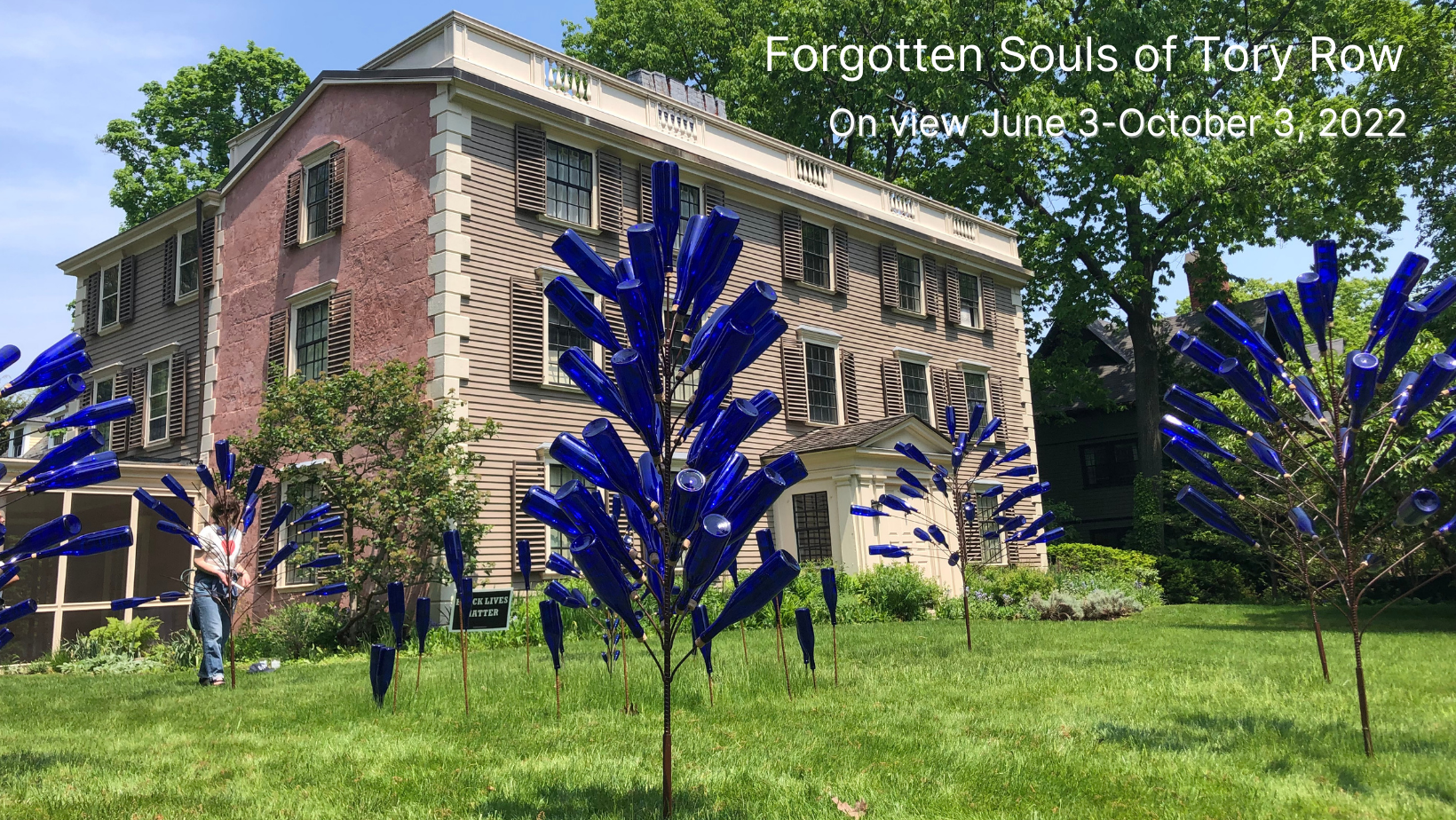
History Cambridge is now hosting an art installation on its lawn titled “Forgotten Souls of Tory Row: Remembering the Enslaved People of Brattle Street.” Created by Black Coral, Inc., this artwork in glass and metal adopts the tradition of bottle trees to evoke the power of ancestors.

History Cambridge is also organizing an online panel discussion called “The Work of Revolution” on Thursday, 23 June. Its event description says:
How did unpaid labor enable the Revolutionary leaders of Cambridge to foment rebellion and to carry out the political and military duties of the War?

Although much is known about George Washington’s residency in Cambridge in the early days of the Revolution, the reality is that it was the labor of women and people of color that enabled the Continental Army to function, as well as feeding, housing, and serving both the American and British troops present in the city. By centering the work experiences of women and BIPOC during this period, we will be expanding the scope of the Revolutionary narrative and bringing to light stories that have not often been shared with a wider audience.
Prof. Robert Bellinger, professor of history and founder and director of the Black Studies Program at Suffolk University, will lead the discussion.

History Cambridge has invited me to be part of this panel, talking about what we know of the people who tended Gen. George Washington’s headquarters in the years 1775 and 1776.

The general brought some enslaved workers from Mount Vernon with him, including his body servant William Lee. Martha Washington probably brought more. Washington also employed a free black woman named Margaret Thomas, as well as a family and a teenager burned out of their homes in Charlestown during the Battle of Bunker Hill. 

Though Tory Row was a place of slavery in those years, it soon became a place of liberation. While in Cambridge, Washington was convinced to let black soldiers remain in the Continental Army. The absence of the Loyalist homeowners, shifting mores, and a change in Massachusetts law meant the people enslaved on “Tory Row” had a good chance to become free by the end of the war.

The “Work of Revolution” discussion is scheduled to start at 7:00 P.M. Register at this page.

There will be a public celebration of the “Forgotten Souls” artwork on 16 July, and a question-and-answer session with the artists on July 21. For more information, visit this page.

Tuesday, August 14, 2018

News of the Revolution in Vienna

Back in February, the Age of Revolutions blog featured Jonathan Singerton’s interesting analysis of how the American Revolution was reported in the Holy Roman Empire.

As the article’s headline notes, the Empire was an “Absolutist State” with strict censorship of the news. As in authoritarian regimes today, the rulers feared that any critique of other rulers could be interpreted as critique of themselves and inspire the local opposition.

Singerton focuses on the news reported in the Wienerisches Diarium, Vienna’s newspaper, and the behind-the-scenes arguments over that reporting. About the Declaration of Independence, he writes:
First news of an announcement arrived in Vienna in mid-August 1776, but on 17th August, the Diarium proclaimed, “We have news from America, which reports that the General Congress has finally declared itself independent with a small majority.”[12] The fact that Congress’s adoption was unanimous and only New York abstained was lost on the Diarium and the Declaration was not immediately reproduced. On August 31st, only the concluding paragraph of the Declaration appeared, and several weeks later, the immortal lines of the preamble featured in the September 11th edition.[13] The body of the Declaration, however, parts of which enumerated the grievances against King George III, were omitted – the Diarium’s managers could not risk disseminating such anti-monarchical writing.

When this edition reached the Queen-Regent Maria Theresa (1717-1780) [shown above] and her co-regent son Joseph II (1741-1790), they were incensed that such an article had passed the censors. Count Christian August von Seilern (1717-1801), the Governor of Lower Austria and previously Ambassador in London (1766-1770), sympathised with the article and futilely attempted to reason with the monarchs, insisting that their authority had not been questioned.[14] The newspaper’s perceived transgressions brought an even higher level of scrutiny.

This reporting created a hotbed of pro-American sentiment in Habsburg territories, which influenced the first diplomatic mission between the United States and the Habsburgs in 1778, when the American representative William Lee arrived in Vienna hoping to procure an alliance with the monarchs. Though he failed to get access to the court, the fervor for the American cause stoked by newspaper coverage created a welcoming environment outside of the court for Lee. He remarked to his brother about his amazement of such interest, “Some of distinction here are warm for the part of America.”[15]
That William Lee was a brother of Richard Henry, Francis Lightfoot, and Arthur Lee—a Virginia dynasty not quite as controlling as the Hapsburgs.