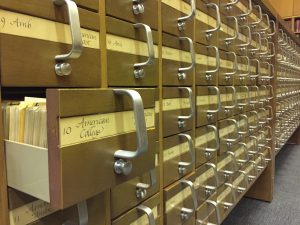
Back in February I spent an afternoon in the New York Public Library, a trip that produced some material on the
legend of George Washington’s Hanukkah. But my real find that day was the original publication of Ebenezer Stevens’s recollection of the
Boston Tea Party. I’d found that material quoted in many places, from Francis S. Drake’s
Tea Leaves to Edith Wharton’s memoir
A Backward Glance (she was a Stevens descendant). But I hadn’t found its earliest manifestation, even in Stevens family papers at the
New-York Historical Society.
But it turned up in a small volume called
Biographical Sketch of Ebenezer Stevens, Lieut.-Col. of Artillery in the Continental Army, by John Austin Stevens. Though this book doesn’t have a date, internal evidence shows it was prepared after 1877 (i.e., it mentions someone dying that year). It was apparently printed for members of the family, and a copy ended up at the N.Y.P.L. [ADDENDUM: I’ve since discovered that this material was first
published in The Magazine of History in 1877, then
reprinted on its own in 1900.]
The book discusses Stevens’s service in Boston’s prewar militia artillery company, commanded by
Adino Paddock. Then the tea ships arrived, producing a split in the company, as the author describes:
Paddock’s company was called upon...to guard the tea and prevent its landing. Paddock, whose sympathies were with the Royal authorities, refused his consent, but at a company meeting the charge was accepted and undertaken by them, First Lieut. Jabez Hatch taking the command. Stevens was among those who volunteered on this service.
That squares with the
minutes of the tea meetings kept by town clerk
William Cooper, which describe militia companies patrolling the wharf where the first ship docked. Indeed, those notes list one of the early volunteers as “Benjamin Stevens,” which could have been a mistake for Ebenezer. It also squares with how the artillery company broke apart in 1774, with Paddock reaffirming his loyalty and many of his men joining the provincials.
Stevens told his family that he was also at the big public gathering in
Old South Meeting-House on the night of 16 Dec 1773, when word came that the
governor had refused to let the tea ships depart without unloading. This is Stevens’s “own recollection of the affair, as taken from his words at a later period by one of his sons”:
I went from the Old South Meeting House just after dark; the party was about seventy or eighty. At the head of the wharf [Griffin’s wharf] we met the detachment of our company on guard, who joined us.
I commanded with a party on board the vessel of which [Alexander] Hodgdon was mate, and as he knew me, I left that vessel with some of my comrades, and went on board the other vessel which lay at the opposite side of the wharf; numbers of others took our places on board Hodgdon’s vessel.
We commenced handing the boxes of tea on deck, and first commenced breaking them with axes, but found much difficulty, owing to the boxes of tea being covered with canvass—the mode that this article was then imported in. I think that all the tea was discharged in about two hours. We were careful to prevent any being taken away; none of the party were painted as Indians, nor, that I know of disguised, excepting that some of them stopped at a paint shop on the way and daubed their faces with paint.
In the past I’ve expressed skepticism about family accounts published long after the fact without contemporaneous documentation (as in the case of
Sybil Ludington). But I’m inclined to believe this account. Why?
First, there’s earlier support for Stevens’s participation in the tea destruction. His name is on the
earliest list of Tea Party participants, published in 1835. That list includes a lot of artillerists, and his account helps to explain why. Among those men was
John Crane; he and Stevens left Boston shortly afterwards and set up a carpentry business in Rhode Island before returning to greater Boston as provincial artillery officers.
Second, Stevens’s story contains a detail that isn’t really important to the event, may even be a little embarrassing, and smacks of how real life works: as he started to board the
Dartmouth, he found that its mate was Alexander Hodgdon, brother of the woman he was courting. Rather than risk being identified or compromising his future in-law, Stevens quickly took his squad to another ship. On 11 Oct 1774, Ebenezer Stevens and Rebecca Hodgdon married, and ten years moved into the the New York mansion shown above a hard century later (courtesy of the
Museum of the City of New York). Alexander later became treasurer of Massachusetts.
Finally, when Stevens’s account goes against the established story of the Tea Party, it doesn’t do so in a way that makes him appear more heroic or romantic. In fact, it denies the most picturesque aspect of the event: that the tea destroyers dressed as Indians. Stevens told his son of improvised disguises instead. I think newspapers emphasized the notion that the men were indistinguishable from “Mohawks” in the weeks that followed as a way to discuss the event without acknowledging who had really done it. The many artists who depicted the event after the war up to now also seized on that striking visual detail, and who can blame them?