J. L. BELL is a Massachusetts writer who specializes in (among other things) the start of the American Revolution in and around Boston. He is particularly interested in the experiences of children in 1765-75. He has published scholarly papers and popular articles for both children and adults. He was consultant for an episode of History Detectives, and contributed to a display at Minute Man National Historic Park.

Subscribe thru Follow.it


•••••••••••••••••


Showing posts with label Shem Drowne. Show all posts

Tuesday, October 17, 2023

Hanson on Copp’s Hill Burying Ground, 22 Oct.

On Sunday, 22 October, Old North Illuminated will host two events featuring John G. S. Hanson speaking about the nearby Copp’s Hill Burying Ground.

A tour of that cemetery with Hanson is already sold out, but it’s still possible to take in his talk “The Stones Cry Out” in the church or online.

The event description says:
Many people visit Boston’s historic burying grounds to see the monuments of historical figures like Samuel Adams, Paul Revere, John Hancock, Crispus Attucks, Samuel Sewall, Prince Hall, and Cotton Mather. But few pause to read the inscriptions on the stones of other early “every day” Bostonians, whose names and lives are now long forgotten.

For those who take the time to look and “listen” closely, these gravestones convey highly personal messages that not only reveal a glimpse into their personal lives, but also the literature that they read, the hymns they sang, and the poetry that moved them. These stones also can tell us a great deal about colonial Bostonians’ attitudes toward life, death, and eternity.

Join burial ground expert John Hanson for “The Stones Cry Out” and explore the history and poignancy of the Copp’s Hill Burial Ground epitaphs, followed by a reception and multimedia presentation at the Old North Church, as we illuminate history through the artistic disciplines of poetry, verse, and music.
Most of the names in that description are buried at the Granary Burying Ground, but Copp’s Hill is the resting-place of Mather and Hall, as well as firebrand merchant captain Daniel Malcom, both men named Robert Newman, Benjamin Edes, and Shem Drowne.

John G. S. Hanson is the author of Reading the Gravestones of Old New England (McFarland, 2021), based on years of research into grave markers and the sources for their texts.

The lecture is scheduled to take place from 5:15 to 6:30 P.M. People can register for in-person or online attendance through this webpage, and Old North Illuminated asks those attendees to donate what they can.

Friday, October 06, 2023

Whither the Weathercock?

Today’s Boston 1775 posting comes from Charles Bahne, a local historian based in Cambridge. In this “guest blogger” essay, Charlie discusses an artifact of the North End in the early 1700s and Cambridge in the late 1800s, making the case to preserve and reproduce it locally.

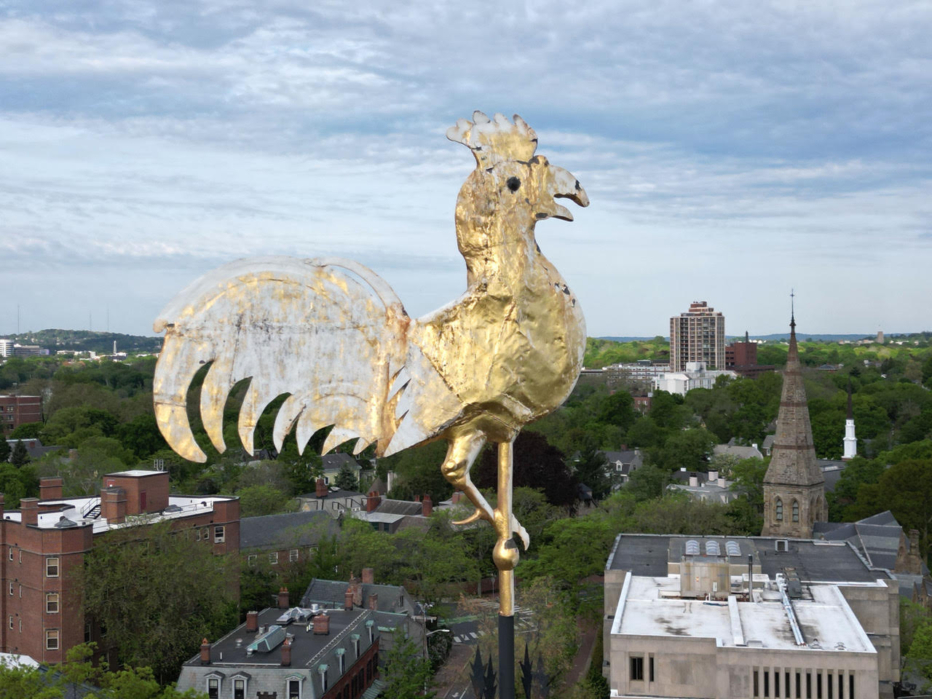
One of the most historic elements of the Cambridge skyline is coming down sometime soon: the big brown church with the rooster on top is losing its rooster.

The Executive Council of the First Church in Cambridge—the stone church on Garden Street, across from the Common—has decided to bring the cockerel weathervane down for its own safety. According to the church’s website, drone videos have revealed significant and dangerous erosion of the gilding on one side of the cockerel, especially its large tail feathers. After extensive consultation, nationally recognized experts in the field of American Folk Art and historic weathervanes have strongly advised removal. The date for its descent is still being determined, but the goal is to make the move as soon as possible.

The church adds, “Once the cockerel is safely down and securely stored, church leaders and the congregation will need to consider next steps in the stewardship of this national treasure, including discerning whether the time has come to consider selling it. Another future decision is whether the Shem Drowne original should be replaced with a replica or something else.”

At 302 years of age, the five-foot gilded fowl is one of the oldest weathervanes still in use in America. Perhaps the first rooster weathervane, or “weathercock,” made in this hemisphere, he was fashioned in 1721 by Shem Drowne, the same coppersmith who crafted the grasshopper vane atop Faneuil Hall.

For a century and a half—nearly half of his existence—he has dominated the corner of Garden and Mason Streets, a landmark for Cantabrigians. And before he landed in Cambridge, the cockerel perched atop a church in Boston’s North End, where he led quite an interesting life.

The weathervane originated with a 1719 dispute among members of a North End parish, over the ordination of a pastor named Peter Thacher. Following Rev. Thacher’s rather tumultuous installation, the dissenting parishioners seceded from the original congregation and erected a new meeting house just three blocks away. As a deliberate insult to their former colleagues, they commissioned the cockerel weathervane for their new building: an allusion to Peter’s betrayal of Christ at the crowing of the cock. Upon placing the new vane on its spindle, “a merry fellow straddled over it, and crowed three times to complete the ceremony.”

Officially the “New Brick Meeting House,” their 1721 structure was commonly known as the “Cockerel Church” in honor of its weathervane; and some people (perhaps not so jokingly) called it the “Revenge Church of Christ.”

Paul Revere worshipped in the Cockerel Church for most of his life; the back yard of his house abutted the meeting house property. The weathercock appears prominently in Revere’s 1769 print of “A View of Part of the Town of Boston,” where he towers over the North End neighborhood.

Before he changed his career from the ministry to writing, Ralph Waldo Emerson preached sermons under the cockerel weathervane for three years, as pastor of the Second Church in Boston, which had merged with the original New Brick parish.

A new building followed in 1845, on the same Hanover Street site, and the weathercock was placed atop it. When that building came down for an 1870 street-widening project, the vane was sold at auction. William Saunders, an antiquarian and a member of the First Church Cambridge congregation, bought it, and the cockerel found his new home, roosting atop First Church’s new stone building. Since 1873 he has graced the corner of Garden and Mason streets, overlooking Cambridge Common.

So our friend the rooster has quite a story to tell, over and above the weather forecast. It’s a story that’s unique to Boston and Cambridge. It’s important that he remain in our community, where he can continue to tell it to us. He must not be allowed to fly the coop, and land somewhere else.

In an ideal world, the historic fowl would be repaired and restored to the Garden Street perch where he has served for 150 years, fulfilling his ancient purpose of informing us which way the wind is blowing.

Should that ideal not be possible, for fragility or other reasons, then all of us in Cambridge and Boston have a stake in the decision. After a century and a half in our town—and another century and a half across the river—the cockerel weathervane has become a valuable member of our entire community. He’s an important part of our shared heritage, and not just an asset belonging to only one organization.

It is understandable, but always sad, when an institution chooses to monetize its patrimony, exchanging its heritage for financial gain. Given the significance of this historic weathercock, it would be a tragedy if he were sold to a distant museum, and exiled to a place where his story cannot be fully appreciated. It would be an even greater tragedy if he were sold to a private collector and locked behind closed doors where the public cannot appreciate him.

If the cockerel weathervane is to be sold, it is imperative for him to remain on public display locally, at the Museum of Fine Arts or a similar organization.

And what of us Cantabrigians who look skyward? We too will be losing a familiar friend, a piece of our history. If Shem Drowne’s classic cockerel is too fragile to remain on his perch above the Common, then he should be replaced with a likeness. Any monetary gain that First Church might realize from the sale should be used to finance the creation of a replica, to keep this fowl’s memory alive atop the tower which has been his home for so long.

After all, what is a big brown church without a rooster on top?

First Church is giving the community a chance to reflect on, ask questions about, and consider next steps following the decision to remove the cockerel, which was announced to the congregation on Sunday, September 10. A first listening session will be on Sunday, October 8, at 12:30, followed by a weeknight Zoom session on a date to be announced. For more information, including photos and videos of the weathervane’s current condition, visit the First Church website.

(And thanks to Cousin Lynn and the late Ol’ Sinc of “Hillbilly at Harvard” for coining the phrase “big brown church with the rooster on top,” many years ago.)

Thanks, Charlie! The Rev. Peter Thacher who prompted that rupture in the New North Meeting wasn’t the same Rev. Peter Thacher who was active during and after the Revolution, but they were collateral relations.

Boston 1775 readers may recall that another weathervane attributed to Shem Drowne was put up for sale through Sotheby’s in January with an asking price around $400,000. I can’t find the result of that auction, but it shows the potential value of this sort of famous folk art.


Saturday, January 07, 2023

The Return of Peter Faneuil’s Grasshopper?

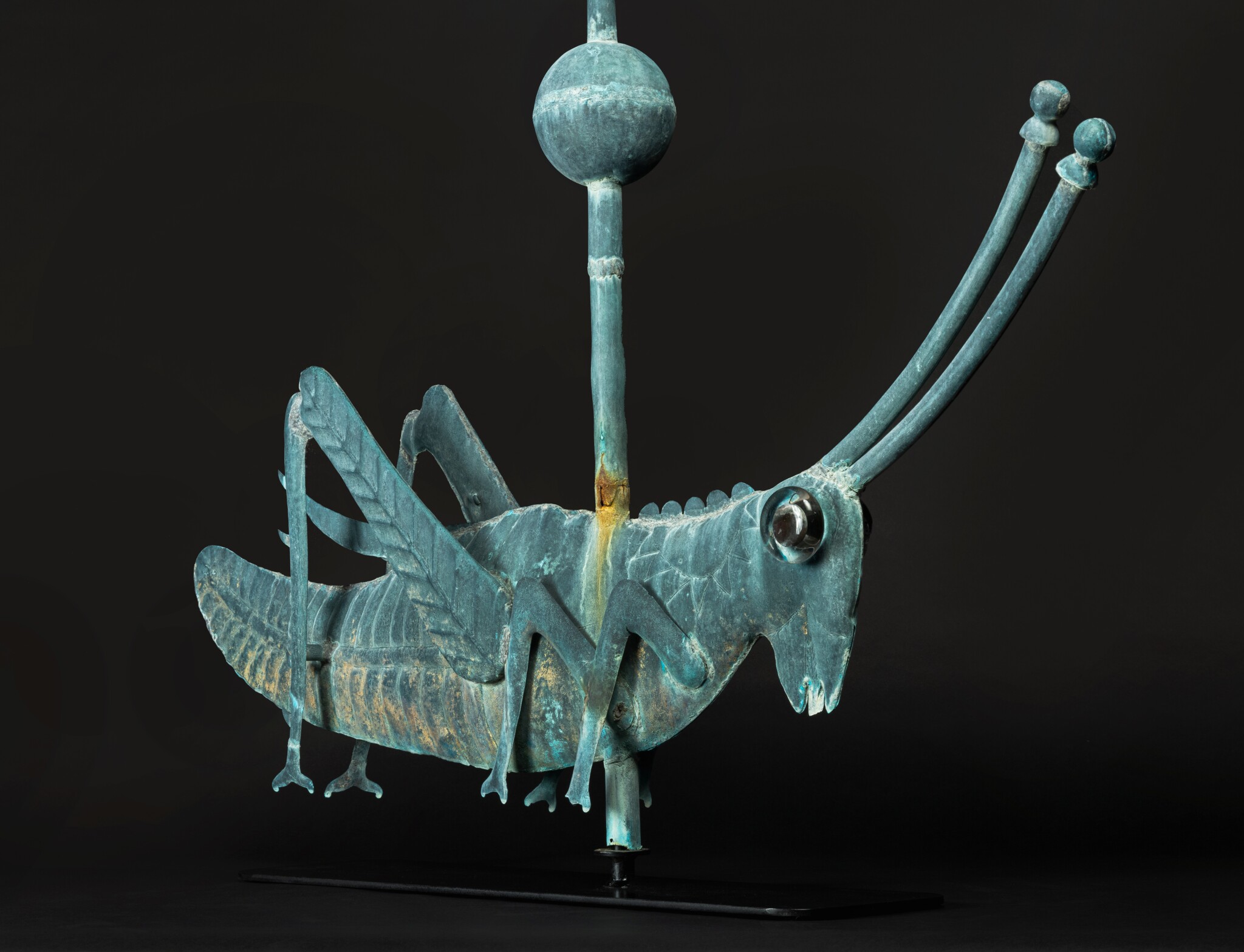
On 23 January, Sotheby’s will auction off what it says is the grasshopper weathervane that Shem Drowne crafted for Peter Faneuil’s summerhouse before 1743, as discussed yesterday.

The auction house’s announcement goes into detail about Drowne’s other, long-documented weathervanes and the short paper trail of the summerhouse grasshopper.

It also says the summerhouse weathervane “disappeared into obscurity” after the demolition of the Faneuil mansion in the 1830s. Which is one way to acknowledge there’s no provenance at all for the object on sale before the twentieth century.

The record begins:
It was acquired in Massachusetts circa 1900 by Captain Lucius Bradford (1864-1939) of Newport, New Jersey who was told that it had been on top of a New Hampshire barn. He stored it inside as a decoration, and it was inherited by his son Leslie Bradford (1895-1987). It continued to be passed down through successive generations of the family until purchased by the current owner.
As I read that webpage, whoever sold the weathervane to Lucius E. Bradford didn’t claim that it had spent time over Boston. Someone—either the “current owner” or an appraiser or Sotheby’s own experts—recently hypothesized this was the weathervane from the Faneuil house.

The silhouette of this grasshopper does match the one on top of Faneuil Hall (and not all sculptors shape grasshoppers that way). They’re about the same size. Both creatures have copper bodies and glass eyes.

The one on Faneuil Hall has been regilded multiple times over the years. The one now offered for sale is mostly green, but Sotheby’s says it shows “traces of gilding,” which I presume would be unusual for a weathervane made for a barn.

Then again, it’s conceivable that some metalworker in the Colonial Revival period fashioned a version of Shem Drowne’s famous grasshopper for customers who liked historic American style.

Sotheby’s estimated price for this weathervane is $300,000–500,000.

Friday, January 06, 2023

Boston’s Other Gilded Grasshopper

In 1743, William Price published a view of Boston from the harbor, showing the town’s many wharves and steeples.

We can see a digital copy of the Boston Public Library’s copy of Price’s print through Digital Commonwealth.

Harvard offers a crisper and more zoomable image scanned from a facsimile of the print published in the mid-1800s. That’s the source of the detail shown here.

This edifice with a weathervane wasn’t a church or civic building. It was the airy summerhouse in the back yard of merchant Peter Faneuil on Pemberton Hill, across the street from the burying ground beside King’s Chapel.

Eliza S. M. Quincy recalled the form of the weathervane in her memoir:
The crest of the former owner,—a grasshopper,—similar to the vane of Faneuil Hall, yet glittered on a summer-house in the garden, which commanded a view only inferior to that from Beacon Hill.
A few years before Quincy’s memoir was published posthumously, Lucius M. Sargent made a preemptive correction:
A grasshopper was not the crest of Peter Faneuil’s arms. I formerly supposed it was; for a gilded grasshopper, as half the world knows, is the vane upon the cupola of Faneuil Hall; and a gilded grasshopper, as many of us well remember, whirled about, of yore, upon the little spire, that rose above the summer house, appurtenant to the mansion, where Peter Faneuil lived, and died. . . .

The selection of a grasshopper, for a vane, was made, in imitation of…the very same thing, upon the pinnacle of the Royal Exchange, in London.
Nobody seems sure about whether the grasshopper weathervane on the Faneuils’ summerhouse came before or after the one on top of Faneuil Hall. But it’s clear there were two. 

The Faneuil Hall grasshopper, made by metalworker Shem Drowne, is still up there, having survived storms, remodeling, thefts, and other indignities.

As for the Faneuil mansion and summerhouse, they were torn down in the 1830s as the area was redeveloped into Pemberton Square. (George Loring Brown painted the house at that time, but that image doesn’t include the summerhouse.) That neighborhood is now largely covered by the Center Plaza building across from Government Center.

The summerhouse weathervane disappeared with the buildings. But has it just hopped back into sight?

TOMORROW: Grasshopper for sale.

Thursday, May 24, 2012

The Grasshopper on Faneuil Hall

Click on the thumbnail at the right to see a nice photograph of the grasshopper-shaped weathervane atop Faneuil Hall, taken by Steve Borichevsky.

That grasshopper was the work of Boston metalworker Shem Drowne (1683-1774), who also created a rooster weathervane for the New Brick Meeting in the North End, a wavy banner for Christ (Old North) Church, and an Indian figure for the Province House. (Drowne himself was a member of the First Baptist Meeting.)

An Indian appeared on the Massachusetts provincial seal, and therefore an appropriate figure to top the governor’s mansion. A rooster was an old Christian symbol. But what did a grasshopper mean in Boston?

Apparently what mattered was what a grasshopper meant in London. A weathervane in that shape topped the Royal Exchange built by Sir Thomas Gresham in 1571. The insect thus became a symbol of worldwide British commerce.

According to Lucius Manlius Sargent, the mercantile Faneuil family brought that symbol to Boston:
…a gilded grasshopper, as many of us well remember, whirled about, of yore, upon the little spire, that rose above the summerhouse, appurtenant to the mansion, where Peter Faneuil lived, and died. That house was built, and occupied, by his uncle, Andrew; and he had some seven acres, for his garden thereabouts. It was upon the westerly side of old Treamount Street. . . . The selection of a grasshopper, for a vane, was made, in imitation of their example, who placed the very same thing, upon the pinnacle of the Royal Exchange, in London.
Thus, Boston probably commissioned Drowne to make a big grasshopper weathervane for Faneuil Hall to honor Peter Faneuil for funding its construction and to signal arrivals from London that Boston was a commercial center, too.