J. L. BELL is a Massachusetts writer who specializes in (among other things) the start of the American Revolution in and around Boston. He is particularly interested in the experiences of children in 1765-75. He has published scholarly papers and popular articles for both children and adults. He was consultant for an episode of History Detectives, and contributed to a display at Minute Man National Historic Park.

Subscribe thru Follow.it


•••••••••••••••••


Showing posts with label Aaron Burr. Show all posts

Saturday, February 14, 2026

“Appointed to the command of the Schooner Isabella”

In the April 1776 letter from Capt. Hector McNeill to Col. Benedict Arnold (shown here) that I quoted yesterday is the line, “My William Farris is Saild for you I hope you will be kind to him.”

William Farris was twenty-three years old that year, having been born in Belfast in 1753. He came to Newburyport at the age of twelve. Then he went to sea.

In an 1832 pension application, quoted in John J. Currier’s History of Newburyport, Mass.: 1764-1905, Farris described what he did at the start of the war:
he was at Quebec as first officer of the Ship Mary Ann, belonging to Boston, in the summer of the year 1775, and there made arrangements with Captain Hector McNiel, and was under further engagement with him for a voyage and as first Officer of a vessel, in the Merchants service with him, and while thus engaged, and before the lading of the vessel, information was received of an expedition undertaken by General Arnold, in the service of the United States, who was then on his way through the woods.

To the best of his remembrance, General Arnold appeared with his Army in the month of November of that year [14 Nov 1775], and immediately thereupon a proclamation was issued by Lieutenant Governor Crambries [Hector Theophilus Cramahé] requiring every Individual in the City to take arms in its defence, or depart therefrom within three days, and declaring all who did not thus manifest their allegiance Rebels and Spies.

Your petitioner did not hesitate to make his election, but immediately procured a passport, leaving all his effects behind him, excepting only such few articles as were necessary for a change, and those contained in a single handkerchief, left the City, and proceeded to join the standard of his country, under General Arnold, who was then at about thirteen miles distance; he was favorably received by the General, and was immediately stationed by him at a place called Point aux Trembles, and there given in charge the care of several vessels, which had been captured from the British, and placed in a small creek at that place; from these vessels various articles which were considered useful and necessary for the American Army were selected and sent down from thence by land.

At this place he was stationed during the whole of the following Winter, having with him an officer from General Arnold’s Army, and a few soldiers, for the protection of this property. On the breaking up of the ice in the spring following, he was sent across the river to direct some Canadians, who were employed for that purpose, in making a number of sweeps, or large bars, for the use of gondolas, which were to be employed in transporting heavy cannon, and as soon as the Ice was sufficiently cleared away he was appointed to the command of the Schooner Isabella, one of the prises which had been captured from the British, mounting four carriage guns, and with this vessel was ordered for Montreal, as a transport, with supplies for the American army.

On arriving at said Montreal, it was found that General Arnold had been superceded in the command at Quebec [by Gen. David Wooster], and that information had been received of the arrival of a British fleet, upon which General Arnold immediately ordered all the materials which were considered useful and proper for the American Army to be selected, and these were laden and put on board the said Schooner, which was then under the command of your petitioner, and General Arnold, Colonel [Aaron] Burr, and several other officers of the American Army took passage in said Schooner with him and went down to the River Sorcel, where reinforcements for the Army were arriving, and at that place said Schooner was hauled in near the banks, and the General and all his officers continued on board several days, having no convenient place on shore for their accommodation.

When it became necessary to leave the said Schooner, there appearing no further use for her, or for the services of your petitioner at that place, he procured a passport from Colonel Burr, with which about the middle of June, 1776, he proceeded for the United States, with a view of entering the Navy, having been employed in the service of the United States, having the charge of said prises, and in the command of said Schooner, the full term of seven months.
I quote that at length because it offers a picture of the environment in which Capt. McNeill spotted the man he identified as Basile Boudrot.

In addition, Farris offers a link between McNeill, his mentor in Québec, and Newburyport, the port that Thomas Parsons had sailed from on his last voyage.

TOMORROW: Transporting the prisoner.

Thursday, October 05, 2023

The Real Life and Death of Mrs. Coghlan

Margaret Moncrieffe was born in Scotland in 1762. Her father was army officer Thomas Moncrieffe, who soon became one of Gen. Thomas Gage’s aides in North America. Her wealthy mother died young.

When the Revolutionary War broke out, Margaret was in the New York area while her father was serving as a brigade major inside besieged Boston.

In 1776 Maj. Moncrieffe came to New York with the British expeditionary force, and his teenage daughter became a suspected spy, potential hostage, and all-around headache.

Over the next ten years, Margaret Moncrieffe:
  • Fell in love with an American officer—most authors believe that man was Aaron Burr.
  • Was sent over to the British in Manhattan.
  • Was married to Lt. John Coghlan of the 23rd Regiment of Foot.
  • Ran away from her husband to London.
  • Became mistress of Lord Thomas Pelham-Clinton.
  • Was sent to a convent in Calais.
  • Fell in with Charles James Fox, Richard Brinsley Sheridan, and others in the British political opposition.
  • Became mistress to a “Mr. Fazakerley.”
  • Became mistress to Lord John Augustus Hervey.
  • Became mistress to Capt. Andrew Barnard.
  • Became mistress to a “Mr. Giffard.”
Then, in June 1787, the London newspapers reported that Margaret (Moncrieffe) Coghlan had died. The Daily Universal Register, which later became the Times of London, stated she passed away on 4 June “After two days illness…at three o’clock.”

The Gentleman’s Magazine included her in its section “Obituary of Considerable Persons,” with these details: “In Cavendish-street, Portland-squ. … Mrs. Margaret Coghlan, lady of John C. esq; and dau. of Colonel Moncrieffe.”

Seven years later, British readers were presented with Memoirs of Mrs. Coghlan, (Daughter of the late Major Moncrieffe.) Written by Herself and Dedicated to the British Nation; Being Interspersed with Anecdotes of the late American and Present French War, with Remarks Moral and Political.

That book described adventures and affairs extending past 1787 to the date of publication. Among her later lovers was retired general William Dalrymple, who makes most of his Boston 1775 appearances as the British army commander in Boston during the Massacre.

In Revolutionary Ladies (1977), Philip Young guessed that Margaret Coghlan had left some memoirs before she died, but someone—he guessed it was the political writer Charles Pigott—had expanded that document in unreliable ways and arranged for it to be published.

In Revolution Song (2017), Russell Shorto cited documents showing Margaret Coghlan was active after 1787. He concluded that she reported her death to newspapers in order to escape creditors and flee to France. Later she published her memoirs herself in another bid for money. That made Coghlan’s memoirs a more credible historical source—albeit coming from someone dishonest enough to fake her own death.

Last month the Journal of the American Revolution published Jane Strachan’s two-part profile of Margaret (Moncrieffe) Coghlan, from birth through fake death to her last recorded writings, documents begging for support from 1803 and 1805. It’s a thorough discussion of her life and the challenges of sorting out the facts about that life. It’s also quite a ride.

Monday, June 27, 2022

The Marriage of Edmund and Elizabeth Randolph

Edmund Randolph and his future wife, Elizabeth Carter Nicholas, were born only a day apart in 1753. They learned to read at the same school.

Edmund returned to Virginia in late 1775 after a few months as an aide de camp to Gen. George Washington in Cambridge. He rekindled his acquaintance with Elizabeth, whom he called Betsey. In August 1776 they married.

Edmund later said he was a deist at that time, but Elizabeth’s faith won him back to Episcopal worship. They had children about once every two years while he rose in state politics.

From all accounts, Elizabeth Randolph wasn’t interested in politics or public life. People didn’t speak of her as a beauty or a glittering conversationalist, and she often complained of illness. But Edmund was devoted to her.

Having served as U.S. attorney general and secretary of state, Edmund Randolph’s career in government ended badly in a tiff with Washington and a costly lawsuit. In the early 1800s the Randolphs settled in Richmond, where Edmund commissioned the house shown above and practiced law, including representing Aaron Burr at his treason trial. Most of their children had grown up to marry other elite Virginians.

Elizabeth Randolph died on 6 Mar 1810. Nineteen days later, Edmund wrote a long letter to their children about their lives and emotional bond. He concluded:
My eyes are every moment beholding so many objects with which she was associated; I sometimes catch a sound which deludes me so much with the similitude of her voice; I carry about my heart and hold for a daily visit so many of her precious relics; and, above all, my present situation is so greatly contrasted by its vacancy, regrets, and anguish, with the purest and unchequred bliss, so far as it depended on her, for many years of varying fortune, that I have vowed at her grave daily to maintain with her a mental intercourse.
After visiting his Betsey’s grave on 9 April, Edmund suffered what he told President James Madison was a “dreadful attack from a hemiplegia, with which, by a kind of sympathy with my poor wife, I was afflicted in a few weeks from her death.”

Edmund reported that the stroke “happily affected no faculty of my mind,” and also reported that he felt “no pain,” but he developed trouble walking and came to “require in rough ground the aid of a crutch.” He cut back on his law practice and tried warm springs, but never fully regained his health. 

Edmund Randolph died on 12 Sept 1813 at age 60 while staying with a friend. He was buried in the nearby churchyard, his grave unmarked until decades later.

Friday, November 05, 2021

The Road to Concord Leads to History Happy Hour, 7 Nov.

On Sunday, 7 November, I’ll be the guest on History Happy Hour, a weekly video conversation with Chris Anderson and Rick Beyer of Stephen Ambrose Historical Tours.

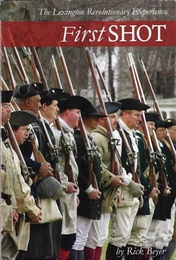
Folks around here remember Rick from his years in Lexington. He created the film “First Shot!: The Day the Revolution Began” and accompanying book and helped to establish the reenactment of the town’s 1773 tea-burning as an annual event. A few years back, I got to work with Rick and the Lexington Historical Society on the Buckman Tavern exhibit “#Alarmed!: 18th-Century Social Media.”

Since then Rick has moved to Chicago and published the book Rivals Unto Death about Alexander Hamilton and Aaron Burr.

Cohost Chris Anderson is a former editor of WWII Magazine, now based in London. He’s published numerous books about World War 2 and, in healthy times, leads tours of the European Theater.

We’re going to discuss The Road to Concord:
a tale you likely have never heard about the lead-up to the famous battles of Lexington and Concord. Discover the secret story of the role played by four stolen cannons. Both Redcoats and Patriots alike had reason to keep this hot take under wraps, and both sides succeeded well enough that the full story has never appeared until now.
I’m sure Rick will be pleased to hear that since publishing the book I’ve learned more about how Lexington was involved in the Massachusetts Provincial Congress’s effort to build up an artillery force by hook or crook.

Anderson and Beyer have two more discussions on Revolutionary history scheduled this month:
  • 14 November: Mike Duncan, author, Hero of Two Worlds: The Marquis de Lafayette in the Age of Revolution
  • 21 November: Andrew Roberts, author, The Last King of America, about George III
Folks can watch the conversations live on the History Happy Hour website and its Facebook page. We’re scheduled to start at 4:00 P.M. on Sunday, Boston time. Eventually the videos go up on YouTube as well.

Monday, February 20, 2017

Reading about Rick Beyer’s Rivals unto Death

Rivals Unto Death: Alexander Hamilton and Aaron Burr is a retelling of the political rivalry that led to the most famous fatal duel in U.S. history. It comes from Rick Beyer, an author and filmmaker from Lexington.

Rick’s behind the “First Shot” film, the “In Their Own Words” pageant, the annual Lexington tea burning, and more to come. I invited him to answer a few questions about his new book.

What was the genesis of Rivals Unto Death? How did you come to write it?

I have Lin Manuel Miranda to thank for that! With the musical Hamilton getting hotter and hotter, the editor who shepherded my first book into print invited me to write about the rivalry. The idea was to squeeze the whole story into a compact and accessible volume. I’ve long been fascinated by this tale, and I jumped at the chance. The publisher had a hurry-up deadline, but I had an ace up my sleeve. A dozen years ago I researched the duel for a History Channel documentary I was supposed to produce. At the last minute Richard Dreyfuss decided he wanted to produce that show, and for some strange reason they went with him instead of me! That research stood me in good stead for this project.

What were the biggest surprises for you as you researched and wrote the book?

To start with, Burr saved Hamilton from capture during the Revolution, and may well have saved his life later on when he extricated Hamilton from what was shaping up as a duel with future President James Monroe. You won’t find that in most history books—or the musical! And there are many more fascinating and little known connections. The two men switched back and forth from allies to adversaries multiple times…so tracing their relationship makes for a fascinating journey.

I was also surprised by the degree to which I revised my opinion of Aaron Burr. He’s not quite the cardboard cutout villain history has portrayed. He was a war hero, a feminist, an abolitionist, a supporter of immigrant rights (far more so than immigrant Alexander Hamilton), a patron of the arts, a loving husband and father, and a brilliant innovator in political campaigning. All and all a fascinating character.

The bulk of Rivals Unto Death is about the tangled legal, commercial, and political world of New York in the early republic. How did you get a handle on that topic?

Important as it was, NYC was tiny by modern standards. When Burr and Hamilton started practicing law there in 1783, there only about two dozen lawyers in the entire city. Today you can find that many in a Wall Street Starbucks! A great source on the crowded cockpit that was early 19th-century New York is the Pulitzer Prize-winning history Gotham by ‎Mike Wallace‎ and Edwin G. Burrows.

One of the things that history tends to paper over is the passion and partisanship of the time. The founders weren’t marble statues; they were flesh and blood men who were often at each other’s throats. So many events and controversies of the late 18th and early 19th centuries seem remarkably familiar today. Street protests ending in violence, hysterical predictions about presidential candidates, accusations of vote fraud, anger over immigration and deficits—it was all there in the time of Hamilton and Burr, and it forms the context for their rivalry. A great source of insights on that score is the website founders.archives.gov, a searchable archive with more than 175,000 pieces of correspondence and other writings from the first five presidents and Alexander Hamilton. Thank you, National Archives!

How did you structure your narrative for readers?

This is a murder mystery in which there is no doubt about who pulled the trigger, but the why is endlessly fascinating. The book opens one week before the duel, at New York’s Fraunces Tavern, where Hamilton and Burr sat side by side at a convivial July 4th dinner. No one else there knew that they already set in motion their duel, and they gave no hint of it that night. How could they share an enjoyable evening when they were dead set on shooting it out? What in the world was going on? That’s what I wanted to explore, and the book goes back to the time of the revolution in a search for clues.

I structured the book as a countdown to the duel. The chapters literally count down from ten to one, and at the beginning of each chapter I note how much time is left until the duel. Burr and Hamilton are on a slow-motion collision course, and as the years tick down, the causes of their ultimate confrontation become clear.

You write that the roots of the rivalry between Hamilton and Burr lay in the two men’s relationships to George Washington. Tell us more about those relationships and how they steered the men.

Hamilton and Burr were each offered a chance to serve on Washington’s staff during the Revolution, Burr when he was twenty, Hamilton when he was twenty-two. Burr lasted ten days and left with a bitter taste in his mouth, harboring a lifelong enmity toward Washington. Hamilton stayed four years, becoming Washington’s most important aide and his lifelong protégé. Over the years, this fundamental divide over Washington shaped their politics and soured their relationship.

Burr challenged Hamilton to their duel after reading a reference to “a still more despicable opinion which General Hamilton had expressed.” Do you have any suspicions about what that opinion was?

Gore Vidal posited that Hamilton accused Burr of having an incestuous relationship with his daughter, but I think that is just a novelist’s invention. Hamilton had written privately to people about his fear that Burr might be secretly scheming to create a new country out of New England and New York, largely for the sake of his own personal aggrandizement. I suspect his “more despicable opinion” involved some variation on that theme. As an immigrant who had adopted America as his own nation, Hamilton was unalterably opposed to breaking apart the nation he had worked so hard to create. “I view the suggestion of such a project with horror,” he once wrote. It seems like just the kind of thing he would expound on at a political dinner not knowing it would eventually bring about about his own demise.

Thanks, Rick! If you have your own questions about Hamilton and Burr, you can ask Rick at these upcoming appearances:

Saturday, January 07, 2017

John Barker Church: “the mere man of business”?

So was the marriage of Angelica Schuyler (shown here) and John Carter/John Barker Church happy? We don’t have a body of correspondence between them as we have for, say, John and Abigail Adams. But their marriage lasted until their deaths, and they certainly enjoyed good circumstances.

In 1780 Carter became partners with former Continental Army commissary general Jeremiah Wadsworth (1743-1804) of Connecticut as the main supplier for Gen. Rochambeau’s troops in North America. The French needed food and supplies for thousands of men.

Unlike the Continental Congress, whose paper money was rapidly losing value, France could pay in specie. Wadsworth and Carter got a cut of everything they supplied. They also gained excellent credit they could use for their other ventures, and money they could lend other businessmen. As a result, by the end of the war, Wadsworth and Carter were very rich.

In August 1782 James McHenry wrote to Alexander Hamilton from Baltimore:
Mr. Carter is the mere man of business, and I am informed has riches enough, with common management, to make the longest life very comfortable. Mrs. Carter is a fine woman. She charms in all companies. No one has seen her, of either sex, who has not been pleased with her, and she has pleased every one, chiefly by means of those qualities which make you the husband of her Sister.
The next July, the Carters and Wadsworth headed to France to collect their final payments. Sometime in 1783, Carter revealed his real name: John Barker Church. There’s no evidence of when he told his wife about that part of his past. By that fall, Benjamin Franklin and John Jay knew about it, though the couple still went by “Carter” for a few months longer.

Finally, the family headed to Britain, and at that point they came out permanently as the Churches. At the end of 1784, Abigail Adams wrote to a sister from London, “Mr. and Mrs. Church are here too, alias Cartar. Mrs. Church is a delicate little woman. As to him, his character is enough known in America.”

Back in Britain, Church quickly paid off the debts that he had left behind in 1774 and reestablished himself in business. He bought a house on Sackville Street in London. He bought a country house near Windsor. The couple entertained widely, not just among the American community—one of John Barker Church’s gambling friends was the Prince of Wales.

We might think that a rather boring, aristocratic life compared to the drama of nation-building that brother-in-law Hamilton threw himself into in America, but John Barker Church was also interested in politics. He was part of the radical Whig faction, causing George III to call his principles “avowedly enemical.” In 1787 he ran for Parliament and lost. The following year, Church took another approach: he bought a rural estate which came with a parliamentary seat, and put himself up for that seat in 1790.

By then the French Revolution was roiling Europe, and Church was decidedly on the side of reform. He opposed Britain’s war measures and hosted French exiles at the height of the Terror. In addition, he:
  • financed Charles James Fox, leader of the Whig left, with big loans he was never able to collect on.
  • bankrolled an attempt to break Lafayette out of a Prussian prison on 1792. (One of these days I’ll tell that story.)
  • helped Talleyrand sail to America in 1794 after Britain suddenly expelled him.
After six years in Parliament, Church gave up his seat, sold his estate, and headed back to the U.S. of A.

In 1797 Robert Morris went bankrupt. Church was one of his creditors, and to settle the debts he took over a great many of Morris’s western land claims. A few years later, the Churches’ oldest son Philip went to a tract in western New York and founded the town of Angelica, named after his mother. John Barker Church himself commissioned a mansion in Belmont called Belvidere.

Meanwhile, Church kept busy in the New York business world. He underwrote loans and was a director of the Manhattan Company and the Bank of North America. The Churches had eight children between 1778 and 1800, most of them living a long time. And still their life was full of drama. John Barker Church fought a duel with Aaron Burr five years before Hamilton did. In fact, Church was the family expert on affairs of honor, supplying the pair of pistols that his nephew Philip Hamilton and his brother-in-law used in their fatal confrontations.

Angelica Church died in 1814. John Barker Church returned to his native Britain and died four years later. He wasn’t a brilliant writer or political theorist, but he certainly wasn’t boring.

TOMORROW: A last word, and comma, from Hamilton.

Sunday, October 09, 2016

Fall Lectures at Fort Plain, New York

This spring I enjoyed the American Revolution in the Mohawk Valley conference organized by the Fort Plain Museum in Fort Plain, New York. I was pleasantly surprised to see the turnout—not only are lots of folks in that region proud of its Revolutionary history and eager to learn more, but some came a long distance to hear us.

The museum has just announced its fall lecture series on upcoming Thursdays.

13 October
“War on the Middleline: The Founding of a Community in the Kayaderosseras Patent in the Midst of the American Revolution”
James E. Richmond will focus on the Revolutionary War in Saratoga County and the surrounding area beyond the 1777 Battles at Saratoga. The talk will feature the impact of the war on average citizens as told “in their own words” in such documents as the records of the committees of correspondence, private journals, and pension applications. Richmond’s talk will culminate with the story of the British raid on Middleline Road in Ballston in October 1780.

20 October
Sir William Johnson and the Evolution of the Mohawk Valley Fur Trade”
Michael Perazzini, the Senior Interpreter at Johnson Hall State Historic Site, will discuss the evolution of the fur trade in upstate New York as well as the changes implemented by Superintendent of Indian Affairs Sir William Johnson. He will display and discuss several artifacts involved in this business. In addition to his work at Johnson Hall, Michael is also a member of Claus’ Rangers, a living history group dedicated to the perspective of the Loyalists.

27 October
“350 Years of Firearms”
As part of this wide-ranging presentation, John Phillips will display 20th-century replicas of the pistols used in the duel between Alexander Hamilton and Aaron Burr. The originals are now the property of the JP Morgan Chase Bank.

3 November
“Forgotten Pioneers: African Americans in the Mohawk Valley”
Main speaker Wayne Lenig is a Research Associate in archaeology at the New York State Museum and formerly an adjunct professor in Anthropology at Fulton-Montgomery Community College. He has worked as a curator at various museums in the region. In addition, Charles Lenig will discuss and demonstrate “West African Drumming in Colonial America.”

Each event starts 7:00 P.M. at the museum, 389 Canal Street in Fort Plain. Admission is free, but donations are appreciated.

Thursday, August 25, 2016

A James Wilson Memorial Award for Gen. Charles Lee

When I saw the movie musical 1776 during the Bicentennial, it left me with a strong impression of James Wilson. He was the Pennsylvania delegate to the Continental Congress shown casting the decisive vote for independence. In the movie Wilson, played by Emory Bass, is a dithering, insecure man who finally chooses sides because he prefers to be in the crowd rather than be remembered for standing up to it.

In real life, Wilson was a highly respected Pennsylvania judge who in 1774 published an important pamphlet on the limits of Parliament’s authority over the colonies. In the Congress he advocated independence early on, withholding his vote only until he felt sure the people of Pennsylvania were behind it.

At the Constitutional Convention of 1787, Wilson was one of the leading theorists of government and a member of the committee of detail, which produced the first draft. After the federal government was in place, President George Washington nominated him to be one of the first Associate Justices of the Supreme Court.

None of those contributions to the country are in 1776. The movie Wilson is simply a pawn in the dramatic conflict between the hard-driving John Adams and the more reluctant revolutionary John Dickinson. I knew that the real Wilson wasn’t part of a singing chorus, of course, and that the conversations in the Congress didn’t proceed precisely as shown. But I didn’t expect the creators of 1776 would distort a historical figure so much.

How did Wilson become vulnerable to such distortion? He had stopped being a household name, even in Pennsylvania. That allowed the playwright Peter Stone to sacrifice Wilson’s real career for the cause of drama.

In the twenty-first century, the Revolutionary figure most deserving of a James Wilson Memorial Award for being misrepresented in historical drama seems to be Gen. Charles Lee. Versions of Lee are supporting characters in both the first two seasons of the television series Turn: Washington’s Spies and the Broadway musical Hamilton. But both stories bend the facts of Lee’s life.

Turn depicts Lee’s capture at the end of 1776, portraying him (played by Brian T. Finney) as caught during a sex game. That’s not so far off as there have been rumors that Lee was visiting a mistress at the New Jersey tavern where British dragoons found him.

In the second season Lee becomes a British secret agent, trying to throw the Battle of Monmouth. Again, there’s a historical inspiration for that plot twist—the captive general did offer Gen. Sir William Howe ideas on how to defeat the colonists—but Lee never tried to undermine the Americans as Turn shows. Instead, as the book discussed yesterday argues, he performed well on the battlefield, causing trouble off of it, mostly for himself.

Even so, that depiction of Lee as a treacherous villain is nothing compared to how he appears as an incompetent buffoon in Lin-Manuel Miranda’s Hamilton. That show features the duel between Lee and Col. John Laurens, with Aaron Burr and Alexander Hamilton as their seconds. (Burr gets inserted into a number of events to increase dramatic unity.) That scene serves to set up the duel everyone knows is coming at the end.

In the play Hamilton refers to Lee as a Virginian, classifying him with his adversaries Thomas Jefferson and James Madison. While Lee did buy land on the Virginian frontier in 1775, he was English by birth and upbringing.

In the musical number “Stay Alive,” Hamilton complains of Washington, “Instead of me, he promotes Charles Lee, makes him second-in-command.” To which Lee, most often played by Jon Rua, memorably responds, “I’m a general. Whee!

Lee could have responded that the Continental Congress had made him its third-ranking general in June 1775, when Hamilton was still a private in his college militia company. The next spring, with Artemas Ward staying in Massachusetts, Lee became second-in-command. He and Hamilton were never up for the same job.

Later, Hamilton asks, “How many died because Lee was inexperienced and ruinous?"

Lee was the Continental general with the widest military experience when the war began. He had been a professional soldier since his teens and actually studied military science. He had fought in major campaigns and sieges, in the American wilderness and on European plains. Americans were delighted that Lee brought all that experience to their army.

As with Judge Wilson, not many people know about Gen. Lee these days. That’s left dramatists free to reshape the details of his career to serve their stories. Given Hamilton’s popularity, a generation of young people is being introduced to Charles Lee as an inexperienced rival to Hamilton from Virginia.

The irony is that there’s no need to change anything about Charles Lee to create drama. He was drama on horseback, roving restlessly through the nascent U.S. of A. with his Italian manservant and his portable Shakespeare and his dogs. The man was a larger-than-life character: smart, slovenly, hot-tempered, witty, eccentric, and self-defeating. Someday I hope we’ll see a more accurate representation of Lee, writing political pamphlets and military plans and indiscreet letters, Washington’s most experienced officer and his biggest headache. Now that would be a show.

Monday, May 30, 2016

Winner and Finalists of the 2016 Washington Book Prize

Last week Mount Vernon, Washington College, and the Gilder Lehrman Institute of American History announced the winner of the 2016 George Washington Book Prize, created to honor “the best new works on the nation’s founding era, especially those that engage a broad public audience.”

The winner was Flora Fraser for The Washingtons: George and Martha, “Join’d by Friendship, Crown’d by Love.” The award announcement says:
While many books have chronicled George Washington’s life and public service, no other has so thoroughly examined the marriage bonds between him and his wife. Few primary sources exist on the life of Martha Washington, who destroyed all but one of the couple’s personal letters. But Fraser’s diligent research has resulted in a more comprehensive understanding of the nation’s first First Lady—and through her important story, a fuller sense of the nation’s first President. Fraser portrays a couple devoted to each other and steadfast in their loyalty: from their short courtship, through raising a family at Mount Vernon, to the long years of the Revolutionary War, to the first U.S. Presidency, and to retirement at their beloved Virginia plantation.
Living in London, Fraser’s previous books have been about European women. She’s a third-generation biographer, a granddaughter of Elizabeth Longford and a daughter of Lady Antonia Fraser.

In addition to The Washingtons, the finalists for this year’s book prize were:
Plenty of good reading there.

Saturday, October 11, 2014

A Hip-Hip Hamilton Coming to the New York Stage

Early next year Lin-Manuel Miranda’s musical about Alexander Hamilton is scheduled to open Off Broadway in New York. Miranda, who won Tony and Grammy Awards for In the Heights, performed some of this material as “The Hamilton Mixtape” at an evening of poetry at the White House in 2009 and at Lincoln Center. That song cycle was in turn inspired by Ron Chernow’s biography of Hamilton.

This month the Hamilton producers announced some casting choices, in addition to Miranda himself in the title role:
The New York Times reports that the show “blends an array of musical styles – including traditional showtune-like numbers and elements of hip-hop and rap, which dominated In the Heights. The musical explores Hamilton’s life as a teenage orphan in the British West Indies, a young leader in the Revolutionary War, a confidant to Washington, a key force behind the American constitution, and the first Secretary of the Treasury, with moments of scandal along the way.”

Friday, August 15, 2014

The Legend of Mme. Jumel

Ben Carp alerted me to this gossipy Gothamist article by Danielle Oteri about Eliza Jumel, long-time owner of the Morris-Jumel Mansion in the Washington Heights area of Manhattan. A taste:
Eliza Jumel’s New York Times obituary [from 1865] states that her mother died shortly after giving birth and that she was placed in the care of “a good woman, and many clergymen visited her comparatively humble dwelling, so that the early years of the little one were passed amid good influences.”

In fact, Eliza “Betsy” Bowen was born in either 1773 or 1775 to a mother who worked as a prostitute for a black madam in a Providence, Rhode Island brothel.

Though the means of her ascent aren’t entirely clear, Jumel left Providence in the early 1790s for New York, then a town of 60,000 people. She worked as an actress, and seems to have used her considerable wit and beauty to gain access to many of the city’s elite.

However, her obituary claims that Eliza was brought into these circles when she eloped to New York with Col. P. Croix; that she attended the inauguration of George Washington, was best friends with Benedict Arnold’s wife, and inspired Patrick Henry to fall in love with her. The obituary also claims she was present at the first session of the Continental Congress in 1774, which would have made her exceedingly distinguished for a 1-year old.
Jumel did have some genuine top Revolutionary connections. Her house, abandoned by its Loyalist owner, was Gen. Washington’s headquarters for a short time in 1776. Her second (documented) husband was Aaron Burr; when that marriage soured, she had the dramatic sense to hire Alexander Hamilton’s son as her attorney.

Saturday, July 12, 2014

“O Burr, O Burr, what hast thou done?”

This is the 210th anniversary of the death of Alexander Hamilton, one day after his duel with Aaron Burr.

In his biography of Burr, James Parton described the winner of that duel reminiscing this way:
He conversed with equal freedom of the duel with Hamilton. He never blamed himself for his conduct in that affair. Despising the out-cry made about the duel, he would indulge, sometimes, in a kind of defiant affectation respecting it. “My friend Hamilton—whom I shot,” he would say, with amazing nonchalance. Usually, however, he alluded to his antagonist with respect, styling him “General Hamilton,” and doing partial justice to his merits. “Was Hamilton a gentleman?” asked a foreigner once in Burr’s hearing. Burr resented the question, and replied with hauteur: “Sir, I met him.”

He told an anecdote relating to the duel, of which the following is the purport. On a journey, while stopping at a tavern to bait his horses, he strolled into the village, and saw a traveling exhibition of wax-works. To amuse an idle moment, he entered. Among the figures were two representing Hamilton and himself in the act of firing. The figures were vilely executed, and the exhibition was made the more ridiculous by some doggerel which the ambitious exhibitor had scrawled underneath. With some difficulty he made it out, as follows:
“O Burr, O Burr, what hast thou done?
Thou hast shooted dead great Hamilton.
You hid behind a bunch of thistle,
And shooted him dead with a great hoss pistol.”
He told this story just as any one would have told it, and laughed at the lines as heartily as any of his auditors.

He was surprised, one day, to receive the following epistle, which is here transcribed from the original: “Aaron Burr: Sir, Please to meet me with the weapon you chuse on the 15 of may where you murdered my father at 1 o’clock with your second. 8 May 1819. J. A. Hamilton.” To which he wrote a reply like this: “Boy, I never injured you: nor wished to injure your father. A. Burr.” On reflection, however, he thought it best not to notice the communication, and tore up his reply. He was afterward informed that the letter was a forgery.
Evidently part of being a gentleman for Burr was what to take notice of and how. Because he saw Hamilton as a fellow gentleman, he was willing to meet him on the dueling field. The “vilely executed” wax figures in a rinkydink tavern didn’t bother him since they were so obviously low-class. And when it came to what he thought was a note from Hamilton’s son, he eventually decided that the wise and genteel course was to act as if it never existed.

Friday, December 13, 2013

Peering into “the Gulf”

On Thanksgiving I quoted Pvt. Joseph Plumb Martin’s description of his regiment’s holiday in December 1777. At the time those soldiers were passing through an area he called “the Gulf.” I decided to plumb that depth and find out more.

This area is currently know as Gulph Mills, Pennsylvania. A large part of the Continental Army camped there for a week starting on 13 Dec 1777 before they moved on to Valley Forge for the winter. So the Gulph Mills encampment got relegated to a footnote.

But the local civic association is happy to promote local history:
Records do not tell just where Washington’s headquarters were as some of his letters were dated “Headquarters Gulph Mill,” others “near the gulph” and one to the Board of War was dated “Headquarters Gulph Creek, 14th December, 1777.” It is thought the Headquarters were the Hughs home at the Walnut Grove Farm, now a part of the Gulph Mills golf course.

General Lafayette’s Headquarters was at the site where the Mary MacFarland Cutler home stood. The Mary Cutler home was torn down to build the Gulph Mills approach to the Expressway. Part of the landscaping of the home can be observed today.
One landmark that does survive is the “hanging rock.” After some proposals to run a highway over it, it’s now on the registry of historic places.

Sheilah Vance wrote a day-by-day series on the encampment, starting here. As a taste, here’s surgeon Albigence Waldo in his diary on 16 December:
Cold Rainy Day, Baggage ordered over the Gulph of our Division, which were to march at Ten, but the baggage was order’d back and for the first time since we have been here the Tents were pitch’d, to keep the men more comfortable.

Good morning Brother Soldier (says one to another) how are you? All wet I thank’e, hope you are so (says the other).

The Enemy have been at Chestnut Hill Opposite to us near our last encampment the other side Schuylkill, made some Ravages, kill’d two of our Horsemen, taken some prisoners. We have done the like by them…
After the army moved into Valley Forge on 19 December, Gulph Mills became an advanced position, occasionally commanded by Col. Aaron Burr.

Saturday, November 23, 2013

Who Was the Father of the Filibuster?

With the U.S. Senate’s filibuster in the news, this Washington Post article by Ezra Klein from 2010 caught my eye. Senate traditionalists often invoke the name of Thomas Jefferson when they praise their unusual rules; he wrote up an early version of those rules. But the rules allowing some sort of minority to block passage of a bill go back to another Founder: Aaron Burr.

Klein quotes at length from political scientist Sarah Binder, author of Politics or Principle: Filibustering in the United States Senate. Using the historical present tense, Binder starts with the established rule of the “previous question motion.” That was the mechanism in Jefferson’s original rules, based on precedents from Britain’s Parliament and common sense, for ending debate and moving to an actual vote:
In 1805, Aaron Burr has just killed Alexander Hamilton. He comes back to the Senate and gives his farewell address. Burr basically says that you are a great body. You are conscientious and wise, you do not give in to the whims of passion. But your rules are a mess. And he goes through the rulebook pointing out duplicates and things that are unclear.

Among his suggestions was to drop the previous question motion. And they pretty much just take Burr’s advice. And once it’s gone, it takes some time for leaders to realize that they can’t cut off debate anymore. But the striking part to me was that we say the Senate developed the filibuster to protect minorities and the right to debate. That’s hogwash! It’s a mistake. Believe me, I would’ve loved to find the smoking gun where the Senate decides to create a deliberative body. But it takes years before anyone figures out that the filibuster has just been created.
Of course, that wasn’t the only time Aaron Burr fathered something without realizing it.

Binder’s analysis rings true to me. It matches what I’ve noticed about other rules and procedures from the early decades of the republic, such as the Electoral College and recess appointments, that are hard to justify on a democratic basis. Almost always it’s impossible to find a record of the Founders discussing those arrangements in advance. There’s no indication that they considered the possible drawbacks to those decisions, the way people could take advantage of them or they could lead to controversy.

Once some part of the political world has benefited from one of those procedures, however, it becomes hard to remove. And after officials from both parties have used the procedure, change is almost impossible. Because by then it’s acquired the force of precedent and “tradition,” not to mention powerful advocates with an interest in maintaining legitimacy.

Sometimes lawyers and politicians invent arguments to justify a tradition they’ve benefited from. Thus we have the irony of the mid-20th-century Senate filibuster rule, used most famously by Sen. Strom Thurmond to stall a mild civil-rights bill in 1957, held up as a protection for “minority rights.” But such noble ideals don’t seem to have been on the minds of the men who instituted such rules.

Sunday, February 06, 2011

Bachmann, Burr, and Balderdash

Rep. Michele Bachmann (R.-Minn.) really likes the Founders. So much that late in college she changed political parties because she didn’t like the portrayal of those men in Gore Vidal’s novel Burr.

“He was kind of mocking the Founding Fathers and I just thought, ‘What a snot,’” she said. “I just remember reading the book, putting it in my lap, looking out the window and thinking, ‘You know what? I don’t think I am a Democrat. I must be a Republican.’”
That quotation comes from the Minneapolis Star-Tribune’s 2007 profile of Bachmann. In December she repeated the anecdote to a group of Republicans in Michigan (she’s exploring a presidential run), and that got more attention.

Of course, Burr is fiction. Furthermore, much of it is in the voice of Aaron Burr, designated black sheep of the founding generation, alienated from the American political establishment for not stepping aside during the 1800 Electoral College debacle, shooting dead great Hamilton, and allegedly trying to found an empire in the west. (The novel’s other narrator is one of the book’s few totally fictional characters.) What should we expect Burr to say? In fact, most of the critical remarks Vidal put in his fictional version’s mouth came from political attacks of the early republic—i.e., what the Founders really said about each other.

It’s not clear why Bachmann equated disliking criticism of Burr’s contemporaries with not being a Democrat. Burr himself had helped to found what became the Democratic Party, but (as shown in the novel) Jefferson pushed him aside. And Vidal by the mid-1970s had also broken with the Democrats for the People’s Party, and was writing such things as “There is only one party in the United States, the Property party…and it has two right wings: Republican and Democrat.” Around the time Bachmann read Vidal’s book, Americans of both main parties were celebrating the Bicentennial together.

Whatever her thinking, Burr made Bachmann a Republican. Within a few years she was studying law at Oral Roberts University, and now she’s one of the most conservative members of Congress.

Bachmann’s feeling for the Founders also surfaced in a speech she gave to Iowans for Tax Relief on 21 January. That speech was broadcast on C-SPAN, and Talking Points Memo reported it this way:
“How unique in all of the world, that one nation that was the resting point from people groups all across the world,” she said. “It didn’t matter the color of their skin, it didn’t matter their language, it didn’t matter their economic status.”

“Once you got here, we were all the same. Isn’t that remarkable?” she asked.

Speaking at an Iowans For Tax Relief event, Bachmann (R-MN) also noted how slavery was a “scourge” on American history, but added that “we also know that the very founders that wrote those documents worked tirelessly until slavery was no more in the United States.”

"And," she continued, "I think it is high time that we recognize the contribution of our forbearers [sic] who worked tirelessly—men like John Quincy Adams, who would not rest until slavery was extinguished in the country."
Bachmann reeled off a remarkable jumble of historical misunderstandings. The U.S. of A. is not the only country formed from “people groups all across the world”; apparently she’s never gone north from Minnesota to Canada, nor visited Brazil, Australia, or even modern London.

Any student of American history should know that at its founding and for much of its first two centuries the country didn’t treat people equally no “matter the color of their skin.” People weren’t “all the same” once they arrived in the U.S.; for decades, laws kept some as slaves or second-class citizens, barred others from citizenship, and kept women out of formal politics. Bachmann acknowledges such facts, but apparently believes that even though the Founders actually set up some of those laws, they didn’t really mean them.

Instead, Bachmann offers the wishful fantasy that “the very founders that wrote those documents worked tirelessly until slavery was no more in the United States.” Some of the men involved in writing the Declaration of Independence, Articles of Confederation, Constitution, and Bill of Rights (usually considered our founding documents) were anti-slavery. A few, such as Benjamin Franklin, were even politically active abolitionists. But most owned slaves and maintained the institution of slavery, even in those documents themselves.

As many critics noted, the one anti-slavery statesman Bachmann named—John Quincy Adams—was neither involved in writing any founding document, nor survived “until slavery was extinguished in the country” in 1865. (I count young Adams among the Founders because he worked as a young diplomatic aide in 1780-83. But my definition of that group is very broad.)

Bachmann’s factual inaccuracy was no surprise. Last month Minnesota Public Radio reported that PolitiFact has found this sort of commentary to be normal for her:
"We have checked her 13 times, and seven of her claims to be false and six have been found to be ridiculously false," PolitiFact editor Bill Adair said.

Adair said no politician has been checked as often as Bachmann without saying at least something that's true.

"I don't know anyone else that we have checked, more than a couple times, that has never earned anything above a false," he said. "She is unusual in that regard that she has never gotten a rating higher than false."
Since then, however, Bachmann’s “Tea Party” response to the two main parties’ State of the Union addresses added two “Barely True” and two “Half True” rankings to her Politifact record.

Bachmann’s speech shows how her understanding of American history begins with certain tenets, to which the facts must bow. America has not just been a model and inspiration for other nations, she believes, but is still unique and exceptional among them. The “Founding Fathers” must be beyond criticism, in either a satirical novel or a stump speech.

Nevertheless, I find it interesting that Bachmann felt she had to acknowledge slavery in U.S. history—she couldn’t just let that part of history pass unremarked, as other politicians have tried. She also felt the need to speak well of equality and diversity, which some other modern political figures have criticized. And because we most of us believe that freedom for all, equality, and diversity are good things, Bachmann had to describe the “Founding Fathers” as tireless crusaders for those values as well.