J. L. BELL is a Massachusetts writer who specializes in (among other things) the start of the American Revolution in and around Boston. He is particularly interested in the experiences of children in 1765-75. He has published scholarly papers and popular articles for both children and adults. He was consultant for an episode of History Detectives, and contributed to a display at Minute Man National Historic Park.

Subscribe thru Follow.it


•••••••••••••••••


Showing posts with label Medford. Show all posts

Sunday, July 19, 2026

Looking Back on a Chat with Medford’s Laura Duggan

Earlier this month I visited Medford Community Media to chat with Laura Duggan of Looking Back at Medford History about The Road to Concord and the history surrounding it.

We got into some deep mysteries, such as why the Thomas Gage Papers are in Ann Arbor, the Samuel Adams Papers are in New York, and a lot of the Thomas Jefferson Papers are in Boston.

The conversation runs for an hour and twenty minutes. You can watch the whole thing here.

Tuesday, June 09, 2026

“Paul Revere and Plan B” in Medford, 11 June

On Thursday, 11 June, I’ll speak to the Medford Historical Society on the topic of “Paul Revere and Plan B: Planning and Improvisation in the Lexington Alarm.”

Our event description says:
After the Battle of Lexington & Concord on April 19, 1775, Massachusetts resistance leaders portrayed the uprising as a mostly spontaneous response to the army’s incursion into a peaceful countryside. Decades later, Henry W. Longfellow presented “Paul Revere’s Ride” as nearly a one-man show.

In truth, the Massachusetts Patriots had prepared for months to resist the Crown military. Revere was part of a network of organizers, informants, and alarm riders. At the same time, Revere and his colleagues succeeded by being able to respond to contingencies by changing their plans.

Drawing on new research, this talk will shed light on one of independent America’s oldest stories—and how the day could have turned out differently.
I developed an earlier, short version of this talk for the 19th of April several years ago, and now I’m backloading it with more about Revere’s pre-war propaganda and espionage work.

The society will meet at the Charlotte and William Bloomberg Medford Public Library starting at 7 P.M. This event is free and open to the public.

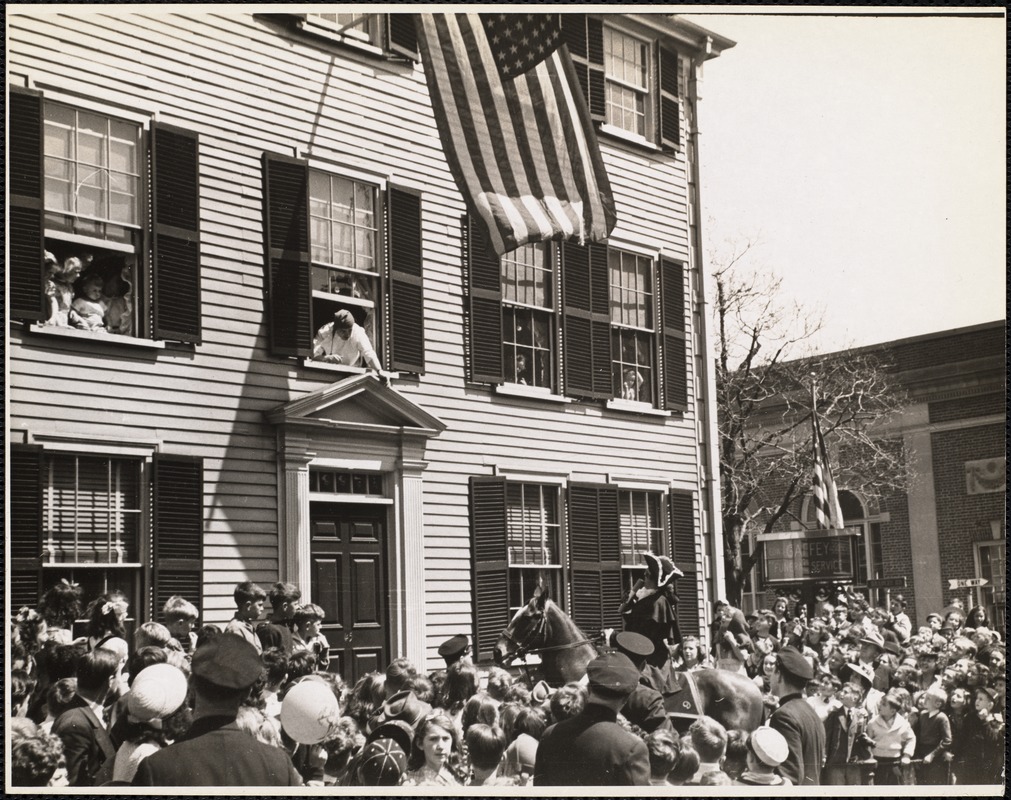
(The photograph above, which comes courtesy of Digital Commonwealth, shows the reenactment of Paul Revere’s stop at the Isaac Hall House in Medford sometime in the mid-1900s.)

Friday, May 02, 2025

“He engages in the fight which was the beginning of the end”

The printer Isaiah Thomas’s family understood him to have been very active on the first day of the Revolutionary War.

As stated in the preface to the 1874 edition of Thomas’s History of Printing in America:
He went out on the night of the 18th of April, to assist in giving notice that the troops were crossing the Charles river. He returned, but was out again by daylight. Crossing the ferry with Dr. [Joseph] Warren he went into a public meeting at Charlestown and urged the arming of the people, and was opposed by one Mr. [James?] Russell “on principles of prudence.”
Gen. Thomas Gage ordered his forces to stop anyone trying to leave Boston via the Neck or the ferry on the night of 18 April, so as to prevent the sort of “notice” Thomas supposedly spread.

Not only did the printer get out of town, this family lore said, but he then got back in. Even though one of the main points of this passage was that Thomas was on the royal authorities’ enemies list.

We know Dr. Warren did get out of Boston early on the morning of 19 April. Richard Frothingham’s 1865 biography of the doctor quoted witnesses saying he rode the ferry to Charlestown, then headed west on horseback.

We also know there was debate in Charlestown about whether to oppose the British army by force. Ultimately most of the townspeople decided to hunker down because they were too vulnerable to counterattack from the army and navy.

As to what Isaiah Thomas did in those busy hours, I’m not sure. He definitely did thrust himself into events at other times, so I’m sure he would have spread the alarm and urged opposition to the troops if he could. I’m just not sure the opportunities were available.

For a couple of paragraphs, the 1874 account slips into a breathless present tense.
As one of the minute men, he [Thomas] engages in the fight which was the beginning of the end. At night he goes to Medford. On the morning of the 20th, he makes a flying visit to his family at Watertown, and then starts on foot for Worcester.

He is constantly met on his journey by bodies of armed men on their way to Cambridge, anxious to learn even the minutest details of yesterday’s fight. After traveling on foot some miles, he meets with a friend who procures him the loan of a horse. Late at night, weary and travel worn, he arrives at Worcester to begin life anew; a good head and stout heart his only capital. . . .

The presses and types sent before him were all that were left as the fruit of five years’ toil and peril. A sum exceeding three thousand dollars (and a dollar meant something then, though soon to lose its meaning) was due him from subscribers, scattered over the continent.
The printer may well have had debts due him, but he was also being sued for debt he owed. The war, a new government, and a new town offered the possibility of a new start.

Isaiah Thomas struggled through the war years but prospered in the new republic. He settled in Worcester, publishing the Massachusetts Spy and many books from that town, and also invested in other print shops and newspapers. Ultimately his estate was solid enough that he set up the American Antiquarian Society to maintain his printing archive and tell his story his way.

TOMORROW: How another printer left Boston.

Sunday, April 27, 2025

Earl Percy’s Map of the Route to Safety

American Heritage just shared a scoop in Edwin S. Grosvenor‘s article “Discovered: First Maps of the American Revolution.”

It’s based on a return visit to the seat of the Dukes of Northumberland, a title bestowed on Earl Percy’s father and inherited by him after his return from the American war.

Grosvenor writes about one document:

On the newly found map, Percy had drawn his route from Lexington to Menotomy and back to Boston. “He's sketching the line of march,” observed local historian Michael Ruderman, studying the new Percy map. “It's the theatre of battle, the hostile territory he had to travel during the afternoon. And he's sketching the landmarks that were significant to him like the Old Powder House tower that he passed on his left."

The Percy map provides many details about the landscape, roads, taverns, and houses that existed in 1775.

Percy averted an even greater disaster by marching his 1,700 men by an unexpected route. Rather than continuing straight to Cambridge, he took a left turn to head to the Charlestown neck, where the ships of the Royal Navy could protect his force with their guns and ferry him across the Charles River, back to Boston.

For nearly 250 years, the maps lay forgotten in a box with dozens of other maps of Revolutionary war battles and encampments brought back by Gen. Percy.
The caption explains: “When rotated with north facing up, the town of Medford is in the upper left, with the home of ‘Col. [Isaac] Royal’ marked outside the town.” At the center, looking like rude high-school graffiti, is the Charlestown powderhouse.

In the lower right corner is Cambridge. Along the bottom is the road from Menotomy village into central Cambridge with several landmarks labeled: “Menotomy mill:g House,” “Adams’s Tavern,” “Brook,” “Grove of Locust Trees,” and “Tavern.”

The last stands at the crucial corner where Col. Percy turned his column onto “Kent’s Lane through which the Troops return’d from Concord” to Charlestown.”

Wednesday, March 19, 2025

“The procession of the old clergymen who filled our pulpit”

Back in January I quoted Dr. Oliver Wendell Holmes on one of the impressive clergymen who came to preach in his father’s pulpit in Cambridge while he was a boy.

Young Oliver was born in 1809 in the house that had belonged to the Harvard College steward Jonathan Hastings. In 1775 the Massachusetts committee of safety and Gen. Artemas Ward took it over as the first rebel headquarters of the war.

In The Poet at the Breakfast Table, Holmes described some ministers whose names I know because they wrote recollections about the Revolutionary period when they themselves were boys.

Holmes recalled the Rev. Thaddeus Mason Harris (1768–1842) of Dorchester this way: “already in decadence as I remember him, with head slanting forward and downward as if looking for a place to rest in after his learned labors.”

The Rev. David Osgood (1747–1822) has made only one appearance in Boston 1775, guarding his privilege to perform all marriages in his town. Holmes recalled him as “the most venerable David Osgood, the majestic minister of Medford, with massive front and shaggy over-shadowing eyebrows.”

Holmes’s longest profile limned the “attenuated but vivacious little Jonathan Homer of Newton, who was, to look upon, a kind of expurgated, reduced and Americanized copy of Voltaire, but very unlike him in wickedness or wit.”

Homer (1759–1843) was minister of the first congregation in Newton, where Homer Street preserves his name. Holmes went on:
The good-humored junior member of our family [Holmes himself?] always loved to make him happy by setting him chirruping about Miles Coverdale’s Version, and the Bishop’s Bible, and how he wrote to his friend Sir Isaac (Coffin) about something or other, and how Sir Isaac wrote back that he was very much pleased with the contents of his letter, and so on about Sir Isaac, ad libitum,—for the admiral was his old friend, and he was proud of him.
Homer and Coffin had been classmates at the South Latin School, one becoming an American clergyman and the other a British admiral. Coffin’s recollections of life in that school were invaluable to me in writing about its culture.
The kindly little old gentleman was a collector of Bibles, and made himself believe he thought he should publish a learned Commentary some day or other; but his friends looked for it only in the Greek Calends,—say on the 31st of April, when that should come round, if you would modernize the phrase.
In other words, that magnum opus’s day of publication would never arrive.

Sunday, October 27, 2024

“The Siege of Boston” Tour for Social-Studies Educators, 21 Nov.

The National Council for Social Studies, the largest professional association devoted to social studies education, will meet in Boston on 19–24 November. Over 3,000 classroom teachers and other educators from around the country are expected to come.

Attendees arriving before Thursday, 21 November, have a choice of two all-day tours, among other offerings. One is a trip to Portsmouth, New Hampshire. The other, which I’m involved in, is an exploration of “The Siege of Boston” in preparation for the Sestercentennial of that campaign.

This tour has been organized by Dr. Gorman Lee through Revolution 250, and he describes it this way:
The Siege of Boston refers to a significant period in colonial history when militias from the American colonies surrounded the British-occupied city of Boston. Teachers will visit five historical sites to explore how the Siege unfolded through the lenses of enslaved and free African Americans, Loyalists, women, and rank-and-file rebels.
The five significant historic sites are:
  • The Royall House & Slave Quarters in Medford, used by Gen. Charles Lee and Col. John Stark during the siege.
  • The Bunker Hill Monument in Charlestown, site of the biggest, bloodiest, and ultimately decisive battle of the siege.
  • Longfellow House–Washington’s Headquarters National Historic Site and nearby Cambridge common, from which Gen. George Washington and the Massachusetts committee of safety directed the siege.
  • The Shirley-Eustis House in Roxbury, a former governor’s mansion used as a hospital.
  • The Dillaway-Thomas House in Roxbury, from which Gen. John Thomas spearheaded the final move onto Dorchester Heights.
Prof. Robert J. Allison of Suffolk University will be the expert guide on the first leg of the tour. I’ll hop on in Cambridge, and gents from the Massachusetts Society of the Cincinnati will be awaiting us in Roxbury. Of course, the docents and curators at each site will share their knowledge.

That’s a packed itinerary, and I expect we’ll adjust the times spent at each site on the day based on time spent in traffic. I’ll try to bring along a store of stories to fill those moments.

This tour has a fee of $50 above the conference registration cost. Conference attendees can sign up for it through this webpage. (At least I think so. I can’t figure out the registration pages myself, but I expect educators have experience navigating that sort of complex bureaucratic system.) 

Sunday, September 15, 2024

Where Was the Charlestown Powderhouse?


Before departing from the “Powder Alarm” entirely, I’ll draw on guest blogger Charles Bahne to address a pertinent question: Where was the powderhouse?

That may seem like a silly question since it’s a stone building that has stood atop the same hill since it was built shortly after 1700.

But some of our sources from 1774 refer to that location in different ways:
  • William Brattle: “This morning the Select Men of Medford, came and received their Town Stock of Powder, which was in the Arsenal on Quarry-Hill.”
  • Boston Gazette: “the powder house on quarry hill in Charleston bounds”
  • Rev. Dr. Samuel Cooper: “You have heard of the taking ye. Windmill, at Cambridg with the Province Powder.”
  • Rev. Ebenezer Parkman: “The Contents Magazine of Powder at Winter Hill had been carryed off.”
  • John Adams: “the Provincial Powder from the Magazine at Cambridge”
Charles Bahne wrote in an email:
Legally, the powder house was in Charlestown. But it was closer (both crow-flies distance, and actual roads) to the populated centers of either Medford or Cambridge, or even Menotomy, than it was to Charlestown.
  • Powder House Sq. to Medford Sq. = 1.23 miles airline, 1.47 miles by road, according to Google Maps
  • Powder House Sq. to Harvard Sq. = 1.90 miles airline, 2.14 miles by road
  • Powder House Sq. to Menotomy [Arlington Center] = 2.13 miles airline, 2.17 miles by road
  • Powder House Sq. to Charlestown Neck [Sullivan Sq.] = 2.47 miles airline, 2.49 miles by road
Once you got "beyond the Neck", Charlestown got long and skinny. And hardly anyone lived there. . . . While the powder house itself was in the town of Charlestown, the property just across the street was in Medford. The town/city boundaries in that area were adjusted at some point in the 1800s.

I suspect that one reason for choosing that site for a powder house—besides the fact that the old windmill was available—was that the area was unpopulated. If by chance it blew up, there was no one nearby to be killed or injured, no other property that might be destroyed.

But it was conveniently at a crossroads. Broadway was a straight line road between Charlestown Neck and Menotomy, although I suspect that it was a lightly used, poorly maintained thoroughfare, and not a highway. . . . The other crossroad was more important, the road from Medford to Cambridge, present day Harvard St., Warner St., and College Ave.
The picture above is a detail from an 1833 map, before the western arm of Charlestown became Somerville. The arrow points to the powderhouse. The circles show the population centers of Medford, Cambridge, and (at the lower right) Charlestown.

Proximity helps to explain why the man who “for a Number of Years had the Care of [the gunpowder] as to sunning and turning it,” William Gamage, lived in Cambridge. Proximity might explain why the Medford selectmen were the last to remove their town’s powder from the tower in August 1774; it was, after all, quite convenient where it was.

As for Winter Hill, that was fairly nearby and large. But the powderhouse stood atop its own drumlin, called Quarry Hill for decades because locals had taken stone from it, including the stone used to build the tower itself. That spot is now known as Powder House Hill.

Saturday, August 31, 2024

“Mr. Brattle presents his Duty to Governor Gage.”

In August 1774, Gen. Thomas Gage asked William Brattle, general overseeing the Middlesex County militia, for an inventory of the gunpowder in the Charlestown powderhouse.

I’ve quoted Brattle’s reply before, but that was an astonishing seventeen years ago, so I’m running that text again, as it appeared in the 5 September Boston Gazette. Apologies to anyone who remembers it exactly from before.

On 27 August, Brattle wrote:
Mr. Brattle presents his Duty to Governor Gage. He apprehends it his Duty to acquaint his Excellency from Time to Time with every Thing he hears and knows to be true and is of Importance in these troublesome Times, which is the Apology Mr. Brattle makes for troubling the General with this Letter.

Capt. [Jonas] Minot of Concord, a very worthy Man, this Minute informed Mr. Brattle that there had been repeatedly made pressing Applications to him to warn his Company to meet at one Minute’s Warning, equipt with Arms and Ammunition, according to law, he had constantly denied them, adding, if he did not gratify them he should be constrained to quit his Farms and Town;

Mr. Brattle told him he had better do that than lose his Life and be hanged for a Rebel, he observed that many Captains had done it, though not in the Regiment to which he belonged, which was and is under Col. Elisha Jones, but in a neighbouring Regiment.

Mr. Brattle begs Leave humbly to quere, Whether it would not be best that there should not be one Commission Officer of the Militia in the Province.

This morning the Select Men of Medford, came and received their Town Stock of Powder, which was in the Arsenal on Quarry-Hill, so that there is now therein, the King’s Powder only, which shall remain there as a sacred Depositum till ordered out by the Capt. General.

To his Excellency General Gage, &c. &c. &c.
This time around, I’m struck by the phrase “warn his company to meet at one minute’s warning, equipt with arms and ammunition.” This was weeks before the Worcester County Convention issued a call for towns to prepare a third of their militia members ”to be ready to act at a minute’s warning.” When the Massachusetts Provincial Congress endorsed that call in October, it left out the reference to a minute. Nonetheless, the popular term for those units became “minute companies” and “minute men.”

This 27 August letter shows that the proposal to have fighting men ready in a minute was already in the air before it became a formal proposal and before it reached print.

Indeed, because Brattle’s letter was transcribed into a lot of newspapers that September, it might well have played a role in popularizing the “minute’s warning” metric. And of course, that letter set off the chain of events that produced the “Powder Alarm.”

For more about that “Powder Alarm” and its Sestercentennial significance, you can listen to my conversation with Tiziana Dearing on WBUR’s Radio Boston show. And come out to the commemorations this Sunday, Monday, and Wednesday.

Wednesday, January 24, 2024

“Breathe their Last within the walls of his Detestable General Hospital”

As I quoted yesterday, in September 1775 commanders of the northern wing of the Continental Army besieging Boston were upset with how Surgeon-General Benjamin Church was ordering sick and wounded men moved to his hospitals in Cambridge.

Gen. John Sullivan and Dr. Hall Jackson complained that there were sick people at those hospitals! Meaning men would be more likely to catch infections there than anywhere else.

In addition, the doctors looked down on New Hampshire men as country bumpkins, and Dr. Church and his assistant surgeons weren’t as skilled as Jackson himself.

Well, Jackson didn’t come right out and say that last part (Sullivan did), but on 16 September he lambasted the central army hospitals this way:
Not an Officer or Soldier [from New Hampshire] will go to the Cambridge Hospital, they had much rather provide for themselves at Mistick at any expense, or even die in Camp with their friends than be forced into a General Hospital cram’d with the sick of 25,000 Troops; and attended by strangers from polite Places, who have never been used to the inquisitiveness and impatience of poor Country People, and are in general to apt to conster their simplicity into impertinence: it is the mind of General Sullivan, and all the Officers from New Hampshire, that unless some alteration is made, another Regiment will never be raised in that Colony.

Capt. [Henry] Dearbourn, with many others, are gone to Canada, for no other reason than to avoid the Sickness of our Camp, and dread of the general Hospital.

The arts, contrivance, and hypocricy, of some of the M—u—setts Patriots is dam—a—ble to the last degree. “A Struggle for Liberty”!—good God! my Soul abhors the Idea! If methodically to kill the wounded; to starve the sick, and languishing because they cannot Diet on Salt Pork, or will not submit to be severed from their dearest friends and relations, if these (my Dear Friend) are the Characteristicks of an Army raised for the defence of Liberty, I frankly confess I have no claim to an employment in the glorious Cause.
When Jackson wrote those words, however, the army had already formally looked into the dispute. On 7 September, Gen. George Washington laid set out a formal process in his general orders:
Repeated Complaints being made by the Regimental Surgeons, that they are not allowed proper Necessaries for the Use of the sick before they become fit Objects for the General Hospital: And the Director General of the hospital complains, that contrary to the Rule of every established army, these Regimental Hospitals are more expensive than can be conceived; which plainly indicates that there is either an unpardonable Abuse on one side, or an inexcusable neglect on the other—

And Whereas the General is exceedingly desirous of having the utmost care taken of the sick (wherever placed and in every stage of their disorder) but at the same time is determin’d, not to suffer any impositions on the public;

he requires and orders, that the Brigadiers General with the commanding Officers of each Regiment in his brigade; do set as a Court of enquiry into the Causes of these Complaints, and that they summon the Director General of the hospital, and their several Regimental Surgeons before them, and have the whole matter fully investigated and reported—This enquiry to begin on the left of the Line to morrow, at the hour of ten in Genl Sullivan’s brigade.
That inquiry ended a week later with Church being cleared of all charges. Jackson’s letter was thus carrying on an argument he had already officially lost.

There must have been similar disputes in other parts of the army because Washington ordered the same sort of inquiry in Gen. William Heath’s brigade in the central part of the lines, then in the brigades on the south wing. The commander-in-chief evidently felt that this process would force everyone to an agreement.

The second inquiry likewise ended in praise for Church. But by then the surgeon-general had left the front, pleading illness. Church even sent in his resignation from Taunton. Adjutant-General Horatio Gates wrote the doctor a flattering letter urging him to come back.

Then suddenly the conflict was resolved by an outside factor: The baker Godfrey Wenwood came to Washington’s headquarters from Newport with a ciphered letter that his ex-wife had asked him to send into Boston. Under questioning, that woman, née Mary Butler, admitted she had handled the letter for her lover—Dr. Church!

The 30 September inquiry in Gen. Joseph Spencer’s brigade was called off “on account of the Indisposition of Dr Church.” That phrase in Washington’s general orders was cover for the fact that Church was under arrest in one of his hospital buildings (shown above) for secretly corresponding with the British military.

On 4 October, Sullivan wrote in triumph:
You will by this Post Receive Intelligence from head-Quarters of Dr. Church’es having been detected in holding a Treasonable Correspondence with the Enemy—his Behaviour Towards our Sick & wounded long since Convinced me that he either was void of humanity and Judgment, or that he was Determined by untimely Removals & Neglect of Duty to Let all those under his care breathe their Last within the walls of his Detestable General Hospital.
On 17 October, Dr. Hall Jackson returned to Portsmouth. Since June, he had been working with no rank or salary. The next month, New Hampshire’s provincial government recognized his service with a commission as chief surgeon for the colony’s troops and back pay.

COMING UP: Back to Capt. Sylvanus Lowell, wounded in 1773. But first, a Sestercentennial event.

Tuesday, January 23, 2024

“Jackson was obliged to take the knife”

Yesterday I left Pvt. William Simpson of Pennsylvania grievously wounded in the leg by a British cannon ball in late August 1775, and two of the top doctors in the American lines arguing over his care.

Dr. Hall Jackson of New Hampshire was treating the troops north of Boston in Medford/Mistick without official commission or pay.

Dr. Benjamin Church, Jr., was overseeing the Continental Army’s medical wing, centered on hospitals in Cambridge.

Both doctors actually agreed that Simpson’s only hope was to have his wounded leg amputated. But Dr. Church insisted that first the man must be moved from Dr. Jackson’s hospital to the army hospital. And as Surgeon-General, Church outranked every other military surgeon.

Here’s Gen. John Sullivan’s story of what Church did next:
he went home himself—Eat his Dinner—Drank his Glass—then went to meet the wounded voluntier who, by the Loss of Blood, The Tearing and Lacerating his flesh by the Fractured Bone had become happy by growing Insensible of his pain—

Jackson had fortold this, but Church Determining to Kill the man Secundem Artem, called his Subs around him assigns each one his post, and then requests Jackson to take off the Limb—

he Refused, Informing them that the only reason was that the Man’s life could not be saved by amputating the Limb or by any other methods, & agreeable to his predictions the Man Died on the Second day.
And that wasn’t the only amputation case Sullivan said that Church’s administration had botched. He also wrote:
a man in my Brigade…was wounded in the Leg—Dr. Jackson was by—said his Leg must be taken off, but he did not dare to do it till Church was sent for—

he sent down two of his Subs, who Complimented Jackson with the Liberty of using the Saw—one of them was to cut the flesh—the other to take up the Arteries. The first failed, leaving some of the muscles untouched, & the other would not if left to himself have taken up the Arteries till the man had Bled to Death—

Jackson was obliged to take the knife from one & the needle from the other—performed the operation—Drest the man & tended him three Days—every symptom was favourable & Doubtless the man would have soon Recovered, but on the Fourth day Doctor Church sent for him & ordered him to the Hospital.

Jackson told them that the fourth being the Day on which the Inflammation was at the highest he would assuredly die if removed—he was not regarded—the man was removed & died accordingly.
Sullivan wrote those stories in early October, after Church had fallen under a shadow. The general was a bit of a hothead and a strong partisan for Dr. Jackson, so he might have slanted the stories against Church.

Back in early September, shortly after Pvt. Simpson’s death, Gen. George Washington had actually ordered inquiries to settle the disagreement about regimental hospitals versus Dr. Church’s centralized army hospitals.

TOMORROW: The results of those inquiries.

Monday, January 22, 2024

“They were hurried Volens Nolens to a general Hospital at Cambridge”

On 27 July 1775, the Continental Congress created a hospital department for its army outside Boston.

It also appointed Dr. Benjamin Church, Jr., to be Director-General of that department—though he was often called the army’s Surgeon-General.

Church had impressed Congress delegates with his years of work in the Boston Patriot leadership, his genteel bearing during a visit to Philadelphia, and his renowned surgical skills.

Receiving the news in August, Church quickly began to develop hospitals in Cambridge and Roxbury. He started to insist that regimental surgeons send their worst sick and wounded to those hospitals instead of maintaining smaller hospitals near their stations.

That policy soon became a bone of contention between Church and Dr. Hall Jackson, who until then had been working as respectful colleagues.

On 5 September, Jackson wrote to New Hampshire politician John Langdon:

I had established a Hospital for General [John] Sullivan’s Brigade had near a hundred Patients for more than a month, under as good regulations as could be desired, provided with every necessity that prudence and economy would dictate. When all of a sudden they were hurried Volens Nolens [willingly or not] to a general Hospital at Cambridge without a single compliment paid either to them, or their former attendants.
Jackson was ready to return home to Portsmouth—he was a volunteer, after all, with no commission or salary. He stated:
General [Charles] Lee, General Sullivan with all the Officers and Surgeons of his Brigade, will not suffer me to hint an intention to leave them; as not a Surgeon in the whole Brigade has ever had the small Pox, or ever performed a Capital Operation. Some Officers in the Army have offered me a substitution equal to anything I would expect, but this I should dipise, their pay being little enough to support their own Commissions with Honour and decency. Gratitude to them, obliges me to continue with them, until the pleasure of the Continental Congress is known…
On 4 September, Sullivan himself had told Langdon:
I know Doctor Church complains of those Regimental Hospitals as having been very expensive, which the Regimental Surgeons Deny, & say he cannot prove the assertion. How that is I cannot say, but am very certain that good Brigade Surgeons may assist in preventing extraordinary expense as well as Doctor Church or any other person, & give great satisfaction to both Officers & Soldiers in the Army.
That conflict had grown worse after the Continental move onto Ploughed Hill on 26 August. William Simpson, a Pennsylvania rifleman, “had his Foot and Ankle shot off by a Cannon Ball as he lay behind a large Apple Tree, watching an Opportunity to Fire at the Enemy’s Advanced Guards.”

It looks like nobody expected Pvt. Simpson to live, but all agreed that his only hope was an amputation. And, as we’ve seen, Hall Jackson considered himself an expert on amputations.

According to Sullivan, “Doctor Jackson…was there, & had every thing prepared to take off the Limb—Doctor Church happened to come in—forbid him to proceed & ordered the man to be sent to the Hospital.”

TOMORROW: How the operation turned out.

Monday, October 23, 2023

Local Archeology for Local Historians in Charlestown and Medford

On Thursday, October 26, folks have a choice between two events on local archeology north of the Charles.

At 6:00 P.M., the City of Boston Archaeology Program, Boston’s Commemoration Commission, and the National Park Service will hold a “public listening event” at the Bunker Hill Museum, asking what people want to know about that battlefield and the destruction of Charlestown.

Co-sponsored by the Charlestown Historical Society and Charlestown Preservation Society, this session will feature Joe Bagley and the City Archaeology Program team, Genesis Pimentel of the Commemoration Commission, and Meg Watters Wilkes of the National Park Service. They will discuss previous archeological work around the battle and how new technology and methods might reveal more.

Folks can help the presenters prepare, or participate in the ongoing discussion, by filling out this form asking about interests in the battle.

At 7:00 P.M. the Medford Historical Commission will host “History Beneath Our Feet: The Archaeology of Thomas Brooks Park” at the Medford Public Library.

This event description says:
Located in West Medford, the wooded and grassy parcel is an important reminder of Native Americans, northern slavery and the Brooks family. The Public Archaeology Laboratory, Inc. and the Commission will share artifacts which were excavated by volunteers from the recent archaeological dig and talk about how these tiny fragments provide greater insight into the people who inhabited the landscape.
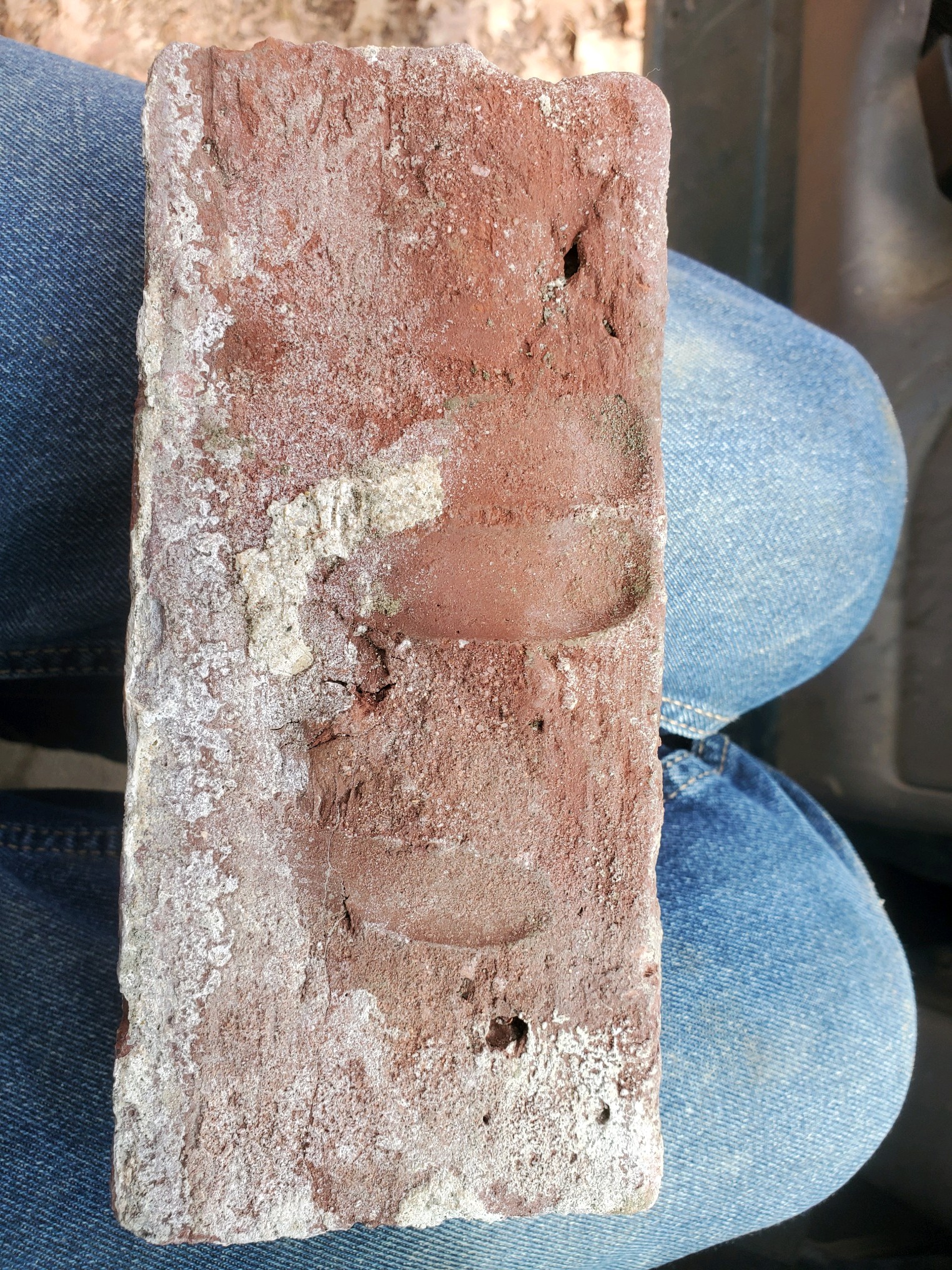
Thomas Brooks owned that land in the mid-1700s, and he also owned a man named Pomp, who around 1765 built a decorative brick wall that’s preserved in the park. The area was recently restored, as described on the historical commission’s website, and part of that work was the new study.

(The photo above, courtesy of the Medford Historical Commission, shows one of the bricks from Pomp’s wall, preserving the impressions of the fingers of the person who made it.)

Saturday, September 16, 2023

“A Sett of Controversial Discourses agreed upon by the Society”

In October 1722, almost a year after being inoculated against smallpox, Ebenezer Turell found a new use for his notebook.

He wrote out what he called “An account of a Society in Har: Colledge.” This was a more serious endeavor than the Telltale essay exchange the previous year.

Ten young men from the Harvard College class of 1721 plus four from nearby classes pledged to meet regularly for intellectual pursuits. One might share “a Discourse of about Twenty minuits,” or the group could engage in philosophical disputations, readings, and epistles.

They also promised “That if we see or hear of any Extraordinary Book, we will give ye best account we can of it to ye Society.”

As an example of what this society (formally) talked about, Turell’s two lectures were:
1 Upon Light, a Phisico-Theological Discourse
2 Upon Providence.
The group was still meeting in October 1723 when Turell took the lead in a new format, combining the discourse and the disputation into a single discussion:
E T read a Lecture to show that it is a point of Prudence To prove & Try all Doctrines in Religion, wch was to serve as an Introduction to a Sett of Controversial Discourses agreed upon by the Society to be successivly carried, one every week.
The last record is from January 1724 when the group agreed on topics for upcoming lectures and discussions. There’s no record of those meetings, however. It’s possible Turell switched to another notebook since he was coming close to the pages he’d already filled with the Telltale material, and that second document didn’t survive. It’s also possible this extracurricular activity just petered out in the winter of 1724 as members moved on.

In 1909 William C. Lane pointed out to the Colonial Society that nearly all the young men in that society went on to be ministers. Those included the Rev. Dr. Charles Chauncy and the Rev. Ebenezer Pemberton of Boston and the Rev. John Lowell (shown above) of Newburyport, ancestor of the celebrated Lowell family.

Ebenezer Turell himself started to train for the pulpit under the Rev. Benjamin Colman of the Brattle Street Meeting in Boston. He became the minister in Medford in 1724, and Colman’s son-in-law two years later. Jane (Colman) Turell shared Ebenezer’s love of writing, though she had a religiously anxious life until she died in 1735.

Turell remarried twice, each time to women in the upper class. As a minister he was a firm Old Light and later a supporter of the Whigs. The Medford congregation granted him a pension in 1773, the year before he preached his last sermon, and he died in 1778. In all, the current church says, Turell oversaw the construction of two church buildings, admitted 323 communicants, baptized 1,037 people, and married 220 couples.

Thursday, February 16, 2023

“Except these boats all in a hurry”

Continental surgeon general Benjamin Church’s secret letter to Maj. Edward Cane of the British army contained three warnings about attacks on the British forces by water.

Early on in that 24 Sept 1775 missive, Dr. Church wrote:
The distroying the Ships in the manner I wrote you before they began to dispair of tho’ the former of the Machine is full of faith that he can do it, Works on hardly and so let him, I say.
This is probably the same “mashine” that engineer Jeduthan Baldwin wrote about in December:
went in the afternoon to Dotchester point to See the mashine to blow up Shiping, but as it was not finished, it was not put into the water.
Church’s letter suggests that the man forming that machine was at work months earlier, in September.

But what was the machine? David Bushnell’s submarine is one possibility. We know he was at work on that invention by August 1775, and that in October people in the American camp were hoping to see it soon. But the dates don’t quite match up; Bushnell was still toiling in the Connecticut River on 7 December, so what did Baldwin see kept out of the water one week later? The machine at Dorchester Point might never have been finished while Bushnell’s Turtle actually went into battle in September 1776.

Church alerted his Crown contacts to other water-borne threats:
This day a floating battery hid herself under Mr Tempels Wharf, from Mistick bridge.

One hundred 50 flat bottom boats are ordered to be Compleated within 30 days they are building them as fast as they can at Water town and Cambrige I see them every day, this you may depend on. And I am not a little Surprised to find them so Engaged in making these boats, for I know the people in general think it impossible ever to go into Boston, you in it. ————. . . .

Our Assembly has been sitting 3 days they have been debating by what means they can keep the Coast Clear of tenders, but have not yet Concluded.

No News from the Congress some days things look as if our General intended to do something soon, than again I am strongly persuaded that nothing will be done, in fact war you out you could not satisfy yourself there is nothing that looks like matters Except these boats all in a hurry.
“Mr. Tempels Wharf” meant the wharf on the Mystic River that led to Robert Temple’s farm in Medford, shown above in a detail from Henry Pelham’s map of the siege.

In October, a couple of weeks after Dr. Church wrote, the Continental troops did try to attack the British in Boston with floating batteries. It didn’t go well, as these posts describe.

Gen. George Washington was indeed eager for an amphibious assault on Boston, but his council of war kept voting down his plans. Even the move onto Dorchester Heights included a contingency attack across the Charles River if the British tried to counterattack. But in the end all those flat-bottomed boats were never used in battle.

TOMORRROW: The flag-raising. 

Friday, June 12, 2020

“The grand source of most of the Evils we groan under”

The same 14 Dec 1747 issue of the Boston Post-Boy that leaked Gov. William Shirley’s letters about riots the previous month also reported on how the Town House in Boston had burned down.

As good descendants of Puritans, the people of Massachusetts couldn’t help but worry that fire might be a sign of divine displeasure at how some of them had been behaving.

On 28 December, a day before issuing a new message to mollify the Boston town meeting, Gov. Shirley issued a proclamation for a public fast in one month. He noted:
the continued and growing Calamities of the War; and the many Difficulties and Embarrassments which attend our Publick Affairs, and in the signal Frown of Divine Providence in the Destruction of the Court-House by Fire, and therein of a great Part of the publick Records of the Province, and other useful and valuable Writings.
On the designated fast day, 28 Jan 1748, ministers in every Massachusetts town preached on how the people should improve themselves.

In Cambridge, the Rev. Nathaniel Appleton (1693-1784, shown above) spoke on The Cry of Oppression where Judgment is Looked for, and the Sore Calamities Such a People May Expect from a Righteous God. In Charlestown, the Rev. Thomas Prentice preached The Vanity of Zeal for Fasts without True Judgment, Mercy and Compassions. In Medford, the Rev. Ebenezer Turell published a Brief and Plain Exhortation to His People on the Late Fast, a condensed version of his sermon.

All three of those clergymen pointed to the same problem. Was it rioting? Spending too much on luxury goods? New Light enthusiasm? Old Light recalcitrance? No, it was that burdensome sin—allowing the value of paper money to depreciate!

“For one and all agree,” Appleton declared from his pulpit, “that the Sinking of the Value of these Bills below what is expressed in the Face of them, is the Cause of the present Complaints and Cries that are heard in the Land.”

“We find GOD complaining most grievously, of his people Israel, Amos viii.5. for their not dealing with just Measures and Weights according to the fixed Standard,” Prentice preached; “…and such like Instability, either in the Measure of Commodities, or in the Weight and Value of Money, is a most dreadful Injustice.”

Turell explained that “the grand source of most of the Evils we groan under at this Day” was “our Medium of Exchange, unstable as Water, and variable as the Wind. . . . We trade and traffick, buy and sell by this Measure, and so we daily oppress one another.”

This was a long-standing challenge to the Massachusetts economy. Without enough specie (gold and silver coinage) to keep commerce going, the province issued notes on paper. Those notes never traded at quite their nominal value, and as time went on the bills came to be worth less and less.

That was a problem for people who had fixed incomes—particularly ministers who had negotiated set salaries with their congregations when they assumed their pulpits.

In his speech to the Massachusetts General Court on 3 February, Gov. Shirley devoted a whole paragraph to both “the extraordinary Emissions of Paper Money, whereby the Value thereof for all Occasions of Life is sunk so low and is still sinking,” and “the Difficulties, which many of the Ministers of the Gospel within this Province are brought under, thro’ the great Depreciation of the Bills of Credit.”

Thus, the question of rebuilding the Town House in Boston or building a new legislative meeting hall somewhere else was also a question of adding to the public debt just when that was becoming a real problem for influential people in the colony.

TOMORROW: Back to the Massachusetts house’s discussion.

Wednesday, March 11, 2020

David Lamson, a Middle-Aged Man of Menotomy

David Lamson was among the men from Cambridge who served in the French and Indian War, according to provincial muster rolls examined by local historian Lucius R. Paige.

Lamson himself had some Native ancestry and probably some African since he was later described as “mulatto” and “half Indian.” He may have been only in his teens when he enlisted.

The man next appears recognizably in government records in March 1767, when he “came from Medford to live at Peter Tufts, jr.’s.” in Charlestown. The town warned Lamson out the next year, disclaiming responsibility if he became ill or needed public assistance, but then taxed him in 1770.

Another Charlestown document puts Lamson in Reading in 1769 before returning, listed as an Indian and described as a “young man” still. His mobility indicates he had no land of his own and moved around the county seeking work.

Within the next few years, Lamson returned to Cambridge, in the western village known as Menotomy. There he had a positive reputation as “a man of undoubted bravery and determination,” respect gained at least in part from his military service.

As a man of color, Lamson was exempt from militia training, despite being only a few years removed from the “young man” label. However, he was on the area’s “alarm list” along with older men and others who didn’t have to train but were still expected to turn out with their guns in an emergency.

And on 19 Apr 1775, Menotomy faced an emergency. Hours before dawn, a column of British soldiers moved through the village on its way to Concord. Around noon, another column of about the same size marched through: Col. Percy’s reinforcements. In between those two sets of redcoats, the local militia company mustered and headed west to confront the king’s troops—from a strategic distance, of course.

That left the “alarm list” or “exempts” in the town. Sometime in the afternoon, word came of a couple of British army supply wagons rolling west. These wagons had been held up, possibly at the bridge across the Charles River. Hastening to meet Lt. Col. Francis Smith’s troops on their way back from Concord, Col. Percy had left those wagons to travel under the protection of several soldiers.

According to nineteenth-century chronicler Samuel Abbot Smith, the Menotomy exempts “met at once in [Benjamin] Cooper’s tavern…to form some plan of capturing” the wagons. “They chose for their leader David Lamson, a mulatto.” Putting a man of color in a leadership role was unusual for this society, but Lamson’s neighbors respected his military experience, his bravery, and most likely his relative youth.

George Quintal, Jr., located a May 1775 document listing “David Lampson” among the men present at that confrontation. Richard Frothingham’s 1849 History of the Siege of Boston stated that Lamson, “a half Indian, distinguished himself in the affair.” Those sources help to confirm Smith’s local lore, published in the 1860s.

Lamson’s group ambushed one British wagon near what would become the corner of Massachusetts Avenue and Medford Street. A company from Chelsea, led by the Rev. Phillips Payson, attacked another wagon. The militiamen killed two of the redcoats in the escort, wounded others, and downed some of the horses. Some of the regulars fled, dropping their weapons and reportedly seeking protection from “an old woman” they found “digging dandelions,” possibly Ruth Batherick.

Menotomy later became the town of Arlington, and it memorializes this short skirmish with a monument crediting the “Old Men of Menotomy.” But their leader was a middle-aged man, exempt from militia training not because of his age but because of his skin color.

I’ll say more about David Lamson and about other Continental soldiers of Native American descent at tomorrow’s Evacuation Day lecture at Longfellow House–Washington’s Headquarters in Cambridge.

Wednesday, November 20, 2019

The Legends of Sarah Bradlee Fulton

Helping her husband and brothers prepare for the Boston Tea Party wasn’t the only patriotic activity that descendants credited Sarah Bradlee Fulton with doing.

In addition, her grandson John A. Fulton, her brother’s great-grandson Samuel Bradlee Doggett, and local hsitorians told these stories about her:
  • She “heard the alarm of Paul Revere” from her house in Medford “on the east side of Main street about one hundred and fifty feet south of the bridge, on the south side of what is now [1897] Tufts place.”
  • The Fultons’ house then “became the headquarters of General [John] Stark’s New Hampshire regiment.”
  • After the Battle of Bunker Hill, “At sunset the wounded were brought into town, and the large open space by Wade’s Tavern between the bridge and South street was turned into a field hospital. Surgeons were few, but the women did their best as nurses. Among them, the steady nerves of Sarah Fulton made her a leader. One poor fellow had a bullet in his cheek, and she removed it; she almost forgot the circumstance until, years after, he came to thank her for her service.”
  • “During the siege of Boston detachments of British soldiers often came across the river under protection of their ships, searching for fuel in Medford.” These redcoats seized a wagon load of wood from her husband John Fulton, and Sarah “flung on a shawl and went in pursuit. Overtaking the party, she took the oxen by the horns and turned them round. The men threatened to shoot her, but she shouted defiantly as she started her team, ‘Shoot away!’ Astonishment, admiration, and amusement were too much for the regulars, and they unconditionally surrendered.”
  • Gen. George Washington gave Maj. John Brooks, later a Massachusetts governor, dispatches to deliver “inside the enemy’s lines.” Because John Fulton was too sick to do that, Sarah walked alone “to the water-side in Charlestown” and “rowed across the river,” returning home at dawn.
  • Washington visited the Fultons in thanks for this mission, and they served him punch from a “new punch-bowl” with a “little silver-mounted ladle.” Descendants saved the bowl, ladle, and chair Washington sat in.
  • The Marquis de Lafayette visited the Fultons decades later.
As with the lore about the Tea Party, no one has offered contemporaneous or documentary evidence to support any of these stories.

To be sure, we wouldn’t expect formal documentation on some of these events, but the historical record offers reasons for doubt. For example, what records survive put Col. Stark at the Admiral Vernon tavern and the Isaac Royall House in Medford. The idea that squads of British soldiers were landing in that town, full of Continental troops, to seize wagonloads of wood is outlandish even before we get to Fulton cowing an armed squad into giving up.

Nonetheless, the legend of Sarah Bradlee Fulton had a lot of appeal in the late nineteenth century. This was the period of Colonial Revival, when dramatic and sentimental stories of the Revolution were popular. It was also a time of growing activism by women, whether or not tied to suffrage. A story about a woman taking an active role in the resistance to the Crown, while remaining within the feminine sphere, served a cultural need.

The Daughters of the American Revolution was founded in 1890. A few years later, women in Medford formed a chapter they named after Sarah Bradlee Fulton. All the quotations above come from the speech of Helen Tilden Wild at that chapter’s formal inauguration in January 1897, as published in the D.A.R.’s American Monthly Magazine.

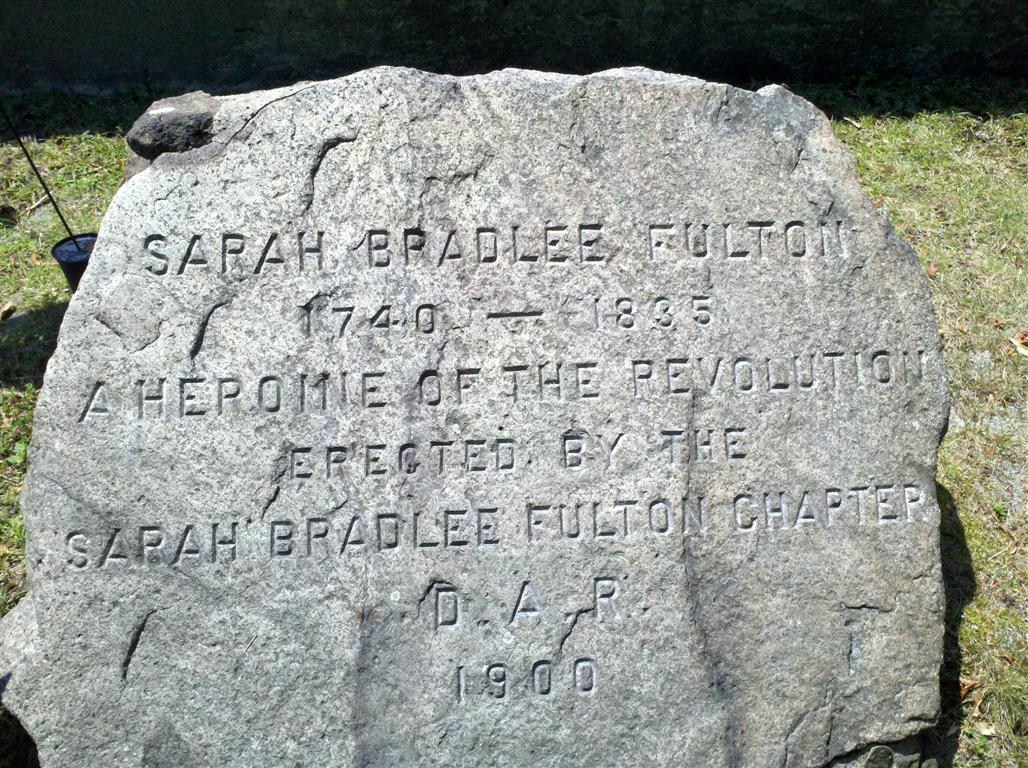
That ensured that Fulton had a constituency to keep her legend alive. In 1900 the Medford D.A.R. chapter graced the town cemetery with the stone marker shown above, calling Fulton “A Heroine of the Revolution.” She was also dubbed “Mother of the Boston Tea Party.” In 1919 the Bloomington, Indiana, D.A.R. chapter produced a three-act play about Sarah Bradlee Fulton to benefit wounded soldiers and sailors.

Monuments to Sarah Bradlee Fulton remain today. In addition to that stone marker, Fulton Street in Medford is named for her. Since 2006, the punchbowl she supposedly used when Washington visited has been in the collection at Mount Vernon. Fulton has her own Wikipedia page, and many other webpages hold her up as an exemplary female Patriot.

And it’s all based on family lore published a century or more after the events.

TOMORROW: Assessing the Bradlees.

Tuesday, November 19, 2019

“A family mansion with a history of the stirring times”

Yesterday I quoted a letter that appeared in the Boston Evening Traveler on the day after the centenary of the Boston Tea Party. It described how a young woman named Sarah Bradlee helped prepare her four brothers and future husband to disguise themselves as they destroyed the tea and to conceal themselves afterward.

That letter offered no evidence for its story beyond the belief of a descendant, and there were discrepancies between its details and the historical record. Nonetheless, a young Bostonian named Samuel Bradlee Doggett picked up on the tale. He spent decades repeating, and perhaps improving, the account.

In his 1894 book A History of the Doggett-Daggett Family, Doggett described himself this way:
Born [29 May 1858] and always living in a family mansion with a history of the stirring times of the Revolution, and associated in early life with those who could tell of those times, he developed an interest in ancestry, which resulted first in a short account of the Bradlee family, printed in 1878, and since that time in the accumulation of material for the present work.
The house Doggett referred to appears above in a photograph from the Digital Commonwealth collection. Nathaniel Bradlee built that home about 1770, and it stood on the corner of Hollis and what became Tremont Street until 1898.

The Traveler letter said Sarah Bradlee was active “at her father’s house,” which would have been difficult since he’d lived in Dorchester and died five years before. Doggett fixed that by stating that Bradlee had disguised the men in her brother’s house—the very house he lived in.

As a genealogist Doggett also corrected the timing of Sarah Bradlee’s marriage. She and her husband, John Fulton, married more than a decade before the Tea Party rather than afterward. In Doggett’s telling, the fact that she lived in Medford and had small children didn’t stop her from going to her brother-in-law’s house in Boston to help on the night of the Tea Party.

Doggett first printed his version of the lore as a single sentence in his History of the Bradley Family (1878), quoting from the Traveler letter (while leaving out the awkward incongruous bits). A few years later he communicated with Francis S. Drake, who retold the story in Tea Leaves (1884), incorporating detail that first appeared in the Traveler letter.

According to Drake, all four Bradlee brothers “lived in the house yet standing, on the southerly corner of Hollis and Tremont Streets.” (Nathaniel did, and Josiah, aged nineteen, might have. David and Thomas were married with families and homes of their own.) The Tea Leaves version:
Their sister, Sarah, assisted her husband, John Fulton, and her brothers, to disguise themselves, having made preparations for the emergency a day or two beforehand, and afterwards followed them to the wharf, and saw the tea thrown into the dock. Soon returning, she had hot water in readiness for them when they arrived, and assisted in removing the paint from their faces. As the story goes, before they could change their clothes, a British officer looked in to see if the young men were at home, having a suspicion that they were in the tea business. He found them in bed, and to all appearance asleep, they having slipped into bed without removing their “toggery,” and feigning sleep. The officer departed satisfied. Mrs. Fulton helped to dress the wounds of the soldiers who were in the battle of Bunker Hill. She died in Medford, Mass., in 1836, and is the authority for the above statement.
Since Doggett wasn’t born until 1858, there must have been some intervening transmission to him. There were direct descendants old enough to have heard from Sarah Bradlee Fulton herself, such as grandson John A. Fulton of Cambridge.

The most dramatic detail of this story—how “a British officer looked in” suspiciously—makes little sense since in 1773 the one British regiment in Massachusetts was stationed out on Castle Island. Lt. Col. Alexander Leslie provided a report on the tea destruction for the royal government from that perspective, but he wrote nothing about officers searching houses in Boston.

Other versions of the tale presented that detail in different ways. The 1873 Traveler version said, “a spy or officer…put his head within the door.” In an 1893 Boston Post article that referenced Doggett, “an indignant Britisher…insisted on doing a thorough search.” An 1897 article for the American Monthly magazine by Helen Tilden Wild, reprinted in the Medford Historical Society Papers, said, “a spy…peered in at the kitchen window.”

In 1896 a number of American newspapers, including the Omaha World-Herald, printed an article describing a conversation with Doggett, his father, and John A. Fulton at age 91. The writer presented Sarah Bradlee Fulton’s story in her voice, not saying whether her descendants supplied those words or the journalist came up with them. In this version, “some soldiers or spies” came into the kitchen of that old house on Hollis and Tremont. Again, there was no evidence offered to corroborate that detail beyond the belief of descendants and its dramatic power.

TOMORROW: The legends of Sarah Bradlee Fulton.

Monday, November 18, 2019

The Bradlee Family and the Tea Party

Last week I discussed David Bradlee, a tailor who showed up at three violent episodes in Boston within five months of late 1769 and early 1770.

Bradlee has also been linked to the Boston Tea Party, along with his brothers, brother-in-law, and sister Sarah. Indeed, Sarah Bradlee Fulton has been latterly dubbed the “Mother of the Boston Tea Party.”

That’s a relatively recent tradition. The earliest printed link between the Bradlee family and the destruction of the East India Company tea that I’ve found appeared in the 17 Dec 1873 Boston Evening Traveler—i.e., a century and a day after the actual event. It was a letter from someone in Medford who signed herself “E.M.G.”

A little digging tells me that letter came from Eliza M. Gill (1851-1924), a schoolteacher in Medford and later clerk at the town hall. She was the longtime secretary of the Medford Historical Society and a co-founder of the town’s chapter of the Daughters of American Revolution.

On the hundredth anniversary of the Tea Party, Gill wrote this letter to the Traveler editors:
I venture to send you the following facts of family history imparted to me by descendants, still living, of men who took part in the Boston tea party.

On the evening of the 16th December, 1773, Miss Sarah Bradlee, at her father’s house, assisted her four brothers, Nathaniel, Josiah, David and Thomas Bradlee, and John Fulton, whom she afterwards married, to disguise themselves as Indians, and saw them start to go to the wharf to take part in throwing the tea overboard.

She soon after followed and witnesses the emptying of the tea chests into Boston harbor. Before its conclusion, however, she returned home, and filling the copper vessels with water, had everything ready on the arrival of her friends, to remove all appearances of their disguise. In ten minutes nothing could be seen that would give any clue that any member of that household had participated in the bold affair. The light in the house, however, attracted the attention of a spy or officer, who put his head within the door, but seeing nothing to excite suspicion, left the party unmolested. The descendants of John Fulton are living in Medford, by one of whom the above was related.

That same evening Peter Harrington, a patriotic and enterprising citizen of Watertown, left his home also to go to Boston and take part in the same affair. His descendants are living in Watertown and Medford, one of whom I am, being the grand-daughter of his twelfth and youngest child, Eliza Harrington.
The letter didn’t offer evidence of the Bradlees’ or others’ participation in the Tea Party. Gill simply stated that at the outset as a fact. She asked readers to take her word as a descendant of Peter Harrington that he had helped to destroy the tea.

The Bradlee family story, also taken from a descendant, offered more vivid details. However, those details created holes. Gill said Sarah Bradlee was active “at her father’s house.” Her father had lived in Dorchester and died in 1768. Gill said Bradlee “afterwards married” John Fulton. That couple had married in 1762 and settled in Medford ten years later, having five children by the time of the Tea Party.

TOMORROW: But that didn’t stop the story from spreading.

Wednesday, October 16, 2019

Hardesty on New England Slavery in Medford, 17 Oct.

On Thursday, 17 October, Jared Hardesty will speak at the Royall House and Slave Quarters in Medford on his new book, Black Lives, Native Lands, White Worlds: A History of Slavery in New England.

The site describes the book this way:
Shortly after the first Europeans arrived in 17th century New England, they began to enslave the area’s indigenous peoples and import kidnapped Africans. By the eve of the American Revolution, enslaved people comprised only about 4% of the population, but slavery had become instrumental to the region’s economy and had shaped its cultural traditions.

In this concise yet comprehensive history, Jared Ross Hardesty focuses on the individual stories of enslaved people in New England, bringing their experiences to life. He also explores the importance of slavery to the colonization of the region and to agriculture and industry, New England’s deep connections to Caribbean plantation societies, and the significance of emancipation movements in the era of the American Revolution.
Hardesty is an Associate Professor of History at Western Washington University. His last book was Unfreedom: Slavery and Dependence in Eighteenth-Century Boston.

This free event is scheduled to start at 7:30 P.M., and will end with a book signing. Royall House expects a large crowd for this event, so attendees must register in advance.

For people who can’t get into this event, Hardesty is scheduled to return to the site on Wednesday, 18 December, for another talk.