J. L. BELL is a Massachusetts writer who specializes in (among other things) the start of the American Revolution in and around Boston. He is particularly interested in the experiences of children in 1765-75. He has published scholarly papers and popular articles for both children and adults. He was consultant for an episode of History Detectives, and contributed to a display at Minute Man National Historic Park.

Subscribe thru Follow.it


•••••••••••••••••


Showing posts with label Old South Meeting-House. Show all posts

Saturday, June 27, 2026

New Boston Museum Exhibits to Visit During the Sestercentennial

Two venerable Boston museums are unveiling big reworked exhibit spaces for the Sestercentennial.

At Revolutionary Spaces’ Old South Meeting House, “Ruckus!” opens formally on 2 July. This is a 25-minute “immersive” show that
drops you right into the heart of the debate and defiance that once filled this iconic space, where ordinary people set extraordinary change in motion.

From the floorboards to the balconies, you will be surrounded by dynamic sound, lighting, and projected animations of fiery revolutionaries, determined citizens, and some unlikely troublemakers whose courage shook these walls.
Revolutionary Spaces encourages people to buy tickets in advance since space at each showing is limited. Arrive around the top of the hour, and the show begins at fifteen minutes past. Tickets include admission to all of Old South’s exhibits and the Old State House.

“Ruckus!” includes loud noises and dynamic lighting to reflect the intensity of the story it tells. It therefore might not be comfortable all visitors. Revolutionary Spaces also offers “Sensory-Friendly Mornings” at the Old State House each month.

The Museum of Fine Arts has reopened its “Art of the Americas: 1700–1800” galleries with a new, hemispheric approach. Thomas Sully’s massive painting of Washington crossing the Delaware stayed where it is, but lots of other iconic artworks are arranged in a new way.

The museum says:
The MFA’s reimagined galleries of 18th-century Art of the Americas bring together works from across North, Central, and South America, and the Caribbean—including works by Native American and Indigenous makers. Together, the eight spaces in this suite, organized by theme, explore how artists have contributed to, or in some cases resisted, ideas of nationhood and identity. Visitors can immerse themselves in expansive versions of familiar stories, discovering the interconnectedness of the Americas and its history, institutions, and people.
The galleries have the themes of “Power and Resistance,” “History and Mythmaking,” “Asian Styles in the Americas,” “Boston’s World,” “Something’s Brewing” (not revolutions but caffeinated beverages), “Communities of Makers,” “Families at Home,” and “Copley’s Ambition.”

Thursday, March 19, 2026

“The gratifycation of being selected to carry the American flag”

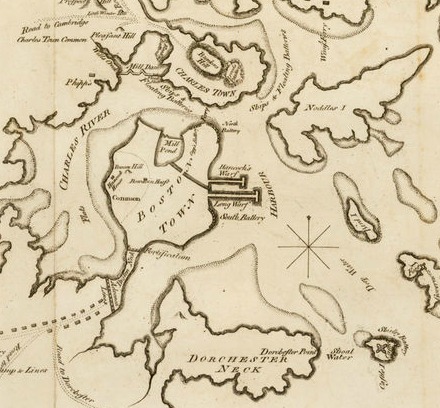
Ens. Samuel Richards had a unique perspective on the Continental Army’s entrance into Boston after the British evacuation on 17 Mar 1776.

The young Connecticut officer was chosen (I don’t know how) to lead the troops in with his regiment’s flag.

He recorded his memories for his family many decades later:
By the enemies inactivity for several succeeding days we concluded they had abandoned the idea of attacking our fort. This comparative inactivity continued untill the 17th of the month when the whole of our troops were paraded and commenced our march into Boston, it being announced that the enemy were evacuating it. I had the gratifycation of being selected to carry the American flag at the head of the column which entered from the Roxbury side.

When arrived in the town numerous incidents crouded upon our view: I can particurize but few of them. The burst of joy shown in the countenances of our friends so long shut up and domineered over by an insulting enemy: the meeting and mutual salutations of parents and children and other members of families having been seperated and continued seperated by the sudden shuting up of the town after the battle of Lexington: the general delapidation of the houses: several churches emptied of all the inside work—and turned into riding schools for their cavalry [that actually happened in only one church, the Old South Meeting-House]: all the places which had been previously used for public resort torn to pieces: and at the stores around the wharves groceries—particularly salt—were in a state of destruction.

As I had no particular command I rambled at my pleasure—and being the carrier of the flag attracted some attention, was almost constantly pressed with invitations to “call in and take a glass of wine with me”

I saw the last boat of the enemy put off and proceed to the shiping.
Richards did some sightseeing, first visiting the fortifications left behind in Charlestown.
The next day I went and viewed the works on Castle island, the enemy had endeavored to blow up every usefull part of the works; in many instances they had succeeded, in others but partially, they had broken off the trunnions of all the heavy cannon, and in addition had spiked them up. In general every thing was mutilated and rendered useless.

I was invited to take lodgings at the house of a respectable widow lady Mrs. C. and treated with the utmost hospitality during the few days of my stay in the town.

On the 25th of the month the troops began their march by regiments toward New York, and by the 4th of April 21 regiments had moved on, ours being one of the number: five regiments being left to garrison the town…
Richards remained in the Continental Army through the year 1780, becoming a captain. He returned to Farmington and worked as the postmaster for two decades. In retirement he followed a daughter to Wilkes-Barre, Pennsylvania, where he died at age eighty-eight.

Tuesday, December 09, 2025

Reenacting Tea Meetings in Faneuil Hall and Old South

Bostonians had lots of public debates over what to do about the East India Company’s tea, both before and after persons unidentified destroyed it in the harbor on 16 Dec 1773.

Some of the meetings before that event lasted hours and attracted so many people that the crowd had to gather in the Old South Meeting-House instead of Faneuil Hall.

In 1774, after Parliament passed the Boston Port Bill, the town meeting had more sessions devoted to discussing whether the town or any of its citizens should pay for the tea.

Families can sample the arguments at those meetings in two ways this season, both within the buildings where Bostonians actually gathered to debate.

Saturday and Sunday, 13 and 14 December, 1 P.M.
252nd Boston Tea Party Anniversary Town Meeting
Boston National Historical Park
Faneuil Hall

In early 1774 Parliament responded to the destruction of over 90,000 pounds of property by closing the port of Boston until the East India Company was compensated for its loss. In May, Bostonians gathered in the Great Hall in Faneuil Hall to vote on their response. Should they pay for the destroyed property, either officially or by private subscription, and reopen the port? Or should they endorse a boycott of British goods and continue protesting Parliament?

At 3 P.M. on each day, the same space will host the “1873 Women’s Tea Party,” a rally by the New England Women’s Suffrage Association. Leading suffragists argued that they were inheritors of the legacy of the American Revolution.

All these programs at Faneuil Hall are free and open to the public for all ages. They last 30-45 minutes. Sign up to attend here.

Tuesday, 16 December, 5 P.M.
Reenactment of the Meeting of the Body of the People
Revolutionary Spaces
Old South Meeting House

Commemorate the 252nd anniversary of the Boston Tea Party with a live reenactment of the Meeting of the Body of the People—held in the very room where it all began.

Feel the tension rise as fiery patriots debate the fate of the East India Company’s tea before thousands of restless colonists. Hear the shouts, the arguments, and the call for action that set a revolution in motion. Watch history come to life as Samuel Adams, John Hancock, Paul Revere, and others grapple with the decision to take bold action, ultimately leading to the dramatic event that became known as the Boston Tea Party.

(The Boston Tea Party Ships & Museum will not host a reenactment of the destruction of the tea in Boston Harbor this year.)

Ticket prices for the Old South reenactment range from $60 for V.I.P. seating to $25 for members of Revolutionary Spaces. Order tickets through this page. Doors will open at 5 P.M., and the reenactment will start at 6:15.

Tuesday, September 30, 2025

Bell-Ringing in 1740s Boston

In my research into Thomas Williston, sexton of the Old Brick Meeting-House from the 1740s to the early 1770s, I came across a petition in the town meeting records that gives a taste of daily life in Boston.

On 14 Mar 1744 Williston and four fellow “Sextons & Bellringers” laid out how they rang their churches’ bells each day.

They weren’t ringing every hour—after all, it would be tough to get any big project done if you had to break off each hour to go to the belfry. Instead, they rang at certain hours only.

The town paid Williston to wind the Old Brick clock since telling the time was more of a secular function than a religious one. By the same rule, the town paid the sextons to ring them bells. But those men were paid at different rates.

Specifically:
  • Isaac Peirce, Old North Meeting-House – 1 P.M., 9 P.M., 5 A.M. – £4.10s for each quarter of the year.
  • Nathaniel Band, New South Meeting-House – 9 P.M., 5 A.M. – 50s. (£2.10s).
  • Joseph Simpson, Hollis Street Meeting-House – 9 P.M., 5 A.M., 1 P.M. – £3.15s.
  • John Roulstone, Old South Meeting-House – 1 P.M. – 30s. (£1.10s).
  • Thomas Williston, Old Brick Meeting-House – 5 A.M., 11 A.M., 9 P.M. – £4.10s.
If I were Simpson, I’d ask why I’m being paid less than Peirce and Williston for ringing the same number of times a day. Not being Simpson, I can imagine some reasons for that difference: an easier bell, less seniority, the church being in a less densely populated part of town and thus serving fewer people. But I’d still ask.

Instead of quibbling among themselves, those five men presented a united front and all together asked the town for more money:
the Petitioners would Represent to the Town that the aforesaid Allowance for the Service aforesaid is so very small, being but about Three pence Old Tenor for each Ringing, that the Petitioners Apprehend they are not by any means Recompenced for their Time & Service and as the Petitioners Allowance is no greater now than has been for about Thirty Years past and Provisions & all Necessarys of Life more than twice as Dear as they were Thirty Years since, they Apprehended the Town would think it reasonable to Increase their Allowance
The meeting empowered the selectmen “to Consider…the Ringing of the Bells, and of the Allowance to be made to the Sextons.” That year’s selectmen included Thomas Hutchinson, Thomas Hancock, and Samuel Adams’s namesake father.

In May 1744 some citizens asked for “the Bell at the New Brick Church at the North End” to be rung at 11 A.M. as well, with its sexton paid. The selectmen took up that question, too. But I can’t find any record of their answer. In May 1745 the town “Voted, that the Bell ringers within the Town be paid for the same as formerly,” so it doesn’t look good for the sextons.

March 1745 had brought the news that “the Old Brick Church Bell…is now broke.” Joseph Marion proposed that the Old South Meeting-House bell be rung more often to fill in the broken bell’s times. The meeting “after some debate” approved that plan. But two days later the town reconsidered and decided the bell at Faneuil Hall, normally rung to signal the start and end of business hours, should be used instead. In May Middlecott Cooke proposed that Boston contribute to the cost of fixing or replacing the Old Brick bell “which was lately broke as he apprehends in the Service of the Town.”

In 1746 Samuel Hunstable asked to be paid for ringing “the Bell of the Meeting house at the westerly part of the Town.” The town meeting put him on the same basis as the other bellringers, but also specified that he increase the number of times a day he rang that bell: 5 and 11 A.M., 1 and 9 P.M.

Finally, in July 1747 the town approved a new payment schedule:
  • Ten Pounds old tenor p. Annum, for once a Day.
  • Twenty Pounds—p. Ditto for twice a Day and
  • Thirty Pounds—p. Ditto for three times a Day.
That was a considerable raise for the sextons, and evidently put them all on the same rate.

TOMORROW: Bell-ringing on occasion.

Monday, May 12, 2025

Thomas Newell and “that Detestable Tea”

Thomas Newell’s diary makes clear that he opposed Parliament’s tea tax in 1773, as most Bostonians did. On 2 December, for instance, he wrote about James Bruce bringing in the Eleanor with “116 Chest of that Detestable Tea.”

But what did Newell do to support that stance?

On 17 November the young man made clear he didn’t participate in the attack on the Clarke family’s warehouse, discussed back here: “This evening a number of persons assembled before Richard Clarke’s, Esq., one of the consignees of tea; they broke the windows, and did other damage. (I was at fire meeting this evening.)”

On 2 December, the same day Capt. Bruce arrived, Newell’s diary contains one of the longer bits of cipher in the diary. The word “Junr” is legible among the little symbols, and a squiggle that doesn’t fit the cipher turns out to be “St.” What was Newell hiding?

Not a whole lot, it turns out. Once deciphered, the line reads: “This Eving. was at St. Andrew’s Lodge, I was chosen Junr Deacon of said Lodge.” Well, good for Thomas Newell.

Some people credit that lodge of Freemasons with being at the heart of the anti-tea operation. (None give it more credit than the lodge itself.) And indeed Newell got more involved the next night.

On 3 December, Newell recorded: “This evening I was one of the watch on board of Captain Bruce (with twenty-four more), that has tea for the Clarkes & Co.” That patrol was to keep the tea from being landed so the tax could be collected.

Finally, here’s Thomas Newell’s account of 16 December:
Town and country sons mustered according to adjournment. The people ordered Mr. [Francis] Rotch, owner of Captain [James] Hall’s ship, to make a demand for a clearance of Mr. [Joseph] Harrison, the collector of the custom house (and he was refused a clearance for his ship). The body desired Mr. Rotch to protest against the custom-house, and apply to the governor for his pass for the castle. He applied accordingly, and the governor refused to give him one. The people, finding all their efforts to preserve the East India Company’s tea, at night dissolved the meeting. But behold what followed the same evening: a number of brave men (some say Indians), in less than three hours emptied every chest of tea on board the three ships, commanded by Captains Hall, Bruce, and [Hezekiah] Coffin (amounting to 342 chests), into the sea.
Was Newell among those “brave men”? I’d guess not. But he surely knew some of them.

A couple of details struck me Newell’s writing about the Boston tea protesters. First, he consistently referred to the people meeting in Old South Meeting-House as ”sons of liberty.” He didn’t worry about calling them the “body of the people.”

Second, in Newell’s telling the crowd that afternoon was trying “to preserve the East India Company’s tea.” By having it shipped back to Britain, that is. Would be a shame if anything else happened to it.

TOMORROW: A mystery name.

Thursday, August 22, 2024

Picking at the Martha Washington Dress Quilt

In the Colonial Revival period, many Americans came forward with relics of the Revolution passed down in their families or discovered in attics.

And some of those were even authentic.

Others, however, were not. I retold the saga of a reputed Thomas Oliver portrait here, for example.

Among items donated to the Bostonian Society in its early decades, I’m skeptical about the machine-woven “Sons of Liberty flag.”

I worked with Dave Ingram on a report about a powder horn ascribed to Richard Gridley; we determined it was almost certainly a Colonial Revival–era creation.

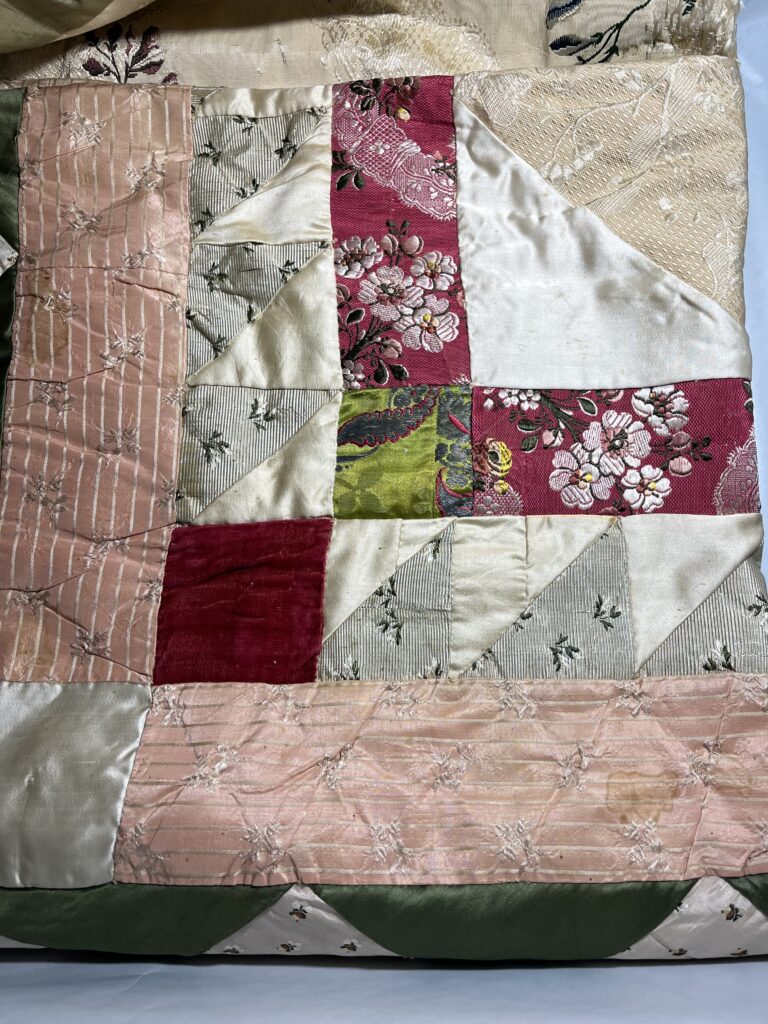
The Old South Meeting House also became a public institution at that time and began receiving donations. In the 1890s one important supporter, Mary Hemenway, gave Old South “a quilt made from fragments of Martha Washington’s dresses,” as Lori Fidler, Associate Director of Collections at Revolutionary Spaces, recently described in this article.

That’s just the sort of object that Americans oohed and aahed over breathlessly during the Colonial Revival. From the Age of Homespun! Touched by the great Washingtons themselves! But how reliable is its lore?

We know the quilt came to Hemenway from Fannie Washington Finch, an actual great-grandniece of George Washington. Her story:
Fannie was born Frances Louisa Augusta Washington in Virginia in 1828. Her mother, Henrietta Spotswood, was the granddaughter of George Washington’s half-brother, Augustine, Jr., while her father, Bushrod, was the grandson of George’s brother, John Augustine. Fannie’s grandmother, Jane Washington, had made the quilt out of scraps she received directly from Martha.
We also know from Finch’s letters in 1884–1886 that she was selling heirlooms from Mount Vernon, including this quilt, because of her “pecuniary condition.” In other words, she needed money.

There are also intriguing details about the quilt itself:
In 1979, a textile curator at Boston’s Museum of Fine Arts examined the quilt, finding the silk pieces to be expensive English-made loom-woven fabrics, consistent with textiles worn by wealthy women of the 1700s. He mentioned that the designs represented a range of time periods, with larger floral patterns from the mid-18th century and tiny blossoms from the late 1700s. . . .

In May 2024,…[Zara] Anishanslin noted that a fabric used in the quilt appeared to be an Anna Maria Garthwaite design. Garthwaite was a female silk designer who lived and worked in the Spitalfields area of London in the mid-1700s.
Thus, Finch might have had a motive to concoct a connection between this quilt and Martha Washington—but the artifact itself really does contain the fabrics a wealthy British-American woman in the mid- to late 1700s would have owned.

Furthermore, Fidler reports, “In her writings, Martha Washington mentions cutting up her garments and distributing pieces to family members and friends as mementos.” Finch couldn’t have inserted that into the historical record.

So on this item, I’m inclined to accept the lore.

Wednesday, July 10, 2024

A Sestercentennial Town Meeting in Old South

Tomorrow, 11 July, and then again on Thursdays every two weeks, Revolutionary Spaces’ Old South Meeting House will host programs based on the Boston town meeting that started on 13 May 1774.

In fact, two town meetings happened in Faneuil Hall that day. The first convened at 10:00 A.M., a continuation of Boston’s regular May meeting. That’s when men who met the property qualification voted on the town’s representatives to the Massachusetts assembly and then dealt with various other matters.

That May those other matters included “firing small Arms on the Neck,” a proposal for a well and pump in Dock Square, and so on. Most questions, like the schoolteachers’ salaries, were put off. The citizens formally adjourned until the first Monday in July.

But at 11:00 A.M. a new meeting officially started. News of the Boston Port Bill had arrived in town, and it presented an emergency.

The gathering chose Samuel Adams as the moderator; he’d served the same role in the earlier meeting (after being reelected to the legislature).

The first motion was to read the Port Bill, the second to ask the Rev. Dr. Samuel Cooper (shown above) to lead a prayer. He came to do so, after making sure the meeting understood “he was just returned fatigued from a Journey.”

Then came the inevitable proposal to form a committee, in this case to formulate a response to the new law. “After some Debate” on that, the meeting broke off for midday dinner and resumed at 3:00 P.M.

In the afternoon, everyone (with no dissenting votes) agreed to appoint a committee “to take the several Proposals, that have been made, & others that may be made, relative to our Conduct on the present Exigency, into their Consideration, & report, as soon as may be, their Opinion.” That’s a very vague mandate, probably recognizing a range of proposals and a lot of unknowns.

There were practical problems, like how to employ or support the many people who would lose work without the maritime trade. There were political considerations like assessing and strengthening support elsewhere—one action everyone agreed right away was communicating with other towns, especially the port of Salem and Marblehead. And finally, there was the choice posed by the Boston Port Bill itself: Should the town (or citizens) repay the cost of the tea destroyed in December?

The staff of Boston National Historical Park designed a program to recreate that discussion, 250 years ago in May. That program is usually offered in the big meeting space in Faneuil Hall, but that’s being refurbished. Like Boston’s overflow public meetings, therefore, these sessions have been moved to Old South.

The events will start at 5:30 P.M. on 11 July, 25 July, 8 August, and 22 August. They’re free, but registration is encouraged.

The programs last about half an hour—much less time than Boston’s town meeting that began on 13 May—and I don’t think was ever officially dissolved.

Tuesday, July 02, 2024

“On the Conduct of the Comittee of Correspondence”

On Monday, 27 June 1774, the political argument over Boston’s committee of correspondence came to a head.

Merchants and friends of the royal government felt that the committee was wielding too much power, dragging the entire community into a costly and treasonous confrontation with the Crown.

Parliament’s Boston Port Bill was stifling every Bostonian’s livelihood, but that problem could go away at the (admittedly significant) cost of £9,660.

The committee’s Solemn League and Covenant boycott was going further than any non-importation measure so far, not only proscribing more goods from Britain and making people pledge not to do any business with people who did import goods. Was that going too far for the country folk?

The Boston Whigs, who had established the standing committee of correspondence back in November 1772, stuck to their position that for the people to make any retreat or compromise would be giving up their British constitutional rights.

The Boston town meeting resumed in Faneuil Hall at 10:00 A.M. His work with the Massachusetts General Court in Salem done (since the Massachusetts General Court in Salem was done), Samuel Adams was once again in the chair.

A motion passed that the meeting should review all the letters the committee of correspondence had written to other towns and colonies about the Port Bill.

But then came another motion: “that this Meeting be adjourned to the Old South Meeting House, the Hall not being sufficient to contain all the Inhabitants assembled.”

The committee chosen to go to Old South and ask if the town could use that space consisted of William Molineux, town clerk William Cooper, and Dr. Benjamin Church, Jr.—all radical Whigs. That alone signaled that their party had the votes to control the meeting. But what if more people came for one side or the other?

In Old South, the meeting reaffirmed its earlier vote to review the correspondence. Cooper began to read the letters aloud. After a while the crowd became bored, and they amended their earlier vote to cover only the Solemn League and Covenant, the letter sent out with that proposal, and “any other Letters that may be particularly called for.”

Eventually someone moved “that some Censure be now passed By the Town on the Conduct of the Comittee of Correspondence; and that said Committee be annihilated.” That would be a total repudiation of the committee and its work.

Adams stated that “he had the Honor of being a Member” of that committee, so someone else should moderate that discussion. By stepping away from the podium for a while, Adams not only made a point of being scrupulously fair but also allowed himself to speak, since the moderator usually didn’t express opinions on motions.

As the temporary chair, the meeting chose Thomas Cushing—merchant, speaker of the House, and another member of the Boston Whigs (though in the moderate set). Again, that showed how that group was in control of this body.

Nonetheless, the debate went on until dark, and still the opponents of the committee said “they had farther to offer.” The meeting voted to adjourn until the next morning at 10:00 A.M.

TOMORROW: The speakers and the vote.

Monday, March 18, 2024

“Dill” Screenplay Reading in Old South, 19 Mar.

On Tuesday, 19 March, Revolutionary Spaces’s Old South Meeting House will host a live reading of a screenplay, performed by local actors and accompanied by music and sound effects.

The drama is called Dill, described as “inspired by real people and real events on the Cape Ann Shore in Massachusetts during a tumultuous time on the cusp of the American Revolutionary War.”

At the risk of spoilers, I’m guessing the central character, “an enslaved woman named Dill, short for Deliverance, who…finds herself in a love triangle between two men,” is based Deliverance Symonds. Abram English Brown wrote a chapter about Symonds in Beneath Old Hearth-Stones (1897).

After the reading, there will be a discussion of the screenplay’s historical context featuring these experts:
  • Lise Breen, author of “Hidden City: Slavery and Gloucester’s Quadricentennial” in Gloucester Encounters: Essays on the Cultural History of the City 1623-2023 and coauthor of Objects of Myth and Memory: American Indian Art at the Brooklyn Museum.
  • Nerissa Williams Scott, producer of Dill and other films, C.E.O. and Lead Creative Producer of That Child Got Talent Entertainment (TCGT), and an affiliated faculty member at Emerson College in the Business of Creative Economy and Visual Media Art departments.
  • Beth Bower, formerly staff archaeologist at the Museum of Afro American History and archaeological and historic resources program manager for the Central Artery project, now studying the 1750–1850 African American community in Salem.
  • Jeanne Pickering, an independent scholar of slavery in eighteenth-century Essex County who maintains the research databases of NorthShoreSlavery.org.
The event announcement does not name the author of the screenplay.

This is a free event, but registration is requested. Doors will open at 6:30 P.M., with light refreshments available, and the performance is scheduled for 7:00.

Friday, December 22, 2023

How Many People Were at the Old South Tea Meetings?

Last weekend, I served as announcer for the reenactment of the “Meeting of the Body of the People” in Old South Meeting-House.

The most striking moment was hearing noises from outside the building, glancing through the window behind me, and seeing the sidewalk and street absolutely packed with people.

The sight reminded me of all the reports from 1773 of throngs outside that same building, locals straining to hear the developments and lending their bodies to the popular pressure. It was even rather spooky.

The crowd also brought up a historical question that appeared both in the introduction to the event and backstage discussions: How many people were at the tea meetings in Old South in late 1773?

In a letter to Arthur Lee about the whole tea crisis dated 31 Dec 1773, Samuel Adams wrote that on 28 November “the Old South meeting-house [had…] assembled upon this important occasion 5000, some say 6000 men.” And later on 16 December, “the meeting…had consisted by common estimation of at least seven thousand men.”

But of course we recognize Adams as a master of propaganda. Here he was using the technique of crediting lots of other people with saying what he wants to say.

The merchant John Andrews wrote similarly about the latter day:
A general muster was assembled, from this and all ye neighbouring towns, to the number of five or six thousand, at 10 o’clock Thursday morning in the Old South Meeting house, where they pass’d a unanimous vote that the Tea should go out of the harbour that afternoon.
But as a rule, I assume Andrews has inflated his numbers by 50–100%.

For example, Andrews wrote that John Ruddock was “the most corpulent man among us, weighing, they say, between 5 and 600 weight.” That would have put the magistrate in the same range as David Lambert, Georgian Britain’s example of corpulency. Justice Ruddock was heavy, but not heavy enough to be able to display himself. He was probably closer to 300 pounds.

Andrews said the cannon now labeled “Adams” and “Hancock” (at the heart of The Road to Concord) must “weigh near seven hundred weight apiece.” The National Park Service has found those guns “weigh about 450 pounds each.”

Finally, we all know that estimating the size of a public crowd, especially at a political event, is notoriously prone to exaggeration. Even today, when we can collect photographic evidence, crowd estimates can be frought with bias, wishfulness, and in some cases simple narcissism.

Using my formula for interpreting John Andrews’s numbers, we should translate his and Adams’s reports of 5,000–7,000 people into about 3,000. That’s still about equal to all the adult white men in Boston.

It’s also far more than the legal capacity of Old South today. But back in 1773 the building’s main floor didn’t have displays in the back, the first gallery had benches instead of individual seats, and the second gallery was open. Most important, people were smaller and had different assumptions about personal space, so they probably crowded together more densely.

Three thousand adults would still probably have been beyond tight—but what if we also count crowds on the streets outside?

Saturday, December 16, 2023

“I went contentedly home & finishd my tea”

One of my favorite accounts of the Boston Tea Party comes from the merchant John Andrews.

He cultivated a sense of detached irony in his letters. So much so that he can come across as barely able to rouse himself and find out what was going on.

Andrews wrote this letter on 18 Dec 1773, more than a day after the event, so he had a chance to digest it and polish his observations.

This extract picks up Andrews’s account as ship-owner Francis Rotch has returned from Milton with the not-unexpected news that Gov. Thomas Hutchinson wouldn’t let the Dartmouth carry its load of tea back to London.
upon readg it, such prodigious shouts were made, that induced me, while drinkg tea at home to go out, & know the cause of it, the [Old South Meeting] house was so crowded could get no further than ye porch, where I found ye moderator [Samuel Phillips Savage], was just declaring the meetg to be dissolvd, which causd another general Shout, outdoors & in, of three cheers; what wth that, & the consequent noise of breaking up the meetng, you’d tho’t the inhabitants of the infernal regions had broke loose.

for my part, I went contentedly home & finishd my tea, but was soon informd what was going forward, but still not crediting it without ocular demonstration, I went & was satisfied–

they mustered I’m told upon Fort hill, to the number of about 200 & proceeded, 2 by 2 to Griffins wharfe, where [the ships captained by James] Hall, [James] Bruce and [Hezekiah] Coffin lay, each with 114 Chests of the ill-fated article on board, the two former with only that article, but ye lattr arriv’d at ye wfe only ye day before, was freighted with a large quantity of other goods, which they took the greatest care not to injure in the least, and before nine O Clock in ye eveng, every Chest, from on board the 3 vessells, was knocked to pieces and Flung over ye sides–

they say the actors were Indians from Naragansett, whether they were, or not, to a transient observer they appeard as Such, being cloathd in Blankets, wth their heads muffled & copper colord countenances, being each arm’d with a hatchet or axe or po [pair of] pistols, nor was their dialect different from what I conceive those geniueses to speak, as their jargon was uninteligible to all but themselves–

not the least insult was offerd to any person, save one Capt [Charles] Conner, a letter of horses in this place, not many years since immergd from dear Ireland who had ript ye lining of his coat & waistcoat under the arms, and watchg his oppoty had nearly filld ’em wth tea, but being detected, was handled pretty roughly, they not only Stript him of his cloaths, but gave him a coat of mud, wth a severe bruising into the bargain, & nothing but their utter aversion to make any disturbance prevented his being tard & featherd.
Conner was also mentioned (though not by name) in the Whig newspapers and in the Rev. Samuel Cooper’s report to Benjamin Franklin. Boston’s political leaders really wanted people to know the men who destroyed the tea (whoever they might be) were acting on principle and not for private gain.

(The depiction of the Tea Party above comes courtesy of the Boston Athenaeum, where I’m typing these words. It was engraved in 1856 by John Andrew, who I don’t think was any relation to the merchant.)

Monday, December 04, 2023

Three Talks on the Tea Party

People are talking about the Boston Tea Party more and more. Here are three upcoming talks tied to its sestercentennial, all featuring history professors who have written books on the event.

Wednesday, 6 December, 1:00 P.M.
Online via the Congregational Library & Archives
Boston Tea Party at 250: Congregationalists and the American Revolution

Prof. Robert J. Allison of Suffolk University and Dr. Tricia Peone, director of the New England’s Hidden Histories Project, discuss documents in the host institution’s collection related to the Tea Party.

The destruction of the tea was one of the greatest acts of civil disobedience of all time, and the event that precipitated the Revolution. What was the political and religious background to the event?

Register here to tune in to this online discussion here.

Monday, 11 December, 6:00 P.M.
Old South Meeting House
Tea: Consumption, Politics, and Revolution, 1773–1776

Prof. James Fichter of the University of Hong Kong marks the publication of his new book Tea with a conversation with Dr. Nathaniel Sheidley, President and CEO of Revolutionary Spaces.

Fichter challenges the prevailing wisdom around the tea protests and boycotts by showing that tea and British goods continued to be widely sold and consumed in North America, and even a significant portion of the tea that the East India Company shipped in 1773 wound up in American teapots.

Books will be available for purchase an signing. This program is free and open to the public, but registration is required. Doors will open at 5:30, and light refreshments will be available.

Wednesday, 13 December, 6:30–8:30 P.M.
via the American Revolution Institute
Defiance of the Patriots: The Boston Tea Party and the Making of America

In 2010, Prof. Benjamin L. Carp of Brooklyn College published the first full study of the Boston Tea Party in a generation. He returns to the event, examining the actions of those who carried out the raid in the context of the global story of British interests in India, North America, and the Caribbean.

People in Washington, D.C., can attend this event at the deluxe Anderson House on Massachusetts Avenue. Folks elsewhere can sign up to watch online.

Thursday, November 30, 2023

Celebrations of Phillis Wheatley’s Boston Pub Date

At the end of November 1773, the ship Dartmouth was moored in Boston’s inner harbor, watched by a militia-style patrol of volunteers to ensure the tea it carried was not unloaded and taxed.

The Rotch family’s vessel, under the command of James Hall, brought other cargo as well. Among those items were copies of Phillis Wheatley’s Poems on Various Subjects, Religious and Moral.

Wheatley had recently become legally free, and she was counting on sales of those books for her income.

Fortunately, by 1 December the local Whigs made clear that everything could be unloaded from the Dartmouth except the East India Company tea, so the books came ashore.

Historians only recently recognized the connection between Wheatley’s book and the Boston Tea Party because no one mentioned it at the time. Wheatley may have been worried 250 years ago today, but by the time she was writing the letters that survive she had her books on dry land and was busy promoting orders.

Wheatley wrote that her books would arrive “in Capt. Hall,” using the common way of referring to a ship by its master rather than its name. About ten years ago Wheatley biographer Vincent Carretta, researcher Richard Kigel, and others realized that the captain of that name arriving in Boston around that time had to be James Hall on the Dartmouth.

The sestercentennial of the Tea Party thus coincides with the sestercentennial of the publication of Phillis Wheatley’s book in America, and both events are being commemorated this season.

Ada Solanke’s play Phillis in Boston will have its last performances for the year in Old South Meeting House, the poet’s own church, on Sunday, 3 December. That site-specific drama depicts the poet, her friend Obour Tanner, her husband-to-be John Peters, her recent owner Susannah Wheatley, and abolitionist Prince Hall. Order tickets here.

The next evening, 4 December, the Boston Public Library will host “Faces of Phillis,” a free program discussing the poet from various perspectives. It will start with a staged reading of parts of Solanke’s plays about Wheatley. Then there will be a panel featuring Solanke, sculptor Meredith Bergmann, and Kyera Singleton of the Royall House & Slave Quarters museum. The evening will conclude with Boston’s Poet Laureate, Porsha Olayiwola, performing a dramatic reading of her own work and one of Wheatley’s poems.

“Faces of Phillis” is scheduled to last from 6:00 to 7:30 P.M. Register for that event here.

Wednesday, November 01, 2023

The Tea Party Sestercentennial, 15–16 Dec.

This year will see the 250th anniversary, or Sestercentennial, of the Boston Tea Party.

As the most photogenic of the pre-war Revolutionary events, the destruction of the taxable tea has been a very big deal for about two centuries of those 250 years. Before that, it appears, the first rule of the Tea Party was that you didn’t talk about the Tea Party.

This December, we’ll be talking a lot about the Tea Party.

On Friday, 15 December, Revolutionary Spaces’ Old South Meeting House will host its recreated “Meeting of the Body of the People,” representing the gatherings in that same space right up until the destruction of the tea began.

Like last year, I’ll be participating as the voice of the narrator booming from the gallery. The real stars will be the people portraying Samuel Phillips Savage, Samuel Adams, Dr. Thomas Young, Francis Rotch, and such observers as Phillis Wheatley, including some of the area’s top reenactors and museum professionals.

Tickets for this event are $40 for an adult, with discounts for seniors, teens, children, and Revolutionary Spaces members. Even though Old South can squeeze in thousands, this will probably sell out. The event starts at 6:15 P.M. on Friday, and there will be no follow-up on the waterfront that night.

On Saturday, 16 December, the exact anniversary date, there will be a program at Faneuil Hall titled “Act One: Faneuil Hall & The Boston Tea Party, A Protest in Principle: A Retrospective on Revolution.” That’s scheduled to take place from 4:00 to 5:30 P.M.

To be frank, I’m not sure what this event will be, but it doesn’t matter since all seats inside Faneuil Hall have already sold out. The program will be shown on screens outside the hall for the general public.

Then that evening’s action will move to the Old South Meeting House, where we’ll do another “Meeting of the Body of the People.” This event has also sold out, which is why Revolutionary Spaces and its volunteers just added the performance on Friday the 15th.

Outside on the steps at Franklin and Washington Streets, near Old South, reenactors will portray citizens of colonial Boston discussing the politics of the day. This “Patriots and Loyalists” program will run from 6:00 to 7:00 P.M., free and open to the public.

At 7:30 P.M., the crowd from Old South and the area around it are invited to follow the fifes and drums to the waterfront. This walk is longer than back in 1773 since the land has been extended. The event description for “Huzzah for Griffin’s Wharf” says there will be a sight of British soldiers, though in 1773 all the regulars were on Castle Island.

Finally, at around 8:00 P.M. spectators can line the Harborwalk near the Boston Tea Party Ships & Museum to watch from across the water as men storm aboard the Beaver and Eleanor to effect the “Destruction of the Tea,” loose leaves donated by people all over the country. There will be some bleacher seating, but the audience is expected to number in the thousands, so most folks will stand.

As in 1773, this action is expected to be disciplined and quick, so the whole event should be over before 9:00 P.M.

Saturday, October 21, 2023

Book Signings in Boston and Newport

On Monday, 23 October, the Old South Meeting House will host the launch of the paperback edition of Stacy Schiff’s biography The Revolutionary: Samuel Adams.

After the hardcover appeared last year, the Wall Street Journal named The Revolutionary one of its Best 10 Books of 2022 and Barack Obama listed it among his recent favorites.

Schiff will discuss the book in the space where a town meeting on 6 Mar 1770 empowered Adams to lead a town committee demanding that the royal government remove all troops from the streets of Boston. John Singleton Copley’s portrait of Adams depicts that effort.

The Old South will open its doors at 6:30 P.M., and the event will begin at 7:00. It is free and open to the public, but Revolutionary Spaces encourages people to register at this link.

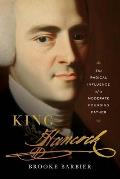
The next night, Tuesday, 24 October, Schiff will appear with Brooke Barbier, author of King Hancock: The Radical Influence of a Moderate Founding Father, at the Colony House in Newport, Rhode Island.

This authors’ discussion will look at the Boston Tea Party as a milestone in the collaboration of the two Boston politicians. Adams and Hancock served together in the Massachusetts General Court in the 1760s and 1770s and later were back-to-back governors in the 1790s. (There were some serious bumps in their relationship in between.)

This event is scheduled to run from 6:00 to 7:30 P.M. The Newport Historical Society is hosting, and admission is $20, or $15 for members. Charter Books will have copies of the two biographies available for purchase. Register here.

Monday, September 11, 2023

“William Dawes” and Other History Camp Boston Videos to Watch

History Camp Boston has now posted videos from its conference at Suffolk University Law School early last month.

That means you can see me talk about “William Dawes Before and After His Ride” (a/k/a “William Dawes’s Secret”).

One of the details I noticed while updating my notes for this talk is the timing of this item from the Boston Gazette published on Monday, 9 May 1768:
Last Tuesday was married, Mr. William Dawes, Jun. to Mrs. Mehitable May, both of this Town, and Yesterday made a handsome Appearance, dress’d wholly in the Manufactures of this Country, wherein he did Honor to himself, and merits the Respect of the Province, agreeable to their unanimous Vote passed the last session…
I hadn’t processed before that Dawes dressed up in his new suit not on his wedding day but on the first Sunday after his wedding, when he and Mehitable went to their church, Old South, for the first time as a married couple.

Weddings were usually small family affairs in colonial New England, but now I’m curious if there are other examples of the first Sunday after a wedding being the public.

History Camp Boston included many more talks about eighteenth-century and Revolutionary topics, so there are plenty of videos to sample, on topics like the Salem witch trials, James Otis, the Tea Party, Thaddeus Kosciuszko, John Hancock, and more. And of course some sessions considered other periods of history as well.

Some of these videos, including mine, were produced with a grant from the Americana Corner Foundation.

Wednesday, June 28, 2023

Joan Donovan on Political Memes at Old South, 29 June

On Thursday, 29 June, Revolutionary Spaces’ Old South Meeting House will host a conversation with Dr. Joan Donovan on “Benjamin Franklin, Rattlesnakes, and Pepe the Frog.”

This discussion will look at memes in American politics from the Founding Era to today. The event description says:
Memes—images that spread quickly through large groups—are a central part of internet culture. Not only have they have been instrumental in the rise of social media, they also have had a major influence on American political discourse.

According to leading media expert Dr. Joan Donovan, memes mirror the behavior of flags and broadsides of the American Revolution, including Benjamin Franklin’s ubiquitous Join or Die engraving and the iconic Gadsden Flag.
I’m intrigued because I’ve written about the quasi-scientific roots of American snakes as political symbols and spoken about Stamp Act protests as memes in the age of weekly newspapers.

Dr. Donovan is a public scholar specializing in media manipulation, political movements, critical internet studies, and online extremism. She is the Research Director of the Harvard Kennedy School’s Shorenstein Center on Media, Politics and Public Policy and directs the Technology and Social Change project, exploring how media manipulation helps to control public conversation, derail democracy, and disrupt society. Donovan is the co-author of Meme Wars: The Untold Story of the Online Battles Upending Democracy in America with tech journalist Emily Dreyfuss and cultural ethnographer Brian Friedberg.

Donovan will be in conversation with Matthew Wilding, Director of Interpretation & Education at Revolutionary Spaces and curator of the upcoming exhibit “Impassioned Destruction: Politics, Vandalism & The Boston Tea Party” at the Old State House.

This event will start at 7:00 P.M., with doors opening thirty minutes earlier. There will be light snacks and refreshments. Register in advance for free.

Monday, January 09, 2023

Boston Tea Party Online Panel Discussion, 10 Jan.

On Tuesday, 10 January, Revolutionary Spaces will launch its commemoration of the Sestercentennial of the Boston Tea Party with an online panel discussion about the event: “‘To Save This Country’: The Boston Tea Party in History.”

The event description says:
Kicking off the 250th anniversary year of this iconic moment in history, this virtual panel will provide a nuanced basis for which to understand the The Boston Tea Party. . . . acclaimed historians will explore how the events preceding the Boston Tea Party led to this historic occasion. We will then move, moment by moment, through the meeting and the destruction of the tea, providing commentary and insight. We will also discuss the aftermath of December 16, 1773 and its legacy. The panel will conclude an audience Q&A.
The panelists are:
  • Dr. Nathaniel Sheidley, president and CEO of Revolutionary Spaces, which operates the Old South Meeting House and Old State House.
  • Prof. Joseph J. Ellis, recipient of the Pulitzer Prize for Founding Brothers: The Revolutionary Generation and the National Book Award for American Sphinx, and author of many more books.
  • Prof. Benjamin Carp, author of Defiance of the Patriots: The Boston Tea Party and the Making of America, Rebels Rising: Cities and the American Revolution, and the new The Great New York Fire of 1776: A Lost Story of the American Revolution.
  • Prof. Sarah Purcell, the L.F. Parker Professor of History at Grinnell College and author of Sealed with Blood: War, Sacrifice, and Memory in Revolutionary America.
  • myself.
The questions prepared for this event are very wide-ranging, starting with the Seven Years’ War and ending with the upcoming commemorations. We’re supposed to both lay out the basic historical facts of the Tea Party and add nuance for people already familiar with those facts. So even at ninety minutes, this conversation could get rushed at the end. If you have burning questions, post them early!

Register to attend “‘To Save This Country’: The Boston Tea Party in History” through this page. The event will start at 6:30 P.M. and end about 8:00. It will be recorded for the WGBH Forum Network.

Monday, November 28, 2022

Tea Leaves and Traditions

Over the past three days I’ve discussed seven purported samples of tea from the Boston Tea Party. And we’re not done yet!

The Old South Meeting House displays a small corked vial of tea beside a paper label printed with Chinese characters. The panel says:
Tradition has it that these tea leaves, as well as the Chinese tea label, are souvenirs from the Boston Tea Party.
For more information we can go over to this webpage from the Boston Tea Party Ships and Museum:
This 18th century tea chest label was donated to the museum in 1987 by the Wells Family Association. Genealogical researcher, author, and descendant of a Tea Party participant, Charles Chauncey Wells researched the connection of the label to his ancestor Thomas Wells, a blacksmith who lived from 1746 until 1810. Thomas Wells worked on the wharves and, like many other young laborers, was entrenched in Boston’s pre-revolutionary rebellion. Down five generations, Charles Chauncey Wells recalls how his grandfather would take the label out, protected under glass, from its hiding place on special occasions to discuss with pride the history of this infamous ancestor! . . .

When the tea label was donated to the Old South Meeting House, experts from Harvard University, Michigan State University, and The British Museum authenticated and translated the document. The label is block printed on rice paper in Old Chinese writing. The paper is of 18th century origin and comes from Canton.
Thomas Wells’s son was prominent in nineteenth-century Boston, but he wasn’t listed as a Tea Party participant in Francis S. Drake’s 1888 Tea Leaves. The family tradition seems to rest on these artifacts.

A similar corked vial, shown above, is in the collection of the Scottish Rite Masonic Museum (formerly the Museum of Our National Heritage) in Lexington. In this blog post from 2012, the museum said:
In 1973, as the Grand Lodge of Masons in Massachusetts and other organizations in the commonwealth prepared for the American Bicentennial, Paul Fenno Dudley (1894-1974) donated this vial of tea to the Grand Lodge’s Museum. The Grand Lodge's collection is now housed at the Scottish Rite Masonic Museum and Library…
That article doesn’t say how this artifact came to Dudley. Drake did list Samuel Fenno in the Tea Party, “principally from family tradition,” but said nothing about the family preserving a sample of tea. And it’s not clear if this vial came to Paul Dudley Fenno through inheritance.

Up in Exeter, New Hampshire, the American Independence Museum displays a vial of tea that I discussed back in May. That’s not the tea collected by Thomas Melvill, as once thought—the Melvill tea is on display at the Old State House in Boston. Instead, this vial may have been modeled after the Melvill artifact. The museum’s webpage on this artifact suggests its label was written in the late 1800s by William Lithgow Willey of the New Hampshire Sons of the American Revolution.

Also in New Hampshire, the Mont Vernon Historical Society holds a small glass jar of tea leaves. Its website says “a lamplighter by the name of Elias Proctor…joined other colonists in salvaging the broken crates of tea that washed ashore,” keeping the salty leaves to dye cloth.

Over time, Proctor reportedly doled out those leaves to relatives:
When Elias gifted family members with his stash, we are told that he always proclaimed the great cause for which it had been sacrificed.

It was from just such a gift that the Horne Family of Dover, NH received some of Elias’s tea. There is a very good chance that it was Mary Horne Batchelder who put some of it in the small vial we have in the museum today. She thought the 117 year old tea would make a nice wedding gift to her children when they got married. She gave some to her son who went west with it and his bride, settling in Kansas. She also gave some to her daughter Marcia who married Frank Lamson on January 9, 1890. Mr. Lamson would bring his new wife and the old tea back to Mont Vernon to live on the farm that bears the family’s name to this day. It would reside there for another generation or two. In the 1970’s, the couple’s daughter, Ella M. Lamson, gave the now 200 year old tea to the Mont Vernon Historical Society where it has been treasured ever since.
As with the samples coming to us through Thaddeus Mason Harris, this story makes no claim that an ancestor participated in destroying the tea cargo. But there’s also a lot of uncertainty in that recreation of the tea’s provenance. Among other details, Boston had no street lamps until after 1773.

I suspect quite a few Americans grew up being told that a small pile of tea leaves came from the Tea Party, as in this family tradition I discussed in September. After all, by the mid-1800s Boston’s historical repositories were accumulating just such artifacts. Such a sight would have been a way to connect children to their family, to history, and to American patriotism.

Of course, one pile of loose black tea leaves looks much like another. During the Colonial Revival, families were eager to connect themselves to fabled moments of the Revolution. Parents wanted to inculcate their children with respect for their ancestors and their country. Why not turn a spoonful of old tea into a history lesson? Who outside the family would ever hear that tale?

Tuesday, November 15, 2022

Meeting of the Body of the People in Old South, 16 Dec.

Revolutionary Spaces is relaunching its Boston Tea Party reenactment this year, in anticipation of 2023’s Sestercentennial event. Today is the last day to buy tickets at the early discount.

Old South Meeting House was the site of the big public protest meetings that started in November 1773 and led up to the destruction of the tea.

On Friday, 16 December, that extended debate over what to do about the taxed tea will be recreated in the same space where thousands of Bostonians gathered in 1773. The museum’s announcement says:
Join Revolutionary Spaces at Old South Meeting House for the return of the reenactment of the Meeting of the Body of the People! Meet iconic Bostonians whose vigorous debate led to the destruction of tea in 1773, as well as other personalities whose contributions shaped colonial Boston. Experience this moment in time in the room where it happened!

Doors open at 5:00 PM for a pop-up tea shop at Old South’s museum store. Come early and meet the Ladies of Boston and other colonial characters you might recognize to learn about what life was like leading up to the Revolution. Ticket holders can enjoy tastes of Revolutionary Spaces’ tea and snag their own box for a special price. Exclusive tea tasting hosted by Revolutionary Spaces’ member community and The Tea Can Company!

In special appreciation of our member community, all Revolutionary Spaces members will also receive one complimentary barrel mug and SAVE 40% off regular retail prices on all tea sold in the museum store during the night of the event.
The meeting reenactment is scheduled to start at 6:30 P.M. I might have something to do with launching it; after several years of serving as narrator for the Boston Massacre reenactments, I’ve been invited to move up three years and be the unseen voice of the Tea Party meetings.

Tickets to the “Meeting of the Body of the People” include access to both of Revolutionary Spaces’ sites, the Old State House and Old South Meeting House, from Friday, 16 December, through Sunday, 18 December.

The early prices are $24 for adults, $20 for people aged 65 and older or aged 13 and younger, and $18 for members of Revolutionary Spaces. After 15 November, the prices will go up.