






“The gratifycation of being selected to carry the American flag”
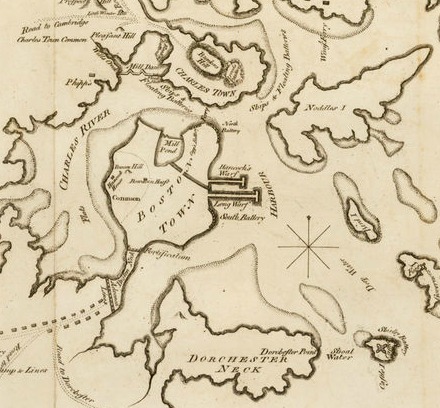
The young Connecticut officer was chosen (I don’t know how) to lead the troops in with his regiment’s flag.
He recorded his memories for his family many decades later:
By the enemies inactivity for several succeeding days we concluded they had abandoned the idea of attacking our fort. This comparative inactivity continued untill the 17th of the month when the whole of our troops were paraded and commenced our march into Boston, it being announced that the enemy were evacuating it. I had the gratifycation of being selected to carry the American flag at the head of the column which entered from the Roxbury side.Richards did some sightseeing, first visiting the fortifications left behind in Charlestown.
When arrived in the town numerous incidents crouded upon our view: I can particurize but few of them. The burst of joy shown in the countenances of our friends so long shut up and domineered over by an insulting enemy: the meeting and mutual salutations of parents and children and other members of families having been seperated and continued seperated by the sudden shuting up of the town after the battle of Lexington: the general delapidation of the houses: several churches emptied of all the inside work—and turned into riding schools for their cavalry [that actually happened in only one church, the Old South Meeting-House]: all the places which had been previously used for public resort torn to pieces: and at the stores around the wharves groceries—particularly salt—were in a state of destruction.
As I had no particular command I rambled at my pleasure—and being the carrier of the flag attracted some attention, was almost constantly pressed with invitations to “call in and take a glass of wine with me”
I saw the last boat of the enemy put off and proceed to the shiping.
The next day I went and viewed the works on Castle island, the enemy had endeavored to blow up every usefull part of the works; in many instances they had succeeded, in others but partially, they had broken off the trunnions of all the heavy cannon, and in addition had spiked them up. In general every thing was mutilated and rendered useless.Richards remained in the Continental Army through the year 1780, becoming a captain. He returned to Farmington and worked as the postmaster for two decades. In retirement he followed a daughter to Wilkes-Barre, Pennsylvania, where he died at age eighty-eight.
I was invited to take lodgings at the house of a respectable widow lady Mrs. C. and treated with the utmost hospitality during the few days of my stay in the town.
On the 25th of the month the troops began their march by regiments toward New York, and by the 4th of April 21 regiments had moved on, ours being one of the number: five regiments being left to garrison the town…

3 comments:
".....to carry the American flag..." Which American flag? Probably meant a regimental colour.
In the late 1800s authors, relying on a newspaper account that described Ens. Richards carrying “the standard,” argued that that was the Continental Navy flag, the variation of the British Union flag with thirteen stripes in the field.
In the early 1900s some authors pushed back against that assumption, saying it was more likely a regimental banner. The Connecticut troops had such banners assigned to them early on, and there were more orders about them in February.
The fact that Richards himself called his standard “the American flag,” however, suggests that he was not simply carrying the banner of his regiment.
Of course, he was writing from decades later when national sentiment and national emblems were more established. But I think if he’d represented the pride of the regiment, he would have said so.
Richards also referred to himself as “the carrier of the flag,” suggesting that he wasn’t just one of a few regimental banner carriers.
Post a Comment