J. L. BELL is a Massachusetts writer who specializes in (among other things) the start of the American Revolution in and around Boston. He is particularly interested in the experiences of children in 1765-75. He has published scholarly papers and popular articles for both children and adults. He was consultant for an episode of History Detectives, and contributed to a display at Minute Man National Historic Park.

Subscribe thru Follow.it


•••••••••••••••••


Showing posts with label Massachusetts General Court. Show all posts

Friday, August 21, 2026

In Exchange for John Callender

In June 1777, as quoted here, the Massachusetts General Court voted to send imprisoned Loyalist Benjamin Davis, Jr., with his father to New York on condition that the royal authorities send back John Callender in exchange.

Callender (1747-1797) had been one of four provincial officers ordered to lead their artillery companies onto the field at the Battle of Bunker Hill.

Only one of those officers, Samuel Russell Trevett, actually stayed through the whole battle doing damage to the regulars. Only one—again, Trevett—kept any of the provincials’ valuable cannon from being captured.

However, two of the other officers had the advantage of being related to Col. Richard Gridley, commander of the artillery. They were Maj. Scarborough Gridley, the colonel’s son, and Capt. Samuel Gridley, his nephew.

Eventually both young Gridleys were removed from the ranks. But that took months, and in July 1775 the new commander-in-chief, Gen. George Washington, had to make an example of someone. So John Callender was cashiered in a very public way.

Callender carved out a second chance for himself. He went to New York in the fall of 1776 as a gentleman volunteer or “cadet” attached to the artillery company commanded by Capt.-Lt. John Johnson (c. 1753–1818, self-portrait shown above).

During the Battle of Brooklyn, Johnson was “desperately wounded,” in the words of Henry P. Johnston. Callender took command of the company and “fought his piece on Long Island until the enemy’s bayonets were at his breast.” Both officers and their men became prisoners.

Johnson was exchanged in May 1777 but was in no physical shape to return to the army. He became Boston’s leading portrait painter during and immediately after the war.

Callender was awarded a Continental Army commission as a captain-lieutenant, dated 1 Jan 1777. And the Massachusetts legislature tried to get him back, as its June resolution showed.

But that didn’t work. Callender was still a prisoner in New York in September. And I rather doubt Benjamin Davis, Jr., returned to Massachusetts to be locked up again.

I suspect the British authorities didn’t see a fair trade in exchanging a Continental officer captured in battle for a young man, barely of age, who just happened to be with his father on a merchant ship when it was seized. It’s possible the Crown freed another young American man whose identity I haven’t found, and it’s possible the issue of Benjamin, Jr.’s trade faded away.

In September 1777, John Callender’s wife Hepzibah asked the Massachusetts legislature to approve another swap for her husband. The man to be freed from the Boston jail this time was John Hill, a Loyalist captured during the evacuation in the spring of 1776.

The General Court approved that swap on 17 September. I presume it actually happened because by the end of the year Callender and Hill were both back on their own sides.

In subsequent years Hill served as “a Capt. of Marines on board a Privateer for 8 months, than as Capt. of Marines in the Jason.” Then with his brother Richard he was inspector of the ferry between Manhattan and Brooklyn.

Callender remained on duty in the Continental artillery force for the rest of the war, mustering out in 1784.

TOMORROW: The Davises in New York.

Thursday, August 20, 2026

The Capture and Release of Capt. Samuel Richards

By 1777, both sides of the Revolutionary War held a significant number of prisoners.

Some of those people were soldiers or sailors captured in military operations while others had been detained as politically suspect.

American authorities were ready to arrange exchange prisoners as long as the British released someone of equal importance.

There were disputes about what that meant, of course. In July, a Boston crowd forcibly prevented Dr. Benjamin Church, suspected traitor and spy, from being traded for Dr. James McHenry, a young military surgeon who had already been paroled.

The Massachusetts government balked at releasing the Loyalist merchant Benjamin Davis, Sr., until a petition linked his case to Samuel Richards of Norwalk, Connecticut, as quoted yesterday.

Richards (1716–1777) lived in the village of Rowayton. He was a committee man clamping down on local Loyalism and captain of the militia company that guarded the shore.

Another Norwalk man, Stephen Hoyt (c. 1750–1809), had crossed to Long Island, New York, to work for the Crown. He cruised the coast in a sloop, picking up recruits for a Loyalist regiment called the Prince of Wales’s American Volunteers.

On the rainy night of 16 March, Capt. Hoyt led about twenty men into Rowayton to raid Richards’s farm. He captured fifteen armed men, including Capt. Richards, three Continental soldiers on leave, and eleven local guards.

Hoyt took those prisoners to New York, where they were locked up in the Provost jail. On 10 April the city’s Royal American Gazette praised the raid: “Such excursions as these will keep the Rebels in constant trepidation & give life & Spirit to our new made Soldiers & Officers.”

In May, Richards’s brother petitioned the Massachusetts General Court to exchange Benjamin Davis, Sr., for Capt. Richards. The legislature approved that plan on 2 June.

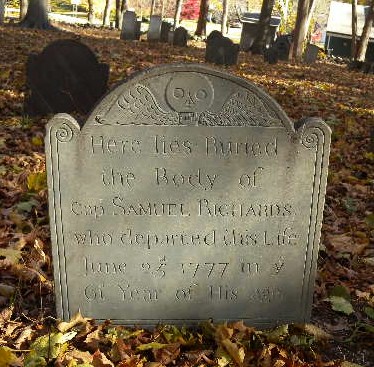
Davis traveled to New York. Samuel Richards returned to Norwalk but died very soon after, on 23 June. His gravestone appears above, courtesy of Find a Grave.

TOMORROW: Benjamin, Jr.

Wednesday, August 19, 2026

“Leave for his brother Benjamin, his son and servant, to depart this State”

As the year 1777 began, the Loyalist Benjamin Davis remained in the Boston jail along with his son and an enslaved servant.

Davis refused to petition the Massachusetts General Court for his release since he didn’t want to recognize the independent state government. But his religious scruples didn’t stop his brother Edward.

On 4 February, Massachusetts Council member Benjamin Austin came into the assembly chamber with
a petition of Edward Davis, of Boston, in behalf of his brother, Benjamin Davis, and son, prisoners in Boston Goal, praying that they may be permitted to go with a cartel to Newport
A “cartel” was the mechanism for a prisoner exchange.

The legislature named a joint committee of Austin and two House members to consider the request. The next day, that committee recommended “That the petitioner have leave to withdraw the same.” The General Court approved. That was a polite way of saying no.

On 18 February, jailer Joseph Otis listed his prisoners. Among the men noted as “being Enemical to the States” was Benjamin Davis but not his son. Benjamin, Jr., might have been paroled into the town, or at twenty years old he might still have been too young to merit his own listing.

On 6 March, the House noted
A petition of Edward Davis, praying leave for his brother Benjamin, his son and servant, to depart this State, in a cartel vessel bound for Halifax.
This time the response was “Read and dismissed.” That was a blunt way of saying no.

A newly elected legislature took their seats in May. Even as the House was getting itself in order
Nathan Cushing, Esq; brought down a Petition of James Richards, of Norwalk, praying that Mr. Benjamin Davis, a Prisoner in Boston, may be exchanged for his Brother Capt. Samuel Richards, a close Prisoner in New York Goal.
Again, the lawmakers referred this to a committee.

On 2 June, the Massachusetts House and Council reached this agreement:
Resolved that the prayer of the within petition be granted, & that Benjamin Davis now a Prisoner in the Goal in the town of Boston, be exchanged for Capt. Samuel Richards a prisoner in New York, provided that proper care be taken that sd Davis does not carry any papers with him & is cautiously sarched when deliver’d up. And it is also

Resolved that Benjamin Davis junr. Son of the aforesaid Davis, now a Prisoner in Boston Goal be exchanged for Mr John Callender a Prisoner in New York, provided due caution be taken that he does not carry any papers with him & is properly sarched when deliver’d up. But if said Callender or some person of equal rank should not be procured in Exchange for said Davis that said Davis be returned to this State.
Two days later, according to what Davis later told the British government, he was let out of the Boston jail. By the end of the year, it appears, the Davises were established in New York.

TOMORROW: The other side of those exchanges.

Thursday, August 06, 2026

Hopestill Capen from the Cornfields to the Jail

On 6 Aug 1776, 250 years ago today, authorities in Boston locked merchant Hopestill Capen (1731–1807) in jail for “aiding and abetting those called enemies to the Colonies.”

For decades Capen had run his dry goods business at the sign of the Cornfields in a building he owned, now known as the Union Oyster House. He served as a militia officer and held minor town offices.

Late in 1769 Capen took on Benjamin Thompson as an apprentice, but that arrangement didn’t last long. The merchant later reportedly told the teenager’s mother “he oftener found her son under the counter, with gimblets, knife, and saw, constructing some little machine, or looking over some book of science, than behind it, arranging the cloths or waiting upon customers.”

from 1771 until just before the war, one of Capen’s tenants in the building was the Whig printer Isaiah Thomas.

During that time, Capen had become known as a mild Loyalist. He signed the complimentary addresses to Gov. Thomas Hutchinson and Gen. Thomas Gage, and he joined the protest against the Solemn League and Covenant.

Capen chose not to evacuate with the British military in 1776, however. Unlike many Loyalists, he had deep family roots in Massachusetts, and all his property was there.

In April 1776 the Massachusetts House directed the Suffolk County justices and sheriff to detain and question dozens of individuals suspected of disloyalty. Capen was fifth on that list, showing his prominence in town.

But it wasn’t until the summer, after Massachusetts had declared independence from the Crown, that the Council ordered those authorities to lock Capen up. No one ever appears to have ever produced evidence of him “aiding and abetting” Crown forces, but he did refuse to pledge allegiance to the new state.

Capen presented himself as a conscientious objector, motivated by religion. In the 1760s he had joined Boston’s small Sandemanian sect, and he said that his faith required him to stay out of the war.

Some analysts have described the Sandemanians as pacifist because of statements like Capen’s. But he wasn’t opposed to military action in principle. He’d been an active member of the Ancient and Honorable Artillery Company as well as the colonial militia, and during the siege he became a sergeant in a Loyal Associated Volunteers under Capt. Adino Paddock.

Rather, the Sandemanian creed said believers should be loyal to the government in control on the grounds that it must be divinely ordained. With the war still going on, and thus divine will not yet clear, Capen insisted that he couldn’t promise his allegiance to the U.S. of A.

Saturday, May 23, 2026

“The consideration of the Petition of Preserved Clap”

In the spring of 1776, Dr. Preserved Clap was forty-five years old. He had a wife and young children back in Amherst. And in Boston he was being hailed as a “Genius” for his idea of how to put damaged cannon back to work. So he stayed.

Though he used the title ”Doctor” and was identified by the Rev. Samuel Cooper as “a Country Surgeon,” I haven’t come across any example of Clap performing medicine. But he threw himself into mechanical tasks.

The authorities put Clap in charge of a team to salvage as many of the artillery pieces the British left behind as they could. Those men appear to have worked into the summer, and then Clap petitioned the Massachusetts General Court for pay.

On 16 September that legislature put into its record:
MEMORIAL of PRESERVED CLAP Overseer. of the Men employed in opening, and stocking the Cannon at Boston, and Castle William.
setting forth
That he and the Men attended that service, for the term of Time specified, for which he, nor they have received any pay therefore the memorialist prays, that the Honorable Court would give him an Order upon the Treasurer for the State aforesaid for the Amount of his Account. or otherwise relieve him as shall seem meet.

The Committee to whom was referr’d the consideration of the Petition of Preserved Clap, have attended that Service, and beg leave to Report by way of Resolve.

several other Accounts exclusive of said Clap’s accompanying this petition, the Committee did not take into consideration as said Clap had no orders to receive the amount of the same,

said Committee do not know of any further service for said Clap.

Resolved that there be paid out of the Publick Treasury of this state to Preserved Clap Forty Three Pound one shilling & Tenpence in full for his within account

and whereas Said Clap Says that he has envented a machine for Boreing Cannon, which may be improved to the grate advantage of this State, therefore

Resolved, That if Said Clap will exhibet a Plan, or Modle of Said Machine, to Hugh orr Esqr and others, a Comtee. for Casting Large Cannon So as to Satisfy them of its Superior utility, upon their report thereof to this Court there Shall then be granted to him Such a Sum for his envention as may appear to be adequate to its Superior usefulness.
Hugh Orr (1715–1798) had come to Massachusetts from Scotland in 1737, settling in Bridgewater after a couple of years. There he built a forge and the first known trip-hammer in British America. Though Orr’s main product was farming implements, at times of war he shifted his works toward making weapons, including muskets in 1748.

In 1776, Orr was representing Bridgewater in the General Court and working to set up a cannon manufactory. Naturally, the legislature set Dr. Clap to him. However, there’s no evidence anything came of that.

Two months later, on 14 November, the Independent Chronicle newspaper ran this notice:
BOSTON, November 11, 1776.

THIS may certify, that Doctor Preserved Clap, has opened the cannon at Castle-William that were spiked up by the enemy; and is the real inventor of a carriage, whereby the cannon that had their trunnions broken off, by this new invented carriage the guns are rendered serviceable, which otherwise would have been useless.

Attest, RICH. GRIDLEY, Chief Engineer.
I looked to see if there was any competing claim to have invented that method of mounting guns in 1776, but I couldn’t find one. Dr. Clap really wanted public credit for his ideas.

TOMORROW: Making a national case.

Tuesday, May 19, 2026

“They talk of sinking Hulks by the Castle”

On 29 Apr 1776, one week after writing the letter to John Adams that I quoted yesterday, the Rev. Dr. Samuel Cooper wrote to Samuel Adams:
this Town…is now in some better Posture of Defence, but the Works proceed slowly. I must repeat what I said to you in my last, There is an absolute Necessity of some able active Commander here, such as [Nathanael] Green, [John] Sullivan, [Israel] Putnam &c upon other Accounts besides fortifying, tho this is of extreme Importance in our Situation— . . .

We have some good Lines, excellent Cannon at Fort Hill; this is all our Defence at present, except the Works thrown up at Dorchester Point which are said to be good—We are now going to erect Works at the Castle, & hope to have a Line of Guns well defended, on the Eastern Point; & are preparing to sink Hulks, between the Rocks of Castle Island, & the lower middle Ground.

The Enemy employ’d no little Time in ruining all the old Works there, and destroying the Guns…
Cooper still wanted someone besides Gen. Artemas Ward to supervise the defense of Boston, but his description of the town’s defenses was a little advanced from the previous week.

A 22 April letter from Boston quoted in the Connecticut Gazette of New London also said: “Tomorrow they talk of sinking Hulks by the Castle.” Those hulks were the keels of old ships, meant to impede Royal Navy warships from sailing easily into the inner harbor.

Of course, those same obstacles would also be a problem for merchant vessels, or American warships. On 30 April James Warren told John Adams: “No hulks as yet sunk; the people of Boston seem much against it; and whether it will be done or not I can’t say.” After all, Warren was merely the speaker of the Massachusetts house.

On 9 May that legislature directed its harbor defense committee “without delay to sink the Hulks.” But on 23 May the Boston town meeting voted (unanimously, it was later said) against that measure. The General Court on 5 June suspended the operation, though empowering the committee to proceed “upon any sudden Alarm or appearance of danger.”

Soon enough, fear of British warships invading Boston waned. No hulks were sunk in the harbor.

Monday, May 18, 2026

“In what a defenceless State we still remain”

I was preparing to write about a document from the Samuel Adams Papers at the New York Public Library, digitized as “Letter from John Scollay” dated 22 Apr 1776.

But after taking a closer look, I realized that only the first two four pages at that link come from a letter by selectman John Scollay. And the first two pages of Scollay’s letter are at this link, called “Letter from William Davis”—which is indeed accurate for the first two of four pages there.

The file called “Letter from John Scollay” also contains a two-page letter from the Rev. Samuel Cooper, dated 29 Apr 1776. His signature is abbreviated, but the handwriting matches Cooper’s other letters in this collection.

The Cooper letter closes by saying he’d recently written to John Hancock and John Adams. The letter to Hancock isn’t listed in the John Hancock Papers project, so it probably hasn’t survived. But the Adams Papers does offer a 22 April letter from Cooper matching the style and concerns as the letter to Samuel Adams.

In particular, Cooper told John Adams he was worried about Boston’s defenses:
After so many Weeks Possession of this Town you would be surpriz’d to see in what a defenceless State we still remain. The Business of Fortifying has lain between Genl. [Artemas] Ward and a Committee of the General Court: Between them both, little or nothing has yet been done. We have but 7 or 8 Guns mounted on Fort Hill. Nothing yet done on any Island in the Harbor.

A British Ship of 40 or 50 Guns with two or three small arm’d Vessells are in Possession of King Road and Nantasket. They take or drive away almost all supplies coming to us by Water; and (would you believe it!) with this inconsiderable Force the Harbor has been, and is now effectually block’d up. Two or three Ships of War have had it in their Pow’r ever since the Evacuation of the Town to come up and cannonade it.
That warship’s primary mission was to stop other British ships from going into the harbor unaware that it waw now in rebel hands. But of course Cooper and other Bostonians couldn’t be sure it wouldn’t attack.
Ward complains that too small a Force, but 5 Regiments not full, were left him. The Court blame him for Inactivity, and He them. I was pleas’d to see your Letters and others from Gentlemen of the Congress mentioning the Importance of putting this Harbor into the best State of Defence. Pray write again and again to press this Matter.

There is a Report here that Ward has desir’d to resign. I wish from my Heart He would do it. He is a good Man, a thoro N. England man, and dispos’d to do us ev’ry Service in his Power. But He certainly wants Decision and Activity. It is of absolute Necessity that some General Officer of the best Qualities be sent to this Department immediately. Pray let [Nathanael] Green or some other be plac’d here.

We are in the utmost Hazard, should the Enemy return, of loosing in this Quarter much more than we have gain’d, by the Departure of the British Forces. Had there been a Man here, at the Head of the Military who would have discern’d at once what was proper to be done; and stated it to the Court, we might have been in a good Posture of Defence Weeks ago.
Ward had indeed put in his resignation on the grounds of ill health, then asked to remain so he could help Massachusetts rebuild. Cooper wasn’t the only local to say Ward moved too slowly. When the minister wrote this letter, however, it had been less than three weeks since Gen. George Washington had departed and left Ward in charge. It therefore doesn’t seem fair to suggest Boston could have been fortified against ocean attack “Weeks ago.”

Sunday, April 26, 2026

“John Hill be sent under a proper Guard to Boston Goal”

As recounted yesterday, on 25 Apr 1776 the Massachusetts General Court issued a resolve to catch John Hill, an Irish-born Loyalist accused of helping to loot Boston as the British evacuated.

I haven’t found any newspaper advertisements for Hill, suggesting that local authorities located him within just a few days.

The Marblehead committee of correspondence sent the man back to Watertown, and on 1 May the legislature passed a new act: 
Whereas John Hill a Prisoner now before this Court is justly suspected to have been assisting Crean Brush in Robbing the Inhabitants of the Town of Boston of their Goods & Merchandize

It is therefore
Resolved that the said John Hill be sent under a proper Guard to Boston Goal, there to be confined as a prisoner until he shall be Examined by the Seven Justices of the Peace of the County of Suffolk or the major part of them who are appointed to try associators and abetters of the Ministerial Army, which Justices are impowered to Examine the said Hill and deal with him in the same manner as if he had remained in Boston after the said Fleet & Army had gone away
Magistrates in Boston were questioning a long list of people who had stayed in town through the siege about their political loyalties.

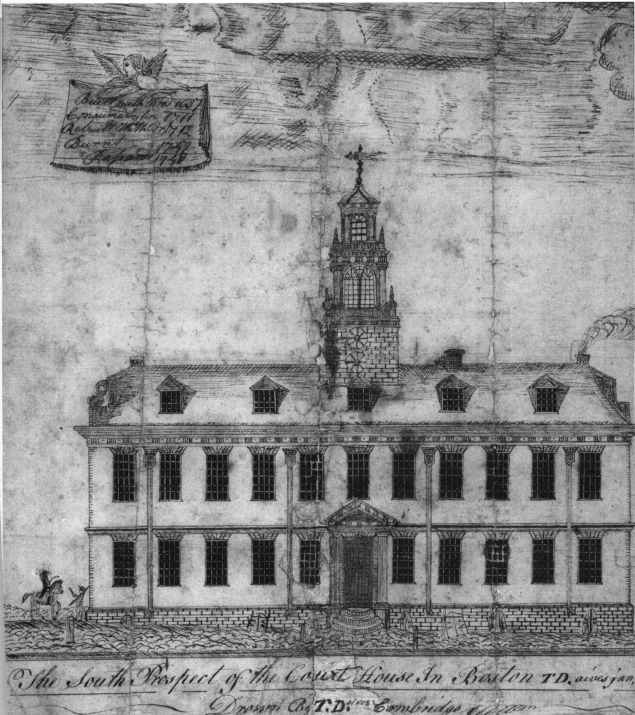
Boston’s “goal” or jail appears on the detail from the 1769 town map above, but barely. At the bottom of that image are two large buildings: the Town House, now the Old State House (lowercase a), and the First or Old Brick Meeting-House (big A). Above the meeting-house is the label “Church Square.” And above that, mostly worn off because of a fold, is the label “Prison.” That building faced onto Queen Street, now Court Street—named for the courthouse, which was conveniently near the prison.

Hill remained in that Boston jail for several months. The United States declared independence. The British military returned to New York in force.

On 18 October, the Connecticut Gazette of New London reported:
Last Saturday [12 October], the Wife and Daughter of one John Hill, a Prisoner in Boston Goal, for being concerned with Crean Brush and others, in Robbing the Inhabitants of Boston, when that Place was evacuated; came to this Town from Providence by Water, and was endeavouring to get a Passage to the West End of Long-Island, but were stopped by the Committee of this Town, and on Examination were found upon them, sundry Papers, containing Matters of Intelligence respecting the People, and State of the Country, sent from said Hill and others in Boston, to be communicated to General [William] Howe;…
TOMORROW: Mystery women.

Saturday, April 25, 2026

“That the said Hill be immediately apprehended”

John Hill was yet another of the Loyalists captured aboard the brig Elizabeth.

[I feel like I’m never getting away! Then again, that’s probably how those passengers felt when they were brought back to New England after trying to evacuate.]

According to recent research shared in the Loyalist Directory, John Hill was born in Ireland about 1737. He moved to New York City in the early 1770s and ran an inn.

In March 1775, Hill came to the aid of William Cunningham during a fight near New York’s Liberty Pole (shown here). Hill later told the Loyalists Commission that “a Mob…beat us with Clubs, and stoned us.” The two men were thrown into prison and put on trial in April. But the foreman of the jury, John Wetherhead (another future Loyalist), kept them from being convicted and punished.

Cunningham and Hill “escaped to Boston,” reaching the besieged town by 5 May. They enlisted in the militia company of James Forrest, another man from Ireland. Hill said he was “appointed Quarter Master to the same Company.”

In March 1776, Gen. William Howe decided to evacuate the town. He ordered Crean Brush to confiscate all cloth that could be useful to the Continental Army. Brush enlisted Richard Hill, formerly sheriff in his county of northeastern New York (which would become Vermont), as an assistant. Richard presumably brought his younger brother, John Hill, onto that team.

As ships pushed off from Boston’s wharves, John Hill and his family squeezed onto the Elizabeth along with Brush, most of the confiscated goods, a squad of British soldiers, and other Loyalists. In Hill’s words, “on the 17th of March 1776, he left Boston, with the Royal Army; but was taken at Sea, by the Rebels.”

The brig, its property, and its wealthiest passengers were sent to Portsmouth, New Hampshire. The Hill family and several others were landed on Cape Ann by 7 April. The Massachusetts authorities summoned John Hill to Watertown for questioning.

On 19 April, the Massachusetts Council reported:
The Committee appointed to examine sundry Persons taken on board the Brigt Sally [sic] bound to Hallifax, & sent to the Council by the Committee of Marblehead…examined [John] Hill who informs your Committee that he is a native of Ireland that he came to New York three or four years since that he came to Boston about ten months ago on the removal of the troops from New York to Boston for the recovery of monies due to him from them and that for the same purpose he was going to Hallifax having acted as a Sutler among the troops.
Sailing off to Canada out of political loyalty was suspect. Sailing there just to collect debts from soldiers seemed more reasonable to these office-holders.

The Council agreed that Hill should be allowed to go free after providing a “written parole not to bear arms against the United Colonies, nor in any way aid or assist the Enemies of the said Colonies.” He probably headed back to Cape Ann to find his wife and at least one child.

In Boston, however, some merchants were still seething at how Brush and his assistants had taken their property. That property itself was up in Portsmouth, being sorted by Continental agent Joshua Wentworth. More information filtered back to Watertown.

On 25 April, 250 years ago today, the whole Massachusetts General Court passed a new resolve:
WHEREAS a certain John Hill, lately taken Prisoner by Commodore [John] Manly, in a Vessell bound from Boston to Hallifax, and brought into Portsmouth, was examined before the Council; and no Evidence then appearing against him, he was discharged & set at Liberty;

And whereas it hath since been made to appear to this Court; that the said Hill, at the time he was taken, as aforesaid, had in his possession Chests, Trunks & Packages of Goods and Merchandizes to the value of three hundred pounds Sterlg. supposed to have been stolen from the distressed Inhabitants of the Town of Boston; and was an Assistant to Crean Brush in his late unwarrantable and highhanded Thefts & Robberies
Therefore

Resolved, That the said Hill be immediately apprehended, wherever to be found, & brought before this Court for Examination, touching the Premises, and all Sheriffs, Constables & other executive Officers, and all the good People of this Colony, are hereby directed & impowered to apprehend the said Hill, wherever he may be found, and bring him forthwith before this Court, in order that he may be dealt with for his aforesaid highhanded Crimes, as to Law & Justice appertains.
TOMORROW: The manhunt was on!

[Boston also had a justice of the peace named John Hill, very involved in events surrounding the Boston Massacre. Unfortunately, the same tag applies to both men, but I think context will make it easy to sort out their stories.]

Thursday, April 23, 2026

“Without the Privelege of Pen, Ink, Paper or Candle”

In April 1776, Watertown was the seat of Massachusetts’s government.

Though people could now go into Boston, that town was still reeling from the siege. Plus, there was smallpox.

So the Massachusetts General Court stayed in Watertown—the assembly in the town’s meeting-house and the Council in an upper chamber of Edmund Fowle’s house (now headquarters of the Historical Society of Watertown, shown here).

Under the provincial charter, because the governor and lieutenant governor were absent (both driven away by the war), the Council exercised executive power.

That’s why, on 12 April, James Otis, Sr., as senior member of the Massachusetts Council, signed this order to imprison five genteel Loyalists captured aboard the brig Elizabeth:
To the Keeper of the Goal at Boston, in the County of Suffolk—Greeting—

You are hereby directed and commanded to take into your Custody Crean Brush, William Jackson, Peter Ramsey, Edward [K]eighley, and Richard Newton, lately taken in their flight from Boston in attempting to carry away from thence under the protection of the British fleet, large Quantities of Goods Wares & Merchandizes, the Rightful Property of the Inhabitants of that town, and having joined themselves with the Fleet & army employed against the united Colonies of America—

and you are commanded to confine the said Crean Brush William Jackson & Peter Ramsen [sic], each in an apartment by himself, without the Privelege of Pen, Ink, Paper or Candle, and not suffer them, or either of them to converse with any person whatever, unless in your hearing, and for the better Security of the said Crean Brush you are further ordered & commanded to put him into Handcufts immediately—

And them and each of them safely keep, ’till the further Order of the Major part of the Council, or they be otherwise discharged by due Course of Law—Hereof fail not at your Peril.
Two days later, Maj. John Grizzage Frazer, as assistant quartermaster for the Continental Army, wrote to Gen. George Washington to say that those men were now locked up. Brush was “in Irons.”

Frazer also passed on the news that on 12 April “8 british seamen” had made off with the cutter from H.M.S. Renown, one of the Royal Navy ships still hovering in the outer harbor, and got into Boston. Those defectors were much more welcome than the Loyalists who had tried to leave.

TOMORROW: Free William Jackson!

Monday, April 20, 2026

“Such Cost and Charge as hath arisen by their being brought before the General Court”

On 13 Apr 1776, the Massachusetts General Court decided that “Caleb Wheaton and others [well, other men], who were taken aboard the brig,” should be brought to its meeting-place in Watertown ”for Examination.”

Four days later, as quoted yesterday, the Marblehead committee of correspondence wrote to say they now thought two of Wheaton’s sons—Joseph and Caleb, Jr.—had stolen a local man’s boat about six weeks before. That apparently focused the legislators’ attention on the family.

On 19 April the Council and the House named members to a joint committee to question the Wheatons.

Four days later, those members determined that Caleb Wheaton, Sr., had been “an Associator”—a member of the Loyalist militia—inside besieged Boston. Furthermore, he had been “in other Instances unfriendly to American Liberty,” perhaps a reference to his work as a Customs officer in Maine, or his statements supporting Parliament back in early 1775.

But the two legislative houses disagreed about what to do with the Wheatons. The published record of the Massachusetts House, readable here, says simply that the Council approved the first recommendation from the committee and the assembly didn’t concur.

Peter Force’s American Archives, evidently based on more complete manuscript records from the Council, revealed more details. The committee recommended
that the said Caleb Wheaton give bond to the Treasurer of this Colony for the sum of three hundred Pounds, with sufficient surety for his future good behaviour, or be confined in some Jail within this Colony until he shall find such surety; or if the said Wheaton shall think proper, and shall procure his passage for himself and family to Nova-Scotia, he may have liberty to remove there on his own expense, provided he will give his promise in writing, not to bear arms against the United Colonies.

And that the said Caleb Wheaton, Jun., and Joseph Wheaton, upon their giving their written paroles not to bear arms against the United Colonies, nor any way to aid or assist the enemies of said Colonies, and they paying the expense of being brought before this Court, may be discharged.
After the lower house said that wasn’t good enough, two more legislators were added to the joint committee, and they went back to rethink their recommendation.

The next day the Council approved a revised proposal:
  • All three Wheatons would be responsible for a £500 bond.
  • They not only had to promise not to fight the colonies, but also “not correspond with any of the Enemies of America.”
  • They had to “pay such Cost and Charge as hath arisen by their being brought before the General Court.” 
  • If any of those conditions weren’t met, they would be “committed to close confinement.”
There was no more mention of letting the Wheaton family resume their trip to Nova Scotia.

On 25 April the House considered those strictures and agreed. (Its journal says “close Imprisonment” instead of “close confinement,” if that matters.)

The committee report on that measure, signed off by Caleb Cushing of Salisbury for the Council, Perez Morton as Council secretary, and James Warren as speaker of the house, went up for auction last year.

Caleb Wheaton came back on 4 May with a petition to the House
setting forth that he has been apprehended as inimical to his Country, that he is released by giving Bonds, and is now in low Circumstance; and praying therefore that he may be enabled to recover his Household Furniture, Provisions, &c. on board the Brig Elizabeth, at Portsmouth; whereby he may support himself and Family.
The assembly gave Wheaton “Leave to withdraw his Petition.” In other words, it said no.

The Massachusetts legislature, especially the lower house, was in no mood to do any favors to Loyalists. In fact, the Wheatons even had to pay the costs of being transported to the General Court. And it appears Caleb, Sr., later told the British government that he was locked up for three months. The Wheatons’ case reflects a popular mood in the spring of 1776 that affected other Loyalists as well.

TOMORROW: William Jackson returns to Boston.

Sunday, April 12, 2026

“What I am to dow whith the Prisoners for I have Thirtey hear now upon Expences”

A lot of the correspondence that followed the Continental capture of the Elizabeth in April 1776 involved money.

First, there was the cost of housing the prisoners taken on that brig.

Eleven men were sent to Gloucester, including four British soldiers and Caleb Wheaton, the Customs officer from Maine. Their families came along.

Winthrop Sargent, Sr. (1727–1793), the Continental Army’s agent at that port, wrote to Gen. George Washington on 7 April:
The Bayer [bearer] of this has under his Gard a Number of Prisoners & Toreys tachen by Comodor [John] Manley & Capt. [Daniel] Warters the Prise is sent to Portsmouth I mack Know doubt you have had Acount of before this Reaches your Excellence thar nams you have below

thare is two Women & Sum Children Left hear which is not Abel to Travel Should be glad your Excellence would Send me Answor to what I Roat you Last about Capt. Watt:s Goods and what I am to dow whith the Prisoners for I have Thirtey hear now upon Expences.

I Rem[ai]n You[r] Hume Sarv.
Winthrop Sargent, Agent

P.S. Sence I rote the above Capt. [Samuel] Tucker here Carres the Prisners to Marvelhead ware thay well be sent to head Quartr will not Carrey the women & Children for fear of the Small Pox so I am fors to porvide for them hear Should be glad of your Order in Regard to the afore
Capt. Tucker on the armed schooner Franklin carried twenty-two people, including the Wheatons, to Marblehead on 9 April. That town’s committee of correspondence sent Azor Orne to ask the Massachusetts Council what to do with them.

On 13 April, the legislature “Resolved that the Soldiers belonging to the British Army, with their Wives and Children, be sent to General [Artemas] Ward.” Apparently they would be treated like other prisoners of war.

The Marblehead committee would be responsible for maintaining all the civilian women and children, tracking the expenses so the town could “endeavour to have the same discharged out of the Monies arising on the Sales of the Cargo and effects found on Board the said Vessel.”

And that was where the big money was. John Rowe heard that the Elizabeth had “Twenty five Thousand pound Sterling On board—in English Goods & Other Merchandise.” The Boston Gazette reported, “she is estimated to be worth about 35,000l. sterling.”

Cdre. Manley had sent the brig into Portsmouth, New Hampshire, where Continental agent Joshua Wentworth would go through the legal process of ”condemning” the ship and its contents and putting them up for auction. Manley, his captains, and his crews were no doubt anticipating a good payday.

TOMORROW: What to do with the Wheatons.

Friday, February 27, 2026

“Possibly not the best man to colonize a new country”

I’ve been analyzing a letter from the Thomas Gage Papers at the Clements Library, written by Jonathan Hastings, Jr., on 11 June 1775.

Hastings addressed his correspondent as “Friend Jacob.” Their families were known to each other, and Jacob probably had connections to Harvard College.

Another clue to Hastings’s correspondent is his comment “Am happy you had so safe a Passage & found your Friends well.” Jacob was obviously traveling. Hastings then offered basic information about the siege, meaning he knew Jacob was far from Massachusetts. Crown forces probably intercepted the letter at sea, not on land.

I looked at the entries in Sibley’s Harvard Graduates for Harvard students in this period named Jacob who might have gone abroad. Almost all were settled down as ministers by 1775, usually inside Massachusetts.

One remaining candidate is Jacob Welsh (1755–1822) from the class of 1774. He was the son of John Welsh (1730–1812), a Boston jeweler and member of the club that used the silver punch bowl now called the “Sons of Liberty Bowl.” This Jacob had one brother, John, Jr., born in 1757.

Sibley’s says nothing about Jacob Welsh’s whereabouts between graduating in July 1774 and entering the Continental Army as an ensign at the start of 1776. (He served until late 1778, first at Fort Ticonderoga and then in the artillery.) Did Welsh leave Massachusetts in that stretch, missing the start of the Revolutionary War because he was in Europe, the Caribbean, or the west?

Jacob Welsh did prove more peripatetic than most of his peers. In addition, Sibley’s says, he “looked for the main chance wherever it might present itself.” After the war he settled in Lunenburg briefly, serving as the town’s legislative representative. But then he sailed to England, smuggling home a “carding and spinning machine” in hopes of securing a state patent for himself. In 1791 Welsh went to Philadelphia and applied to President George Washington to help build the new national capital. He invested in lots of land, as far afield as Louisiana.

In 1807, it appears, Welsh wrote to Gen. Henry Burbeck, a fellow veteran of the Continental artillery corps. According to Heritage Auctions, he submitted “suggestions for the defense of Boston,” including “substitutions for round cannonballs.”

By 1809 Welsh faced a legal judgment of almost a thousand dollars owed to a merchant in Salem. The authorities began to seize his local property. Welsh lit out for Geauga County, Ohio, to manage land that his father had bought a decade before. A county history published in 1878 stated:
Jacob Welsh was a native of Boston, of an old family, and reared in luxury, possibly not the best man to colonize a new country. At the time he came to Ohio, he was a middle-aged man; a gentleman of the old school, of medium height, fair complexion, dressed in small-clothes, with long hose and buckles at the knee, and shoe-buckles over the instep, liberally educated, of imposing appearance and stately address, quite fitted to the aristocratic drawing-rooms of Boston, but not appearing to especial advantage in the woods, trails, and cabins of the Western Reserve. While he was a good conversationalist, he had little energy, small business capacity, and a large disposition to spend money.
After another decade, enough people had settled around Welsh’s land to form a township. He promised his neighbors to “give glass and nails for a meeting-house, and fifty acres of land, to settle a minister.” In return, the township was named after him. In April 1820 Welshfield Township had its first election, and Jacob Welsh was chosen to be a trustee.

According to that county history, after Welsh died in 1822 locals found that he had “forgot” his promised bequests. Twelve years later, the community changed its name to Troy Township. That township’s website offers a more compact version of the story while Sibley’s says Welsh did make his promised donation. The county histories from 1878 and 1880 seem best documented, so I’ve relied on them.

Jacob Welsh’s gravestone appears above, courtesy of Find-a-Grave. The central, unincorporated part of Troy Township is still called Welshfield.

Monday, November 24, 2025

The Laboratory beside Boston Common

As described in The Road to Concord, Boston’s South Writing School shared a fenced-in yard with the militia train’s newer gunhouse.

In September 1774, the two small brass cannon stored in that gunhouse disappeared, even as British regulars stood guard at its door.

Frustrated Royal Artillery men hauled away the rest of the train’s equipment. Then came the outbreak of war, the siege, the evacuation. And Boston had it gunhouse back.

Except it didn’t have the train’s guns anymore. The town meeting sent a committee of Thomas Crafts, Paul Revere, and Thomas Marshall to ask Gen. George Washington for those brass cannon, but they were already on their way to the New York theater.

The state military establishment scrounged up more cannon, mostly old iron guns abandoned by the British military. But those weapons were in demand, needed to arm ships and guard the harbors. Leaving them in a building beside the Common didn’t make sense.

What do you do with a gunhouse that has no guns to house? We can see the answer in a report in the 15 Aug 1776 New England Chronicle about how the town celebrated the eleventh anniversary of the first Stamp Act protest: “a Detachment of the Train of Artillery, with two Field Pieces, marched from the Laboratory into King-Street.” 

The gunhouse was turned into a “Laboratory” or workshop for making weapons, especially artillery equipment. On 3 December the Massachusetts House formally discussed how “to have a laboratory established,” but even before its committee finished its work the 27 Jan 1777 Boston Gazette was telling readers to find Col. Thomas Crafts “at the Laboratory” if they wanted to store their gunpowder.

Crafts had been second-in-command of the train before the war. He’d tried for the rank of artillery colonel in the Continental Army in late 1775 but was rebuffed. Massachusetts then made him colonel of its own artillery regiment, and that job included overseeing the Castle and “the Laboratory on the Common.”

The man running that workshop was William Burbeck (1715–1785, represented above by his gravestone on Copp’s Hill). He had been storekeeper of ordnance at Castle William until the war broke out, then slipped away to become lieutenant-colonel and second-in-command of the Continental artillery regiment under Col. Richard Gridley.

At the end of the siege of Boston, Burbeck informed Gen. Washington that his commission came from Massachusetts, not the Continental Congress. He would therefore stay in Massachusetts, not heading down to New York (or serving further under Col. Henry Knox, thirty-five years his junior).

Burbeck immediately went to work improving Massachusetts’s military supplies. By 18 Apr 1776, the Massachusetts General Court discussed how to supply him “with Powder, wherewith, to prove the Cannon lately Cast for the Use of the Colony.” A year later, he was chosen as the Continental agent to inspect gunpowder.

In the spring of 1778 the state legislature approved regulations for the laboratory in Boston, and that October it unanimously chose Burbeck to be “Comptroller of the Laboratory.” 

A year later, the legislature appointed Burbeck captain-lieutenant of the Castle (under John Hancock as captain of the castle, who was soon more busy as governor). Burbeck remained comptroller of the laboratory, but in early 1782 the General Court determined that work had “greatly decreased,” so it adjusted his pay accordingly while still making him responsible for the facility.

These days we might raise questions about having a weapons workshop, possibly used for testing gunpowder, right next to a school. But the people of newly independent Boston didn’t see a problem. What could go wrong?

TOMORROW: Fire!

Saturday, November 08, 2025

“A proper Method for bringing Dr. Church before the House”

As described yesterday, on 17 Oct 1775 the Massachusetts General Court decided to summon Dr. Benjamin Church to Watertown to explain why he’d sent a ciphered letter into British-occupied Boston.

Dr. Church’s first response to that action arrived on 23 October, as reported by James Warren: “The Speaker communicated to the House a Letter received from Dr. Church, wherein he expresses a Desire to resign his Seat in the House of Representatives.”

The previous month, Church had also tried to resign as Surgeon-General of the Continental Army, following a month of turf disputes with regimental surgeons. Gen. George Washington and his aides had urged him to stay, only to be blindsided by that ciphered letter. Those two resignations suggest that Church was realizing what a hole he’d dug for himself and just wanted to go away.

The legislators didn’t want to let Church go, though. Particularly Speaker Warren. He’d been immersed in this case since Washington had called him to Cambridge to share the first hints of the doctor’s dealings.

Back on 1 October, Warren had written to his friend John Adams:
Dr. C——h has been detected in a Correspondence with the Enemy at least so far that a Letter wrote by him in Curious Cypher . . .

We all thought the Suspicion quite sufficient to Justify an Arrest of him and his Papers, which was done, and he is now under a Guard. He owns the writeing and sending the Letter. Says it was for [John] Fleeming in Answer to one he wrote to him, and is Calculated, by Magnifying the Numbers of the Army, their regularity, their provisions and Ammunition &c, to do great Service to us. He declares his Conduct tho’ Indiscreet was not wicked.
Something had to be done. The legislature therefore voted on 23 October to let Church’s resignation letter “lay on the Table, till the Committee who are directed to consider a proper Method for bringing Dr. Church before the House shall report.”

As Warren and others understood by this time, the Continental Army rules and regulations didn’t allow a court-martial to sentence a spy to death. Gen. Washington was therefore holding off on formal proceedings. His most recent council had decided “to refer Doctor Church for Tryal & Punishment to the General Court of Massachusetts Bay.”

On 26 October the house committee came back with their recommendation. They started by stating that Church “has been convicted by the Judgment of a Council of War, at which his Excellency [Gen. Washington] presided, of having carried on a criminal Correspondence with the Enemy.”

In fact, Washington’s councils weren’t courts and had no power to convict anyone. But neither did the legislature have the power to try and punish Church as the last council suggested—all the General Court could do was expel the doctor. Each body was pushing for the other to take on the authority of judging Dr. Church. And everyone was still waiting for guidance from the Continental Congress.

The General Court voted:
…whereas the said Benjamin Church is also a Member of this House, and the Charge brought against him is of so criminal a Nature, that it is the Duty of the House to make strict Enquiry into the Fact, and upon Proof of the same to manifest their utter Abhorrence thereof:

Therefore, Resolved, That Mr. William Howe, the Messenger of this House, be and he hereby is directed on Friday the 27th of October Instant [i.e., this month], to apply to his Excellency George Washington, Esq; for a sufficient Guard, safely to conduct the said Benjamin Church to and from the Barr of this House, and being furnished therewith, to take the Body of the said Church and bring him to the Barr of the House accordingly, at Ten o’Clock in the Forenoon of the same Day.
On that Friday morning, there was a motion “That there be fixed in the Alley [i.e., aisle] a Bar, at which Dr. Church will be brought.” The stage was set.

I’ll speak about what happened next in Watertown on Sunday afternoon, as detailed here.

TOMORROW: Records of the case.

Friday, November 07, 2025

“The House being jealous of their Priviledges”

As recounted yesterday, on 4 Oct 1775 Gen. George Washington and his fellow generals realized that the Continental Congress’s articles of war weren’t strict enough about passing information to the enemy.

Which was a problem since they had just uncovered evidence that the head of the army’s hospitals, Dr. Benjamin Church, had been doing just that.

In reporting the situation to John Hancock as chairman of the Congress, Washington respectfully wrote that he was “suggesting to their Consideration, whether an Alteration of the 28th Article of War may not be necessary.”

Dr. Church didn’t just have a military appointment. He was also one of Boston’s four representatives in the Massachusetts General Court, elected back on 18 July. Of course, that town meeting hadn’t happened inside British-held Boston. Instead, the “dispersed” inhabitants had gathered in the meetinghouse at Concord.

Dr. Church was active in the first few days of the legislative session in Watertown’s meetinghouse. But in August he took up his new job overseeing the medical care of the army. Two of the other men chosen to represent Boston, Samuel Adams and John Hancock, were away in Philadelphia. That left John Pitts to speak for the town. But that assembly couldn’t do much to affect life in Boston then anyway.

Then in early October came the bombshell news that the army had put Church under arrest. People were soon hearing about why, but this was the house’s first formal response on 14 October:
ORDERED, That Mr. [James] Sullivan bring in a Resolve making a proper Application to General Washington, relative to the imprisonment of one of the members of this House, viz. Doctor Benjamin Church.
The resulting resolution said:
…the House being jealous of their Priviledges, and desirous to know the Cause of said Imprisonment:—— Therefore

Resolved, That the Speaker [James Warren], Mr. Sullivan and Major [John] Bliss, be a Committee to apply to is Excellency George Washington, Esq; requesting him as soon as may be to certify to this House the Cause of the Detention and Imprisonment of said Benjamin Church, Esq; that they may advise thereon.
On 17 October, Warren reported that he had received from Joseph Reed, Washington’s military secretary, “a Letter from Dr. Church to the Enemy, as decyphered by the Rev. Mr. [Samuel] West.” The house voted:
Resolved, That Dr. Church ought to be brought to the Bar of this House, to shew Cause, if any he has, why he should not be expell’d the same.
The next day, Gen. Washington sat down for a council with Benjamin Franklin, Benjamin Harrison, and Thomas Lynch from the Continental Congress and with officials from the New England governments. That meeting would run through 24 October and cover many topics. One item on the agenda was “What Steps are necessary to be pursued with Regard to Dr Church?”

The developments in Watertown offered an out: “Upon a Discussion of all Circumstances it was agreed to refer Doctor Church for Tryal & Punishment to the General Court of Massachusetts Bay.” As for what the army should do, given the articles of war, Washington would wait for the Congress’s guidance.

TOMORROW: Dr. Church makes his move.

Tuesday, November 04, 2025

“So soon as any coroner shall be certified of the dead body”

The Pilgrims of the Plymouth Colony established coroners as an elected office in 1636. By the end of the century, however, that colony had been absorbed into the province of Massachusetts Bay, and the monarchs William and Mary had issued a new charter for the province (shown above).

That 1691 charter stipulated:
it shall and may be lawfull for the said Governour with the advice and consent of the Councill or Assistants from time to time to nominate and appoint Judges Commissioners of Oyer and Terminer Sheriffs Provosts Marshalls Justices of the Peace and other Officers to Our Councill and Courts of Justice belonging…
The charter didn’t mention coroners, but everyone probably assumed they fell within the “other Officers” category. Such officials had presided over inquests in England for centuries, and in Massachusetts for decades. The big difference was that now the royal governor of Massachusetts, appointed by the ministry in London, would name coroners in every county, subject to the consent of the Council.

In 1700 the Massachusetts General Court got around to passing an act on “the office and duty of a coroner.” It stated:
every coroner, within the county for which he is appointed, shall be, and hereby is empowered to take inquests of felonies, and other violent and casual deaths committed, or happening within his precinct.
The law then devoted many more words to spelling out the oath that coroners would swear.

The next section said:
when and so soon as any coroner shall be certified of the dead body of any person supposed to have come to a violent and untimely death, found or lying within his county or precinct, he shall make out his warrant directed unto the constables of the same town where such dead body lies, or of three or four of the next adjacent towns, if need be, requiring them forthwith to summon a jury of good and lawful men of the same town, or such number as shall be sufficient, with those sent for from the neighbouring towns to make up eighteen in all, to appear before him at the time and place in the said warrant expressed
Then the law specified the language of the summons, the oath for the jury foreman chosen by the coroner, the oath for those jurors, and the fines to be levied if the constables or prospective jurors didn’t do their duties. I’m pleased to report that the law let the coroner swear in jurors “by three or four at once,” or else we’d still be waiting.

Out of the pool of eighteen men called, the coroner would choose “fourteen or more” for a jury and give them this charge:
You shall diligently inquire, and true presentment make, on the behalf of our sovereign lord the king, how and in what manner A. B. here lying dead, came to his death; and you shall deliver up to me, his majesty’s coroner, a true verdict thereof, according to such evidence as shall be given to you, and according to your knowledge. . . .

to declare of the death of the person, whether he died of felony, or by mischance and accident? and if of felony, whether of his own or of another’s? and if by mischance or misfortune, whether by the act of God or of man? and if he died of another’s felony, who were principals and who accessaries? who threatened him of his life or members? with what instrument he was struck or wounded? and so of all prevailing circumstances that can come by presumption.

And if by mischance or accident, by the act of God or man, whether by hurt, fall, stroke, drowning, or otherwise, to inquire of the persons that were present, the finders of the body, his relations or neighbours, whether he was killed in the same place, or elsewhere? and if elsewhere, by whom and how he was thence brought? and of all other circumstances.

And if he died of his own felony, then to inquire of the manner, means or instrument, and circumstances concurring.
Coroners could also summon witnesses, and of course they had their own oaths to swear.

The jury findings were specified in such detail that coroners came to use printed forms, filling in the blanks with information about the dead person, the date, the jurors, and so on.

The 1700 law said coroners could collect 10s. per day for travel and expenses, plus 2s. per day for each juror, to be collected from the dead person’s estate (or a dead child’s parents). If not enough money was available, the county treasurer would pay out what was needed.

In 1726 a new law allowed coroners to appoint deputies. In 1739 the legislature decided “some of the coroners within this province have of late greatly multiplied their deputies, and under colour of such deputation persons have pretended to be exempted from duties,” so it made such deputies a temporary appointment.

In contrast, coroners, like justices of the peace, kept their jobs for life—but that meant either their own lifespan, or the lifespan of the monarch under whom they were appointed.

COMING UP: Up for renewal.

Monday, October 20, 2025

A New Schoolmaster for a New Town

In January 1764 the Massachusetts General Court passed a law allowing part of the town of Newbury to split off as the new town of Newburyport.

The new town held its first meeting on 8 February, choosing a clerk, selectmen, and other officials. The inhabitants also chose a committee to determine what schoolhouses the children needed. They decided to keep paying the masters of the Newbury grammar and writing schools for now.

In March that committee recommended:
that at least three large schools should be provided and maintained in sd. Town, viz: one Grammar school not far from the Revd. Mr. [John] Lowel’s meeting house, and two reading, writing & arithmetick schools, one of them adjoining to Queen street, Ordua Lane, or Bartlet’s Lane, preferring the latter, and the other adjoining or near Cross street or Elbow Lane.
That summer, the town bought some land on what is now Winter Street, beside Route 1, and started building a schoolhouse.

To oversee that school the selectmen hired John Vinal, usher of Boston’s South Writing-School. They offered him £80 per year, significantly more than he had been earning in Boston though less than what the bigger town’s schoolmasters earned. In addition, each pupil was to bring “two pistareens” to pay for firewood used during the year.

The selectmen announced: “Boys that can read in a Psalter will be received and carefully taught Reading, Writing & Arithmetick.” The school would meet 8 A.M. to noon and 1 to 4 P.M.

Vinal’s school opened on Monday, 5 November, with the Rev. Mr. Lowell and the selectmen present. Given that Newbury’s youth usually celebrated Pope Night with a big procession and bonfire, I imagine that student body was rather antsy that day.

John Vinal continued to look for ways to supplement his salary. The town needed to survey the “common and undivided land” near the Frog Pond, and in 1771 Vinal produced the map shown above, shared by History Newburyport. Around the pond it shows a burying-ground, a potash house, a ropewalk, a powderhouse, and a windmill.

TOMORROW: Vinal’s lessons.

Thursday, September 25, 2025

Boston’s “Sedan for Removing the Sick”

Lining up the sparse mentions of sedan chairs in colonial Boston reveals a clear pattern: they were used to transport sick people.

In 1674 the Rev. John Oxenbridge of the First Meetinghouse suffered a stroke while preaching the Thursday Lecture and “was carried home in a Cedan.”

Thirteen years later, Judge Samuel Sewall wrote in his diary: “Capt. Gerrish is carried in a Sedan to the Wharf and so takes Boat for Salem, to see if there he may find amendment of his Distemper.”

In May 1715, the newly reappointed governor Joseph Dudley was bed-ridden with gout. At the end of the month, Sewall wrote, he came to Boston and “was carried from Mr. Dudley’s to the Town-House in Cous. [William? Jeremiah?] Dummer’s Sedan: but twas too tall for the Stairs, so was fain to be taken out near the top of them.”

Yesterday I listed five times sedan chairs were advertised for sale in eighteenth-century Boston newspapers. I don’t think it was coincidence that four of those ads were estate sales, and the fifth seller died within two years. Those men might have acquired sedans as they or their wives became too ill to walk around.

Boston also had a public sedan chair, operated by the town itself. In March 1739, the Boston selectmen took note of “A Sedan, or Chair belonging to the Hon. Edward Hutchinson Esqr. which the Town has had the loan of for a considerable time.” One of those local elected officials was Thomas Hutchinson, and the sedan owner was his uncle. The selectmen decided that the chair “be effectually Repaired, and made fit for Use, in the best and frugal manner.”

That sedan chair became part of Boston’s public-health infrastructure. On 4 Jan 1757 the selectmen voted “that the Sedan for Removing the Sick be broke to Peices” and “Mr. [Isaac] Cazneau make a good Serviceable Sedan at the Charge of the Town.” Cazneau was a saddler.

In 1760 the Massachusetts General Court bought land in the sparsely populated western point of the Boston peninsula called “New Boston” for a new hospital. Four years later, the town suffered a serious smallpox epidemic. That appears in the selectmen’s records with an uptick in orders for the sedan chair to carry people to that hospital.
  • 16 Jan 1764: “Information was given the Select men by Dr. [Phillip] Cast, that One Hallet who came from Newfoundland a Month past, and Boards at Mrs. Nicholsons in Fitches Alley, has the Symptoms of the Small Pox upon him whereupon the Select men endeavour’d to perswade him to consent to his being removed, and having obtain’d such consent, he was accordingly removed in the Sedan to the Province Hospital at New Boston.”
  • 20 Jan 1764: “The Select men having prevailed with Mr. Adams to consent that his Child should be removed from his House to the Hospital at New Boston, they at about 12. OClock that Night took Mr. Williston and a number of hands with the Sedan to said House, when they received the Wet Nurse and Child and carried them to said Hospital”.
Similar entries appeared through August of that year.

TOMORROW: “Mr. Williston.”

(The picture above shows a sedan chair used to carry medical patients in La Paz, Bolivia, now in the Wellcome Collection in London.)