


J. L. BELL is a Massachusetts writer who specializes in (among other things) the start of the American Revolution in and around Boston. He is particularly interested in the experiences of children in 1765-75. He has published scholarly papers and popular articles for both children and adults. He was consultant for an episode of History Detectives, and contributed to a display at Minute Man National Historic Park.

Subscribe thru Follow.it


•••••••••••••••••


Showing posts with label John Anthony DeBerniere. Show all posts

Thursday, June 10, 2021

The Later Career of Henry DeBerniere

On 18–19 Apr 1775, Ens. Henry DeBerniere was in the column of British troops that marched to Concord and back. Having visited the town looking for cannon the month before, he was probably one of the main guides for his regimental commander, Lt. Col. Francis Smith.

A couple of months later, he drew a map of the Battle of Bunker Hill that I discussed back here.

We have just a few glimpses of DeBerniere through the next few years as the 10th fought at Brooklyn, Germantown, Monmouth, and Rhode Island. He became a lieutenant during the war, a captain-lieutenant sometime in 1783. As of 1792 he was a captain, still with the 10th Regiment, stationed on Jamaica. Three years later, he was promoted to major.

Britain’s wars with Revolutionary and Napoleonic France opened up more opportunities for career officers. In November 1796, DeBerniere transferred to the 9th Regiment with the rank of lieutenant colonel. Three years later, the regiment fought in Holland, including the Battle of Bergen (shown above).

In 1798 DeBerniere married Elizabeth Longley (1770-1858), eighteen years old and born the year the lieutenant colonel entered the army. That difference in ages may be why later sources estimated he was born later than he was.

Meanwhile, in 1799 Henry’s older brother, retired army officer John Anthony DeBerniere (1744-1812), and his family moved from Ireland to South Carolina. Papers from that branch of the family are in the collections of the South Carolina Historical Society. His gravestone is in the cemetery of St. Philip’s Episcopal Church in Charleston.

On 10 Nov 1805 three British transport ships sailed from Cork, Ireland, to carry Lt. Col. DeBerniere and the 9th Regiment to a new assignment on the continent. A storm blew up, and one of those ships, the Ariadne, was wrecked off Calais. All the regiment’s staff officers and 262 soldiers became prisoners of war.

The Times of London reported that twenty women and twelve children were also captured. Those might have included Lt. Col. DeBerniere’s wife, their son John (b. 1801), and daughter Elisabeth (b. 1803). If not, Elizabeth DeBerniere later joined her husband in France.

The French government chose not to exchange the regimental commander for an officer held in Britain. DeBerniere remained a prisoner at Nancy, far from the coast in northeastern France, year after year as the wars swirled around him.

Eventually Napoleon had to retreat from Moscow, and the Sixth Coalition formed to pursue his army, defeating it at Liepzig in late 1813 and then entering France. In his Narrative of a Forced Journey Through Spain and France, as a Prisoner of War, in the Years 1810 to 1814, Baron Blayney wrote:
Shortly after the head quarters of the grand army were established at Metz, and the sick and wounded were removed from Mayence, &c. towards Verdun and the interior. For six weeks the roads were crowded with waggons, and all the public buildings at Verdun were converted into hospitals. At the same time an hospital fever prevailed at Mayence, and was conveyed to Metz and Nancy, in which latter place Colonel de Bernière of the 9th regiment fell a victim to it, universally regretted.
Henry DeBerniere thus died a captive in the land of his Huguenot ancestors on 6 December 1813.

Parliament approved a £150 annual pension for the widow Elizabeth DeBerniere and her three daughters. The DeBernieres’ only son had already died. Francoise Charlotte Josephine, born while the couple was in France, married the Rev. Newton Smart, and the family took the name of DeBerniere-Smart. Among their descendants is Louis de Bernières, author of Captain Corelli’s Mandolin.

Wednesday, June 09, 2021

The Early Career of Henry DeBerniere

Earlier in the year I analyzed a map almost certainly made by Ens. Henry DeBerniere after his scouting expeditions in the Massachusetts countryside in early 1775.

I also promised a look at DeBerniere’s career after the outbreak of the Revolutionary War, which he helped to make happen when and where it did.

My research was complicated and delayed by what David C. Agnew wrote about the DeBerniere family in the genealogical reference book Protestant Exiles from France, Chiefly in the Reign of Louis XIV (1874):
Jean Antoine de Bernière…came over to Ireland. He is reputed by the present French representatives of the family to have been the chief of his name. For conscience sake he left the estate of Bernières near Caen; he is called in the Crommelin Pedigree, “gentilhomme d’aupres d’Alencon.”

The refugee served under the Earl of Galway at the battle of Almanza; he was wounded and lost a hand; his life was also in danger, but by means of an ancient ring which he wore, and which had been the gift of a French king to one of his ancestors, he was recognised by a tenant on the Bernières lands and received quarter.

On his return to Ireland he married Madeleine Crommelin, only daughter of the great Crommelin. His grandson was Captain [Louis Crommelin] De Bernière of the 30th Regiment, who died from exhaustion after the siege of Senegal in 1762, leaving an only son and heir, Henry Abraham Crommelin de Bernière, who rose to be a Major-General in the British army.

Major-General de Bernière, was born in 1762, and joined the 10th regiment in 1777, at once entering upon active service in America under General [John] Burgoyne.
If that birthyear is correct, then Ens. Henry DeBerniere was only twelve or thirteen years old when he scouted the roads to Worcester and Concord, drew his maps, and wrote his report. That narrative doesn’t read like the writing of a young teenager, and there’s no indication that the people DeBerniere met perceived him as unusually young.

Furthermore, Agnew was obviously wrong about when Henry DeBerniere joined the British army. He was serving in Boston in early 1775, so he probably enlisted before that. Plus, he wasn’t his father’s “only son.”

This webpage about the Crommelin family offers different and seemingly more reliable information, though it doesn’t cite sources:
In 1739 Louis Bernière married Elinor Donlevy, sister-in-law of the Bishop of Dromore, Louis was also a soldier and saw service in Canada and Senegal where he became ill and was sent home on furlough. He never reached Lisburn, dying at sea in 1762. His wife had died previously in 1759 and their children were taken by relatives to be brought up.

The elder son, John Anthony De Bernière born in Lisburn in 1744, was sent to his aunt, the wife of Bishop Marlay, and eventually entered the army. The younger son [Henry] went to Dublin, to the home of Paul Mangin, and in time he also became a soldier, serving in America and France and rising to the rank of Brigadier.
Since Henry’s mother died in 1759, he must have been at least sixteen and quite possibly a little older when he did his scouting missions. Not too much older since ensign was the most junior officer’s rank, but at least in his late teens.

In the 1890s Washington Chauncey Ford published a compilation of “British Officers in America, 1754–1774” in the New England Historical Genealogical Register. It included these listings of commissions:
Birniere, Henry / Ensign / [blank] / 22 August, 1770.
Ensign / 10[th Regiment] / 14 September, 1779.

Birniere, John de / Ensign / 55 / 22 November, 1755.
Lieut. / 44 / 9 August, 1760.
Lieut. / 18 / 4 February, 1769.
Because of the contradictory information, I had to consider the possibility that there were two men named Henry DeBerniere, perhaps cousins, serving in the British army at the same time. But the Army Lists published in the 1770s and 1780s show only one.

In the end, I concluded that Henry DeBerniere followed his father and his older brother John into the army in 1770. It looks like the DeBerniere family had connections and a military pedigree but not a lot of money, plus Henry was the younger son. His army career was probably slower than other officers because he couldn’t buy higher ranks as easily.

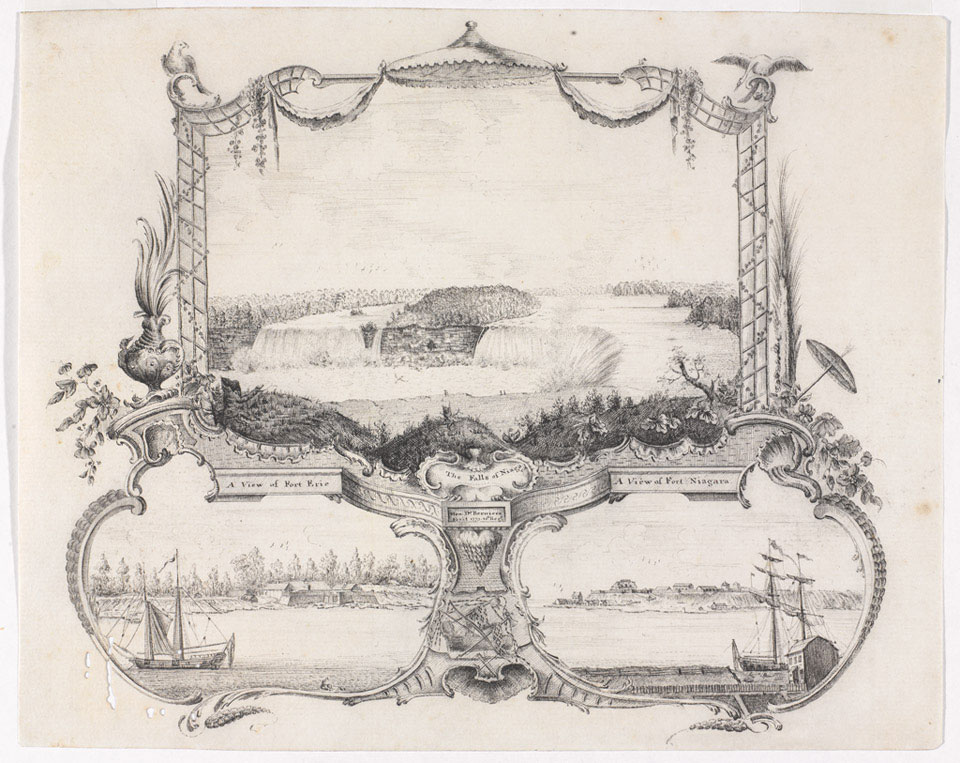
In 1773 the 10th Regiment was stationed along the Niagara River. And we have Ens. DeBerniere’s sketches of Fort Erie, Fort Niagara, and Niagara Falls from that year. Those appear above, courtesy of the U.K.’s National Army Museum. I found another statement saying he probably drew a map of Detroit around the same time.

Thus, by early 1775 Ens. DeBerniere had nearly five years of experience in the army and in North America, and was a practiced draftsman.

TOMORROW: DeBerniere after 1775.