J. L. BELL is a Massachusetts writer who specializes in (among other things) the start of the American Revolution in and around Boston. He is particularly interested in the experiences of children in 1765-75. He has published scholarly papers and popular articles for both children and adults. He was consultant for an episode of History Detectives, and contributed to a display at Minute Man National Historic Park.

Subscribe thru Follow.it


•••••••••••••••••


Showing posts with label Massachusetts Convention of 1768. Show all posts

Saturday, September 29, 2018

“To sit till the troops come”

There’s practically no record of discussions at the Massachusetts Convention of 1768. The gathering issued formal documents in the first couple of days and at the end, but no internal proceedings survive.

The closest we come is a 27 Sept 1768 letter from the Rev. Andrew Eliot to an English supporter of Massachusetts, Thomas Hollis. Eliot wrote:
Their chairman (Mr. [Thomas] Cushing) assures me their determinations will be moderate, and their session short; and that they will not attempt any acts of government. But if the troops arrive before they break up, I will not be bound for their moderation. The people have, at present, great confidence in them.

A gentleman well acquainted with the secrets of the times, just now informed me, that there were three parties in the convention. One, who were fearful of the legality of their proceedings, and would gladly break up without doing any thing. Another party would willingly leave the people to themselves, and not lay any restraints upon them. A third desire to sit till the troops come, and to take the direction of affairs into their own hands. Which party will prevail is uncertain.

I just returned from a journey into the country. I find the people through this Province, are ripe for almost any thing. But how it is with other Provinces, I cannot say. They write well, but do nothing.

I fear we must stand the brunt of ministerial vengeance, unless there is some great change at home. What can we do! Tamely to give up our rights, and to suffer ourselves to be taxed at the will of persons at such a distance, and to be under military government, is to consent to be slaves, and to bring upon us the curses of all posterity; and yet how unable to cope with Great Britain! How dreadful the thought of a contest with the parent country, in whose calamities we have always borne a part, and in whose peace we have enjoyed peace.

Whatever distresses come, we shall not suffer alone; whatever evils come on the Colonies, Great Britain will sensibly feel; and our increase is so great, that time will be, when we shall be free. How impolitic to precipitate a disunion!
The possibility of a severe breach between Massachusetts and Britain was high enough that London stock market suffered a decline. However, like Eliot, the leaders of the Convention thought such a “disunion” would be a calamity, and they worked to make sure that didn’t happen, issuing firm verbal protests to keep the situation from turning violent.

On 28 September, troop transports started to arrive in Boston’s outer harbor. The merchant John Rowe wrote in his diary:
This forenoon came to anchor in Nantasket Roads six sail of Men of War supposed to have the 14th Regmt. & 29th Regmt. on board.
The next day, or 250 years ago today, Deacon John Tudor wrote that the ships were closer:
The Fleet came to Anchor near Castle Willm.
The next issue of the Boston Gazette, dated 3 October, included this one-sentence item of local news:
Thursday last [i.e., 29 September] the Convention, having finish’d their Business, dispersed.
The Massachusetts Convention thus came to a close. You can read its final formal complaint here.

Friday, September 28, 2018

Mixed Reactions to the Massachusetts Convention

The Boston Whigs weren’t surprised there was pushback against their Convention from Massachusetts towns where friends of the royal government dominated local politics—such as Hatfield, as I quoted yesterday.

But they may have hoped for a positive response from Marblehead and Salem, two of the largest towns in the province with a mercantile communities also hit by the Townshend Act and stricter Customs enforcement. Instead, both those towns were in political turmoil, so they didn’t make a clear response.

Salem’s representatives to the Massachusetts General Court in the spring of 1768, William Brown and Peter Frye, had both voted to rescind the body’s Circular Letter. Neither would be reelected. The new representatives for May 1769 were strong Whigs Richard Derby, Jr., and John Pickering. But the Convention came in the midst of that shift.

Likewise, of Marblehead’s representatives, Jacob Fowle had voted to rescind and William Bourne had sat out that vote; neither would be reelected. Richard Brown found that Marblehead didn’t even meet to consider Boston’s invitation. George A. Billias suggested that the loss of several fishing vessels that summer gave the town bigger things to worry about.

Another notable result came from Northampton, to the west. That town regularly sent Joseph Hawley, a respected lawyer and strong Whig, to the General Court. But its citizens voted overwhelmingly—66 or 65 to 1—not to send Hawley or anyone else to the Convention. At the same time, little Montague, which often sat out the regular legislature, sent Moses Gunn to the Convention.

Cambridge was a politically active town, and so close to Boston that it wouldn’t have been much expense to send a delegate. But it also had a relatively large and very wealthy Anglican community, and those citizens kept the town from responding quickly.

The citizens of Cambridge didn’t meet about Boston’s invitation until 26 September, four days after the Convention had started. Katie Turner Getty kindly shared her notes on that meeting, which show that attendees chose Samuel Whittemore, a septuagenarian militia captain from the western part of town, as moderator. But the meeting’s only recorded action was to adjourn “to Tuesday next at three of the clock in the afternoon.”

That would seem to put the next session of the meeting in early October, but that same Monday the Boston Gazette reported:
The Torries [sic] in Cambridge have had the Address, with the Aid of a veering Whig, to get the Town Meeting adjourned to Thursday next.
That would be Thursday the 29th, which is indeed when the men of Cambridge came together again. By then the Convention was nearly over, but Lucius Paige’s town history said the meeting considered
whether it be the mind of the inhabitants of this town to proceed on the article in the Warrant, relating to the choosing a person to join with the committees of Convention of the other towns in this Province, now sitting in Boston, and it passed in the afiirmative.
The town voted to send two delegates to the Convention—more than it had sent to the last General Court. The local Whigs may have been trying to make up for lost time.

Cambridge’s first choice was Andrew Bordman, who had represented the town in that last legislature. He “declined the service.” The town asked Deacon Samuel Whittemore (1721-1784), son of the meeting moderator. He also declined. The town then asked Capt. Whittemore, who said yes. Finally the town chose Thomas Gardner as the second delegate, and he agreed as well.

But neither Whittemore nor Gardner arrived in time to be listed among the Convention attendees by Robert Treat Paine. Both remained politically active, with Gardner taking over for Bordman in the General Court. Whittemore is famous for being wounded during the Battle of Lexington and Concord; Gardner died of wounds suffered at Bunker Hill.

Getty and I are both curious about the identity of the “veering Whig” who delayed Cambridge’s response. Was it Bordman, who had been one of the “Glorious 92” but didn’t want to attend the unofficial Convention? Was it old Samuel Danforth, a Council member who lived in Cambridge and was voting with Gov. Francis Bernard on a couple of issues that week? (Another Council member from Cambridge, William Brattle, voted firmly against Bernard and therefore hadn’t started “veering” yet.) Whittemore as moderator might have had the influence to adjourn the meeting, but he probably wouldn’t have been chosen as delegate after that. Absent a more revealing local source, we’ll never know.

(Read Katie Getty’s Journal of the American Revolution article about Samuel Whittemore here.)

Thursday, September 27, 2018

Contrasting Reactions to the Massachusetts Convention

Massachusetts towns had a range of responses to Boston’s invitation in September 1768 to come to a Convention in Faneuil Hall and discuss the province’s grievances.

The 26 Sept 1768 Boston Gazette proudly ran a dispatch from Petersham in Worcester County. On 19 September, the town’s “Sons of Liberty” had met to choose Theophilus Chandler to attend that Convention. But they didn’t stop there.

The following day, those men of Petersham had a ceremony to “dedicate a Tree to that most amiable Goddess,” Liberty, choosing the Wilkesite time of “45 Minutes past two o’Clock, P.M.”
Accordingly they met at the Time appointed, and having made Choice of a beautiful young Elm, they cut off 17 useless Branches (leaving 92 thereon) and one of them taking hold of the Tree uttered the following Words, “O Liberty! thou divine Goddess! may those that love thee flourish as the Branches of this Tree! but those that hate thee be cut off and perish as these 17, which we are now about to commit to the Flames?[”] And a Pile of condemn’d Shingles being instantly set on Fire, the amputated Branches, together with the Effigies of the 17 strong Asses were cast therefore and consum’d, while the well known Song of Liberty was sung; and having scatter’d their Ashes towards the four Winds of Heaven, they gave three Cheers, and then walked back in Procession, where a Dish of Barley Coffee was prepared for them:
The 92 branches and the 17 lopped off referred to the Massachusetts assembly’s vote not to rescind the Circular Letter. The “Barley Coffee” might have been an early example of eschewing taxed tea.

The Petersham celebrants then drank thirteen “constitutional Toasts,” starting with the royal family and moving on to “Lord Chatham—[John] Wilks,…The brave Corsicans…our glorious intrepid Ancestors,” John Dickinson, James Otis, and “A speedy Repeal of all unconstitutional Acts.”

In contrast, the Connecticut River town of Hatfield met on 22 September, “calmly and fully deliberated and considered” Boston’s invitation, and voted unanimously not to participate.

What’s more, the next day Hatfield approved a long reply to Boston. This document was written mainly by Israel Williams (1709-1788), a wealthy landowner and militia officer who strongly supported the royal government. In the House he had been one of the 17, not one of the 92.

Williams and his neighbors produced a detailed rebuttal to Boston’s points about the danger of the army regiments being stationed in town. They expressed confidence that the regular process of petitioning Parliament would resolve Massachusetts’s problems. Hatfield’s reply ended:
Suffer us to observe that in our Opinion the Measures the Town of Boston are pursuing and proposing to us and the People of this Province to unite in, are unconstitutional, illegal, and wholly unjustifiable, and what will give the Enemies of our Constitution the greatest Joy, subversive of Government, destructive of that Peace and good Order which is the Cement of Society, and have a direct Tendency to rivet our Chains, and deprive us of our Charter Rights and Privileges, which we the Inhabitants of this Town desire may be secured to us, and perpetuated to our latest Posterity.

Thus we have freely expressed our Sentiments, having an equal Right with others, tho’ a lesser Part of the Community, and take this first Opportunity to protest against the proposed Convention;—and hereby declare our Loyalty to His present Majesty, and Fidelity to our Country; and that it is our firm Resolution, to the utmost of our Power, to maintain and defend our Rights in every prudent and reasonable Way, as far as is consistent with our duty to GOD and the KING.
The town clerk who signed off on that message on behalf of Hatfield, Oliver Partridge, was appointed a county judge in October. Every town had its own story.

TOMORROW: Politicking in Cambridge.

Wednesday, September 26, 2018

Running the Numbers on the Massachusetts Convention

On Monday, 26 Sept 1768—250 years ago today—the Massachusetts Convention returned to Faneuil Hall after taking the Sabbath off.

Gov. Francis Bernard reported that on that Monday the gathering declared itself to be in committee, which by eighteenth-century standards meant that all the participants could meet together in private. He also noted a late arriving participant, writing:

The 3 days last week they kept open doors; [James] Otis was then absent. The two days this week they have kept the doors shut; Otis is with them.
In The Otis Family, John J. Waters wrote that the Convention was Samuel Adams’s idea and Otis was wary of it. But Otis had chaired the Boston town meeting that proposed it, as well as reportedly helping to plan that meeting.

Waters’s description of the situation appears to be an interpretation of Otis’s absence, not based on public statements from him or his colleagues. I wonder if this might be an example of reading politics into actions that were actually driven by bipolar disorder. We’ll never know.

In any event, Otis wasn’t the only man who showed up at the Convention after its opening days. Boston’s invitation had gone out to other towns only on 14 September. That didn’t leave much time for the news to travel, for towns to meet about the unusual request, and for any chosen delegates to journey to Boston. The counties closest to Boston had the most representation, naturally. No one came from Berkshire County, in the far west; Lincoln County, in the northeast (Maine); or the islands.

The official record of the Convention’s first days, published in the 26 September Boston Evening-Post and other newspapers, said that on the 22nd there were “a number of Gentlemen upwards of Seventy” representing “Sixty-Six Towns, besides Districts.”

The 26 September Boston Gazette stated, “We hear there is already arrived Committee-Men form [sic] 90 Towns in the Province.” And the next day, the Rev. Andrew Eliot wrote: “The Committees from the several Towns are now met in convention, between 80 and 90.”

The final published record of the Convention reported 96 towns and 8 districts participating. And even that might be an undercount. Robert Treat Paine of Taunton drew up a list of attendees with the towns or districts they represented—evidently the only surviving document that named names. This list was first published by Richard D. Brown in the William and Mary Quarterly in 1969. Furthermore, Brown added seven towns whose own local records say they sent delegates but weren’t on Paine’s list.

Now I can’t make the numbers in Brown’s footnote add up exactly with that list. To increase the confusion, some attendees represented multiple towns (“Leicester and Spencer and Paxton,” “Lunenburg and Fitchburg”) while a few towns sent two people. But it’s clear that about a hundred jurisdictions were represented.

How did the Convention compare to a typical lower house of the Massachusetts General Court? The shortened 1768 legislative session had representatives from over 200 towns, so the Convention was significantly smaller. (In contrast, when the Massachusetts Provincial Congress met in 1774, more towns participated than in the previous session of the Crown-recognized legislature.) The big secondary ports of Marblehead and Salem sent no one, and a few towns made a public point of not participating, as I’ll discuss later.

On the other hand, the Convention attracted participants from several towns that hadn’t bothered to send representatives to the General Court. The smaller ports of Newburyport, Gloucester, Plymouth, and Dartmouth were there, along with most of the big farming towns in Essex, Middlesex, and Suffolk Counties (which would supply militia companies in a military emergency). Some men from Maine did come. All in all, the Convention should have alerted Crown officials that Boston wasn’t alone in feeling aggrieved.

TOMORROW: How two towns responded.

Saturday, September 22, 2018

Opening Day for the Massachusetts Convention of 1768

On Thursday, 22 Sept 1768, 250 years ago today, the Massachusetts Convention met for the first time in Faneuil Hall. Participants were dubbed to be “committees” from their respective towns.

Gov. Francis Bernard sent a strongly worded message from his official home, the Province House (shown here):
As I have lately received from his Majesty [i.e., the Crown government in London] strict Orders to support his constitutional authority within this Government [i.e., in the province of Massachusetts], I cannot sit still and see so notorious a violation of it, as the calling an Assembly of the people by private persons only. For a meeting of the Deputies of the Towns is an Assembly of the Representatives of the people to all intents and purposes; and it is not the calling it a Convention what will alter the nature of the thing. . . .

It is therefore my duty to interpose at this instant, before it is too late. I do therefore earnestly admonish you that instantly and before you do any business, you break up this Assembly and separate yourselves. I speak to you now as a friend to the Province, and a well-wisher to the individuals of it.
Andrew Oliver, the royal secretary of Massachusetts, delivered that message to Thomas Cushing, the Convention chairman (usually speaker of the Massachusetts house). The Convention records noted that the letter was:
said to be by Order of the Governor, but not being signed, it was by a Vote of the Committees returned to the Secretary, with Assurance to him that they should be always ready to pay all due Respect to any Messages which they might be assured should come to them from the Governor of the Province.
The Convention then approved a petition to Gov. Bernard asking him to convene the Massachusetts General Court. Back in June, the governor had ended a legislative session because the lower house refused to rescind its Circular Letter to other colonies. Bernard had explicit orders from the ministry in London to take that action.

The governor therefore declined to receive the petition from the small committee that brought it, sending a note in reply:
Gentlemen,

You must excuse me from receiving a Message from that Assembly which is called a Committee of Convention; for that would be to admit it to be a legal Assembly; which I can by no Means allow.
The Convention responded that this letter wasn’t signed, either. But the three delegates who had been to the Province House “declared in Writing under their Hands that his Excellency delivered the same to them.”

The Convention and the governor having each refused to recognize the other, the first day of the momentous gathering came to a close.

TOMORROW: Meanwhile, in the Council Chamber…

Friday, September 14, 2018

“A pretence for arming the Town”

We pick up the proceedings of Boston’s town meeting on 13 Sept 1768 after the voters present unanimously approved a call for a Convention of representatives from all of Massachusetts’s towns.

According to Gov. Francis Bernard’s report to the Earl of Hillsborough in London:
I should have mentioned before that in the middle of the Hall where they met, were deposited in chests, the Town Arms, amounting as it is said to about 400. These, as I have before informed your Lordship, about 4 or 5 months ago were taken out of the lumber rooms, where they had lain for some years past, to be cleaned; & have since been laid upon the floor of the Town hall to remind the people of the use of them. These Arms were often the subject of discourse & were of singular use to the Orators in the way of Action.
The resolution Boston’s Whig leaders next offered indeed related to such weapons as they proposed making sure the town’s militiamen were all armed:
Whereas, by an Act of Parliament of the First of King William and Queen Mary it is declared that the Subjects being Protestants, may have Arms for their Defence; It is the Opinion of this Town, that the said Declaration is founded in Nature Reason and sound Policy, and is well adapted for the necessary defence of the Community And for as much as by a good and wholesome Law of this Province, every listed Soldier, and other Householder (except [horse] Troopers who by Law are to be otherwise provided) shall be always provided with a well fixed Fire Lock Musket Accoutrement and Ammunition as in said Law particularly mentioned, to the satisfaction of the Commission Officers of the Company; and as there is at this Time a prevailing apprehension, in the Minds of many, of an approaching War with France: In order that the Inhabitants of this Town may be prepared in case of sudden danger; Voted, that those of the said Inhabitants who may at present be unprovided, be and hereby are requested duly to observe the said Law at this Time
“An approaching War with France”? Indeed, the 8 September Boston News-Letter had just carried a couple of alarming items from London:
By a Gentleman just arrived from Calais we are informed, that the common topick of conversation at that place, Dunkirk and other sea ports in France, is of an approaching war with England. . . .

One day last week, at a certain Coffee-House not 100 miles from St. James’s, a wager of 1000 guineas to 20, was laid that war would be declared between Great Britain on the one part, and France and Genoa on the other, before the 3d day of August next.
But if the Whigs were really worried about another French war, why were they objecting to the arrival of British regiments? Surely the people of Massachusetts would welcome their own nation’s professional military protection.

Gov. Bernard saw through the ruse:
As the Subject of their debates turned upon arming the Town & Country against their Enemies, The probability of a French War was mentioned as a pretence for arming the Town & a Cover for the frequent use of the Word Enemy.

It was said that the Enemy would probably be here before the Convention met, that is within 10 days; It was moved that the Arms should be now delivered out to oppose the Enemy; this was objected to for that they might fall into hands who would not use them.

But this flimsy Veil was not allways kept on: it was often said that they had a right to oppose with arms a military force which was sent to oblige them to submit to unconstitutional Laws; and when it was required to be more explicit, the Chairman [James Otis, Jr.] said that they understood one another Very well, & pointing with his hand added “there are the Arms; when an attempt is made agst. your liberties they will be delivered; our Declaration wants no explication:” and indeed it does not.
After this discussion, the resolution about military preparation passed “by a very great Majority.” The earlier votes were unanimous, which meant there were some brave dissenters in the meeting.

The meeting wrapped up with three votes:
  • Thomas Cushing shared a letter from New York merchants supporting non-importation, and the gathering voiced its approval.
  • The town asked local ministers to set aside the next Tuesday “as a Day of Fasting and Prayer.”
  • The town decided for the proceedings of this meeting to be “published in the several News Papers; and also that a Number of Copys be struck off & sent to the several Towns in this Province.”
On Thursday the Boston News-Letter and Boston Chronicle, which both leaned a bit toward the royal government and may have been partly laid out already, ran those proceedings on inside pages, where local news usually appeared. But come Monday, the Boston Gazette, Boston Post-Boy, and Boston Evening-Post all put the town’s business on the front page.

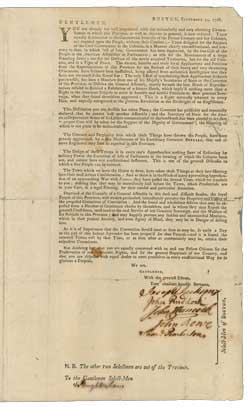
On 14 September—250 years ago today—Boston’s selectmen sent the broadside shown above to the other towns in Massachusetts, inviting them to a Convention in Faneuil Hall eight days later.

TOMORROW: Back to Beacon Hill.

Thursday, September 13, 2018

“The Business of calling another Assembly”

At 10:00 A.M. on 13 Sept 1768—250 years ago today—Boston’s voters reconvened at Faneuil Hall to continue the town meeting they had started the day before. James Otis, Jr., was presiding.

The first piece of business was the response from Gov. Francis Bernard to the town committee that asked him whether the London government had ordered army regiments into town and about the possibility of a new session of the Massachusetts General Court. Bernard sent his response in writing:
Gentlemen

My apprehensions that some of his Majestys Troops are to be expected in Boston, arise from information of a private nature; I have received no publick Letters notifying to me the coming of such Troops, and requiring Quarters for them; whenever I do I shall communicate them to his Majestys Council.

The Business of calling another Assembly for this Year is now before the King; and I can do nothing in it, untill I receive his Majestys Commands.

Francis Bernard.
This reply was weaselly even for Bernard. He’d set off the alarm himself by telling at least one member of the Council and one selectman about the coming regiments, knowing they would spread the news. But since he’d received only a letter from Gen. Thomas Gage in New York, not an official notice from London, the governor refused to say anything more.

The Boston Whigs were probably expecting something like that, having gotten to know Bernard over the last several years. They proceeded to vote on several resolutions that referenced the colony’s original charter from James I, the provincial charter from William and Mary, and principles of the British constitution. The upshot of those resolutions was:
  • In a phrase not yet coined, no taxation without representation.
  • No standing armies or “employing such Army for the enforcing of Laws made without the consent of the People, in Person, or by their Representatives.”
Those passed unanimously.

Gov. Bernard later complained that the meeting was nothing more than “a Set of speeches by the cheifs of the faction & no one else; which followed one another in such order & method, that it appeared as if they were acting a play, evry thing, both as to matter & order, seeming to have been preconcerted before hand.” Which almost everything certainly was.

But some meeting attendees had more radical ideas, according to Bernard’s informants:
One cried out that they wanted a Head [I don’t actually know what that means]; this was overruled: for indeed it was rather too premature. Another, an old Man, protested against evry thing but rising immediately & taking all power into their own hands.

One Man, very profligate & abandoned, argued for massacring their Enemies: his argument was short.—Liberty is as pretious as Life; if a Man attempts to take my Life, I have a right to take his; ergo, if a Man attempts to take away my liberty, I have a right to take his Life. He also argued that when a Peoples Liberties were threatened, they were in a state of War & had a right to defend themselves. And He carried these Arguments so far that his own party were obliged to silence him.
The Whig politicians had another type of action to propose:
Whereas by an Act of Parliament of the First of King William and Queen Mary [i.e., right after the Glorious Revolution], it is declared; that for the Redress of all Grieveances, aud for Amending Strengthning, and preserving the Laws, Parliaments ought to be held frequently, and in as much as it is the Opinion of this Town, that the People labour under many intollerable Grievances, which unless speedily Redressed; threaten the total distraction of our invaluable natural, constitutional and Charter Rights.

And furthermore As his Excellency the Governor has declared Himself unable at the Request of this Town to call a General Court, which is the Assembly of the States of this Province, for the Redress of such Grieveances;

Voted, that this Town will now make choice of a suitable number of Persons to Act for them as a Committee in Convention, with such as may be sent to Join them from the several Towns in this Province, in order that such Measures may be consulted and Advised as his Majestys service, and the peace and safety of his Subjects in this Province may require
This resolution passed unanimously. Boston was ready to host the equivalent of a General Court whether Gov. Bernard cooperated or not. Officially, this would be called a “Convention,” just as the equivalent in 1774 would be a “Provincial Congress.” To represent Boston at the Convention, the town elected the men who represented them in the General Court: Otis, Thomas Cushing, Samuel Adams, and John Hancock.

The proposed time of the gathering: “at Faneuil Hall, in this Town, on Tuesday the 22d. Day of September Instant, at 10. O’Clock Before Noon.” The meeting ordered Boston’s selectmen to send invitations to their counterparts in all the other towns of Massachusetts.

The meeting then proceeded to discuss the immediate threat of “an approaching War with France.”

TOMORROW: Wait—what?