J. L. BELL is a Massachusetts writer who specializes in (among other things) the start of the American Revolution in and around Boston. He is particularly interested in the experiences of children in 1765-75. He has published scholarly papers and popular articles for both children and adults. He was consultant for an episode of History Detectives, and contributed to a display at Minute Man National Historic Park.

Subscribe thru Follow.it


•••••••••••••••••


Showing posts with label Hingham. Show all posts

Saturday, May 31, 2025

Heading into June 1775 with Confidence
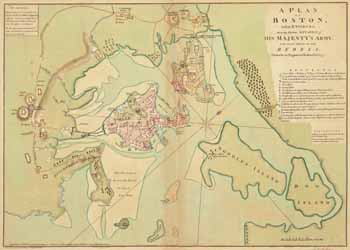
One consequence of the Battle of Chelsea Creek is that by the end of May 1775 the provincial troops started to feel pretty powerful.

The militia mobilization of the Lexington Alarm had done significant damage to the Crown forces. Fortifications were keeping the king’s troops inside Boston.

The Royal Navy was seizing some ships and raiding coasts and islands for food. But three times now the provincial defenses had pushed back. Fairhaven men had recaptured two ships from Capt. John Linzee of H.M.S. Falcon. Hingham and other South Shore companies had forced troops off Grape Island with only a fraction of the hay they wanted.

And the fight over Hog Island and Noddle’s Island was even more impressive. The provincials came away with some livestock, reducing the food supply for besieged Boston. They set fire to hay being grown to feed the army’s horses.

In the fighting that followed, the provincials had deployed artillery for the first time and withstood return fire. They hadn’t lost any men, with four wounded and expected to recover, and reports out of Boston suggested some of the enemy had died. (Two seamen were killed, in fact, but some early reports put the number of Crown casualties as high as thirty.)

From H.M.S. Diana the provincial troops had pulled useful supplies: four four-pounder cannon, twelve swivel guns, the mast, and various bits of fresh rigging—the ship had been launched only the previous year.

And then those troops had actually destroyed the Diana—a Royal Navy warship! True, it was a relatively small vessel that had run aground, but that was obviously a provincial victory and a royalist loss.

Even the most cautious New England commanders and soldiers must have felt they were on a roll when they made the move onto the Charlestown peninsula on the night of 16 June. But the scale of the battle that followed was far beyond any other fight in the Boston campaign.

The Sestercentennial of the Battle of Bunker Hill will be observed on two successive weekends in June:
Make your plans now!

Tuesday, May 27, 2025

“Surely the most ridiculous expedition that ever was plan’d”

After the exchange of fire over Grape Island on 21 May 1775, both sides of the war claimed to have damaged the other and gotten the best of the day.

Four days after the fighting, the New-England Chronicle stated:
Whether any of the Enemy were wounded, is uncertain, though it is reported three of them were. It is thought that they did not carry off more than one or two tons of hay.
As for the gunfire from the departing Royal Navy vessels, that was “without effect.”

The next day’s Connecticut Gazette was even more positive:
the People…wounded 3 of the Enemy, and drove them off. They had got a Ton and Half of Hay on Board.
And the 3 June Pennsylvania Ledger said:
the regulars returned to Boston, with the loss of eight men killed and several wounded, as the provincials were informed by a gentleman that left Boston the next day.
In contrast, Lt. John Barker of His Majesty’s 4th Regiment wrote in his diary that ”a few of the Rebels were killed, without any loss on our side,” and he estimated the amount of hay removed as up to “7 or 8 Tons.”

Militaries always have a better sense of their own losses and usually exaggerate the enemy’s. If we follow that guideline and accept only what each army said about its own force, then the day ended without any casualties on either side.

The Crown forces had taken away a few tons of needed hay, but the Patriots burned far more—even Barker guessed his comrades had left “about 70” tons behind.

The provincials also burned Elisha Leavitt’s barn on the island. Local tradition held that he treated his neighbors to rum during the day to avert similar violence against his property on shore.

As usual, Lt. Barker saw a lot to complain about:
It was surely the most ridiculous expedition that ever was plan’d, for there were not a tenth part boats enough even if there had been Men enough, and the Sloop which carried the Party mounted 12 guns, but they were taken out to make room, whereas if one of two had been left it would have effectually kept off the Rebels
That might have been echoed in the 26 May Connecticut Gazette: “We hear Gen. [Thomas] Gage blamed the Admiral [Samuel Graves] for sending Vessels that were so small, on this Enterprize.” We should ask how the printers could reliably know such a thing. On the other hand, it may be significant that Graves skipped over this action in his self-serving report narrative of the war.

The reaction on the provincial side was very different. In a follow-up letter to her husband, Abigail Adams had nothing but praise for the locals who took part in the fight, particularly their own relatives:
I may say with truth all Weymouth Braintree Hingham who were able to bear Arms, and hundreds from other Towns within 20 30 and 40 miles of Weymouth.

Our good Friend the Doctor [Cotton Tufts] is in a very misirable state of Health, has the jaundice to a [very gr]eat degree, is a mere Skelliton and hardly able to [ride fro]m his own house to my fathers. Danger you [know] sometimes makes timid men bold. He stood that day very well, and generously attended with drink, Bisquit, flints &c. 5 hundred men without taking any pay. He has since been chosen one of the committee of Correspondence for that Town, and has done much Service by establishing a regular method of alarm from Town to Town.

Both your Brothers were there—your younger Brother [Elihu Adams] with his company who gaind honour by their good order that Day. He was one of the first to venture aboard a Schooner to land upon the Island.
That reflects the general mood on the two sides at this time. The British military was having inter-service quarrels over logistics while the provincials were celebrating solidarity. Even though neither side had accomplished a great deal, or suffered a serious loss.

Monday, May 26, 2025

“Assembled on a Point of Land next to Grape-Island”

Yesterday we left the people of Weymouth and surrounding towns in a panic as three or four vessels full of British soldiers appeared off their north coast early on Sunday, 21 May 1775.

Abigail Adams happened to be writing on her husband’s behalf to Edward Dilly, a British publisher and bookseller sympathetic to the American Whigs. She portrayed the situation like this:
Now this very day, and whilst I set writing the Soldiers provincial are passing my windows upon an allarm from the British troops who have been landing a number of Men upon one of our Sea coasts (about 4 miles from my own habitation) and plundering hay and cattle. Each party are now in actual engagement. God alone knows the Event, to whom also all our injuries and oppressions are known and to whom we can appeal for the justice of our cause when the Ear of Man is deaf and his heart hardned.
At the command of Lt. Thomas Innis of the 43rd Regiment, scores of those redcoats started coming ashore, carrying long, sharp…scythes. They got to work harvesting hay from Grape Island, to take back to Boston to feed the garrison’s horses.

Meanwhile, local militia companies gathered in the towns, eventually augmented by three companies from the provincial army camp at Roxbury. An 1893 Hingham town history assumed that Capt. James Lincoln, commander of a new company of Massachusetts troops, took charge. That history stated: “The old people of fifty years ago, used to tell of the march of the military down Broad Cove Lane, now Lincoln Street.”

Once those local men reached the shoreline, however, they discovered that there was little they could do. As the 25 May New-England Chronicle reported:
The People of Weymouth assembled on a Point of Land next to Grape-Island. The Distance from Weymouth Shore to the said Island was too great for small Arms to do much Execution; nevertheless our People frequently fired.

The Fire was returned from one of the Vessels with swivel Guns; but the Shot passed over our Heads, and did no Mischief.

Matters continued in this State for several Hours, the Soldiers polling the Hay down to the Water-Side, our People firing at the Vessel, and they now and then discharging swivel Guns.
In Scituate, Paul Litchfield recorded in his diary, the Rev. Ebenezer Grosvenor went ahead with the second part of his Sunday sermon as normal.

Eventually the tide came in. Abigail Adams wrote of the shoreline defenders:
At last they musterd a Lighter, and a Sloop from Hingham which had six port holes. Our men eagerly jumpt on board, and put of for the Island. As soon as they [the regulars] perceived it, they decamped. Our people landed upon [the] Island, and in an instant set fire to the Hay which with the Barn was soon consumed, about 80 ton tis said.
The newspaper report offered more details:
The Tide had now come in, and several Lighters, which were aground, were got afloat, upon which our People, who were ardent for Battle, got on board, hoisted Sail, and bore directly down upon the nearest Point of the Island.

The Soldiers and Sailors immediately left the Barn, and made for their Boats, and put off from one End of the Island, whilst our People landed on the other. The Sloops hoisted Sail with all possible Expedition, whilst our People set Fire to the Barn, and burnt 70 or 80 Tons of Hay; then fired several Tons which had been polled down to the Water-Side, and brought off the Cattle.
Lt. John Barker basically agreed with that sequence of events in his diary:
as soon as they [the foragers] landed they were fired on from the opposite shore but without receiving any harm, the distance being too great; the party did not return the fire but kept on carrying the hay to the boats, until at last the Rebels in great numbers got into Vessels and Boats and went off for the Island; the party then embarked and sailed off with what hay they had, and as they were obliged to go along shore they were fired upon, when Lt. Innis who commanded was at last forced to return the fire…
Back to the New-England Chronicle:
As the Vessels passed Horse-Neck, a Sort of Promontory which extends from Germantown [in Braintree], they fired their Swivels and small Arms at our People very briskly, but without Effect, though one of the Bullets from their small Arms, which passed over our People, struck against a Stone with such Force as to take off a large Part of the Bullet.
That ended the crisis. All that remained was for the two sides to tote up gains and losses.

TOMORROW: The bottom line.

Sunday, May 25, 2025

“3 Sloops and one cutter had come out”

In May 1775, the people of Hingham and other towns along the South Shore from Boston weren’t really worrying about protecting livestock on harbor islands.

As a 3 May petition from selectmen in Braintree, Weymouth, and Hingham to the Massachusetts Provincial Congress put it, those towns felt “in great danger of an attack from the troops now in Boston, or from the ships in the harbor.”

They worried that the British military would attack the towns themselves, not off-shore pasturage—perhaps to seize food but mostly to punish the rebellious population.

The congress therefore authorized those towns to raise two and a half companies of men for their defense through the end of the year, on the same terms as the provincial soldiers being signed up to keep besieging Boston. In Hingham, James Lincoln took a captain’s commission and started recruiting.

On the morning of Sunday, 21 May, vessels were spotted maneuvering through the islands off the Weymouth shore. Abigail Adams described the response in north Braintree:
When I rose about six oclock I was told that the Drums had been some time beating and that 3 allarm Guns were fired, that Weymouth Bell had been ringing, and Mr. [Ezra] Welds [churchbell in Braintree’s middle precinct] was then ringing.

I immediatly sent of an express to know the occasion, and found the whole Town in confusion. 3 Sloops and one cutter had come out, and droped anchor just below Great Hill. It was difficult to tell their design, some supposed they were comeing to Germantown others to Weymouth. People women children from the Iron Works flocking down this Way—every woman and child above or from below my Fathers.

My Fathers family flying, the Drs. [Cotton Tufts’s] in great distress, as you may well immagine for my Aunt had her Bed thrown into a cart, into which she got herself, and orderd the boy to drive her of to Bridgwater which he did. The report was to them, that 300 hundred had landed, and were upon their march into Town.

The allarm flew [like] lightning, and men from all parts came flocking down till 2000 were collected
In Scituate, Paul Litchfield was home from Harvard College, his senior year cut short by the war. He wrote in his diary:
Just before meeting began in morning, hearing the King’s troops were landing near Hingham, the people in general dispersed, so no meeting.
The 25 May New England Chronicle, newly moved to Cambridge, reported this military response:
Last Sabbath about 10 o’clock A.M. an express arrived at General [John] Thomas’s quarters at Roxbury, informing him that four sloops (two of them armed) were sailed from Boston, to the south short of the bay, and that a number of soldiers were landing at Weymouth.

Gen. Thomas ordered three companies to march to the support of the inhabitants.
But the first newspaper report of the action was the 22 May Newport Mercury:
An express arrived here this morning, from Providence, with advice, that a party of soldiers from Boston had landed at Weymouth, and burnt the town down, and were ravaging the country when the express came away. Troops from all parts of the country were going to oppose them.——The particulars not yet come to hand.
TOMORROW: The particulars of what really happened.

Saturday, May 24, 2025

The Islands of Elisha Leavitt

Elisha Leavitt (1713–1790) was a blacksmith in Hingham, and a lot more. He also traded in goods, “engaged in navigation,” and owned part of a fishing company.

In the 1760s Leavitt started to amass a particular sort of real estate: Boston harbor islands. He bought Georges Island in 1765, Lovells Island in 1767, Grape Island just off Hingham, and half of Gallops Island. All told that was over 150 acres of land useful for raising hay and pasturing livestock.

In 1771 Leavitt bought the big old Thaxter house, shown above in a stereograph from the New York Public Library. By that time his son Martin was at Harvard College, preparing to be a doctor. The family was edging into gentility.

A Hingham tradition held that Leavitt was “a bitter Tory.” However, his name doesn’t appear in the newspapers or in Massachusetts Provincial Congress records as a suspected Loyalist. Aside from one election as a constable decades before, he wasn’t politically visible.

Likewise, there’s a tradition that Leavitt let “Nathaniel Ray Thomas and other tories of Marshfield” into his mansion through a “secret door” in September 1774 and hid them until they could make their way to Boston. But no one claimed to have actually seen this hidden room in the Leavitt house before it was demolished. It doesn’t appear to have been an isolated estate, safe from prying eyes. 

I find it hard to believe Leavitt could be well known for supporting the royal government and continue to live peacefully in Hingham from 1774 into 1777 (when his name first appeared in the Boston papers in an advertisement for an until-recently-enslaved man named Primus) and beyond. Massachusetts towns weren’t very forgiving of “bitter Tories” in those years. I suspect Leavitt may have been less militant than his neighbors but was probably more neutral than Loyalist.

In The Islands of Boston Harbor (1935), Edward Rowe Snow wrote: “Realizing that the British officers needed hay for their horses quartered in Boston, [Leavitt] sent word for them to come down to Grape Island and gather the hay.” But Snow offered no documentary evidence for such an offer.

As men like William Harris, Elijah Shaw, and Henry Howell Williams found out in May 1775, the Royal Navy and army was collecting food and forage as they needed, paying owners who cooperated and just taking the supplies otherwise. After all, there was a war on. Given those alternatives, Leavitt may very well have preferred to take the money.

In any event, on 20 May Lt. John Barker of the 4th Regiment inside Boston wrote in his diary:
A Detachment of 1 Subaltern and 30 [men] sent to Crape Island, about 9 miles from Town in the Bay, to bring up hay.
Barker meant Grape Island, Elisha Leavitt’s nearest island property.

TOMORROW: The alarm.

Saturday, December 07, 2024

How Lincoln Impressed Washington

In June 1775, the Massachusetts Provincial Congress commissioned its president, Dr. Joseph Warren, as a major general in the provincial army.

Under the tacit hierarchy of the New England generals, that would have put Warren under Artemas Ward (considered a captain general) and John Thomas (a lieutenant general), and by seniority at the bottom of all the other major generals in the New England forces.

Of course, Dr. Warren never took up that commission. He went onto the battlefield in Charlestown, fought as a volunteer, and died.

Despite that precedent, the clerk of the provincial congress, Benjamin Lincoln of Hingham, also wanted to be a general.

Lincoln had been a lieutenant colonel in the Suffolk County militia before the war. In January 1776, the General Court promoted him to militia major general. His main mission was coastal defense, and he reported on that situation to John Adams in August.

At the same time, Lincoln was positioning himself for a commission in the Continental Army. Gen. Ward wasn’t in the best of health and had lost the support of Gen. George Washington and other important figures. Even Joseph Ward, a relative and aide, told Adams that Gen. Ward was “under the great disadvantage of bad health” and couldn’t show his men that he was “superior to difficulties dangers or misfortunes” as the best generals did.

Joseph Ward wrote:
If a few old Colonels should resign it might be no disadvantage to the Service; very few of them take much pains to qualify themselves for higher command; they want education, knowledge of the World and genuine ambition to make them shine as Generals. I apprehend that Benjamin Lincoln Esqr. (now a Major General in the militia) is a good man for a Brigadire General; he has never been a Continental Officer nor had much experience, but he is a man of abilities and appears to me to have a good mind. I am well informed that he would like to engage in the Service.
That fall, the Massachusetts General Court raised short-term troops to defend New York. After James Warren declined command, Lincoln became the state major general in charge of that force. They weren’t involved in the big battles and came home in November.

That service was enough to impress Gen. Washington, however. When Massachusetts raised more troops for the winter of 1777 and put Lincoln in charge of them, the commander-in-chief wrote to him:
Give me leave Sir to assure you that this Appointment gives me the highest Satisfaction as the proofs you exhibited of your Zeal for the Service, in the preceding part of this Campaign convinces me, that the command could not have devolved upon a more deserving Officer.
Lincoln served under Gen. William Heath in that winter, besieging a British position near Kingsbridge. Heath’s push fizzled out, further lowering him in Washington’s eyes.

Back in July 1775, when Washington had arrived in Massachusetts, the province’s generals were Ward, Thomas, and Heath. Now Ward was about to resign, Thomas was dead, and Heath was doomed never to have a combat command again. Instead, Washington recommended the Continental Congress consider Benjamin Lincoln as “worthy of your Notice in the Continental Line.”

Lincoln thus became the newest major general in the Continental Army in March 1777. And he retained Washington’s esteem even after having to surrender Charleston to the Crown in May 1780. He also became the U.S. of A.’s first Secretary of War under the Confederation Congress.

On the afternoon of Sunday, 8 December, Robert J. Allison will speak to the Hingham Historical Society on “From Hingham to Yorktown: The Military Campaigns of General Benjamin Lincoln.” You can purchase tickets to attend that talk or view online through this page.

Saturday, November 16, 2024

“The Spies in Henry Barnes’s House” at Hingham, 17 Nov.

Yesterday I wrote about Ens. Henry DeBerniere, the young mapmaking army officer.

He turned up at Henry and Christian Barnes’s house in Marlborough on 1 Mar 1775, along with Capt. William Brown.

Those two officers were “The Spies in Henry Barnes’s House” that I’ll speak about on the afternoon of Sunday, 17 November, in the Hingham Historical Society’s Revisiting The American Revolution series.

Dr. Samuel Curtis will also show up in my talk, just as he showed up at the Barnes house that night, trying to ferret out information on DeBerniere and Brown. So he was spying, too.

I may even bring in Gib Speakman and Prince Demah because of their ties to the Barnes family, even though I can’t link them to events of that night.

Why, you might ask, am I delivering this talk in Hingham rather than in Marlborough, where all the action happened?

Because another player in that night’s drama was Chrisy Arbuthnot, an orphaned ten-year-old niece living with the Barneses. She had come to them from Hingham.

In addition, Prince Demah’s portraits of Henry and Christian Barnes are now among the treasures of the Hingham Historical Society.

Like other talks in this series, this presentation will be accessible in person and online, as part of the whole series or on its town. Admission (which isn’t cheap) helps to fund the society.

Tuesday, November 12, 2024

“I fear Great Brittain will find it difficult to subdue an extensive Continent”

Back in 2008, Heritage Auctions sold a letter from Richard Lechmere (1727–1814) commenting on the first month of the Revolutionary War.

Lechmere was a wealthy merchant, a King’s Chapel vestryman, and a steady supporter of the royal government. The ministers in London had named him to the mandamus Council in 1774. He took that office even though it meant leaving his estate in east Cambridge and moving into Boston.

It’s interesting, therefore, that Lechmere’s letter surfaced in a collection of papers owned by Henry Seymour Conway (1721–1795), a British Member of Parliament and sometime minister who usually opposed stringent measures against the colonies. While Lechmere was a clear “Tory” by Massachusetts standards, in London he might have been among the moderate Whigs who agreed that something had to be done about the colonial resistance but didn’t want the response to be too harsh.

Of course, the outbreak of war has a way of changing people’s outlooks. In this letter Lechmere wrote:
Blood must be shed, before the Colonies can be brought [to s]ubmission is sufficiently prov’d by the Event of 19 April, [it is] my opinion that large quantities must be spilt before the Continent can be reduc’d and indeed I think it a doubtfull matter, whether it can be ever be effected[.]

the Corsicans without resources gave the french a great deal of trouble by retiring into the Interior Country[.] if they were able to do there under those disadvantages, I fear Great Brittain will find it difficult to subdue an extensive Continent, full of people United in the same cause and abounding with every necessary to defend themselves, if they pursue the same method, as the Corsicans, which I believe to be their plan, and especially while Government move[s] so slow, as to give them time, from discipline, to become good soldiers,

we still remain Blockaded and the Rebels are fortifying every pass and Defile in the neighbourhood of the Town, they have strong and extensive lines at Cambridge and Batteries upon the Hills about Charelstown that command the Roads there[.]
Later Lechmere discussed the British military’s attempts to raid the countryside, starting in September 1774 with the “Powder Alarm”:
The Troops have been unsuccessful in a very late Attempt they have made (except removing the powder at Charlestown) by some means or other, the Rebels got intelligence of their intentions, as soon as the scheme is laid, and with their usual industry find means to prevent their Executing it, 250 Troops were sent to [Salem] to secure some Cannon, they got intellig[ence]…Revmo’d the Cannon, and pulled up the Drawbridge...

Yesterday they [the troops] went to Hingham with an Arm’d s[ch]ooner several Sloops and a number of Boats with thirty…Soldiers) to fetch away about 90 Tons of Hay, from an Island about 500 yards form the shore, the Rebels came down to the shore, fired upon them, wounded one or two men, and oblig’d them to return without the Hay...
That description of actions in the harbor matches the skirmish over Grape Island on 21 May. Together with other mentions of things that had happened, and lack of mentions of things that would happen later, that allowed Heritage to date this letter on 22 May 1775.

TOMORROW: Lechmere’s thoughts on Gov. Gage.

(The photo above shows, courtesy of Find a Grave, the memorial plaque for Richard and Mary Lechmere in Bristol Cathedral, where they are buried.)

Saturday, September 14, 2024

Norton on the Year 1774 in Hingham and Concord

Mary Beth Norton was one of the first modern historians of the Loyalists, then a pioneer in exploring how the American Revolution affected women in several books.

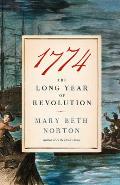
She wrote In the Devil’s Snare about the Salem witchcraft crisis of 1692 and most recently 1774: The Long Year of Revolution, which won the 2021 George Washington Book Prize.

Norton joined the history faculty at Cornell University and is now the Mary Donlon Alger Professor of American History Emerita. Ithaca, New York, though a gorgeous place, is in no way a transportation hub. Therefore, she can’t just pop in for guest lectures elsewhere.

In the coming week, however, Prof. Norton will be speaking to two local historical organizations about how the Revolution developed in 1774.

Sunday, 15 September, 3:00 P.M.
1774: The Long Year of Revolution
Hingham Heritage Museum and online

Inaugurating the Hingham Historical Society’s Revisiting the American Revolution series, Norton analyzes the crucial, but often overlooked, year of 1774 and the pivotal events of that year which would help to forge a new nation. Her book 1774 has become an essential text on the American Revolution.

The society is the whole series of lectures as a package, and since I’m the November speaker I simply must recommend that.

Thursday, 19 September, 7:00 P.M.
1774 and All That: Reflections on a Long Year of Revolution
Concord Museum and online

One of the most acclaimed and original colonial historians of our time, Mary Beth Norton, shares her landmark text 1774: The Long Year of Revolution chronicling the revolutionary changes that occurred from December 1773 to April 1775—from the Boston Tea Party to the Battles of Lexington and Concord. In those 16 months, colonists loyal to King George III began discordant “discussions” that led to their acceptance of the inevitability of war. Professor Norton will be joined in conversation to bring to life this foundational moment in American history.

The in-person seats for this event have sold out, but you can still register for online access.

Thursday, August 08, 2024

History Camp Boston 2024: Be There, Get the T-Shirt

History Camp Boston 2024 is happening this weekend. Hundreds of people have signed up for the full day of presentations by fellow history fans.

While some of the Sunday tours are full, I understand there’s still room in the Suffolk University Law School building for more folks to come on Saturday.

The History Camp Boston website now shows the preliminary schedule for the day. My presentation “Beyond the Thirteen: The American Colonies That Stayed with Britain” is in the opening time slot at 9:30 A.M.

I’m not a morning person, but there’s an advantage to speaking early: I’ll be able to relax, focus on other speakers, and enjoy the rest of the day. As you’ll see, there are lots of sessions about the Revolutionary era!

But my work won’t really be done. In the final time slot, at 4:30 P.M., I’ll be speaking alongside History Camp founder Lee Wright and Scott Nadler from Santa Fe about upcoming Pursuit of History weekends, like the days we organized in April. The first will be in Santa Fe this October.

History Camp Boston’s Saturday session will once again take place at 120 Tremont Street, within sight of the Park Street T station. Doors will open at 8:00 A.M., and there’s a welcome session at 9:00. That gathering will end at 5:30 P.M., but folks can choose to attend Revolution’s Edge at the Old North Church an hour later.

As for the Sunday tours, a fourth was added, making:
  • Boston’s Innovation Trail 
  • Beacon Hill’s 19th Century African American Community 
  • Witches, Privateers, and Bankers: Five Centuries of North Shore History in Beverly
  • A Town Torn Apart: Patriots vs. Loyalists in the American Revolution in Hingham [full]
Can’t wait to see what History Camp Boston comes up with for next year!

Saturday, August 03, 2024

“Revisiting the American Revolution” Lecture Series in Hingham

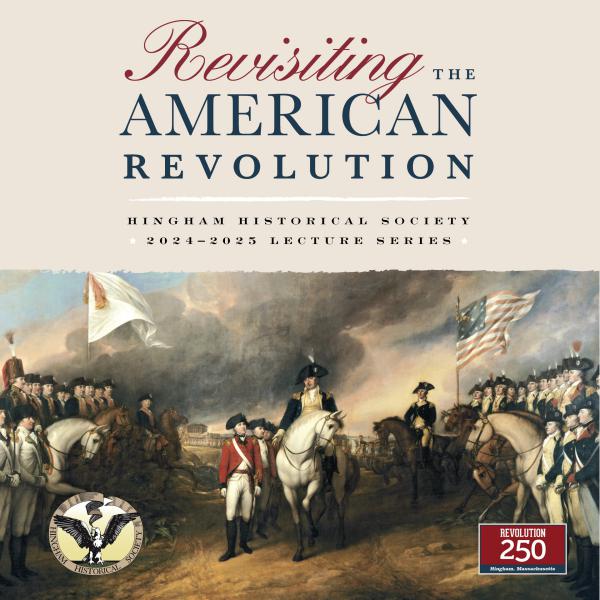
The Hingham Historical Society is hosting a series of seven lectures from September through April 2025 on the theme of “Revisiting the American Revolution.”

I’m honored to be one of those speakers, and a bit humbled to see the others in the lineup.

15 September
1774: The Long Year of Revolution
Mary Beth Norton

Norton is the Mary Donlon Alger Professor of American History Emerita at Cornell University, where she taught from 1971 to 2018. She has written seven books about early American history, including Liberty’s Daughters: The Revolutionary Experience of American Women, 1750-1800 and In the Devil’s Snare: The Salem Witchcraft Crisis of 1692. She was a coauthor of A People and A Nation, one of the leading U.S. history textbooks. Her most recent work, the basis for this talk, won the 2021 George Washington Prize.

27 October
Making Thirteen Clocks Strike as One: Race, Fear, and the American Founding
Robert Parkinson

Parkinson is Professor of History at Binghamton University. He is the author of The Common Cause: Creating Race and Nation in the American Revolution, and most recently, Heart of American Darkness: Bewilderment and Horror on the Early Frontier.

17 November
The Spies in Henry Barnes’s House
J.L. Bell

Bell is the author of The Road to Concord: How Four Stolen Cannon Ignited the Revolutionary War, a National Park Service report on Gen. George Washington in Cambridge, and numerous articles. He maintains the Boston 1775 website, offering daily postings of history, analysis, and unabashed gossip about the American Revolution in New England.

8 December
From Hingham to Yorktown: The Military Campaigns of General Benjamin Lincoln
Robert Allison

Allison is a professor of history at Suffolk University. His books include a biography of American naval hero Stephen Decatur, and short books on the history of Boston and the American Revolution, and an edition of The Interesting Narrative of Olaudah Equiano, or Gustavus Vassa, the African. Two of his classes, “Before 1776: Life in Colonial America,” and “The Age of Benjamin Franklin” are available from The Great Courses. As chair of Revolution 250, a consortium of organizations planning Revolutionary commemorations in Massachusetts, he hosts its weekly podcast, and he is president of the Colonial Society of Massachusetts.

26 January 2025
Hingham’s Revolutionary Canteens
Joel Bohy

Bohy is the director of Historic Arms & Militaria at Bruneau and Co. Auctioneers and a frequent appraiser of Arms & Militaria on the PBS series Antiques Roadshow. His is also an active member of several societies of collectors and historians, an instructor for Advanced Metal Detecting for the Archeologist, and an advisory board member of American Veterans Archaeological Recovery. Growing up in Concord, Massachusetts, helped lead to Bohy’s passion for historic arms & militaria, conflict archaeology, and artifacts like Hingham’s historic Revolutionary War canteens.

9 March
How to Radicalize a Moderate: John Hancock and the Outbreak of the Revolutionary War
Brooke Barbier

Barbier is a public historian with a Ph.D. in American History from Boston College. She is the author of King Hancock: The Radical Influence of a Moderate Founding Father and Boston in the American Revolution: A Town Versus an Empire. Because she believes beer makes history even better, she founded Ye Olde Tavern Tours in 2013, a popular guided outing along Boston’s renowned Freedom Trail.

6 April
The Declaration of Independence: A Guide for Our Times
Danielle Allen

Allen is James Bryant Conant University Professor at Harvard University and Director of the Allen Lab for Democracy Renovation at Harvard Kennedy School’s Ash Center for Democratic Governance and Innovation. She is a professor of political philosophy, ethics, and public policy. She is also a seasoned nonprofit leader, democracy advocate, tech ethicist, distinguished author, and mom. Her many books include the widely acclaimed Our Declaration: A Reading of the Declaration of Independence in Defense of Equality, and she writes a column on constitutional democracy for the Washington Post.

All these talks will take place live beginning at 3:00 P.M. on a Saturday at the Hingham Heritage Museum, and also be streamed online. The society is now selling subscriptions to the entire series for prices ranging from $175 for someone who’s already a member to $675 for someone who wants to become a society Steward. The subscription price for non-members is $200, or about $29 apiece.

Friday, January 27, 2023

“I am (as we say) a daughter of liberty”

For a presentation this week that didn’t come off, I picked out three extracts from the letters of young teenager Anna Green Winslow to her mother in Nova Scotia, showing her political awakening. She wrote between November 1771 and May 1773.

Richard Gridley, retired artillery colonel, explained the political factions to Anna.

Coln. Gridley…brought in the talk of Whigs & Tories & taught me the different between them.
As a girl, and an upper-class girl at that, Anna wasn’t supposed to demonstrate in the streets. But the Whig movement encouraged girls to participate in other ways, such as learning to spin so that local weavers could make more cloth so that local merchants didn’t have to import so much from Britain.

But Anna didn’t know how to spin.

So she contented herself by visiting the Manufactory where her cousin Sally’s yarn had been woven into cloth, and doing a little dance there.
I was at the factory to see a piece of cloth cousin Sally spun for a summer coat for unkle. After viewing the work we recollected the room we sat down in was Libberty Assembly Hall, otherwise called factory hall, so Miss Gridley & I did ourselves the Honour of dancing a minuet in it.
Anna could also participate in the movement as a consumer, choosing to buy more locally produced goods. In one letter she proudly described herself to her mother as a “daughter of liberty.”
As I am (as we say) a daughter of liberty I chuse to wear as much of our own manufactory as pocible. . . . I will go on to save my money for a chip & a lineing &c.
I’m not sure how Anna’s family felt about the politics she was learning in Boston. Her father, Joshua Winslow, was more closely allied with royal officials. Later in 1773 he lucked out (he thought) in being named one of the East India Company’s tea consignees in Boston. But when the town mobilized against allowing that tea to be landed, he had to lie low in Marshfield. Eventually, he left Massachusetts as a Loyalist.

Anna Green Winslow remained in the state, living in Hingham, but she died in 1780. Alas, outside of those letters to her mother in 1771–1773 we have almost no sources about Anna’s life, so we don’t know how her political outlook changed after the Whigs made her father an enemy for agreeing to sell tea, and after the war began.

Friday, December 02, 2022

Talking about Tea

Last weekend I wrote about samples of tea supposedly from the Boston Tea Party preserved in New England museums.

On Tuesday I joined Prof. Robert Allison and Jonathan Lane of the Revolution 250 podcast to talk about those relics, as well as other pieces of Tea Party history and lore.

Was John Hancock really on the docks that night? Who was the man caught trying to sneak away some of the tea (later fictionalized as Dove in Johnny Tremain)? Who came up with the name “Boston Tea Party”? We talked about those questions and many more. Find that podcast episode here.

We also talked (on microphone and off) about some Tea Party relics that hadn’t made my postings, mostly because I hadn’t heard of them yet. Here’s another local purported sample of tea.

The Hingham Historical Society’s Old Ordinary museum is the present repository of loose leaves and a legend, as this blog post explains:
An antique tea caddy, donated to the Society by Mary Henrietta Gibson Hersey, the widow of Alfred Henry Hersey, shortly before her death in 1941, came with a small quantity of loose tea and a note capturing the history of the tea — as provided to the family by an Elizabeth Hersey (unclear which, of a number of Elizabeth’s in the family, this would have been):

“Tea from one of the vessels whose cargo was thrown overboard in Boston harbor by the Patriots at the beginning of the Revolution, December 16, 1773.”
No claim about who collected that tea, so nothing to check.

Finally, here’s another reminder that Revolutionary Spaces’ Old South Meeting-House is hosting a recreation of the “Meeting of the People” mass protests in November and December 1773, which led up to the destruction of the tea. That will start Friday, 16 December, at 6:30 P.M. You can purchase tickets here.

Friday, September 23, 2022

Hingham Historical Lecture Series Starts This Weekend

Starting this weekend, the Hingham Historical Society will host a series of lectures on the theme of “Native Homelands/Settler Colonialism.”

The talks will take place on Sunday afternoons at the Hingham Heritage Museum but also on Zoom. Some of the speakers will be present, and others speaking from their homes.

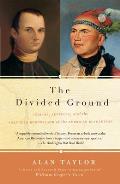
Launching the series on Sunday, 23 September, is Prof. Alan Taylor speaking about “Divided Ground: Indians, Settlers, and the American Revolution.”

Taylor is one of the most respected historians of Revolutionary and post-Revolutionary America today, as well as one of the most productive. Originally from Maine, he wrote The Divided Ground: Indians, Settlers, and the Northern Borderland of the American Revolution in 2006. Taylor won Pulitzer Prizes for William Cooper’s Town in 1996 and The Internal Enemy: Slavery and War in Virginia, 1772-1832 in 2014.

Here are the upcoming talks.
  • 6 November: Robert Miller, “The International Law of Colonialism and New England”
  • 4 December: David S. Jones, “Epidemics, Conflict, and Caregiving during the Colonization of New England” 
  • 22 January 2023: Virginia D. Anderson, “Native Americans, English Colonists, and Strange Beasts” 
  • 26 March: Jean M. O’Brien, “Firsting and Lasting: Writing Indians Out of Existence”
  • 23 April: Lisa Brooks, “A New History of King Philip’s War”
A subscription to all six lectures in person or by video costs $175, or $150 for Hingham Historical Society members.

Monday, January 10, 2022

“Safely delivered of three Male Children”?

On 4 Dec 1752, Thomas Bourne and Susannah Beal married in Hingham’s second parish meetinghouse. In 1765 that community was designated as a district, and ten years later it became the independent town of Cohasset.

Susannah was born in February 1737, making her fifteen years old when she married. Calculating back from Thomas’s reported age at death, he was twenty-two.

Thomas and Susannah Bourne did not have their first child within seven months of their wedding. In fact, they didn’t have their first child within seven years. This was apparently a great disappointment.

On 5 Nov 1764, the Boston Evening-Post ran this article:
We hear from the second Parish in Hingham, that one Mrs. Bourne of that Place (a Person peculiarly fond of Children) was on Monday Evening [i.e., 29 October], to the great Joy of herself and Friends, safely delivered of three Male Children, after having lived upwards of Eleven Years in the connubial State without Offspring with one of the kindest Husbands, and enjoying with an unblemished Reputation every other Species of Earthly Felicity.
This is where the story turns sad. The Cohasset vital records say that all three of the Bournes’ babies died on Tuesday, 30 October. A local history says they were baptized that day and died “soon” after.

Either way, by the time the announcement of the birth of triplets appeared in Boston, those babies were dead. They had no recorded names.

This is where the story turns happy again. Exactly three years after the Evening-Post article, on 5 Nov 1767, Thomas and Susannah Bourne had a son they named Thomas, Jr. He grew up as an only child.

In 1774 and the early years of the Revolutionary War, Thomas Bourne, Sr., served on Cohasset’s governing committees. He turned out with the local militia to guard Hull beach in the winter of 1775–76. He died in 1796 at the age of sixty-six.

Thomas, Jr., grew up and married Jane Doane in 1786, when they were both still in their teens. Her uncle, the Rev. John Brown, performed the ceremony, as he had done for Thomas’s parents.

Jane died giving birth on 9 June 1787. Thomas, Jr., named their baby after her mother.

In April 1790, Thomas Bourne, Jr., married twenty-year-old Betty or Betsy Tower. That September, she gave birth to twin boys who died as infants—the family history seemed to be repeating. The following year, they had a daughter, Priscilla, who died at fourteen months. Then, however, Thomas and Betsy Bourne had a series of daughters and sons:
  • Eliza, 1793.
  • a second Priscilla, 1797.
  • Mary, 1799.
  • a new Thomas, Jr., 1803.
  • Elias, 1807.
  • Marshal, 1811.
The Doane genealogy says this Thomas Bourne became a physician; the local history says he was a farmer like his father. Public records show he served Cohasset as a church deacon, a coroner, a selectman, and eventually a representative in the Massachusetts General Court.

Susanna Bourne, widow of the older Thomas, died in 1819. She was thought to be ninety, but she was really eighty-two. Betsy Bourne, widow of the younger Thomas, died in 1846 at the age of seventy-six.

(The photo above shows Cohasset’s First Parish Meeting House, its oldest part built in 1747.)

Friday, July 16, 2021

Charles Adams’s Wish

On 16 July 1775, Abigail Adams had an urgent message to pass on to her husband John, then at the Continental Congress in Philadelphia:
Our little ones send Duty to pappa. You would smile to see them all gather round mamma upon the reception of a letter to hear from pappa, and Charls with open mouth, What does par say—did not he write no more. And little Tom says I wish I could see par.

Upon Mr. Rice’s going into the army he asked Charls if he should get him a place, he catchd at it with great eagerness and insisted upon going. We could not put him of, he cryed and beged, no obstical we could raise was sufficent to satisfy him, till I told him he must first obtain your consent. Then he insisted that I must write about it, and has been every day these 3 weeks insisting upon my asking your consent.

At last I have promised to write to you, and am obliged to be as good as my word.
Charles Adams was then five years old. His father did not use his influence to land him a spot in the Continental Army. But later in the war Charles did accompany his father and older brother John Quincy on a diplomatic mission to Europe.

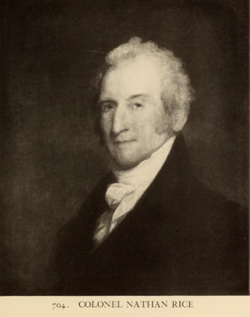
The “Mr. Rice” who started all this heartache with an offhand joke to little Charles was Nathan Rice (1754–1834, shown above later in life), son of a Sturbridge minister who graduated from Harvard College in 1773. By then his widowed mother had married a man in Hingham, bringing the family to the South Shore.

In August 1774 Rice joined the Adams household as one of John’s law clerks alongside John Thaxter. Because their arrival coincided with the shutdown of the Massachusetts courts and Adams’s service at the First Continental Congress, those young men didn’t get to see much lawyering.

Thaxter transitioned into being the Adams family’s live-in tutor, also going on that mission to Europe. Rice joined the army in May 1775, serving in staff positions for most of the war, including as aide de camp to Gen. Benjamin Lincoln.

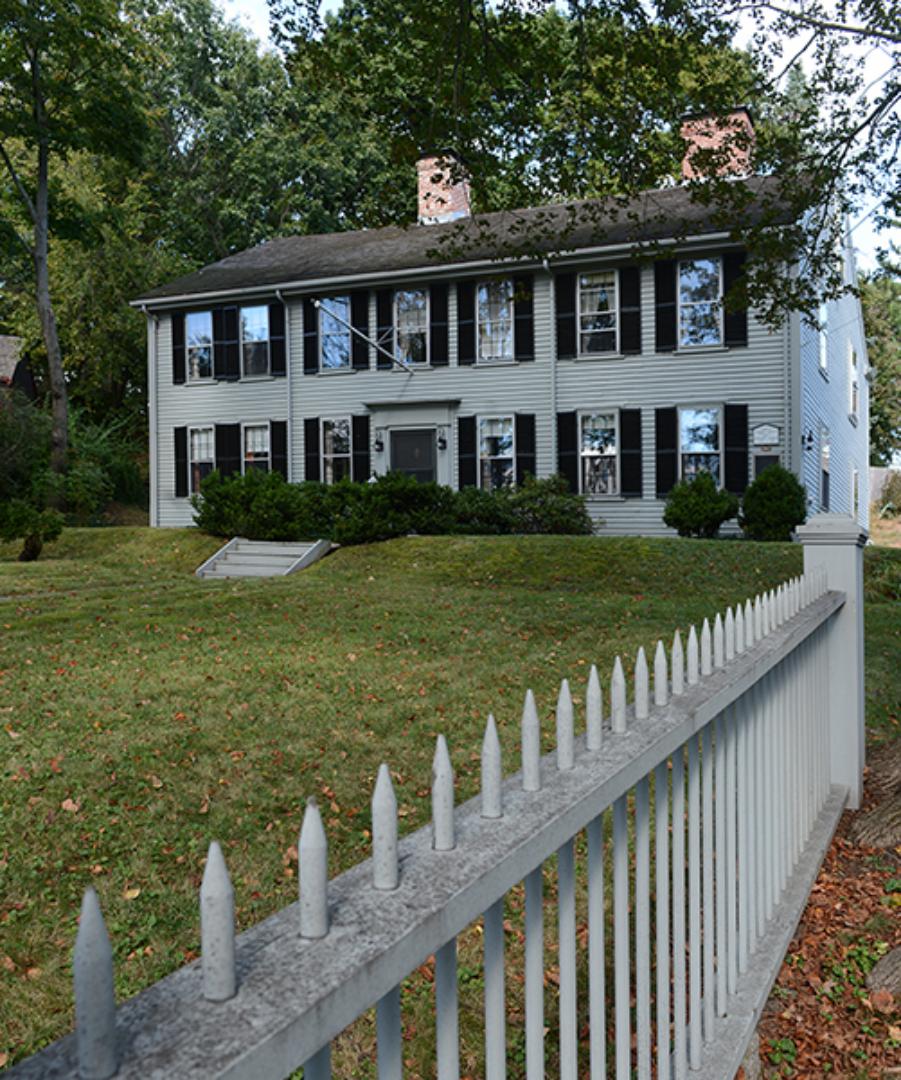
Rice settled in Hingham, having married Sophia Blake. He returned to the army during the Adams administration’s Quasi-War, retiring as a lieutenant colonel. In the 1810s, after raising their children, Nathan and Sophia Rice moved up to Winooski, Vermont. The house they built in 1818, remodeled extensively, became known as the “Mansion House”; there was a local dispute over removing it to build apartments in 2019, and I don’t know how that turned out.

Friday, November 27, 2020

Finding Jurors for the Boston Massacre Trial

On 27 Nov 1770, 250 years ago today, the second trial for the Boston Massacre got under way.

It was supposed to start a week earlier, but the court had trouble finding twelve jurors who were ready to sit on what promised to be an unusually long, unusually charged trial.

The defense team was giving the jurors extra scrutiny. Acting governor Thomas Hutchinson wrote to Gen. Thomas Gage in New York:
My great concern is to obtain an unbiased Jury and for that purpose, principally, I advised Captain [Thomas] Preston to engage one of the Bar, over and above the Council to conduct the Cause in Court, in the character of an Attorney who should make a very diligent inquiry into the characters and principles of all who are returned which he has done and it may be to good purpose, but after all it will be extremely difficult to keep a Jury to the Rules of Law.
That appears to be the reason that the young solicitor Sampson Salter Blowers joined John Adams and Josiah Quincy, Jr., on the defense team. (Blowers appears above later in life, when he was a judge in Nova Scotia.) Robert Auchmuty, senior counsel for the defense in Preston’s trial, saw his job as done.

The defense lawyers challenged every potential juror from Boston as too close to the case. After all, the town was paying Robert Treat Paine to be a special prosecutor. And the judges accepted those challenges. As a result, the jurors all had to come from other towns in Suffolk County (which at that time included all of present-day Norfolk County as well as Hingham). 

The trial record, which is unusually thick for the eighteenth century and published in volume 3 of The Legal Papers of John Adams and thus on Founders Online, shows the difficulty in seating a jury of twelve. The men called were: 
  • Samuel Williams, Roxbury, challenged for cause.
  • Joseph Curtis, Roxbury, challenged for cause.
  • Nathaniel Davis, Roxbury, sworn.
  • Joseph Mayo, Roxbury, sworn.
  • Abraham Wheeler, Dorchester, sworn.
  • Edward Pierce, Dorchester, sworn.
  • William Glover, Dorchester, challenged peremptorily.
  • Isaiah Thayer, Braintree, sworn.
  • Samuel Bass, Jr., Braintree, challenged peremptorily.
  • James Faxen, Braintree, challenged peremptorily.
  • Benjamin Fisher, Dedham, sworn.
  • John Morse, Dedham, challenged peremptorily.
  • James White, Medway, challenged peremptorily.
  • Nehemiah Davis, Brookline, challenged peremptorily.
  • Samuel Davenport, Milton, sworn.
  • Joseph Houghton, Milton, sworn.
  • James Richardson, Medfield, challenged peremptorily.
  • John Billings, Stoughton, challenged peremptorily.
  • Joseph Richards, Stoughton, challenged for cause.
  • Consider Atherton, Stoughton, sworn.
  • Abner Turner, Walpole, challenged peremptorily.
The clerk then called the Boston men whose names were at the bottom of that list, and the defendants challenged them all.
  • John Brown, Boston, challenged for cause.
  • Joseph Barrell, Boston, challenged for cause.
  • Silas Aitkins, Boston, challenged for cause.
  • Harbottle Dorr, Boston, challenged for cause.
The judges had Sheriff Stephen Greenleaf bring in more men, and the process resumed.
  • Samuel Sheppard, Boston, challenged peremptorily.
  • John Goldsbury, Boston, challenged for cause.
  • Samuel Peck, Boston, challenged for cause.
  • William Gouge, challenged for cause.
  • Joseph Turrell, Boston, challenged for cause.
  • Jacob Cushing, Jr., Hingham, sworn.
  • Josiah Lane, Hingham, sworn.
  • Jonathan Burr, Hingham, sworn.
Finally, the court officers did a little legal maneuvering to ensure the last three men from Hingham were indeed eligible, and the opening arguments began.

Joseph Mayo (1721-1776) of Roxbury was named foreman of the jury. He owned a large farm a little past the intersection of modern Washington Street and South Street in Roslindale. A veteran of the Louisbourg expedition of 1745, he was a captain of his town’s militia company. Mayo had also served on town committees to promote non-importation and to instruct the Massachusetts General Court representatives to stand up for the province’s charter rights. But the defense team felt, based on their inquiry, that he could assess the case fairly.

Saturday, October 24, 2020

The Career of Dr. Bela Lincoln

When Bela Lincoln was growing up in Hingham in the 1740s, his father—a wealthy farmer, town official, and militia colonel—insisted on sending him to Harvard College.

Some people didn’t think Bela had the smarts for it. Others felt that his talent was merely hidden by "a natural bashfulness.”

Bela Lincoln did fine at Harvard. After graduating in 1754, he returned to Hingham to study medicine with Dr. Ezekiel Hersey. In 1756 he took a province job as doctor for the community of Acadian exiles (“French neutrals”) resettled in Sherborn.

Young Dr. Lincoln was building his practice during the time he became engaged to Hannah Quincy, from a similarly upper-class family in Braintree. Most of our information about their courtship comes from the diary of John Adams, who also entertained thoughts of proposing to Quincy and therefore wasn’t a neutral observer.

Bela Lincoln and Hannah Quincy married on 1 May 1760. Yesterday I shared Adams’s alarmed description from that December of how rudely the doctor behaved toward his wife, her parents, and the entire gathering. Whatever bashfulness Lincoln had shown as a child, he didn’t show it that night—though perhaps he was overcompensating.

I don’t know of other evidence of strains in the Lincolns’ marriage, though, unless their lack of children counts. I haven’t found anyone else writing of Bela Lincoln as such an obnoxious, overbearing man.

Dr. Lincoln’s career seemed to advance steadily. In 1761, Gov. Francis Bernard appointed him a justice of the peace for Middlesex County. The men of Sherborn elected him to the Massachusetts General Court.

In late 1764 Lincoln sailed to Britain for more medical training, also carrying messages from speaker of the house Thomas Cushing to the province’s agent. He came back the next year with an M.D. from King’s College in Aberdeen, which reflected some combination of study and payment.

Now looking even more prestigious, Dr. Lincoln returned to Hingham to resume his practice. The governor made him a justice in Suffolk County. He trained younger doctors, including the hapless schemer Amos Windship, whom he set up in practice in exchange for a mortgage on an inheritance.

Then Dr. Lincoln fell ill. In the summer of 1771 Edmund Quincy described him as “in a very dangerous State.” At the time he and Hannah were on Georges Island in Boston harbor, perhaps for his health. They had been married more than a decade.

Dr. Bela Lincoln finally died in Hingham on 16 July 1774, leaving his wife Hannah a widow at age thirty-five. (His older brother Benjamin went on to have a distinguished political and military career.)

TOMORROW: A better prospect?

Sunday, September 27, 2020

Exploring Benjamin Lincoln’s Life in Hingham

This afternoon the Hingham Historical Society launches its new season of lectures with the theme “Benjamin Lincoln’s World: Stories from Colonial Hingham to the Early Republic.”

The society is in the process of acquiring Gen. Benjamin Lincoln’s house, a National Historic Landmark that has been owned by one family for eleven generations (shown here).

These online talks are designed to explore Lincoln’s life and work in the Revolution, and to raise interest and funds for turning the house into a house museum. There are seven lectures scheduled through May 2021 and a self-guided walking tour.

Here are the first two events:

Sunday, 27 September, 3:00 P.M.
“Benjamin Lincoln and the American Revolution: A Conversation with David Mattern”
Andy Hoey, Head of Social Studies for the Hingham Public Schools, will interview David Mattern, Gen. Lincoln’s biographer and the recently retired editor of the Papers of James Madison.

Sunday, 25 October, 3:00 P.M.
“The Evolution of Benjamin Lincoln’s Lifelong Home”
J. Ritchie Garrison, Ph.D., former Director of the Winterthur Program in American Material Culture at the University of Delaware, will lead an architectural examination of the Benjamin Lincoln House.

Further lectures will discuss Hingham and the slave trade, colonial schooling, beer-making, women’s lives in early New England, and eighteenth-century lighthouses.

The self-guided walking tour “Getting to Know Benjamin Lincoln’s Neighborhood” will debut on the web in October. It will describe downtown Hingham structures that would have been standing in the general’s lifetime and the families who lived there.

Access to the full series of seven online lectures costs $200, or $175 for Hingham Historical Society members. One can order gift subscriptions, memberships, or copies of David Mattern’s book from the same webpage. Unlike some other online talks, I don’t expect these to be available on the web for free soon, so don’t sleep on this subscription! (That’s a little narcolepsy joke in Gen. Lincoln’s honor.)

Wednesday, August 12, 2020

Paula Bagger with More on Marlborough

After my series of postings about Revolutionary conflict in Marlborough, Paula Bagger of the Hingham Historical Society filled me in on some details about the household of Loyalist merchant Henry Barnes. She has researched that family in the course of making important discoveries about the enslaved artist Prince Demah.

In particular, Paula identified the little girl whom Dr. Samuel Curtis quizzed about the two undercover British army officers who visited the house in March 1775. So I’m sharing Paula’s information as a “guest blogger” posting.


The “child” was undoubtedly Christian (“Chrisy”) Arbuthnot, the daughter of Christian Barnes’s brother William Arbuthnot from Hingham. Born in 1765, Chrisy would have been ten years old whereas the other young women who lived with the Barneses from time to time (Catharine Goldthwait and several Murray nieces of Elizabeth Inman) were older. The Barneses became Chrisy’s guardians when William Arbuthnot, a widower, died in the late 1760s.

Chrisy decamped to England with the Barneses in 1776 and died in 1782 in Bristol.

As for Catharine Goldthwait (1744-1830), who remained in Marlborough trying to preserve the estate in 1775, she traveled to England in the late ’70s or early ’80s. She spent time with her parents, Thomas and Catherine (the latter Henry Barnes’s sister), who had settled in Walthamstow outside London. But she seems to have spent some time with the Barneses in Bristol as well.

In July 1795, Catherine wrote Deborah Barker of Hingham to tell her that Christian Barnes had died in April. Henry Barnes died in London in 1808.

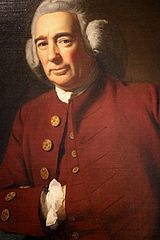
In England, Catharine Goldthwait met and married eighty-year-old Dr. Silvester Gardiner, a wealthy Loyalist widower [shown above]. They returned to America together. After Gardiner died, she married the merchant William Powell of Boston, a wealthy Patriot widower. She had no children of her own but adopted a niece and then two great-nieces.

Thanks, Paula!

One of the oddities I came across while researching this extended family is that Catharine Goldthwait’s sister Mary (1753-1825?) married Francis Archibald in Maine, was widowed, and fell into mental illness—the reason her teen-aged daughter came to live with Catharine Powell in Boston and eventually take her aunt’s last name. Mary Archibald lived on relief in the homes of various Maine householders, including now-famous Revolutionary War veteran Joseph Plumb Martin for several years.


COMING UP: Gossip about Marlborough’s Dr. Curtis.