


J. L. BELL is a Massachusetts writer who specializes in (among other things) the start of the American Revolution in and around Boston. He is particularly interested in the experiences of children in 1765-75. He has published scholarly papers and popular articles for both children and adults. He was consultant for an episode of History Detectives, and contributed to a display at Minute Man National Historic Park.

Subscribe thru Follow.it


•••••••••••••••••


Showing posts with label Spencer Vassall. Show all posts

Sunday, February 20, 2022

“After 28 Years of active and unremitting Service”
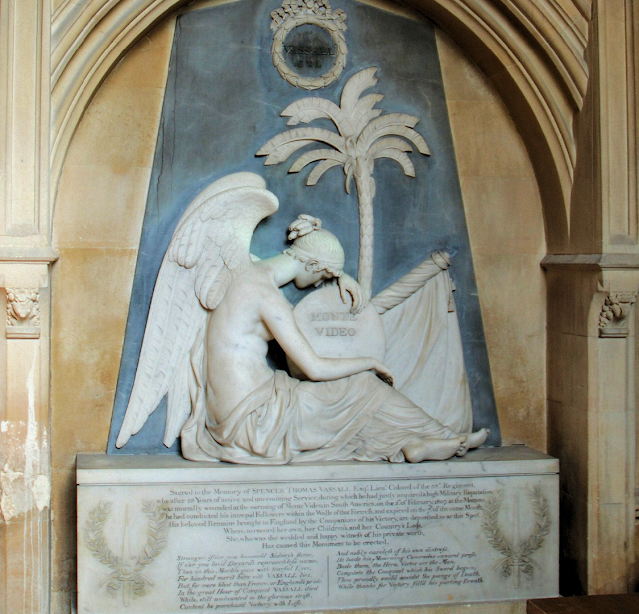
This monument is installed in St. Paul’s Church in Bristol, England. It shows an angel mourning over a stone labeled “Monte Video” with a palm tree in the background.

This artwork was installed to honor of Lt. Col. Spencer Thomas Vassall of His Majesty’s 38th Regiment of Foot. As the inscription explains:
after 28 Years of active and unremitting Service, during which he had justly acquired a high Military Reputation [he] was mortally wounded at the storming of Monte Video in South America, on the 3rd of February 1807, at the Moment he had conducted his intrepid Followers within the Walls of that Fortress, and expired on the 7th of the same Month
Vassall’s fellow officers brought his remains back to Britain, and his wife paid for this monument.

Lt. Col. Vassall began life in 1764 in Cambridge, Massachusetts, the second son of John and Elizabeth Vassall. He was born in the mansion now known as Longfellow House–Washington’s Headquarters National Historic Site. The Vassall family was immensely wealthy from slave-labor plantations on Jamaica.

On 2 Sept 1774, when Spencer was ten years old, thousands of Massachusetts farmers marched up and down the street outside his house in the event later called the “Powder Alarm.” Those men demanded that several neighbors—including attorney general Jonathan Sewall, Council members Samuel Danforth and Joseph Lee, and Middlesex County sheriff David Phips—give up their royal appointments under the new Massachusetts Government Act or apologize for actions they had taken under that law.

At the end of the day the crowd surrounded Lt. Gov. Thomas Oliver’s house, about a mile to the west, and threatened him into signing a resignation. The lieutenant governor was Spencer’s uncle (in two ways). Undoubtedly that experience affected the Vassall and Oliver children, but I don’t think any of them left comments or reminiscences about it.

Nobody in that 1774 crowd knew that Spencer’s father had just written to Gen. Thomas Gage offering to join the Council as well. And John Vassall didn’t want anyone to know. Within a couple of weeks, he packed up his family and moved into Boston for safety. Spencer and his siblings never saw their Cambridge home again.

By early 1776, the Vassalls were in Britain. Later that year, the family bought Spencer, aged twelve, a commission in the British army. He went on active duty a couple of years later. From October 1782 to the end of the American War, he was at Gibraltar while it was under siege from the Spanish and French. In later conflicts he served in Flanders, Antigua, France, Spain, Holland, Ireland, and South Africa. And, as related above, he died leading a British army attack in Uruguay.

One detail not mentioned on Lt. Col. Spencer Vassall’s monument is that he was born in America. His parents had spent even more of their lives in Massachusetts, and their monument in the same church also says nothing about having been born, married, and started a family in Cambridge. The Vassalls left that difficult part of their history behind.

Friday, October 19, 2012

The Vassalls of Cambridge

Although the title of my book-length study for the National Park Service is Gen. George Washington’s Headquarters and Home—Cambridge, Massachusetts, it gets a running start with the building of that house sixteen years before Washington arrived.

In 1759 John Vassall (1738-1797) turned twenty-one and came into his inheritance of large sugar plantations on Jamaica. He had the best upbringing that his maternal grandfather, Lt. Gov. Spencer Phips, could provide. He had a Harvard degree. And from his late father he had farmland in Cambridge with a house on the north side of the road out to Watertown.

But that house evidently wasn’t exactly what John Vassall wanted, so he had it torn down and a handsome new Georgian mansion built nearby. Over the next fifteen years Vassall added to the estate until he owned 90 acres, paying more real-estate tax than anyone else in Cambridge.

In January 1761, John Vassall married Elizabeth Oliver (1741-1807), daughter of a Dorchester man with Caribbean plantations. Seven months earlier, John’s sister Elizabeth had married Elizabeth’s brother Thomas Oliver. Miss Elizabeth Vassall thus became Mrs. Elizabeth Oliver, and Miss Elizabeth Oliver became Mrs. Elizabeth Vassall. In 1766, the Olivers moved to Cambridge, commissioning a handsome mansion of their own, now called Elmwood.

John Vassall’s life in Cambridge in the late 1760s would have given Bertie Wooster fits: he was surrounded by aunts. His father’s brother Henry Vassall and wife Penelope lived pretty much across the street. Near the college was his father’s sister, Anna Borland, and her husband. Two of his mother’s sisters, Mary Lechmere and Rebecca Lee, lived along the Watertown road to the west with their husbands. Then came another paternal aunt, Susanna Ruggles, with hers. And finally the Olivers. All those houses are still intact, too, though one has been moved. They comprise most of “Tory Row.”

This chapter describes the “Powder Alarm” of 2 Sept 1774 from the Vassalls’ point of view. Imagine being Spencer Vassall, John and Elizabeth’s ten-year-old second son, watching 4,000 men with sticks march past your house to the town common to demand that all the men appointed to the new royal Council step down. Then watching those thousands of men walk back past your house to your uncle’s, where they threatened his life until he signed a resignation under protest. Did Spencer know that his father had recently told Gov. Thomas Gage he was willing to sit on the Council as well? (That news was kept secret, and John Vassall never actually took the seat.)

The Vassalls left their Cambridge home for their Boston home that September, then left Boston for Halifax in 1775 and were in London by June 1776. With most of his wealth coming from Jamaica, John Vassall easily weathered the loss of his Massachusetts properties. In fact, the memorial inscriptions for him and his wife in St. Paul’s Church in Bristol don’t even mention Massachusetts, where both were born and where they had seven of their eight children (two dying young).

And what about Spencer Vassall? He was ready to fight in the American war. His father bought him an army commission, and he apparently entered the service in 1778 at the age of fourteen. Lt. Vassall served at Gibraltar from October 1782 to the end of the war; for the British, staving off Spain’s attempt to regain this territory was an important and heroic campaign. Vassall remained in the army through the wars with Revolutionary and Napoleonic France, serving in Flanders, Antigua, France, Spain, Holland, Ireland, and South Africa. He died leading a British attack on Montevideo, Uruguay, in 1807.

Amelia Opie wrote an epitaph to Capt. Spencer Vassall that began:
Stranger, if e’er you honor’d Sidney’s fame,
If e’er you lov’d Bayard’s reproachless name,
Then on this marble gaze with tearful eyes,
For kindred merit here with Vassall lies!…
The first chapter of the report includes more mediocre poetry about the captain, plus the family’s vital records, descriptions of John Vassall’s social and public life, details of a mysterious shooting in Lincoln, and remarks on whether Vassall was really a figure in Mercy Warren’s The Group or involved in a Loyalist disinformation campaign during the war.

Tuesday, August 04, 2009

Revisiting the “Powder Alarm” in Cambridge, 8 and 15 August

At 2:00 P.M. on the next two Saturdays, 8 and 15 August, I’ll lead a walking tour in Cambridge titled “The Powder Alarm of 1774 and the End of British Government in Massachusetts.” This is just one of the tours and events of the 2009 Cambridge Discovery Days.

I’ve led this tour along Brattle Street before, but this year’s excursion will include:

  • a new site (well, it’s been there for over two hundred years, but I haven’t had anything to say about it before).
  • Lt. Gov. Thomas Oliver’s anguished description of confronting the crowd at his house.
  • what that day meant to the previously unpolitical John Vassall and his young sons.
I’ll have to talk fast and walk fast, and the route is about a mile and a half, so please wear comfortable shoes if you come along. Our starting point is the Cambridge Center for Adult Education building at 42 Brattle Street.