


J. L. BELL is a Massachusetts writer who specializes in (among other things) the start of the American Revolution in and around Boston. He is particularly interested in the experiences of children in 1765-75. He has published scholarly papers and popular articles for both children and adults. He was consultant for an episode of History Detectives, and contributed to a display at Minute Man National Historic Park.

Subscribe thru Follow.it


•••••••••••••••••


Showing posts with label Archibald Kennedy. Show all posts

Saturday, November 21, 2015

Lt. Gov. Colden’s Unsafe Situation
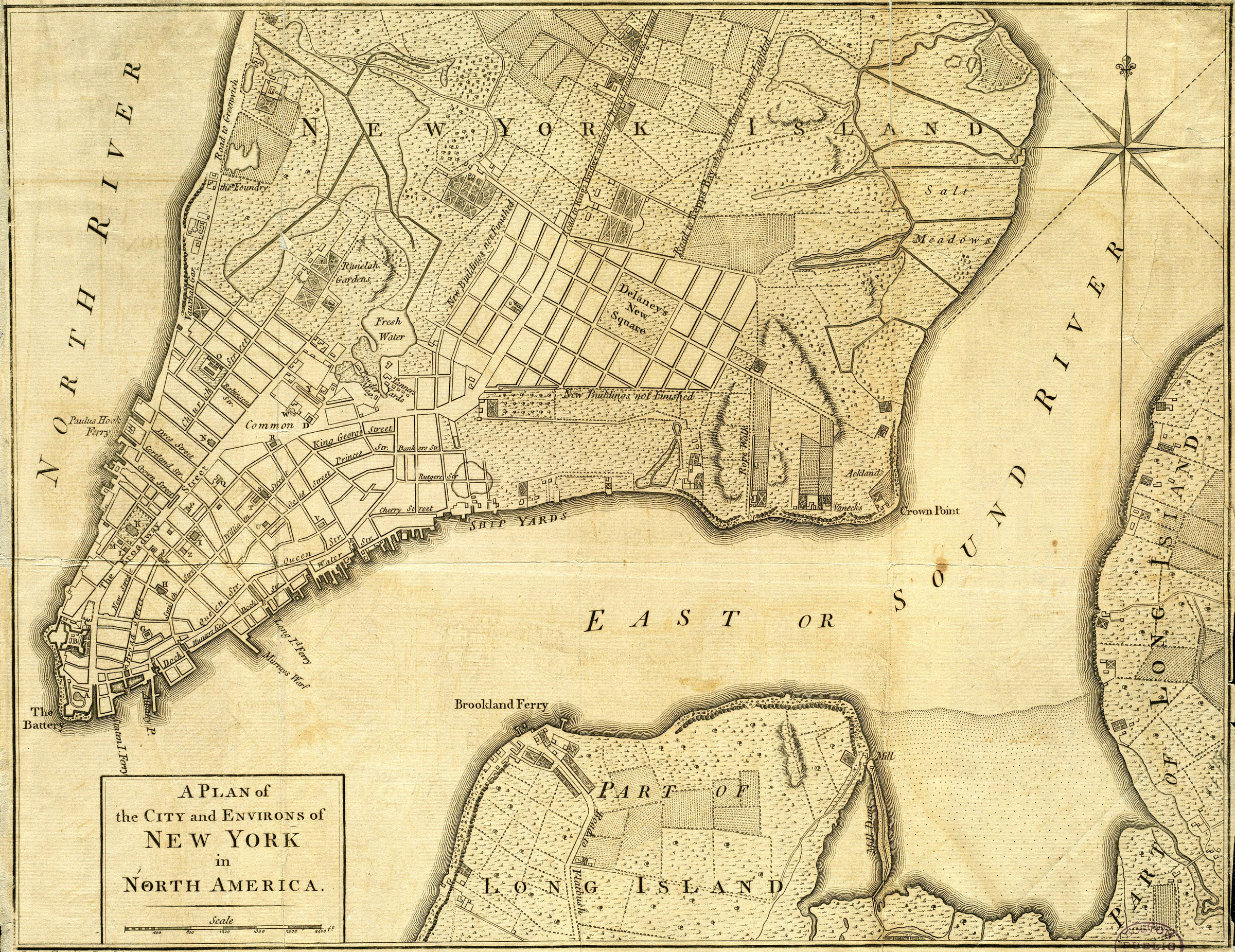
As November 1765 began, New York acting governor Cadwallader Colden was holed up in Manhattan’s Fort George (on the far left of the map above) with a contingent of the king’s military forces and the stamped paper for three colonies. Outside was a crowd of thousands of men convinced that the Stamp Act was tyrannical and determined to keep it from taking effect.

Maj. Thomas James commanded some men from the Royal Artillery inside the fort. That, and his contemptuous remarks, had caused the crowd to tear apart the mansion he was renting in town on the night of 1 November. 

Capt. Archibald Kennedy had sent “Lieutenant Owen & twenty four Marines” to the fort to support Colden. However, he added, “by doing this I leave the Ships without Marines, & as most of our men are imprest there is a great risque of their deserting.” But he declined to take charge of the stamps, lest the crown attack his home and property.

Colden asked the military engineers how they would strengthen Fort George. On 2 November, Capts. Harry Gordon (d. 1787), Thomas Sowers, and John Montresor delivered their report:
The most necessary & Expeditious way of putting this Fort in an immediate posture of defence.

A Number of Barrells Boxes or such Instruments as will contain a sufficient quantity of earth to make them Musquet proof to be put on the Salient Angles of the Bastions to form a Lodgement for 12 Men each, filld with earth 4 ft. 6 in. high. The Earth for filling them to be taken from the inside of the parapet leaving only a Banquet inside of the Barrells Boxes &c. A piece of artillery behind those lodgements towards the shoulders of the Bastions.

Two Pieces of light artillery covered with their mantelets &c. to be mounted on each Flank & the shoulders rais’d to cover them.

A Howitzer to be mounted on each Curtin towards the Town

The Crows feet to be scetterd to the Gate, Sorties and other practicable Avenues to the Fort.

All the Remainder of the Chevaux des frises to be fix’d and ready to plant along the places where the parapet remains en harbet and to be steadied by some Earth thrown against them

A Lodgment of Mattresses or Bedding or any thing proper to make a Covering a top of the large House for a Serjeant & 12 good men who have been practised to firing.

One hundred hand Grenades to be lodg’d at each Curtin & forty near each small lodgment on the Points of the Bastions to be loaded & ready to be lighted & thrown.

The Gate to be Barricaded within at Night as fast as possible & two pieces of large artillery to be planted against it, & two light pieces at some distance behind the Chevaux des frises.

The several Fronts of the Fort to be disencumbered from the Buildings &c

’Twould be necessary for the defence of the Fort if Capt. Kennedy’s House was taken possession of as it commands two Fronts the most accessible of the Fort.

Proper Instruments & Workmen for the defence should be immediately provided and a sufficient number of Men at least three hundred.

Notwithstanding the above Improvements for the defence of the place, its still under great inconveniences arising principally from the want of proper cover within, & being commanded by the Circumjacent Buildings.
In other words, even with at least 300 men, plenty of weapons, Kennedy’s full cooperation, and a lot of hard work, Fort George would still be vulnerable. It had been built to protect the city from attack by sea, not to withstand a siege by land. And was there time to do all those things anyway?

The next morning, a paper was found inside an oyster shell at the gate of Fort George, addressed to Colden himself:
Sir

As one who is an enemy to Mischief of all kinds, & a Well wisher to you & your Family, I give you this Notice that Evil is determined against you & your Adherents & will in all human Probability take Effect, unless Speedily prevented by your public Declaration upon Oath, That you will never, in any Manner, countenance, or assist, in the Execution of the Stamp Act, or anything belonging to it; and also, that you will, to the utmost of your Power, endeavour to get it repealed in England, and meanwhile prevent its taking Effect here. Your Life may depend upon the Notice you take of this Advice.

Benevolus

P.S. I well know the Guides of the People would only shew you that they may dare also; but don't incense them, for God’s Sake, by an unpolitical Contempt! You are not safe at Flushing.
Flushing was where Colden had his country estate. He was probably wishing he were there.

TOMORROW: Reaching a compromise. 

Friday, November 20, 2015

Capt. Kennedy and the Stamped Paper

On the night of 1 Nov 1765, after the Stamp Act was supposed to take effect, a New York mob signaled its disapproval of that development by burning the coach and other vehicles of Lt. Gov. Cadwallader Colden. Then some of that crowd destroyed the estate being rented by Maj. Thomas James, the commander of the fort protecting Colden and the stamped paper.

The acting governor responded with a public announcement early on the morning of 2 November that he was suspending enforcement of the new law until the new royal governor arrived. That calmed the immediate situation.

Colden also sent a letter to Capt. Archibald Kennedy (c. 1723-1794, shown here), the highest-ranking officer in the Royal Navy at New York, aboard his ship Coventry. The acting governor asked the captain if he was willing to take over the protection of the stamps:
The Gentlemen of the Council are desirous that the Stamp’d papers now in the Fort, should be put on board one of the Men of War—and I desire to know as soon as possible from you whether or not you will order them to be received on board—
Capt. Kennedy quickly wrote back to Colden:
I have this Instant received yours of this date informing me it is the desire of the Council that the Stamp’d paper should be sent on board one of the Kings Ships,

as they are already lodged in Fort George which is a place of security sufficient to protect them from any attempt the Mob can possibly make to destroy them. cannot see any plausable reason for moving them, and indeed the very attempting to move them must be attended with much greater risque than they can possibly be exposed to while there,

I shall ever be ready when necessity requires to give you all the assistance in my power
Though it seems clear Kennedy wasn’t assisting at all at that moment.

Aboard his warship, Kennedy was safe from any angry crowds, but his property wasn’t. The captain’s father had been a major businessman in New York, he had earned a lot of money from naval prizes in the wars against France, and he had married a Schuyler sister. Through inheritance, investments, and marriage, Kennedy owned a whole lot of New York real estate, including his own mansion at 1 Broadway.

The lieutenant governor explained that to British officials the next month:
Kennedy absolutely refused to receive them [the stamps], & with good reason, for he was aware of their design to force Him to deliver them by Threatning to destroy the Houses he was possesst of in the City, of which he had in his own & his wife’s Right more than perhaps any one Man in it.
I sense that Colden might have been more exasperated at his Council for suggesting this unrealistic solution than at Kennedy for resisting it. But Parliament didn’t like Kennedy’s action, or inaction, and recalled him to Britain over it. Of course, Kennedy didn’t need the navy’s salary, so he retired.

TOMORROW: Lt. Gov. Colden assesses his defenses.

Tuesday, November 17, 2015

Protesting the Stamped Papers inside Fort George

As I noted back here, the designated Stamp Tax collector for New York, James McEvers, resigned that post on 26 Aug 1765, after hearing about how Bostonians had smashed up Andrew Oliver’s house.

Acting governor Cadwallader Colden insisted on enforcing the law nonetheless. Because the British military had made New York its base at the end of the Seven Years’ War, there was a sizable contingent of soldiers in the city, as well as Royal Navy ships and marines. Colden thus didn’t have the problem that stymied Gov. Francis Bernard in Massachusetts—that he could not rely on the militia to stop a mob when the mob was made up of the militiamen.

Colden asked the navy, under the command of Capt. Archibald Kennedy, to intercept the ships carrying stamped paper and carry that precious cargo to Fort George, there to be protected by the Royal Artillery under Maj. Thomas James.

That didn’t sit well with the city’s inhabitants, as reported in the New-York Gazette of 7 Nov 1765 and reprinted eleven days later in the Boston Post-Boy:
On the 23d of October, by Capt. Davis, arrived a parcel of the stamps, which immediately raised a spirit of general uneasiness in the town;—they were put under convoy of a man of war, landed and deposited in the fort. The Governor had very injudiciously, some time before the arrival of the stamps, made a great shew of fortifying the fort, providing it with mortars, guns, ammunition, and all the necessaries for the regular attack of an enemy—and it was given out that he threatened to fire on the town if the stamps were molested (which greatly exasperated the people). Representations against these measures were made to him; and they were, I believe, discontinued, but resumed again upon the arrival of the stamps.

From this time several papers appear’d stuck up in public places about the town, threatening every person that should deliver or receive a stamp. The preparations at the fort were continued with greater vigour, and the people grew more uneasy and enflamed. On the 31st of October, the merchants had a meeting, where they enter’d into an obligation that none of them should order any goods from England till the stamp act was repeal’d, that the orders already sent (and not executed) should be countermanded, (except grindstones, &c. for such ships as were there belonging to this place) and that they should accept no goods on commissions, or assist in the sale of any sent here. This was subscribed by upwards of two hundred merchants.

The shopkeepers also obliged themselves to purchase no goods sent here contrary to the above articles, till the stamp act was repealed. That evening a large company suddenly assembled and marched to the walls of Fort George, and from thence thro’ several streets in the city. The magistrates appeared, and endeavoured to disperse them, but in vain. After a short time they suddenly dispersed of themselves without doing any mischief. It was rumour’d about town a much larger concourse would assemble the next night, and their visit was by some expected, while others thought they would meet no more.
The map above shows Fort George, courtesy of the Library of Congress. The big round spot at the bottom is the Bowling Green with a statue of King George III in the center. (ADDENDUM: The statue was installed in 1770.) It’s currently the site of the Alexander Hamilton U.S. Custom House.

TOMORROW: The day the Stamp Act was supposed to take effect.

Monday, November 16, 2015

Two Gentlemen Who Couldn’t Possibly Take Charge of Connecticut’s Stamped Paper

When the British government instituted the Stamp Act for North America, one of the first steps was to buy a lot of paper. With the tax added, that paper was budgeted to bring in over £100,000 from the thirteen colonies that became the U.S. of A. alone. The untaxed cost of that paper was less, but it was still a substantial investment for the government.

The paper was also a substantial chunk of government property to take care of. Naturally, most colonial officials didn’t want to take any more responsibility for that than they had to.

On 9 Sept 1765, as the anti-Stamp protests heated up in Connecticut, designated stamp master Jared Ingersoll asked a favor of Cadwallader Colden (1688-1776, shown here), the acting governor of New York:
the Stampt papers intended for this Colony are Expected to arrive Soon at N. York & were to have been forwarded to me who am appointed the Distributer here, but the unaccountable rage & fury of the Mob is at present So high against Stamp Officers & papers that I do not think it Safe to have the later Sent here as yet

I have therefore to desire of you to protect the Same when they Shall arrive by placing them in the Fort, or otherwise as you shall be Able, until Some further Steps may be taken . . .

my Duty to the King obliges me to give You this trouble

I am Sr
Yr Most Obedt & Most Humbl. Servt.…
On 14 September, Colden responded:
I have yours of the 9th desiring me to take care of the stamp Paper for your Colony when they arrive. In my opinion they may be put more safely & with greater ease on board one of the Men of War at this Place, & more easily conveyed from thence to your Colony, than by placeing them in this Fort, where it is too probable there will be a necessity of placeing those designed for this Colony. This Fort at present is crowded with Men & military Stores. It may be proper for you or some Person for you to be in this place to take care of your Stamp’d Papers, as my hands are too full with the affairs peculiar to this Province. . . .

I am with great Regard, Sir,…
Ingersoll publicly resigned his post as stamp master on 19 September, as described starting here. He therefore told Colden that the papers were really no longer his charge:
by the time that your favour of the 14th reached my house, I had been Compelled in a most Extraordinary manner to declare I would not directly or indirectly intermeddle with the Stampt papers intended for this Colony—at present therefore when all the Springs of Government are broken I can do no more than recommend to you to take the best Care you Can of those Stampt papers for the Crown until you shall have further directions concerning them from the Commissioners of Stamps, or from me

I am
Yr. Most Obedt. Humb Servt.…
When the stamps for Connecticut actually arrived, Gov. Colden silently disregarded that request and had his son David (1733-1784) take up the correspondence on 28 October:
The Gover. Orders me to inform you that Captn. Davis has brought over three Packages of Stamp’d Papers Marked for Connecticut, which are now lodged in the Governor’s House in the Fort. The Gaspey Cutter is now here & is a very fitt vessell for carrying the Papers to you if you can prevail upon Captn. [Archibald] Kennedy to order her to do it. We hear more Stamped Paper is on board three Ships daily expected here.

I am with great Regard, Sir,…
Ingersoll replied directly to the acting governor on 31 October:
Yesterday I received your favour of the 28th advising me of the Safe arrival of part of the Stamp papers intended for this Colony. I immediately advised with the Governour [Thomas Fitch] on the Subject & for Answer have to Say, that as the people of this Colony have with impunity offered the most high handed violence to my person on account of my having undertaken to be Distributor of Stamps And still Continue their threats to me in case I shall intermeddle with the Stamp papers, as also the destruction of the papers themselves, and as the house of Representatives of this Colony have lately voted the Act of Parliament itself unprecedented & unconstitutional whereby the peoples Spirits are kept up, and as we have no Strong hold wherein to place the papers, I Cannot think it Safe for me or the papers or prudent to bring them into the Colony & have therefore only to thank you for your past goodness & to repeat to you my request that you will be So good as to keep & protect the papers that have or shall arrive at N.York until you Shall receive further directions about the Same.

I am Sr
Yr. Most Obedt. Humble Servt.…
I like how the complimentary closes to those letters give an “Alphonse and Gaston” tone to this exchange.

By the time Colden received Ingersoll’s last letter, the situation in New York had become dire. Connecticut’s paper was the least of his troubles.