J. L. BELL is a Massachusetts writer who specializes in (among other things) the start of the American Revolution in and around Boston. He is particularly interested in the experiences of children in 1765-75. He has published scholarly papers and popular articles for both children and adults. He was consultant for an episode of History Detectives, and contributed to a display at Minute Man National Historic Park.

Subscribe thru Follow.it


•••••••••••••••••


Showing posts with label sexuality. Show all posts

Monday, September 07, 2026

“Ever afterwards, he was known as Dr. Bush”

David Bushnell’s pioneering submarine didn’t do much damage to the Royal Navy in 1776, but the next year he came back with another invention.

As Christian McBurney relates in this article, in August 1777 Bushnell oversaw an attack on H.M.S. Cerberus with explosive mines. They didn’t hit the warship, but they did destroy a schooner and kill three British sailors.

In August 1779 Bushnell became an officer in a new Continental corps of “Sappers and Miners.” Two years later, Capt. Bushnell led his specialized unit in the siege of Yorktown.

In 1787 Bushnell moved from Connecticut to France. There’s not much evidence of what he did there. Some people speculate that he crossed paths with Robert Fulton, who would design his own submarine as well as a steamboat. However, it looks to me like Fulton didn’t go to France until 1797, and by then Bushnell was back in the U.S. of A.

Not in Connecticut, however. Instead, Bushnell settled in Georgia “in 1795 or 96,” according to the Rev. George White’s Historical Collections of Georgia (1854). At first he was “a teacher in the County of Columbia.”
He was eminently distinguished for his classical and scientific learning. His chief enjoyments were found in the instruction of his classes, and an occasional visit to a few men of congenial spirit. . . .

His old fellow soldier, the Hon. Abraham Baldwin, received him into his family, under whose auspices he had no difficulty in placing himself at the head of one of the most respectable schools in Georgia. In this vocation he spent several years, and under his guidance and tuition many of our most useful citizens received valuable instructions in learning and morals.
Bushnell and Baldwin (1754–1807, shown above) had met at Yale in the early 1770s. Baldwin was barely a “fellow soldier,” though; he had been a chaplain for Connecticut troops but spent most of the war preparing for the Congregationalist pulpit. Then in 1783 he suddenly changed direction, became a lawyer, and moved to Georgia.

Within a few years Baldwin was representing the state in the Confederation Congress, the Constitutional Convention, and the first federal House of Representatives. He also served as president of the nascent University of Georgia while it was organized.

As for the “family” that Baldwin welcomed Bushnell into, both men were lifelong bachelors. It looks like Bushnell shared Baldwin’s house for several years before the younger man died suddenly in 1807 while serving in the U.S. Senate.

The Historical Collections of Georgia profile of Bushnell continued:
Late in life, he settled in Warrenton as a practitioner of physic. Then, and ever afterwards, he was known as Dr. Bush. For reasons which have never been disclosed, he had some time before he settled in Georgia, dropped the last syllable of his name; and until the publication of his last will and testament, no person in this country, except his old friend Baldwin, was apprised of the fact that his family name was Bushnell.
The name of “David Bush, Phicion [physician]” does appear on Georgia tax records for 1805, owning “Stock in trade & House adjoining Warrenton.” Three years later, he bought more real estate. In 1810 David Bush was one of the commissioners to incorporate the town of Warrenton, named for Dr. Joseph Warren.

At least one other local did know Dr. Bush’s real name, however. In 1814 George Hargraves, a notary in Warren County, wrote a letter to Thomas Jefferson enclosing a “description and drawing of a Torpedo” that might be useful to the U.S. in the current war. He said the inventor was “a man of science” mentioned in David Ramsay’s history of the Revolution, hinting: “you will readily conjecture who the Inventor is.” Bushnell must therefore have entrusted Hargraves with his secret, just as he trusted the man to be an executor of his will.

Dr. Bush probably died in early 1826. Hargraves started advertising for his debtors to come pay what they owed the estate on 15 March of that year.

On 9 August an item appeared in the Middlesex Gazette of Middletown, Connecticut, reminding readers about Bushnell and his “destructive machine.” It reported:
About 30 years since, Mr. Bushnell left his native town, and from that period no information was received respecting him, until very recently, when a gentleman arrived in Saybrook from Georgia, with the intelligence that Mr. Bushnell had lately died in that State, leaving about 9,000 dollars in cash; accumulated principally by the practice of Medicine; which Mr. B. had given to him, he being a particular friend, provided that if he should, upon inquiry, discover that Mr. B’s connexions in Saybrook, were from their character, worthy of the property, such connexions were to receive the whole amount.

The gentleman with whom it was entrusted, ascertained, on reaching Saybrook, that Mr. Bushnell’s nearest relatives were four nephews, and those all men of worth and integrity, and faithfully divided the property among them.
Those were the sons of David Bushnell’s brother Ezra. In addition to the money, this article said, he bequeathed them an “unfinished a piece of mechanism, upon which he had bestowed much pains”—but what it was, the newspaper didn’t, or couldn’t, say.

The Middlesex Gazette stated: “Mr. Bushnell…bore a very high reputation as a mechanical genius, and was esteemed an exemplary member of society, although possessing many eccentricities of character.” Again, the paper didn’t say what those eccentricities were.

Monday, May 11, 2026

“Not playing cards but fondling and kissing each other”

In preparation for tomorrow’s talk about Benjamin Thompson’s early years, I’ve been reviewing the evidence of his affair with Mary (Dill) Thomas, wife of printer Isaiah Thomas.

When Isaiah moved to divorce Mary in 1777 by petitioning the Massachusetts Council, he submitted testimony from several people who had seen his wife traveling with the militia major from New Hampshire in February 1775, behaving like man and wife.

The printer’s file also offered an affidavit from Mary Fowle of Londonderry, New Hampshire, who had stayed with the Thomases in Boston from 20 Sept 1774 to 16 April 1775.

In Sex and the Scientist, Jane Merrill quotes Fowle describing how “Major Thompson [was] then a refugee in Boston who borded in a house opposite.” Mary Thomas started visiting him several times a day even though (or because) she had two children under the age of three.

One Saturday the printer’s wife “dressed herself, shifting her Linen, which I knew was not her custom,” said her house guest. Mary Thomas came home with “a small piece of parchment, on which a Lady’s face had been drawn with a black lead pencil. . . . the Major had taken much pains with it.”

Soon Mary Thomas visited Thompson’s ”bed-chamber, where they staid the whole afternoon and part of the evening.” Fowle stated, “I could not but think there was more intimacy between them than I before tho’t of.” She observed the couple “kissing each other, laying in each others laps, speaking fondly of each without regarding me.”

One day Isaiah came home from business after his wife had gone to play cards with Maj. Thompson. Mary Fowle and a household servant went across to fetch her. They found the couple “not playing cards but fondling and kissing each other, she often laying her head on the Major’s shoulder, and their arms round each other.”

As if that wasn’t clear enough, in February 1775 Mary Thomas insisted on taking that trip to Newbury with Maj. Thompson, first having her hair “in the greatest taste much powdered.” Later the printer gathered testimony from several innkeepers about that journey. At the time, however, he just seems to have felt trapped.

On one Sunday, Isaiah Thomas and Mary Fowle went to church. When they came home, his daughter Mary Ann, who turned three years old that March, showed them a “copper” that Maj. Thompson had given her to go into another room. Fowle stated the little girl said, “The major kissed her Mama and felt her bosom.” In response, little Mary Ann’s mother told her she was lying and threatened to whip her.

Isaiah finally demanded that Mary admit to what was going on. She acknowledged having a sexual affair. And when did it start? True to Benjamin Thompson’s character, he first got into Mary Thomas’s bed right after writing a letter to his own wife back in Concord, New Hampshire.

I won’t bother asking if these marriages can be saved.

TOMORROW: Who was Mary Fowle?

Sunday, November 09, 2025

“Let not that man be trusted who can voilate private faith”

The Massachusetts Whigs were flabbergasted by the evidence that Dr. Benjamin Church, Jr., was corresponding with someone behind enemy lines.

By the fall of 1775, those men had worked alongside Dr. Church for a decade. He had helped to compose instructions for representatives, correspondence to Whigs in Britain, and political verse for engravings.

The doctor had delivered the Massacre memorial oration in 1773. He had represented Boston in the Massachusetts Provincial Congress and then the General Court, serving on the most sensitive committees.

His fellow legislators had chosen Church to take important documents to the Continental Congress in Philadelphia, and then to escort Gen. George Washington across the state from Springfield. He was serving as the top doctor in the Continental Army.

Church’s erstwhile colleagues wrote to each other in astonishment.

One group of Massachusetts Patriots who didn’t express such surprise, however, were the Massachusetts Whigs’ wives.

Those women had noted Church’s habit of extramarital affairs, rumored as early as 1769. By 1774 he was maintaining a mistress outside of Boston. To other men’s wives, the doctor’s betrayal of Sarah Church made it easy to believe he’d betrayed his political movement as well.

Abigail Adams wrote to her husband John on October 9:
You have doubtless heard of the viliny of one who has professd himself a patriot, but let not that man be trusted who can voilate private faith, and cancel solem covanants, who can leap over moral law, and laugh at christianity.
Mercy Warren, wife of Massachusetts house speaker James Warren, added her voice three days later:
I fear a Late Instance of perfidy and Baseness in one who Rancked Himself among the Friends to the Rights of society and the Happiness of the Community Will occasion many Inviduous Reflections from the Enemies of the American Cause.

I was Ever sorry that there should be one among the Band of patriots Whose Moral Character was Impeachable for when the Heart is Contaminated, and the Obligations of private Life Broken through, And the man has thrown of[f] the Restraints Both of Honour and Conscience with Regard to His own Domestic Conduct, what Dependance is to be Made on the Rectitude of His public Intentions.
Abigail Greenleaf, wife of the publisher Joseph Greenleaf, wrote to her brother Robert Treat Paine on 14 October:
How Sir, did you receive the news of the Perfidy & treachery of Docter Church? Was it not in Silent astonishment? It will I believe, bow down the grey hairs of his Father & Mother, with Sorrow to the grave. His Poor wife too, is an object of the Pitty, & Compassion of every one. She still Loves him, tho, he has treated her in so base a manner. If she looses her senses I think twill not be strange; but it will be melancholy.
Abigail Adams came back to the topic on 21 October:
What are your thoughts with regard to Dr. Church? Had you much knowledg of him? I think you had no intimate acquaintance with him.

“A foe to God was ne’er true Friend to man
Some sinister intent taints all he does.”
The wise response to such questions from a spouse was of course: ‘I agree with you, dear. I barely knew the man. You’re so right.’

Thursday, July 10, 2025

“You shake it within an Inch of my Nose”

Some years back, I mentioned Simeon Potter’s dispute with John Usher, but I was relying on a secondary source that I’ve come to see as unreliable.

I’m therefore retelling that story in more detail using the court documents published by the Rhode Island Historical Society in 2006 (available as a P.D.F. from Family Search) and other sources.

In 1761 Potter was a wealthy gentleman in Bristol, Rhode Island. He’d been born in that town forty-one years earlier to a poor or middling family. He’d therefore grown up without much schooling, trained to be a cooper. But because of a privateering windfall at the start of King George’s War, Potter had made himself into one of the richest men in the whole colony.

Reflecting his new genteel status, Capt. Potter took on prestigious positions in politics and the church. He became a warden of the local Anglican church, St. Michael’s. Few New England towns of Bristol’s size—about 1,200 people in 1774—had an Anglican church, but this was at the coast and therefore served mariners.

The minister of St. Michael’s was the Rev. John Usher. He was the son of a wealthy bookseller who had risen to be lieutenant governor of New Hampshire. After graduating from Harvard College, Usher had joined the Church of England, defying the New England orthodoxy. The missionary Society for the Propagation of the Gospel paid part of his salary, and his congregants sometimes paid the rest.

In 1761 Usher was over sixty years old. His exact age is unclear since his tombstone says he was seventy-five when he died in 1775, but a memorial plaque later installed in his church says he was eighty. Either way, he’d been the minister at St. Michael’s since 1724, when Simeon Potter was still a little boy.

According to Usher’s report back to the S.P.G., the trouble started because
Notwithstanding he [Potter] has an agreeable wife, he has by report for some years back kept a criminal conversation with a young woman, one of my parish. . . . After many general hints from the Pulpit…I told her what reason I had to suggest she was guilty of the notorious sin of Adultery. . . . Upon this she told the man immediately what I had said
Frankly the minister shouldn’t have been surprised by that.

On the morning of 14 August, Charles Munro said, “the Rev. Mr. John Usher and Capt. Simeon Potter…engaged in warm words or Differing” on the street. Richard Smith added that Usher told Potter, “wherever he went there was whoring carried on.” Smith also quoted the men as saying:
[Potter:] if it wont for your Age and Gown I would not have your Cane shook over my head

[Usher:] I don’t shake it over your head nor mean to shake it over

[Potter:] you shake it within an Inch of my Nose
Simeon Potter, despite his fearsome reputation, was “small in stature,” according to Father Elzear Fauque. Also, in the manners of the time clubbing another man with a cane implied that the caner was a gentleman and the canee was not; given Potter’s background, his class status might have been a sensitive spot.

The minister’s son, Hezekiah Usher, called this “Ill treatment” of his father. Potter may also have said something about the minister’s daughter, but I can’t find another trace of her.

On 18 August, Usher and Potter met yet again on Church Lane. They picked up where they had left off. Hezekiah Usher stated:
I heard my Father say to sd. Potter if ever he cast any more reflections on his Family especially on his daughter twould cause him to reflect on his family and upon that the said Potter came up to my Father who was then on the edge of the Gravell’d Walk and said who of my Family and my Father said Your Father
Potter’s father, Hopestill Potter, was in fact sitting in a chair at his own front door nearby.

The quarrel caught the ears of several neighbors, though trees along the street blocked some people’s views. Witnesses agreed that Usher was holding his walking-stick in the middle, waving it around as he spoke. Some said this was “Usher’s naturall way of Shaking his Cane at any Person when he is earnest in talk.” One said the cane was “up as if he was agoing to strike.” But all the trial witnesses agreed they never saw the minister actually touch the captain.

According to Hezekiah Usher, after his father mentioned the captain’s father, Capt. Potter “rusht close up to my Father and said what reflections can you cast on him”? Usher replied, “I’ll blow him up.”

The captain then punched his sexagenarian minister in the face.

TOMORROW: In court.

Tuesday, April 15, 2025

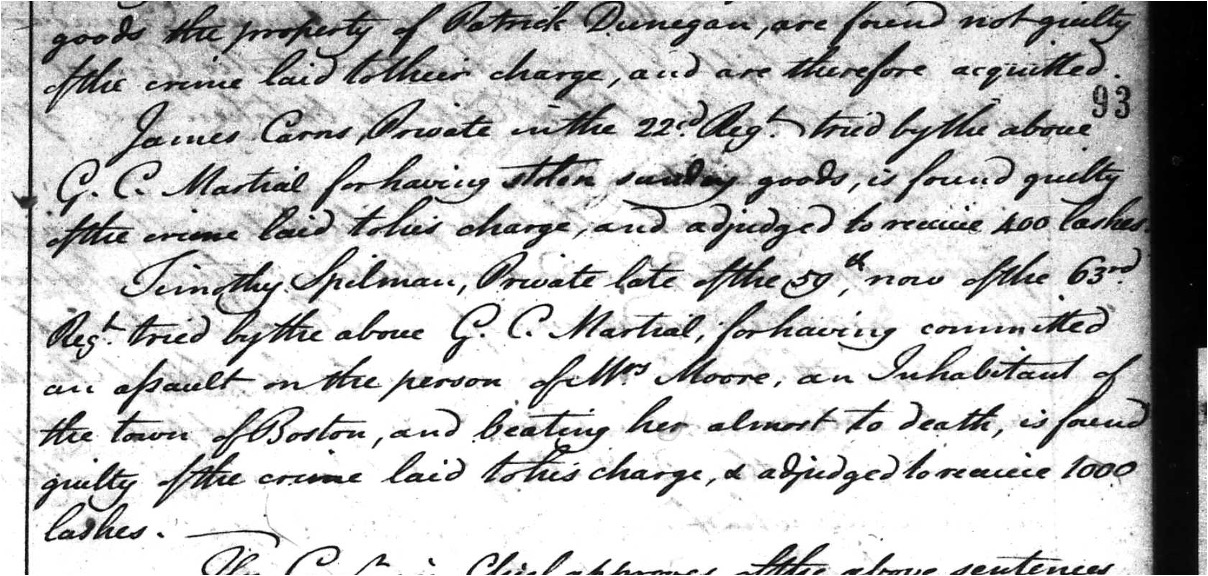
“Guilty of the crime laid to this charge, & adjudged to receive 1000 lashes”

Here’s a taste of another presentation at last week’s “1775: A Society on the Brink of War and Revolution” conference at the Concord Museum.

Sarah Pearlman Shapiro, now a visiting assistant professor at Brown University, shared a paper on “Care Work Vulnerabilities and Sexual Assault in 1775 Boston.”

But it was really about one case, described in this short essay for the David Center for the American Revolution:

In late December 1775, Anne Moore packed up her employer’s home and office, preparing to move with the British 59th Regiment’s physician from occupied Boston to London. By the end of the evening, Moore would need medical care. The sun had long since set when her colleague, Private Timothy Spillman, arrived with various items to include alongside the doctor’s remedies and medical supplies. Moore offered Private Spillman rum and water to warm up from the bitter cold before she retired to her bedroom upstairs. In the middle of the night, Private Spillman extinguished the candle next to her bed, knocked her unconscious against the windowpane, and attempted to sexually assault her. When she came to, she ran into the cold and to her neighbors in search of help.

Private Spillman was brought before a British General Court-Martial for nearly killing Moore. In his deposition, Private Spillman claimed he did not know Moore and she must have fallen down the stairs. From her deposition, along with her stark bruises on her face and neck, Private Spillman was sentenced to one thousand lashes for assault. However, the verdict reached by the thirteen men made no reference to the sexual nature of the attack. Eighteenth-century notions of consent—she had offered him a drink—precluded such a verdict.
Because this assault happened inside besieged Boston, and because Spillman was enlisted in the British army, he was tried by court-martial rather than the civilian courts. The same legal principles seem to have applied. But the record of the procedure was preserved in Britain’s War Office papers rather than in Massachusetts archives.

You can read the verdict yourself in this extract from microfilm at the David Center.
However, Prof. Shapiro told me that because Spillman was being transferred (“draughted”) from one regiment to another, his punishment fell through the cracks, and there’s no record of it being carried out.

Friday, March 14, 2025

“1775: A Society on the Brink” Conference in Concord, 11–12 Apr.


On 10–11 April, the Concord Museum will host a conference, organized with the David Center for the American Revolution at the American Philosophical Society and the Massachusetts Historical Society, on the topic “1775: A Society on the Brink of War and Revolution.”

The full schedule is available here.

The conference will start with a reception on Thursday evening, followed by a keynote discussion at 7 P.M.:

From Boycotts to Bullets: Was the Outbreak of the American Revolution Inevitable?
  • Serena Zabin, Carleton College
  • Robert A. Gross, University of Connecticut, Emeritus
  • Katherine Grandjean, Wellesley College
On Friday, 11 April, the day will be devoted to five paper sessions, each seventy-five minutes long and featuring three papers by scholars ranging from graduate school to emeritus rank. A panel moderator will offer commentary and coordinate questions from the floor. One of those panels stands out for me—I’m sure you’ll see why.

9 A.M.: Faith and Ideas

10:30 A.M.: Communities in Crisis
  • Donald Johnson, North Dakota State University, “From Observers to Generals: The Transformation of Local Committees at the Outset of the Revolutionary War”
  • Sarah Pearlman Shapiro, Brown University, “Care Work Vulnerabilities and Sexual Assault in 1775 Boston”
  • Kevin M. Sweeney, Amherst College, Emeritus, “The Guns of April: Kinds and Quantities of Firearms Kept and Borne in 1775”
  • Comment: J. L. Bell, Boston1775.net
1:30 P.M.: The Coming of War

3:00 P.M.: Myth, Material, and Memory

4:15 P.M.: Concluding Remarks

The conference registration is only $20 and includes the Thursday evening reception and a boxed lunch on Friday. All attendees must register in advance. I hope to see some of you there!

Sunday, January 12, 2025

“He continues, with his usual Success, to carry on his Operations”

The Newport Mercury advertisement I quoted yesterday was just the start of a campaign extolling Dr. John Newman’s cancer cure.

On 3 May, another letter appeared in the newspaper addressed to printer Henry Barber and signed by “Your Constant Readers.” This listed ten more Rhode Islanders who had been cured in the last two months, eight from Newport plus one each from Bristol and North Kingston.

On 28 June, “A Friend to Mankind” reported:
Mr. Benjamin Blossom of Massachusetts State, was sorely afflicted with a Cancer, seated near the eye; which extended itself round both his eye-lids; its progress had been so rapid that the eye-lashes were eaten off, insomuch that in the opinion of good judges it was thought incurable.

However, he applied to the said Doctor, who by his method of cure, in ten days fully extracted the Cancer, without giving the least pain or inconvenience to the eye.
That might have been Benjamin Blossom (1722–1797) of Dartmouth or his son, Benjamin, Jr. (1753–1837), of Fairhaven.

The longest letter yet appeared on 6 September. It was signed “D.G.,” but the writer identified himself (or herself) as the writer of previous “observations on the conduct of Doctor JOHN NEWMAN” published in the paper.

This letter added three more people to the list of Newman’s patients: “Col. Ebenezer Sprout, of Middleborough, Massachusetts State”; “Mr. Elihu Robertson, of Elizabeth Islands, Massachusetts State”; and “Mrs. Parker, her place of residence I have forgot.”

According to the letter, the Middleborough man “had a Cancer, which had eaten out one of his eyes, two years before he applied for relief: entirely extracted and will soon be effectually cured.” This could be the militia colonel Ebenezer Sproat, who would die in 1786, or his namesake son (shown above), a former Continental Army officer who would help to lead the settlement of Marietta, Ohio, where he died in 1805. Reportedly the Shawnee called the younger man “Hetuck,” meaning “eye of the buck deer/buckeye,” but authors connect that to his height rather than the prominence of his eyes.

“D.G.” closed by saying: “I am not intimately acquainted with the Doctor, but as his reputation for humanity seems generally acknowledged, I must own I have a great partiality in his favour.” Frankly, I can’t help suspecting that Newman wrote all those letters himself.

Newman himself spoke out in yet another letter dated 22 November:
For the Benefit of the Public.

DOCTOR JOHN NEWMAN advertises his Removal from his former Place of Residence in the Ferry Wharf-Lane, to the House No. 113, in Louis-Street, at the Sign of the Pestle and Mortar: Where he continues, with his usual Success, to carry on his Operations in the Cure of the Cancer, and other Disorders incident to the human Body:

And in a more particular Manner, has discovered a new and safe Method for the Cure of the Venereal Disease, which he accomplishes in Six Days (provided the Patient adheres to his Advice) without the least Inconvenience—and takes this fresh Opportunity of acknowledging to the Public the many Favours received by their most obliged Servant.
I can’t help noting that only the first Newport Mercury letter about Dr. Newman, published the month after the legislature lowered his sentence for corresponding with the enemy, stated that he would offer his cure for free to anyone who couldn’t pay.

COMING UP: The cure from Fort Pitt.

Friday, January 10, 2025

“He has by him a large Quantity of Patent Medicines”

Yesterday’s posting introduced the character of John Newman, a doctor from Rhode Island who came to Salem in 1790 to treat cancer patients.

The earliest glimpse of this man that I’ve found is from 1777, when he bought land in Newport. In the following years, Newman built a house on that land, which in 1782 he sold to the William Terrett, a British-born maker of leather breeches and gloves.

As of 2003, the Magazine Antiques stated that that house still stood, albeit at a different location in Newport. But Google Street View is showing me a vacant spot at that address.

It’s significant that when Newman bought and built his house, the British military held Newport.

Our next sighting of the man is an ad in the 13 July 1782 Newport Mercury:
Dr. JOHN NEWMAN,
Living in Ferry Wharf Lane, informs the Public, that he has by him a large Quantity of Patent Medicines, such as

GENUINE Turlington’s Balsam of Life, Elixir Salutis, Hill’s Balsam of Honey, Hooper’s Pills, Anderson’s Scots ditto, the Essence of Pepper Mint, best of Rose’s Teeth Powder, with Brushes, and Essence of Pearl for cleaning the Teeth and preventing the Scurvy; also, an elegant Assortment of Perfumery for the Ladies, with a variety of other Articles too tedious to be enumerated in a News Paper.

N.B. Said Newman extracts Teeth with giving but very little Pain; also cures the venereal Disease, by a Method lately found out, without the Patient’s altering his or her way of living, or taking any Mercury, and the cure perfected in a very short Time.
Those medications had been invented in Britain. Hooper’s Female Pills and Turlington’s Balsam, for instance, had received their royal patents in 1743 and 1744, respectively. Dr. John Hill was still active in Britain, marketing his Balsam of Honey.

Since the U.S. of A. was still at war with Britain 1782, how was Newman obtaining “GENUINE” supplies of all these medications?

In September, the state charged Newman with leaving Newport on 1 August without authorization and going to British-occupied New York. He was “convicted of an illicit correspondence with the enemy, and sentenced to be fined and imprisoned.”

TOMORROW: Pleading his cases.

Friday, January 03, 2025

A New Edition of The Power of Sympathy

As a self-proclaimed propagator of unabashed gossip from Revolutionary New England, I have to note the recent publication of a new edition of The Power of Sympathy.

William Hill Brown published this novel pseudonymously in 1789. Most readers quickly recognized that it was based on a recent sex scandal in the top echelon of Boston society: rising attorney Perez Morton had impregnated his wife Susan’s sister, Fanny Apthorp.

In 1787 that affair led to a baby and parental rejection. In 1788 came a challenge to a duel from a Royal Navy officer and months of newspaper innuendo. Finally, Fanny committed suicide. Brown’s novel presented her character sympathetically—but was the book another layer of scandal?

This edition has been assembled by Prof. Jennifer Harris at the University of Waterloo and Prof. Bryan Waterman at New York University. It includes not only Brown’s The Power of Sympathy but also his play Occurrences of the Times, exploring some of the same incident as farce, and another closet drama, Sans Souci, alias, Free and Easy, digging into the sensitive spots of upper-class Boston.

Appendices reprint Fanny Apthorp’s final letters, which circulated at the time, and her sister Sarah Wentworth Morton’s poems; newspaper coverage of the case; newspaper essays on the place of women in the new republic; and letters from Mercy Warren and Abigail Adams about proper behavior for young republican gentlemen.

(Early on, people speculated that Sarah Wentworth Morton herself had written The Power of Sympathy, and that Mercy Warren had written the San Souci play. Warren was exasperated by that suggestion, Morton probably humiliated. I find it significant that both women eventually discarded their early anonymity and published under their own names, establishing how they wanted to be remembered as writers.)

The publisher of this new edition, Broadview Press, is based in Ontario. The book appears to have been published in Canada last month, but is scheduled to officially appear in the U.S. of A. this summer.

Saturday, October 26, 2024

More Misrepresentation of James Wilson

The American Philosophical Society has just shared what might be the best blog posting of the season: Renée Wolcott’s “Spurious Sexploits: The Case of the James Wilson Diary.”

James Wilson was a Pennsylvania jurist who played important roles at the Constitutional Convention and on the first U.S. Supreme Court.

He was also prominent at the Second Continental Congress, though not in the way portrayed in the musical 1776.

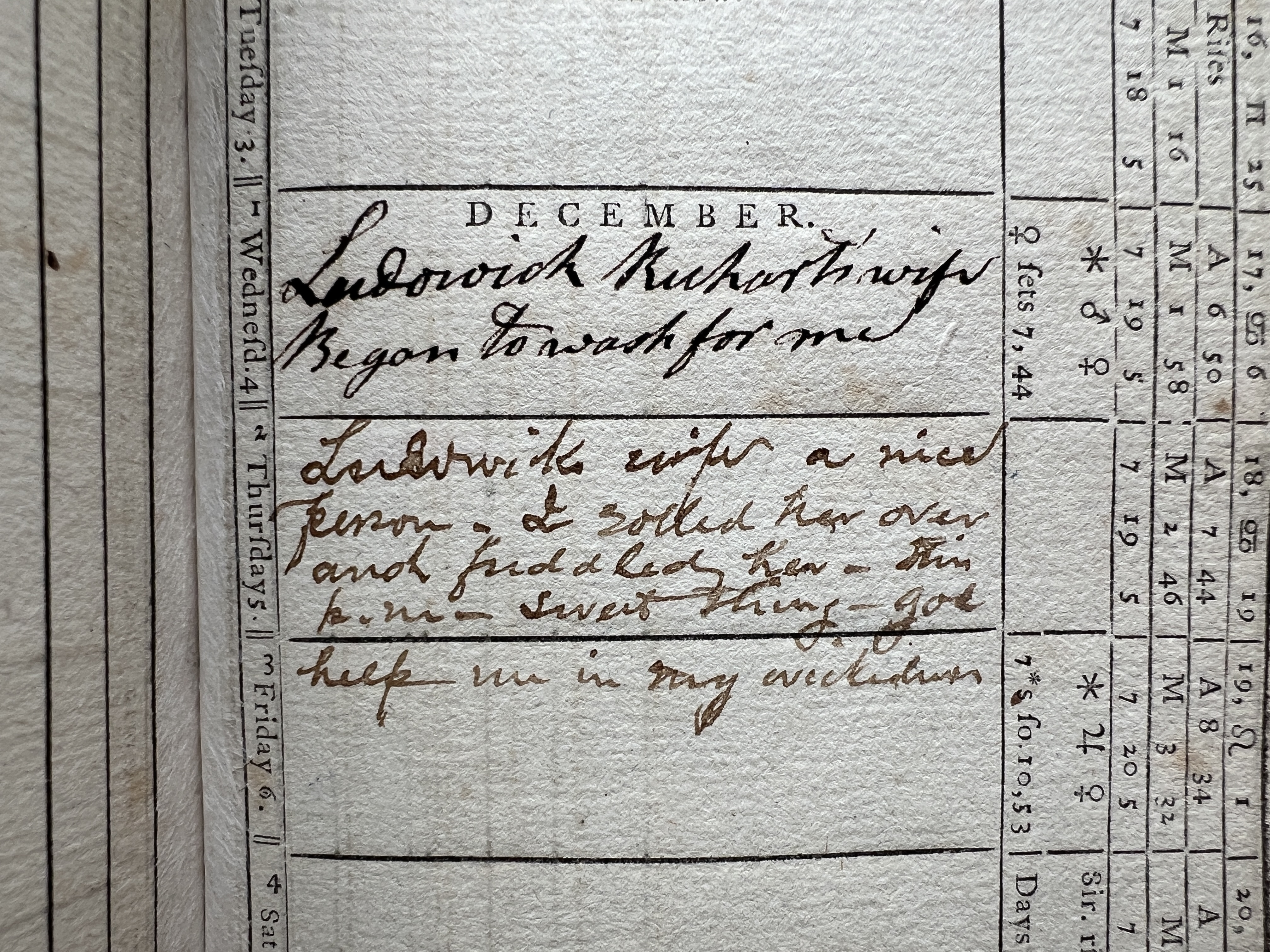
The diary in question is a 1773 almanac with notes of various sorts throughout—a common eighteenth-century artifact. Originally written in black ink, those notes have faded to brown.

What makes it interesting is how some of those notes describe sexual exploits. As Wolcott explains:
In the space dedicated to Wednesday, December 4, Wilson wrote “Ludowick Richart’s wife Began to wash for me” in his usual dark brown ink.

In the space immediately below, for Thursday, December 5, the paler ink continued, “Ludowicks wife a nice person – I rolled her over and fuddled her – This p.m – sweet thing – god help me in my wickedness.”
In conserving the diary, Wolcott started with the knowledge that the six diary entries referring to sex are now a lighter brown than the innocuous business entries. She tested a sampling of marks and found that Wilson wrote most of his entries in iron gall black ink, but those remarks about sex are in a different ink.

That raised the possibility that Wilson chose to write those entries in a common red ink of the day, one that didn’t contain iron. Were those his “red letter days”?

Further examination under “a powerful stereomicroscope,” however, showed that the quality of the inks differed in other ways as well. There are also textual clues that the sexual lines weren’t written in 1773: word usage, lack of the long s, &c.

So now the mystery is, as Wolcott writes, “Why this forger wished to present James Wilson as a satyr.” 

Thursday, October 17, 2024

“Selwyn, whose constant flow of exquisite wit made him generally acceptable”

As described yesterday, on Christmas Eve in 1769 the brothers Patrick and Matthew Kennedy got drunk and stomped around the neighborhood of Westminter Bridge in London, clubbing people.

One of those people died: watchman George Bigby.

Within weeks, the Kennedys were tried, convicted, and sentenced to death. Matthew was about to step on the cart that would take him to the gallows when a reprieve arrived.

The brothers had a sister, Catherine or Kitty, who was one of London’s leading courtesans. (Many discussions of this case amalgamate Kitty Kennedy with another courtesan named Polly Kennedy, née Jones. There are some nice pictures of that woman, but I’m convinced by the historian Horace Bleackley that I shouldn’t use them because they show a different person.)

Kitty Kennedy’s closest gentleman friends were Lord Robert Spencer, brother of the Duke of Marlborough, and the Hon. John St. John, brother of Viscount Bolingbroke. Both men were members of Parliament. St. John, a barrister, actually testified at the brothers’ trial, claiming a prosecution witness had offered not to testify in exchange for £10; by implication, all the witnesses were dubious.

But Kitty had some prominent ex-lovers as well. And even more men who were won over by entreaties from her and her admirers. Among the aristocrats who publicly supported leniency for the Kennedys were the Duke of Manchester, until recently lord of the bedchamber to George III; the Earl of Carlisle; Viscount Palmerston; the Earl of Fife, who was in the British House of Commons because his peerage was Irish; and Sir George Savile, M.P.

But the Kennedy family’s most active champion was George Selwyn (1719–1791, shown above), yet another member of Parliament. Not because Selwyn was enamoured of Kitty Kennedy—he was gay. And not because he was against hanging—Selwyn was notorious for his fetish for watching people die. Rather, Kitty Kennedy’s admirers seem to have convinced Selwyn that her brothers were not the sort of young men who should be hanged.

There was an obvious class prejudice behind the campaign to keep the Kennedys from being executed. They weren’t street thugs, people said; they worked in an auction house, and had a sister who was a social celebrity. And hadn’t Matthew suffered enough in thinking he was about to be hanged?

Of course, other people thought the Kennedys had been drunk, cruel, and violent, and under the law of the day deserved their death sentence, even if only one could have struck the fatal blow.

Horace Walpole was among those who helped push for leniency while reveling in the insider nature of the campaign. For instance, sometime in 1770 Walpole wrote to Selwyn:
After you was gone last night, I heard it whispered about the room that a bad representation had been made at the Queen’s house against the unhappy young man. Do not mention this, as it might do hurt; but try privately, without talking of it, if you cannot get some of the ladies to mention the cruelty of the case; or what do you think of a hint by the German women [i.e., certain ladies in waiting], if you can get at them?
In his memoirs Walpole later described the case this way:
Two Kennedys, young Irishmen, had been charged with, and one of them had been condemned for, the murder of a watchman in a drunken riot. They had a handsome sister, who was kept by two young men of quality.

Out of friendship to them, Mr. George Selwyn had prevailed on six or seven of the jury to make an affidavit that, if some circumstances, which had really been neglected by the counsel for the prisoners, had appeared on the trial, they would not have brought in their verdict murder.

Mr. Selwyn applied for mercy, and the young convict was reprieved; but when the report was made in Council, Lord Mansfield prevailed to have him ordered for execution.

Mr. Selwyn, whose constant flow of exquisite wit made him generally acceptable, applied in person to the King, and represented that Lord Rochford, the Secretary of State, had under his hand assured the pardon; that such an act had always been deemed pardon, and that the prisoner had been made acquainted with it. The King immediately renewed his promise, the criminal was ordered for transportation…
That commutation was made on 17 April. Matthew Kennedy was put on a ship bound for America.

TOMORROW: Shipboard conditions.

Sunday, June 02, 2024

Talking about Ebenezer Richardson in Stoneham, June 4

On the evening of Tuesday, 4 June, I’ll speak to the Stoneham Historical Society. The society is headlining my talk “The Most Hated Man in Revolutionary Boston.”

Was that Gov. Thomas Hutchinson? Customs Commissioner Benjamin Hallowell? Or even Boston 1775’s latest figure in the spotlight, Capt. John Malcom?

No, for producing long-lasting, multifaceted, bitter antipathy, I don’t think anyone could beat Ebenezer Richardson. In fact, I’ve argued that Richardson did as much as any other individual to turn people in rural Massachusetts against the royal government.

Richardson was born in 1718 on a Woburn farm touching the border with Stoneham. Until the age of thirty-four he was an ordinary middling New England farmer—married, raising children, and helping to house his wife’s poor widowed sister.

Over the next quarter-century Richardson became a secret adulterer, an outcast from his home town, a government informant, a Customs officer, a target of riots, a convicted child murderer, and a fugitive. Starting around 1760, each new scandalous episode linked him more closely to royal officials, whom people saw as protecting him.

I’ve chased traces of Ebenezer Richardson through archives on two continents. This talk brings his story back to, well, not quite to his home town, but to the neighboring town, and also the town where his widowed mother moved after she remarried.

This event is scheduled to start at 7:00 P.M. at the Stoneham Public Library, 431 Main Street. It is free and open to the public, sponsored by the Stoneham and Massachusetts Cultural Councils.

Wednesday, December 06, 2023

“Ye. uncommon size & penetration of his genius”

When the Locke family returned to Sherborn, after the Rev. Dr. Samuel Locke resigned as president of Harvard College (because he’d fathered a child with his housekeeper), they had a nice home waiting for them.

The Lockes owned a “large convenient Dwelling-House” situated “near the Northerly side of the Common on the road to Holliston” and “opposite the Meeting-House.”

The attached estate included “two Barnes, and other Out-Houses,” and ninety-two acres of land, including “Pasturage, Arable land, Meadow, &c with a large quantity of good Fruit Trees; as also a valuable Lot of Wood.”

There had been some hurt feelings when Locke had left Sherborn’s pulpit in 1769, but the congregation found a replacement within a year, with the college providing some settlement money. The townspeople didn’t seem to hold a grudge against Locke personally.

In fact, Locke’s neighbors continued to refer to him with the honorifics “Reverend” and “Doctor.” In March 1774 they voted to put him on the committee of correspondence, which after the war started became the committee of public safety.

To supplement his income, Locke prepared boys for Harvard, having them board at his house. One student, John Welles, recalled him as “the most learned man in America,” and “a perfect gentleman, dignified.”

The Continental Journal for 22 Jan 1778 reported: “Thursday morning last [i.e., 15 January] died suddenly of an apoplectic fit, the Rev. Dr. Samuel Lock of Sherburn.” According to John Goodwin Locke’s Book of the Lockes, “He died from the bursting of a blood-vessel, when aiding in driving some cattle from his field.” (Sherborn’s published town records say the date was 15 Jan 1777, but apparently someone forgot to start writing the new year. That error confused later people, like the person who carved the headstone shown above.)

Contemporaries glossed over Locke’s adultery. A neighbor wrote: “Some domestic troubles embittered the last years of his life, but he was never known to make a complaint, but bore them with Christian resignation.” His successor at Harvard, the Rev. Dr. Samuel Langdon, is credited with this eulogy:
In Memory of ye. Revd. Samuel Locke D. D. [sic]

As a Divine he was learned and judicious—In ye. pastoral relation vigilant and faithfull—as a christian devout & charitable—In his friendships firm & sincere—humane affable & benevolent in his disposition—in ye. conjugal & parental relations kind, & officious—ye. uncommon size & penetration of his genius—ye. extensiveness of his erudition—yt. fund of useful knowledge wh. he had acquired—ye. firmness & mildness of his temper & manners—his easiness of access & patient attention to others-join’d with his singular talents for government, procur’d him universal esteem, especially of ye. governers & students of Harvard College over wh. he PRESIDED four years with much reputation to himself & advantage to ye. public—after wh. he retired to ye. private walks of Life, entertaining & improving ye. more confined circle of his friends until his Death wh. was very sudden on ye. 15th: day of January 1778—aged 45.
For the president of a college Locke had embarrassed by having an affair to say he was in “conjugal & parental relations kind, & officious” suggests that some contemporaries shared John Andrews’s opinion that his wife had somehow driven him into the arms of his housekeeper. But Mary Locke left no account herself, and no one else commented on her.

Be that as it may, Locke left an estate worth over £3,600. The widow Locke continued to live in Sherborn and to raise their three children. There’s an advertisement for settling her estate in the 11 June 1789 Independent Chronicle.

Of Mary and Samuel Locke’s children, Samuel, Jr., became the local doctor. He married Hannah Cowden, and they had four daughters, one dying in infancy. He died in 1788, aged twenty-seven, thus probably before his mother.

In 1792 the Locke family farm was put up for sale. The sellers were the couple’s daughter Mary, the doctor’s widow Hannah, and Samuel Sanger, the same man who had administered the widow’s estate. It evidently did not sell because in 1794 the widow Hannah Locke advertised it again, now on her own.

Mary Locke the daughter died in 1796, aged thirty-three. The family historian wrote: “She had been an invalid for some years before she died.” He also stated: “She was a lady of considerable personal and mental attractions, and if we may judge from the wardrobe which she left, not inattentive to that personal adornment to which many of her sex are addicted.” That judgment seems to be based entirely on the number of gowns in her probate inventory.

The youngest sibling, John Locke, moved from Sherborn to Union, Maine, and then to “Northampton, where he died, as it is said, by drinking cold water when heated.” That death wasn’t so sudden, however, as to preclude seeking medical attention and writing a will. John Locke was only thirty-four years old, continuing the family tradition of dying young.

The Rev. Dr. Samuel Locke’s grave went unmarked for decades. A sexton found his skeleton in 1788 when he was burying the eldest son. By 1853 the former minister’s remains had been dug up and reinterred in a new town cemetery. At the time his skull was judged to show “those phrenological developments which indicate great mental powers.”

When the younger Mary Locke died in 1796, both the Sherborn town records and the local Moral and Political Telegraphe newspaper described her as the minister’s “only daughter,” making a point. According to Sibley’s Harvard Graduates, however, the child Samuel Locke fathered in 1773 was also a girl, named Rebecca Locke. Clifford K. Shipton wrote that “she became a well-known figure in Boston and Worcester,” but I haven’t unearthed any sign of her.

Tuesday, December 05, 2023

The Lockes in Wedlock

Three years ago I wrote about the sestercentennial of the Rev. Samuel Locke’s inauguration as president of Harvard College.

Normally I wouldn’t find such a ceremony interesting, but that was all in service of the really juicy 250th anniversary that I can finally discuss this month: Locke’s departure from that job after people discovered he’d impregnated his housekeeper.

The earliest surviving source on that affair is the letter of John Andrews that I quoted here. That’s a mostly sympathetic account, dwelling on Locke’s religious crisis: he had mystified his colleagues by holding back from taking communion and leaving chapel suddenly during prayers. He exhibited “most sincere grief,” earning the “ye. compassn. of all.”

Yet Andrews also described Locke offering his housekeeper £150—for what, it’s not clear. A doctor who graduated in the Harvard class of 1782 told Harvard librarian John Langdon Sibley that he’d heard Locke had summoned his own physician, Dr. Marshall Spring of Watertown, but then couldn’t express his request. Was he trying to ask for an abortifacient?

Most striking, Andrews blamed Locke’s wife for the trouble, writing that her “vices, has been ye. means of drivg. him to it.”

Mary (Porter) Locke was born in 1738, daughter of the Rev. Samuel Porter of Sherborn. Her mother Mary, a Coolidge from Cambridge, died in 1752. Her father the minister died in 1758. At the age of twenty, therefore, she was left an orphan with a fair amount of property in her home town.

Samuel Locke came to Sherborn in 1759, having taught school and preached in Lancaster and Plymouth. Within a few months the congregation offered him the job of minister. In January 1760, less than two months after being ordained, Locke married Mary Porter in Natick.

On 11 February Locke wrote a letter to Edward Wigglesworth in Boston, having apparently heard that that young merchant was getting married:
It seems to be ordained by Providence in ye. oeconomy and constitution of all created, animate nature we are acquainted with that each individual of ye. several species should be drawn by some secret attraction to those of its own kind; and indeed it appears to be a necessary precaution for ye. preservation of order amidst ye. immense variety of creatures that people ye. world and for ye. regular conservation and increase of ye. several classes into which they are divided.

But man has a nature peculiarly adapted for society and friendly intercourse and is directly urged to it by ye. great difficulties, if not utter impossibility, of subsisting alone independent of and inconnected with others of ye. same nature with himself,—his wider capacities demand more gratifications, and he feels in himself innumerable wants which a life of sollitude cannot supply, and many powers to which it cannot give employment.

Hereupon he is naturally led by some affections amost peculiar to our kind to select some from among ye. many individuals of human nature for peculiar intimacy and tenderness in order to improve the condition of his existence and refine ye. common principles of benevolence into a peculiar affection for some individuals.

And I apprehend in particular with regard to ye. nuptial tie (ye. closest of any) we are not only directed to it by ye. constitution of our nature and ye. many miseries which a forlorn individual must necessarily suffer while he stands alone without any prop to support him, but also by ye. continued course of Providence in preserving in all ages such an apparent equality between ye. sexes.

This, I think is an additional call to every one to be up and doing. You will therefore, Sr., I trust, find a complyance with your duty in ye. respect a solid foundation of ye. most substantial happiness which this world affords,—and that it will be a happy medium of improvement in sosial virtue, and of increasing to you that felicity which I cannot describe but heartily wish to be ye. portion of every human creature in a way consistent with ye. wise designs of ye. great Father and governor of ye. universe.
Locke’s language was highly philosophic, but the bottom line was that he believed a man needed a wife for his “innumerable wants’ and “many powers.”

The Lockes had three children in regular fashion:
  • Samuel, Jr., in 1761.
  • Mary in 1763.
  • John in 1765.
Then they didn’t have any more. That’s an unusual pattern for a New England couple of this period. Sometimes a husband and wife had no children, suggesting a fertility problem. More typically, the wife was pregnant every two or three years for up to two decades. For a couple to have a few children and stop suggests that something came between them, medically or interpersonally.

At first Locke resisted recruitment by Harvard College, but in late 1769 he finally agreed and moved his family to Cambridge. Samuel and Mary were both familiar with that town, him from his college days and her from living with her maternal relations.

In his profile of Locke, Clifford K. Shipton wrote that “Mrs. Locke was a feeble, sickly woman,” but he cited no evidence to support that. Andrews was nastier, saying Mary’s unspecified “vices” had driven Samuel to adultery. Either way, the implication was that the college president turned to his housekeeper for sex that he couldn’t have with his wife.

The one female commenter I’ve found, Hannah Winthrop, made no remarks about Mary Locke but wrote that she hoped the post of president would “be filld with a person who may do Honor to the Station.”

In December 1773, 250 years ago this month, the Locke family returned to the town of Sherborn. The town’s pulpit had been filled by another minister, and no doubt some people no longer saw Samuel Locke as fit to preach. But Mary still owned property there, and Samuel had bought 120 more acres in 1772. The Lockes also had three children to raise, aged twelve to eight.

TOMORROW: Can this marriage be saved?

Sunday, December 03, 2023

“A See becoming Vacant in a Sudden Surprising manner”

As I quoted yesterday, in December 1773 the Rev. Ezra Stiles was worried by rumors from Cambridge about the sudden resignation of Harvard College president Samuel Locke.

On 20 December the Newport minister finally heard the cause, as he set down in his diary:
Mr. [William?] Ellery left Cambridge last Friday: he tells me that the Week before, President Locke resigned the Presidency of Harv. College, alledging two Reasons.

1. Ill state of Health.

2. That his Usefulness was ruined by the evil Report raised & spread abroad about him. This was that his Maid was with Child by him.

He sent in this Resigno. from Sherburn, whereto he is removed. A most melancholly Event, & humbling Providence!
Despite the nod to a claim that Locke was resigning only because of an “evil Report” about him, Stiles seems to have accepted that the president really had impregnated his maid.

I’ve found one comment about this incident from a woman. Hannah Winthrop was wife of the college professor delegated to secure college property in the president’s house. On 1 Jan 1774, she wrote to her friend Mercy Warren as quoted here:
I have no news of a domestick kind to tell you, we go on in the same little peacefull Circle as usual Varied with alternate sickness & health, sometimes Amused, sometimes astonishd with Viewing Events which happen in the great World. Here, beholding a See becoming Vacant in a Sudden Surprising manner. but it is best for one so near the seat where Candor ought to Reign, to draw a Veil over what the Delinquent tenderly Calls Human imperfections. I know you join me in earnest wishes that it may be filld with a person who may do Honor to the Station.
Harvard was already drawing a veil over a painful subject. Indeed, the college and its supporters did such a good job of keeping the “Sudden Surprising” news about Locke out of print that it wasn’t until Stiles’s diary entry was published in 1901 that historians knew about it.

Well, the Harvard librarian John Langdon Sibley (1804–1885) filed a recollection of the event from a Harvard student. And Winthrop Sargent (1792–1874) must have read John Andrews’s postscript about it, quoted yesterday, when he published other parts of the same letter. Surely other researchers had seen those sources and others. But nothing about the affair appeared in print.

No evidence appears to have survived about Locke’s housekeeper. The vital records of Cambridge list a girl named Hannah Lock, baptized at some unspecified time in 1773, with no named parents. Was this the president’s newborn daughter? Likewise, a Hannah Lock died of consumption in Cambridge on 19 Nov 1809, with no further information about her in that record.

COMING UP: Wedlock.

Saturday, December 02, 2023

“A child Laid to him by his housekeeper”

Though the Harvard College corporation kept quiet about the reason for president Samuel Locke’s resignation in December 1773, news was already seeping out. Tea wasn’t the only thing people around Boston were talking about 250 years ago.

One of the finest sources on Revolutionary Boston is the collection of letters that the businessman John Andrews wrote to his brother-in-law William Barrell in Philadelphia in the 1770s.

Andrews was a gossip sponge, and apparently uninhibited when writing to someone out of town. His letters were discovered during the Civil War, sent back north to the Massachusetts Historical Society, and published in the society’s Proceedings in 1866.

Not entirely, though. The transcriber, Winthrop Sargent, focused on political developments and conflicts with the royal authorities. And of course there was this thing called the Victorian sensibility.

One bit left out of print came from a letter Andrews dated 29 Nov 1773. Most of that letter was about money issues, followed by a paragraph about the arrival of East India Company cargos. (Andrews was working under the impression that two ships had arrived, not one.)

Then came a long postscript in small writing along the left side of the page:
P.S. I have a secret to tell you, which not only affects ye. direction of our Colledge, but brings great dishonor upon it:

after sufferg. the most poignant distress for two months past, and repeatedly leavg. ye. Sacraments, with frequently leavg. off, while in Prayer at ye. Chappel in a most abrupt manner, & going out; it has come out that no less a man than P—i—t L—ke has a child Laid to him by his housekeeper: after trying every method compromise to ye. mattr. wth. her, without effect, even to ye. offerg. her £150 Sterlg., he has retird to ye. Country, [???] wth. ye. most sincere grief, his situation excites ye. compassn. of all, as he is curs’d wth. a wife, whose vices, has been ye. means of drivg. him to it
Clifford K. Shipton quoted two clauses out of that passage in his Sibley’s Harvard Graduates biography of Locke, but I think this is the first time the whole thing is out in the world.

Andrews’s letter tells us that two days before Locke wrote out his resignation from the college presidency, people in Boston were already talking about the sex scandal behind it.

By 9 December, the Rev. Ezra Stiles down in Newport wrote in his diary: “More melancholy news about President Locke of Harvard College Camb.” And a week later: “The Corporation of Harvard College met last Week, & sent a Committee to wait on President Locke, & on return, voted his Answer not satisfactory.”

The Rev. Nathaniel Appleton of Cambridge was the corporation member who forced Locke to stop dithering and resign. His grandson, recent Harvard graduate Nathaniel Walker Appleton, wrote to his classmate Eliphalet Pearson on 14 December:
The unhappy affair concerning the late Pr-s-d-nt remains as yet something in the dark, perhaps Time may discover it. He resigned on 6th. Inst & went off to Sherburne the next Day. We Hope that the Corporation will make Choice of a Person to fill the vacant Chair who by his exemplary VIRTUE will remove the Blemish which now lays upon the College.
But only Andrews’s letter was straightforward about what that blemish was.

TOMORROW: And it was all Mrs. Locke’s fault?

(Incidentally, lately I’ve seen some items identifying John Andrews as a lawyer. He’s labeled “Merchant” in the 25 Feb 1771 Boston Post-Boy report of his marriage to Ruth Barrell. He was later a selectman and helped to set up the Boston Sail-Cloth Manufactory, the Massachusetts Fire Insurance Company, the Boston Dispensary, and other organizations.)

Tuesday, October 24, 2023

Turning London’s Queer Underground into a Game

In 2017 Wehrlegig Games released the first version of John Company, an interactive historical game based on the rise and fall of the British East India Company.

Players had to navigate the company’s world-spanning bureaucracy and the fallout of their actions in India. That game is in its second edition.

Now Wehrlegig Games is preparing to release Molly House, a game based on the lives of queer people in eighteenth-century London. This game has been in development for a few years, and its launch is more than funded through the crowdfunding site BackerKit.

The description on Board Game Geek says:
In Molly House, players take the roles of the gender-defying mollies of early eighteenth century London. Throw grand masquerades and cruise back alleys while evading moralistic constables who seek to destroy your community. Be careful, there may even be informers in your midst!

Over the course of an hour, players will draft hands of vice cards representing the different gestures, desires, and encounters that were frowned upon by the Society for the Reformation of Manners, a citizen group that sought to stamp out any behavior it deemed deviant in late 17th and early 18th century London. These cards allow players to host festivities with the help of their fellow mollies and create joy. But, those same cards can also lead players to be arrested and to the ultimate ruin of the molly house.

As players encounter the Society’s enforcers, they will often have to pay bribes or may be coerced into becoming informers for the Society. Informers must try desperately to undermine the community around Mother Clap’s Molly House without being discovered by their fellow mollies.
The description on Backerkit lays out how the game connects to historic developments:
The rapid growth of London in the late 17th century allowed for greater anonymity, and the increase in population gave access to a wider range of people, allowing queer people to congregate in burgeoning communities. Molly House is a game about how these communities formed and flourished even in the shadow of great persecution. It is an intimate game about the very idea of intimacy.

Molly House is also a game about policing. Here the primary policing actors are not city officials but instead a citizen group, the Society for the Reformation of Manners, which sought to weaponize the legal apparatus of the city in order to destroy a community it perceived as a threat. Critically, this goal could not have been accomplished without the intimidation and eventual compliance of a handful of informers, drawn from the ranks of the house’s patrons.

Lastly, Molly House is a game about the practice of history itself. So much of queer history has been lost: hidden, suppressed, or outright destroyed. But, the story of the molly houses of the eighteenth century was protected in the most unexpected of places. As witnesses were pulled before the authorities in London, they gave their testimony and their accounts were preserved in the proceedings of the Old Bailey (London’s central criminal court). 
Board Game Geek also offers perspectives on the development of the game by Cole Wehrle, co-founder of the company, and Jo Kelly, the primary designer.

I don’t play board games often, especially these more esoteric games. And the culture of developing those games is even more fascinatingly foreign, with its own vocabulary and traditions. Like period fiction, dramas on stage and screen, and video games, well designed board games and role-playing games offer unique ways to explore the dramas and contingencies of history.  

Thursday, October 05, 2023

The Real Life and Death of Mrs. Coghlan

Margaret Moncrieffe was born in Scotland in 1762. Her father was army officer Thomas Moncrieffe, who soon became one of Gen. Thomas Gage’s aides in North America. Her wealthy mother died young.

When the Revolutionary War broke out, Margaret was in the New York area while her father was serving as a brigade major inside besieged Boston.

In 1776 Maj. Moncrieffe came to New York with the British expeditionary force, and his teenage daughter became a suspected spy, potential hostage, and all-around headache.

Over the next ten years, Margaret Moncrieffe:
  • Fell in love with an American officer—most authors believe that man was Aaron Burr.
  • Was sent over to the British in Manhattan.
  • Was married to Lt. John Coghlan of the 23rd Regiment of Foot.
  • Ran away from her husband to London.
  • Became mistress of Lord Thomas Pelham-Clinton.
  • Was sent to a convent in Calais.
  • Fell in with Charles James Fox, Richard Brinsley Sheridan, and others in the British political opposition.
  • Became mistress to a “Mr. Fazakerley.”
  • Became mistress to Lord John Augustus Hervey.
  • Became mistress to Capt. Andrew Barnard.
  • Became mistress to a “Mr. Giffard.”
Then, in June 1787, the London newspapers reported that Margaret (Moncrieffe) Coghlan had died. The Daily Universal Register, which later became the Times of London, stated she passed away on 4 June “After two days illness…at three o’clock.”

The Gentleman’s Magazine included her in its section “Obituary of Considerable Persons,” with these details: “In Cavendish-street, Portland-squ. … Mrs. Margaret Coghlan, lady of John C. esq; and dau. of Colonel Moncrieffe.”

Seven years later, British readers were presented with Memoirs of Mrs. Coghlan, (Daughter of the late Major Moncrieffe.) Written by Herself and Dedicated to the British Nation; Being Interspersed with Anecdotes of the late American and Present French War, with Remarks Moral and Political.

That book described adventures and affairs extending past 1787 to the date of publication. Among her later lovers was retired general William Dalrymple, who makes most of his Boston 1775 appearances as the British army commander in Boston during the Massacre.

In Revolutionary Ladies (1977), Philip Young guessed that Margaret Coghlan had left some memoirs before she died, but someone—he guessed it was the political writer Charles Pigott—had expanded that document in unreliable ways and arranged for it to be published.

In Revolution Song (2017), Russell Shorto cited documents showing Margaret Coghlan was active after 1787. He concluded that she reported her death to newspapers in order to escape creditors and flee to France. Later she published her memoirs herself in another bid for money. That made Coghlan’s memoirs a more credible historical source—albeit coming from someone dishonest enough to fake her own death.

Last month the Journal of the American Revolution published Jane Strachan’s two-part profile of Margaret (Moncrieffe) Coghlan, from birth through fake death to her last recorded writings, documents begging for support from 1803 and 1805. It’s a thorough discussion of her life and the challenges of sorting out the facts about that life. It’s also quite a ride.

Monday, August 21, 2023

“Complying with her constitution’s earnest call”

Sarah Robinson (1720–1795, shown here) was the younger sister of Elizabeth (Robinson) Montagu.

In 1748 Robinson started sharing a house in Bath with Lady Barbara Montague (c. 1722–1765). This lady’s Montague family was different from the Montagu family that Sarah’s sister married into.

Two years later, Robinson penned her first novel, The History of Cornelia—published, like all her work, anonymously or pseudonymously, and for money.

In 1751 Sarah Robinson married George Lewis Scott (1708–1780), one of George III’s instructors—a job she had helped to secure for him, apparently.

However, that marriage broke up within a year, with the Robinson family stating it was never consummated. The unhappy couple grumbled about each other for the rest of their lives. (George Lewis Scott would later introduce Thomas Paine to Benjamin Franklin, but that’s another story.)

The woman now called Sarah Scott went back to “Lady Bab” in Bath and back to earning money with her pen. By the end of that decade she was also translating from the French, creating educational materials, writing history books about Protestants on the continent. Scott’s most successful novel appeared in 1762: A Description of Millenium Hall and the Country Adjacent. Almost everything she wrote had a moralizing element.

By 1778 Lady Bab had died, but Sarah Scott had gained a comfortable income through family gifts and inheritance. She stopped publishing, but she kept up her lively literary correspondence with her sister.

In October of that year, Catharine Macaulay left Bath for Leicester, and the next month word got back that the celebrated historian had married William Graham. But that wasn’t all people heard.

On 27 November, Sarah Scott sent this news to Elizabeth Montagu, as transcribed in The Correspondence of Catharine Macaulay, edited by Karen Green:
Mrs Macaulay’s marriage was reported in good time to change conversation, of which the Duel between the two gaming counts had been the sole topic, and it was entirely worn out.

A Gamester appears to me so far from being a loss to the world that I consider the marriage as the more melancholy event of the two, because it is a dishonor to the sex. If I had not more pride than revengefulness in my temper I might derive much consolation from the moral certainty that her punishment will equal her offence.

The man she has married is in age about 22, in rank 2nd Mate to the Surgeon of an India man. He is brother to a Dr [James] Graham, who etherized and electrified her, till he has made her electric per se.

She wrote a letter to Dr Wilson acquainting him with her marriage, and her reasons for it, which she tells him in the plainest terms are constitutional; that she had been for some years struggling with nature but found that her life absolutely depends on her complying with her constitution’s earnest call (perhaps she calls it nature’s, but I shall not, for it is not the nature of woman, and woman cannot find her excuse in the nature of a beast) and she would have chosen him, if his age, as he must be sensible, did not disqualify him for answering a call so urgent.
In other words, Macaulay had discovered that all those medical symptoms that had crippled her for years—fatigue, weakness, “pains in my ears and throat,” “irritations of my nerves,” and above all “a Billious intermitting Autumnal fever”—would go away when she had sex. Really good sex. Sex with a man less than half her age just returned from the sea. Sex that her doting seventy-five-year-old patron, the Rev. Dr. Thomas Wilson, simply wouldn’t have been able to supply.

Which of course ticked Wilson off, as Scott’s letter went on to describe:
The Doctor shews the letter, but I have not seen it, and the Gentlemen declare it cannot be shown to a woman. Old Wilson is rewarded for his folly; he is in the highest rage, and having some years ago by Deed given her the furniture of the house they lived in and 300 peran[num] for her life, he intends to apply to the law to be released from this engagement; on pretence of its having been given without value received. It will make a curious cause, . . .

If there is any zeal still remaining in the world for virtue’s cause the pure Virgins and virtuous Matrons who reside in this place, will unite and drown her in the Avon, and try if she can be purified by water, for Dr Graham’s experiments have shown that fire has a very contrary effect on her, being a Salamander it is the element truly congenial to her. Were she flesh and blood one could not forgive her, but being only skin and bone she deserves no mercy.
Given Sarah Scott’s own unorthodox domestic history, perhaps she shouldn’t have looked down on Catharine Macaulay’s choice of a second husband. But, as the two poems that Christopher Anstey shared a week later demonstrate, all the fashionable people in Bath were gossiping about the Grahams.

COMING UP: The lawsuit.

Saturday, August 19, 2023

“A sweet pretty nostrum, quite pleasant and new”

After Christopher Anstey won Lady Anna Miller’s biweekly poetry contest at Batheaston on 3 Dec 1778, as described yesterday, he waved aside calls to read his ode “Winter’s Amusement” again.

Instead, he pulled out what he later called an “Epode.” That word signals that it was part of the ode, though written with a different metre and tone.

When both poems were published in The New Foundling Hospital for Wit (1786), Anstey’s lines were simply headed: “LINES Repeated by the Author, on Being Asked to Read the Preceding Stanzas a Second Time.”

That’s the version I’m following rather than the one in the collection of Anstey’s work published by his son in 1808, on the assumption that it’s closer to the original:
Must I read it again, Sir?—So—here do I stand,
Like the priest that holds forth with a skull in his hand—
Repeat such a dreadful memento as this is,
To spleen the young fellows, and frighten the misses?
When beauties assemble to laugh and be gay,
How cruel to preach upon beauty’s decay!
How hard, that the fairest of all the creation,
Should suffer one wrinkle by anticipation!
What delicate nymph but must shrink when she hears
Her charms will all fade in the winter of years?
What languishing widow would e’er wish to know
Her charms were all faded a long while ago?
Unless one could bring some receipt to supply
Fresh Cupids to bask in the beam of her eye.
Recall the lost rose, or the lily replace,
That have shed their dead leaves o’er her ever green face!
And this (thank the gods) I can promise to do,
By a sweet pretty nostrum, quite pleasant and new,
Which learned historians and doctors, I find,
Have lately reveal’d for the good of mankind.
A nostrum like which, no elixir yet known,
E’er brac’d a lax fibre, and strengthen’d its tone.
Nore’er was so grand a restorative seen,
For bringing back sixty—to lovely sixteen!
To you then, ye fair, if old Time should appear,
And whisper a few little hints in your ear,
That Cupid his triumphs begins to resign,
Your nerves are unstrung, and your spirits decline,
You have no other physical course to pursue,
Than to take—a young husband your springs to renew;
You may take him—I think—at—about twenty-two!
For when both the spirits and nerves are in fault,
Platonic affection is not worth a groat.
The conjugal blessing alone is decreed
The truest specific for widows indeed;
And I trust they will find it, as long as they live,
The best of amusements that winter can give!
The opening line shows that Anstey wasn’t surprised to win the poetry competition that day. He’d already prepared this encore.

While people might have wondered about the relevance of Anstey’s ode to people they knew, they couldn’t miss his allusion to “learned historians and doctors”—the famous historian Catharine Macaulay had recently left nearby Bath and married Dr. William Graham.

Macaulay had indeed been a “languishing widow,” complaining about her “nerves,” albeit more than a decade from “sixty.”

Graham was indeed “about twenty-two!” In fact, he was twenty-one, but that didn’t rhyme.

Even the phrase “Platonic affection” was a jab. The previous year, a London publisher had issued this print of Macaulay with her then-housemate, the Rev. Thomas Wilson, calling them “The Political Platonic Lovers.”

TOMORROW: Audience response.

(The photograph above by Ian is here via Flickr shows a statue in the form of a large ornamental vase standing in the Royal Victoria Park in Bath. Many sources say this is the vase the Riggs-Millers brought back from Rome and used at their literary salons, or a replica of that vase. It’s neither of those things. It doesn’t look like the engraving the couple published in 1775, and it’s not even hollow. Like Anstey’s second poem, it’s a heavy-handed follow-on to an original.)