Around the fiftieth anniversary of the Battle of
Lexington and
Concord, more details about
Dr. Samuel Prescott came into print.
As I quoted yesterday, in 1824 a local newspaper stated that when Dr. Prescott started to spread the alarm about regulars on the march he “was returning from Lexington before day light…from a visit to the
lady who afterwards became his wife.”
That detail about Prescott spending the evening with a lady was significant because it wasn’t necessary to excuse his being on the road that night. As a
doctor, Prescott could have been out late after making a house call.
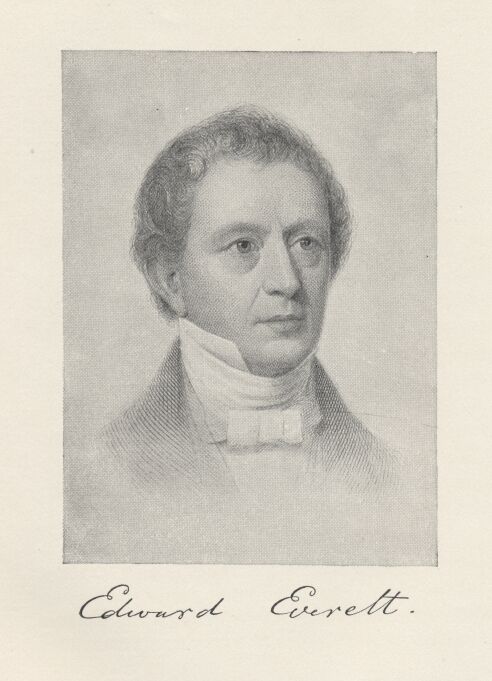
The following year, Edward Everett came to Concord to deliver a historical oration. As he would do on many occasions (most famously at the dedication of the Gettysburg National Cemetery in 1863), he consulted published and local sources in order to retell the event he was commemorating.
Everett didn’t add anything to the historic record, but he brought together sources:
After staying a short time at Lexington, Messrs Revere and Dawes, at about one o’clock of the morning of the nineteenth of April, started for Concord to communicate the intelligence there. They were soon overtaken on the way by Dr. Samuel Prescott of Concord, who joined them in giving the alarm at every house on the road.
The Concord newspaper hadn’t named
Paul Revere and
William Dawes. Revere’s account and Elias Phinney’s book about the fighting on Lexington common hadn’t included Prescott’s full name. But here all three riders were together in one recounting at last.
The Rev.
Ezra Ripley’s 1827
History of the Fight at Concord stated:
Nothing very interesting occurred in the march of the British from Lexington to Concord. Intelligence had been given by Mr. Samuel Prescott, who had passed the evening at Lexington, and had seen and escaped the British officers on the road…
This book added little to the printed record about Prescott, but it showed that Ripley, the long-time town minister, accepted that he “had passed the evening at Lexington” and wasn’t just riding out on errands.
In 1835 Lemuel Shattuck was finally unabashed enough to drop a surname into his Concord history:
They [Revere and Dawes] had not travelled far before they were overtaken by Dr. Samuel Prescott of Concord, who had spent the evening at Lexington, at the house of Mr. Mulliken, to whose daughter he was paying his addresses; and having been alarmed, was hastening his return home. All rode on together, spreading the alarm at every house.
“Mr. Mulliken” was
Nathaniel Mulliken, a well-known clockmaker. He died in 1767, but his widow and sons were carrying on that business in 1775. Their house was close to the road.
British regulars were accused of looting and burning it on their return to Boston.
All that means there was a lot of documentation about the Mullikens. By the Bicentennial authors wanted this woman’s full name, and in the published town records they found an unmarried daughter who would be the right age for Dr. Samuel Prescott’s attention: Lydia Mulliken. The published town records say she was born in 1753 and baptized in 1752 (I’m pretty sure one of those figures is an error).
Back in 1824, the local newspaper assured readers that Dr. Samuel Prescott visiting his fiancée into the very early hours of 19 April “was the custom on such occasions in those days.” Lots of subsequent authors included similar comments. They read like either wink-wink-nudge-nudge hints those young people were
canoodling or prim denials that they weren’t.
At his blog Historical Digression, Patrick Browne
expressed some skepticism about the story of Dr. Prescott’s visit to his fiancée because it didn’t surface until decades after the event. That detail also fit easily into Colonial Revival sentimentality.
Browne noted an inaccuracy in Lemuel Shattuck’s history to show he wasn’t always reliable. However, that example shows Shattuck boosting Concord over another town, a typical flaw of local chronicles. That same closeness to Concord suggests Shattuck actually had reliable sources about Dr. Prescott and Mr. Mulliken’s daughter.
Furthermore, we now have the 1824 newspaper as an earlier source on the doctor visiting his betrothed.
In fact, Shattuck was more accurate about the fate of Samuel Prescott and Lydia Mulliken’s relationship than that article.
TOMORROW: Torn apart by war.