J. L. BELL is a Massachusetts writer who specializes in (among other things) the start of the American Revolution in and around Boston. He is particularly interested in the experiences of children in 1765-75. He has published scholarly papers and popular articles for both children and adults. He was consultant for an episode of History Detectives, and contributed to a display at Minute Man National Historic Park.

Subscribe thru Follow.it


•••••••••••••••••


Showing posts with label Abiah Holbrook. Show all posts

Sunday, November 23, 2025

Back to the Scene of the Crime

A significant portion of The Road to Concord focuses on one spot in Boston: the corner of West Street and Tremont Street. There, across from the Common, stood the South Writing School and the newer gunhouse of the militia train of artillery.

(Now that space is occupied by a Suffolk University dormitory, a Sal’s Pizza, and a Blue Bikes rack.)

In September 1774, as I wrote in the book, the artillery company dissolved amid political recriminations. Soon their four small brass cannon disappeared, two from that corner.

In April 1775, war broke out, in some immediate sense because of those cannon, and all of Boston’s public schools shut down.

The following March, the British military left Boston. Patriot authorities gained control. After tending to the most dire problems, the selectmen looked ahead to a new school year, which would ordinarily begin in July.

In June the selectmen ordered the South Writing School to reopen. However, Master Samuel Holbrook was still out of town. So were a lot of families—Boston’s population was only a fraction of what it had been.

The selectmen therefore said that James Carter, the master of the Queen Street Writing School, would fill in for Master Holbrook. In effect, I think, that was consolidating the two schools for at least a few months until enough pupils returned to justify reopening both schoolhouses.

In October 1777 the town looked into repairing the South Writing School, possibly from damage during the siege. Two months later, Master Holbrook asked for an assistant, to be paid £34 plus £16 “on Accot. of the rise of Provisions”—i.e., the price of food had inflated. 

Ordinarily a schoolmaster had an adult assistant called an “usher,” paid about half of the master’s salary. Holbrook asking for an “assistant” with a smaller salary suggests that he was seeking to hire a teenager, as he had employed Andrew Cunningham in 1774–75. Perhaps he had in mind his own son Abiah, then fourteen years old.

We can see the effects of inflation in how the town meeting voted to pay Holbrook over the next few years:
  • March 1778: £100 salary plus £100 “on Account of the present high Price of Provisions &c.” in the next six months.
  • November 1778: £140 more to cover the remaining six months of the year.
  • March 1779: a town committee recommended £600 for Holbrook himself plus £100 for his usher and £30 house rent. The meeting approved even more: £640 for the master, £300 for the usher.
  • November 1779: and another supplemental grant, £1,500 for September through March.
Master Holbrook’s usher arriving in October 1778 was named Abiah Holbrook. The master’s son would still have been too young to command that title and salary. But Holbrook also had a nephew named Abiah Holbrook. A man of that name advertised a school in Portsmouth, New Hampshire, from 1775 to 1777. So perhaps that man moved to Boston to work for his uncle, taking the place of his young cousin. Running writing schools was a family business; Master Holbrook had started out working as usher under his own brother—named, of course, Abiah.

Thus, as the 1770s ended, the South Writing School was back in operation under Master Samuel Holbrook, just as it had been at the start of the decade. But it was costing a lot more to operate, at least in inflated wartime currency.

TOMORROW: Changes at the gunhouse.

Sunday, October 19, 2025

John Vinal “continues to keep a private School”

Back in September I quoted John Adams’s account from 17 Apr 1764 of meeting a man who had taken the smallpox inoculation before him:
My Unkle [Dr. Zabdiel Boylston?] brought up one Vinal who has just recoverd of it in the natural Way to see Us, and show Us. His face is torn all to Pieces, and is as rugged as Braintree Commons.
That couldn’t have been very encouraging.

That man was John Vinal (1736–1823), the usher, or assistant teacher, at Boston’s South Writing School under Abiah Holbrook.

The Boston Athenaeum has a painting of Vinal, apparently copied from an earlier canvas around 1900. I’ll have to look for smallpox scars the next time I see it.

On 15 May Vinal petitioned the Boston town meeting “that an allowance may be made him, in consideration of the Straits and Difficultys he has been reduced to by means of the Small Pox.” After some debate the town voted to pay Vinal £15 on top of his usual salary of £50.

That was just one way Vinal augmented his town salary. Like other town teachers, he offered private lessons. As early as 1756 he advertised an evening school for adults. This 15 Sept 1760 Boston Evening-Post notice lays out his subjects:
John Vinal
Hereby gives Notice, that he intends an Evening-School will be opened as usual, at the South Writing School, the 29th of this Instant, where Persons may be taught Writing, Arithmetic, Algebra, &c. also Book-keeping, in so plain a Method, that any Person of a common Capacity, may in a short Time, at a small Expence, be able to keep his own Accompts with Exactness.
In the 3 Oct 1763 Boston Post-Boy Vinal promised to cover “Reading, Writing, Arithmetic vulgar and decimal, Navigation and several Branches of the Mathematics; also the Italian Manner of Bookkeeping.”

That still left some free hours of the day. The boys at the town schools went home for their midday dinners, and then again at the end of the day. Master Holbrook probably had his own private pupils come into the South Writing School at that time, so where did that leave Vinal?

He hustled over to a space that yet another teacher, Richard Pateshall, used for private lessons in “the Rudiments of the Latin Tongue” along with English reading, spelling, and arithmetic. While Pateshall was out, Vinal went to work teaching children, as shown in this 30 Apr 1764 Boston Post-Boy ad:
John Vinal,
Hereby gives Notice, that he continues to keep a private School, opposite William Vassall’s Esq; where Youth may be instructed in Reading, Writing and Arithmetic in the best Manner, from XI to XII o’Clock, A.M. and from V to VI o’Clock, P.M. Misses may also be taught Spelling. Those who send their Children, may depend upon their being faithfully instructed.
That ad appeared less than two weeks after Adams saw Vinal’s smallpox-ravaged face. A lesson the youth would never forget.

TOMORROW: Moving up.

Thursday, January 28, 2021

“I was requested by my Father to go to the Stable”

As I described yesterday, in 1791 Duncan Ingraham asked the Massachusetts government to compensate him for property taken from him before the Revolutionary War.

Specifically, Ingraham wanted to be paid for “four, four pound iron Cannon of the value ninety six pounds.” (A “four pound” cannon didn’t weigh or cost four pounds; rather, it shot a cannonball that weighed four pounds.)

To support that claim, Ingraham attached an affidavit from dry goods merchant John Molineux (1753-1794) which said:
I John Molineux of Boston in the County of Suffolk & Commonwealth of Massachusetts, declare, that according to the best of my remembrance, some time in the Month of October in the Year 1774, I was requested by my Father to go to the Stable, belonging to the House of Capt. Ingraham at West Boston, with two Teams, & take from thence two Pair Cannon, which was accordingly done, & conveyed into the Country, & beleive they were taken by Authority
Molineux’s father was the hardware merchant William Molineux, who had been at the forefront of the Boston resistance, pushing into confrontations, since about 1767. Ingraham was thus the second Boston businessman, after Joseph Webb, to formally claim that William Molineux had taken cannon from him for the use of the Massachusetts Provincial Congress.

That October 1774 date is significant. The congress convened for the first time on 7 October. Then delegates debated how best to oppose the royal authorities. Not until 20 October did the shadow legislature formally take up the question of “what is necessary to be now done for the defence and safety of the province,” and it took another week before the body appointed a committee to start buying military supplies.

That means Molineux was collecting cannon—which have no peacetime use—for the Provincial Congress before that legislature officially voted to prepare for war. We know Molineux must have acted before that 27 October vote because he died on 22 October.

Nonetheless, in 1792 the official state legislature paid Duncan Ingraham for his four iron cannon, recognizing that they had become part of the Patriots’ artillery force. Molineux probably jumped the gun, or in fact several guns, but retroactively the government agreed that he’d acted “by Authority.”

TOMORROW: How much money did Ingraham get?

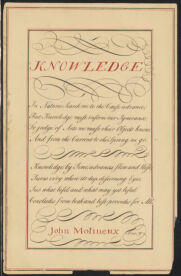
(The image above is a handwriting specimen that John Molineux produced in the 1760s for his writing-school master, Abiah Holbrook, now in the Harvard University library collection.)

Tuesday, May 12, 2020

Fire Buckets and the Fenno Family

The Skinner auctioneers blog offers Christopher D. Fox’s detailed discussion of firefighting and leather fire buckets in Boston.

In particular, Fox profiles one maker of those buckets:
While there were certainly a number of merchants in Boston from whom fire buckets could be purchased, few seem to have advertised in the papers. In addition, it is very rare to find a mark or signature on a fire bucket that identifies its maker. As a result, the identities of nearly all of the makers of fire buckets around Boston have been lost. One exception to this are the buckets produced by John Fenno Jr.

John Fenno Jr. was born in Boston on May 4, 1732, to John Fenno (1707-1790) and Hannah Capen (1712-1792). He married Katherine Hodges (1729-1810) on April 4, 1755, and together they had six children. Fenno’s father worked in the leather business and it is likely that John learned the leatherworking trade from him. While it is not clear exactly when John Fenno Jr. began working on his own, an advertisement in the Massachusetts Centinel in April 1785 indicates that by then his business was well established. “John Fenno, jun. Hereby gives notice to those gentlemen who are so well disposed as to enter into Fire Societies, and all others, that he continues to make Leather Buckets, strong and neat, of a large size, and handsome shape. — Hoses for Engines, and Hoses for the West-India use — Boots, Gloeshoes, and Shoes of all sizes, at the sign of the Leather Bucket, next door to Dr. Samuel Curtis’s at the South End.” Fortunately for historians and collectors, Fenno’s fire buckets are identifiable as he marked his work with a rectangular stamp reading “I. FENNO” on the back of his buckets near the stitched seam.

Unfortunately, in the spring of 1787 his house burned and Fenno was forced to relocate his business as testified by a newspaper advertisement in May of that year. This advertisement is interesting in that beyond the text describing what he makes and sells, it illustrates two of his principal products; shoes and buckets. Over the next several years his business continued to flourish and he expanded his offerings to include hoses for firefighting equipment and other uses. In October 1794 Fenno placed the following advertisement in the Columbian Centinel: “John Fenno, Informs the Public, that he continues to make Leather Buckets, after the best manner, at the sign of the Bucket, Orange Street, South end, Boston. A number of Buckets may be had on the shortest notice. Said Fenno makes Hoses for Engines, and Hose for the conveyance of Oil and Molasses on board vessels.” Fenno apparently continued his bucket-making business until his death on December 5, 1812.
Fenno’s next-younger brother, Ephraim (1734-1790), also became a leather-dresser in Boston. He turned “melancholy” in the late 1780s, was admitted to the almshouse in November 1788, and died there, as tracked in his son’s letters (P.D.F. download).

John and Ephraim’s uncle Benjamin Fenno (b. 1719) might have been the man who looked after the town granary before the Revolutionary War. That granary eventually was taken down to built the Park Street Church, but it left its name on the neighboring burying-ground.

The next generation of the Fenno family left a literary trail. The bucket-maker John Fenno’s daughter born in 1765 is variously called Janet, Jennet, Jenny, and Jane. As Jenny Fenno and then as Jane Ames, she published three volumes of religious verse, as I discussed here. Here’s a look at her 1805 volume for sale.

Ephraim had a son named John Fenno (1751-1798), who assisted Abiah and then Samuel Holbrook at the South Writing School. After the war and some unsuccessful shopkeeping he became the publisher and editor of the Gazette of the United States, the Federalist Party organ in the nation’s capital (first New York and then Philadelphia). He died of yellow fever, far from Boston.