J. L. BELL is a Massachusetts writer who specializes in (among other things) the start of the American Revolution in and around Boston. He is particularly interested in the experiences of children in 1765-75. He has published scholarly papers and popular articles for both children and adults. He was consultant for an episode of History Detectives, and contributed to a display at Minute Man National Historic Park.

Subscribe thru Follow.it


•••••••••••••••••


Showing posts with label Harbottle Dorr. Show all posts

Wednesday, November 26, 2025

“To accommodate the Youth of the South part of the Town with a School House”

As March 1780 began, the selectmen of Boston were looking for two new schoolmasters and one temporary schoolhouse.

Before the war, men tended to serve as schoolmasters for many years. There was more churn among the ushers, or assistant teachers—they probably had so little chance of advancement that they took jobs in other towns.

By 1780 the wartime economy was causing problems for everyone, but especially men who provided services in return for set salaries. The town provided extra grants (of paper money), but it also paid late, so the teachers were struggling.

William Bentley had taught at the North Latin School for three years, starting as usher in 1777 and becoming master in 1779. But on 23 Feb 1780 parents told the selectmen that he would leave “next Satturday.” A couple of years later Bentley became a minister in Salem, a job more to his liking. (He kept it for more than thirty-five years.)

Fortunately, the North Latin School usher, Aaron Smith, could keep the lessons going there. He and two other men immediately applied for the job of master. Furthermore, that public school was the smallest in Boston—only 39 boys attended as of July 1781.

On 8 March, Smith promised the selectmen that as master he would stay for at least twelve months, so the selectmen gave him the job. One problem solved! (Smith did serve through the end of the 1780–81 school year before leaving.)

The South Writing School presented a bigger difficulty. The night before the selectmen heard about Bentley’s departure, that schoolhouse had caught fire. Then Master Samuel Holbrook resigned, as described yesterday. I can’t be sure, but it looks like he took his usher with him.

There were probably over 150 boys attending the South Writing School—a drop from before the war, when the town routinely counted over 200, but still too many to let loose unsupervised on the town.

At the time, a schoolhouse was a large room with long desks and benches for all those boys. The master and usher needed their own desks, and the room needed a stove and a firewood supply, but that was about it. No chalkboards, bookshelves, or other special pedagogical equipment. The town just need to find a big room unoccupied during the day.

On the morning after the fire, the selectmen delegated two of their number, Nathan Frazier and Harbottle Dorr, “to apply to the Overseers of the Poor, for the use of the Workhouse Hall for Mr. Holbrooks Scholars.” At best that might have been a short-term remedy.

On 1 March, the selectmen added John Preston to that committee and sent them to ask whether the “Labretory” could become the new Writing School. After all, it was right next to the fire-damaged building.

A week later those selectmen reported:
That Colo. [William] Burbeck has the care of it at present for the use of the State—that he came in possession of it under Colo. [Thomas] Crafts

that the Land on which it is built belongs to the Town, Major [Adino] Paddock building on it first—

That it will answer for a School, tho not without a very great expense to the Town in fitting it up in a proper manner.
So the town could demand the property back, kick out the artillerists in the middle of a war, and refit the building with a lot of money—which it didn’t have. Not a practical solution. 

On 13 March, Boston embarked on its annual town meeting to elect new officials. One item on that meeting’s agenda was “what is necessary to be done to accommodate the Youth of the South part of the Town with a School House.” Eventually, on 21 March, the meeting chose a committee to tackle that problem, headed by militia colonel Josiah Waters. John Preston wasn’t reelected as a selectman, but he was put on that committee, so he couldn’t escape the problem.

The schoolhouse committee submitted their first report on 24 March. It was “Recommitted,” or rejected, and the town meeting record doesn’t even say what they suggested. On 4 April they told the meeting:
That upon enquirey they had found that the Widow Holbrook had a Room which would accomodate about Seventy or Eighty Scholars, and that they were of Opinion that if this Room could be obtained it would be best to hire it for a School
This was Rebecca Holbrook, widow of the late Abiah Holbrook and sister-in-law of Samuel Holbrook. So she knew what a writing master needed in order to teach.

The town meeting quickly approved that idea and directed the selectmen “to agree with Mrs. Holbrook for said Room as they shall Judge for the Interest of the Town.”

TOMORROW: The cheapest solution.

Thursday, December 30, 2021

Ezekiel Price on “A Great & Glorious Event”

Yesterday’s posting raised the question of when exactly Boston heard about the American and French victory at Yorktown. The most immediate reaction would appear in people’s diaries, so I looked for my usual informants on daily events.

John Adams? In 1781 he was far away in Europe.

Merchant John Rowe? His surviving diaries end in 1779.

Printer John Boyle? He stopped compiling his “Journal of Occurrences” in 1778.

Shopkeeper and selectman Harbottle Dorr? He stopped collecting newspapers assiduously at the end of 1776, adding just a few issues from the next two years.

Robert Treat Paine was keeping his diary out in Taunton in 1781. Fortunately, the folks at the Massachusetts Historical Society have done the hard work of deciphering his handwriting and publishing pertinent entries in the Paine Papers. On 26 October, he wrote: “News came that Cornwallis had Surrendred to Genl. Washington, on 17th. Instant.”

I wanted more detail than that, and I wanted a voice from Boston. Fortunately, Harvard has preserved and digitized the 1781 almanac diary of Boston court official and insurance broker Ezekiel Price (1727–1802), who was a gossip sponge.

Price’s entry for 26 Oct 1781 appears on sequence 37–38 of the digitized version of this diary:
This Morning Mr. Thomas Hulbert [?] came to Town from Providence who brings a Hand Bill printed at Newport Yesterday in which is an Account that the afternoon before one Capt Lovett arrived there from York River who brot an account that Lord Cornwallis & his Army Surrendered Prisoners of War to Genl. Washington on the 18th. instant—

that Cornwallis had wth. him in Garrison 9000 Men with an immense quantity of Stores also that a 44[-gun warship] & one frigate & 100 Transports were Captured—

Mr. Winship who left Newport Yesterday tells me that he saw Capt. Lovett & his Mate who informed him that they say the British Flag lowered & the Continental & French Flags hoisted on the Forts at York Town—that he heard the Huzzas upon the Occasion—

they they saw the French Admiral go on shoar at the Fort that the American Vessells which lay below York Town went up to Town & that he went up so near the Forts that he could throw a Bisket on Shoar—

From all these Accts. it is beyond a doubt that Lord Cornwallis & his great Army with Vast quantities of Artillery & Military Stores are in Possession of our illustrious Genl. Washington & the Allied Army—A Great & Glorious Event—

On this Joyful occasion all the Bells in Town were rang most part of the day & the Sons of Freedom showed evident marks of their felicity. In the Evening the Coffee house was illuminated & Fireworks displayed.

Mr. [John?] Marston tells me that a French Gentleman acquainted him he had received a Letter from a Person who was in York Town at the time of the Surrender & adds that Genl. Washington had ordered 1200 Horse to the Reinforcement of Genl. [Nathanael] Greene.
Price recorded additional information on 27 and 31 October. He came to date Cornwallis’s surrender to the 17th, like Paine. That was when the British general first raised the white flag. It wasn’t until the 19th that the commanders signed surrender terms and the Crown troops gave up their arms, but we now treat that date as the significant one.

Monday, February 22, 2021

“Mentor” Remembers the Massacre

Before February ends, I need to note one event from this month 250 years ago.

On 11 Feb 1771, the Fleet brothersBoston Evening-Post ran as its first front-page item a letter signed “Mentor.” It recalled the previous year’s Boston Massacre and repeated the Whig arguments against standing armies and quartering troops in a populous town.

The author then offered a new idea:
I therefore propose it to the understanding and discreet, as well as the zealous, friends of liberty and mankind, that a regular plan be formed for an annual & solemn remembrance of the 5th of March.

I would speak my own mind on this occasion with freedom, tho’ with becoming diffidence. And I own, that in my present view of the matter, it seems to be expedient to exclude, the reverend and worthy gentlemen of the Clergy from being concerned in any part of the exercises of the day. This proposed exclusion does not arise from any aversion to that useful order of men, or from any doubt of their learning, integrity or fortitude. But I conceive that this celebration ought to be considered and conducted solely with a reference to civil society and domestick policy. And it is in general, perhaps, of little advantage to true religion, or good government, that the clergy should interfere in matters purely temporal, and wholly affecting social compacts and political oeconomy.

It may therefore be proper to chuse two persons to deliver (one in the forenoon and the other in the afternoon) a dissertation on—THE POLICY OF STANDING ARMIES; AND THE NATURAL TENDENCY OF QUARTERING REGULAR TROOPS IN POPULOUS CITIES IN TIME OF PEACE.—This choice should be at such a convenient time as to give the speaker opportunity to mature his thoughts, digest his arguments and form his diction.

By this means, it is likely the performance will be devoid of crude sentiments and inelegant language; and if the audience are not instructed with a sensible, judicious and useful disquisition on so important subjects, yet their time will not be wholly misemployed in giving countenance to those efforts of genius, which may throw some new ray of light upon those sciences, the knowledge of which can never be too generally diffused, or too universally inculcated.—But might we indulge the pleasing hopes, that on these occasions some rising worthy, some genius yet unborn, will pervade the mazy system and perplexed labyrinth of fraud and usurpation;—that will rescue one right from the jaws of power, and restore one liberty to oppressed mankind;—how would the flattering thought inspire our hearts—how would grateful millions bless the institution!

Many benefits resulting from this plan, I decline pointing out; of some plausible objections I am aware, but do not think myself obliged, at present, to obviate them. I have offered my sentiments in a manner becoming a good citizen:—they claim, I trust, some small attention. What is proposed with decency is intitled to candid treatment; but ill-placed ridicule, illiberal and censorious dogmatism, never promoted the cause of GOD or man.
It’s striking that “Mentor” was Josiah Quincy, Jr., the young lawyer whose role in the Boston Massacre had been on the defense teams for Capt. Thomas Preston and the eight British soldiers. He had helped to clear most of those men.

Quincy might have made his public proposal to shore up his standing as a Whig. But how many people knew he made it? Harbottle Dorr’s copy of this issue of the Evening–Post has “J. Quincy” written at top of the “Mentor” letter, but not in Dorr’s usual style and therefore perhaps a later addition. 

It’s striking that Quincy was very clear on what Boston’s Massacre orations should not be. Not a sermon, as much as the town liked a good long religious discourse glancing at the current events. The Massacre arose from a political problem, Quincy felt, and it deserved a wholly political response.

But Quincy was also concerned about ensuring that the orations “be devoid of crude sentiments and inelegant language,” to be “mature.” Was he concerned that some planned public commemorations or some Whig colleagues would be too populist and incendiary?

And what about the article’s wish that orators be chosen “at such a convenient time as to give the speaker opportunity to mature his thoughts”? Was Quincy warning fellow Bostonians that they should hurry up and ask someone because the anniversary was less than a month away, or was he worried about someone less “mature” offering to speak anytime?

The text of the “Mentor” letter is from the Colonial Society of Massachusetts’s publication of Quincy’s writings, available here.

Saturday, February 06, 2021

A Short Narrative “from the London Edition”?

On 16 July 1770, six days after the Boston town meeting reaffirmed its ban on selling copies of its Short Narrative of the Horrid Massacre locally, this advertisement appeared in the Boston Evening-Post:

Next WEDNESDAY will be Published,
[from the London Edition]
And to be Sold at the Printing-Office in Milk Street,
A NARRATIVE of the last horrid MASSACRE, in BOSTON, perpetrated in the Evening of the 5th of March 1770, by Soldiers of the 29th Regiment; which with the 14th Regiment were then Quartered there: some OBSERVATIONS on the STATE OF THINGS prior to that CATASTROPHE.
The printers on Milk Street were John Kneeland and Seth Adams, both trained by the former’s father. Isaiah Thomas wrote of them, “They were three or four years in the business, and printed chiefly for the booksellers.”

That ad seems to promise a completely new printing of the report, getting around the ban as a reprint of a book from London. No copy of that edition survives, however, so the town authorities may have squelched it.

Nevertheless, some Bostonians did obtain unauthorized copies of the Short Narrative, including the hatter Harbottle Dorr, who eventually bound his with his newspapers. We can examine it here, courtesy of the Massachusetts Historical Society. And if we look closely, we see some curious details.

The title page of Dorr’s copy says it was printed for William Bingley in London, based on Edes & Gill’s original edition.
However, the type doesn’t exactly match the Bingley edition, which is now on Google Books.
The letter forms and spacing are ever so slightly different, and Dorr’s copy says “Messirs. EDES and GILL” instead of “Messrs. EDES and GILL.”

Then let’s skip ahead to page 25. The last line on Dorr’s copy is “These assailants, who issued from Murray’s” with the addition of a D (to signal the signature) and the first word on the next page, “barracks.”
Bingley’s edition actually had another line on that page: “barracks (so called) after attacking and wound-” And no D.
If we now turn to page 25 of an Edes & Gill copy, we see that it makes a perfect match for Dorr’s page 25.
There are other little differences between the two editions said to be printed by Bingley. For example, the top of page 33 says “His honour’s” in the London copy, “His Honor’s” in Dorr’s copy and in the Edes & Gill original.

Some printer had taken copies of the latest pages printed by Edes & Gill, removed the Boston title page at the front, and substituted a title page designed to look as much as possible like the Bingley edition from London.

The resulting copies could thus be sold to Bostonians as imports. Edes & Gill presumably got some money for the printed pages they were sitting on. People like Dorr could finally buy a copy for themselves. And just a few genuine Bingley editions shipped to America were turned into many more.

This subterfuge was noted by Thomas Randolph Adams in a bibliography published by the Colonial Society of Massachusetts in 1966. He cited copies of the ersatz London edition then at the Boston Public Library, the Boston Athenaeum, the Huntington Library, the Library of Congress, and Harvard and Yale Universities, so quite a few were made. I first read about this subterfuge in a booklet from the Boston Public Library.

TOMORROW: Where did the Boston printers learn that trick?

Friday, November 27, 2020

Finding Jurors for the Boston Massacre Trial

On 27 Nov 1770, 250 years ago today, the second trial for the Boston Massacre got under way.

It was supposed to start a week earlier, but the court had trouble finding twelve jurors who were ready to sit on what promised to be an unusually long, unusually charged trial.

The defense team was giving the jurors extra scrutiny. Acting governor Thomas Hutchinson wrote to Gen. Thomas Gage in New York:
My great concern is to obtain an unbiased Jury and for that purpose, principally, I advised Captain [Thomas] Preston to engage one of the Bar, over and above the Council to conduct the Cause in Court, in the character of an Attorney who should make a very diligent inquiry into the characters and principles of all who are returned which he has done and it may be to good purpose, but after all it will be extremely difficult to keep a Jury to the Rules of Law.
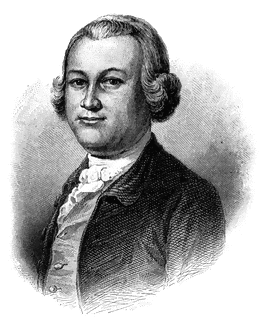
That appears to be the reason that the young solicitor Sampson Salter Blowers joined John Adams and Josiah Quincy, Jr., on the defense team. (Blowers appears above later in life, when he was a judge in Nova Scotia.) Robert Auchmuty, senior counsel for the defense in Preston’s trial, saw his job as done.

The defense lawyers challenged every potential juror from Boston as too close to the case. After all, the town was paying Robert Treat Paine to be a special prosecutor. And the judges accepted those challenges. As a result, the jurors all had to come from other towns in Suffolk County (which at that time included all of present-day Norfolk County as well as Hingham). 

The trial record, which is unusually thick for the eighteenth century and published in volume 3 of The Legal Papers of John Adams and thus on Founders Online, shows the difficulty in seating a jury of twelve. The men called were: 
  • Samuel Williams, Roxbury, challenged for cause.
  • Joseph Curtis, Roxbury, challenged for cause.
  • Nathaniel Davis, Roxbury, sworn.
  • Joseph Mayo, Roxbury, sworn.
  • Abraham Wheeler, Dorchester, sworn.
  • Edward Pierce, Dorchester, sworn.
  • William Glover, Dorchester, challenged peremptorily.
  • Isaiah Thayer, Braintree, sworn.
  • Samuel Bass, Jr., Braintree, challenged peremptorily.
  • James Faxen, Braintree, challenged peremptorily.
  • Benjamin Fisher, Dedham, sworn.
  • John Morse, Dedham, challenged peremptorily.
  • James White, Medway, challenged peremptorily.
  • Nehemiah Davis, Brookline, challenged peremptorily.
  • Samuel Davenport, Milton, sworn.
  • Joseph Houghton, Milton, sworn.
  • James Richardson, Medfield, challenged peremptorily.
  • John Billings, Stoughton, challenged peremptorily.
  • Joseph Richards, Stoughton, challenged for cause.
  • Consider Atherton, Stoughton, sworn.
  • Abner Turner, Walpole, challenged peremptorily.
The clerk then called the Boston men whose names were at the bottom of that list, and the defendants challenged them all.
  • John Brown, Boston, challenged for cause.
  • Joseph Barrell, Boston, challenged for cause.
  • Silas Aitkins, Boston, challenged for cause.
  • Harbottle Dorr, Boston, challenged for cause.
The judges had Sheriff Stephen Greenleaf bring in more men, and the process resumed.
  • Samuel Sheppard, Boston, challenged peremptorily.
  • John Goldsbury, Boston, challenged for cause.
  • Samuel Peck, Boston, challenged for cause.
  • William Gouge, challenged for cause.
  • Joseph Turrell, Boston, challenged for cause.
  • Jacob Cushing, Jr., Hingham, sworn.
  • Josiah Lane, Hingham, sworn.
  • Jonathan Burr, Hingham, sworn.
Finally, the court officers did a little legal maneuvering to ensure the last three men from Hingham were indeed eligible, and the opening arguments began.

Joseph Mayo (1721-1776) of Roxbury was named foreman of the jury. He owned a large farm a little past the intersection of modern Washington Street and South Street in Roslindale. A veteran of the Louisbourg expedition of 1745, he was a captain of his town’s militia company. Mayo had also served on town committees to promote non-importation and to instruct the Massachusetts General Court representatives to stand up for the province’s charter rights. But the defense team felt, based on their inquiry, that he could assess the case fairly.

Wednesday, September 09, 2020

The Cradle of Liberty’s Doorways into the Past

In the early designs of Faneuil Hall, I believe, the bottom level of the building was surrounded by a series of arches open to the air. In the 1800s some of those arches were turned into windows, others into doors.

I once heard Massachusetts Historical Society president Bill Fowler say to members on a tour of the fire-suppression system, “Each of these tanks represents a naming opportunity.” In the same way, I propose, each of those doors is a chance to honor more Bostonians who contributed to the Cradle of Liberty and to tell the public more about its history.

Now here’s where not being able to visit the hall easily these days gets in my way. I’m not sure how many doors there are and which offer public access. Photographs indicate there are three doors on the west side (facing Congress Street) and five on the east side (facing Quincy Market), plus a ramp to a door on the north for people with limited mobility. There are probably other doors on the north and south sides, but perhaps not for the public.

So here’s a proposal on designating those doors in the Hall Formerly Known as Faneuil.

We can name the three central entrances on the east side “The Freeholders’ Entrance,” “The People’s Entrance,” and “The Inhabitants’ Entrance.” That would reflect the three types of meetings that took place in Faneuil Hall when it was the seat of Boston’s government:
  • ordinary town meetings, described in official records as “a Meeting of the Inhabitants of the Town of Boston, at Faneuil Hall,…”
  • meetings of inhabitants meeting a higher property requirement (“freeholders”) to elect Boston’s representatives to the Massachusetts General Court.
  • meetings of “the Body of the People” with no legal authority but expressing popular sentiment on non-importation, tea, slavery, and other issues. 
For visitors, the different designations on those doors could spur questions about who had a voice in Boston’s government.

The remaining two doors on the east side could be named to honor the selectmen and the town clerk (and other employees) who kept Boston’s government running. Ideally, those portals would be close to the selectmen’s and clerk’s chambers, but I don’t know if that’s possible. I’m tempted to name the entrances in specific honor of:
  • William Cooper, town clerk from 1761 to 1809, or more than half the time Faneuil Hall was the seat of Boston’s government.
  • Harbottle Dorr as representative of all the selectmen in that period, if only so we could refer to “the Dorr Door.”
Over on the west side, I propose to call the central door, right behind the statue of Samuel Adams, the Adams Entrance. The Boston town meeting was Adams’s main base of support. Of course, his surname prompts thoughts of his relatives from Braintree, but they had much less to do with Faneuil Hall.

Another west door would become the Nell Entrance in honor of William Cooper Nell, Boston historian and civil rights activist. In response to the U.S. Supreme Court’s Dred Scott decision, Nell organized a commemoration of the Boston Massacre inside the hall in 1858, one of many protests he led in the ante-bellum period. Nell also wrote two books about African-American soldiers in the Revolutionary War, arguing that black men had always contributed to the nation and deserved equal rights within it.

The third door on the west side would be the Stone Entrance in honor of Lucy Stone, advocate not only for racial equality but for extending the vote to the half of the population who are women. She organized and spoke at the New England Women’s Tea Party held in Faneuil Hall on 15 Dec 1873, timing the event to the centenary of the most famous Boston Tea Party. Like Nell, Stone used the building’s Revolutionary fame to advance rights for more Americans.

Along the sides, I’d call one door the Peter Faneuil Entrance (or Exit), acknowledging his original gift to Boston. This could be in the portion of the building that he originally funded. That designation would allow signage to discuss both his gift to Boston and the businesses that money came from.

I’d name another side doorway as the Bulfinch Entrance, recognizing Charles Bulfinch, the local architect who expanded the hall to its present dimensions in 1806.

If there are more side doors, there are other historic figures associated with the Cradle of Liberty. James Otis, Jr., was very active at Boston town meetings during the 1760s, and the city may lack monuments that reflect his importance. Wendell Phillips came to prominence with anti-slavery speeches in Faneuil Hall. Boston politics owes a lot to Elisha Cooke, Sr., and Elisha Cooke, Jr., organizers of the town’s first political machine, though neither lived to see Faneuil Hall.

And there may well be other figures I haven’t thought of. There may be convincing arguments besides historical inertia for retaining the building’s original name and set-up. This proposal is just my attempt to communicate through public memorials at a prominent civic site how:

  • Our society no longer overlooks the enslaved people who suffered for Peter Faneuil’s wealth.
  • We maintain the memory of local slavery and the efforts it took to correct it.
  • We recognize historical change and the possibility of change in the future.

Tuesday, August 04, 2020

“Assertions that Salem, Marblehead and Newbury had departed”

On 31 July 1770, Faneuil Hall hosted another meeting of “The Trade and Inhabitants of the Town of Boston.” The group of people invited to participate had widened again to include not just businessmen but all “Inhabitants.”

Per the report in the 13 August Boston Gazette, the spur for this meeting appears to have been “some very positive Assertions that Salem, Marblehead and Newbury had departed from the Non-Importation Agreement.”

In his copy of that newspaper, Harbottle Dorr wrote that those assertions came from the merchant John Amory (1728-1803, shown here courtesy of the Museum of Fine Arts).

Amory and his brother Jonathan (1726-1797) had a mercantile house together. They hovered in the political middle—not taking strong stands, signing the non-importation agreement but not following it strictly, protesting against too much protest. Eventually John would be a Loyalist exile while Jonathan remained in America.

At this juncture, it appears, John Amory was telling his colleagues in the Boston business community that other ports in the province would soon be bringing in goods, so they might as well drop their boycott.

The meeting responded by appointing a committee of William Molineux, William Phillips, William Cooper, William Greenleaf, and, for diversity, Ebenezer Storer ”to repair forthwith to the Towns above said and Haverhill” and find out what was going on.

In addition, the Body named a larger group of top Whig politicians—John Hancock, Phillips, Samuel Adams, Molineux, Greenleaf, Dr. Joseph Warren, Dr. Thomas Young, John Adams, Josiah Quincy, Richard Dana, Henderson Inches, Thomas Cushing, and Jonathan Mason—“to consider what may be proper to be done toward strengthening a Union of the Colonies.”

On 7 August, the Molineux committee returned from Essex County and “reported that the Conduct of our Brethren in said Towns was honorable and sincere.” The Boston meeting that day “VOTED UNANIMOUSLY” to express their “utmost satisfaction” and “sincere Respect” for their colleagues to the north.

That gathering then appointed a similar committee—Molineux, Cooper, William Whitwell, Thomas Boylston, and Mason—to take the same message to “Providence and New Port in Rhode Island.”

Only after that 7 August meeting—two weeks after the initial 31 July response to Amory—did Edes and Gill report on these proceedings. The Boston Whigs had evidently been sitting on the story until they had good news to announce. It wouldn’t have helped the non-importation movement for other port to read any hint that some Massachusetts towns were dropping out.

TOMORROW: What really happened in Salem?

Friday, January 31, 2020

“Voted to proceed to the Business of the Meeting”

On 23 Jan 1770, as described yesterday, the Bostonians meeting about non-importation in Faneuil Hall received a letter from acting governor Thomas Hutchinson declaring their gathering to be illegal and ordering them to disperse.

In response, those men “unanimously voted to proceed to the Business of the Meeting.” Sheriff Stephen Greenleaf asked moderator William Phillips for a written message to take back to the governor. The meeting came up with this note, addressed to the sheriff:
It is the unanimous Desire of this Body, that you inform his Honor the Lieutenant-Governor, that his Address to this Body has been read and attended to, with all that Deference and Solemnity which the Message and the Times demand; and it is the unanimous Opinion of this Body, after serious Consideration and Debate, that this Meeting is warranted by Law: And they desire you to inform his Honor, that they had determined to keep Consciences void of just Offence towards God and towards Man.
In Smugglers and Patriots, John W. Tyler stated that letter was written in the fine hand of John Hancock (shown above). The previous week, he shied from leading a crowd to the governor’s house. Now Hancock was ready to stand at the front of the movement.

Before leaving, Greenleaf made sure to tell the people he wanted “to be considered in the Light only of the Bearer of his Honor’s Letter.” In other words, Hutchinson stood alone, his show of authority ending in a resounding defeat.

The “Body of the Trade” then proceeded through a series of votes. In response to accusations that someone had tried to burn down the store of importer William Jackson, the meeting offered a £100 reward for the arsonist. A further resolution suggested that an enemy of the community—Harbottle Dorr suggested it was Jackson himself—had planted the evidence of that crime.

Another resolution asked people “totally to abstain from the use of Tea upon any pretence whatever” since tea accounted for “the greatest Part of the Revenue” from the Townshend duties.

But the main business of the meeting was about naming and shaming the shopkeepers who were still defying the non-importation committee.

The first group was the merchants Jackson, Theophilus Lillie, John Taylor, and Nathaniel Rogers. The meeting deemed them “obstinate and inveterate Enemies of their Country, and Subverters of the Rights and Liberties of this Continent.” It declared that people should respond by “withholding not only all commercial Dealing; but every Act and Office of common Civility” from them. The resolution went on for a long time. You can read it here in the Boston Gazette.

Then the meeting turned to a second group of defiant businesspeople:
Most of those people were “strangers in this Country,” the meeting declared. They had “in the most insolent manner too long affronted this people, and endeavoured to undermine the liberties of this country.” Invoking Biblical language (Isaiah 51:1), the gathering declared “that they deserve to be driven into that obscurity, from which they originated, and to the hole of the pit from whence they were digged.”

The next day, Lt. Gov. Hutchinson wrote to Lord Hillsborough, the Secretary of State, about his attempt to stop the meeting. He said he’d spoken with Phillips, his Council, and the town’s justices of the peace about how such meetings would lead to “high treason,” but no one had agreed with him. He acknowledged his letter had failed to disperse the crowd. But Hutchinson insisted that “it made them more anxious to restrain all disorders.”

In the coming weeks, we’ll see how that worked out.

Sunday, September 09, 2018

“A System of Politicks exceeding all former exceedings”

On Thursday, 9 Sept 1768—250 years ago today—Boston was charging into a political crisis.

Edes and Gill’s Boston Gazette for Monday the 5th included an essay signed “Clericus Americans.” Harbottle Dorr attributed that essay to the Rev. John Cleaveland (1722-1799, gravestone shown here) of Ipswich; Cleaveland certainly asked for it to be reprinted in the midst of another dispute a couple of years later.

Cleaveland was an early adherent of the New Light religious movement, expelled from Yale College for attending a “separatist” revival in his home town. After spending a couple of years as minister to a small New Light congregation in Boston, he moved out to Ipswich to serve a breakaway group there. After that he left Ipswich only to serve as a chaplain in the French and Indian and Revolutionary Wars. In fact, Cleaveland proved so popular and steady that by 1774 his church absorbed the one it had split from.

In sum, “separatism” had worked for the Rev. John Cleveland, and he didn’t back down from controversy. “Clericus Americans” laid out a radical argument in a series of leading questions: Didn’t Englishmen have a right to their own property? Couldn’t they move anywhere within the British Empire? Hadn’t the early settlers of New England built their communities at their own expense?Wouldn’t any attempt to restrict English colonists’ rights—such as the Townshend Acts—negate their compact with the royal government in Britain? And thus:
Whether the political union, connection, &c. &c. of these Colonies to the British empire and government are not hereby entirely dissolved, and the Colonists reduced to a state of nature? 
This was the argument underlying the Declaration of Independence eight years later. Cleaveland wasn’t arguing for independence—the letter ended with a plea for all colonists to pray for the health of the king and queen. But he did argue that Parliament’s taxation without representation, Gov. Francis Bernard’s early closing of the Massachusetts General Court for not rescinding the circular letter, and Customs officials’ rumored requests for army protection had delegitimized those government authorities.

Cleaveland called for Massachusetts to start over: each town should “chuse Representatives for a general assembly” to maintain good government while the colony petitioned George III to restore its “first original charter,” with no London appointees at the top.

In a report to Lord Hillsborough, the Secretary of State, Gov. Bernard wrote:
In the Boston Gazette of the 5th inst [i.e., this month] appeared a paper containing a System of Politicks exceeding all former exceedings. Some took it for the casual ravings of an occasional enthusiast: but I persuaded myself that It came out of the Cabinet of the Faction and was preparatory to some actual operations against the Government.

In this persuasion I considered that if the Troops from Halifax were to come here of a sudden, there would be no avoiding an insurrection, which would at least fall upon the Crown officers, if it did not amount to an Opposition to the troops.
Bernard knew that army troops really were on their way. On 3 September, he had received a letter from Gen. Thomas Gage in New York, alerting him that on orders from London he was moving the 14th Regiment of Foot from Halifax to Boston. Gage also offered to send the 29th Regiment if Bernard wanted it.

The governor wanted to create a soft landing for those soldiers:
I therefore thought it would be best that the Expectation of the troops should be gradually communicated, that the Heads of the Faction might have time to consider well what they were about, & prudent Men opportunity to interpose their advice. I therefore took an occasion to mention to one of the Council, in the Way of discourse, that I had private advice that troops were ordered hither, but I had no public orders about it myself. This was in the 8th insta: & before night it was throughly circulated all over the town.
On 9 September, the merchant John Rowe wrote in his diary: “The Governour told mee in Conversation Yesterday morning that he had Stav’d off the Introducing Troops as long as he could but could do it no longer.” Bernard also wanted people to understand that he hadn’t asked for army regiments, that the government in London had made the decision on its own.

Some Bostonians, describing themselves as “apprehensive that the landing of troops in the town, at this particular juncture, will be a matter of great uneasiness, and perhaps be attended with consequences much to be dreaded,” petitioned for a town meeting. The town hadn’t met since June, right after the Liberty riot. The selectmen agreed, scheduling a meeting for 9:00 A.M. on Monday, 12 September—earlier in the day than usual, but time was essential. The Edes and Gill shop began printing official notices with that summons.

Even before then, people started to act. On Friday night, Gov. Bernard wrote, there was a large but unofficial meeting “where it was the general Opinion that they should raise the Country & oppose the troops.” In other words, a significant number of people thought the town of Boston should call for the Massachusetts militia to rise up against the king’s army.

TOMORROW: The beacon on Beacon Hill.

Sunday, January 21, 2018

“At my trial for caning Gill”

In April 1768 John Mein went on trial for assaulting rival printer John Gill. In fact, he faced two trials—in criminal and civil court.

On 19 April the local magistrates cited Mein for criminal assault and fined him 40 shillings, or £2. Not a huge amount, but a judgment that he had disturbed the peace of Boston.

At the same time, Gill sued Mein for £200 in damages. John Adams represented Gill. The case was tried on 28 April, and the 2 May Boston Post-Boy reported the verdict:

after a long Hearing the Jury found a Verdict in favour of the former [Gill], for one Hundred and thirty Pounds Lawful Money Damages, and Costs of Court. From which Judgment we hear both Parties appealed to the next Superiour Court. 
I’m skipping further ahead of the Sestercentennial anniversaries to finish this story. The appealed case came up in the March 1769 session of Massachusetts’s highest court. Benjamin Kent and Robert Auchmuty were Mein’s attorneys. On Gill’s side, Adams was joined by James Otis, Jr.

Kent was a Whig with many Loyalist relatives; though he stayed in Massachusetts through the Revolutionary War, in 1785 he went to spend his last years with them in Nova Scotia. Auchmuty was one of Boston’s leading attorneys supporting the royal government. Otis and Adams were of course active opponents of that government.

The John Adams Papers contain his notes from the trial, but those don’t provide a useful summary, with disconnected phrases like “Kick upon the A—se” and “Distinction between Bump and Tumour.”

The facts of the assault don’t seem to have been in doubt, or even the question of whether Mein was in the wrong. Rather, the question was how much was he in the wrong. Had he planned the attack for days? Had the Gazette provoked Mein, so Gill was partially at fault? How big was the stick, and how big was Gill?

In the end, the jury found for Gill but awarded him £75 and costs—a smaller award than before, but still a “Large Sum,” as Harbottle Dorr wrote. At some point Mein wrote that his decision to cane Edes or Gill had “cost me about £100 St[erling].” He filed for a new trial but later withdrew that motion. By November 1769 Mein had worse to worry about.

Mein later wrote, “Otis at my trial for caning Gill, bandied about this Liberty of the Press as the Salvation of America, and said, that in beating him I had endeavoured to shutt up that great Source of freedom.” Seeing Otis in court must have particularly irked Mein because he was convinced that “Americus,” the anonymous newspaper writer who had called him disloyal and set off the whole affair, was Otis himself.

Saturday, January 20, 2018

“Two violent blows…upon the back part of the head”

On 18 Jan 1768, John Mein of the Boston Chronicle asked Benjamin Edes of the Boston Gazette to identify “Americus,” who had attacked him in a newspaper essay. Edes refused.

On 19 January, Mein asked again, hinting that this was a matter of honor. In his own words he went to the Edes and Gill print shop “to ask them one after another to take a short Walk.” Again, Edes refused.

On 21 January, the rival Boston News-Letter published a letter about the dispute:
Mr. [Richard] Draper.

I have heard an incorrect Account of a Difference between Messrs. Edes and Mein, greatly to the disadvantage of the latter: If Mr. Mein has been guilty of an insolent Attempt to break in upon the Liberty of the Press, it is just he should be exposed, and treated with due Contempt: If he is innocent, it is cruel to Propagate such a malicious Representation of his Impudence and Affectation: If therefore by Publishing this you can influence the Parties concerned to give a true State of the Matter, you will oblige a great Number of your Readers who are anxious to know the whole of the Affair, besides your humble Servant,

Just. Pacis.
That prompted Edes to publish the lengthy description of his interaction with Mein in the 25 January Boston Gazette. I quoted Edes’s report yesterday.

A whole week had gone by since Mein’s first visit to the Edes and Gill shop. But now the private argument between printers was out for everyone to read. That appears to have galvanized Mein into action. Now that the Boston Gazette printers had denied his “short Walk” challenge (and made the whole thing public), Mein resolved “to cane the first of them I mett.”

On the evening of 26 January (and I’m getting ahead of the Sestercentennial here), Mein ran into his rival. Not Edes, the politically active member of the Loyall Nine. Rather, Mein spotted Edes’s partner and relative by marriage, John Gill. According to Isaiah Thomas, “Gill was a sound whig, but did not possess the political energy of his partner.”

Mein hit Gill with his walking stick. According to legal papers, Mein “gave the said John Gill two violent blows…upon the back part of the head.” Such a caning wasn’t just an assault; under British dueling customs, it was also a way to signal that one’s opponent had forfeited any claims to be a gentleman. However, to locals like Harbottle Dorr, Mein merely behaved “like a ruffian.”

What the News-Letter had called “a Difference between Messrs. Edes and Mein” quickly became a “Dispute…between Messieurs Gill and Mein”—and more. “Populus” in the Gazette wrote:
If we suffer the Printers to be abused, for resolutely maintaining the Freedom of the Press, without discovering our just Resentment against those who endeavour to force them from their Duty, we shall soon find the Press shut against us—For it cannot be expected that one or two Men who will be subject to the Malice of the publick Enemies, bear to be bruised, and run the Hazard of being assassinated, if the Public, whose Cause they are fighting do not zealously patronize their Cause.

The People in this Province, and this Town in particular, must for the foregoing Reasons, be justified in their general Disapprobation of, and Disgust to Mr. Mein, for his late Spaniard-like Attempt on Mr. Gill, and in him, upon the Freedom of the Press.
“Populus” then revived the initial complaint that Mein had revealed “his Enmity to this Country, by villifying her great and firm Friend, the illustrious Mr. [William] Pitt, under God and the King, the Saviour of Britain, and the Redeemer of America.” In other words, it was very important to preserve the freedom of the press, and to attack anyone who published bad things about America’s political hero.

TOMORROW: Going to court.

Thursday, July 07, 2016

Marshfield Town Meeting “penetrated with the highest sense of gratitude”

In February 1775 Marshfield’s Loyalist community was feeling emboldened by the presence of a hundred British regulars, and perhaps upset by the complaints from neighboring towns about those troops.

At that time, local historian Lysander Salmon Richards later wrote, Marshfield had only three selectmen: Dr. Isaac Winslow, Abijah White, and Ephraim Little. And they were all in the Loyalist camp.

Thus, those men could call an official town meeting on the terms they chose. Which started with applying to Gen. Thomas Gage for permission to hold such a meeting. The Massachusetts Government Act had forbidden towns from meeting more than once a year without the royal governor’s approval, which was a big strike at local self-government and thus a big grievance for the Patriot side.

According to Boston businessman Harbottle Dorr, Marshfield was the first town to approach the governor under the new law. Most towns were either claiming to meet by adjournment from a previous session or just gathering without official sanction.

Marshfield’s meeting took place on 20 February. The attendees chose Dr. Winslow to moderate. The records of that meeting say:
A vote was put to know the mind of the Town, whether they will adhere to, and abide by the Resolves and Recommendations of the Continental and Provincial Congresses, or any illegal assemblies whatsoever? and it passed in the negative.

Secondly, The vote was put to know the mind of the Town, whether they will return their thanks to General Gage, and Admiral [Samuel] Graves, for their ready and kind interposition, assistance, and protection from further insults and abuses with which we are continually threatened? and it passed in the affirmative.

Thirdly, They voted that a Committee be chosen to draw up and send the same to General Gage, and Admiral Graves, said Committee consisting of 23 persons.
Dr. Winslow chaired that large committee and probably drafted the addresses in the home he had recently inherited. (That home is shown above; now the 1699 Winslow House, I’m speaking there this evening.) Marshfield’s address to Gen. Gage matches the neighboring towns’ complaint in its high-flying rhetoric:
We, the Inhabitants of Marshfield, in legal Town Meeting assembled, this 20th day of February, 1775, beg leave to return your Excellency our most grateful acknowledgments for your seasonable assistance and protection, in sending a detachment of his Majesty’s Troops to secure and defend the loyal people of this Town, from the threats and violence of an infatuated and misguided people. We assure your Excellency (whatever may have been surmised to the contrary) that there were sufficient ground and reasons for making application; and we are fully convinced that this movement has preserved and promoted, not only the peace and tranquillity of this Town in particular, but of the County in general; owing, in great degree, to the prudence, firmness, and good conduct of Captain [Nisbet] Balfour, who, with pleasure as well as justice we say it, has done every thing in his power to obtain those laudable ends and purposes.

Thankfully we acknowledge our obligations to our Sovereign, for his great goodness and wisdom, in placing at the head of affairs, in this Province, in this day of difficulty, confusion, and discord, a gentleman of your Excellency’s well known humanity, moderation, capacity and intrepidity, and shall constantly implore the Supreme Governour of the universe to assist and direct you in the faithful discharge of the various functions of your exalted station, with fidelity to your King, with honour to yourself, and with happiness to the people committed to your charge.

With pleasure we embrace this opportunity of expressing our detestation and abhorrence of all assemblies and combinations of men (by whatever specious name they may call themselves) who have or shall rebelliously attempt to alter or oppose the wise Constitution and Government of Great Britain.

Furthermore, we beg leave to inform your Excellency, that in the most critical and dangerous times, we have always manifested and preserved our loyalty to the King, and obedience to his laws; carefully avoided all constitutional covenants and engagements whatsoever, that might warp us from our duty to our God, our King, and country; and as we are determined to persevere in the same course, we flatter ourselves that our endeavours and exertions will meet with our most gracious Sovereign’s approbation, as well as your Excellency’s, and that under his and your gentle and humane government and kind protection, we may peaceably and quietly sit under our own vines and fig-trees, and have none to molest or make us afraid.
(Fans of Hamilton will recall how George Washington also liked to quote Micah 4:4.)

The address to Adm. Graves was shorter but similar in tone:
We, the Inhabitants of Marshfield, in Town Meeting legally assembled, the 20th of February, A.D. 1775, penetrated with the highest sense of gratitude, present our sincere and hearty thanks to you sir, for your ready compliance with a request of a number of our inhabitants, in ordering an armed Vessel to protect and defend us from the lawless insults and abuses with which we were threatened by numbers of seditious and evil-minded people, for no other reason (that we can conceive) but our loyalty to the best of Kings, and firm adherence to the laws of Government. With hearts replete with gratitude, we contemplate the paternal care and goodness of our most gracious Sovereign, in the appointment of a gentlemen to command his Navy in America, at this critical juncture, whose duty, inclination, and abilities, so happily coincide to answer the good purposes of his department.

Permit us to acquaint your Honour, that we have always endeavoured to comport ourselves, and regulate our conduct agreeable to the laws of England and this country; that we have not been guilty of any riots or illegal assemblies, or adopted or subscribed any unconstitutional resolves, covenants, or combinations whatsoever, but have constantly and uniformly borne, our testimony against such measures and proceedings; that it is our serious intention and firm resolution to respect the English Constitution; and demean ourselves like true, loyal and obedient subjects, by doing which we apprehend we shall entitle ourselves to the continued protection of our most gracious King, your Honour, and every friend to peace and good Government.
Dr. Winslow and his Loyalist colleagues weren’t the only men at that meeting, however. Marshfield’s longtime town clerk, Nehemiah Thomas, also attended to keep the official record. And he surely didn’t like what was going on.

TOMORROW: The Patriot party objects.

Tuesday, March 08, 2016

Naming a Massacre

Bostonians started to call the killings on King Street on 5 Mar 1770 a “massacre” almost immediately, according to the official record. The minutes of the emergency town meeting that started the next day begin:

At a Meeting of the Freeholders and other Inhabitants of the Town of Boston at Faneuil Hall on Tuesday the 6th. Day of March 1770 – 11 O’Clock A:M; occasioned by the Massacre made in King Street, by the Soldiery the preceeding Night . . .

Upon a Motion made it was Voted, that if any of the Inhabitants present could give information respecting the Massacre of the last Night, that they be desired to do it in Meeting, that the same might be minuted by the Town Clerk
That clerk was William Cooper, and it appears he was the person who started to apply the term “massacre” as he took notes at that meeting.

By the end of that town meeting that afternoon, Cooper was writing the phrase “horrid Massacre.” On the afternoon of the 12th, that had become “the late horred Massacre.” The latter meeting had chosen a small committee headed by James Bowdoin to write Boston’s official report on the event, which had the title A Short Narrative of the Horrid Massacre in Boston.

In choosing that word, Boston Whigs strengthened the links they perceived between them and government reformers in London. The term echoed the Massacre of St. George’s Fields, which had taken place in London in May 1768. A crowd had turned out to show support for the radical politician John Wilkes. Magistrates “read the Riot Act,” ordering the people to disperse. When they didn’t, soldiers fired at the crowd, killing six to eleven people.

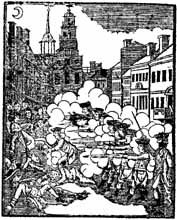
A related question is when the term “Boston Massacre” arose. At the end of 1770, Isaiah Thomas published his first Massachusetts almanac, to cover the following year. He had Paul Revere produce a new version of the image he’d taken from Henry Pelham, this time as a woodcut rather than an engraving. Harbottle Dorr pasted that picture in his newspaper collection beside the first reports of the shootings. That example is discolored by glue, but we can see the label “BOSTON MASSACRE” at the top. That phrase also appeared in advertisements for the almanac.

Another label, John Johnson of Minutemen and Their World has pointed out, was “Preston’s Massacre,” after Capt. Thomas Preston, acquitted in late 1770 of having ordered soldiers to fire into the crowd. That phrase appeared in the 5 Mar 1771 issue of Salem’s Essex Gazette, exactly one year after the event. A week later, Edes and Gill reprinted that text in their Boston Gazette, filled out with large display type, dark borders, and a description of Boston’s first-anniversary memorial events.

The war that followed a few years later brought several more events labeled as “massacres”: the Paoli Massacre, Baylor Massacre, Waxhaw Massacre, Cherry Valley Massacre, Sugarloaf Massacre, Pyle’s Massacre, and Gnaddenhutten Massacre. Most of those events were actually fights between the two armies in which one side was really successful at wiping out the other. Only a couple involved attacks on unarmed civilians, with the Gnaddenhutten attack the worst atrocity.

Thursday, August 27, 2015

“The same enraged mob whent to the house of Judge Hutchinson”

On 26 Aug 1765, the Boston Gazette ran this notice on the bottom of its third page amidst the local news:
Messieurs Edes & Gill.

I Desire the Printers of the Thursday’s Paper [Richard Draper’s “News-Letter”] to tell their Readers who those Gentlemen of Integrity and Reputation were that informed the Populace that an honorable Gentleman had “not only spoke but wrote AGAINST laying on the Stamp Duties”

And if these Gentlemen will make it appear to be a Fact, they shall have the Honor of three Cheers, with the free Consent, of your humble Servant,

TOM.
As Harbottle Dorr’s note on his copy of the newspaper shows, readers understood that the “honorable Gentleman” in question was Lt. Gov. Thomas Hutchinson.

Bostonians had been assigning Hutchinson some blame for the Stamp Act for weeks. On 14 August he tried to defend—reportedly with his sword—the house of stamp agent Andrew Oliver. The next night he refused to tell crowds at his door that he’d opposed the law because, as he wrote, “I did not like to be accountable to them.”

On top of that, Hutchinson was also connected to the Customs house inquiry that had riled Boston’s maritime community the previous year, as described yesterday. On the night of 26 August, crowds visited four men who had been part of that scandal, ransacking at least two of their homes. And then they headed for Hutchinson’s mansion in the North End.

The lieutenant governor left several accounts of this event, but I’ll quote one from his niece Hannah Mather Crocker, recently printed in Reminiscences and Traditions of Boston. Hannah’s father, the Rev. Samuel Mather (1706-1785, shown above courtesy of the American Antiquarian Society), was Hutchinson’s brother-in-law and neighbor. Thirteen years old at the time, she recalled:
The same enraged mob whent to the house of Judge Hutchinson [&] demanded his person. Not finding him, they distroyed great part of his house and furniture [&] drank wine till many of them could drink no more.

Part of the mob whent to Dr. Mather’s house where he had taken refuge. The Dr. told them his house was his castle and he should protect his brother Hutchinson.

At last the contest grew so warm that it was not thought safe for Mr. Hutchinson to stay any longer at his sister’s house. The present writer of this account was sent to shew him a private pass, the back way through an alley to the house of Mr. Thomas Edes [1715-1794] father of the late Edwards Edes.

There he remained till six o’clock in the morn when he partook of breakfast with his sister’s family. He conducted like a calm philosopher through the whole scene. After breakfast he whent up to court in his common dress, as his bag wig and robes had been distroyed by the mob. He opened court with a very affecting speach.
Young lawyer Josiah Quincy, Jr., heard that speech and wrote down one of two versions to survive. According to him, Chief Justice Hutchinson began:
Gentlemen: There not being a Quorum of the Court without me, I am oblig’d to appear.—Some Apology is necessary for my Dress—indeed I had no other. Destitute of every Thing—no other Shirt—no other Garment, but what I have on.—And not One in my whole family in a better Situation than myself. The Distress of a whole family around me, young & tender Infants hanging about me [Hutchinson’s youngest children were eleven and thirteen], are infinitely more insupportable than what I feel for myself, tho’ I am obliged to borrow Part of this Cloathing.
In addition to almost all his household’s clothes, Hutchinson was missing his windows, his furniture, his plate, his family pictures, his wainscotting, his front fence, his official comission as lieutenant governor, £900 sterling, and—perhaps most devastating to a historian—his books and manuscripts. Fortunately for Hutchinson, he had a backup mansion in Milton.

TOMORROW: A street-level view of this riot.

Friday, February 27, 2015

“God Save the People!” Exhibit Opens in Boston

Today the Massachusetts Historical Society opens its “God Save the People!” exhibit about the political conflict in Boston that grew from 1765 to 1775 and exploded into war. Last night I attended a preview, and can happily recommend a visit for anyone interested in American history. The exhibit will be up through the “So Sudden an Alteration” conference and into September. It’s open Monday through Saturday from 10:00 A.M. to 4:00 P.M., and free.

In designing an exhibit worthy of the sestercentennial, the M.H.S. staff tackled a few challenges. One is the size of the exhibit space: three rooms (though one can also peek into the Treasures Room with its semi-permanent display of portraits of James Bowdoin, George Washington, young John and Abigail Adams, and old Lafayette). Any exhibit is a fraction of the available material, but, given the size of the M.H.S. holdings, this exhibit had to show a very small selection indeed.

Another challenge was that the society chose long ago to focus on documentary material. Most of its holdings are letters, diaries, and other writings. Multiple pages plucked from the John Rowe’s extensive (if suspiciously incomplete) diary and Harbottle Dorr’s newspaper collection provide continuity over the decade. But such writings are best read while sitting down at length instead of gazed at.

To enhance the exhibit’s visual dimension, the society has drawn on its fine collection of portraits—though those of course show only the very top of society. The engravings of Paul Revere and other cartoonists, usually shown both in original form and enlarged for easier examination, illustrate stages of the conflict. And we get to see some of the grab-bag of artifacts that the society has accumulated over the years, such as:
The family of those officers also loaned other items to illustrate the courtship of Capt. John Linzee of the Royal Navy and local miss Sukey Inman.

The tent poles of the exhibit are the most famous Boston events: the Stamp Act protests, the conflict over non-importation leading up to the Massacre and succeeding trials, the Tea Party, and Bunker Hill. Ironically, conflicts that were played out largely in documents, such as the argument over judicial salaries, are less visible.

There was, of course, a parallel struggle for liberty in those years, by blacks both free and enslaved. The exhibit represents that history through the figure of Phillis Wheatley; it shows her portrait, one of the few surviving documents in her own handwriting, and her writing desk. Beside them is the Bucks of America medal, though I think that’s really a relic of the African-American community’s strive for acceptance in the early republic of the 1780s rather than of the Revolutionary War.

Among the exhibit’s strengths is being able to see some of the same figures at different times. Thus, one of the first items is shopkeeper Cyrus Baldwin’s 15 Aug 1765 letter to his brother Loammi describing “an effigy of the honorable stamp master of this province” hanging from a big tree in the South End. (That was weeks before that tree was designated Liberty Tree.) Among the later items is Cyrus Baldwin’s complaint about losing a chest of tea to Charlestown Patriots, as Chris Hurley narrated earlier this year. We see Samuel Quincy telling his legal colleague Robert Treat Paine that prosecuting Customs official Edward Manwaring for the Massacre will be “another Windmill adventure,” and later Quincy exchanging letters with his dying Patriot brother Josiah.

Perforce, the exhibit focuses on the top of society, the class involved in formal politics, the class most likely to save their papers. That stratum offers a variety of stories—even, in the portrait of Customs commissioner Charles Paxton, a silent bit of queer history.

The dimension of pre-Revolutionary Boston I think this exhibit can’t capture so easily is the everyday life of most Bostonians and how that intersected with the political developments. But there are glimpses—in, for example, Isaac Vibird’s newspaper protest that his wife had visited a proscribed importer’s shop just to pick up some locally made shoes. So when you go, take some extra minutes to read the newspaper pages and see what else was going on.

Monday, February 09, 2015

Missing Stamp Act Sources

Yesterday I quoted an extract from Jared Ingersoll’s letter of 11 Feb 1765, about the House of Commons debate over the Stamp Act, as it appeared in the 27 May Boston Post-Boy. Researching that text was a good reminder of how spotty the historical record remains.

When the Newport Mercury published that same text on the same day, its printer datelined the item “New London, 10 May.” That strongly suggests the text first appeared in print in the 10 May issue of the New-London Gazette. But no copies of that newspaper are known to have survived. Thus, the publication that sparked the “Sons of Liberty” movement is apparently lost.

The same situation applies to other descriptions of the debate. The 13 May Newport Mercury and 13 May Boston Gazette both contained a long description of the discussion in the House of Commons, paraphrasing opposition member Isaac Barré’s speech at length (but not emphasizing the same points as Ingersoll’s letter).

The 13 May article from Newport indicates that its source for that description was the New-York Gazette, or Weekly Post-Boy, published on Thursdays. But the run of that newspaper is not available for 1765. (That article also included the claim that there was “a majority of about forty voices in favour of the bill.” In fact, the vote was 245-49, so that report wasn’t completely reliable.)

Finally, in 1852 the historian Jared Sparks (shown above as a young clergyman) reported that Francis Dana (1743-1811) of Boston had “heard Barré’s speech, and wrote home an account of it at the time.” As far as I can tell, that letter has never been published. Does its text survive in the Sparks Manuscripts at Harvard (MS Sparks 44)? The Dana family papers at the Massachusetts Historical Society? Or nowhere? How did it accord with the other accounts?

In digging around I was also struck by how Boston shopkeeper Harbottle Dorr began his personal newspaper archive in 1765. Apparently he decided that something big started that year.