J. L. BELL is a Massachusetts writer who specializes in (among other things) the start of the American Revolution in and around Boston. He is particularly interested in the experiences of children in 1765-75. He has published scholarly papers and popular articles for both children and adults. He was consultant for an episode of History Detectives, and contributed to a display at Minute Man National Historic Park.

Subscribe thru Follow.it


•••••••••••••••••


Showing posts with label Benjamin Tallmadge. Show all posts

Sunday, October 09, 2022

Knocking Down the Myths of Agent 355

Her Half of History is Lori Baker’s podcast about notable women in various times. Recently she’s been sharing episodes about women involved in espionage.

I like her take on the Culper Ring and whether those spies included a female agent, source, courier, or cover. You can glean her basic conclusion from the title of that episode: “Agent 355: Washington’s Mostly Mythical Spy.”

The historical record of espionage is always sparse, for obvious reasons. We know that Maj. Benjamin Tallmadge invented a code for his agents that used the number 355 for “lady” and the number 701 for “woman.”

We also know that Abraham Woodhull used the number 355 once, in a letter dated 15 Aug 1779. That dispatch referred to bringing a lady along on a trip into New York because the security was getting stricter.

As Baker says, per her transcript:
This brief mention is 100% of the solid, historical record on Agent 355. It is the only time she is ever mentioned. Everything else is either a speculation or an outright fabrication. And oh wow, does imagination run wild. . . .

Culper…wrote “355,” the code for lady. Much has been made of the fact that he did not write 701, the code for woman. . . . [Using 355] certainly meant she was either the wife or daughter of a gentleman. That is to say, she had some social standing.

Morton Pennypacker and more recently Brian Kilmeade and Don Yaeger have taken this linguistic nugget of truth and run miles with it. Agent 355 was, according to them a young coquette living in the height of New York society, attending parties with the cream of the British officers. She was also, according to them, a lover of Robert Townsend and later maybe even bore him a child.

Author Alexander Rose calls this an “utterly fantastical and fanciful tale” (Rose, 325), and he is absolutely right. He points out that the letter was written by Woodhull and he says a lady of my acquaintance, not Townsend’s acquaintance (Rose, 325).

Rose then goes on to inform the reader with absolute assurance that the lady in question was Anna Strong. Anna Strong was a Setauket neighbor of Woodhull’s…[who] may have been willing to pretend she was his wife. . . .

This theory seems far more plausible to me than the young New York coquette theory, but at the end of the day Rose does not offer any more proof than the others. Woodhull does not say that this happened. He certainly does not name Anna Strong, and surely she is not the only Long Island resident who could have posed as his wife, if anyone did.
Baker is also skeptical of the family lore about Anna Strong signaling Continental spies in Long Island Sound—and rightfully so, I think. I’ve never been able to figure out the practical logic of that tale, which Pennypacker published a century and half after the war without specifying a source.

Modern American culture thirsts for examples of women active in historical events. In the last century, the extremely sparse documentary tidbits about 355 have been spun out in all sorts of adventures: Agent 355, Turn: Washington’s Spies, The 355, Y: The Last Man. Those stories proudly present themselves as fiction. Most histories of the Culper Ring contain a large amount of fictional speculation as well.

(The picture above appears on Wikipedia’s page for Agent 355, which treats the competing claims too credulously. Its caption says it shows “Agent 355, as depicted in an 1863 issue of Harper’s Weekly.” In fact, that magazine article was about Antonia Ford, who gathered information for Confederate commanders in the U.S. Civil War. The original caption, “General [J.E.B.] Stuart’s New Aid,” has been cropped out. Such is our interest in seeing Agent 355, if such a lady ever existed.)

Friday, December 17, 2021

“An alledged libel against Julius Deming”

While researching the life of Elisha Horton, as I laid out yesterday, I came across newspaper articles about a local political controversy in the early 1800s.

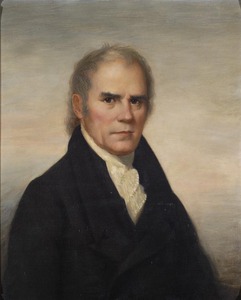
The other main figure in this story is Julius Deming (1755–1838, shown here). Born in Lyme, Connecticut, Deming became a captain of cavalry under his cousin Col. Henry Champion and then, also under cousin Henry, an army commissary at Litchfield.

As the war ended, Deming remained in Litchfield and set himself up as a merchant. He married Dorothy Champion, cousin Henry’s daughter. (Another daughter was Deborah Champion, and I wrote about her legend back in 2014.)

For business Deming traveled to London, traded with China, and formed partnerships with prominent men like Benjamin Tallmadge and Oliver Wolcott. He grew richer. He became the local magistrate and served in some state and county offices, though his family understood him not to enjoy politics. (This story suggests he had strong feelings about politics nonetheless.)

Among the businesses Deming invested in was a paper mill, where he hired Elisha Horton as his manager. One source tells me Horton started work at the Litchfield paper mill in the early 1790s, the other that he started work for Deming in the early 1800s. Maybe there were two mills, or maybe Deming bought a mill where Horton was already working for the previous owner.

The 1790s and 1800s of course saw the rise of party politics in the U.S. of A. New England Federalists like Julius Deming were shocked when Thomas Jefferson won the Presidency in 1800 and his allies made inroads in their region. Litchfield had two newspapers keeping an eye on each other: the Litchfield Monitor (Federalist) and the Witness (Republican).

By September 1805, if not before, Deming was in a feud with Selleck Osborn (1783–1826), the young publisher of the Witness. There was a dispute over coverage of a lawsuit involving Tallmadge and Wolcott. Then on 9 October the Witness published an article headlined “Reign of Terror” reporting that on the recent Election Day Deming had tried to intimidate a Republican voter.

On 11 December the Witness’s last piece of local news, festooned with a pointing hand, was:
Yesterday the Editor and Printer of the WITNESS, were indicted by the State’s attorney, for an alledged libel against Julius Deming, Esq.
That case hinged on Deming’s political methods. And when it went to court, a key witness was Elisha Horton.

TOMORROW: What Elisha Horton wanted to say.

Saturday, May 25, 2019

“I am My Dear Marquis with the truest affection…”

portrait of the rosy-cheeked young Lafayette painted for Jefferson, now at the Massachusetts Historical Society
There was a lot of news coverage earlier this month about locating a letter from Alexander Hamilton to the Marquis de Lafayette that was stolen from the Massachusetts State Archives sometime around 1940.

Fortunately for the study of history, the archive had made a photostat of the document before it disappeared. The text of the letter was therefore available to be included in the printed edition of Hamilton’s papers and at Founders Online. That in turn led to a document dealer recognizing that the original had been stolen when it came back onto the market. Now the state is taking legal steps to get that document back.

Here’s the text of the 21 July 1780 dispatch:
My Dear Marquis

We have just received advice from New York through different channels that the enemy are making an embarkation with which they menace the French fleet and army. Fifty transports are said to have gone up the Sound to take in troops and proceed directly to Rhode Island.

The General is absent and may not return before evening. Though this may be only a demonstration yet as it may be serious, I think it best to forward it without waiting the Generals return.

We have different accounts from New York of an action in the West Indies in which the English lost several ships. I am inclined to credit them.

I am My Dear Marquis
with the truest affection
Yr. Most Obedt
A Hamilton
Aide De Camp
The letter highlights some of the relationships depicted—indeed exaggerated—in the Broadway musical Hamilton: the close friendship between these two young officers and young Hamilton’s willingness to act on Gen. George Washington’s behalf.

Another link to recent popular culture: The warning Hamilton sent on had come from the Culper Ring on Long Island, inspiration for the recent television series Turn: Washington’s Spies. The rumor about a Caribbean naval battle, which was false, had come through Maj. Benjamin Tallmadge, another character on that show.

The mystery I can’t figure out is why this letter was in the Massachusetts archives in the first place. It has nothing to do with Massachusetts.

Wednesday, August 17, 2016

“Left her three years ago in a condition almost helpless”

Yesterday we left Eunice Hazard and her children in Newport, Rhode Island, in 1779 after her husband Thomas evacuated the town with the British military.

In February 1782 she described her situation in a petition to the Rhode Island Assembly:
that she is the wife of Thomas Hazard, late of Narragansett, now a refugee in New York; that the said Thomas Hazard left her three years ago in a condition almost helpless, with seven young children, one of them at the breast, and the rest unable to subsist themselves; and that from that time to this, she has encountered many difficulties in bringing up and supporting the said children, and hath at length exhausted all the resources in her power, and expended not only what remained in her hands of her said husband’s effects, but also nearly the whole of what came to her particular use from the estate of her late honored father; and thereupon she prayed this Assembly to take her unhappy case under consideration, and extend unto her and her children such grace and favor as may seem meet, and in particular to grant her that house and lot of land lying in Newport, which was her said husband’s late estate…
Eunice was a genteel descendant of Rhode Island founder Roger Williams, so she commanded sympathy. Pending their final decision, the legislature ordered the official managing the Hazard estate to give her the current year’s rent.

That vote was striking since the state had decreed in July 1780 that Thomas Hazard had “joined the enemy.” Which he had. He had supported the British army during the occupation of Newport by raiding the New England coast for livestock.

Furthermore, in that same month of July 1780, as Christian M. McBurney reveals in Spies in Revolutionary Rhode Island, Hazard had landed back in Rhode Island to gather information on the newly arrived French fleet. After four days stranded behind enemy lines, Hazard escaped back to New York. He then drew a map of the French warships and land defenses that survives in Gen. Sir Henry Clinton’s papers.

In September 1780, Hazard was setting up a military unit at Manor St. George on Long Island. Maj. Benjamin Tallmadge, Continental dragoons officer and spy manager, raided that site in November. The Americans carried off at least one of Hazard’s soldiers—a black man named Misick Parlay.

Despite her husband’s work, in November 1782 the Rhode Island Assembly decided that Eunice Hazard could have his property. But only that part remaining after some was “surrendered to the creditors of the said Thomas Hazard.” And only after she paid the state for “a debt due from the said estate to Martin Howard, Jr.,” apparently the same man who had been colony’s stamp agent in 1765.

Several months later, the war ended. And Thomas Hazard decided to return to his family.

TOMORROW: So how did that go?

Wednesday, January 22, 2014

“A young female coming out from the city”

This month’s discussion about the Deborah Champion legend expressed more than a little skepticism about that story of a young woman carrying important military information on horseback.

That tale, and similar stories of riders like Abigail Smith, Sybil Ludington, and Emily Geiger, have strong narrative and cultural appeal. Each offers an individual protagonist and a beginning, middle, and end. Such adventures show young women being active for America—though not, heavens forbid, using weapons themselves.

But just because those particular stories have little evidence to support them doesn’t mean that no young women were active during the war. In fact, there’s good evidence that some were, but, alas, that evidence doesn’t necessarily come neatly packaged as a story.

Here’s a first-person account from Benjamin Tallmadge (1754-1835), an officer in the Continental Army light dragoons from Long Island, New York. It was published first in Jeptha R. Simms’s History of Schoharie County and Border Wars of New York (1845) and then in the Memoir of Col. Benjamin Tallmadge (1858). In December 1777 Tallmadge (shown above in a portrait based on a sketch by John Trumbull) was a twenty-three-year-old major attached to the Continental Army at Valley Forge. His mounted unit received an assignment that called on their ability to travel fast and light. Tallmadge wrote:
being informed that a country girl had gone into Philadelphia, with eggs, instructed to obtain some information respecting the enemy, I moved my detachment to Germantown, where they halted, while, with a small detachment, I advanced several miles towards the British lines, and dismounted at a tavern called the Rising Sun, in full view of their out-posts.

Very soon I saw a young female coming out from the city, who also came to the same tavern. After we had made ourselves known to each other, and while she was communicating some intelligence to me, I was informed that the British light horse were advancing. Stepping to the door, I saw them at full speed chasing in my patrols, one of whom they took.

I immediately mounted, when I found the young damsel close by my side, entreating that I would protect her. Having not a moment to reflect, I desired her to mount behind me, and in this way I brought her off more than three miles up to Germantown, where she dismounted.

During the whole ride, although there was considerable firing of pistols, and not a little wheeling and charging, she remained unmoved, and never once complained of fear after she mounted my horse.

I was delighted with this transaction, and received many compliments from those who became acquainted with it.
That was apparently Tallmadge’s introduction to the world of intelligence. Eventually Gen. George Washington asked him to run the spy ring inside New York. Tallmadge was extremely circumspect about those activities when he composed that memoir for his children. Though his other papers include documents revealing his intelligence activities, including a codebook, in his memoir he wrote only that Gen. Washington “requested me to take charge of a particular part of his private correspondence.”

The Rising Sun tavern between Philadelphia and Germantown may have been a regular rendezvous point for exchanging intelligence in the winter of 1777-78. Commissary of prisoners Elias Boudinot wrote in his journal about going there to meet “a little poor looking insignificant Old Woman” who passed him important news hidden in “a dirty old needle book, with various small pockets in it.” John Nagy’s Spies in the Continental Capital offers strong evidence to support the family tradition that woman was Lydia Darragh, born in Ireland in 1729.

As for the young woman Tallmadge met, we don’t know her name. We don’t know the information she provided. At that stage in his career, Tallmadge probably wasn’t privy to the details, and later he learned to keep his mouth shut.

Since we don't know that young woman’s name or her mission or the results, we don’t have quite enough information make a compelling true story out of her three-mile ride with “considerable firing of pistols, and not a little wheeling and charging.” Which is a pity, because it seems to have really happened.

[This is an updated version of the posting that appeared on 1 Dec 2006.]

Tuesday, December 19, 2006

Farewell Ceremony

Last week we saw an elaborate ceremony for a departing military administrator, so it seems appropriate to recall how Gen. George Washington bid farewell to his officer corps at the end of the Revolutionary War.

This description of the event at the Fraunces Tavern in New York comes from the memoir of Col. Benjamin Tallmadge, Washington's deputy for intelligence:

The time now drew near when the Commander-in-Chief intended to leave this part of the country for his beloved retreat at Mount Vernon. On Tuesday, the 4th of December, it was made known to the officers then in New York, that Gen. Washington intended to commence his journey on that day. At 12 o’clock the officers repaired to Francis' Tavern, in Pearl Street, where Gen. Washington had appointed to meet them, and to take his final leave of them.

We had been assembled but a few moments, when His Excellency entered the room. His emotion, too strong to be concealed, seemed to be reciprocated by every officer present. After partaking of a slight refreshment, in almost breathless silence, the General filled his glass with wine, and turning to the officers, he said, “With a heart full of love and gratitude, I now take leave of you. I most devoutly wish that your latter days may be as prosperous and happy as your former ones have been glorious and honorable.”

After the officers had taken a glass of wine, Gen. Washington said: “I cannot come to each of you, but shall feel obliged if each of you will come and take me by the hand.”

Gen. [Henry] Knox being nearest to him, turned to the Commander in Chief, who, suffused with tears, was incapable of utterance, but grasped his hand; when they embraced each other in silence. In the same affectionate manner, every officer in the room marched up to, kissed, and parted with his General-in-Chief.

Such a scene of sorrow and weeping I had never before witnessed, and hope I may never be called upon to witness again. It was indeed too affecting to be of long continuance—for tears of deep sensibility filled every eye—and the heart seemed so full, that it was ready to burst from its wonted abode. Not a word was uttered to break the solemn silence that prevailed, or to interrupt the tenderness of the interesting scene. The simple thought that we were then about to part from the man who had conducted us through a long and bloody war, and under whose conduct the glory and independence of our country had been achieved, and that we should see his face no more in this world, seemed to me utterly insupportable.

But the time of separation had come, and waving his hand to his grieving children around him, he left the room, and passing through a corps of light infantry who were paraded to receive him, he walked silently on to Whitehall, where a barge was waiting. We all followed in mournful silence to the wharf, where a prodigious crowd had assembled to witness the departure of the man who, under God, had been the great agent of establishing the glory and independence of these United States. As soon as he was seated, the barge put off into the river, and when he was out in the stream, our great and beloved General waived his hat, and bid us a silent adieu.

We paid him the same compliment, and then returned to the same hotel whence Gen. Washington had so recently departed.
Of course, Washington came back to the national scene, first to chair the Constitutional Convention of 1787, then as President from 1789 to 1797, and finally as commander-in-chief during the “quasi-war” scare of 1798. But one of his greatest services to the U.S. of A. was to establish a tradition of bidding farewell to public posts when voluntary retirement from a position of unequaled power in a society was practically unknown.

Friday, December 01, 2006

A Real Ride by a "Country Girl"

It's not hard to figure out why the legend of Sybil Ludington and the Danbury raid became so popular in the twentieth century. It's a good story, with an individual protagonist and a beginning, middle, and end. At sixteen, Sybil was young enough for schoolgirls to identify with her. Most important, her tale is one of the few anecdotes from the Revolution that shows an individual woman contributing to an American military victory through physical activity (though not using weapons herself—heaven forbid!). Sybil’s story came to light just as women's suffrage was finally gathering steam, and it served the values of that time and the decades that followed.

We know many other women were active in the Revolutionary movement, but they usually remained in the domestic sphere, worked collectively, and didn't get noticed. (Of course, the same applies to most males. But the exceptional males far outnumber the exceptional females.)

Here's a better documented example of a young woman helping the American forces, a first-person account from the Memoir of Col. Benjamin Tallmadge, published in 1858. In December 1777 Tallmadge (shown here in a portrait based on a sketch by John Trumbull) was a twenty-three-year-old cavalry officer attached to the Continental Army at Valley Forge. His unit received an assignment that called on their ability to travel fast and light:

being informed that a country girl had gone into Philadelphia, with eggs, instructed to obtain some information respecting the enemy, I moved my detachment to Germantown, where they halted, while, with a small detachment, I advanced several miles towards the British lines, and dismounted at a tavern called the Rising Sun, in full view of their out-posts.

Very soon I saw a young female coming out from the city, who also came to the same tavern. After we had made ourselves known to each other, and while she was communicating some intelligence to me, I was informed that the British light horse were advancing. Stepping to the door, I saw them at full speed chasing in my patrols, one of whom they took.

I immediately mounted, when I found the young damsel close by my side, entreating that I would protect her. Having not a moment to reflect, I desired her to mount behind me, and in this way I brought her off more than three miles up to Germantown, where she dismounted.

During the whole ride, although there was considerable firing of pistols, and not a little wheeling and charging, she remained unmoved, and never once complained of fear after she mounted my horse.

I was delighted with this transaction, and received many compliments from those who became acquainted with it.
That was apparently Tallmadge's introduction to the world of intelligence. Eventually that would become a major responsibility for him; as Washington besieged New York, he asked Tallmadge as a Long Islander to run the spy ring inside the city. Tallmadge was extremely circumspect about those activities when he wrote his memoir. Though his other papers include plenty of evidence to confirm his intelligence activities, including a codebook, for his children he wrote only that Gen. Washington “requested me to take charge of a particular part of his private correspondence.”

The Rising Sun tavern between Philadelphia and Germantown seems to have been a regular rendezvous point for exchanging intelligence in the winter of 1777-78. Commissary of prisoners Elias Boudinot wrote in his journal about rendezvousing there with "a little poor looking insignificant Old Woman" who passed him important news hidden in "a dirty old needle book, with various small pockets in it." (That could have been Lydia Darragh, whose daughter Ann later told much more romantic stories about her mother's spying during that winter. Darragh, born in Ireland in 1729, certainly wasn't a "country girl" or "young damsel," but her daughter certainly wouldn't have depicted her as a "poor looking insignificant Old Woman.")

Who was the brave young woman Tallmadge met south of Germantown? What information did she provide the Continental commanders? I don't know. I don't think anyone does. She was a spy, after all, so she kept her mouth shut. Even Tallmadge, at that stage in his career, probably wasn't privy to all the details. And since we don't know that young woman's name or her mission or the results, we can't make an inspiring "true" story out of her, as people have with Sybil Ludington. Pity.

Wednesday, June 28, 2006

under cover with George Washington, Spymaster

Thomas B. Allen's kids' book George Washington, Spymaster looks like fun from front to back. Not only is it about spying (oooh!), but National Geographic Books has used all the tricks in a designer's bag. Messages are hidden on the front cover and many pages inside. The book offers a transcription of Maj. Benjamin Tallmadge's code book and examples of secret messages. The usual period (and not-so-period) engravings we see in children's books about the Revolution are supplemented with new art in woodblock style by Cheryl Harness. The typeface is artfully distressed Caslon. Even the small size of the book evokes the 18th century.

But how reliable is the book's information? Espionage is always a murky subject, and years after a war it gets even harder to separate truth from wishful claims. Stories of spying are a great way to burnish a family's or town's patriotic standing. They can explain an ancestor who didn't seem to do much. They can even explain an ancestor who acted like a Loyalist. "Grandpa John? Oh, he only said all those things to maintain his cover. He was in contact with General Washington all along." And if there's no documentation for those family claims—well, that shows how deep under cover Grandpa and Grandma had to be!

In that vein, I don't believe the legend of John Honeyman and the Battle of Trenton (pp. 46-9)—and neither does David H. Fischer. The stories of Alexander Bryan (75), "Old Mom" Rinker (101-2), and Lydia Darragh (102-8) seem to be equally free of contemporaneous documentation. They may be true, they may be fiction, they may be a mix of the two. Allen notes that family lore is the source for most of those tales but tells them anyway, alongside stories with strong contemporaneous documentation. I suspect this actually puts the period spy stories at a disadvantage since they're full of murk, false starts, and loose ends—like real life. The grandmothers' tales, on the other hand, were polished by years of telling and retelling before they were captured on paper. (See this posting for a link to my paper on grandmothers' tales.)

Since I concentrate my research on the start of the Revolution in New England, I know rather little about what went on down in New York, Philadelphia, and other tropical climes. I can't say whether Allen's portrayal of Tallmadge, Darragh, John Andre, Nathan Hale, Hercules Mulligan, and other figures is reasonably accurate. But it makes me nervous when I see the book is mistaken on some Boston details:

  • Gen. Thomas Gage didn't order troops to arrest John Hancock and Samuel Adams in Lexington on their way to Concord, as page 27 says. Patriots thought that was probably the British column's mission, and prepared accordingly, but our intelligence is a lot better now because we have Gage's papers (at the Clements Library in Ann Arbor). We have two drafts of the general's orders. We have his intelligence file, telling us what he was tracking. We also have lots of eyewitness testimony about what the British soldiers did in Lexington after it had sent the local militia fleeing. Nothing points to an attempt to capture Hancock and Adams.
  • Allen says James Lovell was among the Patriots who broke the cipher that Dr. Benjamin Church and printer John Fleeming used to communicate in late 1775 (37). Lovell was deep into codes later in the war, but at that time he was locked up tight in Boston jail.
  • George Robert Twelves Hewes did not become "a Patriot after seeing his shop 'pulled down and burned by British troops'" (168). The army converted his little shoemaking shop into firewood in the winter of 1775-76. By that time, Hewes had chased a British soldier for mugging a woman, witnessed the Boston Massacre, pushed his way into the Boston Tea Party, and argued with a Customs man, prompting a major riot on his behalf in January 1774. Hewes was a staunch Patriot well before the war started.
The first two of these points have a lot to do with espionage, so Allen should have found more accurate information in his research.

So my bottom line on George Washington, Spymaster: Kids, treat this book like a spymaster treats a new intelligence source. Enjoy the stories and the games, but don't believe every word.