


J. L. BELL is a Massachusetts writer who specializes in (among other things) the start of the American Revolution in and around Boston. He is particularly interested in the experiences of children in 1765-75. He has published scholarly papers and popular articles for both children and adults. He was consultant for an episode of History Detectives, and contributed to a display at Minute Man National Historic Park.

Subscribe thru Follow.it


•••••••••••••••••


Showing posts with label George Clymer. Show all posts

Saturday, July 02, 2022

“The Sick suffered much for Want of good female Nurses”
The fourth quotation to track down from that U.S. Army webpage is the first to appear in its paragraph about the creation of the Continental Congress’s nursing policy:
Shortly after the establishment of the Continental Army on June 14, 1775, Maj. Gen. Horatio Gates reported to Commander-in-Chief George Washington that “the sick suffered much for want of good female Nurses.”
The way that webpage lays out events, Gates’s warning prompted the Congress to hire nurses.

However, as I showed yesterday, the Congress established its standards for an army medical department in July 1775 without needing guidance from the generals at Cambridge

The phrase “the sick suffered much for want of good female Nurses” doesn’t appear on Founders Online, which includes all of Washington’s incoming and outgoing correspondence during the war.

It doesn’t appear in the Journals of the Continental Congress, still searchable through the Library of Congress’s old American Memory website, where we can find the paragraph’s other phrases (approximately) because those were part of official resolutions.

I tracked the phrase in question to Peter Force’s American Archives (digitized and searchable here) and the Orderly Book of the Northern Army, at Ticonderoga and Mt. Independence, published by Joel Munsell in 1859.

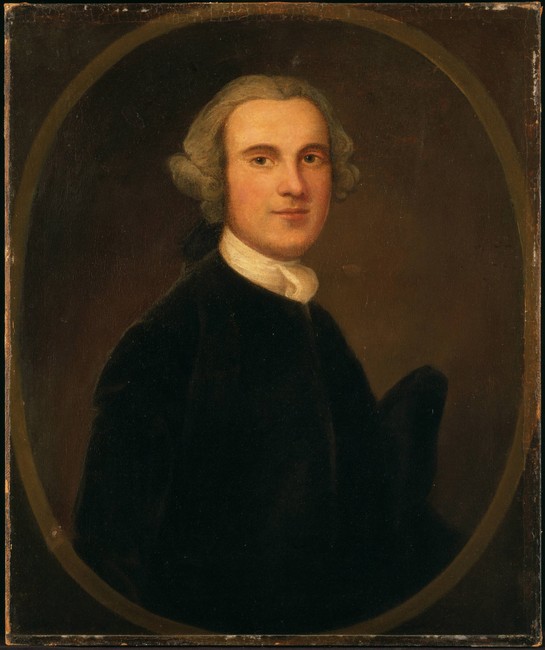
Not surprisingly, yet another committee of the Congress was involved. In November 1776, the Congress sent two delegates—Richard Stockton of New Jersey (shown above) and George Clymer of Pennsylvania—to northern New York to assess the Continental forces in the aftermath of the collapse of the invasion of Canada.

Stockton and Clymer consulted with Gen. Gates, Gen. Philip Schuyler, and commissary general Joseph Trumbull before reporting back to the Congress on 27 November. That body named a larger committee to take up the discussion and report back, which meant the original report wasn’t entered into the Congress’s journal.

The first committee report, as printed in the Munsell book, includes this about medical care:
Your Committee also beg leave further to Report, that they have visited the General Hospital for the Northern Army, situated at Fort George; that there is a Range of Buildings erected convenient for the Purpose, which on the 20th of October last contained about four hundred Sick, including those wounded and sent from General [Benedict] Arnold’s Fleet; that they were sufficiently supplied with fresh Mutton and Indian Meal, but wanted Vegetables; that the Director-General in that Department [Dr. Samuel Stringer] obtained a large Supply of Medicines, but the Sick suffered much for Want of good female Nurses and comfortable Bedding; many of those poor Creatures being obliged to lay upon the bare Boards. Your Committee endeavoured to procure Straw as the best temporary Expedient; but they earnestly recommend it to the Attention of Congress, that a Quantity of Bedding be speedily furnished,…
The American Archives version has fewer capital letters, more italics, and one added “that.”

Thus, a Revolutionary War source did say “the Sick suffered much for Want of good female Nurses.” But that source wasn’t Gen. Gates writing to Gen. Washington on or shortly after 14 June 1775. It was Richard Stockton and George Clymer reporting to the Continental Congress in November 1776.

That report came more than a year after the Congress authorized hiring nurses for its hospitals; it didn’t prompt that hiring. Stockton and Clymer were actually describing an anomaly in the army’s medical establishment. Up in the frontier fortifications along Lake Champlain and Lake George, there weren’t enough women to staff the army hospitals as commanders had come to expect.

In fact, back on 13 July 1776 Gen. Schuyler had ordered:
One woman from each company of each of the Pennsylvania Battalions now at this post, to be draughted as soon as possible, and sent to the General Hospital at Fort George. They will have the customary allowance of provisions, and so forth from Dr. Stringer, director of the hospital there.
The Continental Army expected soldiers’ wives to be ready to serve as nurses.

TOMORROW: How the error appeared and metastasized.

Saturday, January 15, 2022

Franklin’s Lost Comments about His Armonica

Michael Hillegas (1729-1804) was one of Benjamin Franklin’s colleagues in Philadelphia. Son of immigrants from Germany, he became a merchant, then invested in refining both sugar and iron.

In 1775 the Continental Congress appointed Hillegas one of its two treasurers. The other, George Clymer, became a delegate to the Congress the next year, leaving Hillegas as the sole treasurer until 1789. 

Hillegas was an early member of Franklin’s American Philosophical Society, and he had a particular interest in music. Sources say he played the flute and violin, and he ran a shop offering musical instruments, printed music, staff paper, strings, and lessons.

Sometime in the late 1760s Hillegas asked his friend Franklin to send him that new glass instrument, the glassy-chord or armonica. Unfortunately, when it arrived, some of the glass bowls were broken, and in January 1769 Franklin promised to order replacement parts.

By November nothing had arrived, so Hillegas reminded Franklin of his request in a letter that also asked about other things. Franklin wrote back on 17 Mar 1770.

Some of those letters between Franklin and Hillegas no longer survive, but Hillegas and his nineteenth-century descendants made the documents now lost available to scholars.

The earliest publication of Franklin’s 17 Mar 1770 letter was in Mathew Carey’s American Museum, or, Universal Magazine in 1790. The same text appeared in William Temple Franklin’s 1817 set The Private Correspondence of Benjamin Franklin. That transcription contained a single paragraph about what sort of metal plates different European nationalities were using on their roofs. (Ah, the Enlightenment!)

In 1859, however, the Historical Magazine printed a longer text of what it said was the same letter. This transcription appears to have been made from the original since the article is prefaced with this comment:
LETTERS OF FRANKLIN.

The original of the following letters from Benjamin Franklin to Michael Hillegas, Esq., were found among the papers of the late Mr. Henry Kuhl, of this city, a son-in-law of Mr. Hillegas. Mr. Hillegas was an alderman of Philadelphia, and a prominent citizen.

W. D.
The paragraph printed in 1859 but not in 1790 or 1817 reads:
Charles James, who undertook to provide your Glasses, and the only Workman here acquainted with such Matters, was a very negligent, dilatory Man, and put me off from time to time. At length he died suddenly. And those who succeed him in the Shop cannot find the Directions. They were in your Letter which I left with him and I have no Copy. So I think you cannot do better than to go to my House and suit yourself out of the Glasses I left there. If you get one of the proper Size but too sharp, Mr. [Francis] Hopkinson will show you how to grind it down, tho’ it were a Note or two.
Obviously, that paragraph is significant in the history of Franklin’s glassy-chord/armonica. It also shows a less flattering side of the inventor, his annoyance at not receiving his order simply because the skilled artisan he relied on had died. Supply-chain problems!

Now we get into the mysteries of modern editorial practices. The current Papers of Benjamin Franklin project, as digitized at its own website and at the National Archives’ Founders Online, includes only the first paragraph of Franklin’s 17 Mar 1770 letter, quoted from The American Magazine. The paragraph about the late armonica builder is nowhere to be seen.

However, the Franklin Papers cites the Historical Magazine transcription as a source about the making of the armonica, even quoting from the missing second paragraph. At some points the Papers editors deemed the Historical Magazine transcription to be reliable, but they didn’t reprint the entire text.

The Franklin Papers’ truncated quotation of the second paragraph has proved misleading. The original sentences make clear that Franklin’s glassblower “died suddenly” before he could complete the order. The editors’ summary is ambiguous about who died, the artisan or the friend who was supposed to receive the instrument (i.e., Hillegas). William Zeitler at the thorough website glassarmonica.com guessed that the intended recipient died instead of the glassblower.

Now it’s possible that I’ve missed some explanation or supplemental material in the Papers of Benjamin Franklin because I’m relying on the electronic versions rather than the printed volumes. But for the sake of glassy-chord scholars everywhere, I’m making noise about the Historical Magazine transcription.

Tuesday, April 11, 2017

“Sent you one of phillis whetleys books”

Yesterday I quoted from a letter that Deborah Cushing sent her husband Thomas in September 1774 when he was serving in the First Continental Congress.

When that letter is cited today, it’s usually because Cushing mentioned the poet Phillis Wheatley. She said:
I rote you by Mr [Richard] Cary and sent you one of phillis whetleys books which you will wonder att but Mrs. Dickerson and Mrs. Clymer Mrs. Bull with some other ladys ware so pleasd with Phillis and her performances that they bought her Books and got her to compose some pieces for them which put me in mind of mrs vanhorn to hume

I thought it would be very agreabel
In an undated letter that talks about Gov. Thomas Gage removing John Hancock from command of the Cadets, and therefore must come from August 1774, Deborah Cushing wrote that “mr Dickerson & mr Climer & ladies” had recently visited her. (She also cautioned her husband, “Dont Eat any meat super which you know always make you sick.”)

George Clymer (shown above) was one of the more radical Philadelphia Whigs. In 1774 he made his second visit to Boston, having previously traveled there for his health.

As for “Dickerson,” we can narrow down his identity with the help of John Adams’s diary for 31 August:
Mr. [John] Dickenson, the Farmer of Pensylvania, came to Mr. Wards Lodgings to see us, in his Coach and four beautifull Horses. He was introduced to Us, and very politely said he was exceedingly glad to have the Pleasure of seeing these Gentlemen, made some Enquiry after the Health of his Brother and Sister, who are now in Boston.
Dickinson’s most famous brother was Philemon Dickinson, a general in the Revolutionary War and later a U.S. senator. But there were other brothers and half-brothers. Back in 1769, a Dickinson brother had visited Boston and dined with the Sons of Liberty at Lemuel Robinson’s tavern in Dorchester. However, the list of attendees and John Adams’s diary for that date both refer to Dickinson’s brother simply as his brother, poor guy. And we don’t even know if the man visiting in 1774 was the same brother.

Nor have I been able to identify the sister of John Dickinson who was visiting Boston. Was she “Mrs. Bull”? Complicating that inquiry is that people of the time sometimes referred to their siblings-in-law without the “in-law” appendage, so by Dickinson’s “Brother and Sister” Adams could have meant his “brother and his brother’s wife.”

Lastly, I’m baffled by what Deborah Cushing meant by “got her to compose some pieces for them which put me in mind of mrs vanhorn to hume.” Cushing wasn’t great with names (see “Dickerson”), but clearly she had some allusion in mind. Any ideas?

On 4 October, Thomas Cushing wrote back to Deborah, saying he had shown her letters to John Dickinson, Thomas Mifflin, Charles Thomson, and their wives, and they had praised her “patriotic, calm & undaunted spirit.” Which I hope was reassuring since she’d already reminded him she was nervous about her writing skills.