J. L. BELL is a Massachusetts writer who specializes in (among other things) the start of the American Revolution in and around Boston. He is particularly interested in the experiences of children in 1765-75. He has published scholarly papers and popular articles for both children and adults. He was consultant for an episode of History Detectives, and contributed to a display at Minute Man National Historic Park.

Subscribe thru Follow.it


•••••••••••••••••


Showing posts with label Charles Townshend. Show all posts

Sunday, July 20, 2025

“There are always joys while going through manuscripts”
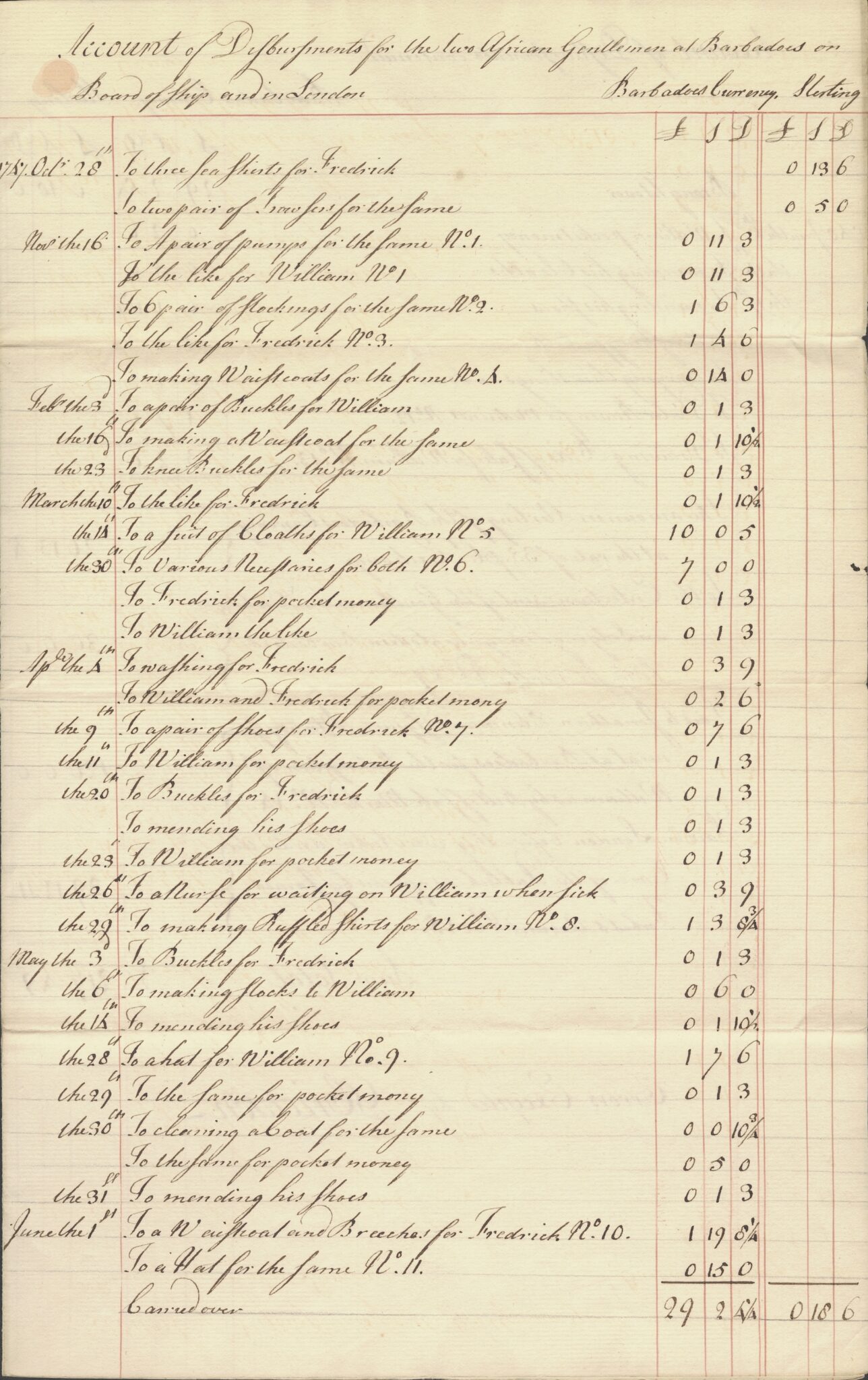
Last month, Commonplace published Jayne Ptolemy’s “The Record Scratch: Uncovering Documents Relating to William Ansah Sessarakoo,” and I recommend reading the whole article.

Ptolemy, who’s on the staff of the William L. Clements Library in Ann Arbor, wrote:
The Clements holds the papers of Charles Townshend (1725-1767), who served as Secretary of War during the Seven Years’ War and the Chancellor of the Exchequer in the decades leading up to the American Revolution. These days, he is mostly known as the straw man for incendiary British taxation policies due to his role in sponsoring the infamous Townshend Acts.

Internally at the library, however, we mostly grumbled about him under our breath because his papers were in a complicated arrangement, the finding aid was difficult to navigate, and the boxes even harder to pull for researchers. It needed someone to puzzle out what was in each box and add descriptive information to the finding aid to make it more manageable. Unfortunately, I don’t have a penchant for economic history, so figuring out how to describe the contents of “Miscellaneous Treasury Papers” meant trying to disambiguate a great many reports on tariffs, duties, and excises.

There are always joys while going through manuscripts—an unexpected doodle, a funny quote, beautiful papers—but most of what I was encountering was financial document after financial document–Until one stopped me right in my tracks. It referred to expenses “for the two African Gentlemen at Barbadoes.” Written in 1747, the use of “Gentlemen” to describe African peoples was eye-catching enough, but glancing down at the accounts, the entries for making waistcoats, providing pocket money, buying ruffled shirts, and more signaled something extraordinary. . . .

And then, a document written from Bridgetown, Barbados, laid it all out:
Whereas John Corrantee and the Caboceers of Annamabo are at present exceedingly well disposed towards the British Nation, and beg the resettlement of that place by the English, and the fort to be rebuilt

And whereas a Son of John Corrantee’s Named Ansah was sold here by Captain Hamilton who he (Corrantee) is very anxious to have redeemed

We hereby give it as our Opinion that the Redemption of the said Ansah will be very acceptable to John Corrantee (who is the leading man at Annamabo) . . . and will be a means to conciliate Corrantee to, and rivet him in the Interest of the British Nation in opposition to the French, who have been aiming for some Years past at the aforesaid settlement.
OH.

OH NO.
“The Record Scratch” is a fine metaphor for that moment, though I don’t think it gives a good sense of the rest of this article.

Friday, August 11, 2023

“Only the tax on tea retained”

In a conversation earlier this week I shared, and not for the first time, an observation about Lord North’s repeal of the Townshend duties in 1770. Parliament scrapped the duties on everything but tea—yet tea was what accounted for the bulk of the revenue, so it wasn’t that big a change.

That fact had stuck with me since I read this passage in Oliver M. Dickerson’s 1958 article in the New England Quarterly, “Use Made of the Revenue from the Tax on Tea”:
In its original form this act [written by Charles Townshend] included import duties upon glass, white lead, painters’ colors, and paper as well as tea. Total collections on articles other than tea were so unimportant that they were repealed in 1770 and only the tax on tea retained.
Dickerson did more work with Treasury records on American colonial revenue than anyone else in his time, so his remark seemed reliable.

At the same time, I couldn’t help recalling that Dickerson developed a real animus toward the British Customs service, which enforced and collected those tariffs. He revived the Boston Whigs’ accusation that Customs officers had shot at the crowd in King Street in his 1954 paper, “The Commissioners of Customs and the ‘Boston Massacre’,” also published in the New England Quarterly. After 1770, not even the Boston Whigs believed that anymore.

So was Dickerson’s conclusion backed up by data or just his impression? Would his impression be solid? I wanted to see the numbers Dickerson used for his conclusion about the Townshend duties. Unfortunately, the paragraph I quoted above had no citations.

Later in the same paper, however, Dickerson quoted a figure for total collections under Townshend’s revenue act, and then another for “Total reported collections of American taxes from all sources, 1765-1774.” Both those citations pointed to his own book, The Navigation Acts and the American Revolution, published in 1951.

Luckily, I have a copy. Even more luckily, I remembered where I’d shelved it.

The data pertinent to the passage above appears in Table 11 on page 198: “Tax Collections Under the Townshend Revenue Act at Four Principal Ports, 1768–70, Exclusive of Paper, Continental Colonies Only.”

The totals for Boston and Salem:
  • white glass: £684
  • green glass: £169
  • lead and painters’ colors: £168
  • tea: £5,524
The Massachusetts ports thus accounted for about 31% of all money the Customs service collected on the continent from the Townshend duties, and tea was responsible for 84% of that money.

In New York, tea duties brought in 88% of the total. In Philadelphia, 84%. Only in Charleston, which brought in far more highly-taxed green glass and far less tea than the other three ports, did the other commodities come close to reaping as much revenue as tea.

(The Townshend Act also put a tariff on paper. Or, to be exact, papers. Dickerson wrote frankly ahead of this table: “This omits paper, as the task of computing the tax on sixty-seven kinds of paper at forty-three different ports is more difficult than the results justify. The paper duty at best was a nuisance tax and the yield was small.”)

Thus, Dickerson did present data to support his conclusion. In removing most of his predecessor’s import duties in 1770, Lord North kept more than three-quarters of the actual taxation. I don’t know if the American Whigs were privy to those figures at the time, but the situation helps to explain why they weren’t mollified.

Tuesday, April 11, 2023

A Taste of Shumate’s Sugar Act

At the Journal of the American Revolution, John Gilbert McCurdy (author of Quarters) just reviewed Ken Shumate’s new book, The Sugar Act and the American Revolution.

I’m pleased to know about this study because I’ve long seen histories mention the Sugar Act of 1764 as colonial Americans’ first grievance of the decade. It prompted James Otis’s pamphlet The Rights of the British Colonies Asserted and Proved, which established “no taxation without representation” as the logical foundation for colonial resistance (without using that phrase, which didn’t appear until 1768).

And yet in looking at the more widespread resistance to the Crown in the late 1760s, and reading the colonists’ own arguments, the taxes and restrictions on sugar (and molasses, and rum, and later coffee and wine) show up barely at all.

Shumate’s study offers some explanations. First, the traders of the 1760s were used to an imperial tax on molasses, which was first instituted in 1733. The main purpose of that law was to discourage trading with French, Spanish, and Dutch West Indies, so objecting to it didn’t come across as patriotic or law-abiding. It was easier to smuggle quietly.

Then in 1764 prime minister George Grenville revised the law, actually cutting the duty in the hope that more American merchants would see obeying the law as the economical alternative. Then in early 1766 the Marquess of Rockingham’s government reduced the duty still further. There was literally less to complain about. To be sure, that last revision meant the government was taxing molasses from the British islands, too, but the North Americans were so pleased with Rockingham’s repeal of the Stamp Act that they didn’t raise a fuss.

Another big factor in the colonial response, I think, was that that Sugar Act’s taxes and trade restrictions affected only a small portion of the population. Molasses traders and rum distillers were a special interest. The biggest threat to their business actually came from distillers on the British Caribbean islands producing their own rum instead of shipping all the raw material to the mainland.

In contrast, the Stamp Act affected everyone in the colonies who filed or responded to lawsuits, read newspapers, got married, and more, which meant everyone. Though rum made from molasses was popular, tea was even more popular, so Charles Townshend’s 1767 tax on that import produced more widespread, longer-lasting opposition.

As McCurdy writes:
Although strict enforcement actually increased with the 1766 revision, the Americans raised few objections to the Sugar Act. Instead, between 1768 and 1772, the law brought in nearly £165,000 from duties on molasses, sugar, madeira, and other goods. But taxing British sugars did little to stem the tide of foreign products as 97 percent of the four million gallons of molasses that came into America derived from foreign sources.

Colonial ambivalence toward the Sugar Act continued despite the Townshend duties of 1767. Although Boston merchants demanded that no British goods would be imported until all taxes were repealed — including the Sugar Act — resistance from merchants in Philadelphia and New York forced them to drop this demand. Indeed, it was not until after the Boston Tea Party of 1773 and the Coercive Acts of 1774 that Americans turned against the Sugar Act.
Looking back, writers started to treat the Sugar Act as the start of their troubles. At the time, however, colonists saw bigger things to complain about.

Monday, January 28, 2019

Deciphering the Boston Whigs’ Conspiracy Rumors

What with The Saga of the Brazen Head, the January 1775 brawl between British army officers and watchmen, the federal government shutdown, and ordinary news, I’ve had to neglect what was happening in Boston in 1768 and 1769.

So here’s what the Whigs reported on 27 Dec 1768:
A report is current, that Mr. Alderman T—k, has procured a copy of the will or instruments whereby C—m—r P——, gave to the late C. T——d, the reversion of an estate represented to him as worth £50,000—which he intends to produce in the House of C—m—s next s—s—n, in order to shew what secret influence had been exerted for the procurement of an American B—d of C—s—ms.

It might also be of special service to present that H—e with the picture of a certain lady of pleasure, whose influence was powerful enough to procure £500 a year for a B. that those guardians of the people might see how the monies taken from Americans is charmed away and applied not for the lessening of the national debt but for the support of M——l w—h—s and p—si—s.
Well!

Let’s translate.
  • “Mr. Alderman T—k” was Barlow Trecothick, a leader of the London merchants who did business with the North American colonies. He had trained with and married a daughter of the late Boston potentate Charles Apthorp. Massachusetts merchants considered him one of their best friends in Parliament. They didn’t know that on 15 November Trecothick told the House of Commons, “I look upon America as deluded.”
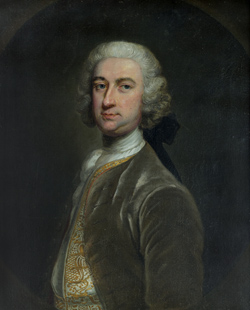
  • “C—m—r P——” was Charles Paxton, one of the Commissioners of Customs in Boston (shown here). He was the most unpopular of those five men at this time, having worked at the port’s Customs house for years before getting the big promotion of overseeing the service across North America.
  • “the late C. T——d” was Charles Townshend, the Chancellor of the Exchequer in London until his unexpected death in September 1767. He designed the Townshend Acts, which imposed duties on certain goods shipped from Britain to North America in order to pay for colonial administrators’ salaries.
  • “in the House of C—m—s next s—s—n”: in the House of Commons next session.
  • “American B—d of C—s—ms”: American Board of Customs.
In sum, that first sentence suggested there was evidence that Paxton had bribed Townshend with a big inheritance to enlarge the Customs bureaucracy in the colonies and, presumably, put Paxton on its governing board.

It’s true that Paxton was in London while Townshend wrote the new law. However, the sparse surviving correspondence between the two men shows no friendship or close collaboration. Townshend was already talking about reforming American colonial government before Paxton arrived.

Trecothick never produced the rumored evidence of corruption. Indeed, he may have had no idea about how the Boston Whigs were invoking his name in spreading this conspiracy theory.

In the second sentence above:
  • “that H—e”: the House of Commons.
  • “a certain lady of pleasure”: no idea.
  • “£500 a year for a B.”: a Board? a Baronet? (Gov. Francis Bernard was made a baronet in 1769, and his pension indeed turned out to be £500.)
  • “M——l w—h—s and p—si—s”: ministerial whores and pensioners.
Again, the conspiracy theory behind this accusation was never put to the public test of a Parliamentary inquiry or legal trial.

Underneath that accusatory propaganda was a serious political issue. The Townshend duties were enacted by a Parliament where the colonists had no representatives, and they were earmarked in part to insulate royal appointees from colonial pressure through regular salaries. Charles Townshend really did seek to increase London’s power in the colonies, and Charles Paxton really was one of the bureaucrats charged with and benefiting from that effort.

Tuesday, September 04, 2018

Talks to Take in about the Townshend Tariffs

This month’s Lowell Lecture Series at the Old South Meeting House, presented by the Paul Revere Memorial Association, focuses on how the new duties of 1767 roiled the British Empire. The series is titled “Lead, Glass, Paper, & Tea: The Townshend Acts and the Occupation of Boston.”

(That leaves out one category of dutied goods—painter’s colors. That really only affected specialized merchants like the Gore family. But since I spoke about the Gores at Old South a few years back, I feel obligated to stick up for their concerns.)

Here are the talks, starting tomorrow evening and continuing on each Wednesday.

5 September
“A certain sloop called the Liberty”: Charles Townsend, John Hancock & the Boston Madeira Party
On June 10, 1768, the King’s Commissioners of Customs seized John Hancock’s sloop Liberty and its smuggled cargo of Madeira wine. William Fowler, Jr., Distinguished Professor of History, Northeastern University, will describe how the Commissioners, fearing for their lives, fled to the safety of Castle William, while John Adams argued his case in defense of Hancock and Liberty at the Old State House.

12 September
Paul Revere’s Sons of Liberty Bowl: An American Icon
American patriot Paul Revere is wrapped in a swirling mixture of myth and poetry through which history often descends, but as a craftsman he left behind tangible traces as well. Gerald W. R. Ward, Senior Curator of American Decorative Arts and Sculpture, Emeritus, at Boston’s Museum of Fine Arts, will relate the story behind Revere’s Sons of Liberty Bowl, crafted in 1768 to commemorate the “Glorious 92” legislators who bravely opposed King and Parliament’s imposition of the Townshend Acts.

19 September
Liberty Teas and Nervous Collectors: The Townshend Acts in Boston
From the emergence of “homegrown” industries in response to British taxes on imports, to harassment of officials by the Sons of Liberty, the Townshend Acts set the stage for tensions that would erupt in 1770 with the Boston Massacre. Learn how these new laws impacted 18th-century Bostonians’ everyday life in an interactive, first-person presentation featuring costumed actors from the Boston Tea Party Ships & Museum!

26 September
Tyranny Unmasked: The Townsend Acts in Britain, Ireland & America
The Townshend Acts marked a new radical phase in the crisis that eventually destroyed Britain’s American empire. Occupied Boston was the toast of radical patriots throughout George III’s dominions, and observers began to wonder whether Britain’s days as an imperial power were numbered. University of New Hampshire Professor of History Eliga Gould will tell the fascinating story of this transformation—as it appeared to Bostonians and from the standpoint of people on the far shores of the Atlantic.

All these talks are scheduled to begin at 6:30 P.M. They are free and open to the public, thanks to the historical organizations involved and the Lowell Institute.

Saturday, July 07, 2018

Reviewing the “Townshend Moment”

A few weeks back, I attended a talk at the Colonial Society of Massachusetts by Prof. Patrick Griffin about his new book, The Townshend Moment: The Making of Empire and Revolution in the Eighteenth Century.

Here’s a review of The Townshend Moment by William Anthony Hay for the Claremont Review of Books.

Griffin posits that the rise of power in 1767 of two brothers—George and Charles Townshend—was a crucial juncture in the late-eighteenth-century British Empire. George, who had succeeded to the title of Viscount Townshend in 1764, took the job of Lord Lieutenant of Ireland. Simultaneously, Charles became Chancellor of the Exchequer and the government’s principal voice in the House of Commons.

Though the Townshends consulted closely with each other, they had grown up apart and were quite different men. Hay summarizes:
The brothers were the scions of a failed aristocratic marriage. After their parents separated, the eldest, George, was raised by his father while their mother raised Charles. George, “brave, clever and not devoid of good feeling,” was intemperate in his judgements, impatient with authority, and exaggerated his superiors’ faults. Charles’s talent matched his ambition, but Griffin describes him as fickle, uncertain which political faction to join, and thereby unwilling to be pinned down. The confident and well-connected brothers relied on each other almost exclusively.
In 1767 the goal they shared was to strengthen the authority of the London government over its dependent territories, both across the Irish Sea and across the Atlantic.

The Townshend Act(s), named after Charles, not only instituted tariffs on certain goods shipped to North America but also established that the primary purpose of those funds was to pay salaries for royal appointees in North America, this insulating them from local popular pressure. Charles Townshend died suddenly in late 1767, but the British government remained committed to that model, despite widespread protest from American colonists.

George, Lord Townshend, also ran into opposition from the local legislature—in his case, the Irish parliament. He clearly felt it didn’t deserve as much deference as the Parliament in London. He lasted five years in that job, returning to Ireland in 1773 to fight a duel with an Irish peer. After that, Lord Townshend amassed additional offices, military titles, and a higher peerage but never seems to have exercised as much authority again.

Given the brothers’ short tenure, I’m not sure how influential the Townshends really were. How far ahead of other British ministers were they, and how much did the programs they instituted depend on them? Indeed, the Townshends’ biggest influence appears to have been the antithesis to their plans—the pushback from locals who felt these new rules turned them into second-class subjects.

Hay concludes his review by noting the eventual results of the “Townshend moment” in 1767:
Neither Townshend brother would have intended the ultimate outcomes of their reform projects. Instead of rationalizing empire to make it more governable, those efforts challenged the underlying assumptions that had sustained order. Their reforms unearthed frustrations that ended up pulling the periphery of empire apart. Lord Townshend, who lived until 1807, saw the colonies win their independence. Irish patriots gained fragile autonomy in 1782, but failed to resolve contradictions in their own regime that made it ungovernable. Union with Britain in 1800 traded the fragile autonomy for the benefits of full participation.
Still, it’s always valuable to consider America’s Revolutionary conflict from the perspective of the British government and the men, however briefly, at its head.

Thursday, November 02, 2017

Charles Paxton, Customs Commissioner

Charles Paxton (1708-1788, shown here in a portrait at the American Antiquarian Society) was a major figure in Boston’s 1767 Pope Night procession.

Not as a member of the North End or South End Gangs, to be sure. Paxton was the target of those processions, which became a protest against the Townshend duties and the new Commissioners of His Majesty’s Customs. (The daytime protest will be part of the “Devil and the Crown” reenactment this Saturday.)

Paxton was one of those five Commissioners, having risen in the Customs service in Massachusetts. He had tried to join that agency as early as 1734, proposing a new office at Plymouth with himself in charge. He got a post in Marblehead and Salem in the early 1740s.

Paxton also became marshal of Boston’s vice-admiralty court, which helped to enforce the Customs laws. So he made money from seizures of smuggled goods in all sorts of ways. Some said he played favorites with whose goods he seized, though it’s possible they just meant he should be as lenient as other Customs officers.

Naturally, Paxton’s work made him unpopular with the maritime community in Essex County. In 1752 he gained the post of Surveyor of Customs in Boston, allowing him to become just as unpopular with an even larger maritime community.

When Boston’s merchants sued to overturn writs of assistance in 1761, Paxton was the nominal defendant. He won that case, and others, in the Massachusetts courts. The fact that Chief Justice Thomas Hutchinson was one of Paxton’s oldest friends didn’t mollify their opponents.

During the first Stamp Act riot on 14 Aug 1765, Paxton reportedly offered shelter to the stamp agent, Andrew Oliver. So during the second Stamp Act riot on 26 August, a mob went to Paxton’s home and threatened to pull it apart.

Paxton’s landlord, Thomas Palmer, came out and convinced the crowd not to harm his property. He bought them a barrel of punch at a nearby tavern. So instead those people headed to the North End and ripped apart Hutchinson’s house, among others.

In July 1766 Paxton sailed for London, nominally for his health. He happened to be in the capital when Chancellor of the Exchequer Charles Townshend proposed new tariffs and a new board to enforce them. Bostonians blamed Paxton for suggesting those measures, but there’s no evidence for that. He no doubt did lobby to be named as one of the Commissioners, and succeeded.

Thus, when Paxton arrived back in Boston on 5 Nov 1767, he had made himself into the most unpopular royal appointee in the colony. In 1768 Samuel Adams would look back on Paxton’s trip in a newspaper essay published under the name of “Candidus”:
Happy for America’s sons had mother Ocean taken him into her bosom (father Abra’m surely never will)

happy I say had it been for America, nay thrice happy for the mother country had he never reached Albion’s shore: less treasure had been expended by her; less animosity had taken place between the mother and her children; less villainy had been perpetrated here, had he never returned.
When your neighbors publicly wish you had drowned at sea for the good of the nation, you are not popular.

Another thing made Paxton a target of Boston’s crowds: he was queer.

TOMORROW: Poor Charles the Bachelor.

Wednesday, September 06, 2017

“Destroying all party distinctions”

As stated in a passage I quoted a couple of days ago, soon after Charles Townshend died, his post as Chancellor of the Exchequer was offered to Lord North, who accepted it on 11 September. That quick succession made the British government of the time seem more stable than it was.

The leading minister in London was William Pitt, Earl of Chatham. Normally the prime minister was also First Lord of the Treasury, but Pitt had instead taken a peerage and the post of Lord Privy Seal. His ally, the Duke of Grafton (shown here), took the Treasury title.

Chatham promised King George III in 1766 that this government would be based on “measures not men,…destroying all party distinctions.” He would recruit other ministers based on their talents, not their alliances, and thus unite many factions.

That hadn’t worked out. By accepting that earldom Pitt, formerly “the Great Commoner,” had lost a lot of his popularity in London. Then he fell ill with gout and depression. Chatham turned over almost all legislation to the ministers he’d appointed, declining even to meet with them. The result was squabbling and lack of coordination among men with competing ambitions and loyalties.

That situation affected the American colonies. The minister with the most responsibility for administering those colonies was the Secretary of State for the Southern Department, the Earl of Shelburne. He, like Chatham, supported preserving American autonomy. But he couldn’t institute any of his policy choices.

Meanwhile, Townshend gained more power over fiscal policy than preceding Chancellors of the Exchequer, becoming a full member of the cabinet. After losing a fight in Parliament over a higher land tax (never popular with Britain’s big landowners), he turned to a new source of revenue: the American colonies. Townshend focused on import tariffs, thinking those were the sort of “external taxes” that the colonists would accept.

Townshend suddenly died when the Duke of Grafton was struggling to hold together the government for Chatham without Chatham’s help. Soon the First Lord brought in one faction of the Whig opposition, that grouped under the Duke of Bedford, shuffling appointments to make room. In February 1768, the ministry created a new post—Secretary of State for the Colonies—for the Earl of Hillsborough, who favored more control from London.

Britons in America followed all that news, of course, but it was even more confusing at a distance. They still clung to hope that Chatham was in charge, watching out for them.

Tuesday, September 05, 2017

“He was the delight and ornament of this House”

Yesterday I quoted Horace Walpole’s immediate response to the death of Charles Townshend in September 1767. Townshend had a big personality full of contradictions, and he seems to have both fascinated and exasperated his political peers—who expressed themselves so handsomely.

Walpole had more to say about Townshend later in his Memoirs of the Reign of King George III:
On the 4th of September, 1767, died Charles Townshend, of a neglected fever, in, I think, the forty-second year of his age. He met his approaching fate with a good humour that never forsook him, and with an equanimity that he had never shown on the most trifling occasions. Though cut off so immaturely, it is a question whether he had not lived long enough for his character. His genius could have received no accession of brightness; his faults only promised multiplication. He had almost every great talent, and every little quality. His vanity exceeded even his abilities, and his suspicions seemed to make him doubt whether he had any. With such a capacity he must have been the greatest man of this age, and perhaps inferior to no man in any age, had his faults been only in a moderate proportion—in short, if he had had but common truth, common sincerity, common honesty, common modesty, common steadiness, common courage, and common sense. . . .

Charles Townshend, who had studied nothing accurately or with attention, had parts that embraced all knowledge with such quickness, that he seemed to create knowledge instead of searching for it; and, ready as [Edmund] Burke’s wit was, it appeared artificial when set by that of Charles Townshend, which was so abundant, that in him it seemed a loss of time to think. He had but to speak, and all he said was new, natural, and yet uncommon. If Burke replied extempore, his very answers, that sprang from what had been said by others, were so painted and artfully arranged, that they wore the appearance of study and preparation: like beautiful translations, they seemed to want the soul of the original author. Townshend's speeches, like the Satires of Pope, had a thousand times more sense and meaning than the majestic blank verse of Pitt; and yet, the latter, like Milton, stalked with a conscious dignity of pre-eminence, and fascinated his audience with that respect which always attends the pompous but often shallow idea of the sublime.
Edmund Burke himself, in his 1774 speech on American taxation, recalled his political colleague and frequent adversary this way:
In truth, Sir, he was the delight and ornament of this House, and the charm of every private society which he honoured with his presence. Perhaps there never arose in this country, nor in any country, a man of a more pointed and finished wit, and (where his passions were not concerned) of a more refined, exquisite, and penetrating judgment. If he had not so great a stock, as some have had who flourished formerly, of knowledge long treasured up, he knew better by far than any man I was ever acquainted with how to bring together within a short time all that was necessary to establish, to illustrate, and to decorate that side of the question he supported. He stated his matter skilfully and powerfully. He particularly excelled in a most luminous explanation and display of his subject. His style of argument was neither trite nor vulgar, nor subtle and abstruse. He hit the House between wind and water; and, not being troubled with too anxious a zeal for any matter in question, he was never more tedious nor more earnest than the preconceived opinions and present temper of his hearers required, with whom he was always in perfect unison. He conformed exactly to the temper of the House; and he seemed to lead because he was always sure to follow it.
For Burke always knowing the pulse of Parliament was, to be sure, somewhat faint praise, but praise nonetheless.

Monday, September 04, 2017

“All those parts and fire are extinguished”

On 24 Aug 1767, the British politician Thomas Whately wrote to former boss George Grenville about gossip he’d heard from yet another Member of Parliament, Grey Cooper:
He told me that the Chancellor of the Exchequer [Charles Townshend, shown here] having been not well of a long time, and he observing that he looked still worse a few days ago, he advised Lady Greenwich [Townshend’s wife, made a baroness just days before] to send for a physician;

she at first said that Mr. Townshend’s disorder was only lowness of spirits; but at last called in Sir William Duncan [doctor to King George III], who has pronounced it to be a slow fever of the putrid kind; from which he does not apprehend any danger at present, but says that it is a disorder liable to so many accidents that he cannot answer for the event.

Mr. Townshend yesterday kept his bed, but I believe rather because he was desired than because he was obliged to do so.
The fever turned out to be more dangerous than Dr. Duncan guessed. Two hundred fifty years ago today, Townshend died.

Late that month, Horace Walpole reacted:
But our comet is set too! Charles Townshend is dead. All those parts and fire are extinguished; those volatile salts are evaporated; that first eloquence of the world is dumb! that duplicity is fixed, that cowardice terminated heroically. He joked on death as naturally as he used to do on the living, and not with the affectation of philosophers, who wind up their works with sayings which they hope to have remembered. With a robust person he had always a menacing constitution. He had had a fever the whole summer, recovered as it was thought, relapsed, was neglected, and it turned to an incurable putrid fever.

The Opposition expected that the loss of this essential pin would loosen the whole frame [i.e., bring down the government]; but it had been hard, if both his life and death were to be pernicious to the Administration. He had engaged to betray the latter to the former, as I knew early, and as Lord Mansfield has since declared. I therefore could not think the loss of him a misfortune. His seals were immediately offered to Lord North, who declined them. The Opposition rejoiced; but they ought to have been better acquainted with one educated in their own school. Lord North has since accepted the seals—and the reversion of his father’s pension.

While that eccentric genius, Charles Townshend, whom no system could contain, is whirled out of existence, our more artificial meteor, Lord Chatham, seems to be wheeling back to the sphere of business—at least his health is declared to be re-established; but he has lost his adorers, the mob, and I doubt the wise men will not travel after his light.
Townshend’s program for raising revenue from the American colonies, the Townshend duties, was due to go into effect on 20 November. Now the architect of that policy was gone.

TOMORROW: Assessing Charles Townshend.

Friday, July 07, 2017

“The colonies submit to pay all external taxes”

On 11 Apr 1767, a letter signed “Benevolus” appeared in the London Chronicle. It was reprinted in two other London newspapers within the week.

The Pennsylvania Chronicle, the influential newspaper still co-owned by Benjamin Franklin, ran the letter on 8 June, and Boston newspapers carried it by the end of that month.

“Benevolus” wrote to refute several misconceptions about the American colonists, such as “That they refused to contribute towards the expence of those [recent] wars,” and “That they pay no taxes.”

Misconception number 8 was “That the colonies contend the parliament of Britain has no authority over them.” The essayist assured London readers:
The truth is, that all acts of the British legislature, expressly extending to the colonies, have ever been received there as laws, and executed in their courts, the right of parliament to make them being never yet contested, acts to raise money upon the colonies by internal taxes only and alone excepted.
For “internal taxes” on trade or property within the colonies, Americans insisted—just as Britons did—that only a legislature which represented them could enact such taxes.

But “Benevolus” allowed something else:
The colonies submit to pay all external taxes laid on them by way of duty on merchandizes imported into their country, and never disputed the authority of parliament to lay such duties.

The distinction indeed between internal and external taxes is here looked upon as groundless and frivolous, and some are apt to wonder how a sensible people should ever advance it. But an American founds it thus; an internal tax to be raised in the colonies by authority of parliament, forces the money out of my purse without the consent of my representative in assembly: An external tax or duty is added to the first cost and other charges of the commodity on which it is laid, and makes a part of its price: If I do not like it, at that price I refuse it. If I do like it, I pay the price, and do not need to give my consent by my representative for the payment of this tax, because I can consent to it myself in person.

However, whether there be validity in this distinction or not, seems to be immaterial; since if they are willing to pay external though not internal taxes, and we say they are the same, ’tis then the same thing to us, provided we get the same money from them, as much as they ought or are able to pay, and we may let them please themselves with their futile distinction as long as they think proper.
Assurances like this one emboldened Charles Townshend to propose new bills in May 1767 laying tariffs on tea, wine, glass, paper, and other goods shipped into the American colonies. After all, those were all “external taxes.” That distinction was how Townshend could say ”he would cut off that Hand before he would vote for taxing America” at the same time he was proposing new Customs duties to be collected in America.

“Benevolus” wasn’t just any political observer, though. He was the designated agent for multiple colonial governments and the most respected American in London. He was Benjamin Franklin.

Thursday, July 06, 2017

A New Approach to “American Affairs” in 1767

On 6 July 1767, 250 years ago today, the Boston Post-Boy printed important news from London. A letter dated 11 May described the new policy of Britain’s finance minister, Charles Townshend:
A few Days before the House of Commons adjourned for the Easter Holidays, the Ch[ancello]r of the Ex[cheque]r opened his budget, with very great Applause, even Mr. G——lle [George Grenville, former prime minister] complimented him on the Occasion: among other things he made it appear, that besides paying the Navy and Army and all other Charges for Government for the Last Year, he had sunk [i.e., reduced] Three Millions, nine hundred Thousand Pounds of the National Debt, and assured them that the next Year he would discharge a much greater Sum, notwithstanding they had reduced the Land-Tax one Shilling in the Pound.

He took an Occasion Yesterday to say, that it was reported out of Doors that he was for taxing America. I declare, says he, I am not, nor never was; I thought the Stamp-Act a very improper Measure, and us’d my Endeavours for the Repeal; and (holding out his Hand) he said he would cut off that Hand before he would vote for taxing America; and if any of the Duties laid on Trade shall appear burthensome, nothing shall be wanting in me to remove them.
“Duties laid on Trade”? What did that refer to? The newspaper then printed under the dateline of 14 May:
Yesterday the Chancellor of the Exchequer mov’d the House for Leave to bring in the following Bills, which was agreed to.

An Act to permit Wine, Fruit and Oil to be carried from Spain and Portugal directly to North-America

An Act laying a Duty on China, Paper, Glass, and Painters Colours, shipped from Great-Britain to the Colonies.

An Act for settling a Salary on the Governor, and Judges, &c in North America.

An Act for Establishing a Board of Revenue in North America.
And there was yet more information in letters sent by “some Gentlemen at the New-England Coffee House”—merchants doing business with the region, some of whom had family there as well. Those came with some passengers on a ship that left London on 14 May.
The Parliament met the 13th of May upon American Affairs, and resolved that a Bill be brought in after the following Manner,

That a Tax be laid on Painters Colours, Paper, Glass and China. That the Americans may have Liberty of importing Lemmons, Wine, Fruit & Oil directly from Spain and Portugal, subject to a Duty, the Duty on Wine to be 7£ per Ton

That the Duty on Tea remaining in England be taken off, and a Duty of 3d. per lb. be laid on the Importation in America.

That there be a Board of Customs, as also a Court of Exchequer in New England.

That the Legislative Power of New-York cease until they comply with the Billeting Bill.

That the Governors and Judges be made independent by encreasing their Salary, which is to be paid out of the Revenues of the Customs.

George Grenville made a Motion to oblige the Americans to take an Oath of Allegiance and Obedience to the Parliament of Great Britain, which was put to Vote—for the Question 90[;] against it 180 odd.
The chancellor of the exchequer’s new bills became known as the Townshend Acts—a program that installed new tariffs on selected goods shipped from Britain to America, strengthened the Customs service to collect that revenue, and directed it to officials appointed by the London government.

Another new law put pressure on the New York assembly to supply barracks and firewood for royal troops in that province. Though the House of Commons voted down Grenville’s proposal that Americans have to swear an oath of allegiance, the rest of the package had a lot to concern North American Whigs, regardless of Townshend’s assurance that he opposed “taxing America.”

And by the time the Post-Boy and other newspapers printed that intelligence, the laws had already sailed through the entire Parliament. On 29 June, King George III gave his assent, and the Townshend Acts became law.

TOMORROW: Who assured Townshend that Americans wouldn’t object to tariffs?

Saturday, February 04, 2017

“Instructions for my Son George”

Among the documents made public in the Georgian Papers Programme is a little booklet, bound with red string, titled “Instructions for my Son George, drawn by my-Self, for His good, that of my Familys, and for that of His People, according to the Ideas of my Grand-Father, and best Friend, George I.”

This document was signed by Frederick, Prince of Wales, on 13 Jan 1749, two years before his death. The wording suggests the prince already suspected he would not survive his own father, George II, and thus never succeed to the throne of Great Britain. Instead, his “Son George” would become George III.

The pages begin:
As I allways have had the tenderest Paternal Affection for you, I cannot give you a Stronger proof of it, than in leaving this Paper for your in your Mother’s hands, Who will read it to you from time to time and will give it to you when you come of age or when you get the Crown.
What is the main advice? Prince Frederick urged his son to “try never to spend more in the Year, than the Malt and two Shillings in the Land Tax.”

Britain’s malt duty was six shillings per bushel of malt from 1697. In 1760, the year George III ascended the throne, it was reduced to three shillings per bushel, which would have thrown off his father’s calculations. The land tax was likewise revised in George III’s reign; Charles Townshend hoped that the new duties on imports to America in 1767 would allow the government to reduce the tax paid by landowners in Britain.

By living within his royal means, Prince Frederick hoped his son would achieve two important related goals: “to reduce the National Debt” and to “lower interest.” One of the biggest impediments to that program, he warned, would be sycophants urging the king to live more lavishly. (To be sure, Frederick had been a bit of wastrel in his own youth, but now he was in advice-giving mode.)

The prince provided counsel useful for anyone in a position of power:
Flatterers, Courtiers or Ministers, are easy to be got, but a true Friend is difficult to be found. The only rule I can give You to try them by, is, if they will tell you the Truth, and will venture for Your Sake that of your Family or that of Your People (which three things I hope you will never Separate, nor ought they ever to be Separated) to risk some moments of disagreeable Constructions to your Passions, through which they may lose your Favour, if you are a Weak Prince; but will settle themselves firmer in it, if you turn out that man, which I hope God will make you.
This document reflects some other conflicts, or potential conflicts, that we don’t hear much about. One was the possible competing interests of Britain and the family’s other realm of Hanover. Prince Frederick urged his son to separate the two monarchies, which wouldn’t happen until Victoria became queen of Great Britain while a male relative took over in the German state.

The other conflict was the bitter feud between the Prince of Wales and his own father, George II. Frederick told young George that “unsteady measures, you see, my son, have Sullied and hurt the Reign of your Grand Father.”

Combined with his mother’s alleged advice to be a strong ruler, we can see the roots of George III’s insistence on a bigger revenue stream from America and firmer measures against the resistance there. His father wrote:
If you can be without War, let not your Ambition draw you into it. A good deal of the National Debt must be pay’d off, before England enters into a War. At the same time never give up your Honour nor that of the Nation.
As it turned out, George III’s long reign from 1760 to 1820 began during one war with France, then continued through more conflicts with the French in the American War, the wars of the French Revolution, and Napoleon’s wars—which sparked another American war.

(Above is a sketch from the Royal Collection Trust showing the future George III at about age nine, two years before his father dictated these instructions.)

Thursday, December 29, 2016

“George, be King”

John Nicholls (1744-1832) was a Member of Parliament from 1783 to 1787, and again from 1796 to 1802.

Politically, Nicholls leaned to the left, opposing Edmund Burke and then the younger William Pitt and eventually his early ally Charles James Fox. He saw good in the early French Revolution, opposed British war measures, and championed electoral reforms.

Nicholls’s father had been physician to George II, so he was privy to court gossip from an early age. But of course his political views colored how he interpreted gossip about that monarch and his grandson and successor. In his Recollections and Reflections Personal and Political as Connected with Public Affairs during the Reign of George III, published in 1820, Nicholls profiled the new king this way:
The young King (for he was at that time little more than twenty-two years of age) was of a good person, sober, temperate, of domestic habits, addicted to no vice, swayed by no passion—what had not the nation to expect from such a character? . . .

I recollect the expression used to my father by Mr. [Charles] Pratt, at that time Attorney General, afterwards better known by the name of Lord Camden, within four months after the King’s accession: “I see already, that this will be a weak and an inglorious reign.”

I recollect also the relation which a friend of my father’s gave to him of a conversation which he had had with Charles Townshend: “I said to Charles Townshend, I don’t want to know any state secrets, but do tell me what is the character of this young man?” After a pause, Charles Townshend replied, “He is very obstinate.”

It was also observed that the Princess Dowager of Wales had kept the young Prince from having any confidential intimacy with any person except herself and the Earl of Bute: the pretence for this was the preservation of his morals. In truth, they had blockaded all approach to him. A notion has prevailed, that the Earl of Bute had suggested political opinions to the Princess Dowager; but this was certainly a mistake. In understanding, the Princess Dowager was far superior to the Earl of Bute; in whatever degree of favour he stood with her, he did not suggest, but he received, her opinions and her directions. The late Marquis of Bute told me, that at the King’s accession, his father, the Earl of Bute, had no connexion beyond the pale of Leicester House [the late Prince of Wales’s residence]. He added, “I never lived with my father, nor did any of his children.” Could such a man be fit to be a minister?

The Princess Dowager of Wales was a woman of a very sound understanding, and was considered as such by all who had occasion to converse with her. But she had been educated in the Court of her father, the Duke of Saxe Gotha. . . . When the Princess of Wales came to the Court of St. James, she found the British Sovereign a very different character from that which she had seen at Saxe Gotha. She found him controlled by his Ministers, indulged in petty gratifications, but compelled to submit to their opinions on all important subjects. We cannot be surprised that she was disgusted at this; and it is well known that she ever impressed upon the King from his early years this lesson, “George, be King.”
In his History of the Life and Reign of George IV (1831), William Wallace cited Nicholls and repeated his analysis, but turned that quotation from the Princess Dowager into “George, be a king.”

George III indeed tried to influence the ministries that governed under him. But he also sincerely believed in the British constitutional notion of Parliament’s sovereignty. After Gen. Cornwallis’s defeat at Yorktown, he accepted the defeat of Lord North’s ministry—a major step away from monarchical supremacy.

Sunday, February 08, 2015

Finally, the Debate Over the Stamp Act

So did Isaac Barré speak against the Stamp Act in the House of Commons on 6 Feb 1765? Edmund Burke recalled that debate as unexciting, but on 12 February Horace Walpole wrote that Barré had delivered “a pretty heavy thump” to bill advocate Charles Townshend.

On 4 May the Providence Gazette cited “several Letters from London” to Newport that characterized Barré’s remarks this way:
Col. B—, confirmed the Equity of the Taxation, but doubted whether the Colonies were in a Capacity to pay it, and seemed inclinable to favor them.
Not very stirring.

But Jared Ingersoll (1722-1781), outgoing agent (lobbyist) for Connecticut, sent a much more dramatic account to Gov. Thomas Fitch. That manuscript, dated 11 Feb 1765, was transcribed and published in 1918.

Part of that letter was also published in America in 1765, including the 27 May Boston Post-Boy:
Mr Charles Townshend spoke in favour of the Bill, (Stamp Duty), and concluded his Speech by saying to the following Effect:

“These Children of our own Planting, (speaking of Americans), nourished by our Indulgence, until they are grown to a good Degree of Strength and Opulence, and protected by our Arms, will they grudge to contribute their Mite to relieve us from the heavy load of national Expence which we lie under?[”…]

Which having said and sat down, Mr. Barre arose, and, with Eyes darting Fire [he was in fact blind in one eye] and an outstretched Arm, spoke as follows, with a voice somewhat elevated, and with a Sternness in his Countenance, which express’d in a most lively Manner, the feelings of his Heart:

“Children planted by your Care? No! Your Oppression planted them in America; they fled from your Tyranny, into a then uncultivated Land, where they were exposed to almost a1l the Hardships, to which humane Nature is liable; and among others, to the Savage Cruelty of the Enemy of the Country; a People the most subtile, and, I take upon me to say, the most truly terrible of any People that ever inhabited any Part of GOD’s EARTH, and yet actuated by Principles of true English Liberty; they met all these Hardships with Pleasure, compared with those they suffered in their own Country, from the Hands of those that should have been their Friends.

“They nourished up by your Indulgence? They grew by your Neglect of them: As soon as you began to care about them, that Care was exercised in sending Persons to Rule over them, in one Department and another; who were, perhaps, the Deputies of some Deputy, of Members of this House, sent to spy out their Liberty, to misrepresent their Actions, and to prey upon them; Men, whose Behaviour, on many Occasions, has caused the Blood of those Sons of LIBERTY, to recoil within them; Men promoted to the highest Seats of Justice: some to my Knowledge, were glad by going to foreign Countries, to Escape being bro’t to a Bar of Justice, in their own.

“They protected by your Arms? They have nobly taken up Arms in your Defence, have exerted their Valour, amidst their constant and laborious Industry, for the Defence of a Country whose Frontier, while drench’d in Blood, its interior Parts have yielded all its little Savings to your Enlargement: and BELIEVE ME, REMEMBER I THIS DAY TOLD YOU SO, That the same Spirit which actuated that People at first, will continue with them still: But Prudence forbids me to explain my self any further. GOD KNOWS, I do not at this Time speak from Motives of Party Heat; What I deliver, are the genuine Sentiments of my Heart: However superior to me in general Knowledge and Experience, the respectable Body of this House may be, yet I claim to know more of America than most of you, having seen and been conversant in that Country. The People there are as truly Loyal, I believe, as any Subjects the King has; But a People jealous of their Liberties, and who will vindicate them, if they should be violated; but the Subject is too delicate, I will say no more.”
That speech inspired American opponents to the Stamp Act to call themselves “Sons of Liberty,” a phrase with deeper roots in British culture that lasted into other political battles as well.

Barré remained one of Parliament’s most vocal opponents of new taxes on the American colonies. Not that his oratory convinced many of his colleagues. His motion to adjourn without approving the bill, which was a form of up-or-down vote, failed by 245 votes to 49.

As for Jared Ingersoll, he decided the fight against the Stamp Act was lost, applied successfully for the position of stamp agent in Connecticut, and became a target of the Sons of Liberty—the very political movement his reporting had helped to inspire.

Monday, September 23, 2013

The Legend of “Gentleman Johnny” Burgoyne

The past couple of posts have explored the geneses of commonly-stated nicknames for Gen. Horatio Gates and Chancellor of the Exchequer Charles Townshend.

During the discussion of those names on the Revlist, Richard Patterson wrote:
Not only is the evidence of Gates being called “Granny” somewhat suspect, but I believe that there are no references to Gen. John Burgoyne being called “Gentleman Johnny” before George Bernard Shaw refers to him as “Gentlemanly Johnny” in his play The Devil’s Disciple.
Shaw’s drama, which premiered in 1897, contains this exchange:
Richard. A thousand pardons. I thought I had the honor of addressing Gentlemanly Johnny.

Sensation among the officers. The sergeant has a narrow escape from a guffaw.

Burgoyne (with extreme suavity). I believe I am Gentlemanly Johnny, sir, at your service. My more intimate friends call me General Burgoyne.
The Google Ngram Viewer indeed shows no references to “Gentleman[ly] Johnny” as a nickname for Burgoyne before the twentieth century. The name seems to have flourished in histories written in the 1910s and 1920s—i.e., enough time for Shaw’s reference to sink into the popular culture with its origin forgotten. Now “Gentleman Johnny” is a standard way to refer to Burgoyne, especially in the titles of biographies about the general.

In Inventing George Washington, Edward Lengel describes the early twentieth century as a period of “debunking” in American historiography, when authors delighted in breaking down the almost saintly descriptions of the nation’s Founders published during the Victorian period, especially around the Centennial. Part of that movement was based on new sources and more clear-eyed analysis, but the debunkers created some myths of their own.

That was the period when alliterative (or near-alliterative) nicknames like “Gentleman Johnny,” “Champagne Charley,” and “Granny Gates” appear to have become received wisdom in history books. Those authors may have been particularly fond of such references as a way to cut the Revolution’s military and political leaders down to size, to make them seem more human. Even if those nicknames were really bunk.

Sunday, September 22, 2013

The Legend of “Champagne Charley” Townshend

Charles Townshend (1725-1767) was the British Chancellor of the Exchequer in the mid-1769s responsible for the Customs duties on tea, glass, lead, paper, paper, alcohol, and painter’s colors that became known as “Townshend duties.” Many modern histories say he was nicknamed “Champagne Charley” or “Charlie,” but that phrase arose nearly a century after his death.

Townshend did like champagne. His taste became notorious after he delivered a striking speech in the House of Commons on 8 May 1767. Unabashed gossip Horace Walpole recalled:
It was on that day, and on that occasion, that Charles Townshend displayed in a latitude beyond belief the amazing powers of his capacity, and the no less amazing incongruities of his character. He had taken on himself, early in the day, the examination of the [East India] Company’s conduct; and in a very cool sensible speech on that occasion, and with a becoming consciousness of his own levity, had told the House that he hoped he had atoned for the inconsideration of his past life by the care he had taken of that business. . . .

He returned about eight in the evening, half-drunk with champagne, and more intoxicated with spirits. He rose to speak without giving himself time to learn, and without caring what had been in agitation, except that the motion [proposed in the afternoon] had given an alarm. The first thing he did, was to call God to witness that he had not been consulted on the motion,—a confession implying that he was not consulted on a business in his own department; and the more marvellous, as the disgrace of which he seemed to complain or boast of, was absolutely false. There were sitting round him twelve persons who had been in consultation with him that very morning, and with his assistance had drawn up the motion on his own table. . . .

before he sat down, he had poured forth a torrent of wit, parts, humour, knowledge, absurdity, vanity, and fiction, heightened by all the graces of comedy, the happiness of allusion and quotation, and the buffoonery of farce. To the purpose of the question he said not a syllable. It was a descant on the times, a picture of parties, of their leaders, of their hopes, and defects. It was an encomium and a satire on himself. . . .

Such was the wit, abundance, and impropriety of this speech, that for some days men could talk or inquire of nothing else. “Did you hear Charles Townshend’s champagne speech?” was the universal question. For myself, I protest it was the most singular pleasure of the kind I ever tasted. The bacchanalian enthusiasm of Pindar flowed in torrents less rapid and less eloquent, and inspires less delight, than Townshend’s imagery, which conveyed meaning in every sentence. It was Garrick writing and acting extempore scenes of Congreve.

A light circumstance increased the mirth of the audience. In the fervour of speaking Townshend rubbed off the patch from his eye, which he had represented as grievously cut three days before: no mark was discernible, but to the nearest spectators a scratch so slight, that he might have made, and perhaps had made it himself with a pin.

To me the entertainment of the day was complete. He went to supper with us at Mr. [Henry Seymour] Conway’s, where, the flood of his gaiety not being exhausted, he kept the table in a roar till two in the morning, by various sallies and pictures, the last of which was a scene in which he mimicked inimitably his own wife, and another great lady with whom he fancied himself in love, and both whose foibles and manner he counterfeited to the life.
When Walpole wrote that everyone was asking, “Did you hear Charles Townshend’s champagne speech?” one suspects that Walpole himself was asking that question and spreading that phrase.

It spread far enough that another politician, Sir George Colebrooke, later insisted:
Mr. Townshend loved good living, but had not a strong stomach. He committed therefore frequent excesses, considering his constitution, which would not have been intemperance in another. He was supposed, for instance, to have made a speech in the heat of wine, when that was really not the case. . . .

He had a black ribbon over one of his eyes that day, having tumbled out of bed, probably in a fit of epilepsy, and this added to the impression made on his auditors that he was tipsy, whereas it was a speech he had meditated a great while upon, and it was only by accident that it found utterance that day.

I write with certainty, because Sir George Yonge and I were the only persons who dined with him, and we had but one bottle of champagne after dinner...
Colebrooke’s version matches a lot of the details in Walpole’s, just with more sympathy for Townshend. The term “champagne speech” stuck, especially as Walpole’s memoirs were reprinted in the 1800s and quoted by historians.

In 1866 the English music hall performer George Leybourne introduced the song “Champagne Charlie”, which became a big hit. The next year Punch magazine headlined a short article “Champagne Charley,” beginning:
It is with a gentleman’s reluctance that Mr. Punch has brought himself to print the above vulgarity. But he heeds no sacrifice of feeling when he can instruct. He has just lighted upon an amusing passage in that most entertaining book, Mr. [J. Heneage] Jesse’s Memoirs of George the Third, and it is a triumph of art to be able to append a morsel of readable stuff on such a peg or such a name for a time:—

“Exactly a hundred years ago Charles Townshend delivered one of the most brilliant speeches over heard in the Commons. He had previously spoken with calmness and judgment, then went to dinner with two friends, and re-appeared in the House about eight, half drunk with champagne, and more Intoxicated with spirits. But whatever may have been the source of his inspiration, there flowed from his lips such bursts of impassioned eloquence, such flashes of wit, such bitterness of invective, so varied a torrent of mingled ribaldry and learning, of happiness of allusion, imagery, and quotation, that everybody was enchanted. For some days, says Walpole, the universal question was, ‘Did you hear Charles’s champagne speech?’”

Now, if Townshend had been called Champagne Charley, the words, instead of being intolerable (luckily the cleverest of the burlesque writers, and a respected contributor to Mr. Punch, has wittified the tune) would have been worth remembering. As it is, they inspire Mr. Punch with a desire to kick the person who uses them. When shall we escape the Cad-lyrics of the music-halls?
Note how Mr. Punch managed to express disdain for popular music-hall songs and yet give a good plug for one written by a contributor.

That magazine item appears to have glued the nickname of “Champagne Charley” to Townshend even though it obviously referred to a modern song (and therefore a “vulgarity”) and said Townshend did not have that nickname in his lifetime.

TOMORROW: General John Burgoyne, Gentleman.