






Capt. Thomas Preston in Retirement
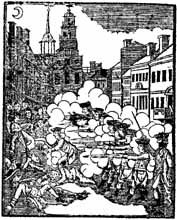 I’ve been considering this statement about the Boston Massacre, which Caleb Bates, born in Hingham in 1780, gave to the librarian of Harvard University in 1856:
He said he was well acquainted with Miss Troutbeck who resided in Hingham, daughter of the clergyman in Boston, & that they went to Halifax at the evacuation of Boston by the British & that he had many of her letters.The Troutbeck family did go to Halifax, Nova Scotia, in 1776, before moving on to Britain. And they did live in Hingham in the early 1800s. Yesterday I discussed two sisters in that family. The most likely informant was Sarah Troutbeck (1760-1840), who was in her mid-teens during the evacuation.
She told him many times that she knew Capt. [Thomas] Preston well when in Halifax, that as newspapers from Boston often came, containing very severe reflections on his conduct on the evening of the 5th of March 1770, he repeatedly said that the Bostonians “wronged” him, he never gave the order to “Fire,” that when the riot broke out he was in his loose gown & slippers sitting by his fire, that he immediately went, at the peril of his life, & did all he could to suppress it, that the truth was there was a great tumult among the people, the rabble calling the troops damned lobster-backs & other hard names, & from the mass went out the word “Fire”, by whom given it was not known, & such was the noise that it could not be known where it originated, some supposing it was given by one person, others by another, & that he had nothing to do with it.
But was Capt. Thomas Preston in Halifax in 1776? He’s not easy to track after he left Boston, but there’s no sign he was ever in Nova Scotia.
Preston was acquitted of ordering the shooting in the fall of 1770. In the first week of December, Boston newspapers reported, he sailed for London on H.M.S. Glasgow. On 5 Mar 1771, the first anniversary of the Massacre, Secretary of War Barrington wrote to Gen. Thomas Gage, “Captain Preston has had all his expences paid and a Pension of £200 a Year bestowed upon him. He is a perfectly satisfied Man, which is a thing not to be found every Day.”
That might simply have been a promise of a pension since the Parliamentary Register dates Preston’s annual payments (“during pleasure”) from 29 Sept 1772. Edmund E. Everard’s history of the 29th Regiment echoed that figure: “In November [1772] Captain Thomas Preston was granted a pension of £200 a year upon the military establishment of Ireland, in consideration of his faithful services.” Everard also stated that Preston was Irish in origin, aged 43 in December 1773 with eighteen years of army service.
Preston continued to be listed on British Army Lists as a captain in the 29th Regiment until 1774, but by then he must have sold his rank and retired. And he probably retired to Ireland. Sometime between 1783 and 1787 Preston submitted testimony to the Loyalists Commission on behalf of the Boston merchant Gilbert Deblois; at that time he was living on Merrion Street in Dublin.
“Captain Preston” was still receiving £200 per year on the Irish establishment in January 1790, according to a list published in Walker’s Hibernian Magazine.
In 1822, speaking to descendants of Josiah Quincy, Jr., John Adams said that he had once passed Preston on the street in London. That would have been in the 1780s, when Adams was an American diplomat. However, Adams didn’t say that Preston spoke to him about their earlier acquaintance, so the former President could have been mistaken about whom he saw. Adams never mentioned such a meeting in his own writings.
In any event, there’s no evidence to corroborate that Preston was in Halifax during the short period when the Troutbeck family was there, or ever. Perhaps Troutbeck heard these statements from someone else, perhaps she met Preston somewhere else, perhaps Bates’s memory wasn’t as accurate as he thought. But the provenance of this information doesn’t stand up to scrutiny.
Furthermore, the internal evidence of the Troutbeck story renders it dubious. Capt. Preston was “captain of the day” on 5 March 1770, and thus on duty. He would not have been “in his loose gown & slippers sitting by his fire” that evening.
(In addition, the term “lobster-backs” doesn’t appear in authentic sources from Revolutionary America, so far as I can tell. It became popular in histories written in the mid-1800s.)
The basic political points of the Troutbeck anecdote are true: There was fighting between locals and soldiers earlier that night. Capt. Preston did arrive on King Street to find another violent confrontation. He didn’t give the soldiers any order to fire. (After the trial, Pvt. Edward Montgomery reportedly admitted he yelled out the order.) The “loose gown & slippers” is the only aspect of this anecdote that’s new, and that’s the most dubious detail.

