J. L. BELL is a Massachusetts writer who specializes in (among other things) the start of the American Revolution in and around Boston. He is particularly interested in the experiences of children in 1765-75. He has published scholarly papers and popular articles for both children and adults. He was consultant for an episode of History Detectives, and contributed to a display at Minute Man National Historic Park.

Subscribe thru Follow.it


•••••••••••••••••


Showing posts with label Thomas Jefferson. Show all posts

Tuesday, August 04, 2026

Back to Philadelphia for “The Road to Independence” in September

In April, I went to Philadelphia to help lead the Pursuit of History Weekend on “The Road to Independence,” nearly three full days of exploring the city and the Continental Congress’s move to breaking from Britain.

That was so much fun that we’re offering a similar program on 18–20 September. The anniversary of the Declaration of Independence has passed, of course, but we can dig deeper into its history in this Sestercentennial year. In fact, we have the chance to take in new material and historic spaces not available in the spring.

This time our base will be the Arch Street Meetinghouse, commissioned by Quakers in 1803–04 and shown above. We’ll also visit Carpenters’ Hall, Independence Hall, the controversial Presidents’ House site, the Arch Street Burying-Ground, the Museum of the American Revolution, the American Philosophical Society Museum, and other places in scenic Philadelphia.

One addition to this session is the First Bank of the United States, which just reopened after a major refurbishment. We’ll visit that on Sunday, our “extra” day when we go outside the period of our main focus.

Our speakers this time around will be:
  • Jane E. Calvert, Ph.D., author of Penman of the Founding and founding director of the John Dickinson Writings Project.
  • Christina R. Carrick and James P. McClure, Ph.D., editors at the Papers of Thomas Jefferson.
  • Shawn David McGhee, Ph.D., author of No Longer Subjects of the British King: The Political Transformation of Royal Subjects to Republican Citizens, 1774–1776.
  • Samuel A. Forman, M.D., M.P.H., author of Joseph Warren and Ill-Fated Frontier, and a native of Philadelphia.
  • Richard Vague, author of The Banker Who Made America: Thomas Willing and The Rise of the American Financial Aristocracy, 1731–1821.
  • J. L. Bell, program director and author of The Road to Concord.
We’re expecting this session to be smaller than the one in the spring, but still looking for two to three dozen folks interested in Revolutionary history.

For more information about what’s included, costs, and registration for “The Road to Independence,” please visit the Pursuit of History website.

(Meanwhile, I’m also working on the program for a new Pursuit of History Weekend in November.)

Saturday, July 04, 2026

“Avoid becoming the draughtsman of papers to be reviewed by a public body”

Two hundred fifty years ago today, the Continental Congress finished polishing the Declaration of Independence and voted to approve the final text.

True to his character, Thomas Jefferson chose to be “a passive auditor” as his colleagues hashed over the words he’d drafted. But, he admitted to James Madison, the debate affected him:
during the debate I was sitting by Dr [Benjamin] Franklin, and he observed that I was writhing a little under the acrimonious criticisms on some of it’s parts; and it was on that occasion that, by way of comfort, he told me the story of John Thompson the Hatter, and his new sign. 
Jefferson didn’t explain that allusion in his letter to Madison, but he put it into his notes on Franklin:
When the Declaration of Independance was under the consideration of Congress, there were two or three unlucky expressions in it which gave offence to some members.

the words ‘Scotch and other foreign auxiliaries’ excited the ire of a gentleman or two of that country.
(Yes, suggesting that the Scottish were foreigners from outside the British Empire would have prompted complaints.)
severe strictures on the conduct of the British king, in negativing our repeated repeals of the law which permitted the importation of slaves, were disapproved by some Southern gentlemen, whose reflections were not yet matured to the full abhorrence of that traffic. altho’ the offensive expressions were immediately yielded, these gentlemen continued their depredations on other parts of the instrument.

I was sitting by Dr Franklin who percieved that I was not insensible to these mutilations. ‘I have made it a rule, said he, whenever in my power, to avoid becoming the draughtsman of papers to be reviewed by a public body. I took my lesson from an incident which I will relate to you.

when I was a journeyman printer, one of my companions, an apprentice Hatter, having served out his time, was about to open shop for himself. his first concern was to have a handsome sign-board, with a proper inscription. he composed it in these words ‘John Thompson, Hatter, makes and sells hats. for ready money,’ with a figure of a hat subjoined. but he thought he would submit it to his friends for their amendments.

the first he shewed it to thought the word ‘Hatter,’ tautologous, because followed by the words ‘makes hats’ which shew he was a Hatter. it was struck out.

the next observed that the word ‘makes’ might as well be omitted, because his customers would not care who made the hats. if good & to their mind, they would buy, by whomsoever made. he struck it out.

a third said he thought the words ‘for ready money,’ were useless as it was not the custom of the place to sell on credit. every one who purchased expected to pay. they were parted with, and the inscription now stood ‘John Thomson sells hats.’

‘sells hats’ says his next friend? why nobody will expect you to give them away. what then is the use of that word? it was stricken out, and ‘hats’ followed it, the rather, as there was one painted on the board.

so his inscription was reduced ultimately to ‘John Thomson’ with the figure of a hat subjoined.’
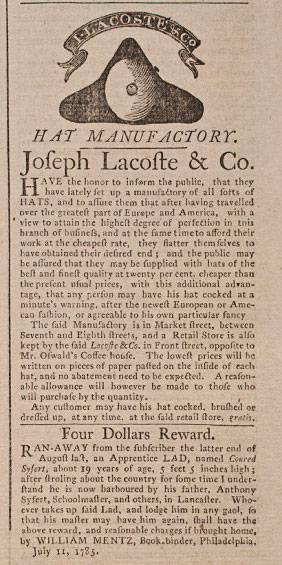
I don’t know any examples of authentic eighteenth-century hatters’ shop signs in the British Empire, but Colonial Williamsburg and the Adverts 250 Project have shared images of hatters’ wordy newspaper advertisements.

TOMORROW: Spreading the word.

Friday, July 03, 2026

“They unanimously pressed on myself alone to undertake the draught”

A few days after Timothy Pickering delivered an Independence Day oration in Salem in 1823, casting doubt on Thomas Jefferson’s importance in drafting the Declaration of Independence, Joseph E. Sprague (1782–1852) sent the text of that speech to Jefferson himself:
Supposing you might feel some little curiosity to see Col Pickering unwilling & ungrateful tribute to the illustrious Author of the Declaration of Independence I have taken the liberty to enclose it to you
Sprague was a postmaster and a Jeffersonian politician between terms in the Massachusetts House, so he had time to stir up trouble.

Near the end of the month Jefferson shared his version of the drafting story with his good friend and ally James Madison:
You have doubtless seen Timothy Pickering’s 4th of July Observations on the Declaration of Independance. if his principles and prejudices personal and political, gave us no reason to doubt whether he had truly quoted the information he alledges to have recieved from Mr [John] Adams, I should then say that, in some of the particulars, mr Adams’s memory has led him into unquestionable error. at the age of 88. and 47. years after the transactions of Independance, this is not wonderful.

nor should I, at the age of 80, on the small advantage of that difference only, venture to oppose my memory to his, were it not supported by written notes, taken by myself at the moment and on the spot.

he says ‘the Committee (of 5. to wit, Dr [Benjamin] Franklin, [Roger] Sherman, [Robert R.] Livingston and ourselves) met, discussed the subject, and then appointed him and myself to make the draught; that we, as a subcommittee, met, & after the urgencies of each on the other, I consented to undertake the task; that the draught being made, we, the subcommittee, met, & conned the paper over, and he does not remember that he made or suggested a single alteration.’ now these details are quite incorrect.

the Committee of 5. met, no such thing as a subcommittee was proposed, but they unanimously pressed on myself alone to undertake the draught.

I consented; I drew it; but before I reported it to the committee, I communicated it separately to Dr Franklin and mr Adams requesting their corrections; because they were the two members of whose judgments and amendments I wished most to have the benefit before presenting it to the Committee; and you have seen the original paper now in my hands, with the corrections of Doctor Franklin and mr Adams interlined in their own hand writings   

their alterations were two or three only, and merely verbal. I then wrote a fair copy, reported it to the Committee, and from them, unaltered to Congress. this personal communication and consultation with mr Adams he has misremembered into the actings of a sub-committee.
Jefferson didn’t write to Madison because he thought his friend might need convincing about this story. Rather, he was writing for posterity, putting his version of history on paper for us.

Though Pickering quoted John Adams’s letter, Jefferson took pains to excuse Adams of any fault but poor memory. By this time the two men had been corresponding amicably for over a decade. Indeed, Jefferson praised Adams in his letter:
had mr Adams been so restrained, Congress would have lost the benefit of his bold and impressive advocations of the rights of revolution. for no man’s confident & fervid addresses, more than mr Adams’s, encoraged and supported us thro’ the difficulties surrounding us, which, like the ceaseless action of gravity, weighed on us by night and by day. . . . he supported the declaration with zeal & ability, fighting fearlessly for every word of it.
Jefferson was less respectful of the arch-Federalist Pickering, though:
Timothy thinks the instrument the better for having a fourth of it expunged. he would have thought it still better had the other three fourths gone out also, all but the single sentiment (the only one he approves) which recommends friendship to his dear England, whenever she is willing to be at peace with us.
TOMORROW: Doctor’s advice.

Thursday, July 02, 2026

“Jefferson proposed to me to make the draught”

At last we come to John Adams’s dramatic description of how he—and he alone—convinced Thomas Jefferson to draft the Declaration of Independence, in his August 1822 letter to Timothy Pickering.
You enquire why so young a man as Jefferson was placed at the head of the Committee for preparing a declaration of Independence? I answer, it was the Frankfort advice, to place Virginia at the head of everything.

Mr: Richard Henry Lee, might be gone to Virginia, to his sick family, for aught I know, but that was not the reason of Mr: Jefferson’s appointment. There were three Committees appointed at the same time. One for the declaration of Independence; another for preparing Articles of Confederation; and another for preparing a Treaty to be proposed to France. Mr Lee was chosen for the Committee of confederation, and it was not thought convenient that the same person should be upon both.
In fact, Lee wasn’t named to any of those three committees. Roger Sherman and Robert R. Livingston were placed on the Declaration committee on 11 June and the Articles committee on 12 June.
Mr Jefferson came into Congress in June 1775. and brought with him a reputation for literature, science, and a happy talent at composition. Writings of his were handed about remarkable for the peculiar felicity of expression. Though a silent member in Congress, he was so prompt, frank, explicit and decisive upon Committees, not even Saml Adams was more so, that he soon seized upon my heart, and upon this occasion I gave him my vote and did all in my power to procure the votes of others. I think he had one more vote than any other, and that placed him at the head of the Committee. I had the next highest number and that placed me the second.

The Committee met, discussed the subject, and then appointed Mr: Jefferson & me to make the draught; I suppose, because we were the two highest on the list.

The Sub-Committee met; Jefferson proposed to me to make the draught.

I said I will not; You shall do it.

Oh No!

Why will you not?

You ought to do it.

I will not.

Why?

Reasons enough.

What can be your reasons?

Reason 1st. You are a Virginian, and Virginia ought to appear at the head of this business. Reason 2d. I am obnoxious, suspected and unpopular; You are very much otherwise. Reason 3d: You can write ten times better than I can.

“Well,” said Jefferson, “if you are decided I will do as well as I can.”

Very well, when you have drawn it up we will have a meeting.

A meeting we accordingly had and conn’d the paper over. I was delighted with its high tone, and the flights of Oratory with which it abounded, especially that concerning Negro Slavery, which though I knew his Southern Bretheren would never suffer to pass in Congress, I certainly never would oppose.

There were other expressions, which I would not have inserted if I had drawn it up; particularly that which called the King a Tyrant. I thought this too personal, for I never believed George to be a tyrant in disposition and in nature; I always believed him to be deceived by his Courtiers on both sides the Atlantic, and in his Official capacity only, Cruel.

I thought the expression too passionate and too much like scolding for so grave and solemn a document; but as [Benjamin] Franklin and Sherman were to inspect it afterwards, I thought it would not become me to strike it out. I consented to report it and do not now remember that I made or suggested a single alteration.

We reported it to the Committee of Five. It was read and I do not remember that Franklin or Sherman criticized any thing. We were all in haste; Congress was impatient and the Instrument was reported, as I believe in Jefferson’s hand writing as he first drew it.
Adams made a copy of Jefferson’s draft before it was complete, and Jefferson kept another draft with marks on it. The latter shows that Franklin did make substantive contributions.

On Independence Day in 1823, Pickering quoted liberally from Adams’s letter in an oration, which he then published.

TOMORROW: What did Jefferson think of that?

Tuesday, June 30, 2026

“In the shape in which Mr. Jefferson had presented it”

In August 1822, Timothy Pickering wrote to John Adams with questions about the drafting of the Declaration of Independence.

Pickering had served as Secretary of State while Adams was President. The men fell out over foreign policy, and Adams chose a new Secretary of State. Later Adams grouped Pickering in the “Essex Junto” he said undermined him, to Pickering’s puzzlement.

But by 1822 both men were out of public office. Thomas Jefferson and his adherents had been in the White House for two decades. Old intraparty enmities didn’t seem so important as ongoing interparty enmities.

Pickering asked to clear up what he considered mysteries about how the Continental Congress chose its committee to write the Declaration:
Mr. Jefferson being first on the list, became the chairman. This, considering the composition of the committee, and that Mr. Jefferson was the youngest man, would appear remarkable. Mr. Charles Lee, who married a daughter of R. H. Lee, once gave me this account: That Mr. Lee having moved the resolution for declaring the Colonies independent, would, according to the usual course, have been elected chairman of the committee for preparing the declaration; but sickness in his family caused him to return home.—Mr. Jefferson, another Virginian, was then chosen to supply his place.
As Pickering said, in many committees of this sort, the first man named was not only expected to be chairman but also the principal writer of the committee’s report—in this case, the Declaration.

However, Pickering misstated the history in a couple of ways. Jefferson was older than another committee member, Robert R. Livingston. And Richard Henry Lee had a second reason to return home besides a sick wife: he wanted to be involved in how Virginia formed a state government.

The letter went on:
The late [Massachusetts] Chief Justice [Theophilus] Parsons once told me, that in conversing on this subject, you informed him, that you and Mr. Jefferson were the sub-committee to prepare the declaration, and that you left to Mr. Jefferson the making of the draught. . . . But I was at a loss to account for the committee’s letting it be reported in the shape in which Mr. Jefferson had presented it to them.
Pickering guessed that the other members of the committee held back their criticism of the wordy draft after “observing a strong attachment of the parent to his offspring,” figuring Jefferson would more easily accept revisions from the Congress as a whole.

As an arch-Federalist, Pickering invited Adams, the last Federalist President, to confirm his theories because:
there is no end of the praises of Mr. Jefferson as the author of the declaration of independence:—if he had been the author of our independence itself, he could hardly have been more eulogized.—I have thought it desirable that the real facts in this case should be ascertained.
Could Adams’s recollections knock former President Jefferson down a peg or two?

TOMORROW: Adams’s reply.

Monday, June 29, 2026

Show Changes on the Declaration of Independence

On this date 250 years ago, the Continental Congress was taking the weekend off from formal sessions.

The Congress’s proposed Declaration of Independence was lying “on the table,” discussion of it tabled in favor of tasks like a naming a committee on manufacturing sulphur and choosing who would sign another $1,000,000 in currency.

Of course, a lot of politicking happened that weekend, off the record. Delegates were no doubt reading the draft submitted on 28 June 1776, composed by Thomas Jefferson with input from John Adams, Benjamin Franklin, Roger Sherman, and possibly Robert R. Livingston. Obviously, it needed further revision.

Earlier this year, the Thomas Jefferson Papers project at Princeton University created a website laying out that writing and revision process in detail, displaying and analyzing the existing documentary record. It’s well worth a visit.

It’s also interesting to think about the pedagogical and design challenge of this project. As the editors explain:
Past editors of Jefferson’s papers employed different techniques to show the declaration’s development and the committee’s revisions to the draft. Some used the root text before any revisions were made and added extensive annotation to explain later changes. Others printed the draft as it was submitted to Congress, using annotation to describe the changes that had been made up to that point. One edition printed three stages of revision as three separate, side-by-side columns for comparison. Others simply included an image of the chaotic draft without attempting to transcribe or break down the contents . . .

The Papers of Thomas Jefferson, in the series’ first published volume, printed the underlying “original Rough draught” with footnotes showing changes made before Adams made his copy. In a different part of the same volume, the Papers printed the draft as submitted to Congress, with the changes made by the committee marked, and also printed the final Declaration of Independence. While a dedicated researcher could piece together the development of the draft, it is difficult to get a clear narrative of the draft’s development through print sources alone. For this exhibit, we separated stages of revision into three tabs, so changes to the text can be viewed side by side with zoom-capable images of the manuscript.

The first tab shows the base text before any alterations were made. This is completely in Jefferson’s hand and strips out changes and corrections that were later marked on the page.

The second tab shows changes marked before Adams made his copy. These might be early revisions Jefferson made to his own work or revisions made in early consultations with committee members.

The third tab shows the remaining revisions marked on the document prior to its submission to Congress. To ascertain this stage, we examined three copies that Jefferson sent to friends in the days shortly after July 4, in which he reconstructed the draft that the committee had laid before Congress. We also consulted another copy of the draft that Jefferson transcribed into his Notes of Proceedings of the Continental Congress, which he compiled sometime between August 1776 and August 1783. When possible, we have identified the committee member who contributed each revision.
Adams and Jefferson both left recollections of the writing process. Unfortunately, that means we don’t know what happened.

TOMORROW: The Adams chronicle.

Friday, June 26, 2026

Celebrating the Sestercentennial at Adams National Historical Park

Adams National Historical Park will host a full week of events commemorating the Sestercentennial of the Declaration of Independence, which John Adams had a little something to do with.

Unless otherwise noted, all these events will take place on the grounds of the Old House at Peace field, located at 135 Adams Street in Quincy.

Friday, 26 June, 6 P.M.
Slice of History
A night of pizza and rewatching the animated cartoon Liberty’s Kids. This event is intended for viewers ages 18–30, who might enjoy memories of the original broadcasts, but all are welcome.

Saturday, 27 June, and Sunday, 28 June
The Adamses and the American Revolution
Adams Farm at Penn’s Hill, 141 Adams Street
Ranger talks and special programs sharing the experiences of the Adams family during the American Revolution and their contributions to American independence.

Sunday, 28 June, 4 P.M.
Jefferson & Adams
This stage play by Howard Ginsberg dramatizes the friendship between John Adams, Thomas Jefferson, and Abigail Adams. Actors Bill Barker, Sam Goodyear, and Abigail Schumann bring to life the fifty-year relationship—often contentious, sometimes turbulent, and ultimately enduring.

Tuesday, 30 June, 6 P.M.
My Dearest Friend
Written by Peter Manos, this play reveals the American Revolution and the founding of the United States through the rich, witty, and passionate correspondence between Abigail and John Adams. They spent years apart, sometimes on separate continents, but stayed intensely in love for more than half a century.

Wednesday, 1 July, 10 A.M. to 4 P.M.
Stories of the American Revolution
Learn more about the many stories of the American Revolution through ranger talks and special programs.

Wednesday, 1 July, 6 P.M.
Quincy’s Women on the Page
Novelists Stephanie Dray, Laura Kamoie, and Jodi Daynard share their experiences bringing Quincy women, including Abigail Adams, to life through historical fiction.

Thursday, 2 July, 11 A.M., 1 and 3 P.M.
Independence Forever: The Continental Congress
Become a delegate to the Second Continental Congress and re-enact the passage of the Declaration of Independence. This interactive event is an invitation to adults and children to take part in the debate about whether to remain loyal to the British crown or to create a new nation.

Friday, 3 July, 11 A.M., 1 and 3 P.M.
John and Abigail Adams
The couple share their experiences during the American Revolution. Music by the Conchords at noon and 2 P.M.

Saturday, 4 July, 11 A.M., 1 and 3 P.M.
Readings of the Declaration of Independence
Lend your voice to these live public readings of the Declaration of Independence 250 years after it was adopted. The afternoon readings will be held at the Adams Farm at Penn’s Hill, the Adamses’ home during the American Revolution.

Sunday, 5 July, 10 A.M. to 4 P.M.
Stories of the American Revolution
Learn more about the many stories of the American Revolution through ranger talks and special programs.

These special programs are all free to attend and don’t require reservations. Parking is at the Visitor Center at 1250 Hancock Street, half a mile away. Also half a mile away is the Quincy Center station on the M.B.T.A. Red Line. Events may be modified or cancelled due to especially hot or stormy weather.

Saturday, May 09, 2026

Declarations of Independence around Boston—Collect Them All!

To commemorate the 250th anniversary of the Declaration of Independence, multiple institutions in greater Boston have collaborated to lay out a Declarations Trail—exhibits of different significant copies of that document.

The Leventhal Map Center at the Boston Public Library has opened “Declarations: Printing a New Nation” with eight printings from broadsides and newspapers, along with maps showing the spread of that news. It will be up through 13 September. Shown here is the library’s copy of the Declaration as printed by Ezekiel Russell for the newly independent Massachusetts government.

The Boston Athenaeum exhibit “Imagined Nation” displays early printings in the context of such items as George Washington’s copy of Thomas Paine’s Common Sense, maps of the young republic, and World War II–era posters. That runs through November.

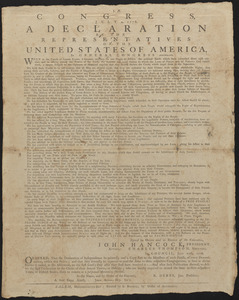
The Massachusetts Historical Society’s “1776: Declaring Independence” display, up through December, includes “handwritten copies of the Declaration by John Adams and Thomas Jefferson as well as multiple early printings, including a rare Dunlap broadside.” That was the first official presentation of the text, commissioned from printer John Dunlap by the Continental Congress in July 1776.

In Cambridge, three parts of the Harvard University library system are creating linked displays. The university archives is offering “Harvard and the American Revolution.” Next week the Harvard Map Collection will open “Charting Independence.” And starting on 18 May the Houghton Library will host “War of Words,” a display assembled by curator John Overholt to feature “the posters, pamphlets, newspapers, and images that brought news of the American Revolution to those who lived through it.”

In addition to the sites on the Declarations Trail, the Commonwealth Museum regularly displays Mary Katherine Goddard’s official reprinting of the Declaration signed by John Hancock and sent to the state in 1777.

And the “The Road to Revolution: Massachusetts and the Independence Movement” exhibit in Revolutionary Spaces’s Old State House, drawing on material from the M.H.S., includes a “rare 1776 Boston broadside printing of the Declaration of Independence.”

Most of those exhibits are free to the public. Many have special tours, talks, and workshops scheduled as well.

In a parallel initiative, five Revoloutionary-era institutions with admission fees—the Paul Revere House, Old State House, Old North Church, Old South Meeting-House, and King’s Chapel—have combined to offer visitors the Boston 250 Pass with a 10% on regular adult admission.

Saturday, July 19, 2025

Nominees for the 2025 George Washington Book Prize

The finalists for the 2025 George Washington Book Prize, all history titles published last year, have been announced.

In alphabetical order of the author’s surname, they are:
  • Jane E. Calvert, Penman of the Founding: A Biography of John Dickinson (Oxford University Press)
  • Francis D. Cogliano, A Revolutionary Friendship: Washington, Jefferson, and the American Republic (Harvard University Press)
  • Michael D. Hattem, The Memory of ’76: The Revolution in American History (Yale University Press)
  • Tyson Reeder, Serpent in Eden: Foreign Meddling and Partisan Politics in James Madison’s America (Oxford University Press)
  • Cara Rogers Stevens, Thomas Jefferson and the Fight against Slavery (University Press of Kansas)
The sponsors of this prize are Mount Vernon, the Gilder Lehrman Institute of American History, and Washington College. Mount Vernon will host an event featuring all the authors on 12 August, and the winner will be announced at a gala dinner in New York on 8 October.

Friday, July 04, 2025

“Two hundred and forty-nine years later…”

Mother Jones just shared David Corn and Tim Murphy’s article “Here are the Declaration of Independence’s Grievances Against King George III. Many Apply to Trump.”

It begins:
When Thomas Jefferson was writing the Declaration of Independence in the weeks leading up July 4, 1776, he wanted to not only rely on just high-falutin enlightenment ideals to justify the case for separation from Great Britain. His aim was also to present a slam-dunk indictment of King George III—to prove that the royal was a “tyrant” and that he and Parliament had forfeited their right to rule the Americans by breaking their own laws and trampling on the rights of their people. This is why about half of the Declaration is a list of 27 specific grievances lodged against the King and his regime.

Two hundred and forty-nine years later, many of these grievances apply to the reign of Donald Trump. Here’s a look at how Trump stacks up against the Mad King.

He has refused his Assent to Laws, the most wholesome and necessary for the public good.

This grievance refers to the King refusing to approve laws passed by the colonies. Trump used his veto power a few times during his first presidency and has not had to do so this year. But he’s shown his disregard for Congress by simply ignoring existing laws. The Elon Musk-led DOGE attack on the government violated numerous laws—including those governing privacy and data. Trump paid no heed to the War Powers Resolution when he launched a military attack on Iran. He illegally impounded funds approved by Congress. He has misinterpreted the International Emergency Economic Powers Act and the Alien Enemies Act of 1798 to claim powers not afforded the president. Legal experts have said that Trump’s firing of inspectors general and commissioners of independent government commissions is illegal—though some of these cases are still being litigated in the courts. He has also issued an executive order to end birthright citizenship, which is enshrined in the Constitution.
On the Mother Jones site, that last paragraph includes lots of links for reports on the violations. And it goes on, all the way down to “He has excited domestic insurrections amongst us…”

This record is all the more remarkable for two reasons. First, several of the Congress’s complaints about George III referred to things the royal government did while it was openly waging war against the people of America for over a year. And secondly, Britain didn’t have a written Constitution to render the violations so clear.

Thursday, May 15, 2025

“To become a Keeper of the Light House on Bald Head”

Commonplace published David E. Paterson’s article “Jefferson’s Mystery Woman Identified.”

It begins:
Historians have long wondered what prompted President Thomas Jefferson’s cryptic sentence in a note dated January 13, 1807, to Treasury Secretary Albert Gallatin: “The appointment of a woman to office is an innovation for which the public is not prepared, nor am I.”

Given Jefferson’s opinion explicitly expressed elsewhere that women were best suited to domestic roles, not to boisterous public political forums, and not as actors in the halls and offices of government, scholars of the early republic and popular authors alike, since at least 1920, have tried to reconstruct the specific context in which the president made this comment. For the last twenty years, the consensus explanation has been that Treasury Secretary Albert Gallatin, unable to find enough qualified men to fill federal government jobs, proposed hiring women for those positions.

However, while Jefferson’s statement may reflect his thoughts on women as office holders in general, my recent research in federal records proves that Jefferson wrote the sentence in reaction to Gallatin’s proposal to appoint a specific woman to a specific job.
As Paterson says, Gallatin’s letter to the President and other pertinent documents don’t survive, so he had to work with other sources. One key bit of news:
The Wilmington (N.C.) Gazette of October 21, 1806, reported that five days earlier, a man named Joseph Swain, hunting deer and wild hogs on Bald Head Island, fired at a noise he heard in the bushes—only to find that he had killed his father-in-law, light-keeper Henry Long.
Paterson’s research also indicates that Gallatin; Timothy Bloodworth, the federal Customs Collector at Wilmington; and twelve local men were all willing to see a woman appointed to the office in question. Only President Jefferson deemed that “the public” wasn’t prepared for that.

Nineteen years later, President John Quincy Adams made the opposite call in regard to the same type of federal office.

For additional reading, here’s Kevin Duffus’s article for Coastal Review on the slain lighthouse keeper, Henry Long. It turns out he was born in the Palatinate in 1743. At the age of ten his family emigrated to Maine, the same region where Christopher Seider’s family first settled. His father, a schoolteacher also named Heinrich Lange, was still there in 1767, according to Jasper Jacob Stahl’s History of Old Broad Bay and Waldoboro.

As a young man, Henry Long moved to North Carolina, which had German-speaking Moravian communities. He became a river pilot, married, and had children. Entering his fifties, Long seems to have wanted a more stable job. In 1794 the Hooper family—who also had roots in the Massachusetts colony—recommended him to the federal government to tend the lighthouse off Cape Fear. And that went well for twelve years.

Monday, March 17, 2025

The Plain Language of the Alien Enemies Act

In 1798 the U.S. Congress, caught up in the possibility of war against France (then under the Directory government), passed a series of controversial laws.

The Naturalization Law made it harder for immigrants to become citizens of the U.S. of A. by increasing the number of years a person had to live in the country before applying. This was repealed in 1802.

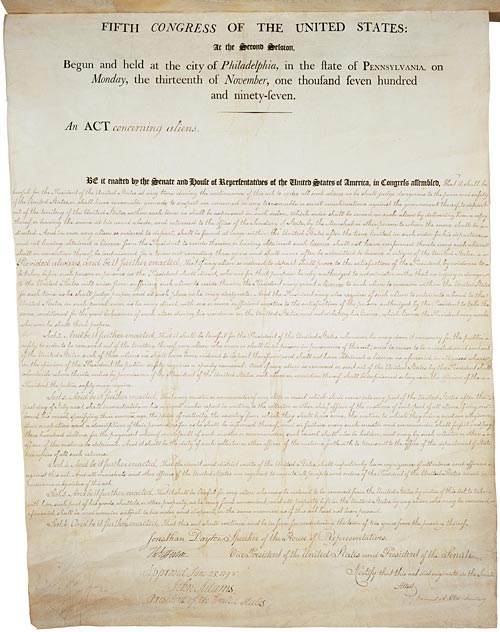
The Act Concerning Aliens (distinguished as the Alien Friends Act) empowered the President to jail or deport any non-citizen who he determined was “dangerous to the peace and safety of the United States.” This expired after two years.

The Sedition Act criminalized combining to oppose government measures and criticizing the U.S. government, House, Senate, or President. The John Adams administration deployed this law against Jeffersonian politicians and printers. It expired in 1800.

The Alien and Sedition Acts were strongly opposed at the time. They led to Jeffersonian victories over Federalists. Since then, historians and legal scholars have almost universally treated these laws as a Bad Thing.

The fourth of those laws from 1798 remained on the books, however: the Act Respecting Alien Enemies. It didn’t have an expiration date. Instead, its language limits the circumstances under which a President can invoke it.

The Alien Enemies Act empowers a President to act only
whenever there shall be a declared war between the United States and any foreign nation or government, or any invasion or predatory incursion shall be perpetrated, attempted, or threatened against the territory of the United States, by any foreign nation or government
If “any foreign nation or government” is in a “declared war” with the U.S. of A. or has made a “predatory incursion,” then the federal government can jail and deport that country’s male citizens aged fourteen or older. The U.S. Constitution further vests the power to declare war in Congress, not the executive branch.

Last week the White House illegally invoked the Alien Enemies Act to justify deporting hundreds of Venezuelans to El Salvador even though there’s no declared war against Venezuela nor any invasion by Venezuela.

In place of the law’s actual conditions, the White House claimed that the Tren de Aragua criminal gang and Venezuela amount to something it calls “a hybrid criminal state.” (It didn’t address how in 2023 the Venezuelan government deployed 11,000 soldiers to break up a Tren de Aragua stronghold.) The White House also claims that illegal migration by individuals, in unspecified numbers, is the equivalent of a government-led invasion.

In some ways, the President is an expert on criminal states. He’s a convicted felon, facing additional federal and state charges, adjudicated as liable for sexual assault, and bound by multiple legal settlements for fraud. But that experience in crime doesn’t give this President the legal power to invoke a statute contrary to its provisions.

The executive branch then further demonstrated its lawlessness by ignoring a judicial order to stop flying people out of the country until the legal issues can be decided.

The Nicolás Maduro regime in Venezuela shows the danger of allowing a coup plotter—in this case, Maduro’s predecessor Hugo Chávez after 1992—to take political office. Coup plotters by definition don’t respect elections and the rule of law. Venezuela is now only nominally republican, actually authoritarian (as is El Salvador). But Venezuela isn’t in declared war against or invading the U.S. of A., as the Alien Enemies Act stipulates. It’s not the only criminal state in this story.

Tuesday, February 11, 2025

More about the Prayer Attributed to Jefferson—or Was That Washington?

The February 2025 issue of Church & State has an article by Brian Kaylor about the prayer that House Speaker Mike Johnson falsely attributed to Thomas Jefferson last month.

Kaylor also wrote about the prayer at his website, Word&Way.

To provide a more complete account of the prayer than I could offer in January, I’ll summarize Kaylor’s articles.

The Rev. George Lyman Locke of Bristol, Rhode Island, composed the text in 1882, calling it a prayer “for our country.” Colleagues in the Episcopal church pushed to have it included in the American Book of Common Prayer, particularly at the 1916 general convention.

At that same convention, another delegate suggested that the church should instead use or adapt part of George Washington’s circular letter to the state governors on 8 June 1783:
I now make it my earnest prayer, that God would have you and the State over which you preside, in his holy protection that he would incline the hearts of the Citizens to cultivate a spirit of subordination & obedience to Government, to entertain a brotherly affection and love for one another, for their fellow Citizens of the United States at large and particularly for their brethren who have served in the field—and finally that he would most graciously be pleas’d to dispose us all to do Justice, to love mercy and to demean ourselves, with that Charity, humility & pacific temper of mind, which were the Characteristicks of the Divine Author of our blessed Religion & without an humble immitation of whose example in these things, we can never hope to be a happy Nation.
After a delay of three years (there was a war, after all), the Episcopal bishops recommended adopting Locke’s prayer “for our country” instead of Washington’s. Locke’s words were finally added to the American Book of Common Prayer in 1928, after his death.

However, Kaylor found that in 1921 three newspapers in Louisiana printed Locke’s text while attributing it to Washington—evidently conflating the two proposals. And that attribution spread for years. Not everyone repeating the lines invoked Washington’s name—Franklin D. Roosevelt called it only “an old prayer” in 1940—but many did.

The next chapter of the story began during the Cold War, a period of increased public piety as the U.S. of A. sought to draw a distinction between itself and the Communist bloc. In 1956 an Episcopal pastor in Virginia, the Rev. Herbert Donovan, credited the prayer to Thomas Jefferson. The Jefferson Foundation picked that up. Within a couple of decades Jefferson got credit more often than Washington.
Furthermore, people started to say that Jefferson read or recited that prayer every day. Kaylor theorizes that idea started because Jefferson owned a 1796 edition of the Book of Common Prayer which was stolen from a vault at the University of Virginia in 1973. Since the prayer appears in the modern Book of Common Prayer, some people decided Jefferson read it, too. Those people didn’t realize how the Episcopal church changes with the times, like all institutions.

Kaylor also notes that while people in or playing to the religious right have been most vocal about attributing the prayer to Jefferson, religious people in the center and left have repeated that credit, too. There’s broad appeal in believing that the most famous Founders thought just like us.

Saturday, January 04, 2025

Off to a Great Start

Yesterday, after being chosen Speaker of the House by the minimally required 218 members, Rep. Mike Johnson delivered a speech that included these lines about a ceremony earlier in the day:
I was asked to provide a prayer for the nation. I offered one that is quite familiar to historians and probably many of us. It said right here in the program, it says right under my name, ‘it is said each day of his eight years of the presidency, and every day thereafter until his death, President Thomas Jefferson recited this prayer.’

I wanted to share it with you here at the end of my remarks. Not as a prayer per se right now, but really as a reminder of what our third President and the primary author of the Declaration of Independence thought was so important that it should be a daily recitation.
You can no doubt see where this is going.

Monticello’s Thomas Jefferson Encyclopedia discusses this prayer among many other spurious quotations attached to the third President’s name with no evidence.

This text is called a “National Prayer for Peace,” and the historic site’s research staff says:
We have no evidence that this prayer was written or delivered by Thomas Jefferson. It appears in the 1928 United States Book of Common Prayer, and was first suggested for inclusion in a report published in 1919.
In other words, this text appears to date from the Woodrow Wilson administration, either the “he kept us out of war” period or the “we need a League of Nations” period, and was then officially adopted by a particular denomination of Protestant Christianity. The primary author of the Declaration of Independence did not know this text, nor make it a “daily recitation.”

Monticello also notes that Gov. Franklin D. Roosevelt, who was Episcopalian, used this text in his Thanksgiving Day address in 1930. Johnson could thus have connected his speech with a major U.S. President. But of course Roosevelt was a Democrat who expanded the federal government to help Americans during an economic crisis and then helped lead the global fight against fascism. Johnson is serving an ideology and a President with different goals.

As Monticello points out, folks who know anything about Thomas Jefferson’s ideas on religion should quickly doubt any claim that he composed a public prayer like this. Jefferson considered religion a private matter. He was proud of authoring a Virginia law that ended the establishment of religion and guaranteed freedom of thought. As President he broke from his predecessors’ precedents and declined to issue Thanksgiving proclamations.

Here’s a real Jefferson quote on the latter matter. In 1808 the Rev. Dr. Samuel Miller, a Presbyterian minister then based in New York, wrote asking him “to recommend…a day of Fasting, Humiliation and Prayer.”

The third President replied:
I consider the government of the US. as interdicted by the constitution from intermedling with religious institutions, their doctrines, discipline, or exercises. this results not only from the provision that no law shall be made respecting the establishment, or free exercise, of religion, but from that also which reserves to the states the powers not delegated to the US. . . .

I do not believe it is for the interest of religion to invite the civil magistrate to direct it’s exercises, its discipline or its doctrines: nor of the religious societies that the General government should be invested with the power of effecting any uniformity of time or matter among them. fasting & prayer are religious exercises.
It would be hard to find a U.S. President more opposed to a “National Prayer” of any kind than Jefferson.

[ADDENDUM: Sharing a more complete story of the prayer.]

Saturday, November 30, 2024

“Recapturing the realities of daily governance”

Creating a Federal Government is an online database developed at Washington University in St. Louis and launched earlier this year.

It seeks to document the U.S. federal government from its creation in 1789 until 1829. That starts with listing all the people documented as hired by the federal government in that period, their jobs, where they worked, and other details.

The project explains itself this way:
What happens to our story of the American founding when we shift the focus from the pursuit of electoral office and toward the actions of appointed officials? Recapturing the realities of daily governance is crucial to our understanding of both the nation’s past and its present. . . .

Day in and day out, the Founding Fathers were consumed with managing the thousands of employees in the federal government. Much as we might now prefer reading their most high-minded writings about the meaning of representative government, once the Founders moved into federal leadership they were far more concerned with day-to-day matters. This does not mean they lost sight of the big picture or pressing national goals. Rather, they understood that their ability to realize their goals for the nation depended on their ability to organize and mobilize the personnel and resources of the federal government.

This task was all the more difficult because they did not possess the organizational tools that we have today. First and foremost, the federal government was highly decentralized. Although each federal agency did possess a central office in the nation’s capital, they had the most limited staff. Nothing reveals this state of affairs more clearly than the fact that so much of the minutiae of managing the federal government appears in the familiar handwriting of people like George Washington, Thomas Jefferson, and James Madison. As cabinet members and later as Presidents, they devoted much of their time to appointing subordinates and drafting specific instructions to them.
Indeed, those high officials were flooded with requests from people seeking appointments. There was no civil service system to channel that process, simply personal connections and peristence.

Fortunately for those top managers, and for the people trying to document every federal employee, the national government was quite small. And for a brief time under one President, it got smaller:
That President was Thomas Jefferson, and the period was 1801-1803. Jefferson came into office convinced that the federal government had become too large and expensive. He also suspected that many in the federal workforce shared dangerous ideas that put them at risk of violating the commitment to republican government that was at the core of the government’s mission. So Jefferson fired a number of personnel and eliminated a small number of federal offices. The result was to produce a brief reduction in the total number of federal employees. But the combination of the Louisiana Purchase (which expanded the federal domain), international tension, and ongoing domestic challenges led Jefferson to hire new officials and create new offices. As a result, he left office with a federal government larger and more powerful than the one he inherited.
In the period covered by this database, the population of the U.S. of A. grew from a little less than 4 million people to more than 12 million. Both the country and the economy expanded. So we shouldn’t be surprised that the federal government grew as well.

In contrast, for the last four decades the number of federal government civilian employees has hovered around 3 million (as high as 3.19 million in 1990, as low as 2.71 million in 2007). During that time, the national population has grown by more than 100 million people, or 46%.

TOMORROW: Looking in the Creating a Federal Government database for familiar faces.

Friday, September 20, 2024

Barbara Oberg and the Infrastructure of Early American Scholarship

Barbara Oberg, historian of early America, passed away this month. Though Oberg had the rank of professor in the Princeton History Department, she was known for a career of less visible work that benefited historical scholarship.

Primarily, Oberg was the lead editor of the Benjamin Franklin Papers and then the Thomas Jefferson Papers. Between the two series, she oversaw the publication of more than twenty volumes. In doing so, she both helped generations of scholars and readers access that correspondence and trained other documentary editors.

Dr. Oberg also edited collections of scholarly essays: Women in the American Revolution: Gender, Politics, and the Domestic World, Federalists Reconsidered, and Benjamin Franklin, Jonathan Edwards, and the Representation of American Culture.

Oberg was also known within the profession for serving the non-university organizations that support scholars, research, and publication. The Omohundro Institute for Early American History and Culture just eulogized her this way:
Barbara was also an insightful and incisive leader. Keenly aware of the importance of institutions for scholarship, she was devoted to the organizations that support early American history, including the OI. From 2010 to 2023, she served on the OI’s Executive Board, presiding as Chair from 2014 onward. Her steady counsel, exceptional generosity, and subtle wit helped us flourish even as we navigated shifts in leadership and sponsorship and moved into our new home. We are profoundly grateful to her for her help.

The OI is not the only organization to have benefitted from Barbara’s keen intellect and energetic engagement. She helped steer the American Philosophical Society, the Colonial Williamsburg Foundation, the Society for Historians of the Early American Republic, and the Society of Documentary Editors.

Indeed, at “A Life in Letters: A Celebration of Dr. Barbara Oberg”—a 2023 symposium jointly organized by the OI and the American Philosophical Society—historians, editors, and cultural leaders gathered in Philadelphia to discuss the ongoing importance of Barbara’s work. At “Barbara Fest,” as we called it, speakers and audience members alike testified to her profound impact on the organizations they cared most about.
The sessions of that symposium can be viewed here on YouTube. Historians of early America discuss Franklin, Jefferson, women, the field of documentary editing, and what Barbara Oberg brought to each of those areas.

Thursday, September 19, 2024

Kenneth Lockridge and the New Social History

Kenneth A. Lockridge died last month at the age of seventy-nine. He was Professor Emeritus of History at the University of Montana, having previously taught at the University of Michigan and the University of Illinois, Chicago.

Lockridge’s first book, published in 1970, was A New England Town: The First Hundred Years: Dedham, Massachusetts, 1636–1736.

It was one of a bevy of studies of rural New England communities published in the 1970s, including John Demos’s A Little Commonwealth, Michael Zuckerman’s Peaceable Kingdoms, and Philip J. Greven’s Four Generations.

Robert A. Gross applied and extended that approach in The Minutemen and Their World, about Concord in the Revolutionary period.

This “new social history” focused on the lives of ordinary men and women rather than political elites, on long-term social and economic trends rather than individual narratives. Eventually it was no longer new, and younger historians developed other approaches, such as looking at the experiences of people who weren’t ordinary because of race, sex, or other factors.

Lockridge went on to write such books as Literacy in Colonial New England, Settlement and Unsettlement in Early America, and On the Sources of Patriarchal Rage: The Commonplace Books of William Byrd and Thomas Jefferson and the Gendering of Power in the Eighteenth Century.

He also published studies of Sweden, his wife’s home, and after retirement moved to that country to be with family.

The University of Montana has named its workshop for historical works in progress after Lockridge.

Saturday, July 06, 2024

“Throw himself on the justice of his country”

Josh Marshall, who earned a doctorate in American history before founding the Talking Points Memo political website, recently quoted Thomas Jefferson on the question of whether the responsibilities of U.S. Presidents put them above the law.

I think the Founders would have been aghast at the idea that any government officials weren’t subject to the rule of law. That was the whole point of founding a republic without a monarch or a hereditary nobility with its own separate court system.

Until recently, only a small fraction of people disagreed with that notion, most of them with deep personal interests at stake—like Richard Nixon.

As a former chief executive Jefferson had experience with the choice of acting for what he perceived as the public good or staying strictly within defined law.

In a letter to John B. Colvin dated 20 Sept 1810, Jefferson wrote:
Whether circumstances do not sometimes occur which make it a duty in officers of high trust to assume authorities beyond the law, is easy of solution in principle, but sometimes embarrasing in practice. a strict observance of the written laws is doubtless one of the high duties of a good citizen: but it is not the highest. the laws of necessity, of self-preservation, of saving our country when in danger, are of higher obligation. to lose our country by a scrupulous adherence to written law, would be to lose the law itself, with life, liberty, property & all those who are enjoying them with us; thus absurdly sacrificing the end to the means.
But once a President or other high officials make such a decision, Jefferson went on to say, they also have the responsibility to subject themselves to public inquiry, including in the courts.
the officer who is called to act on this superior ground, does indeed risk himself on the justice of the controuling powers of the constitution, and his station makes it his duty to incur that risk. but those controuling powers, and his fellow citizens generally, are bound to judge according to the circumstances under which he acted. they are not to transfer the information of this place or moment to the time & place of his action: but to put themselves into his situation. . . .

it is incumbent on those only who accept of great charges, to risk themselves on great occasions, when the safety of the nation, or some of it’s very high interests are at stake. an officer is bound to obey orders: yet he would be a bad one who should do it in cases for which they were not intended, and which involved the most important consequences. the line of discrimination between cases may be difficult; but the good officer is bound to draw it at his own peril, & throw himself on the justice of his country and the rectitude of his motives.
If an executive’s reasons were really so good, Jefferson felt confident in saying, he’d be able to “throw himself on the justice of his country” and make a case for himself.

Sunday, March 31, 2024

“Our firm belief in telling a story here that is accurate and honest”

Daniel P. Jordan, director and then president of Thomas Jefferson’s Monticello for over twenty years, died earlier this month.

Ann Lucas, Senior Historian Emerita at the site, provided a remembrance for its website that says, in part:
Jordan adhered to Jefferson’s principle to “follow the truth wherever it may lead.” As director-elect, he visited Monticello several times as a “regular tourist,” and was struck by the fact that he never once heard a reference to Jefferson owning a plantation or the enslaved labor that it required. Once in leadership, he conveyed to staff that “from January the first on, we're going to try to tell the most honest story we can about Jefferson and slavery and race and the plantation, and it's all going to be based on serious scholarship."

Toward that end, Jordan defined new academic departments (research, archaeology, restoration, education, publications, and historic plants), accelerated the publication of Jefferson’s writings with The Papers of Thomas Jefferson: Retirement Series, and established the Robert H. Smith International Center for Jefferson Studies. He supported a new generation of Jefferson-era research, passing the torch of the Thomas Jefferson Foundation professorship from Merrill Peterson to Peter Onuf.

No event more clearly illustrates Jordan’s dedication to transparency and scholarship - and his confidence in the Monticello staff - than his response to the Sally Hemings DNA study. Steadfast in the face of opposition, Jordan, in his words, “set the tone” to support Monticello’s scholars.

Within 24 hours of the 1998 release of the study linking Jefferson to the paternity of Hemings’ son, Monticello held a press conference, posted public statements on the web site, and instructed interpreters in how to initiate conversations on the subject with visitors. The Foundation pledged to continuously evaluate all relevant evidence, advancing “our firm belief in telling a story here that is accurate and honest - and thus inclusive - about Jefferson’s remarkable life and legacy in the context of the complex and extraordinary plantation community that was Monticello.”
Those findings, bolstered by historical analysis, were convincing for the great majority of historians. There was a great outcry from a few authors, descendants, and self-appointed Jefferson “protectors,” quite like the objections we hear today to “woke” history and any effort at diversity, equity, and inclusion in institutions. In fact, some of the same people are objecting.

Friday, February 16, 2024

Cogliano on A Revolutionary Friendship, 17 Feb.

Back in 2020, I looked at the trend of dual (and occasional treble) biographies of major Founders.

These books use the friendship, rivalry, or simple collaboration of two early American politicians as a lens, using that relationship to produce a more focused view of the Founding period.

The occasion for those musings was the publication of Stephen Knott and Tony Williams’s Washington and Hamilton: The Alliance that Forged America.

Starting with that book, one could move by degrees of separation from Hamilton to Madison (Jay Cost, The Price of Greatness: Alexander Hamilton, James Madison, and the Creation of American Oligarchy) to Jefferson (Andrew Burstein and Nancy Isenberg, Madison and Jefferson) to Lafayette (Tom Chaffin, Revolutionary Brothers: Thomas Jefferson, the Marquis de Lafayette, and the Friendship that Helped Forge Two Nations) and back to Washington (David A. Clary, Adopted Son: Washington, Lafayette, and the Friendship that Saved the Revolution).

I’m sure more examples of this trend have appeared since 2000. But this posting is prompted by a book coming out this month: A Revolutionary Friendship: Washington, Jefferson, and the American Republic by Francis D. Cogliano.

Some authors have looked at Washington and Jefferson together before, emphasizing the antagonism of the two men (e.g., Thomas Fleming, The Great Divide: The Conflict Between Washington and Jefferson that Defined a Nation).

As Cogliano explains on The Whiskey Rebellion podcast, which he produces with colleague David Silkenat, the two Presidents were friendly and productive for most of their careers, falling out only after Jefferson’s 24 Apr 1796 letter to Philip Mazzei became public.

Frank Cogliano is a Massachusetts native, a professor and dean at the University of Edinburgh, and the outgoing interim director of the Robert H. Smith International Center for Jefferson Studies at Monticello.

That institution will celebrate the publication of A Revolutionary Friendship this Saturday, 17 February. Although that book launch is sold out, it will be livestreamed for anyone interested on Facebook, YouTube, and Monticello’s own website starting at 4:30 P.M.

Cogliano will be joined in conversation about his book by Annette Gordon-Reed, Peter Onuf, and Monticello’s new president, Jane Kamensky.