J. L. BELL is a Massachusetts writer who specializes in (among other things) the start of the American Revolution in and around Boston. He is particularly interested in the experiences of children in 1765-75. He has published scholarly papers and popular articles for both children and adults. He was consultant for an episode of History Detectives, and contributed to a display at Minute Man National Historic Park.

Subscribe thru Follow.it


•••••••••••••••••


Showing posts with label Old North Meeting-House. Show all posts

Monday, April 13, 2026

Caleb Wheaton “industriously vindicating the Measures of the Ministry”

In yesterday’s discussion of how the Massachusetts legislature dealt with Loyalists captured on the Elizabeth in April 1776, I left out Caleb Wheaton and his sons: Caleb, Jr.; Joseph; and John.

That’s because their story is complex and detailed enough to deserve a few postings on their own. And even then there will be holes and mysteries.

Vital records of Rehoboth show Caleb Wheaton born there in 1713. There were lots of Wheatons in that region, however, including across the nearby border in Rhode Island. Unfortunately for us, that means there were other men with the same name moving in and out of the eighteenth-century record.

Documents in Caleb Wheaton’s filing to the Loyalist Commission in 1784 show that he served in the Massachusetts army raised by Gov. William Shirley to hold Annapolis Royal in 1744. Later he was “Commandant of St. George’s Fort in the Eastern Part of the Province of Massachusetts,” now Thomaston, Maine.

Customs Commissioner Charles Paxton certified that his agency made Wheaton “a preventive Officer at Machias in which he conducted himself faithfully and diligently to the Acceptance of the Board.” That couldn’t have been a full-time position, given the size of trade in the region.

By 1774, Wheaton owned 200 acres in Machias, Maine, where he lived, and 173 more acres in Dedham. Capt. Solomon Smith wrote that he “was Situated in the most advantagest place for traid in the harbour of Machias.” Wheaton’s family consisted of a wife and nine children, some grown.

That year, Caleb Wheaton testified, he was “obliged to fly from his Estate and Property…on Account of his Attachment to the British Government.”

The 13 Feb 1775 Newport Mercury ran these two articles:
Rehoboth, February 3, 1775.

A Number of the Inhabitants of this Town assembled on Monday last [28 January], to enquire into the Conduct of Mr. Caleb Wheaton, who lately came here from the Eastward, and who had rendered himself obnoxious, by openly espousing & vindicating the Plan of Despotism now carrying on against the Colonies. A Committee was appointed to wait on him, and after making an Acknowledgment of his Villany, asking Forgiveness, and promising Amendment, he was ordered to depart the Town in twelve Hours. . . .

PROVIDENCE, Feb. 4.

Mr. Caleb Wheaton, who some Time since was obliged to quit this Town for industriously vindicating the Measures of the Ministry, returned here from Rehoboth the Beginning of this Week, which Place he had likewise been obliged to leave; and Yesterday a Number of the Inhabitants paid him a second Visit, to remind him of their former Request, when he thought proper to make a precipitate Flight.—So many all the Enemies to America become destitute of a Resting-Place for the Soles of their Feet.
The reference to “the Eastward” makes me think these items referred to Caleb Wheaton, Sr., from Maine.

Like other New England Loyalists, Wheaton found protection in army-occupied Boston. Gen. Thomas Gage certified that “he was employ’d as an Officer of Guides in the Kings Service.” According to E. Alfred Jones’s Loyalists of Massachusetts, “By orders of General Sir William Howe he pulled down the Old North Meeting House,” which happened on 16 Jan 1776.

TOMORROW: The Wheaton brothers.

Wednesday, December 17, 2025

Eight Runaway Men in a Boat from Boston

Capt. Richard Dodge was a Continental Army officer stationed in Chelsea during the second half of 1775. Like his regimental commander, Lt. Col. Loammi Baldwin, he sent periodic reports to Gen. George Washington’s headquarters about what he saw in Boston harbor.

On 16 December, Dodge reported some exciting news: “Last Eveing Eight men Runaway in a bote from Boston to our guard at the farry.”

Following recently enacted protocol, Dodge sent those men to a local health committee who “Clensed them by Smooking them” against the smallpox.

Six (or seven, according to the 25 December Boston Gazette) of those eight men were “masters of Vassels” captured by the Royal Navy and brought into Boston over the preceding months.

One, Capt. James Warden, had sailed for the Philadelphia merchant Thomas Mifflin and was anxious to renew their acquaintance now that Mifflin was the army’s quartermaster general. Naval Documents of the American Revolution reports that Warden was commanding the schooner Tryal on 22 August when it surrendered to H.M.S. Nautilus under Capt. John Collins.

The Essex Journal of Newburyport identified another of those ship’s captains as named Nowell, possibly Silas Nowell (who wouldn’t have been held that long). He came out with a copy of the Boston News-Letter, the only newspaper still being published in the town, and the news that Gen. John Burgoyne had sailed for England.

On 17 December, 250 years ago today, Dodge wrote out a précis of what those men told him about life inside Boston. The prices for food were high. One escapee reported that “he Dined with a man that Dined with Lord parsey a feu Day ago upon horse beaff.”

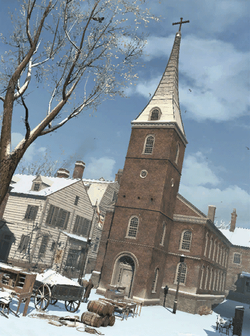
Firewood was even scarcer with winter coming on. Gen. William Howe had ordered the Old North Meeting-House and empty houses torn down for fuel. We also know Howe told London that he might have to order wharves torn up next.

Citing Capt. Nowell, the newspapers added that “all the drugs and medicines in the town have been seized for the use of the army.”

TOMORROW: Tales of the searcher.

Tuesday, September 30, 2025

Bell-Ringing in 1740s Boston

In my research into Thomas Williston, sexton of the Old Brick Meeting-House from the 1740s to the early 1770s, I came across a petition in the town meeting records that gives a taste of daily life in Boston.

On 14 Mar 1744 Williston and four fellow “Sextons & Bellringers” laid out how they rang their churches’ bells each day.

They weren’t ringing every hour—after all, it would be tough to get any big project done if you had to break off each hour to go to the belfry. Instead, they rang at certain hours only.

The town paid Williston to wind the Old Brick clock since telling the time was more of a secular function than a religious one. By the same rule, the town paid the sextons to ring them bells. But those men were paid at different rates.

Specifically:
  • Isaac Peirce, Old North Meeting-House – 1 P.M., 9 P.M., 5 A.M. – £4.10s for each quarter of the year.
  • Nathaniel Band, New South Meeting-House – 9 P.M., 5 A.M. – 50s. (£2.10s).
  • Joseph Simpson, Hollis Street Meeting-House – 9 P.M., 5 A.M., 1 P.M. – £3.15s.
  • John Roulstone, Old South Meeting-House – 1 P.M. – 30s. (£1.10s).
  • Thomas Williston, Old Brick Meeting-House – 5 A.M., 11 A.M., 9 P.M. – £4.10s.
If I were Simpson, I’d ask why I’m being paid less than Peirce and Williston for ringing the same number of times a day. Not being Simpson, I can imagine some reasons for that difference: an easier bell, less seniority, the church being in a less densely populated part of town and thus serving fewer people. But I’d still ask.

Instead of quibbling among themselves, those five men presented a united front and all together asked the town for more money:
the Petitioners would Represent to the Town that the aforesaid Allowance for the Service aforesaid is so very small, being but about Three pence Old Tenor for each Ringing, that the Petitioners Apprehend they are not by any means Recompenced for their Time & Service and as the Petitioners Allowance is no greater now than has been for about Thirty Years past and Provisions & all Necessarys of Life more than twice as Dear as they were Thirty Years since, they Apprehended the Town would think it reasonable to Increase their Allowance
The meeting empowered the selectmen “to Consider…the Ringing of the Bells, and of the Allowance to be made to the Sextons.” That year’s selectmen included Thomas Hutchinson, Thomas Hancock, and Samuel Adams’s namesake father.

In May 1744 some citizens asked for “the Bell at the New Brick Church at the North End” to be rung at 11 A.M. as well, with its sexton paid. The selectmen took up that question, too. But I can’t find any record of their answer. In May 1745 the town “Voted, that the Bell ringers within the Town be paid for the same as formerly,” so it doesn’t look good for the sextons.

March 1745 had brought the news that “the Old Brick Church Bell…is now broke.” Joseph Marion proposed that the Old South Meeting-House bell be rung more often to fill in the broken bell’s times. The meeting “after some debate” approved that plan. But two days later the town reconsidered and decided the bell at Faneuil Hall, normally rung to signal the start and end of business hours, should be used instead. In May Middlecott Cooke proposed that Boston contribute to the cost of fixing or replacing the Old Brick bell “which was lately broke as he apprehends in the Service of the Town.”

In 1746 Samuel Hunstable asked to be paid for ringing “the Bell of the Meeting house at the westerly part of the Town.” The town meeting put him on the same basis as the other bellringers, but also specified that he increase the number of times a day he rang that bell: 5 and 11 A.M., 1 and 9 P.M.

Finally, in July 1747 the town approved a new payment schedule:
  • Ten Pounds old tenor p. Annum, for once a Day.
  • Twenty Pounds—p. Ditto for twice a Day and
  • Thirty Pounds—p. Ditto for three times a Day.
That was a considerable raise for the sextons, and evidently put them all on the same rate.

TOMORROW: Bell-ringing on occasion.

Monday, April 27, 2020

Onesimus Mather in Freedom

It’s hard to find traces of the Rev. Dr. Cotton Mather’s enslaved servant Onesimus after the minister grudgingly manumitted him in late 1716 or early 1717.

In some respects that’s good because it means the man didn’t have to return to his former owner for support and thus get mentioned in his diary. (Because the minister would have been all over that.) Nor was Onesimus ever recorded entering the almshouse.

According to Mather, Onesimus had a wife and children while still enslaved. There’s no official record of this marriage, however. We don’t know the name of the wife or of any surviving children.

The vital records of Boston show two black men named Onesimus marrying and having children in Boston in the 1720s, the decade after Mather’s manumission. One of those men could have been the minister’s former servant marrying again—or perhaps neither were. Puritans knew the name of Onesimus from a slave mentioned in the New Testament, so they reused it.

The Rev. Joseph Sewall married one Onesimus to a black woman named Jane at the Old South Meeting-House on 3 June 1725. That couple baptized a son named William in that church on 23 Apr 1728. It’s not stated if they were enslaved or free.

The other Onesimus is more likely to have been the man who worked for Cotton Mather because he went to the Mathers’ meetinghouse in the North End to marry. This man was described as a free Negro when the Rev. Joshua Gee married him to a woman named Hagar on 15 Feb 1727. Gee was then Mather’s colleague at the church. Cotton Mather died a year later.

[Assuming, that is, that the marriage did indeed happen in what we now call 1727. The published Boston town records suggest that was a New Style date. But if the marriage actually took place on 15 Feb 1728, that was two days after the Rev. Dr. Mather died—too close to be a coincidence.]

The Old North Meeting’s records show Onesimus and Hagar having three children baptized:
  • Onesimus on 22 Mar 1730.
  • John on 10 Oct 1731.
  • another Onesimus on 5 May 1734, and time Hagar is not on the record.
That indicates the first Onesimus died young, and Hagar might have died as well. As the minister’s diary shows, Onesimus had already lost one namesake son and perhaps another son before becoming free. Eighteenth-century parenting was full of sadness.

Twenty years later, in 1754, a “free negro” named Onesimus married a woman named Phillis, enslaved to Rachel Fessenden. Again, this could be the baby baptized in 1734 or it could be a completely unrelated man.

A more certain appearance of the Rev. Cotton Mather’s former servant appears in the Boston selectmen’s records of highway repairs. I’ll explore why that source exists in future postings. For this one, it’s necessary only to say that in some years the Boston selectmen made a list of all the free black men in town. As Eric Hanson Plass noted in his study of Boston’s early African-American community, this is as close as we have to a census of those men.

On 11 Nov 1725, the selectmen’s list included twenty-six Negro men, including one named “Onesimas." They were drafted for “Eight Days...in Clensing or Repairing the High wayes or other services for the Comon benefit.” Again, this could be either Onesimus who got married that decade.

Thirteen years later, on 13 Sept 1738, the selectmen drafted five men for one day’s work and sixteen men for two days. In the second group was “Onesimus Mather.”

This confirms that more than thirty years after being given to Cotton Mather, and more than twenty years after becoming free again, that man was still living freely in Boston. It’s also notable that he was using his old master’s surname, which of course carried great cachet in those parts. That’s why, even while I caution against assuming that ex-slaves adopted their former owners’ surnames, I feel comfortable referring to this free man as Onesimus Mather.

Thursday, May 14, 2015

Old North Lecture and Puppet Show, 20 May

On Wednesday, 20 May, the Old North Church is offering an unusual combination of programs.

At 6:30 P.M., Robert J. Allison will speak on the topic “How Did Old North Become Old North?” When Christ Church was built in Boston’s North End in 1723, there already was an “Old North,” the venerable Puritan Meeting House over which the Mathers presided. How did the upstart Anglican congregation become the “Old North” of Boston legend? This talk will focus on Old North’s place in Boston history and myth.

Bob Allison is Professor and Chair of the History Department at Suffolk University. He is the author of many books, including most recently The American Revolution: A Concise History. Allison is also president of the South Boston Historical Society, a Fellow of the Massachusetts Historical Society, and vice president of the Colonial Society of Massachusetts.

This talk, part of the church’s Spring Speaker Series, is free. Reserve tickets here.

At 8:00 P.M., or immediately after the lecture, Noah’s New Americans will perform “Paul Revere’s Ride: A Shadow Play.” This group is a colonial history club for youth aged 8 to 17 based at the Noah Webster House in West Hartford, Connecticut. They’ve prepared a dramatization of Henry Wadsworth Longfellow’s 1860 poem about Paul Revere using the ancient storytelling form of shadow puppetry.

As I said, an unusual combination.

Tuesday, July 30, 2013

Miscellaneous Observations from Dr. Ephraim Eliot

Toward the end of the 1821 Two Discourses pamphlet I’ve been quoting, the Rev. Henry Ware (shown here) started to add miscellaneous notes. Dr. Ephraim Eliot’s marginal notes in the copy at Harvard University therefore also got a bit miscellaneous, but the result is some more intriguing clues about life in eighteenth-century Boston.

On page 58 the pamphlet says:
The British troops, during the blockade of Boston, treated the churches with particular disrespect. The steeple of the West Church they destroyed, because they supposed it had been used as a signal staff…
Eliot, whose father had stayed in Boston through the siege, commented: “direction for bombardment” and “Christ church was frequently used for signals”. That suggests that locals did indeed use the West Meeting-House steeple and possibly that of Christ Church (now Old North Church) to signal Continental artillerists outside the town where their mortars were landing.

The West Meeting-House had the spire closest to the British army positions on the Common and the Continental Army positions in Cambridge. By the time Ware wrote, the use of the North Church spire by Paul Revere’s confederates on 18 Apr 1775 had already been revealed, but Eliot didn’t mention it in his note.

On the same page the pamphlet reprints an item from the church records:
“October 7, 1762. Voted, that the singers sound the base at the end of the lines, whenever they think proper.” I copy this vote simply because I do not know what it means.
Eliot added this explanation:
The meaning is, that the singers paused a few beats between every line, the bass in the most solemn tones [?] used to continue the sound of the last note in the three first lines of a verse, till the tenor sounded the first note of the next line. There was always a complete pause between the verses, bass & all.
Clearly there had been such a big change in church singing between 1762 and 1821 that even the Rev. Mr. Ware, first president of the Harvard Musical Association, didn’t know the old style.

Finally, on page 59:
In 1781 I find record of a baptism by immersion of a child about ten years old, at the particular request of his mother, “a bathing tub being prepared for that purpose in the meeting-house.“
Eliot added:
It was the tub of the old North [fire] engine then the largest in Boston.
This information was eventually repeated in A History of the Second Church, or Old North [Meeting], in Boston, by Chandler Robbins, published in 1852. However, I’ve been unable to identify the family involved.

Baptism by immersion wasn’t just fashion; it was a theological dividing-line between Boston’s Congregationalists and Baptists. In 1780 and 1781 ministers from Wells and Ipswich advertised pamphlets about the validity of sprinkling water on babies rather than fully immersing older people. But apparently the Rev. John Lathrop, though a Congregationalist, was willing to provide immersion at a mother’s insistence.

Monday, July 29, 2013

Dr. Eliot’s Gossip about Boston’s Ministers

Yesterday I started quoting from Dr. Ephraim Eliot’s notes inside a copy of an 1821 pamphlet in the Harvard library. That pamphlet is a sermon about the split of the New North Meeting-House’s congregation in 1719, a major event in Boston.

Eliot was the youngest son of the Rev. Andrew Eliot (1718-1778), a later minister of the New North Meeting. And the family clearly put some of the blame for the split on one of the ministers at the Old North Meeting:
The difficulties at the new north [meeting-house] were more owing to Cotton Mather & his influence than to any others. Increase [Mather] was in his dotage. He [Cotton] was afraid of [Rev. Peter] Thachers popular talents, joined & directed the opposition & thought to get them into his parish. if he had thought of their building another meeting house, he would have been quiet.
Instead, the group that split off from the New North formed a new congregation and built the New Brick Meeting-House, attracting some members from the Mathers’ church.

Eliot had other critical things to say about Cotton Mather in his marginal notes. On page 18 he wrote:
No greater enemy to the quakers existed. In his account of the witchcraft of John Goodman’s children, He says, that shewing them a bible or carrying them into his study, would instantly bring them out of their fits, the sight of a book of quakerism or the [Anglican] book of common prayer would throw them into horrid convulsions.
An Irish woman was hanged in Boston in 1688 on the testimony of the Goodman children.

Eliot recorded even juicier gossip about some of Boston’s other pre-Revolutionary ministers which I don’t recall seeing elsewhere. On page 23 and then page 41 he wrote about what the Rev. Samuel Checkley (1695-1769) of the New South Meeting was known for:
for eating; he was the largest man in Boston, & his mouth was always full, & his jaw going when not preaching. My father used to say, he hated to preach after Checkley, on acct of the cracking of raisin seeds under his feet with which the floor of the pulpit was always covered. While the people were singing, he was chomping plumbs. . . .

Checkley lost his popularity more from his gourmandising disposition than any other way. he laid out all his money in tidbits, cakes, Raisins, oysters, &c. & ran in debt for other things. To such a degree that his parish chose a committee to get from him a schedule of his debts, which they paid. But he was ashamed to note the debt he owed in small shops for gingerbread &c. Those creditors became noisy, & another committee was chosen to receive & pay all such claims.
Checkley’s daughter Elizabeth became the first wife of Samuel Adams.

And about the Rev. Ebenezer Pemberton (1705-1777), minister of the New Brick Church starting in 1754:
So high did his vanity carry him that when asked by Mr. Eliot to exchange, he observed that his people would consent to hear no other parson. His popularity burned out. But the parish dwindled more from his being a violent Tory, & the Bosom friend of Gov [Thomas] Hutchinson, who was one of his parish. Many people would not worship at the New Brick because of that circumstance.
Thus, in 1777 the shrinking New Brick Meeting had a building but no pastor while the Old North Meeting had no building but a popular pastor—the Rev. John Lathrop (1740-1816). They worked out the obvious solution, thus starting to reverse the splits of the early decades.

TOMORROW: A few more tidbits from Dr. Eliot’s notes.

[The photograph above, courtesy of the Boston Public Library’s Flickr stream, shows the house in the North End where Dr. Ephraim Eliot grew up. It was originally built by the Rev. Increase Mather after the fire mentioned yesterday.]

Sunday, July 28, 2013

Someone’s Been Writing in Two Discourses

I stumbled across this Google Books file of Henry Ware’s Two Discourses Containing the History of the Old North and New Brick Churches, United as the Second Church of Boston, published in 1821, and noticed someone had written in it. These scans come from a copy owned by Harvard University.

The title page is signed by John F. Eliot, but the note on page 7 is signed “EE,” which indicates the notes come from that man’s father, Dr. Ephraim Eliot (1761-1827). Ephraim was a son of the Rev. Andrew Eliot and brother of the Rev. John Eliot. He left several detailed essays about the history of Boston, including a wonderful profile of Dr. Amos Windship.

Ephraim Eliot evidently went through this pamphlet and added his own recollections and family lore. Thus, after a description of the galleries built in the Old North Meeting-House in the 1680s, his handwritten footnote describes their shape (“altogether formed an octagon”), name (“they were called Hanging Galleries”), and fate:
upon a general repair of the house [they] were removed, when I was a small boy. The society had become very small, & they were for a long time useless. I remember the talk about taking away the hanging galleries, but never saw them.
And then that meetinghouse was torn down during the siege of Boston and turned into firewood.

On page 6 Eliot wrote this interesting note:
My good old grandmother was brought up in the belief, that Increase [Mather (1639-1723), shown above] was endowed with the gift of prophecy. as one instance of it, she used to tell, that on concluding his last sermon before the fire, he exclaimed, there must be an instant reformation, or there will be a [phrase ending “tation,” unreadable in the scan because of ink bleeding from the other side of the paper]. Before the next morning, the meeting house was in ashes, with many other buildings.
Enoch Pond’s 1870 biography of Mather suggests that Eliot’s grandmother wasn’t the only one who’d noticed that sequence of events:
In the year 1676,…Boston was visited with a distressing fire. In some unaccountable way, Mr. Mather had a presentiment of the approach of this calamity, and warned his people of it, two Sabbaths in succession. The very night of the second Sabbath, the fire broke out in his immediate neighborhood, his meeting-house and dwelling-house were both consumed, and whole streets were laid in ashes.
TOMORROW: Unabashed gossip about Boston’s ministers.

Thursday, June 07, 2007

Where Was Paul Revere's "North Church"?

Yesterday I had a chat with Cambridge historical tour guide Donna “Mistress Elizabeth” La Rue about which Boston steeple Paul Revere used to send his lantern signal to Patriots in Charlestown. He told the founder of the Massachusetts Historical Society that he’d arranged “if the British went out by Water, we would shew two Lanthorns in the North Church Steeple; and if by Land, one, as a Signal.”

Did “the North Church” mean the Old North Meeting-House in North Square, near Revere’s home, or Christ Church on Salem Street, a couple of blocks away and now called Old North Church? Congregationalist meeting-houses weren’t usually called “churches”—though sometimes they were. Anglican churches weren’t usually designated by geographic location—though sometimes they were. (Earlier discussion on that nomenclature here.)

Revere named the building in 1798, so he probably used the term that prevailed in that decade. If he meant the Old North Meeting-House, it’s notable that he didn’t mention that the British military had pulled it down more than twenty years before. But would Bostonians of that decade have understood the term “North Church” to mean Christ Church? That’s what Donna and I discussed yesterday.

Here’s an advertisement in the 20 May 1794 Salem Gazette:

John Wilson,
NEXT door to the Rev. Doctor Stillman, opposite to the North Church, Salem Street, Boston—respectfully informs the Ladies of Salem and its vicinity, that he has erected a machine for the Glazing of Linen and Calico Gowns...
And a passage from the diary of the Rev. William Bentley of Salem, 3 Nov 1797:
We took leave of Mr. Freeman & then passed to the North End. At the head of Hancock’s Wharf we saw the Frigate & received the kind attentions of Col. Claghorn. We then left the town, passing the North Church in Salem Street & over Charlestown & Malden Bridges continued our route towards Salem.
Quotes like these show that in the 1790s people were using the term “North Church” to refer to a building on Salem Street—which could only be Christ Church. Old North Meeting-House was not only gone, but it had been a couple of blocks away.

A helpful architectural clue appears in the account of Richard Devens, the Charlestown Patriot to whom Revere arranged to send the signal. As quoted in History of the Siege of Boston, by Richard Frothingham (ironically, the first author to promote the Old North Meeting-House theory), Devens wrote:
Soon afterward, the signal agreed upon was given; this was a lanthorn hung out in the upper window of the tower of the N. Ch., towards Charlestown.
Below is part of a northwest-looking image of Boston’s 1768 skyline engraved by none other than Paul Revere from a drawing by Christian Remick. It’s not an exact picture—it’s more like one of those tourist maps that enlarges all the businesses that have sponsored the map and shrinks all the rest. In this case, the town’s places of worship stand out, not just because they were the tallest buildings in town but also because Remick and Revere were making a point about Boston being a godly town.

Fortunately, for this question we simply need to compare the Old North Meeting-House steeple on the left to the Christ Church spire on the right. They were both drawn to stand out. But which has an “upper window”?

We do have to ask why Revere and his confederates would signal from an Anglican church, one whose minister and congregants (by and large) supported the Crown. Again, the picture hints at a likely answer. Christ Church was high on Copp’s Hill and had the tallest spire in Boston. A signal from its tower would be more visible than the same signal from the Old North Meeting-House. Furthermore, once the military authorities spotted those lanterns, it would take a longer time for men to climb up there and snuff them out.

Friday, April 13, 2007

From Which Steeple Did Those Two Lanterns Shine?

Boston 1775 reader Bill Welsch, of the American Revolution Round Table–Richmond, has written:

have you considered discussing the controversy over in which steeple the signal lanterns were hung? I’ve read and have copies of material by Frothingham, Watson, Weldon, Booth, Zellner, Fitch, Babcock, and Fischer debating Christ Church versus the Second Church.
Bill refers to a little historic controversy that boiled up in the late 1800s after Henry W. Longfellow’s poem “Paul Revere’s Ride” made the signal from the church steeple so famous. Longfellow took that detail from a letter Revere had written in 1798, which said he arranged for those two lanterns to be hung in the “North Church Steeple.” The poet believed that meant Christ Church in the North End, which he visited for research in 1860.

In his History of the Siege of Boston (first printed in 1849, reprinted in 1872), Richard P. Frothingham had echoed Revere’s phrase about the “North Church steeple” [p. 58]. However, later in that book it becomes clear that Frothingham considered “Old North Church” [p. 282] or “Old North Chapel” [p. 328] to be Boston’s Second Congregationalist Meeting-House, which the British army pulled down for firewood in December 1775.

In 1873, the rector of Christ Church announced that Frothingham was mistaken. The historian replied in 1876 with a pamphlet titled The Alarm on the Night of April 18, 1775, making a more explicit case that Revere’s “North Church” was the Second Meeting-House. John Lee Watson and Charles Deane answered the next year in Paul Revere’s Signal: The True Story of the Signal Lanterns in Christ Church, Boston. You can trace the rest of this debate in Bill Welsch’s list of authors above.

It’s true that the Second Meeting was known as “Old North” in Revere’s time, to distinguish it from the “New North” meeting under the Rev. Dr. Andrew Eliot (as well as the “New Brick Meeting” under Rev. Ebenezer Pemberton, which had broken away from the New North). The loss of the Old North building prompted its congregation to unite with the New Brick Meeting during the war.

However, the scholarly consensus is clear that hanging those lanterns in the Second Meeting-House was one of Frothingham’s rare mistakes. (His history of the siege is still the most thorough study of the first campaign of the Revolutionary War, more than a century and a half later.)

The key to Revere’s identification, I believe, is his word “Church.” In the 1700s, Bostonians were still fairly consistent about distinguishing between Congregationalist “meeting-houses” and Anglican “churches.” When Revere wrote “North Church,” he meant the one and only Episcopal church in the North End, formally Christ Church. Its steeple, helped by the terrain, soared above the neighborhood. As a teenager, Revere had signed up for a little society of bell-ringers for that church, even though his family weren’t Anglicans, so he knew the building well. In contrast, when Revere and his neighbors spoke of the Second Meeting, they usually called it “Old North Meeting” or “Mr. [John] Lathrop’s Meeting.”

By the time Frothingham was writing in the late 1800s, however, the meeting-house/church distinction had faded. (He himself was a Universalist.) The congregation of Old South Meeting-House officially became Old South Church when they moved to their new building, but in his book Frothingham had referred to that institution as both a church and a meeting-house. Similarly, he called Old North Meeting a “Church” and a “Chapel,” which no one had called it in the previous century. (The only “chapel” in pre-Revolutionary Boston was King’s Chapel.)

Meanwhile, the “North Church” Paul Revere knew continued to stand tall in the North End, eventually lasting long enough to inherit the nickname “Old North.” Which only added to the confusion.