


J. L. BELL is a Massachusetts writer who specializes in (among other things) the start of the American Revolution in and around Boston. He is particularly interested in the experiences of children in 1765-75. He has published scholarly papers and popular articles for both children and adults. He was consultant for an episode of History Detectives, and contributed to a display at Minute Man National Historic Park.

Subscribe thru Follow.it


•••••••••••••••••


Showing posts with label Peleg Wadsworth. Show all posts

Friday, December 14, 2018

Benjamin Burton and the Tea Party
In the fall of 1833, Maine’s newspaper were eager to name residents of the young state who had participated in the Boston Tea Party sixty years before.

The 9 October Augusta Age newspaper listed three men: Benjamin Simpson, Ephraim Smith, and “Col. Benjamin Barton of Warren.”

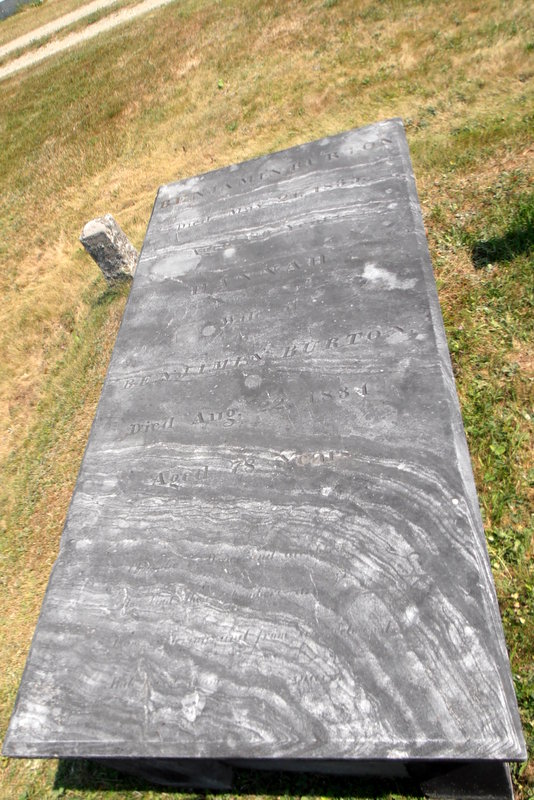
That third man was actually named Benjamin Burton. He was born 9 Dec 1749 in Thomaston and died 21 May 1835 in Warren, having lived much of his life in Cushing. The top of his marble sarcophagus appears here, courtesy of Find-a-Grave.

Burton rose to the rank of major during the Revolutionary War and also had an exciting time as a prisoner of war alongside Gen. Peleg Wadsworth. He later became a colonel in the militia, magistrate, and legislator.

Obviously by 1833 Burton was stating publicly that he had helped to destroy the tea in Boston harbor. In that same period he was also applying for a federal pension for his Revolutionary War service. His application file says nothing about the Tea Party, which wasn’t pertinent to whether he qualified.

Benjamin Carp’s Defiance of the Patriots cites a letter from Burton to Maine historian William D. Williamson in 1835 as a source. The book says Burton was a sailor on the Cumberland who happened to be in Boston on the crucial night and joined in destroying the tea. I haven’t seen that letter to know if it offers more detail to assess.

Thirty years later, in his History of Thomaston, Rockland, and South Thomaston, Maine, Cyrus Eaton relayed Burton’s claim to be at the Tea Party this way:
[Burton,] happening to be at Boston on a visit, went in the crowd to the Old South meetinghouse, and, as soon as the patriot orator had closed his animated address, hearing the shout tea-party, tea-party, and being touched with the spirit of the times, joined the party, was stationed in the hold of one of the ships to fasten the slings upon the tea-chests, and labored with his might between two and three hours in the work of destruction. It being about the time of low water, the detested tea rested on the ground and, when the tide rose, floated as a scum upon the water and was lodged by the surf along the shores.
That account strikes me as unreliable. The term “tea party” wasn’t applied to the event until the 1820s.

Even farther afield, the website of the Tea Party Ships and Museum states that Burton “was also one of the men who led the meeting at the Old South Meeting House before the tea protest actually began.” None of the nineteenth-century sources makes such a claim. It’s possible that was based on a misreading the phrase about “the patriot orator” above as applying to Burton rather than Samuel Adams or another of the politicians who spoke that night.

Monday, February 06, 2017

Dinner with the Old Colony Club in 1769

The Old Colony Club started as a group of seven young gentlemen from Plymouth. They formed their club in January 1769, and on 22 December of that year had a dinner to commemorate the landing of the first British settlers in what was then the Plymouth Colony but was subsumed into Massachusetts.

The dinner took place at the inn of Thomas Southworth Howland, another descendant of the first settlers, starting at 2:30 P.M. According to club records, the food consisted of:

1. A large baked Indian whortleberry pudding.

2. A dish of sauquetash.

3. A dish of clams.

4. A dish of oysters and a dish of codfish.

5. A haunch of venison roasted by the first jack brought to the Colony.

6. A dish of sea-fowl.

7. A ditto of frost-fish and eels.

8. An apple pie.

9. A course of cranberry tarts, and cheese made in the Old Colony; dressed in the plainest manner (all appearances of luxury and extravagance being avoided, in imitation of our worthy ancestors whose memory we shall ever respect).
At 4:00 the club walked solemnly back to “Old Colony Hall,” the procession “headed by the steward carrying a folio volume of the laws of the Old Colony” of Plymouth. Other descendants gathered as a military company and “discharged a volley of small arms, succeeded by three cheers.”

Peleg Wadsworth brought out the boys from his “Private Grammar School opposite the Hall,” who sang “a song very applicable to the day.” Young Elkanah Watson might have been among those boys; his namesake father, his teacher Wadsworth, and the school’s other teacher, Alexander Scammell, were among the men who joined the club members for toasts that afternoon.

The public part of the ceremony ended at sunset with a cannon being fired and the club taking down their “elegant silk flag” inscribed “Old Colony 1620.”

Friday, July 15, 2016

When Minutemen Marched into Marshfield

So in 1775 there were a hundred British soldiers stationed in Marshfield, mostly on the estate of Nathaniel Ray Thomas. Their commander was Capt. Nisbet Balfour of the 4th Regiment.

And on the morning of 20 April, according to Isaac Thomas (who was nine years old at the time), the Marshfield militia was summoned by musket shots and drum.

I wouldn’t just leave the story there, would I?

The colonel of the Plymouth County militia was Theophilus Cotton (detail of his gravestone shown above, courtesy of Find-a-Grave). We have many documents about militia companies that he commanded that day, such as this roster from Hanson. That’s because the men who turned out in April 1775 expected to be paid, so the Massachusetts government asked for and kept paperwork with their names and days of service.

However, we don’t have, to my knowledge, contemporaneous narratives of what happened in Marshfield, from either the locals or the British troops. Instead, we have accounts written decades later by the historians of nearby towns, based and focused on the activities of men from those towns.

Dr. James Thacher’s History of the Town of Plymouth (1832) relates two detailed and flattering anecdotes about how Plymouth’s “watchful sons of liberty” intimidated British officers visiting from Marshfield. As for the military activity in Marshfield, he wrote:

Capt. Balfour, with his company remained at Marshfield for several weeks unmolested, but the day after Lexington battle, governor [Thomas] Gage, apprised of their danger, took off his troops, by water, to Boston.

At this period minute companies were organized in town, and immediately on hearing of the bloodshed at Lexington, Col. Theophilus Cotton, of this town, marched to Marshfield with a detachment of militia under his command. There were at the same time about sixty fishing vessels with their crews on board at anchor in Plymouth harbor. The fishermen voluntarily left their vessels, and speedily marched to Marshfield with their arms, resolutely determined to attack the company of British troops. When arrived at Marshfield, their numbers had increased to near one thousand men, collected from the different towns, burning with the feelings of revenge: they might have surrounded and captured the whole company before they could get to their vessels, but were restrained by Col. Cotton, who it is said had received no orders for the attack.
A more detailed account appeared seventeen more years on in Justin Winsor’s History of Duxbury (1849):
Immediately after the news arrived of the bloodshed at Lexington, Col. Cotton with his regiment formed for an attack on Balfour’s party. On the 20th Col. Cotton and Maj. [Ebenezer] Sprout met in Duxbury, at Col. Briggs Alden’s for consultation. Maj. Judah Alden, who was in Rhode Island when the news came of the fight, had just returned, having ridden all day on horseback, and soon after learning the circumstances of the case, he met Cato, a negro who had been sent by Capt. Balfour to ascertain the numbers of the men who were marching against him. Maj. Alden suspecting his design, told him to tell Balfour, they were coming in a host after him, and dismissed him.

Col. Cotton again returned to Plymouth; and, about 7 o’clock, on the morning of the 21st, marched for Marshfield with a portion of his regiment, consisting of the Plymouth company under Capt. [Thomas] Mayhew, the Kingston under Capt. Peleg Wadsworth, and the Duxbury under Capt. Geo. Partridge. They proceeded to Col. Anthony Thomas’ [sic], about a mile N. W. of Capt. John Thomas’, where were Balfour’s troops.

At this juncture Col. Cotton and Lt. Col. Alden held a long conference, as to the course to be taken. At noon there were assembled about 500 men, including the crews of many fishing vessels in the harbor. In the afternoon Capt. [Earl] Clapp’s company from Rochester and Capt. [Jesse] Harlow’s from Plympton arrived. Capt. Peleg Wadsworth was greatly dissatisfied with the delay, and moved forward his company until within a short distance of the enemy, and then halted as his numbers were too small to venture an attack.

About 3 o’clock, P. M., two sloops hove in sight and anchored off the Brant rock. Balfour then conveyed his company through the Cut river [Green Harbor] in boats, and reaching the sloops soon sailed for Boston, leaving however several sentinels behind to watch the movements of the Americans, who also set guards for the night.

The British watch finally left and in going to their boats, they passed one of the American sentry posts, where were stationed Blanie Phillips, and Jacob Dingley, both of Duxbury. Dingley was seized, and conveyed to their boat, when they concluded to release him. Phillips escaped, fired his gun, and gave an alarm, which roused the country for many miles around.

Balfour, it is reported, said that if he had been attacked, he should have surrendered without a gun. In their hurry to escape they left much of their camp equipage behind.
That final detail is the sort that always makes me skeptical: no source for information from the other side of the war, flattering to the author and readers as local descendants. In the following sentences Winsor cited “an inhabitant of Duxbury” whom Balfour spoke with in New York later in the war, so it’s possible the captain told that person. But it’s also possible that’s what the Plymouth County men told themselves.

With Capt. Balfour and the regulars went Nathaniel Ray Thomas, who settled in Nova Scotia, and possibly some other Marshfield Loyalists. His Patriot son John regained the mansion at the center of the estate after the war. Later Daniel Webster bought that house and enlarged it, creating the Victorian structure which (after a fire) is now reproduced on the property. Locals point out that could have been the site of the second battle of the Revolutionary War.

Sunday, January 17, 2016

Elkanah Watson’s “embryo military duties”

I’m skeptical about a bunch of the stories Elkanah Watson told in his memoir, Men and Times of the Revolution, but I like this early anecdote of growing up in Plymouth:
I remained at the ordinary common-school until the age of fourteen. This school was kept by Alexander Scammel and Peleg Wadsworth, both afterwards distinguished officers in the revolutionary army. In common with the other patriotic spirits of the age, they evidently saw the approach of the coming tempest. I remember them as early as 1771, intently studying military tactics, and have often seen them engaged in a garden adjoining my father’s, drilling each other.

They formed the boys into a military company, and our school soon had the air of a miniature arsenal, with our wooden guns and tin bayonets suspended around the walls. At twelve o’clock, the word was given, “to arms,” and each he seized his gun; then, led by either Scammel or Wadsworth, we were taught military evolutions, and marched over hills, through swamps, often in the rain, in the performance of these embryo military duties. A sad and impressive commentary upon the effect of these early influences, is afforded by the fact that half this company perished in the conflicts of the Revolution.

Scammel was tall in person, exceeding six feet, slender and active. He was kind and benevolent in his feelings, and deeply beloved by his pupils. He was eminently distinguished during the Revolution for his conduct and bravery. In 1777, he was very conspicuous at the battle of Saratoga, leading his regiment of the New-Hampshire troops, in a desperate charge upon Burgoyne’s lines. At the siege of Yorktown, he held the important station of Adjutant-General to Washington’s army, and there fell in a reconnoisance upon the British works.
Actually, Scammell (shown above) had resigned as adjutant earlier in 1781 to take up a battlefield command. But otherwise Watson had accurate information about him.