J. L. BELL is a Massachusetts writer who specializes in (among other things) the start of the American Revolution in and around Boston. He is particularly interested in the experiences of children in 1765-75. He has published scholarly papers and popular articles for both children and adults. He was consultant for an episode of History Detectives, and contributed to a display at Minute Man National Historic Park.

Subscribe thru Follow.it


•••••••••••••••••


Showing posts with label William Prescott. Show all posts

Tuesday, June 23, 2026

The Significance of Breed’s Hill Instead of Bunker’s

For one last posting on the label “Breed’s Hill,” I’ll share some thoughts on whether that label matters.

These days, it’s mostly useful as a fact that people (mostly of the male variety, to be frank) deploy to show they know more than average: ‘Well, actually, the Battle of Bunker Hill was fought on Breed’s Hill.”

Which is true, though:
Even more trenchant, what difference did that name make to the outcome of the battle? How did the “Breed’s Hill” label affect the seizure of the Charlestown peninsula? Or the deaths or wounding of nearly 1,500 men?

Well, actually, there’s an argument that Col. William Prescott’s insistence on fortifying Breed’s Hill before Bunker’s Hill, as he understood his orders to specify, did shape the outcome of the battle. Could the provincials have prevailed if they’d had a strong fallback position?

I’m dubious. The goal of the Massachusetts command—the committee of safety, Gen. Artemas Ward, and his council of war—was to keep the British army from seizing the Charlestown and Dorchester peninsulas, as intelligence said the Crown would soon try to do. The New England army’s countermeasure was to seize those positions first.

The real challenge, as Gen. John Thomas indicated from Roxbury, was holding those positions against a British counter-countermeasure. Thomas didn’t think that was feasible and declined to go onto Dorchester Heights that June.

The geography of Charlestown was more welcoming for such an advance from the mainland, but it doesn’t look like the New England army was truly prepared to hold that ground. With only a couple of days to get organized, the provincials didn’t have all the tools, artillery, and reinforcements lined up to fortify and stay on those high points. We see that from the limited support the front-line troops got during the battle.

Even beyond that, the crucial problem for the New England army turned out to be gunpowder. That would have been a problem no matter which hill they fortified.

To be fair to Gen. Ward, he was worried about a possible second British advance in Roxbury or elsewhere along the siege lines. He couldn’t throw all the provincial resources into Charlestown. But the Continental operation to fortify Dorchester Heights in March 1776 shows how effective preparation could overcome adverse conditions.

I even wonder if fortifying Bunker’s Hill might have changed the British commanders’ thinking in a way that would have produced a worse outcome for the provincials. Gen. William Howe saw a small redoubt on a relatively short hill that was close enough for cannon to reach Boston and thus worth cleaning out. He focused on that spot, with disastrous results.

If Howe had seen fortifications on Bunker’s Hill also or instead, he might have decided on a more cautious strategy, focused on cutting the provincials off at the neck. That might have produced many more rebel casualties and fewer British ones. The New Englanders could have ended the day more dismayed, the regulars more chuffed, with a consequent effect on the larger siege.

Monday, June 22, 2026

“Orders to march to Breeds Hill in Charlestown”

As I quoted yesterday, in July 1775 the Massachusetts Provincial Congress officially deemed the provincial fortification of Breed’s Hill in Charlestown to have been done “by some Mistake.”

Nine months later, Dr. Cotton Tufts echoed that assessment in a letter to John Adams: “Could a greater Blunder have been committed than that of Breeds Hill. Yet it finally has operated to our Advantage and trust will continue to do so.”

By then, New Englanders had decided that the Battle of Bunker Hill had worked out well because, even though they’d suffered hundreds of casualties and lost territory, the cost for the British army was catastrophic.

Who had made that fateful mistake? The report used the passive voice to avoid naming names, but everyone knew the battlefield commanders who’d overseen the building of the redoubt were Col. William Prescott, Connecticut general Israel Putnam, and Massachusetts colonel Richard Gridley of the artillery.

And the rumor I quoted here absolved Gridley, saying one of the top two infantry officers had insisted on Breed’s Hill. Or, to be exact, either Prescott or Putnam had insisted on digging the redoubt there before fortifying a fallback position on Bunker’s Hill, as the other two men thought wise.

Adams followed up the report from Massachusetts with some questions from Philadelphia. On 25 August, Prescott wrote back: “On the 16 June in the Evening I received Orders to march to Breeds Hill in Charlestown. . . . We arrived at the Spot, the Lines were drawn by the Enginier and we began the Intrenchmant…”

No written orders survive. If Gen. Artemas Ward and his council of war did indeed use the name “Breed’s Hill,” that would be our earliest confirmed example of that label, before the newspapers accounts I quoted here. But it’s also possible Prescott wrote “Breed’s Hill” in hindsight to reflect his understanding of those orders.

Prescott’s letter criticized some other officers. Gridley “the Enginier forsook me.” His “Field Officers being indisposed could render me but Little Service.” That makes it notable that Prescott didn’t complain about Putnam overruling his judgment and insisting on fortifying Breed’s Hill first. It thus seems clear that Prescott had been the officer sticking to that course.

Prescott didn’t take that position (figuratively and literally) because he deemed it more strategic for attacking Boston, as some analysts have argued. He declared that he was following instructions from his superiors. Perhaps those orders included some ambiguous term like “Charlestown Hill.” The memory of such a command probably empowered Prescott to convince Gridley to draw the entrenchment lines despite his and Putnam’s concerns—because that’s what they understood the council of war had told them to do.

TOMORROW: Why that mattered.

Saturday, June 20, 2026

“The engineer and two generals went on to the hill”

engraved portrait of Israel PutnamYesterday I quoted Samuel Gray’s 11 July 1775 description of the Battle of Bunker Hill, based on what he called “my own knowledge.”

Gray wasn’t in the battle—he was probably behind the lines in Roxbury—but he could describe the terrain and basic action.

Gray then went on to share a rumor that must have been going around the provincial camps, specifying that this wasn’t first-hand knowledge:

I am informed that, in a council of war, it was determined to intrench on Charlestown Hill and on Dorchester Hill the same night, but not till we were so supplied with powder, &c., as to be able to defend the posts we might take, and annoy the enemy; that on Friday a resolution was suddenly taken to intrench the night following, without any further council thereon; that the engineer and two generals went on to the hill at night and reconnoitered the ground; that one general and the engineer were of opinion we ought not to intrench on Charlestown Hill till we had thrown up some works on the north and south ends of Bunker Hill, to cover our men in their retreat, if that should happen, but on the pressing importunity of the other general officer, it was consented to begin as was done.
Gray didn’t name names. But “the engineer” was Richard Gridley, commander of the artillery regiment. The “two generals” were William Prescott (actually a colonel) of Groton and Israel Putnam from Connecticut (shown above).

A fair amount of ink has flowed out debating whether Prescott or Putnam was responsible for building the redoubt on Breed’s Hill (Gray’s “Charlestown Hill”) before fortifying portions of the taller Bunker’s Hill.

Some authors have written Putnam made that call, based on his higher rank; his image as fearless, aggressive fighter; and a conviction that he was in command of the provincial troops during that battle.

Others point out that Prescott oversaw the building of the redoubt and then its defense while Putnam was more focused on Bunker’s Hill, trying to get men to fortify there.

And of course there’s the possibility that Gray’s information was incorrect, that Gridley, Putnam, and Prescott did discuss where to fortify but didn’t divide so neatly, at least on that night.

This letter confirms that in the weeks after the battle people were asking why the provincials positioned themselves as they did. Because that was turning out to be a very big deal.

TOMORROW: Mistakes were made?

Thursday, June 11, 2026

Remembering the Battle of Bunker Hill This Week

Next week brings the 251st anniversary of the Battle of Bunker Hill, and the Charlestown Historical Society and partner organizations have planned several events to commemorate it.

On Saturday, 13 June, there will be an Author & Historian Symposium in the lodge beside the Bunker Hill Monument. Among the scheduled speakers from 10 A.M. to 4:30 P.M. are:
  • Timothy Reardon on the Brothers of the Battle of Bunker Hill descendants group 
  • James Philbrick on his ancestor, David Howe
  • Joni and Christine Parker on their ancestor, Benjamin Parker
  • Christian Di Spigna on Dr. Joseph Warren
  • J. L. Bell on the “whites of their eyes” quotation
  • Joe Bagley on archeology in Charlestown, including the dig completed the day before
  • Julie Hall on how public relations shaped the American Revolution
Throughout the day family artifacts, letters, journals, ephemera, and other historic items will be on display for visitors. A musket demonstration by the National Park Service is scheduled for 4:30.

Charlestown’s annual Bunker Hill Day Parade will be on Sunday, 14 June, from 12:30 to 4:30 P.M. I understand through other sources that there will also be a sidewalk demonstration against White House censorship of signs quoting later generations on the monument inside the lodge, as discussed here.

On Tuesday, 16 June, the society, the city of Boston, and GBH will cohost a community viewing of the Bunker Hill portion of Ken Burns, Sarah Botstein, and David Schmidt’s documentary series The American Revolution. Some of the historians, archeologists, and descendants from Saturday will be on hand, as well as Donald R. Ryan, biographer of William Prescott. That discussion will take place from 6 to 8 P.M. in the street-level meeting room of the Bunker Hill Museum.

On Wednesday, 17 June, the Bunker Hill Monument Association will have its annual meeting at 11 A.M. in the museum. Prof. Robert Allison from Suffolk University will speak on “The Importance of the Left Flank and the Rail Fence.” This event is open to B.H.M.A. members and invited guests only.

Finally, from 3:30 to 5 P.M. that Wednesday, the annual Remembrance Ceremony on the monument grounds will be open to the public.

Monday, January 19, 2026

“It was attributed to General Prescott”

After the British army and the New England provincials went to war in April 1775, people stopped worrying about political pamphlets like A Letter from a Veteran, to the Officers of the Army Encamped at Boston.

John Adams broke off his “Novanglus” essays. The New York printer Hugh Gaine struggled to remain politically balanced, literally printing on both sides of the conflict. Most prewar essays fell into obscurity.

Nearly half a century after A Letter from a Veteran appeared, William Tudor, Jr. (1770–1830, shown here), wrote about it in The Life of James Otis, of Massachusetts:
A few of the officers felt an esteem for the people, and were reluctant to engage in a civil war, which they knew would bring great misfortunes upon the country, and as they supposed, overwhelm it. There was to much folly and disgusting arrogance in many of the subalterns, and careless ignorance about the whole subject of dispute, that one of their superior officers published a small pamphlet, entitled, “A letter from a Veteran to the Officers of the army encamped at Botton.” It is remarkably well written, and while it justifies his own government, reproves the frivolity and rashness that treated the Americans with contempt. It was attributed to General Prescott.
Tudor didn’t state a source for this information, and the expression “It was attributed” suggests he wasn’t completely sure about it.

That book might have given the pamphlet more visibility. James Fenimore Cooper took a passage from A Letter from a Veteran (imperfectly cited) as a chapter epigraph in his 1825 novel Lionel Lincoln: or, The Leaguer of Boston. His protagonist was a British army officer with conflicting loyalties.

Tudor’s emphasis on how A Letter from a Veteran “reproves” British officers who showed contempt for Americans might also have given people a false sense of its overall argument. It expressed very little sympathy for New Englanders.

In 1860 a catalogue of the Massachusetts Historical Society library attributed A Letter from a Veteran to, of all people, Col. William Prescott, the commander of the provincial redoubt at Bunker Hill.

That made no sense. William Prescott was never a high officer in the regular British army or, so far as I see, any sort a general. He wasn’t a political writer, and he certainly wouldn’t have published a criticism of New England religious zealotry.

Nonetheless, the attribution to William Prescott was repeated in other American publications for the rest of the nineteenth century.

TOMORROW: General Prescott and General Prescott.

Monday, June 17, 2024

Capt. John Linzee’s Ties to Boston

This is the anniversary of the Battle of Bunker Hill in 1775.

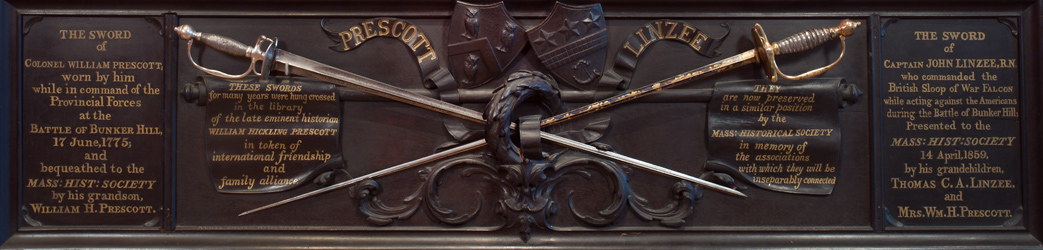
Among the Massachusetts Historical Society’s unique artifacts from that event are the crossed swords of Col. William Prescott from the provincial troops and Capt. John Linzee from the Royal Navy, as highlighted here.

Those weapons were donated by the historian William Hickling Prescott, his wife Susannah, and her cousin. William was a grandson of the colonel. Susannah was a granddaughter of the captain.

Though born in England and serving the king, Capt. Linzee had strong ties to Boston. In 1772, while master of H.M.S. Beaver, he married Susannah Inman of Cambridge, favored niece of John and Hannah Rowe.

The Linzees started having children. The first was born in Plymouth, England; the second back in Boston during the siege; the third on the Delaware River, reportedly during a battle which it didn’t outlive.

The Linzees’ fourth child was born at Barbados, the next four in Plymouth. The captain had a busy war.

Susannah Linzee’s father, Ralph Inman, had left Boston in the evacuation of 1776. Her stepmother, Elizabeth (Murray Campbell Smith) Inman, never left. She kept hold of their property, which is how he could return to his Cambridge estate when the fighting died down.

John Rowe also never left. When that merchant died in 1787, he bequeathed Susannah Linzee some Boston property. She came back to America, and the Linzees’ ninth child was born in Boston in 1789.

The following September, Capt. Linzee sailed H.M.S. Penelope into Boston harbor, writing to Gov. John Hancock that he intended to salute the flag of the U.S. of A. with thirteen guns if the battery at the Castle would reciprocate.

Linzee’s letter also mentioned his “exceeding ill State of Health,” and indeed he was so sick the Penelope sailed away without him while he recuperated in his wife’s house. A few months later, however, Capt. Linzee was back “in perfect health” on his ship along with his two eldest sons.

In the following years, things started to go wrong for Capt. Linzee.

TOMORROW: A British officer in Boston.

Monday, June 17, 2019

Refighting Bunker Hill with the Angry Staff Officer

This is the anniversary of the Battle of Bunker Hill. For an overview of the action this year, I’m pointing to the Angry Staff Officer’s article “Warfighter: Bunker Hill.”

It sets aside the mysteries, ambiguities, and evidence that historians focus on, and also applies modern military terms to the situation in 1775. Here’s a taste:
On the night of June 16, Col. [William] Prescott with chief engineer Richard Gridley and about 500 men crossed Charlestown Neck and occupied Breed’s Hill. Equipped with survivability equipment, they began construction of a fighting position on the height of the crest. During the night, ISR assets on the Royal Navy ships in the harbor spotted the movement and called for fire on the hill. Rounds began to impact, but the guns soon fell silent: Admiral Richard [sic—Samuel] Graves had been awoken by the firing and ordered the men to cease fire. Working all night, the Patriots dug a substantial fortification on Breed’s Hill with earthworks and firing platforms. When the sun rose, the British found that the height had been seized and fortified.

During the morning hours, more men arrived on the neck and began improving the fighting positions. An earthen trench was constructed down the left side of the redoubt. Just behind it, the New Hampshire and Connecticut troops constructed additional defenses extending to the left using log fences and stone walls to erect a position that ran down the slope towards the Mystic River. Between the fence and the trench, pioneers dug three v-shaped trenches to tie in the trench and the fence. This still left the extreme left vulnerable to flanking parties moving along the coast, so Col. [John] Stark led a detachment down the bluff to the river and emplaced a series of rock walls in depth. He then placed detachments of marksmen behind each wall, with strict fire control measures. He drove a stake forty yards in front of this position, with instructions for his men to aim at the enemy’s feet; this compensated for the natural rise of the musket and would place their fire center mass.

Arrayed across the dominant heights, the Patriot forces overlooked the key terrain where the British would have conduct an amphibious landing. Between this beach and the heights lay a series of swamps and rail fences that served as natural obstacles that would disrupt British movement and maneuver.

Secondary fighting positions were constructed on Bunker Hill to the rear of Breed’s Hill to serve as a fallback position for Patriot forces should they be forced to retrograde.

Fires

With their navy, the British brought significant fires dominance to the battlefield. Naval gunfire began again in the early morning hours of June 17 to suppress the Patriot lines. Over 100 guns were brought to bear on the enemy lines. This sustained fire was also meant to disrupt Patriot movement, but the natural lay of the land allowed Patriots to maneuver their forces in relative safety. In the afternoon, the British landed 12 pound and 6 pound batteries on the beach to provide additional suppressive fire.

The Patriots had four guns in position between the Connecticut and Massachusetts troops, but their gunners abandoned the field prior to the battle and so negated the majority of effects of the guns.

Sustainment

The British were forced to move all supplies via boat across the river, slowing their rate of supply and reinforcement significantly. The 6 pounder battery commander neglected to conduct a precombat inspection prior to deployment and found to their chagrin that their caissons were filled with 12 pound shot rather than 6 pound shot. This denied General [William] Howe his mobile fire support that he was counting on for close in fires.

On the Patriot side, they were already dangerously short of gunpowder. Each soldier had only about 30-40 rounds of ammunition. Lack of an overall field commander meant that there was no one individual tasked with overseeing logistics from the assembly area to the forward line of troops. This oversight would play an outsized role in the coming fight.
Now that we’ve reviewed the big picture, I’ll get into the smaller stories and questions.

Monday, June 12, 2017

Moses Parker and His Comrades in the Redoubt

As I said yesterday, Col. Ebenezer Bridge’s regiment was one of the New England units ordered onto the Charlestown peninsula on the night of 16 June 1775. Maj. John Brooks and three companies stayed behind at first for other duties, but Bridge, Lt. Col. Moses Parker, and the rest of the regiment crossed the isthmus to Bunker’s Hill.

That meant those men helped to dig the redoubt on Breed’s Hill during the morning of 17 June. The soldier usually said to be first killed in the battle was a member of the regiment: Asa Pollard of Billerica. Men from Bridge’s regiment were presumably those who wanted to give their comrade a religious burial while Col. William Prescott insisted they keep digging.

In the same regiment, Capt. Ebenezer Bancroft’s company used a cannon to widen embrasures in the redoubt, as discussed here. Capt. John Ford and his men fired another of the cannon left behind by members of the Massachusetts artillery regiment.

During the battle Col. Bridge suffered wounds from a sword, indicating close combat at the end of the battle. Nonetheless, some junior officers accused him of “misbehaviour and neglect of duty,” saying he had cowered behind the walls of the redoubt. On 20 August, Gen. George Washington ordered “A Court of enquiry to sit this day, at three in the afternoon, to examine into the Reasons for a complaint exhibited against Col. Ebenezer Bridge.” On that board was Col. Prescott, who knew more than anyone about the conditions in the redoubt.

That board of officers recommended a general court-martial to adjudicate Bridge’s case. On 11 September, Washington’s general orders announced “The Court are of opinion that Indisposition of body, render’d the prisoner incapable of action, and do therefore acquit him.” Ebenezer Bridge remained with the army until December, then held military posts in Massachusetts for many years.

In that battle Bridge’s regiment suffered 16 or 17 men dead and 25 wounded. Lt. Col. Parker was shot in the thigh (or knee, according to one source) and left wounded in the redoubt. As the British troops swept over the fortification and up to Bunker’s Hill, they made Parker and the other wounded provincials into prisoners of war.

Reporting rumors from inside Boston, Abigail Adams wrote on 5 July:
Our prisoners were brought over to the long wharff and there laid all night without any care of their wounds or any resting place but the pavements till the next day, when they exchanged it for the jail, since which we hear they are civily treated. Their living cannot be good, as they can have no fresh provisions.
Later American accounts declared that the conditions inside the Boston jail were terrible, though no jail at that time was healthy. This period was when Boston suffered the worst food shortages since the British government’s supply ships hadn’t yet started to arrive.

Parker’s wound apparently became infected. Surgeons amputated his leg, probably a desperate measure. On 4 July 1775, he died.

TOMORROW: Remembering Moses Parker.

Thursday, June 16, 2016

Two Swords from the Battle of Bunker Hill

It’s that time of year, when Boston 1775’s thoughts turn to the anniversary of the Battle of Bunker Hill on 17 June.

Boston Magazine’s website just featured one of the Massachusetts Historical Society’s most striking artifacts of that fight: the crossed swords of Col. William Prescott of the Massachusetts army and Capt. John Linzee of the Royal Navy:
Both men figured prominently in the battle—Linzee’s ship fired upon Prescott’s men—and their weapons were passed down through their respective families. Nearly 50 years after the conflict, the bitterness of war gave way to the power of love when Prescott’s grandson—William H. Prescott—married Susan Amory, a descendant of Linzee.
The merchant John Rowe listed the guests at his niece Susannah Inman’s marriage to Capt. Linzee on 1 Sept 1772. According to The Linzee Family of Great Britain and the United States of America, the Linzees had a daughter they named Hannah Rowe Linzee, who married Thomas Coffin Amory. That couple’s child Susannah married the historian William H. Prescott, who bequeathed the swords to the society in 1859.

Another Linzee granddaughter, born Elizabeth Tilden Linzee, married James Sullivan Warren, a grandson of Dr. John Warren and great-nephew of Dr. Joseph Warren, who died at Bunker Hill. And a Linzee great-granddaughter married a grandson of Paul Revere.

The Rev. Nathaniel Frothingham missed the M.H.S. meeting when those swords arrived, but he was nonetheless inspired to write this poem about them:
The Crossed Swords
Transferred from Mr. Prescott’s Library to that of the Massachusetts Historical Society.


Swords crossed,—but not in strife!
The chiefs who drew them, parted by the space
Of two proud countries’ quarrel, face to face
Ne’er stood for death or life.

Swords crossed, that never met
While nerve was in the hands that wielded them;
Hands better destined a fair family stem
On these free shores to set.

Kept crossed by gentlest bands!
Emblems no more of battle, but of peace;
And proofs how loves can grow and wars can cease,
Their once stern symbol stands.

It smiled first on the array
Of marshalled books and friendliest companies;
And here, a history among histories,
It still shall smile for aye.

See that thou memory keep
Of him, the firm commander; and that other,
The stainless judge; and him, our peerless brother,—
All fallen now asleep.

Yet more: a lesson teach,
To cheer the patriot-soldier in his course,
That Right shall triumph o’er insolent Force:
That be your silent speech.

Oh, be prophetic too!
And may those nations twain, as sign and seal
Of endless amity, hang up their steel,
As we these weapons do!

The archives of the Past,
So smeared with blots of hate and bloody wrong,
Pining for peace, and sick to wait so long,
Hail this meek cross at last.

Sunday, June 21, 2015

Sgt. George Marsden of His Majesty’s 59th Regiment

To delve into the British army career of George Marsden, I turned to Don Hagist, author of British Soldiers, American War and other books.

Don checked his thorough records and found that Marsden first arrived in New England in 1768 with the 59th Regiment of Foot in a company commanded by Capt. John Willson. They came to Boston, and local Whigs soon made Capt. Willson notorious for supposedly encouraging slaves to revolt.

As Don told me:
Marsden is on the April 1769 roll for the grenadier company, prepared in Boston. On the October 1770 roll for the company he shows up as being appointed serjeant, but in 1774 he’s a private again.
Unfortunately, the regiment did a lousy job in filing its paperwork, so we don’t know about anything the dates in between except that the regiment was in Nova Scotia from 1769 to 1774. (Marsden’s descendants also understood him as coming through Nova Scotia with the British army, but as an officer during the earlier French and Indian War.)

The fact that Marsden (usually written “Marsdin” in the muster rolls) became a sergeant suggests that his officers saw him as intelligent and dependable. Furthermore, while enlisted men often bounced from private to corporal and back depending on the regiment’s needs, a sergeant usually stayed a sergeant. So what’s the significance of Marsden’s demotion? Had he lost his superiors’ confidence? Did he resent losing that rank? We don’t know.

On 24 July 1774, the 59th Regiment prepared to sail from Nova Scotia back to Boston as part of Gen. Thomas Gage’s build-up of troops. And Pvt. George Marsden was no longer with them.

Don tells me that British regiments often suffered a wave of desertions just before they made a big move. Soldiers might have built ties with locals that they were loath to break, or they might have realized that their officers’ departure meant this was a good chance to make a run for it.

After July 1774 Marsden disappears from all records, as far as I can tell, until he enlisted in Col. James Scamman’s Massachusetts regiment on 19 May 1775. That unit was made up of men from southern Maine and New Hampshire. Marsden’s home was then listed as “Londonderry,” which one later researcher interpreted to mean Londonderry in Ireland. However, that same document listed several other men from Londonderry as well, so it probably referred to Londonderry, New Hampshire. Evidently Marsden had found his way to that town.

Marsden became the Scamman regiment’s adjutant, an administrative post, undoubtedly because of his experience as a sergeant in the British army. A month later came the Battle of Bunker Hill. Marsden’s old regiment, the 59th, was fighting on the British side. Had Marsden been captured, he would almost surely have been recognized, tried as a deserter in arms with the enemy, and executed. Nevertheless, he pushed ahead to the front lines faster than his colonel.

Adj. Marsden testified against Col. Scamman in his court-martial the following month, and I can’t imagine that the regimental meetings were smooth after that. At the end of the year, however, it was clear who prevailed. Scamman was left out of the Continental Army. In contrast, Marsden was commissioned as a Lieutenant in Col. William Prescott’s regiment—i.e., the commander who had actually been in the redoubt on Breed’s Hill was ready to fight alongside him. (Similarly, Ens. Joshua Trafton, who also got on Scamman’s bad side, was offered a lieutenant’s commission and eventually became a captain.)

George Marsden is thus like Thomas Machin, Daniel Box, Andrew Brown—deserters from the king’s army who had been recognized for their skills but barred by the British class system from rising into the officer class. In the Continental Army, Marsden became an officer. In the new republic, he was considered a gentleman. Like Machin and Brown, Marsden or his family retroactively came up with a more genteel history for him in Britain, making him an officer of the king who resigned before the war and wiping out any embarrassment about his having deserted.

TOMORROW: Marsden’s mysterious marriage.

Friday, April 24, 2015

John Jupp “found his way to Shirley”

Among the men from Shirley who marched during the Lexington Alarm of 19 Apr 1775 was John Jupp, a private in Capt. Henry Haskell’s company, Col. William Prescott’s regiment.

Jupp had more recent military experience than most of his companions. According to Seth Chandler’s History of the Town of Shirley, Massachusetts, he
was an Englishman by birth, and a soldier of the British army that came here to enforce colonial obedience. He was connected with the military department under Governor [Thomas] Gage at Boston, previous to the outbreak of the American Revolution. He deserted from the service of the king and found his way to Shirley…
Jupp and Mary Simonds recorded their intention to marry on 12 Nov 1774 in the Shirley meeting-house (shown above in its present form).

If her death listing from 1826 was accurate, Mary Simonds was born about 1735, making her close to forty years old when she wed. I suspect she had property since Jupp was said to have “owned a small farming estate, situated near the center of the town,” and a recently deserted soldier wouldn’t have been able to buy such land.

On 16 Jan 1775, Jupp sold a silver watch for cash and three dollars on credit to James Parker (1744-1830), who was teaching school in Haskell’s shop. Again, this doesn’t seem like the sort of property a deserting soldier would have on his own, but who knows?

Jupp served with the town militia company for ten days in April 1775. Shirley’s vital records say John and Mary Jupp had a daughter on 26 September. (However, another transcription of those records indicates that the child born that day was named John; I assume that was a misreading.)

In January 1776, John Jupp was 74 miles away in the camp at Cambridge, once again serving in a militia company under Capt. Haskell. Massachusetts had called those men up to ensure the lines around Boston didn’t collapse while Gen. George Washington strove to rebuild his forces.

Then on 9 Mar 1777, John Jupp enlisted as a private in the Continental Army for three years. He was in Capt. Sylvanus Smith’s company, Col. Timothy Bigelow’s regiment—a unit that was at Saratoga and Valley Forge. Though military records state that John Jupp was “sick at Shirley” in January 1779, his wife and daughter saw little of him in those years.

TOMORROW: Can this marriage be saved?

Sunday, June 15, 2014

Capt. Bancroft and the Sight of the Enemy

Yesterday I started quoting from the reminiscence of the Battle of Bunker Hill credited to Ebenezer Bancroft, captain of a company from Dunstable, Massachusetts.

According to Bancroft, Col. William Prescott had given him charge of two cannon left in the redoubt on Breed’s Hill by the artillery company of Capt. Samuel Gridley. Bancroft had fired a couple of times, causing no damage but, he later claimed, nonetheless affecting the battle:
By this time the British had landed. They learned that we had cannon on the right or most westwardly part of the fort, which was probably the reason they did not attempt to flank us on that quarter till the close of the action. We were not able to use these cannon in the action because the enemy advanced and the firing commenced before we had time to dig down the bank far enough to use them against the enemy. Still as the few shots that were fired gave the enemy notice that we had artillery and prevented their attempting to turn our right flank, it must be regarded as a very important circumstance, for had they attempted it, they would have succeeded, and we should not have had more than a shot or two at them. I was fully persuaded that the moment they attempted this point, we could no longer maintain our fort, and the event showed that I was not mistaken, for it was not more than four minutes after they turned this flank before we were obliged to retreat.

The British troops had begun their march. They were steadily and confidently advancing directly in our front. Our men turned their heads every minute to look on the one side for their fellow soldiers who had gone off with the tools and for the reinforcements, which were expected, and on the other to see a sight to most of them new, a veteran enemy marching on firmly to the attack, directly in their front. It was an awful moment.

The enemy had advanced perhaps half the way from their station toward us, and our men seeing no reinforcements began by a simultaneous movement to draw off from the east side of the redoubt. This in my opinion was the very crisis of the day, the moment on which every thing depended. Col. Prescott hastened to them, and I followed him. We represented with earnestness that they must not go off, that if they did all would go; that it would disgrace us to leave, at the bare sight of the enemy, the work we had been all night throwing up; that we had no expectation of being able to hold our ground, but we wanted to give them a warm reception, and retreat. It is but justice to these men to say that they cheerfully took their places again, and maintained them as bravely as any that fought on that day.

As the enemy were advancing within gunshot, Col. Prescott and the officers gave orders to the men to take particular notice of the fine coats [of the officers and sergeants], and aim as low as the waistband, and not to fire till ordered. A firing of eight or ten guns commenced before orders, at the left of the redoubt, but was immediately stopped. We wished the fire to be held till the enemy were within six rods.

Our first fire was shockingly fatal. There was scarcely a shot but told. The enemy were thrown into confusion and retreated a short distance. Their lines were broken, and it was some minutes before they had conveyed their dead and wounded into their rear. A scattering fire was still kept up by our men.

They formed again and advanced, and were a second time driven back in the same confusion. They formed a third time and flanked us. A body of reinforcements which had come up in the rear of the redoubt, gave them a fire. At this moment, as I understood, Gen. [Joseph] Warren fell. Our ammunition was now nearly expended, which the enemy probably learned by those who had fired away all their powder, throwing stones, which were abundant in the trench. We were soon surrounded on all sides. The enemy had advanced on each side of the point of the redoubt, and were pouring into the gateway. The day was over, and we had nothing more but to retreat as well as we could.
Did Bancroft survive? (Well, of course he did since we have this recollection. But how?)

TOMORROW: Out of the redoubt.

Saturday, June 14, 2014

Capt. Ebenezer Bancroft and the Embrasures

With the anniversary of Bunker Hill coming up, I’m going to share some accounts of that battle, said to be from eyewitnesses. And in most cases I’m sure they really are from eyewitnesses.

The first comes from Ebenezer Bancroft (1738-1827) of Dunstable, Massachusetts, who was a captain in the provincial army. It was reportedly “written from dictation in 1826” by Bancroft’s grandson John B. Hill of Mason, New Hampshire, and printed for the first time in The Granite Monthly in 1878.

That magazine said it had taken the text from proofs of Hill’s Sketches of Old Dunstable, which was never published as a stand-alone book. Instead, Hill’s material was appended to a much shorter address that nevertheless gets top bibliographic billing: Bi-Centennial of Old Dunstable, by S. T. Worcester.

Here’s the start of Bancroft’s account:
On the night of the 16th of June, 1775, my company was ordered out with the detachment to take possession of the heights of Charlestown. This detachment consisted of three regiments commanded by Col’s [William] Prescott, [Ebenezer] Bridge and [James] Frye, and amounted in all to between 1000 and 1200 men. These regiments were principally from Middlesex county, Col. Prescott from Pepperell, Col. Bridge from Chelmsford, Col. Frye from Andover. I was that evening on a court-martial and could not get liberty to go with my company, but in the morning of the 17th General [Artemas] Ward granted me permission to join my company, though the court-martial was not through.

Soon after I reached the hill our men left work and piled their intrenching tools in our rear, and waited in expectation of reinforcements and refreshments, but neither reached us, if any were sent. The reinforcements halted at Charlestown Neck. Whilst I was standing by the redoubt before the action began, a ball from the Somerset passed within a few inches of my head, which seriously affected my left eye so that it finally became totally blind.

When the works were planned no calculation was made for the use of cannon, and of course no embrasures were left for them. But on the morning of the 17th two ship cannon were sent up and a platform with them. About ten o’clock the British troops began to make their appearance at the wharves in Boston.

General [Israel] Putnam, who had been incessant in his exertions through the morning to bring reinforcements, now rode up to us at the fort and says: “My lads, these tools must be carried back,” and turned and rode away. An order was never obeyed with more readiness. From every part of the line volunteers ran and some picked up one, some two shovels, mattocks, etc., and hurried over the hill.

When the pile of tools was thus removed I went through the lines to form an estimate of the number of men in the redoubt, at the same time stating that those who had gone with the tools would come back, though I was by no means confident that they would. I estimated the number then left in the redoubt at 150, but was afterward informed by one of the captains of Col. Frye’s regiment that he counted them, and the whole number, including officers, was 163. I was not certain that any reinforcements after this time came into the redoubt; thus the number of our effective force was very materially reduced. General Putnam had given his orders and gone, and nobody seemed to think it belonged to him to stop the men and execute the order in a proper way.

The artillery-men had all gone with the tools, and Col. Prescott came to me and said, “If you can do anything with the cannon I wish you would. I give you the charge of them.” I directed the men to dig down the bank in order to form an embrasure, which they were forced to do with their hands, for the party that had carried off the intrenching tools had not left us a single shovel or mattock. Men never worked with more zeal. Many of them dug till their fingers bled. To loosen the earth I loaded the cannon and fired into the gap, and they dug again, and I fired a second time. Both these balls fell in Boston, one near the meeting-house in Brattle square, the other on Cornhill, as I was afterward informed by Boston gentlemen.
The first time I read a retelling of that anecdote, it sounded like the provincials fired point-blank into the earthen wall to create the embrasures, and I recall at least one author expressing doubt that anyone would ever do that. Bancroft’s (or Hill’s) words suggest that the men started the excavate the openings by hand, and he fired the cannon through the narrow hole they opened in order to make it easier for them to widen. As to whether those shots reached all the way into central Boston, that still seems dubious.

TOMORROW: What effect did those cannon have on the battle?

Thursday, August 15, 2013

The Lessons of Bunker Hill for Gen. Washington

In preparing my presentation on the Battle of Bunker Hill earlier this month, I nearly came to the conclusion that Gen. George Washington took two lessons, one good and one bad, from what he heard about that battle. By “nearly” I mean those thoughts occurred to me too late to articulate in my talk, so I’m throwing them out now.

The first lesson was the value of preparation. New England troops moved onto the Charlestown peninsula on the evening of 16 June 1775 in haste, fearing that the British army was about to make a similar move. As a result, there was a lot left to arrange.

Col. Richard Gridley, Col. William Prescott, and Gen. Israel Putnam spent significant time discussing which hill to fortify. None of Gridley’s American artillery units went onto the peninsula until the next morning; one company discovered its gunpowder cartridges wouldn’t fit inside its cannons. Several regiments came onto the field on 17 June, but Prescott and Putnam were frustrated at the lack of reinforcements for the redoubt, leaving the same men who had spent all night digging that fortification to defend it.

In contrast, Gen. Washington and his staff meticulously planned the move onto the Dorchester peninsula in March 1776. Geography and the frozen ground made that a bigger challenge, solved in part by Col. Rufus Putnam’s idea to use pre-fabricated fortifications to provide cover while the men dug in. But Washington also made sure the artillery was moved in the night and well supplied. Fresh troops came onto the peninsula before daybreak. The Continental troops on Dorchester heights were in much better position for a fight than the troops in Charlestown nine months before.

However, Washington also took the lesson from Bunker Hill that he should seek to draw the British army into a big battle so that the Continental soldiers could kill and wound a lot of them. Throughout the siege of Boston the new commander kept proposing ways to storm the British positions. Washington agreed to Gen. Artemas Ward’s Dorchester strategy only after all the other generals had voted against his own plan, and only because he hoped that the British would finally come out for the big battle he wanted.

When Gen. William Howe cut short his attack on Dorchester and instead sailed away, Washington wrote to a friend in Virginia, “I can scarce forbear lamenting the disappointment as we were prepared for them at all points.”

For the next two years Washington and some of his generals kept pursuing the Bunker Hill strategy, trying to draw Howe into a deadly attack. The American commander did get the big battles he wanted—at Brooklyn, at Harlem Heights and White Plains, at Brandywine. But of course Gen. Howe won those battles, and the big casualties were on the American side.

Not until the Valley Forge winter of 1777-78 did Gen. Washington drop his quest for a big, decisive battle and become what his new artillery commander Henry Knox called “our Fabian commander.” Washington never oversaw a battle like Bunker Hill, with such high numbers of the enemy killed and wounded, but he had finally realized he didn’t have to.

Thursday, May 02, 2013

Q. & A. on Bunker Hill with Nathaniel Philbrick, part 2

Today Boston 1775 concludes a colloquy with Nathaniel Philbrick, author of Bunker Hill: A City, a Siege, a Revolution.

Q. What could the American commanders have done differently to win the battle? What could the British commanders have done differently to avoid such heavy losses? And how would a different outcome on 17 June 1775 have affected the siege of Boston or the war?

A. The most obvious failing of the American commanders had to do with the artillery regiment under Colonel Richard Gridley, who had the unfortunate habit of picking officers to whom he was related. With only one or two exceptions, the officers under Gridley’s command were both cowardly and ineffectual, and several of them were seen running scared from the scene of the battle.

Since most of the American troops were already terrified of the British cannons, it was especially unnerving to see their own artillery officers proving so pathetically incompetent. This led large numbers of soldiers to linger back on Bunker Hill, where they could avoid the battle to the south. For those fighting in the redoubt and along the breastworks and rail fence, it was infuriating to realize that hundreds, if not thousands of their own men were on the Charlestown peninsula but were providing them with no help.

Both Colonels William Prescott and John Stark were highly critical of Israel Putnam, who had stationed himself on Bunker Hill. Putnam seems to have chiefly occupied himself trying to build a fortification that might serve as a fallback position for those on the front line, but this was hardly a priority at this point in the battle when Prescott and Stark needed every soldier and musket they could get. According to Stark, if Putnam had done what he should have and gotten those lollygaggers to join the fighting, “he would have decided the fate of his country in the first action.”

On the British side, it might have all gone very differently if they had followed Henry Clinton’s advice and landed some soldiers to the north at Charlestown Neck, where they would have cut off the American retreat.

If the American army had been routed at Bunker Hill and the British had then pursued them into Cambridge, the war might have been effectively over before it even got started. If the Americans had decisively won the battle, it might have convinced the British ministry to agree to a compromise. The ironic thing is that both alternative outcomes would have meant that America remained a part of the British Empire.

Q. A movie studio has bought the dramatic rights to Bunker Hill. While acknowledging that authors have zero influence on casting, let’s imagine that you’re making that movie. You’ve spent a lot of mental time with several of the characters involved in the start of the Revolution. Cast a couple of those leading roles with well-known actors or actresses, past or present, and explain why they would be good choices.

A. I’m terrible at this kind of thing, but I’ll give it a try, limiting myself to actors/actresses from the past.

Errol Flynn as Joseph Warren. He’d bring a swashbuckling, action-hero charisma to the role that would be great, particularly when it comes to Warren delivering his Massacre-Day Oration in a toga and when he fights to the death at the redoubt on Breed’s Hill.

Katharine Hepburn as Mercy Scollay, Warren’s fiancĂ©e. Scollay was apparently very bright and high strung and Kate would be perfect; while we’re at it, let’s cast an older Spencer Tracy as her father John Scollay, chair of the Boston Selectmen.

Let’s go with a young Ernest Borgnine as Israel Putnam since you need a big athletic loveable guy with a wild streak.

I’d pick Laurence Olivier to be Thomas Gage and tell him to bring out his inner Hamlet.

I picture both Colonels Prescott and Stark as being thin and wiry and fairly humorless—maybe a dour Jimmy Stewart for Prescott and Max von Sydow as Stark?

See, I told you I was lousy at this kind of thing.

Hey, I don’t think that was so bad! At top: Olivier tries to channel Gen. John Burgoyne in The Devil’s Disciple. Below: Young Errol Flynn as Fletcher Christian in In the Wake of the Bounty.

TOMORROW: The Bunker Hill giveway. Answers accepted until midnight!

Wednesday, May 01, 2013

Q. & A. on Bunker Hill with Nathaniel Philbrick, part 1

Here’s the first part of my blog interview with Nathaniel Philbrick, author of the new book Bunker Hill: A City, a Siege, a Revolution.

Q. Your new book is titled Bunker Hill, but it describes the years before that battle on 17 June 1775 and continues to the end of the siege of Boston in 1776. How did you decide on the boundaries of your story? Did you start with the battle and expand, or did you set out to tell a story of the American Revolution and narrow in on that battle?

A. All of my books seem to be about communities under incredible stress and trauma, and from the first I wanted Bunker Hill to be about what the Revolution did to the inhabitants of Boston. I knew it had to end with the evacuation of the British, and it seemed natural that it begin after the Tea Party with the Boston Port Act and the arrival of General Gage and his army. Within those time constraints the Battle of Bunker Hill was the pivotal event—when a rebellion turned into a war.

Q. What aspect of the Battle of Bunker Hill did you find most surprising, or feel isn’t as well known as it should be? What misconceptions do you think people have about the battle, then or now?

A. I don’t think it’s generally understood what a confused and confusing event it was.

The Americans’ original plan was to postpone, if not stop altogether, an impending British attack by building a fort on Bunker Hill, which is on the north end of the Charlestown peninsula and would have commanded the approaches to Cambridge without directly threatening the British in Boston. But for reasons that are still not clear, William Prescott built his redoubt about a half mile to the south on Breed’s Hill, less than a cannon shot away from Boston. Instead of delaying a British attack, Prescott ended up provoking the bloodiest battle of the Revolution.

The amazing thing is that the battle went as well as it did for the Americans, and that’s led to another misconception. The British, not the Americans, actually won the battle, but they suffered casualties of almost fifty percent. As General Howe admitted, “The success is too dearly bought.”

So there you have it, a battle named for the wrong hill that was won by the war’s ultimate losers. No wonder people are confused.

Q. My favorite anecdote about the Battle of Bunker Hill revolves around Abijah Willard recognizing his in-law William Prescott on the edge of the redoubt. In The Whites of Their Eyes, Paul Lockhart raised doubts about that story, but you find it plausible. Would you please summarize the anecdote and the issues involved in judging its authenticity?

A. Early on in the battle a cannon ball decapitated one of Prescott’s men. Prescott could see that the rest of his soldiers, most of whom had no previous war experience, were badly shaken. In order to inspire them, he jumped up onto the fort’s parapet and began to strut back and forth, waving his sword and shouting at the British. Apparently Prescott was wearing a banyan—a long loose-fitting coat that must have been swirling about him like a cape.

Meanwhile, at that moment in Boston, General Thomas Gage was examining the American stronghold through his spyglass when he saw this maniac dressed in a banyan making a spectacle of himself. Standing beside Gage was a loyalist named Abijah Willard. Gage handed his spyglass over to Willard and asked if he knew who that crazy guy was. According to tradition, Willard recognized that it was none other than his brother-in-law William Prescott.

“Will he fight?” Gage asked.

“Yes, sir,” Willard replied. “He is an old soldier and will fight as long as a drop of blood remains in his veins.”

The story may seem too good to be true, but it comes from Prescott’s son, which is a pretty trustworthy source, I think. Paul Lockhart is justifiably skeptical of the anecdote, pointing out that given the distance and the fact that eighteenth-century spyglasses were pretty primitive compared to what we have today it would have been impossible for Willard to recognize any face that far away, especially with smoke in the air.

My theory is that given Prescott’s much-commented-on coat, a facial recognition was not required. I’ve played around a bit with eighteenth-century telescopes here on Nantucket and have come to believe that Willard recognized the coat, not the face, and said, “Aha, that’s my madman brother-in-law Bill.”

TOMORROW: More of this interview. And have you entered the contest for a copy of Bunker Hill?

Wednesday, March 20, 2013

“Hardcore guys—90% of them emanate from a one-square-mile neighborhood called Charlestown”

This week Deadline.com broke the news that Warner Bros. paid a fairly hefty sum for a movie option on Nathaniel Philbrick’s upcoming book, Bunker Hill: A City, A Siege, A Revolution.

The article said:

The project was acquired for Pearl Street Films as a potential directing vehicle for Argo helmer Ben Affleck, who partners in the company with Matt Damon. Word is that Affleck (who is busy adapting the Dennis Lehane novel Live By Night to direct, star in and produce) will turn the book over to his Argo scribe Chris Terrio, making this a major project.
But not Affleck’s next project, and of course there’s a possibility that it might never be filmed. But if Affleck wanted to combine his fondness for Boston with what he learned from Argo about staging historical fiction, Bunker Hill offers a terrific combo.

Back in 2007 I was part of a discussion of the movie potential for that battle and offered this scene of Abijah Willard recognizing hardcore guy William Prescott on the provincial redoubt.

In The Whites of Their Eyes, Paul Lockhart was skeptical that ever happened. I’m pleased to say that Philbrick’s Bunker Hill makes the case that it was possible. But just because we can’t rule out the story doesn’t mean it really happened.

I’m still not totally convinced about the details, given the multiple versions of the tale that have come down to us. The tale must have been juiced for drama before it was first written down. But it’s documented enough for Hollywood.

Thursday, July 12, 2012

“A few artillery cartridges were discovered…”

As I wrote back here, during the Battle of Bunker Hill the two provincial artillery companies ordered to the redoubt on Breed’s Hill in Charlestown discovered a problem with their supplies. The cloth or paper packets of gunpowder in their carriage boxes were too big to fit inside their cannon.

In the course of the battle those artillery companies just sort of melted away. Gen. Israel Putnam led a few of those companies and some infantrymen in trying to use the cannon, but to limited effect.

Inside the redoubt, Col. William Prescott made use of the artillery regiment’s abandoned powder, according to his son. The story picks up after the soldiers in the redoubt had repelled the second British advance:
Nearly the whole front rank was swept away by the first fire of the Americans, so that General [William] Howe was seen standing almost alone, two of his aids having fallen by his side, if my recollection serves me. This was a triumph, and was felt as such by the soldiers; but it was destined to be short-lived.

The interval was now longer, and Colonel Prescott again went among his men, encouraging and assuring them their enemies could never be rallied again if they were once more driven back. They cheered him; said they were ready for the red coats again. . . . Colonel Prescott, however, foresaw with great concern that their ammunition must be nearly exhausted, and, on conferring with his officers, found his worst apprehensions confirmed. He learned from them that the men had little, almost no, ammunition left, and he knew that they were destitute of bayonets. A few artillery cartridges were discovered, which he ordered to be opened, and the powder distributed among the soldiers, exhorting them not to waste a kernel of it, but to make it certain that every shot should tell. . . .

The [British] artillery was directed to the opening between the breastwork and the rail fence, and. from the position they took, they raked the breastwork, drove the men into the redoubt, and did much execution within it. The grenadiers and infantry advanced under the command of Generals Howe, [Henry] Clinton, and [Robert] Pigot upon the southern and eastern sides of the redoubt, making the attack on three sides of it at the same time. A few straggling muskets only were discharged as they advanced.

The Americans having, some only one, and none more than three or four, rounds of ammunition were now directed to reserve their fire till the enemy were within twenty yards, when they poured on them a deadly volley, which made them waver for an instant, and then they sprang forward without returning it. The fire from the redoubts was continued for a few minutes, but soon slackened for want of ammunition, and the British advanced to the wall, which then served as a cover to the front ranks of their columns against the fire of the Americans. Those of the latter who had no bayonets were ordered to retire to the back part of the redoubt, and fire on the enemy as they shew themselves on the parapet.

The redoubt was entered at the southern side or angle. The first officer and whole front rank were shot down as they mounted, among them the gallant Major [John] Pitcairn, as I have always understood. [British sources say Pitcairn had already been fatally wounded by this point and never mounted the redoubt.]

By this time, the ammunition of the Americans was wholly exhausted. The discovery of another cannon cartridge furnished powder for the last muskets that were fired. The Americans, destitute of bayonets, had nothing but the butts of their guns to resist the entrance of the enemy with, and many of them used the barrels after the stocks were broken. The British had entered the redoubt, and were advancing, when Colonel Prescott ordered a retreat.
Prescott’s son composed this account based on his father’s comments and his own reading at some point before he died in 1844. (William, Jr., was only twelve in 1775 and not at the siege.) The document was published in the 1870s by historian Richard Frothingham and the Massachusetts Historical Society.

(The image above accompanies this behind-the-scenes essay from the National Park Service about statue conservation, using the Prescott statue beside the Bunker Hill Monument as an exemplar.)

Saturday, June 16, 2012

Thompson Maxwell Sets Up Stakes on Breed’s Hill

Thompson Maxwell left at least three memoirs of his life; I’ve previously puzzled over his accounts of the Boston Tea Party.

In the autumn of 1818 Maxwell reportedly dictated the first memoir of his military service to Gen. James Miller (later a character in the first chapter of Nathaniel Hawthorne’s The Scarlet Letter).

Here is the old veteran’s account of June 1775, up to the Battle of Bunker Hill:
I then took command, agreeable to [ensign’s] rank in my company under Captain Wilkinson [actually Capt. Josiah Crosby and Lt. Daniel Wilkins]. We were formed into regiments, my company in Colonel James Reed’s regiment, and engaged for eight months.

Next fight was that of Bunker Hill. On the sixteenth of June Colonel Reed was ordered to Charlestown neck. About twelve o’clock the same day a number of our officers passed us and went on to Bunker Hill. General [Artemas] Ward with the rest returned and went to Cambridge. In the evening Colonel [William] Prescott passed with his regiment. My brother Hugh Maxwell was the senior Captain in this regiment; he stepped out and asked Colonel Reed and myself if we would come on to the Hill that night. We did so, we went on to Breed’s Hill.

We found Colonel [Israel] Putnam there, with Colonel Prescott’s command. Colonel Prescott requested my brother Hugh to lay out the ground for the intrenchment. He did so; I set up the stakes after him. Colonel Prescott seemed to have the sole command.

Colonel Reed and I returned to our command on the neck about eleven o’clock, P.M. At day in the morning, we again went on to the Hill, found Putnam and Prescott there. Prescott still appeared to have command; no other regiment was there but Prescott’s through the night.

Captain Maxwell after day suggested, in my hearing, to Colonel Prescott the propriety of running an intrenchment from the N. E. angle of the night’s work, to a rail fence leading to Mystic River. Colonel Prescott approved, and it was done. I set up the stakes after my brother.

About seven o’clock I saw Colonels Putnam and Prescott in conversation; immediately after Putnam mounted his horse and went full speed toward Cambridge. Colonel Reed ordered all his men to their commands; we returned and prepared for action. At eleven o’clock, A.M. we received orders from Colonel Prescott to move on. We did so. We formed by order of Prescott down by the rail fence, and part on the entrenchmemt. We got hay and wadded between the rails after doubling the fence by post and rails from another place.
It’s obvious that Maxwell was trying to provide evidence on the question of whether Prescott or Putnam was in command during the battle, a burning historiographical question in the early 1800s. But I think the real value of his account is showing the improvised nature of the provincials’ planning, with officers hurrying back and forth.

Thompson Maxwell’s niece Priscilla wrote a memoir of her father, Capt. Hugh Maxwell. That book described how Hugh was badly wounded at Bunker Hill, but said nothing about him having helped to lay out the American defense lines. However, Hugh Maxwell had experience as both a rural surveyor and a military officer, so that detail in his younger brother’s recollections strikes me as credible.

Wednesday, June 22, 2011

“You will have bloody work to-day”

Yet another version of the Abijah WillardWilliam Prescott anecdote I’ve been discussing appeared in The Prescott Memorial, a genealogy published in 1870 by William Prescott, M.D.

That book quoted manuscript material from “Dr. Oliver Prescott, Jr., who was a nephew of Colonel William Prescott, and intimate in his family”; he had heard Col. Prescott often “relate a variety of anecdotes and incidents in his experience while in the army,” which he subsequently wrote down. In 1870, those pages were owned by “Miss Harriet Prescott of Cambridge, Mass.”

This version of the tale goes:
On the morning of the battle [of Bunker Hill], Governor [Thomas] Gage, the British commander, viewed the American works from an elevated position in Boston (Copp’s Hill), and called upon the tory refugees to see if they knew the commanding officer.

Abijah Willard, a mandamus counsellor, whose wife was a sister to Colonel Prescott, having viewed the works with the glass, informed Gage that he knew the commander well, “It is my brother-in-law, Prescott.”

“Will he fight?” asked Gage.

“Yes,” replied Willard, “that man will fight h—l, and if his men are like him you will have bloody work to-day.”
Each version of the story quotes Willard’s reply differently, though all three replies convey the same warning about Prescott’s bellicosity.

So what can we conclude? It seems certain that young men in the Prescott family heard this story as they grew up. They had no written source, and consequently the stories diverged before the mid-1800s. Nevertheless, all three versions contain the same core elements: Uncle Abijah Willard, Gen. Gage, Col. Prescott in the redoubt, the question “Will he fight?”

But there’s a question I’ve learned to ask about all early stories of British officials during the siege of Boston: How could Americans have known? Given that there was a, you know, war going on, how could the Prescott family have learned about Willard’s conversation with Gage?

Paul Lockhart describes the difficulty of Willard recognizing Prescott at the distance from Charlestown to Boston, and it would be even harder for Prescott to have heard Willard. Furthermore, as described in his entry in the Dictionary of Canadian Biography, Willard evacuated in 1776, worked as a commissary for the British army, and settled in New Brunswick after the war. So even if he had remained friends with Prescott up until the war began, he wasn’t around to pass on this story.

After Willard died in 1789, his third wife, the former Mary McKown, came back to Massachusetts until her own death in 1807. As for Willard’s surviving children:
  • daughter Elizabeth Wales also returned and died in Lancaster in 1822. Family historian Joseph Willard described her as “a very bright, intelligent lady, full of vivacity and conversation.”
  • daughter Anna Goodhue became the wife of a U.S. senator (shown above) and died in Lancaster in 1858. Joseph Willard also had nice things to say about her, though he didn’t describe her as a conversationalist.
  • son Samuel might never have left Lancaster, and lived there well into the 1800s.
That leaves the possibility that Abijah Willard’s widow or children heard the story from him and later passed it on to Col. Prescott or his family. Or maybe they took some statement Willard made about Prescott always being ready to fight and attached it to a very dramatic moment. It seems significant that the Prescott boys grew up believing that the tale involved Willard, not just any Loyalist.

Nevertheless, if Willard couldn’t have recognized Prescott at that distance, then the tale is a myth. Alas.